Argument
This presentation is based on Chapter 13: Writing
a Classical Argument, from The Allyn and Bacon
Guide to Writing (6th edition).
The purpose of this presentation in ENG 1123 is to
define argument, and to explain how to evaluate
and develop arguments.
It starts with a
question!
What is argument? (Discuss.)
Why do we need it?
model: argument as fight
Argument as fight
Where do we find examples of argument as
hostility-charged fist waving, argument as
shouting match?
the media! The government! Family feuds!
political talk shows, campaign advertisements, blogs, newspapers, etc.
model: argument as two-sided debate
or argument as pro-con debate
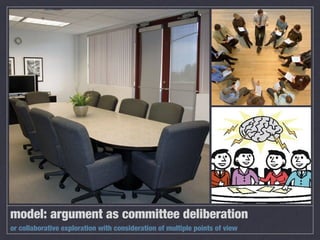
model: argument as committee deliberation
or collaborative exploration with consideration of multiple points of view
Which model should we
prefer in academic
writing?
While the fight model charges argument with
hostility and the pro-con debate reduces every
argument to two sides and the ultimate goal is to
win, the model of a committee of diverse voices
dedicated to the common cause of finding a
solution to a problem allows us to see argument
as both process and product.
Argument has two main
components:
Truth seeking: open minded search for the best
course of action or solution to a problem, taking
into account all of the available information and
alternative points of view
Persuasion: the art of making a claim on an issue
and justifying it convincingly so that the
audience’s initial resistance to your position is
overcome and they are compelled to move toward
your position
Aren’t truth seeking
and persuasion at
odds?
Truth seeking requires that we relax our certainties and
be willing to change our views
Persuasion asks us to be certain enough to convince
others
If we avoid argument as fight and argument as pro-con
debate, approaching argument as a truth seeking
process that results in a persuasive product, or
argument essay, the two work well together.
Stages of
developmentLevel 1: Personal opinion: We often start
arguments with strong personal opinions but have
trouble justifying our opinions with reasons and
evidence; we often rely on circular arguments that
are insulting to those who hold opposing
viewpoints.
Think of examples. Discuss. When you start from a
position of certainty, what is the focus of your
research?
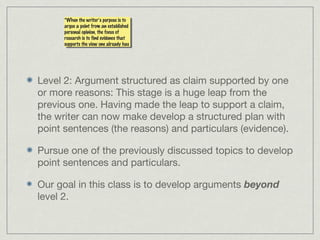
Level 2: Argument structured as claim supported by one
or more reasons: This stage is a huge leap from the
previous one. Having made the leap to support a claim,
the writer can now make develop a structured plan with
point sentences (the reasons) and particulars (evidence).
Pursue one of the previously discussed topics to develop
point sentences and particulars.
Our goal in this class is to develop arguments beyond
level 2.
*When the writer’s purpose is to
argue a point from an established
personal opinion, the focus of
research is to find evidence that
supports the view one already has
*When the writer’s purpose is to
argue a point from an established
personal opinion, the focus of
research is to find evidence that
supports the view one already has
Level 3: Increased attention to truth seeking: A
level 3 argument writer becomes increasingly
engaged with the complexity of the issue as he or
she considers multiple points of view, conducts
research, and evaluates stances.
Level 3 argument writers are willing to change
their positions when they see the power of other
arguments.
Level 4: Ability to articulate the unstated
assumptions underlying their arguments.
This argument writer understands that each
reason in an argument is based upon an
assumption, value, or belief (often unstated) that
the audience must accept if the argument is to be
persuasive.
At this stage, students are able to identify and
analyze their own assumptions as well as those of
their intended audience.
Level 5: Ability to link an argument to the values
and beliefs of the intended audience. When writers
understand their audience’s values and beliefs,
they can adapt the structure and tone of an
argument to more effectively appeal to them.
Level 5 argument writers who approach argument
as both process and product, thus, become skilled
in truth seeking and persuasion.
What is the first step to
formulating an argument, then,?
Find an arguable issue.
Make a list of several communities that you belong
to and then identify one or more questions
currently being contested within those
communities.
Pick two or three issues of interest to you, and try
framing them in different ways: as broad or narrow
questions, as open-ended or “yes/no” questions.
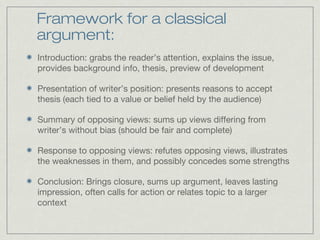
Framework for a classical
argument:
Introduction: grabs the reader’s attention, explains the issue,
provides background info, thesis, preview of development
Presentation of writer’s position: presents reasons to accept
thesis (each tied to a value or belief held by the audience)
Summary of opposing views: sums up views differing from
writer’s without bias (should be fair and complete)
Response to opposing views: refutes opposing views, illustrates
the weaknesses in them, and possibly concedes some strengths
Conclusion: Brings closure, sums up argument, leaves lasting
impression, often calls for action or relates topic to a larger
context

Argument in academic writing

  • 1.
  • 2.
    This presentation isbased on Chapter 13: Writing a Classical Argument, from The Allyn and Bacon Guide to Writing (6th edition). The purpose of this presentation in ENG 1123 is to define argument, and to explain how to evaluate and develop arguments.
  • 3.
    It starts witha question! What is argument? (Discuss.) Why do we need it?
  • 4.
  • 5.
    Argument as fight Wheredo we find examples of argument as hostility-charged fist waving, argument as shouting match?
  • 6.
    the media! Thegovernment! Family feuds! political talk shows, campaign advertisements, blogs, newspapers, etc.
  • 7.
    model: argument astwo-sided debate or argument as pro-con debate
  • 8.
    model: argument ascommittee deliberation or collaborative exploration with consideration of multiple points of view
  • 9.
    Which model shouldwe prefer in academic writing? While the fight model charges argument with hostility and the pro-con debate reduces every argument to two sides and the ultimate goal is to win, the model of a committee of diverse voices dedicated to the common cause of finding a solution to a problem allows us to see argument as both process and product.
  • 10.
    Argument has twomain components: Truth seeking: open minded search for the best course of action or solution to a problem, taking into account all of the available information and alternative points of view Persuasion: the art of making a claim on an issue and justifying it convincingly so that the audience’s initial resistance to your position is overcome and they are compelled to move toward your position
  • 11.
    Aren’t truth seeking andpersuasion at odds? Truth seeking requires that we relax our certainties and be willing to change our views Persuasion asks us to be certain enough to convince others If we avoid argument as fight and argument as pro-con debate, approaching argument as a truth seeking process that results in a persuasive product, or argument essay, the two work well together.
  • 12.
    Stages of developmentLevel 1:Personal opinion: We often start arguments with strong personal opinions but have trouble justifying our opinions with reasons and evidence; we often rely on circular arguments that are insulting to those who hold opposing viewpoints. Think of examples. Discuss. When you start from a position of certainty, what is the focus of your research?
  • 13.
    Level 2: Argumentstructured as claim supported by one or more reasons: This stage is a huge leap from the previous one. Having made the leap to support a claim, the writer can now make develop a structured plan with point sentences (the reasons) and particulars (evidence). Pursue one of the previously discussed topics to develop point sentences and particulars. Our goal in this class is to develop arguments beyond level 2. *When the writer’s purpose is to argue a point from an established personal opinion, the focus of research is to find evidence that supports the view one already has *When the writer’s purpose is to argue a point from an established personal opinion, the focus of research is to find evidence that supports the view one already has
  • 14.
    Level 3: Increasedattention to truth seeking: A level 3 argument writer becomes increasingly engaged with the complexity of the issue as he or she considers multiple points of view, conducts research, and evaluates stances. Level 3 argument writers are willing to change their positions when they see the power of other arguments.
  • 15.
    Level 4: Abilityto articulate the unstated assumptions underlying their arguments. This argument writer understands that each reason in an argument is based upon an assumption, value, or belief (often unstated) that the audience must accept if the argument is to be persuasive. At this stage, students are able to identify and analyze their own assumptions as well as those of their intended audience.
  • 16.
    Level 5: Abilityto link an argument to the values and beliefs of the intended audience. When writers understand their audience’s values and beliefs, they can adapt the structure and tone of an argument to more effectively appeal to them. Level 5 argument writers who approach argument as both process and product, thus, become skilled in truth seeking and persuasion.
  • 17.
    What is thefirst step to formulating an argument, then,? Find an arguable issue. Make a list of several communities that you belong to and then identify one or more questions currently being contested within those communities. Pick two or three issues of interest to you, and try framing them in different ways: as broad or narrow questions, as open-ended or “yes/no” questions.
  • 18.
    Framework for aclassical argument: Introduction: grabs the reader’s attention, explains the issue, provides background info, thesis, preview of development Presentation of writer’s position: presents reasons to accept thesis (each tied to a value or belief held by the audience) Summary of opposing views: sums up views differing from writer’s without bias (should be fair and complete) Response to opposing views: refutes opposing views, illustrates the weaknesses in them, and possibly concedes some strengths Conclusion: Brings closure, sums up argument, leaves lasting impression, often calls for action or relates topic to a larger context