This document provides an overview of rhetorical analysis and its key components. It defines rhetoric as persuasive communication and examines an author's audience, purpose, genre, argument components like claims and evidence, and types of evidence. The document instructs readers to analyze how an argument is made through its rhetorical elements, not just the topic itself.
WHAT IS RHETORIC?
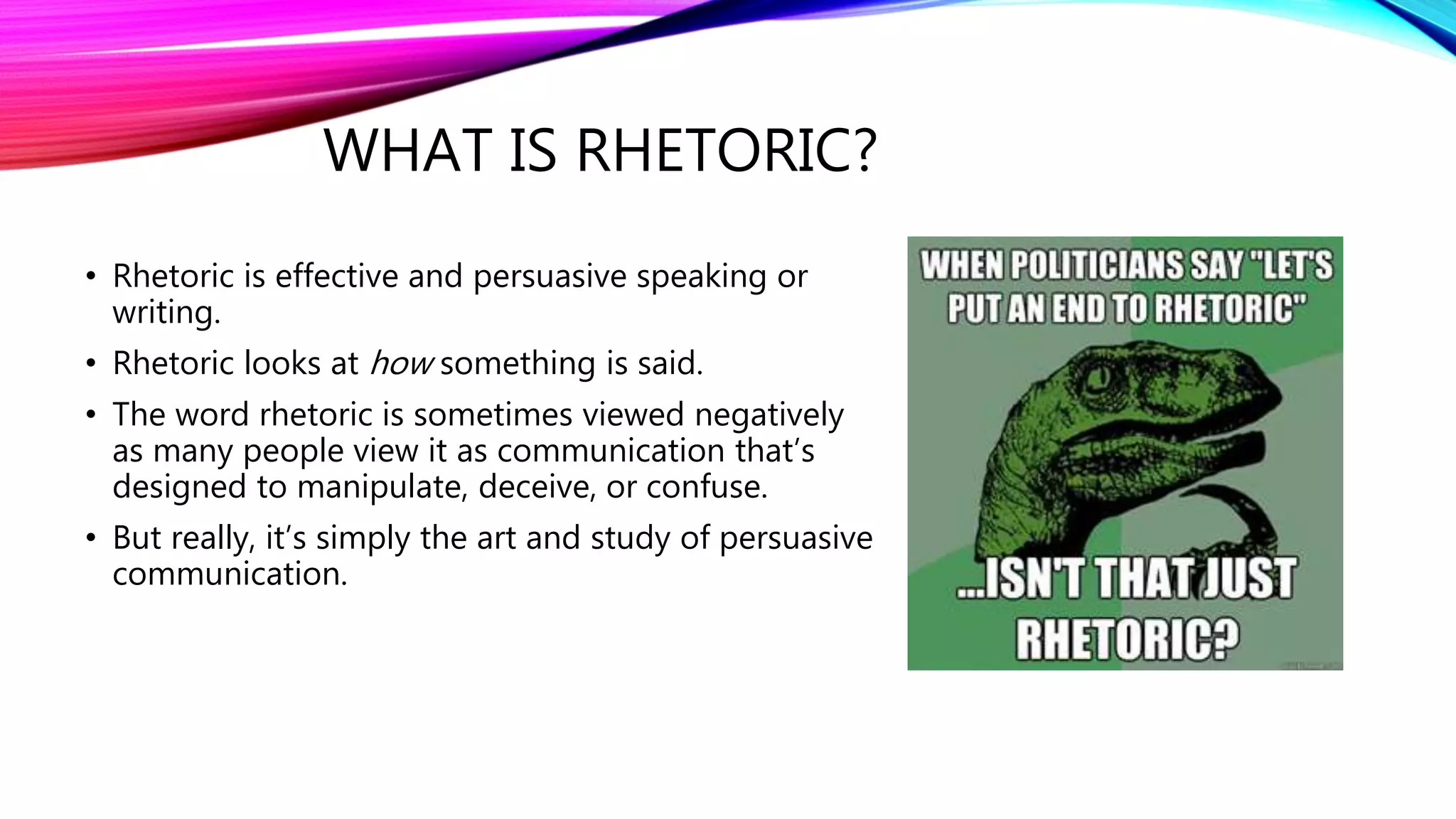
•Rhetoric is effective and persuasive speaking or
writing.
• Rhetoric looks at how something is said.
• The word rhetoric is sometimes viewed negatively
as many people view it as communication that’s
designed to manipulate, deceive, or confuse.
• But really, it’s simply the art and study of persuasive
communication.
3.
WHAT’S THE DIFFERENCE?
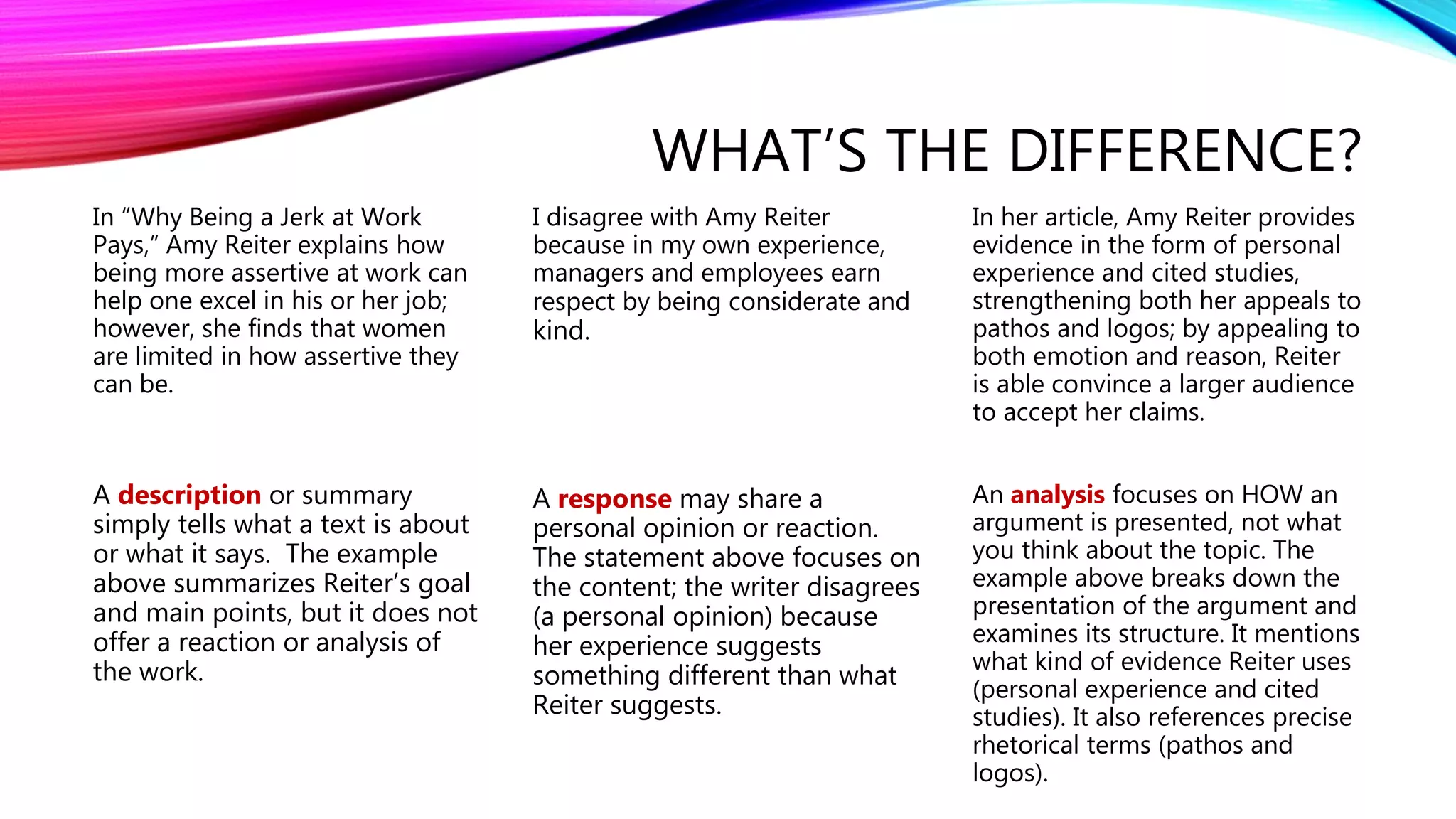
In“Why Being a Jerk at Work
Pays,” Amy Reiter explains how
being more assertive at work can
help one excel in his or her job;
however, she finds that women
are limited in how assertive they
can be.
A description or summary
simply tells what a text is about
or what it says. The example
above summarizes Reiter’s goal
and main points, but it does not
offer a reaction or analysis of
the work.
I disagree with Amy Reiter
because in my own experience,
managers and employees earn
respect by being considerate and
kind.
A response may share a
personal opinion or reaction.
The statement above focuses on
the content; the writer disagrees
(a personal opinion) because
her experience suggests
something different than what
Reiter suggests.
In her article, Amy Reiter provides
evidence in the form of personal
experience and cited studies,
strengthening both her appeals to
pathos and logos; by appealing to
both emotion and reason, Reiter
is able convince a larger audience
to accept her claims.
An analysis focuses on HOW an
argument is presented, not what
you think about the topic. The
example above breaks down the
presentation of the argument and
examines its structure. It mentions
what kind of evidence Reiter uses
(personal experience and cited
studies). It also references precise
rhetorical terms (pathos and
logos).
4.
RHETORICAL SITUATION: AUDIENCE
•The audience is the person or group of people to which the text is directed.
• The audience is NEVER everyone; it would be impossible to write a text that appeals
to everyone.
• An audience can be defined by gender, race, ethnicity, nationality, age, education
level, field of study, and many other factors. Always ask yourself what kind of person
the writer is talking to.
• You can determine this through things like tone (is it formal or informal?), word
choice (does the author use slang or vocabulary that only certain groups will
know?), or appeals (is the author focusing on logical or emotional appeals?).
5.
RHETORICAL SITUATION:
PURPOSE
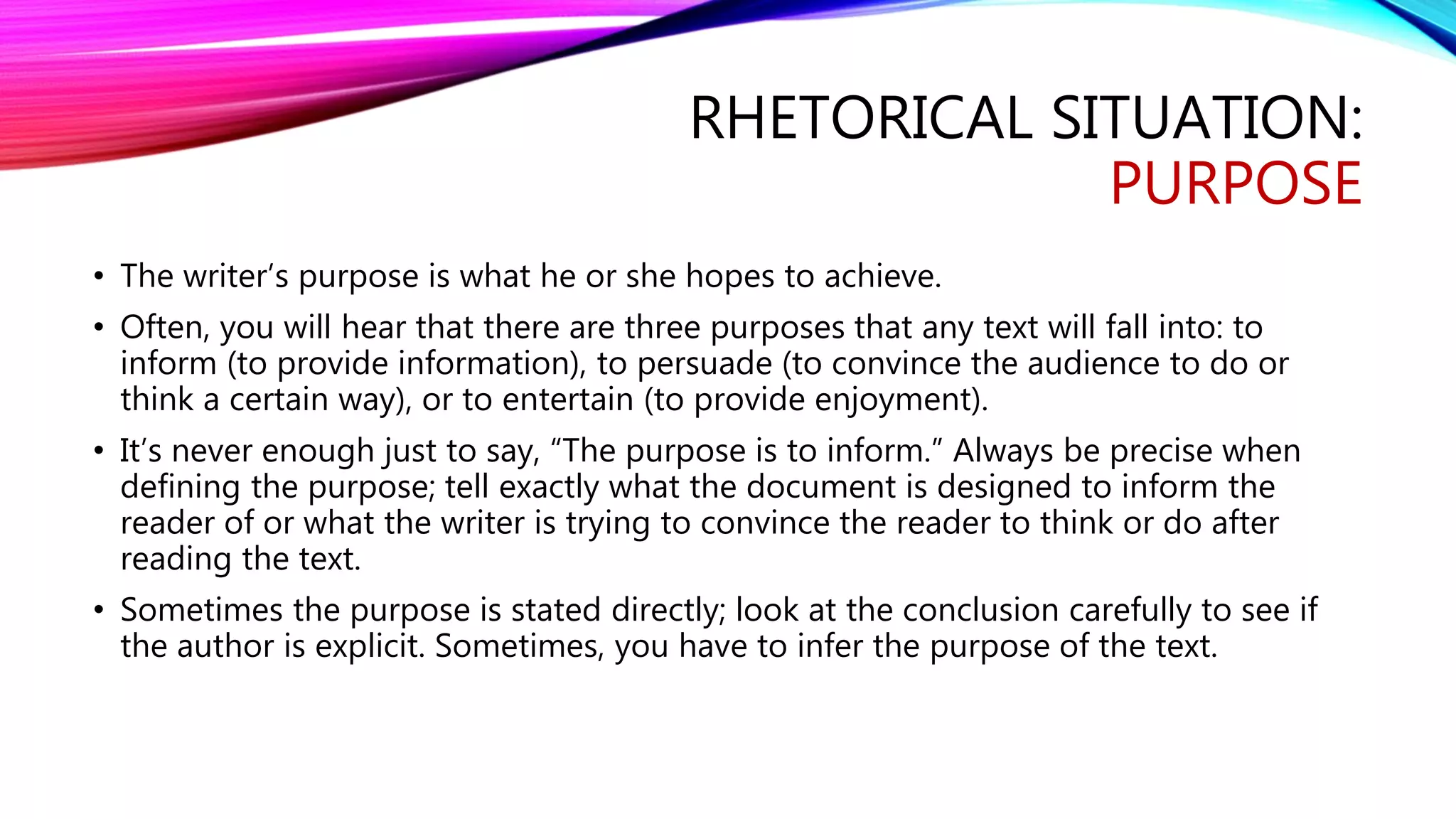
• Thewriter’s purpose is what he or she hopes to achieve.
• Often, you will hear that there are three purposes that any text will fall into: to
inform (to provide information), to persuade (to convince the audience to do or
think a certain way), or to entertain (to provide enjoyment).
• It’s never enough just to say, “The purpose is to inform.” Always be precise when
defining the purpose; tell exactly what the document is designed to inform the
reader of or what the writer is trying to convince the reader to think or do after
reading the text.
• Sometimes the purpose is stated directly; look at the conclusion carefully to see if
the author is explicit. Sometimes, you have to infer the purpose of the text.
6.
RHETORICAL SITUATION:
GENRE (TYPE)
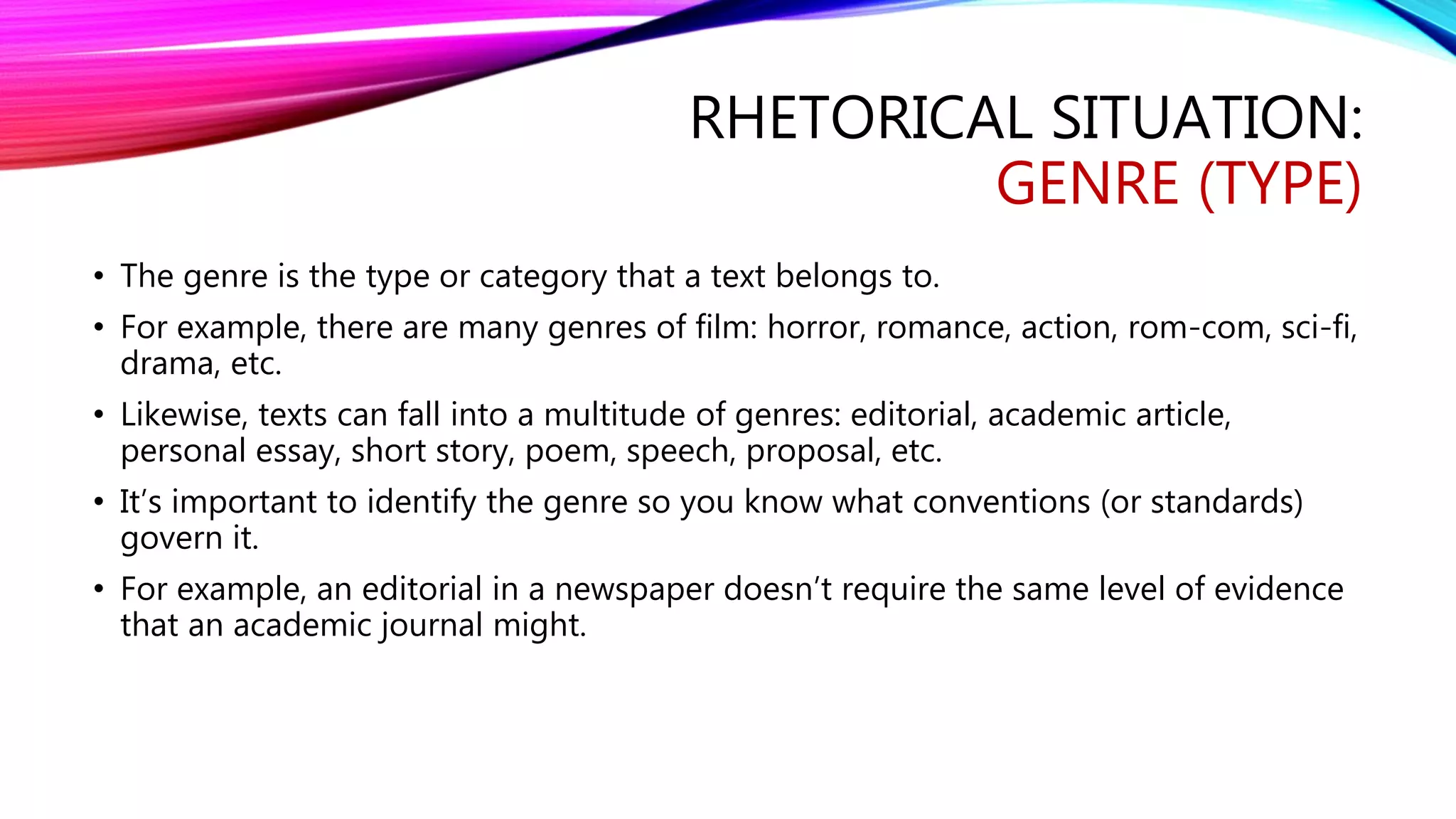
•The genre is the type or category that a text belongs to.
• For example, there are many genres of film: horror, romance, action, rom-com, sci-fi,
drama, etc.
• Likewise, texts can fall into a multitude of genres: editorial, academic article,
personal essay, short story, poem, speech, proposal, etc.
• It’s important to identify the genre so you know what conventions (or standards)
govern it.
• For example, an editorial in a newspaper doesn’t require the same level of evidence
that an academic journal might.
7.
PARTS OF ANARGUMENT
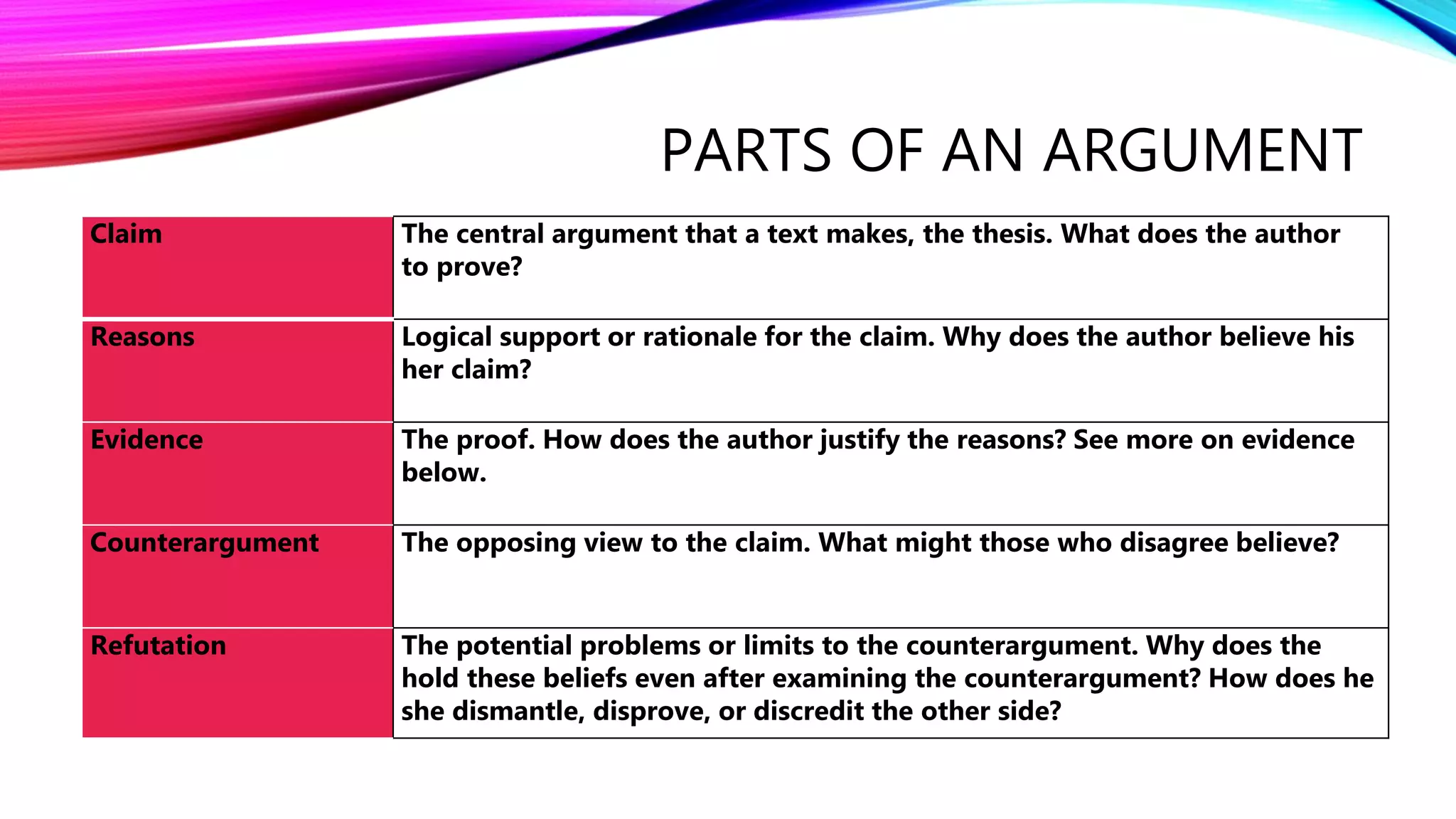
Claim The central argument that a text makes, the thesis. What does the author
to prove?
Reasons Logical support or rationale for the claim. Why does the author believe his
her claim?
Evidence The proof. How does the author justify the reasons? See more on evidence
below.
Counterargument The opposing view to the claim. What might those who disagree believe?
Refutation The potential problems or limits to the counterargument. Why does the
hold these beliefs even after examining the counterargument? How does he
she dismantle, disprove, or discredit the other side?
8.
EXAMPLE ARGUMENT PARAGRAPH
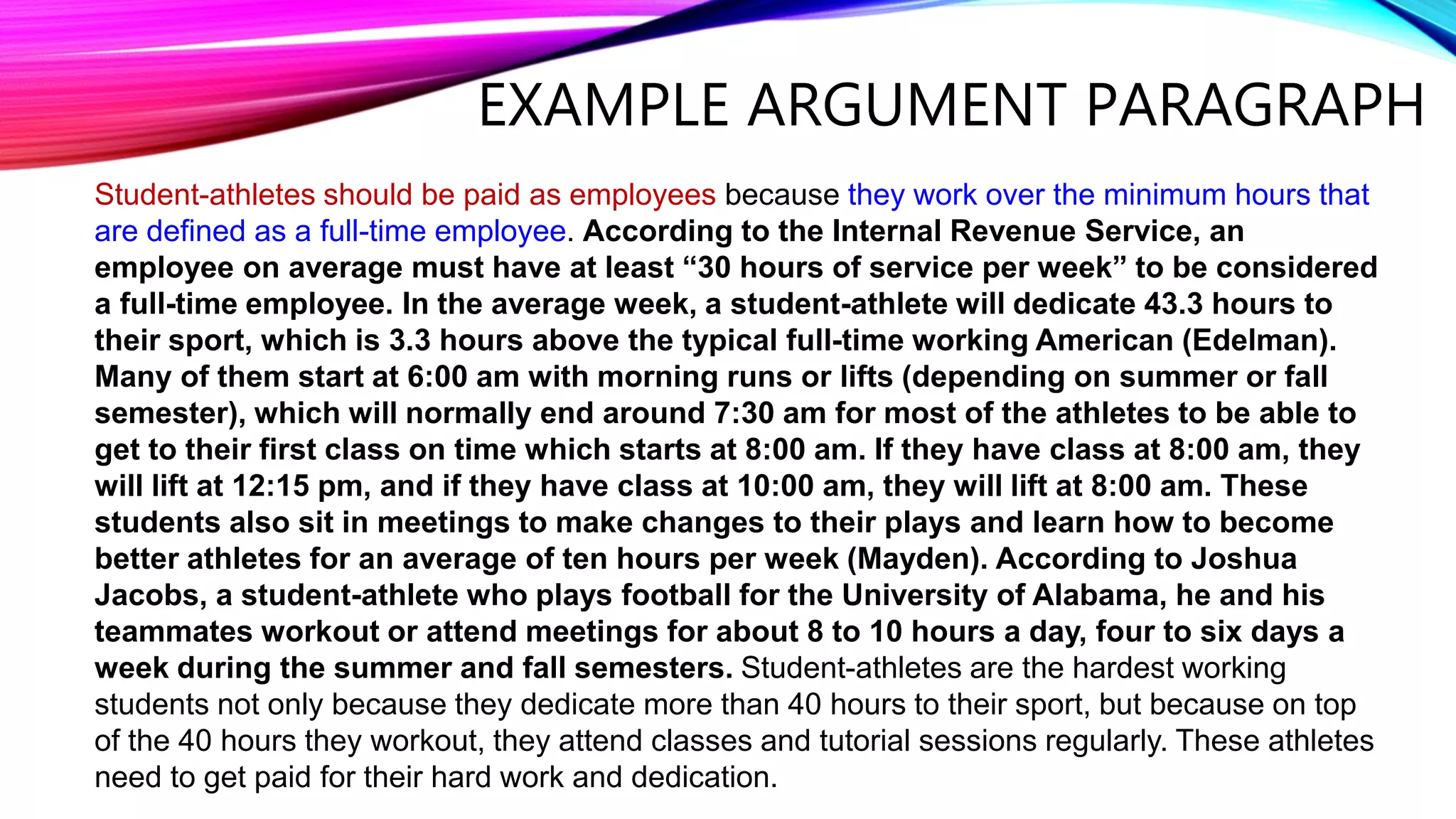
Student-athletesshould be paid as employees because they work over the minimum hours that
are defined as a full-time employee. According to the Internal Revenue Service, an
employee on average must have at least “30 hours of service per week” to be considered
a full-time employee. In the average week, a student-athlete will dedicate 43.3 hours to
their sport, which is 3.3 hours above the typical full-time working American (Edelman).
Many of them start at 6:00 am with morning runs or lifts (depending on summer or fall
semester), which will normally end around 7:30 am for most of the athletes to be able to
get to their first class on time which starts at 8:00 am. If they have class at 8:00 am, they
will lift at 12:15 pm, and if they have class at 10:00 am, they will lift at 8:00 am. These
students also sit in meetings to make changes to their plays and learn how to become
better athletes for an average of ten hours per week (Mayden). According to Joshua
Jacobs, a student-athlete who plays football for the University of Alabama, he and his
teammates workout or attend meetings for about 8 to 10 hours a day, four to six days a
week during the summer and fall semesters. Student-athletes are the hardest working
students not only because they dedicate more than 40 hours to their sport, but because on top
of the 40 hours they workout, they attend classes and tutorial sessions regularly. These athletes
need to get paid for their hard work and dedication.
9.
EXPLANATION
• In theparagraph above, the first part of the first sentence is the claim; it’s what the
student hopes to prove.
• The “because” statement is one reason for her claim; it explains why she believes her
claim.
• The bolded sentences in the middle provide evidence; they offer data and an
anecdote to show the reasons are valid and can be backed up. They offer proof.
10.
CONSIDER THE EVIDENCE
•Choosing strong evidence is one of the most important tasks that a writer must
complete. Writers choose the evidence that best fits their genre and appeals to their
target audience.
• If you were writing an academic article in the hard sciences (like physics or biology),
a personal anecdote may not be appropriate; instead, you would want to provide
hard empirical data like statistics.
• If you were writing an editorial on the DREAM Act, a personal anecdote may be
more effective than dry, boring numbers; it would help you connect with your
readers on an emotional level.
11.
ASK QUESTIONS ABOUTTHE
EVIDENCE
• Does the author provide one type of evidence or a mix?
• Is the evidence appropriate for the genre and audience? For example, if an author is
targeting an uneducated audience, citing sophisticated studies full of technical
terms may not be an effective choice.
• Does the author provide enough evidence?
• Is the evidence credible? Can it verified through other sources?
• Does the evidence seem logical? Are there gaps or inconsistencies? Are there logical
fallacies (see more on logical fallacies below)?
• Does the evidence appeal to the audience’s emotions? It is too emotional or just
enough to get the audience to care?
• Does the author seem to omit evidence that contradicts his or her claim? (Yes, you
can analyze what an author chooses NOT to include just as you would what he does
choose to include).
12.
TYPES OF EVIDENCE
•Anecdotes
• Case studies
• Statistics
• Facts
• Established theory
• Law or precedence
• Hypothetical situation
• Analogies or metaphors
• Personal experience (make sure it is relevant)
• Textual evidence


![Argumentative Essay [Autosaved].pptxasdf](https://cdn.slidesharecdn.com/ss_thumbnails/argumentativeessayautosaved-251123231228-be72e8ed-thumbnail.jpg?width=640&height=640&fit=bounds)


