VALUE EDUCATION
Unit-III
Value Education towards National
and Global Development
Dr.N.SASIKUMAR
Assistant Professor
Department of Education
Alagappa University
Karaikudi-630003
Value Education towards
National and Global Development
4 Value literally means something that has a price,
something precious, dear and worthwhile. It is defined as a
belief upon which man acts by preference. By a close
examination of different sources of the meaning of values,
we may say:
4 Values are general standards and higher order norms.
4 Value is a belief that something is good and worthwhile.
4 Value is a measure of goodness or desirability.
4 Values are socially defined and accepted desires and goods
that are internalized through the process of learning,
socialization and conditioning.
Categorisation of Values
i) Constitutional and National Values
ii) Social Values
iii) Professional Values
iv) Religious and Moral Values
v) Aesthetic Values
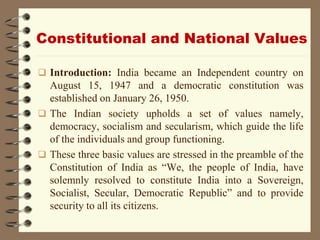
Constitutional and National Values
 Introduction: India became an Independent country on
August 15, 1947 and a democratic constitution was
established on January 26, 1950.
 The Indian society upholds a set of values namely,
democracy, socialism and secularism, which guide the life
of the individuals and group functioning.
 These three basic values are stressed in the preamble of the
Constitution of India as “We, the people of India, have
solemnly resolved to constitute India into a Sovereign,
Socialist, Secular, Democratic Republic” and to provide
security to all its citizens.
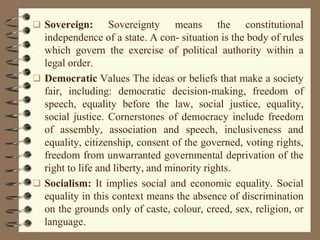
 Sovereign: Sovereignty means the constitutional
independence of a state. A con- situation is the body of rules
which govern the exercise of political authority within a
legal order.
 Democratic Values The ideas or beliefs that make a society
fair, including: democratic decision-making, freedom of
speech, equality before the law, social justice, equality,
social justice. Cornerstones of democracy include freedom
of assembly, association and speech, inclusiveness and
equality, citizenship, consent of the governed, voting rights,
freedom from unwarranted governmental deprivation of the
right to life and liberty, and minority rights.
 Socialism: It implies social and economic equality. Social
equality in this context means the absence of discrimination
on the grounds only of caste, colour, creed, sex, religion, or
language.
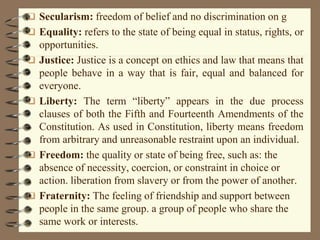
 Secularism: freedom of belief and no discrimination on g
 Equality: refers to the state of being equal in status, rights, or
opportunities.
 Justice: Justice is a concept on ethics and law that means that
people behave in a way that is fair, equal and balanced for
everyone.
 Liberty: The term “liberty” appears in the due process
clauses of both the Fifth and Fourteenth Amendments of the
Constitution. As used in Constitution, liberty means freedom
from arbitrary and unreasonable restraint upon an individual.
 Freedom: the quality or state of being free, such as: the
absence of necessity, coercion, or constraint in choice or
action. liberation from slavery or from the power of another.
 Fraternity: The feeling of friendship and support between
people in the same group. a group of people who share the
same work or interests.
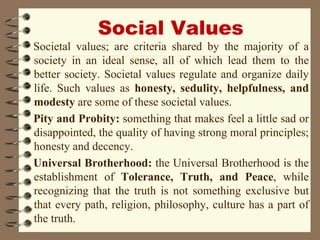
Social Values
Societal values; are criteria shared by the majority of a
society in an ideal sense, all of which lead them to the
better society. Societal values regulate and organize daily
life. Such values as honesty, sedulity, helpfulness, and
modesty are some of these societal values.
Pity and Probity: something that makes feel a little sad or
disappointed, the quality of having strong moral principles;
honesty and decency.
Universal Brotherhood: the Universal Brotherhood is the
establishment of Tolerance, Truth, and Peace, while
recognizing that the truth is not something exclusive but
that every path, religion, philosophy, culture has a part of
the truth.
Professional Values
Knowledge thirst, sincerity in profession,
regularity, punctuality and faith.
Religious Values - Tolerance, wisdom,
character. Aesthetic values - Love and
appreciation of literature and fine arts and
respect for the same. National Integration
and international understanding.
 Knowledge Thirst: Curiosity that motivates
investigation and study. desire to know, lust for
learning. type of: curiosity, wonder. a state in
which you want to learn more about something.
 Sincerity in Profession: It builds confidence and
trust, two things a leader cannot be without.
Sincerity also allows a person to build credibility
in the workplace
 Regularity: Regularity is the quality of being
stable and predictable. constancy, balance, routine,
homogeneity, invariability, system, periodicity,
routineness, recurrence, evenness and harmony.
Punctuality: strictly observant of an
appointed or regular time; not late; prompt.
made, occurring, etc., at the scheduled or
proper time: punctual payment. pertaining
to or of the nature of a point.
Integrity Faith: Being authentic and honest
in faith and honest with our fellow man is
called integrity. We need to have integrity
of faith in all we think, say and do. In early
America, a man's word was his bond.
Religious and Moral Values
The intersections of morality and religion involve
the relationship between religious views and
morals. It is common for religions to have value
frameworks regarding personal behavior
meant to guide adherents in determining
between right and wrong.
Tolerance: Tolerance is being open and receptive
to the beauty of differences. Tolerance is
respecting and appreciating the culture of others.
Tolerance is mutual respect through mutual
understanding. The seeds of intolerance are fear
and ignorance.
Wisdom: “The capacity, the desire, and the
active endeavor to realize what is of value in
life, for oneself and others.” Prudence is a close
synonym of wisdom. Values are at the core of
wisdom, some say that human values will
determine the future.
Character: Character refers to the sum of an
individual's qualities and characteristics
which differentiate him/her from others. An
individual's character is actually an
amalgamation of his/her qualities which makes
him unique and helps him stand apart from the
rest
Aesthetic Values
Aesthetic value is the value that an object,
event, or state of affairs (most
paradigmatically an artwork or the natural
environment) possesses in virtue of its
capacity to elicit pleasure (positive value) or
displeasure (negative value) when
appreciated or experienced aesthetically.
 Love and Appreciation of literature : Love is
not only are we willing to sacrifice for others and
support them through thick and thin, but we also
realize there's nothing wrong with being
vulnerable. Appreciation of literature The ability
to read and respond creatively, sharing the author's
role by drawing on one's own imagination and
experience..
 Fine arts:The arts promote the understanding
and sharing of culture. They promote social
skills that enhance the awareness and respect of
others. The fine arts enhance perceptual and
cognitive skills.
Environmental Ethical Values
 Environmental ethics is an established field of
practical philosophy "which reconstructs the
essential types of argumentation that can be made
for protecting natural entities and the sustainable
use of natural resources.
 There are many different principles on which to
draw in moral reasoning about specific
environmental problems. This lesson reviews three
basic pairs of principles: justice and
sustainability; sufficiency and compassion;
solidarity and participation.
National Integration and
international understanding
 The main objective of national integration is to
encounter all fissiparous forces/tendencies, which is
posing threat to the Indian nation. National integration
is a complex concept. It has social, political, religious,
regional and economic dimensions.
 The progress and security of any nation depends upon
national unity and emotional integration of its people. To
promote among the peoples unity, peace, affection and
brotherhood. The purpose of education is to make the
individual acquire social efficiency.
Need of Humanistic value
for espouse peace in the society
 Peace as a state of law or civil government, a
state of justice or goodness, a balance or
equilibrium of Powers.
 Our values are important because they help us to
grow and develop. They help us to create the
future we want to experience. Every individual and
every organization is involved in making hundreds
of decisions every day. The Basis of the social and
moral life of a human. group. Moreover, social
values are certain qualities and beliefs that are
shared within a specific culture or group of people.
Conflict of cross-cultural influences
 conflict occurring between individuals or social
groups that are separated by cultural boundaries
can be considered “cross-cultural conflict.” But
individuals, even in the same society, are potentially
members of many different groups, organized in
different ways by different criteria.
 When an aspect of cultural identity is threatened or
misunderstood, it may become relatively more
important than other cultural identities and this
fixed, narrow identity may become the focus of
stereotyping, negative projection, and conflict. This
is a very common situation in intractable conflicts.
Cross-border education
 Cross-border education is the movement of people, knowledge
programs providers and curriculum across national or
regional jurisdictional borders. It also refers to dual and joint
degree programs, branch campuses, and virtual, on-line
education.
 An individual who traverses a nation's territorial boundaries
to obtain an education. Learn more in: Globalization, Cross
Border Education, and Student Migration: Determining Student
Institutional Choice Factors.
 Our training and mentoring on Budgeting of Cross-Border
Projects and Evaluation of Cross-Border Projects programmes
are intended to support private sector, public sector,
community/voluntary sector or cross-sectoral partnerships
that are challenged by the requirements of delivering cross-
border
Value Education_Unit_III.ppt

Value Education_Unit_III.ppt

  • 1.
    VALUE EDUCATION Unit-III Value Educationtowards National and Global Development Dr.N.SASIKUMAR Assistant Professor Department of Education Alagappa University Karaikudi-630003
  • 2.
    Value Education towards Nationaland Global Development 4 Value literally means something that has a price, something precious, dear and worthwhile. It is defined as a belief upon which man acts by preference. By a close examination of different sources of the meaning of values, we may say: 4 Values are general standards and higher order norms. 4 Value is a belief that something is good and worthwhile. 4 Value is a measure of goodness or desirability. 4 Values are socially defined and accepted desires and goods that are internalized through the process of learning, socialization and conditioning.
  • 3.
    Categorisation of Values i)Constitutional and National Values ii) Social Values iii) Professional Values iv) Religious and Moral Values v) Aesthetic Values
  • 4.
    Constitutional and NationalValues  Introduction: India became an Independent country on August 15, 1947 and a democratic constitution was established on January 26, 1950.  The Indian society upholds a set of values namely, democracy, socialism and secularism, which guide the life of the individuals and group functioning.  These three basic values are stressed in the preamble of the Constitution of India as “We, the people of India, have solemnly resolved to constitute India into a Sovereign, Socialist, Secular, Democratic Republic” and to provide security to all its citizens.
  • 5.
     Sovereign: Sovereigntymeans the constitutional independence of a state. A con- situation is the body of rules which govern the exercise of political authority within a legal order.  Democratic Values The ideas or beliefs that make a society fair, including: democratic decision-making, freedom of speech, equality before the law, social justice, equality, social justice. Cornerstones of democracy include freedom of assembly, association and speech, inclusiveness and equality, citizenship, consent of the governed, voting rights, freedom from unwarranted governmental deprivation of the right to life and liberty, and minority rights.  Socialism: It implies social and economic equality. Social equality in this context means the absence of discrimination on the grounds only of caste, colour, creed, sex, religion, or language.
  • 6.
     Secularism: freedomof belief and no discrimination on g  Equality: refers to the state of being equal in status, rights, or opportunities.  Justice: Justice is a concept on ethics and law that means that people behave in a way that is fair, equal and balanced for everyone.  Liberty: The term “liberty” appears in the due process clauses of both the Fifth and Fourteenth Amendments of the Constitution. As used in Constitution, liberty means freedom from arbitrary and unreasonable restraint upon an individual.  Freedom: the quality or state of being free, such as: the absence of necessity, coercion, or constraint in choice or action. liberation from slavery or from the power of another.  Fraternity: The feeling of friendship and support between people in the same group. a group of people who share the same work or interests.
  • 7.
    Social Values Societal values;are criteria shared by the majority of a society in an ideal sense, all of which lead them to the better society. Societal values regulate and organize daily life. Such values as honesty, sedulity, helpfulness, and modesty are some of these societal values. Pity and Probity: something that makes feel a little sad or disappointed, the quality of having strong moral principles; honesty and decency. Universal Brotherhood: the Universal Brotherhood is the establishment of Tolerance, Truth, and Peace, while recognizing that the truth is not something exclusive but that every path, religion, philosophy, culture has a part of the truth.
  • 8.
    Professional Values Knowledge thirst,sincerity in profession, regularity, punctuality and faith. Religious Values - Tolerance, wisdom, character. Aesthetic values - Love and appreciation of literature and fine arts and respect for the same. National Integration and international understanding.
  • 9.
     Knowledge Thirst:Curiosity that motivates investigation and study. desire to know, lust for learning. type of: curiosity, wonder. a state in which you want to learn more about something.  Sincerity in Profession: It builds confidence and trust, two things a leader cannot be without. Sincerity also allows a person to build credibility in the workplace  Regularity: Regularity is the quality of being stable and predictable. constancy, balance, routine, homogeneity, invariability, system, periodicity, routineness, recurrence, evenness and harmony.
  • 10.
    Punctuality: strictly observantof an appointed or regular time; not late; prompt. made, occurring, etc., at the scheduled or proper time: punctual payment. pertaining to or of the nature of a point. Integrity Faith: Being authentic and honest in faith and honest with our fellow man is called integrity. We need to have integrity of faith in all we think, say and do. In early America, a man's word was his bond.
  • 11.
    Religious and MoralValues The intersections of morality and religion involve the relationship between religious views and morals. It is common for religions to have value frameworks regarding personal behavior meant to guide adherents in determining between right and wrong. Tolerance: Tolerance is being open and receptive to the beauty of differences. Tolerance is respecting and appreciating the culture of others. Tolerance is mutual respect through mutual understanding. The seeds of intolerance are fear and ignorance.
  • 12.
    Wisdom: “The capacity,the desire, and the active endeavor to realize what is of value in life, for oneself and others.” Prudence is a close synonym of wisdom. Values are at the core of wisdom, some say that human values will determine the future. Character: Character refers to the sum of an individual's qualities and characteristics which differentiate him/her from others. An individual's character is actually an amalgamation of his/her qualities which makes him unique and helps him stand apart from the rest
  • 13.
    Aesthetic Values Aesthetic valueis the value that an object, event, or state of affairs (most paradigmatically an artwork or the natural environment) possesses in virtue of its capacity to elicit pleasure (positive value) or displeasure (negative value) when appreciated or experienced aesthetically.
  • 14.
     Love andAppreciation of literature : Love is not only are we willing to sacrifice for others and support them through thick and thin, but we also realize there's nothing wrong with being vulnerable. Appreciation of literature The ability to read and respond creatively, sharing the author's role by drawing on one's own imagination and experience..  Fine arts:The arts promote the understanding and sharing of culture. They promote social skills that enhance the awareness and respect of others. The fine arts enhance perceptual and cognitive skills.
  • 15.
    Environmental Ethical Values Environmental ethics is an established field of practical philosophy "which reconstructs the essential types of argumentation that can be made for protecting natural entities and the sustainable use of natural resources.  There are many different principles on which to draw in moral reasoning about specific environmental problems. This lesson reviews three basic pairs of principles: justice and sustainability; sufficiency and compassion; solidarity and participation.
  • 16.
    National Integration and internationalunderstanding  The main objective of national integration is to encounter all fissiparous forces/tendencies, which is posing threat to the Indian nation. National integration is a complex concept. It has social, political, religious, regional and economic dimensions.  The progress and security of any nation depends upon national unity and emotional integration of its people. To promote among the peoples unity, peace, affection and brotherhood. The purpose of education is to make the individual acquire social efficiency.
  • 17.
    Need of Humanisticvalue for espouse peace in the society  Peace as a state of law or civil government, a state of justice or goodness, a balance or equilibrium of Powers.  Our values are important because they help us to grow and develop. They help us to create the future we want to experience. Every individual and every organization is involved in making hundreds of decisions every day. The Basis of the social and moral life of a human. group. Moreover, social values are certain qualities and beliefs that are shared within a specific culture or group of people.
  • 18.
    Conflict of cross-culturalinfluences  conflict occurring between individuals or social groups that are separated by cultural boundaries can be considered “cross-cultural conflict.” But individuals, even in the same society, are potentially members of many different groups, organized in different ways by different criteria.  When an aspect of cultural identity is threatened or misunderstood, it may become relatively more important than other cultural identities and this fixed, narrow identity may become the focus of stereotyping, negative projection, and conflict. This is a very common situation in intractable conflicts.
  • 19.
    Cross-border education  Cross-bordereducation is the movement of people, knowledge programs providers and curriculum across national or regional jurisdictional borders. It also refers to dual and joint degree programs, branch campuses, and virtual, on-line education.  An individual who traverses a nation's territorial boundaries to obtain an education. Learn more in: Globalization, Cross Border Education, and Student Migration: Determining Student Institutional Choice Factors.  Our training and mentoring on Budgeting of Cross-Border Projects and Evaluation of Cross-Border Projects programmes are intended to support private sector, public sector, community/voluntary sector or cross-sectoral partnerships that are challenged by the requirements of delivering cross- border