Importance of Value Education
PRESENTED BY–
VEDANTA
B.E. – EE (4TH YEAR)
What is Value Education ?
 Character education or moral education
 Not the kind of separate subject that one has to teach as their regular
subject
 Learners learn values from educators and implement them to lead a better
a life ahead
 Irrespective of religion, language, caste or creed
Education in ancient India -
 Education has stood firm since the age of brahminism
 Education was mainly based on inculcating qualities in students
 Revolution was brought by Buddhist education system, which was open to
all and based on Discipline, Meditation and Wisdom
 Educated ones were called ‘THINKERS’
 It was based on dharma, irrespective of religion
 Students were taught about the reality of life and emphasis was always laid
on gaining enlightenment
 Yet, most were deprived of this due to varna system
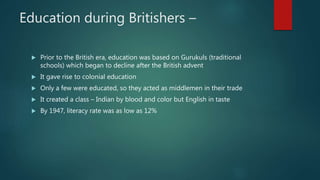
Education during Britishers –
 Prior to the British era, education was based on Gurukuls (traditional
schools) which began to decline after the British advent
 It gave rise to colonial education
 Only a few were educated, so they acted as middlemen in their trade
 It created a class – Indian by blood and color but English in taste
 By 1947, literacy rate was as low as 12%
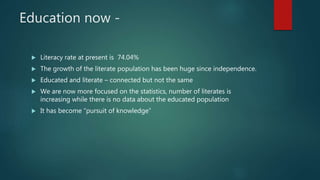
Education now -
 Literacy rate at present is 74.04%
 The growth of the literate population has been huge since independence.
 Educated and literate – connected but not the same
 We are now more focused on the statistics, number of literates is
increasing while there is no data about the educated population
 It has become “pursuit of knowledge”
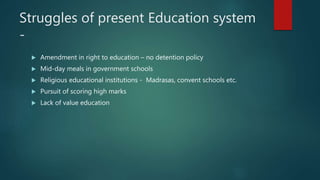
Struggles of present Education system
-
 Amendment in right to education – no detention policy
 Mid-day meals in government schools
 Religious educational institutions - Madrasas, convent schools etc.
 Pursuit of scoring high marks
 Lack of value education
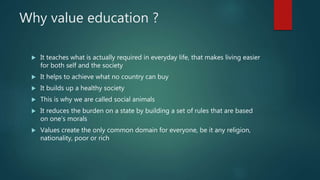
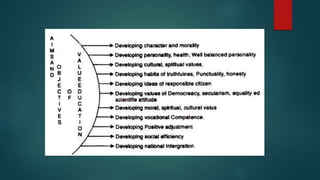
Why value education ?
 It teaches what is actually required in everyday life, that makes living easier
for both self and the society
 It helps to achieve what no country can buy
 It builds up a healthy society
 This is why we are called social animals
 It reduces the burden on a state by building a set of rules that are based
on one’s morals
 Values create the only common domain for everyone, be it any religion,
nationality, poor or rich
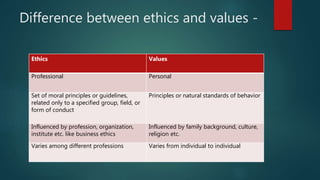
Difference between ethics and values -
Ethics Values
Professional Personal
Set of moral principles or guidelines,
related only to a specified group, field, or
form of conduct
Principles or natural standards of behavior
Influenced by profession, organization,
institute etc. like business ethics
Influenced by family background, culture,
religion etc.
Varies among different professions Varies from individual to individual
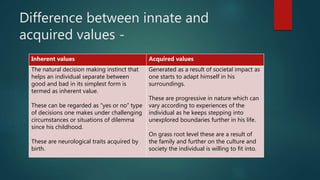
Difference between innate and
acquired values -
Inherent values Acquired values
The natural decision making instinct that
helps an individual separate between
good and bad in its simplest form is
termed as inherent value.
These can be regarded as “yes or no” type
of decisions one makes under challenging
circumstances or situations of dilemma
since his childhood.
These are neurological traits acquired by
birth.
Generated as a result of societal impact as
one starts to adapt himself in his
surroundings.
These are progressive in nature which can
vary according to experiences of the
individual as he keeps stepping into
unexplored boundaries further in his life.
On grass root level these are a result of
the family and further on the culture and
society the individual is willing to fit into.
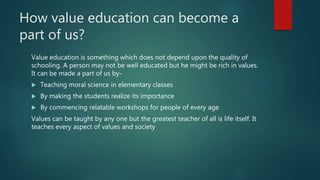
How value education can become a
part of us?
Value education is something which does not depend upon the quality of
schooling. A person may not be well educated but he might be rich in values.
It can be made a part of us by-
 Teaching moral science in elementary classes
 By making the students realize its importance
 By commencing relatable workshops for people of every age
Values can be taught by any one but the greatest teacher of all is life itself. It
teaches every aspect of values and society
Any Questions ?
THANK YOU

Importance of value education

  • 1.
    Importance of ValueEducation PRESENTED BY– VEDANTA B.E. – EE (4TH YEAR)
  • 2.
    What is ValueEducation ?  Character education or moral education  Not the kind of separate subject that one has to teach as their regular subject  Learners learn values from educators and implement them to lead a better a life ahead  Irrespective of religion, language, caste or creed
  • 3.
    Education in ancientIndia -  Education has stood firm since the age of brahminism  Education was mainly based on inculcating qualities in students  Revolution was brought by Buddhist education system, which was open to all and based on Discipline, Meditation and Wisdom  Educated ones were called ‘THINKERS’  It was based on dharma, irrespective of religion  Students were taught about the reality of life and emphasis was always laid on gaining enlightenment  Yet, most were deprived of this due to varna system
  • 4.
    Education during Britishers–  Prior to the British era, education was based on Gurukuls (traditional schools) which began to decline after the British advent  It gave rise to colonial education  Only a few were educated, so they acted as middlemen in their trade  It created a class – Indian by blood and color but English in taste  By 1947, literacy rate was as low as 12%
  • 5.
    Education now - Literacy rate at present is 74.04%  The growth of the literate population has been huge since independence.  Educated and literate – connected but not the same  We are now more focused on the statistics, number of literates is increasing while there is no data about the educated population  It has become “pursuit of knowledge”
  • 6.
    Struggles of presentEducation system -  Amendment in right to education – no detention policy  Mid-day meals in government schools  Religious educational institutions - Madrasas, convent schools etc.  Pursuit of scoring high marks  Lack of value education
  • 7.
    Why value education?  It teaches what is actually required in everyday life, that makes living easier for both self and the society  It helps to achieve what no country can buy  It builds up a healthy society  This is why we are called social animals  It reduces the burden on a state by building a set of rules that are based on one’s morals  Values create the only common domain for everyone, be it any religion, nationality, poor or rich
  • 8.
    Difference between ethicsand values - Ethics Values Professional Personal Set of moral principles or guidelines, related only to a specified group, field, or form of conduct Principles or natural standards of behavior Influenced by profession, organization, institute etc. like business ethics Influenced by family background, culture, religion etc. Varies among different professions Varies from individual to individual
  • 9.
    Difference between innateand acquired values - Inherent values Acquired values The natural decision making instinct that helps an individual separate between good and bad in its simplest form is termed as inherent value. These can be regarded as “yes or no” type of decisions one makes under challenging circumstances or situations of dilemma since his childhood. These are neurological traits acquired by birth. Generated as a result of societal impact as one starts to adapt himself in his surroundings. These are progressive in nature which can vary according to experiences of the individual as he keeps stepping into unexplored boundaries further in his life. On grass root level these are a result of the family and further on the culture and society the individual is willing to fit into.
  • 11.
    How value educationcan become a part of us? Value education is something which does not depend upon the quality of schooling. A person may not be well educated but he might be rich in values. It can be made a part of us by-  Teaching moral science in elementary classes  By making the students realize its importance  By commencing relatable workshops for people of every age Values can be taught by any one but the greatest teacher of all is life itself. It teaches every aspect of values and society
  • 12.
  • 13.