INTRODUCTION
Presented-by Sakshi garg
Mba 1st sem
S.G.I.T College
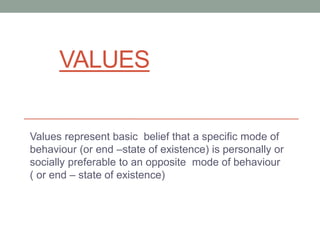
VALUES
Values represent basic belief that a specific mode of
behaviour (or end –state of existence) is personally or
socially preferable to an opposite mode of behaviour
( or end – state of existence)
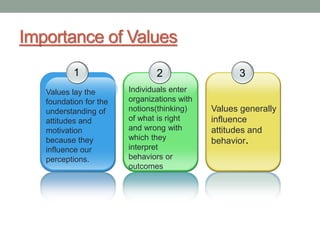
Importance of Values
1 2
Individuals enter
organizations with
notions(thinking)
of what is right
and wrong with
which they
interpret
behaviors or
outcomes
3
Values generally
influence
attitudes and
behavior.
Values lay the
foundation for the
understanding of
attitudes and
motivation
because they
influence our
perceptions.
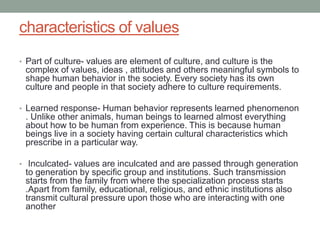
characteristics of values
• Part of culture- values are element of culture, and culture is the
complex of values, ideas , attitudes and others meaningful symbols to
shape human behavior in the society. Every society has its own
culture and people in that society adhere to culture requirements.
• Learned response- Human behavior represents learned phenomenon
. Unlike other animals, human beings to learned almost everything
about how to be human from experience. This is because human
beings live in a society having certain cultural characteristics which
prescribe in a particular way.
• Inculcated- values are inculcated and are passed through generation
to generation by specific group and institutions. Such transmission
starts from the family from where the specialization process starts
.Apart from family, educational, religious, and ethnic institutions also
transmit cultural pressure upon those who are interacting with one
another
• Social phenomenon- values are social phenomenon, that is ,cultural habits
are shared by aggregates of people living in organized society. An individual
‘way of thinking and behaving is not culture, rather group behavior constitutes
culture. Group is developed and reinforced through social pressure upon
those who are interacting with one another
• Gratifying Responses- values exist to meet the biological and other needs of
the individuals in the society. Thus , elements in the cultural become
extinguished when they no longer are gratifying to members of the society.
The society rewards behaviors which are gratifying for its members.
• Adaptive process-culture is adaptive, either through a dialectical process or
evolutionary process. Dialectical or sharply discontinuous change occurs
when the value system of a culture becomes associated with the gratification
of one group or class in the environment. In such a case, other classes of the
society reject the logic of the value system and replace it with a new value
system, such as through revolution or other methods. In the evolutionary
process the change occurs slowly as a gradually process, but not through
revolution.
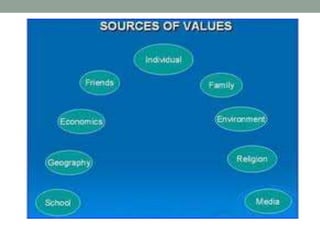
Factors on value formulation
• Value forming institution- the life and development of a society are both
based upon and produce values. Therefore, there can be various
institutions in the society which inoculate values in an individual. In
particular , there are four ,major institutions which provide the basic
sources of values for persons and organizations like family school state
and religion.
•
• Organizational values – Apart from value forming institutions of the
society organizations, where the individuals work, also shape their values
though in a lesser degree. An organization has its own values which are
reflected in the form if collective values of individual who join it . However
, since various organizational process are designed mostly by managers
at comparatively higher levels, organizational values are more in tune
with the values of these managers. An individual may subscribe those
organizational values easily which match with may either leave the
organization or may adjust himself to the values of the organization . This
happen in he form if a slow process and the individual finds these values
acceptable over the period of time. Thus his values system changes to
conform to organizational values.
PEERS AND
COLLEAGUES
an individual gets clue of behavior from his peers and
colleagues. He develops and applies beliefs attitudes,
and values derived from the groups of peers and
colleagues with whom he is associated. An individual
in a world group tends to conform to the group’ norms
as long as he values the friendship and approval of
his associate or fears the possibility that they will cut
him from rights, privileges,and benefits they can offer
Work and specialization
• work consists of the tasks or responsibilities associated with a
particular job or position in an organization. Essentially, work is
human energy directed at he achievement of a desired end. In
organizations', this work is organized, directed, controlled and
entrusted to individual willing to become employees through a
more or less permanent association with organization. An
individual’s experience over a period of time constitutes his
career. Generally, this career id within an occupation, and in an
occupational career, the individual follows a related,
progressive series of jobs ,positions , or stages of
development.
Work and career create special values that give unity, cohesion
and meaning to persons and groups therefore, each work will
have its own values and persons performing the work will
follow that values.
For example , in an organization ,sales people, accountants
,engineers will have their values
and
PROFESSIONAL CODES-
Professional codes are an increasing source of ethical norms for
managers in business organizations . There are three types of
codes available in an organization. First if the so called company
creeds or philosophies which usually cover those basic
philosophies and behaviors that govern the business. Most of the
companies have such sets, either expressly or otherwise.
Sometimes these documents are prepares to build the company
image by showing the company’s operational policies which set
up guides to action that have an ethical selling handling costumer
complaints etc.
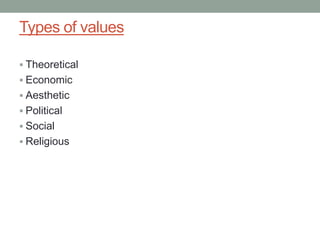
Types of values
 Theoretical
 Economic
 Aesthetic
 Political
 Social
 Religious
THANK YOU
Any question?

Values

  • 1.
  • 2.
    VALUES Values represent basicbelief that a specific mode of behaviour (or end –state of existence) is personally or socially preferable to an opposite mode of behaviour ( or end – state of existence)
  • 3.
    Importance of Values 12 Individuals enter organizations with notions(thinking) of what is right and wrong with which they interpret behaviors or outcomes 3 Values generally influence attitudes and behavior. Values lay the foundation for the understanding of attitudes and motivation because they influence our perceptions.
  • 4.
    characteristics of values •Part of culture- values are element of culture, and culture is the complex of values, ideas , attitudes and others meaningful symbols to shape human behavior in the society. Every society has its own culture and people in that society adhere to culture requirements. • Learned response- Human behavior represents learned phenomenon . Unlike other animals, human beings to learned almost everything about how to be human from experience. This is because human beings live in a society having certain cultural characteristics which prescribe in a particular way. • Inculcated- values are inculcated and are passed through generation to generation by specific group and institutions. Such transmission starts from the family from where the specialization process starts .Apart from family, educational, religious, and ethnic institutions also transmit cultural pressure upon those who are interacting with one another
  • 5.
    • Social phenomenon-values are social phenomenon, that is ,cultural habits are shared by aggregates of people living in organized society. An individual ‘way of thinking and behaving is not culture, rather group behavior constitutes culture. Group is developed and reinforced through social pressure upon those who are interacting with one another • Gratifying Responses- values exist to meet the biological and other needs of the individuals in the society. Thus , elements in the cultural become extinguished when they no longer are gratifying to members of the society. The society rewards behaviors which are gratifying for its members. • Adaptive process-culture is adaptive, either through a dialectical process or evolutionary process. Dialectical or sharply discontinuous change occurs when the value system of a culture becomes associated with the gratification of one group or class in the environment. In such a case, other classes of the society reject the logic of the value system and replace it with a new value system, such as through revolution or other methods. In the evolutionary process the change occurs slowly as a gradually process, but not through revolution.
  • 6.
    Factors on valueformulation • Value forming institution- the life and development of a society are both based upon and produce values. Therefore, there can be various institutions in the society which inoculate values in an individual. In particular , there are four ,major institutions which provide the basic sources of values for persons and organizations like family school state and religion. • • Organizational values – Apart from value forming institutions of the society organizations, where the individuals work, also shape their values though in a lesser degree. An organization has its own values which are reflected in the form if collective values of individual who join it . However , since various organizational process are designed mostly by managers at comparatively higher levels, organizational values are more in tune with the values of these managers. An individual may subscribe those organizational values easily which match with may either leave the organization or may adjust himself to the values of the organization . This happen in he form if a slow process and the individual finds these values acceptable over the period of time. Thus his values system changes to conform to organizational values.
  • 7.
    PEERS AND COLLEAGUES an individualgets clue of behavior from his peers and colleagues. He develops and applies beliefs attitudes, and values derived from the groups of peers and colleagues with whom he is associated. An individual in a world group tends to conform to the group’ norms as long as he values the friendship and approval of his associate or fears the possibility that they will cut him from rights, privileges,and benefits they can offer
  • 8.
    Work and specialization •work consists of the tasks or responsibilities associated with a particular job or position in an organization. Essentially, work is human energy directed at he achievement of a desired end. In organizations', this work is organized, directed, controlled and entrusted to individual willing to become employees through a more or less permanent association with organization. An individual’s experience over a period of time constitutes his career. Generally, this career id within an occupation, and in an occupational career, the individual follows a related, progressive series of jobs ,positions , or stages of development. Work and career create special values that give unity, cohesion and meaning to persons and groups therefore, each work will have its own values and persons performing the work will follow that values. For example , in an organization ,sales people, accountants ,engineers will have their values and
  • 9.
    PROFESSIONAL CODES- Professional codesare an increasing source of ethical norms for managers in business organizations . There are three types of codes available in an organization. First if the so called company creeds or philosophies which usually cover those basic philosophies and behaviors that govern the business. Most of the companies have such sets, either expressly or otherwise. Sometimes these documents are prepares to build the company image by showing the company’s operational policies which set up guides to action that have an ethical selling handling costumer complaints etc.
  • 11.
    Types of values Theoretical  Economic  Aesthetic  Political  Social  Religious
  • 12.