HUMAN VALUES: SOME
REFLECTIONS
 
Presented By:Presented By:
Dr. Santosh Kumar BeheraDr. Santosh Kumar Behera
Department of Education,Department of Education,
Sidho-Kanho-Birsha University,Sidho-Kanho-Birsha University,
Purulia, West BengalPurulia, West Bengal
Email:Email: santoshbehera.skbu@gmail.comsantoshbehera.skbu@gmail.com
santoshbehera.jkc@gmail.comsantoshbehera.jkc@gmail.com
CONCEPT OF VALUE
According to its verbal meaning, Value signifies that quality of an
individual or thing.
 The term ‘Value’ Literally means ‘to be of worth’, Something that has
a price.
In French term value means, “the excellence or appreciation”.
Value means the feeling of honesty, truthfulness and humanity.
In the German term value means, Dignity or Nobility.
Value is nothing but it is the combination of so many good ideas.
Value means, to have some attention or concentration of mind on a
particular object.
Philosophical meaning of the term value, the self maintaining order or
idea of good.
According to Urban, “Value is that which satisfies human desire”.
CONCEPT OF VALUE
HUMAN VALUES
Human values are closely related with human life. No human life is
possible without values. Human Values are those universal concepts,
drivers of action which are found in all cultures, all societies, all times
and in all places where human beings eke out their lives.
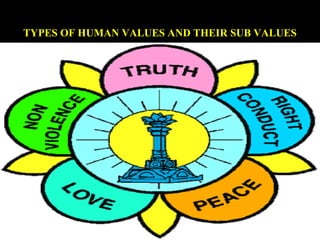
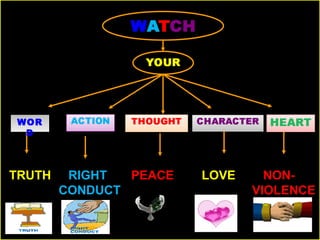
The five human values, which can be found in all cultures, all societies
and in all religions, are Truth, Right Conduct, Love, Peace and Non-
Violence. These values are eternal; they are eternal essences, which
elevate human life to its highest expression, its highest capacity.
Human values are a set of consistent behaviors and measures that
guide human beings in doing what is right and acceptable by the
society. They attract dignity, respect and appropriateness among
people. Human values are used to set laws in most cases.
Human values are people's beliefs, feelings and attitudes towards
things, situations or other people.
Human values have an inherent energy and dynamism. Human values do
not follow the laws of physical science. They cannot be depleted.
Normally, when we spend energy our resources we become drained of
energy to the extent of our expenditure. But human values multiply as
they are applied, used, expressed and acted out. They benefit both the
giver and the recipient.
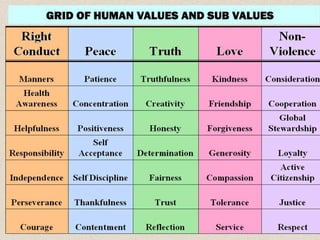
TYPES OF HUMAN VALUES AND THEIR SUB VALUES
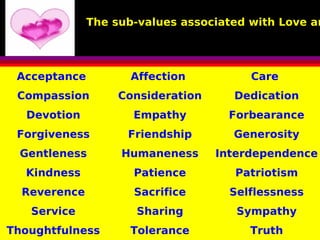
Acceptance Affection Care
Compassion Consideration Dedication
Devotion Empathy Forbearance
Forgiveness Friendship Generosity
Gentleness Humaneness Interdependence
Kindness Patience Patriotism
Reverence Sacrifice Selflessness
Service Sharing Sympathy
Thoughtfulness Tolerance Truth
The sub-values associated with Love ar
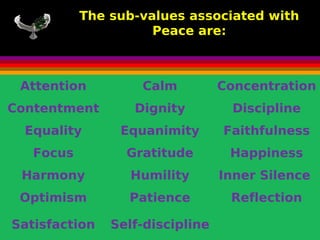
The sub-values associated with
Peace are:
Attention Calm Concentration
Contentment Dignity Discipline
Equality Equanimity Faithfulness
Focus Gratitude Happiness
Harmony Humility Inner Silence
Optimism Patience Reflection
Satisfaction Self-discipline
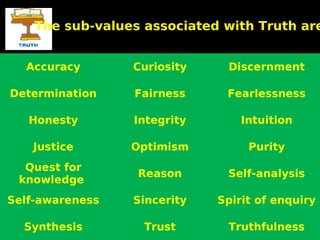
The sub-values associated with Truth are
Accuracy Curiosity Discernment
Determination Fairness Fearlessness
Honesty Integrity Intuition
Justice Optimism Purity
Quest for
knowledge
Reason Self-analysis
Self-awareness Sincerity Spirit of enquiry
Synthesis Trust Truthfulness
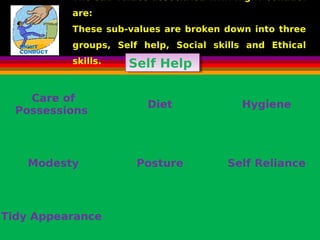
The sub-values associated with Right Conduct
are:
These sub-values are broken down into three
groups, Self help, Social skills and Ethical
skills.
Care of
Possessions
Diet Hygiene
Modesty Posture Self Reliance
Tidy Appearance
Self HelpSelf Help
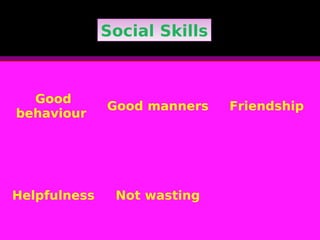
Social SkillsSocial Skills
Good
behaviour
Good manners Friendship
Helpfulness Not wasting
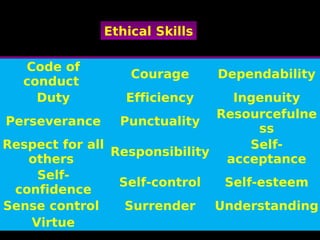
Ethical SkillsEthical Skills
Code of
conduct
Courage Dependability
Duty Efficiency Ingenuity
Perseverance Punctuality
Resourcefulne
ss
Respect for all
others
Responsibility
Self-
acceptance
Self-
confidence
Self-control Self-esteem
Sense control Surrender Understanding
Virtue
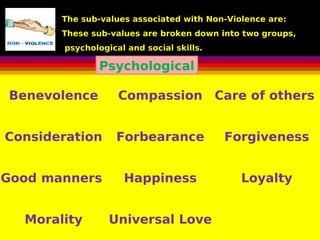
The sub-values associated with Non-Violence are:
These sub-values are broken down into two groups,
psychological and social skills.
Psychological
Benevolence Compassion Care of others
Consideration Forbearance Forgiveness
Good manners Happiness Loyalty
Morality Universal Love
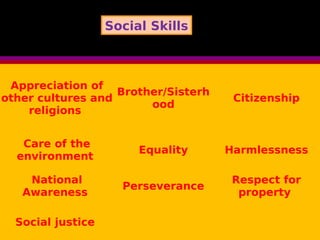
Social SkillsSocial Skills
Appreciation of
other cultures and
religions
Brother/Sisterh
ood
Citizenship
Care of the
environment
Equality Harmlessness
National
Awareness
Perseverance
Respect for
property
Social justice
APPROACHES OF HUMAN VALUES
There are two main approaches these
are:
1.The direct method and
1.The inter-curriculum and extra-
curriculum method
THE DIRECT METHOD
The direct method uses five
proven teaching techniques, they
are:
•Thought for the day
•Stories
•Values based songs
•Activities
•Silent sitting
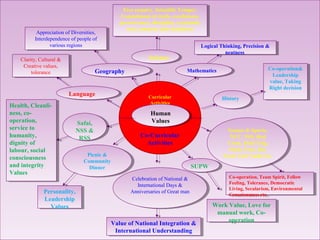
THE INTER-CURRICULUM AND
EXTRA-CURRICULUM METHOD
Logical Thinking, Precision &
neatness
Logical Thinking, Precision &
neatness
Co-operation&
Leadership
value, Taking
Right decision
Co-operation&
Leadership
value, Taking
Right decision
Work Value, Love for
manual work, Co-
operation
Work Value, Love for
manual work, Co-
operation
Value of National Integration &
International Understanding
Value of National Integration &
International Understanding
Personality,
Leadership
Values
Personality,
Leadership
Values
Appreciation of Diversities,
Interdependence of people of
various regions
Appreciation of Diversities,
Interdependence of people of
various regions
Curricular
Activities
Co-Curricular
Activities
Human
Values
Human
Values
LanguageLanguage
Safai,
NSS &
RSS
Safai,
NSS &
RSS
Picnic &
Community
Dinner
Picnic &
Community
Dinner
Games & Sports,
NCC, NSS, Red
Cross, Field Trip,
Study Tour, Boy
Scout ,Girl Guide etc.
Games & Sports,
NCC, NSS, Red
Cross, Field Trip,
Study Tour, Boy
Scout ,Girl Guide etc.
HistoryHistory
ScienceScience
Celebration of National &
International Days &
Anniversaries of Great man
Celebration of National &
International Days &
Anniversaries of Great man
GeographyGeography MathematicsMathematics
SUPWSUPW
Co-operation, Team Spirit, Fellow
Feeling, Tolerance, Democratic
Living, Secularism, Environmental
Consciousness etc.
Co-operation, Team Spirit, Fellow
Feeling, Tolerance, Democratic
Living, Secularism, Environmental
Consciousness etc.
Health, Cleanli-
ness, co-
operation,
service to
humanity,
dignity of
labour, social
consciousness
and integrity
Values
Health, Cleanli-
ness, co-
operation,
service to
humanity,
dignity of
labour, social
consciousness
and integrity
Values
Clarity, Cultural &
Creative values,
tolerance
Clarity, Cultural &
Creative values,
tolerance
Free enquiry, Scientific Temper,
Commitment of truth, carefulness,
perseverance, discipline, systematic
ness, neatness and cleanliness
Free enquiry, Scientific Temper,
Commitment of truth, carefulness,
perseverance, discipline, systematic
ness, neatness and cleanliness
TRUTH RIGHT PEACE LOVE NON-
CONDUCT VIOLENCE
WOR
D
WOR
D
DUTIES AND RESPONSIBILITIES OF THE TEACHERS
IN INCULCATION OF HUMAN VALUES
Organize various clubs like nature club, adventure club, literature club
in the school as a mean of personal growth helping individual students to
clarify their own thinking through personal experience, to express their
ideas and reflect upon and modify attitudes. This will also help the
students in a group to know each other as individuals grow together in a
group, deepening their relationship and learn to tolerate each others,
differences.
Design projects and suggest themes for project work.
Organize tours and visits in nature, walk in countryside, to
historic monuments, to synagogues, temples, shrines,
factories, farms, power stations, sewage disposal works and
housing projects.
Organize student self-government, Mock
parliaments, etc.
Encourage the students to learn more and more
international and regional languages and provide
facilities for the same.
Organize exhibitions on history of freedom
movement on permanent basis in the school adding
new dimensions and materials from time to time.
Organize activities like paragraph writing, storytelling,
recitations, group songs, action songs, solo songs, shadow
play, one act play, group dances, etc. for developing self-
confidence, sense of achievements, self-respect, team spirit
and appreciation by suggesting topics and songs from
history, freedom struggle, in the background of nationalism
and patriotic spirit.
Organize national integration exhibitions depicting the
cultural, economic, historical and social aspects.
Organizing debates, declamations and paper reading
contests on the suggested topics for discrimination between
right and wrong and the topics from the lives of great leaders,
patriot, sages and saints.
Have a notice board with “new thought of the day”- for
students to read, reflect and introspect.
In the morning assembly include prayer, good thoughts, talk
by teachers, students, recitations. Patriotic songs of different
languages may be sung as song of the day.
Organize social service camps, visits and excursions laying emphasis
on “shram-daan”, cleaning colonies, hospitals, schools, distribution of
food material, medicines, clothing’s etc. during natural calamities, help
accident victims, lending help to blind, old, children etc. for developing
team spirit, dignity of labour, helpfulness, service to humanity, honesty
and concern others.
Organizing inter-house meets, and cultural meets to develop quality
of leadership, initiative, and fellow feeling amongst the participants.
Demonstration of skills can also be organized for self-confidence.
Organizing games-sports, scouting guiding, NCC and Yoga
programmes to help cultivate sense of discipline, punctuality,
cooperation and spirit of competition amongst the students.
Participation of students in national days and other days of national
importance.
Encourage the spirit of “Each one teach one”.
Display quotations from great thinkers on the themes of value
education at all the suitable corners of the school.
Put pictures and charts with short biographical notes of national and
international great men who contributed for the good of the mankind,
in libraries, laboratories, classrooms and halls.
Ensure active participation of local community and parents to
strengthen the programme of value education in schools.
Ensure that the students participate in plantation programmes
organized by local communities / NGOs / Government Departments /
Organizations for improvement of environment.
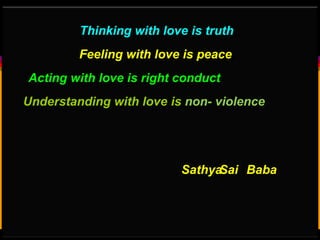
Thinking with love is truth,
Feeling with love is peace,
Acting with love is right conduct
Understanding with love is non- violence
SathyaSai Baba
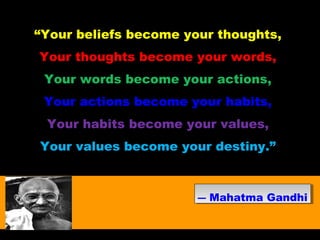
“Your beliefs become your thoughts,
Your thoughts become your words,
Your words become your actions,
Your actions become your habits,
Your habits become your values,
Your values become your destiny.”
― Mahatma Gandhi― Mahatma Gandhi
References
•Dhankar, N. (2010). Value Education. New Delhi: APH Publishing Corporation.
•Gawande, E. N. (2002). Value Oriented Education: Vision for Better Living. New Delhi:
Sarup & Sons, pp. 126-130.
•Gupta, N.L. (2000). Human Values in Education. New Delhi: Concept Publishing
House.
•Kapur, J.N. (1996). Ethical Values for Excellence in Education and Science. Vishwa
Prakashan.
•Mohanty, J. & Nayak, B.K. (1996). Modern Trends and Issues in Education. Cuttack:
Takshyasila
•Mukerjee R.K. (1969). Social Structure of Values. New Delhi: S. Chand and Co.
•Nayak, B.K. (1997). Education in Emerging Indian Society. Orissa: Taratarini
Pustakalaya, pp.99-101.
•NCERT (1992). Education in Values: A Source Book. New Delhi
NCERT (2005). National Curriculum Framework for School Education. New Delhi:
National Council of educational Research and Training.
•NCTE (1978). Teacher Education Curriculum: A Framework. New Delhi:
National Council for Teacher Education.
•Pandya, R. and Mathu, A. (2004). Imbibing Value Education: Various
Perspectives. Delhi: Kalapaz Publications
•Pillai, K.K. (1986). Value Oriented Education. Journal of Educational
Research and Extension. Vol. 22. No.4.
•Ruhela, S.P. (1986), Human Values and Education. New Delhi: Sterling
Publishers Private Limited, P.14.
•Sharma, J.N., & Goyal, B.R. (2005). Strategies for Inculcation of Values.
Jaipur: Avinashkar Publishers, Distributors.
•Sharma, Y.K. & Katoch, K.S. (2007). Education for Values, Environment
and Human Rights. New Delhi: Deep & Deep Publications Pvt. Ltd.
•Venkatian, N. (ed.) (1980). Value Education. New Delhi: APH Publishing
•www.slideserve.com/cullen/the-final-stage-the-five-human-values
•www.saieditor.com/falco/?p=87
•www.srisathyasaividyavahini.in/index.php?
option=com_content&view=article&id=115&Itemid=163
Human Values: Some Reflections By Dr. Santosh Kumar Behera ppt

Human Values: Some Reflections By Dr. Santosh Kumar Behera ppt

  • 1.
    HUMAN VALUES: SOME REFLECTIONS   PresentedBy:Presented By: Dr. Santosh Kumar BeheraDr. Santosh Kumar Behera Department of Education,Department of Education, Sidho-Kanho-Birsha University,Sidho-Kanho-Birsha University, Purulia, West BengalPurulia, West Bengal Email:Email: santoshbehera.skbu@gmail.comsantoshbehera.skbu@gmail.com santoshbehera.jkc@gmail.comsantoshbehera.jkc@gmail.com
  • 2.
    CONCEPT OF VALUE Accordingto its verbal meaning, Value signifies that quality of an individual or thing.  The term ‘Value’ Literally means ‘to be of worth’, Something that has a price. In French term value means, “the excellence or appreciation”. Value means the feeling of honesty, truthfulness and humanity.
  • 3.
    In the Germanterm value means, Dignity or Nobility. Value is nothing but it is the combination of so many good ideas. Value means, to have some attention or concentration of mind on a particular object. Philosophical meaning of the term value, the self maintaining order or idea of good. According to Urban, “Value is that which satisfies human desire”. CONCEPT OF VALUE
  • 4.
    HUMAN VALUES Human valuesare closely related with human life. No human life is possible without values. Human Values are those universal concepts, drivers of action which are found in all cultures, all societies, all times and in all places where human beings eke out their lives. The five human values, which can be found in all cultures, all societies and in all religions, are Truth, Right Conduct, Love, Peace and Non- Violence. These values are eternal; they are eternal essences, which elevate human life to its highest expression, its highest capacity.
  • 5.
    Human values area set of consistent behaviors and measures that guide human beings in doing what is right and acceptable by the society. They attract dignity, respect and appropriateness among people. Human values are used to set laws in most cases. Human values are people's beliefs, feelings and attitudes towards things, situations or other people.
  • 6.
    Human values havean inherent energy and dynamism. Human values do not follow the laws of physical science. They cannot be depleted. Normally, when we spend energy our resources we become drained of energy to the extent of our expenditure. But human values multiply as they are applied, used, expressed and acted out. They benefit both the giver and the recipient.
  • 7.
    TYPES OF HUMANVALUES AND THEIR SUB VALUES
  • 9.
    Acceptance Affection Care CompassionConsideration Dedication Devotion Empathy Forbearance Forgiveness Friendship Generosity Gentleness Humaneness Interdependence Kindness Patience Patriotism Reverence Sacrifice Selflessness Service Sharing Sympathy Thoughtfulness Tolerance Truth The sub-values associated with Love ar
  • 10.
    The sub-values associatedwith Peace are: Attention Calm Concentration Contentment Dignity Discipline Equality Equanimity Faithfulness Focus Gratitude Happiness Harmony Humility Inner Silence Optimism Patience Reflection Satisfaction Self-discipline
  • 11.
    The sub-values associatedwith Truth are Accuracy Curiosity Discernment Determination Fairness Fearlessness Honesty Integrity Intuition Justice Optimism Purity Quest for knowledge Reason Self-analysis Self-awareness Sincerity Spirit of enquiry Synthesis Trust Truthfulness
  • 12.
    The sub-values associatedwith Right Conduct are: These sub-values are broken down into three groups, Self help, Social skills and Ethical skills. Care of Possessions Diet Hygiene Modesty Posture Self Reliance Tidy Appearance Self HelpSelf Help
  • 13.
    Social SkillsSocial Skills Good behaviour Goodmanners Friendship Helpfulness Not wasting
  • 14.
    Ethical SkillsEthical Skills Codeof conduct Courage Dependability Duty Efficiency Ingenuity Perseverance Punctuality Resourcefulne ss Respect for all others Responsibility Self- acceptance Self- confidence Self-control Self-esteem Sense control Surrender Understanding Virtue
  • 15.
    The sub-values associatedwith Non-Violence are: These sub-values are broken down into two groups, psychological and social skills. Psychological Benevolence Compassion Care of others Consideration Forbearance Forgiveness Good manners Happiness Loyalty Morality Universal Love
  • 16.
    Social SkillsSocial Skills Appreciationof other cultures and religions Brother/Sisterh ood Citizenship Care of the environment Equality Harmlessness National Awareness Perseverance Respect for property Social justice
  • 17.
    APPROACHES OF HUMANVALUES There are two main approaches these are: 1.The direct method and 1.The inter-curriculum and extra- curriculum method
  • 18.
    THE DIRECT METHOD Thedirect method uses five proven teaching techniques, they are: •Thought for the day •Stories •Values based songs •Activities •Silent sitting
  • 19.
  • 20.
    Logical Thinking, Precision& neatness Logical Thinking, Precision & neatness Co-operation& Leadership value, Taking Right decision Co-operation& Leadership value, Taking Right decision Work Value, Love for manual work, Co- operation Work Value, Love for manual work, Co- operation Value of National Integration & International Understanding Value of National Integration & International Understanding Personality, Leadership Values Personality, Leadership Values Appreciation of Diversities, Interdependence of people of various regions Appreciation of Diversities, Interdependence of people of various regions Curricular Activities Co-Curricular Activities Human Values Human Values LanguageLanguage Safai, NSS & RSS Safai, NSS & RSS Picnic & Community Dinner Picnic & Community Dinner Games & Sports, NCC, NSS, Red Cross, Field Trip, Study Tour, Boy Scout ,Girl Guide etc. Games & Sports, NCC, NSS, Red Cross, Field Trip, Study Tour, Boy Scout ,Girl Guide etc. HistoryHistory ScienceScience Celebration of National & International Days & Anniversaries of Great man Celebration of National & International Days & Anniversaries of Great man GeographyGeography MathematicsMathematics SUPWSUPW Co-operation, Team Spirit, Fellow Feeling, Tolerance, Democratic Living, Secularism, Environmental Consciousness etc. Co-operation, Team Spirit, Fellow Feeling, Tolerance, Democratic Living, Secularism, Environmental Consciousness etc. Health, Cleanli- ness, co- operation, service to humanity, dignity of labour, social consciousness and integrity Values Health, Cleanli- ness, co- operation, service to humanity, dignity of labour, social consciousness and integrity Values Clarity, Cultural & Creative values, tolerance Clarity, Cultural & Creative values, tolerance Free enquiry, Scientific Temper, Commitment of truth, carefulness, perseverance, discipline, systematic ness, neatness and cleanliness Free enquiry, Scientific Temper, Commitment of truth, carefulness, perseverance, discipline, systematic ness, neatness and cleanliness

  • 21.
    TRUTH RIGHT PEACELOVE NON- CONDUCT VIOLENCE WOR D WOR D
  • 22.
    DUTIES AND RESPONSIBILITIESOF THE TEACHERS IN INCULCATION OF HUMAN VALUES Organize various clubs like nature club, adventure club, literature club in the school as a mean of personal growth helping individual students to clarify their own thinking through personal experience, to express their ideas and reflect upon and modify attitudes. This will also help the students in a group to know each other as individuals grow together in a group, deepening their relationship and learn to tolerate each others, differences.
  • 23.
    Design projects andsuggest themes for project work. Organize tours and visits in nature, walk in countryside, to historic monuments, to synagogues, temples, shrines, factories, farms, power stations, sewage disposal works and housing projects.
  • 24.
    Organize student self-government,Mock parliaments, etc. Encourage the students to learn more and more international and regional languages and provide facilities for the same. Organize exhibitions on history of freedom movement on permanent basis in the school adding new dimensions and materials from time to time.
  • 25.
    Organize activities likeparagraph writing, storytelling, recitations, group songs, action songs, solo songs, shadow play, one act play, group dances, etc. for developing self- confidence, sense of achievements, self-respect, team spirit and appreciation by suggesting topics and songs from history, freedom struggle, in the background of nationalism and patriotic spirit.
  • 26.
    Organize national integrationexhibitions depicting the cultural, economic, historical and social aspects. Organizing debates, declamations and paper reading contests on the suggested topics for discrimination between right and wrong and the topics from the lives of great leaders, patriot, sages and saints.
  • 27.
    Have a noticeboard with “new thought of the day”- for students to read, reflect and introspect. In the morning assembly include prayer, good thoughts, talk by teachers, students, recitations. Patriotic songs of different languages may be sung as song of the day.
  • 28.
    Organize social servicecamps, visits and excursions laying emphasis on “shram-daan”, cleaning colonies, hospitals, schools, distribution of food material, medicines, clothing’s etc. during natural calamities, help accident victims, lending help to blind, old, children etc. for developing team spirit, dignity of labour, helpfulness, service to humanity, honesty and concern others. Organizing inter-house meets, and cultural meets to develop quality of leadership, initiative, and fellow feeling amongst the participants. Demonstration of skills can also be organized for self-confidence.
  • 29.
    Organizing games-sports, scoutingguiding, NCC and Yoga programmes to help cultivate sense of discipline, punctuality, cooperation and spirit of competition amongst the students. Participation of students in national days and other days of national importance. Encourage the spirit of “Each one teach one”. Display quotations from great thinkers on the themes of value education at all the suitable corners of the school.
  • 30.
    Put pictures andcharts with short biographical notes of national and international great men who contributed for the good of the mankind, in libraries, laboratories, classrooms and halls. Ensure active participation of local community and parents to strengthen the programme of value education in schools. Ensure that the students participate in plantation programmes organized by local communities / NGOs / Government Departments / Organizations for improvement of environment.
  • 31.
    Thinking with loveis truth, Feeling with love is peace, Acting with love is right conduct Understanding with love is non- violence SathyaSai Baba
  • 32.
    “Your beliefs becomeyour thoughts, Your thoughts become your words, Your words become your actions, Your actions become your habits, Your habits become your values, Your values become your destiny.” ― Mahatma Gandhi― Mahatma Gandhi
  • 33.
    References •Dhankar, N. (2010).Value Education. New Delhi: APH Publishing Corporation. •Gawande, E. N. (2002). Value Oriented Education: Vision for Better Living. New Delhi: Sarup & Sons, pp. 126-130. •Gupta, N.L. (2000). Human Values in Education. New Delhi: Concept Publishing House. •Kapur, J.N. (1996). Ethical Values for Excellence in Education and Science. Vishwa Prakashan. •Mohanty, J. & Nayak, B.K. (1996). Modern Trends and Issues in Education. Cuttack: Takshyasila •Mukerjee R.K. (1969). Social Structure of Values. New Delhi: S. Chand and Co. •Nayak, B.K. (1997). Education in Emerging Indian Society. Orissa: Taratarini Pustakalaya, pp.99-101. •NCERT (1992). Education in Values: A Source Book. New Delhi NCERT (2005). National Curriculum Framework for School Education. New Delhi: National Council of educational Research and Training.
  • 34.
    •NCTE (1978). TeacherEducation Curriculum: A Framework. New Delhi: National Council for Teacher Education. •Pandya, R. and Mathu, A. (2004). Imbibing Value Education: Various Perspectives. Delhi: Kalapaz Publications •Pillai, K.K. (1986). Value Oriented Education. Journal of Educational Research and Extension. Vol. 22. No.4. •Ruhela, S.P. (1986), Human Values and Education. New Delhi: Sterling Publishers Private Limited, P.14. •Sharma, J.N., & Goyal, B.R. (2005). Strategies for Inculcation of Values. Jaipur: Avinashkar Publishers, Distributors. •Sharma, Y.K. & Katoch, K.S. (2007). Education for Values, Environment and Human Rights. New Delhi: Deep & Deep Publications Pvt. Ltd. •Venkatian, N. (ed.) (1980). Value Education. New Delhi: APH Publishing
  • 35.

Editor's Notes

  • #2 The “gestalt” of the curriculum plan Curriculum design is also called curriculum organization