Presentation on
Presenter: Md .Faruque-A-Azam .
Course Name: :Theory of
Computation
Course Code: CSE 203
Turing machine
INTRODUCING TURING MACHINES
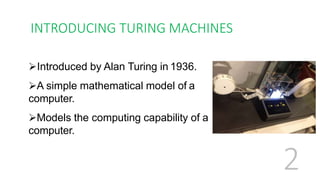
Introduced by Alan Turing in 1936.
A simple mathematical model of a
computer.
Models the computing capability of a
computer.
DEFINITION OF TURING MACHINE
A Turing machine is a mathematical model of computation that defines an
abstract machine, which manipulates symbols on a strip of tape according to a
table of rules. Despite the model's simplicity, given any computer algorithm, a
Turing machine capable of simulating that algorithm's logic can be
constructed.
It normally accepts the input string, or completes its computation, by entering a
final or accepting state.
REPRESENTATION OF TURING MACHINE
A Turing Machine is expressed as a 7-tuple (Q, T, B, ∑, δ, q0, F) where:
•Q is a finite set of states
•T is the tape alphabet (symbols which can be written on Tape)
•B is blank symbol (every cell is filled with B except input alphabet initially)
•∑ is the input alphabet (symbols which are part of input alphabet)
•δ is a transition function which maps Q × T → Q × T × {L,R}. Depending on its
present state and present tape alphabet (pointed by head pointer), it will move to
new state, change the tape symbol (may or may not) and move head pointer to
either left or right.
•q0 is the initial state
•F is the set of final states. If any state of F is reached, input string is accepted.
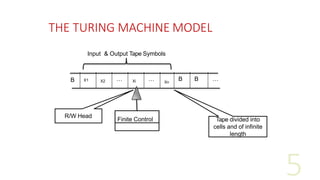
X1 X2 … Xi … Xn
B B …
Finite Control
R/W Head
B
Tape divided into
cells and of infinite
length
Input & Output Tape Symbols
THE TURING MACHINE MODEL
PROPERTIES OF TURING MACHINES
 A Turing machine can recognize a language iff it
can be generated by a phrase-structure grammar.
 The Church-Turing Thesis: A function can be
computed by an algorithm iff it can be computed by
a Turing machine.
THANKS
7

Turing machine

  • 1.
    Presentation on Presenter: Md.Faruque-A-Azam . Course Name: :Theory of Computation Course Code: CSE 203 Turing machine
  • 2.
    INTRODUCING TURING MACHINES Introducedby Alan Turing in 1936. A simple mathematical model of a computer. Models the computing capability of a computer.
  • 3.
    DEFINITION OF TURINGMACHINE A Turing machine is a mathematical model of computation that defines an abstract machine, which manipulates symbols on a strip of tape according to a table of rules. Despite the model's simplicity, given any computer algorithm, a Turing machine capable of simulating that algorithm's logic can be constructed. It normally accepts the input string, or completes its computation, by entering a final or accepting state.
  • 4.
    REPRESENTATION OF TURINGMACHINE A Turing Machine is expressed as a 7-tuple (Q, T, B, ∑, δ, q0, F) where: •Q is a finite set of states •T is the tape alphabet (symbols which can be written on Tape) •B is blank symbol (every cell is filled with B except input alphabet initially) •∑ is the input alphabet (symbols which are part of input alphabet) •δ is a transition function which maps Q × T → Q × T × {L,R}. Depending on its present state and present tape alphabet (pointed by head pointer), it will move to new state, change the tape symbol (may or may not) and move head pointer to either left or right. •q0 is the initial state •F is the set of final states. If any state of F is reached, input string is accepted.
  • 5.
    X1 X2 …Xi … Xn B B … Finite Control R/W Head B Tape divided into cells and of infinite length Input & Output Tape Symbols THE TURING MACHINE MODEL
  • 6.
    PROPERTIES OF TURINGMACHINES  A Turing machine can recognize a language iff it can be generated by a phrase-structure grammar.  The Church-Turing Thesis: A function can be computed by an algorithm iff it can be computed by a Turing machine.
  • 7.