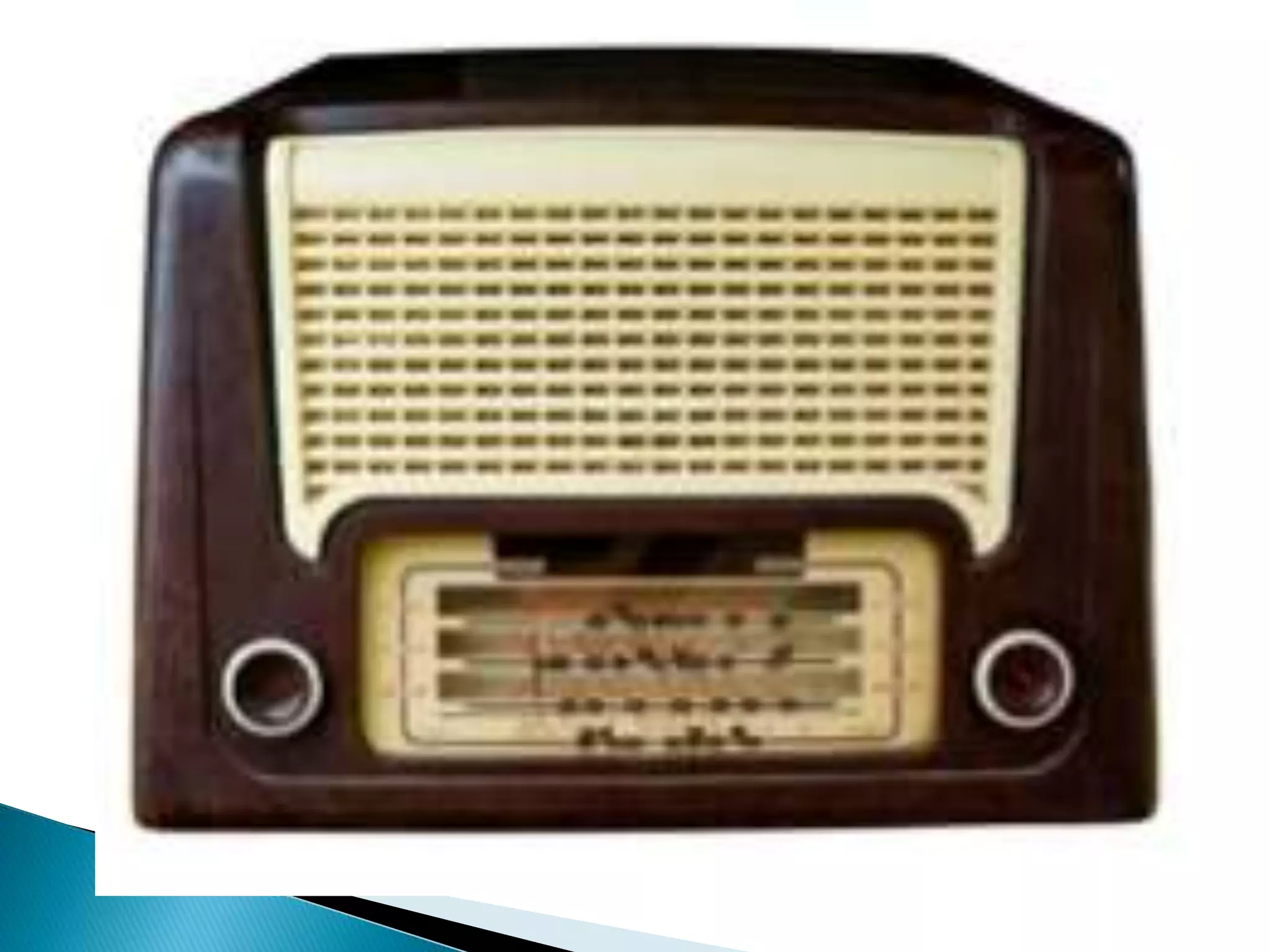
RADIO
TELEVISION
FILMS IN EDUCATION
Mass media have come to play a
fundamental role in modern society. The mass
media are media of communication – Newspaper,
Magazine, Television, Radio, Movies, Videos, CDs
and other forms that reach mass audiences. Media
can be basically divided into two categories:
1. PRINT MEDIA
2. NON PRINT MEDIA
Mass media education is now
largely dependent on electronic media which has
a good number of inherent advantages:
 Facilitates diverse learning objectives
 Electronic media through the variety and
newness can motivate the learner, stimulate
imagination, create and sustain interest
 Helps in involving the learner in the
teaching learning process and keep the
concentration going
 They can cater to individual needs
 They reduce the burden of the teacher
A) EDUCATIONAL RADIO
B) EDUCATIONAL TV
C) FILMS IN EDUCATION
 Radio has been playing a vital role in the field of
communication since its origin.
 Even though it works with sound only, it has the
power to stimulate values and to increase
knowledge and understanding.
 At one given time, radio can simultaneously arrest
the attention of thousands of people.
 In some places of the world it is the only medium
of education for children who live in remote areas.
 By using programs the teacher has a device suited
to help in the development of the art of listening
and the knowledge and command of language.
 School Broadcasting
 Adult Education & Community
Development Projects
 Farm & Home Broadcasts
 University Broadcasts
 Language Learning Projects
I. Service- Based Types
a. Music
b. Spoken word programes
c. Programes for special audiences- Farm,
Home & Youth programes
d. News service
e. External services
a. Talks
b. Interviews
c. Panel discussion
d. Live broadcasts
e. Forum
f. Dramatisation
g. Quiz
 Easy accessibility
 Wide coverage
 Low capital investment & Operating Costs
 Easy learner reception
 Easy production
 Feasible mode of learner enrichment
 Effective means of thought promotion
 Supporter of motivation for learner
 Radio brings the pupil to the classroom who
have made rare contributions to the society
 In this connection it may cited that the voice
of a great Scientist, inventor and outstanding
writer, poet, musician, can be heard over
radio, giving direct experience to the child.
 Since radio works with voice & sound only, it
helps the students in their imagination when
exposed to broadcasting.
 It also acts in stimulating interests of children
and extracting creativity in them.
 Almost every subject can be taught through
radio, but the radio is more suitable for
certain subjects such as languages & music.
 Radio specifically can provide opportunities
for developing listening comprehension as
well as improvement of vocabulary, etc.
 Radio is one of the cheapest medium.
 When compared to other devices like TV,
radio is easily repairable.
 The spare parts are available & relatively
cheaper.
 It consumes less current and can be operated
using battery also.
 No face to face interaction & one way
communication.
 It cannot be used effectively for all subjects
especially Sciences.
 It is only an auditory presentation and very
little of what we hear, we can remember.
 Production of radio programs requires
expertise.
 ETV is a system that presents learning
content in various subjects produced by an
agency.
 It is a means of providing formal education as
well as non formal.
 Wayne Coy calls ETV as the “Electronic
blackboard of the future”.
o ETV combines both sensory and auditory
experiences.
o It offers uniformity of communication.
o It is a versatile educational vehicle.
o It stimulates and reinforces ideas.
o It provides live broadcasts of ‘on the spot’
events.
o It is a means for leisure time activities.
1. Monologue: A narrator narrates the aspects,
interlacing it with visuals & illustrations.
2. Dialogue: Conversation between two people.
3. Interviews
4. Panel discussion
5. Quiz
6. Dramas
 Television as a means of extending children’s
experience.
 To provide background material for a lesson
the teacher will deliver.
 To reinforce and review ideas already covered
in class.
 To provide salient illustration that will
stimulate class discussion.
 It is a one way communication.
 Low and poor accessibility.
 Costly affair both production and receiving.
 Difficult to integrate TV and classroom
teaching.
 Visuals become a source of distraction.
I. PLANNING & PREPARATION OF
PROGRAM
o The ultimate user of the ETV program is the
teacher
o The teachers role in making decisions
regarding the content, matter & sequence is
of utmost importance
o TV presentation requires some extra skills
other than classroom teaching skills.
o So a teacher should be competent to present
a lesson in the studio
o The teacher has to get the pupil ready to
watch a program by providing necessary
background information and later on
conclude based on observations after viewing
of the program.
o He should be in a position to clarify doubts &
elaborate certain missing links.
o The teacher should be trained to evaluate all
aspects of the program so that he will be in a
position to suggest modifications both in
content & style of presentation.
 Educational films are one such means of indirect
experience.
 Motion pictures or films present an abstracted
version of the real events omitting unnecessary
and unimportant details.
 A film is a multiple media communication which
presents facts in a realistic way, dramatize
human relations arouses emotions and transmits
attitudes.
 It may be use for the communication of ideas,
attitudes and experiences to a large number of
people.
-> Instructional films
-> Documentary films
 They are specially planned to achieve certain
educational objectives and are made in
specific subject areas or teaching purposes.
 These films can be background films or direct
teaching films.
 They help to promote to achieve a skill, an
attitude or to convey certain facts,
information, phenomena or theory.
 They are made on specific topics/aspects and
highlight them.
 Documentaries with relevance to a curriculum
can be used as supplementary material for
classroom teaching.
 Motion pictures motivate students and
compel attention.
 They do provide recreation
 It can bring in past & distant present into the
classrooms.
 They are vivid & hence good motivators &
help develop good study habits.
I. The teacher selects the film
 He should take care to select a film which
would help realize his objectives.
 For that he should :
(a) know the best films available
(b) know the source of these films
(c) be familiar with the content
 The teacher should organise the filming in a
systematic manner by making proper seating
arrangements, check lighting, check
ventilation & test projector & trial run the film
 The teacher should go through the
instructional manual & guide, which
accompanies the film.
 He should prepare the students by providing
the necessary background information & keep
the students ready.
 The film should be presented at the right
moment integrating it with classroom
teaching.
 If necessary the screening should be stopped
to just recapitulate in between.
 At the end of the film a brief conclusion with
students interaction should be conducted on
the spot.
 There should be immediate evaluation, either
oral or written for feedback.
 In the light of information obtained, the
teacher should immediately correct
misconceptions or errors if any n the
learner’s understanding.
 There is a time lag between screening of
lesson and feedback session, hence some
important doubts & explanations can be
missed.
 It is a costly affair to procure hardware and it
is a dream for most of our ill equipped
schools.
 The teachers are also not trained in the use
and maintenance of equipment.
Non print media
Non print media

Non print media

  • 1.
  • 2.
    Mass media havecome to play a fundamental role in modern society. The mass media are media of communication – Newspaper, Magazine, Television, Radio, Movies, Videos, CDs and other forms that reach mass audiences. Media can be basically divided into two categories: 1. PRINT MEDIA 2. NON PRINT MEDIA
  • 3.
    Mass media educationis now largely dependent on electronic media which has a good number of inherent advantages:  Facilitates diverse learning objectives  Electronic media through the variety and newness can motivate the learner, stimulate imagination, create and sustain interest  Helps in involving the learner in the teaching learning process and keep the concentration going  They can cater to individual needs  They reduce the burden of the teacher
  • 4.
    A) EDUCATIONAL RADIO B)EDUCATIONAL TV C) FILMS IN EDUCATION
  • 7.
     Radio hasbeen playing a vital role in the field of communication since its origin.  Even though it works with sound only, it has the power to stimulate values and to increase knowledge and understanding.  At one given time, radio can simultaneously arrest the attention of thousands of people.  In some places of the world it is the only medium of education for children who live in remote areas.  By using programs the teacher has a device suited to help in the development of the art of listening and the knowledge and command of language.
  • 8.
     School Broadcasting Adult Education & Community Development Projects  Farm & Home Broadcasts  University Broadcasts  Language Learning Projects
  • 9.
    I. Service- BasedTypes a. Music b. Spoken word programes c. Programes for special audiences- Farm, Home & Youth programes d. News service e. External services
  • 10.
    a. Talks b. Interviews c.Panel discussion d. Live broadcasts e. Forum f. Dramatisation g. Quiz
  • 11.
     Easy accessibility Wide coverage  Low capital investment & Operating Costs  Easy learner reception  Easy production  Feasible mode of learner enrichment  Effective means of thought promotion  Supporter of motivation for learner
  • 13.
     Radio bringsthe pupil to the classroom who have made rare contributions to the society  In this connection it may cited that the voice of a great Scientist, inventor and outstanding writer, poet, musician, can be heard over radio, giving direct experience to the child.
  • 14.
     Since radioworks with voice & sound only, it helps the students in their imagination when exposed to broadcasting.  It also acts in stimulating interests of children and extracting creativity in them.
  • 15.
     Almost everysubject can be taught through radio, but the radio is more suitable for certain subjects such as languages & music.  Radio specifically can provide opportunities for developing listening comprehension as well as improvement of vocabulary, etc.
  • 16.
     Radio isone of the cheapest medium.
  • 17.
     When comparedto other devices like TV, radio is easily repairable.  The spare parts are available & relatively cheaper.  It consumes less current and can be operated using battery also.
  • 18.
     No faceto face interaction & one way communication.  It cannot be used effectively for all subjects especially Sciences.  It is only an auditory presentation and very little of what we hear, we can remember.  Production of radio programs requires expertise.
  • 21.
     ETV isa system that presents learning content in various subjects produced by an agency.  It is a means of providing formal education as well as non formal.  Wayne Coy calls ETV as the “Electronic blackboard of the future”.
  • 23.
    o ETV combinesboth sensory and auditory experiences. o It offers uniformity of communication. o It is a versatile educational vehicle. o It stimulates and reinforces ideas. o It provides live broadcasts of ‘on the spot’ events. o It is a means for leisure time activities.
  • 24.
    1. Monologue: Anarrator narrates the aspects, interlacing it with visuals & illustrations. 2. Dialogue: Conversation between two people. 3. Interviews 4. Panel discussion 5. Quiz 6. Dramas
  • 25.
     Television asa means of extending children’s experience.  To provide background material for a lesson the teacher will deliver.  To reinforce and review ideas already covered in class.  To provide salient illustration that will stimulate class discussion.
  • 26.
     It isa one way communication.  Low and poor accessibility.  Costly affair both production and receiving.  Difficult to integrate TV and classroom teaching.  Visuals become a source of distraction.
  • 27.
    I. PLANNING &PREPARATION OF PROGRAM o The ultimate user of the ETV program is the teacher o The teachers role in making decisions regarding the content, matter & sequence is of utmost importance
  • 28.
    o TV presentationrequires some extra skills other than classroom teaching skills. o So a teacher should be competent to present a lesson in the studio
  • 29.
    o The teacherhas to get the pupil ready to watch a program by providing necessary background information and later on conclude based on observations after viewing of the program. o He should be in a position to clarify doubts & elaborate certain missing links.
  • 30.
    o The teachershould be trained to evaluate all aspects of the program so that he will be in a position to suggest modifications both in content & style of presentation.
  • 33.
     Educational filmsare one such means of indirect experience.  Motion pictures or films present an abstracted version of the real events omitting unnecessary and unimportant details.  A film is a multiple media communication which presents facts in a realistic way, dramatize human relations arouses emotions and transmits attitudes.  It may be use for the communication of ideas, attitudes and experiences to a large number of people.
  • 35.
    -> Instructional films ->Documentary films
  • 36.
     They arespecially planned to achieve certain educational objectives and are made in specific subject areas or teaching purposes.  These films can be background films or direct teaching films.  They help to promote to achieve a skill, an attitude or to convey certain facts, information, phenomena or theory.
  • 37.
     They aremade on specific topics/aspects and highlight them.  Documentaries with relevance to a curriculum can be used as supplementary material for classroom teaching.
  • 38.
     Motion picturesmotivate students and compel attention.  They do provide recreation  It can bring in past & distant present into the classrooms.  They are vivid & hence good motivators & help develop good study habits.
  • 39.
    I. The teacherselects the film  He should take care to select a film which would help realize his objectives.  For that he should : (a) know the best films available (b) know the source of these films (c) be familiar with the content
  • 40.
     The teachershould organise the filming in a systematic manner by making proper seating arrangements, check lighting, check ventilation & test projector & trial run the film
  • 41.
     The teachershould go through the instructional manual & guide, which accompanies the film.  He should prepare the students by providing the necessary background information & keep the students ready.
  • 42.
     The filmshould be presented at the right moment integrating it with classroom teaching.  If necessary the screening should be stopped to just recapitulate in between.  At the end of the film a brief conclusion with students interaction should be conducted on the spot.
  • 43.
     There shouldbe immediate evaluation, either oral or written for feedback.  In the light of information obtained, the teacher should immediately correct misconceptions or errors if any n the learner’s understanding.
  • 44.
     There isa time lag between screening of lesson and feedback session, hence some important doubts & explanations can be missed.  It is a costly affair to procure hardware and it is a dream for most of our ill equipped schools.  The teachers are also not trained in the use and maintenance of equipment.