Work Systems and the Methods, Measurement, and Management of Work
by Mikell P. Groover, ISBN 0-13-140650-7.
©2007 Pearson Education, Inc., Upper Saddle River, NJ. All rights reserved.
Time Study and Work Measurement
Chapters:
12.Introduction to Work Measurement
13.Direct Time Study
14.Predetermined Motion Time Systems
15.Standard Data Systems
16.Work Sampling
17.Computerized Work Measurement and
Standard Maintenance
18.Economic Justification and Applications of
Time Standards
19.Learning Curves
Part III
Work Systems and the Methods, Measurement, and Management of Work
by Mikell P. Groover, ISBN 0-13-140650-7.
©2007 Pearson Education, Inc., Upper Saddle River, NJ. All rights reserved.
Introduction to Work Measurement
Sections:
1. Time Standards and How They Are
Determined
2. Prerequisites for Valid Time Standards
3. Allowances in Time Standards
4. Accuracy, Precision, and Speed of
Application in Work Measurement
Chapter 12
Work Systems and the Methods, Measurement, and Management of Work
by Mikell P. Groover, ISBN 0-13-140650-7.
©2007 Pearson Education, Inc., Upper Saddle River, NJ. All rights reserved.
Time Is Important
 Most workers are paid for their time on the job
 The labor content (cost of labor time) is often a
major factor in the total cost of a product or
service
 For any organization, it is important to know
how much time will be required to accomplish a
given amount of work
Work Systems and the Methods, Measurement, and Management of Work
by Mikell P. Groover, ISBN 0-13-140650-7.
©2007 Pearson Education, Inc., Upper Saddle River, NJ. All rights reserved.
Some Definitions
 Work measurement – evaluation of a task in terms of
the time that should be allowed by an average worker to
perform the task
 4 techniques
 Focus on human work
 Standard time (allowed time) – amount of time that should
be allowed for an average worker to process one work unit
using the standard method and working at normal pace
 Includes allowance
 Time study
Work Systems and the Methods, Measurement, and Management of Work
by Mikell P. Groover, ISBN 0-13-140650-7.
©2007 Pearson Education, Inc., Upper Saddle River, NJ. All rights reserved.
Some Definitions
 Work measurement
 Time study – all the ways in which time is analyzed in
work situations
 Broader term
 Focus on machine times
 How much time it should take to accomplish a given task
 Both terms (work measurement and time study) can be
used interchangeably
Work Systems and the Methods, Measurement, and Management of Work
by Mikell P. Groover, ISBN 0-13-140650-7.
©2007 Pearson Education, Inc., Upper Saddle River, NJ. All rights reserved.
When Are Time Standards Beneficial?
Characteristics of industrial situations in which
time standards would be beneficial
 Low productivity: significant opportunities for
improvement
 Repeat orders: once the time standard is set
for the first, it can be used for successive ones
 Long production runs: reduced average cost of
work measurement
 Repetitive work cycles: work measurement can
be justified more readily
 Short cycle times: requires less time to set
standards
Work Systems and the Methods, Measurement, and Management of Work
by Mikell P. Groover, ISBN 0-13-140650-7.
©2007 Pearson Education, Inc., Upper Saddle River, NJ. All rights reserved.
Functions of Time Standards
 They define a “fair day’s work”
 They provide a means to convert workload into
staffing and equipment needs
 They allow alternative methods to be
compared objectively
 They provide a basis for wage incentives and
evaluation of worker performance
 They provide time data for:
 Production planning and scheduling
 Cost estimating
 Material requirements planning
Work Systems and the Methods, Measurement, and Management of Work
by Mikell P. Groover, ISBN 0-13-140650-7.
©2007 Pearson Education, Inc., Upper Saddle River, NJ. All rights reserved.
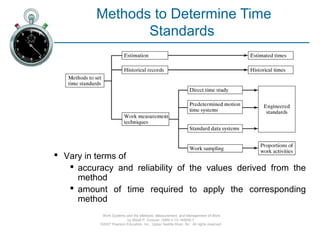
Methods to Determine Time
Standards
 Vary in terms of
 accuracy and reliability of the values derived from the
method
 amount of time required to apply the corresponding
method
Work Systems and the Methods, Measurement, and Management of Work
by Mikell P. Groover, ISBN 0-13-140650-7.
©2007 Pearson Education, Inc., Upper Saddle River, NJ. All rights reserved.
Methods to Determine Time
Standards
 Estimation
 Judgment of a person who is familiar with the job
 Subjective
 Least accurate method
 Historical records
 Records on the actual times and production quantities for
previous identical or similar job orders - “Time card”s
 Average time per part
 Improvement over estimates
 Limitation: No indication of efficiency measures
 Work measurement techniques
 Time consuming
 More accurate than estimation and historical records
Work Systems and the Methods, Measurement, and Management of Work
by Mikell P. Groover, ISBN 0-13-140650-7.
©2007 Pearson Education, Inc., Upper Saddle River, NJ. All rights reserved.
Work Measurement Techniques
1. Direct time study (DTS)
2. Predetermined motion time system (PMTS)
3. Standard data systems (SDS)
 These 3 are known as engineered standards
 Some effort has been made to determine the best
method to accomplish a given task
4. Work sampling
 Determine proportions of time spent in work
activities using randomized observations

Introduction to time study

  • 1.
    Work Systems andthe Methods, Measurement, and Management of Work by Mikell P. Groover, ISBN 0-13-140650-7. ©2007 Pearson Education, Inc., Upper Saddle River, NJ. All rights reserved. Time Study and Work Measurement Chapters: 12.Introduction to Work Measurement 13.Direct Time Study 14.Predetermined Motion Time Systems 15.Standard Data Systems 16.Work Sampling 17.Computerized Work Measurement and Standard Maintenance 18.Economic Justification and Applications of Time Standards 19.Learning Curves Part III
  • 2.
    Work Systems andthe Methods, Measurement, and Management of Work by Mikell P. Groover, ISBN 0-13-140650-7. ©2007 Pearson Education, Inc., Upper Saddle River, NJ. All rights reserved. Introduction to Work Measurement Sections: 1. Time Standards and How They Are Determined 2. Prerequisites for Valid Time Standards 3. Allowances in Time Standards 4. Accuracy, Precision, and Speed of Application in Work Measurement Chapter 12
  • 3.
    Work Systems andthe Methods, Measurement, and Management of Work by Mikell P. Groover, ISBN 0-13-140650-7. ©2007 Pearson Education, Inc., Upper Saddle River, NJ. All rights reserved. Time Is Important  Most workers are paid for their time on the job  The labor content (cost of labor time) is often a major factor in the total cost of a product or service  For any organization, it is important to know how much time will be required to accomplish a given amount of work
  • 4.
    Work Systems andthe Methods, Measurement, and Management of Work by Mikell P. Groover, ISBN 0-13-140650-7. ©2007 Pearson Education, Inc., Upper Saddle River, NJ. All rights reserved. Some Definitions  Work measurement – evaluation of a task in terms of the time that should be allowed by an average worker to perform the task  4 techniques  Focus on human work  Standard time (allowed time) – amount of time that should be allowed for an average worker to process one work unit using the standard method and working at normal pace  Includes allowance  Time study
  • 5.
    Work Systems andthe Methods, Measurement, and Management of Work by Mikell P. Groover, ISBN 0-13-140650-7. ©2007 Pearson Education, Inc., Upper Saddle River, NJ. All rights reserved. Some Definitions  Work measurement  Time study – all the ways in which time is analyzed in work situations  Broader term  Focus on machine times  How much time it should take to accomplish a given task  Both terms (work measurement and time study) can be used interchangeably
  • 6.
    Work Systems andthe Methods, Measurement, and Management of Work by Mikell P. Groover, ISBN 0-13-140650-7. ©2007 Pearson Education, Inc., Upper Saddle River, NJ. All rights reserved. When Are Time Standards Beneficial? Characteristics of industrial situations in which time standards would be beneficial  Low productivity: significant opportunities for improvement  Repeat orders: once the time standard is set for the first, it can be used for successive ones  Long production runs: reduced average cost of work measurement  Repetitive work cycles: work measurement can be justified more readily  Short cycle times: requires less time to set standards
  • 7.
    Work Systems andthe Methods, Measurement, and Management of Work by Mikell P. Groover, ISBN 0-13-140650-7. ©2007 Pearson Education, Inc., Upper Saddle River, NJ. All rights reserved. Functions of Time Standards  They define a “fair day’s work”  They provide a means to convert workload into staffing and equipment needs  They allow alternative methods to be compared objectively  They provide a basis for wage incentives and evaluation of worker performance  They provide time data for:  Production planning and scheduling  Cost estimating  Material requirements planning
  • 8.
    Work Systems andthe Methods, Measurement, and Management of Work by Mikell P. Groover, ISBN 0-13-140650-7. ©2007 Pearson Education, Inc., Upper Saddle River, NJ. All rights reserved. Methods to Determine Time Standards  Vary in terms of  accuracy and reliability of the values derived from the method  amount of time required to apply the corresponding method
  • 9.
    Work Systems andthe Methods, Measurement, and Management of Work by Mikell P. Groover, ISBN 0-13-140650-7. ©2007 Pearson Education, Inc., Upper Saddle River, NJ. All rights reserved. Methods to Determine Time Standards  Estimation  Judgment of a person who is familiar with the job  Subjective  Least accurate method  Historical records  Records on the actual times and production quantities for previous identical or similar job orders - “Time card”s  Average time per part  Improvement over estimates  Limitation: No indication of efficiency measures  Work measurement techniques  Time consuming  More accurate than estimation and historical records
  • 10.
    Work Systems andthe Methods, Measurement, and Management of Work by Mikell P. Groover, ISBN 0-13-140650-7. ©2007 Pearson Education, Inc., Upper Saddle River, NJ. All rights reserved. Work Measurement Techniques 1. Direct time study (DTS) 2. Predetermined motion time system (PMTS) 3. Standard data systems (SDS)  These 3 are known as engineered standards  Some effort has been made to determine the best method to accomplish a given task 4. Work sampling  Determine proportions of time spent in work activities using randomized observations