MOTION
ECONOMY
WHAT’S MOTION ECONOMY?
Motion economy is the process of minimizing
the physical and perceptual loads imposed on
people engaged in any type of work, whether
it be in the workplace.
Also, it facilitates a better layout of
offices, warehouses, plants, and operating
areas like office desk, work bench and
aircraft etc.
The Four Principles of Motion Economy
1. Reduce the Number of Motions:
‰Eliminate or reduce the number of motions.
2. Perform Motions Simultaneously:
‰Design improvements in the methods and tools which allow both
hands to be used at the same time.
3. Shorten Motion Distances:
‰Reduce - walking, reaching, stretching, squatting and turning,
etc.
4. Make Motion Easier:
‰Work should be smooth and rhythmical, reduce fatigue and
promote safety.
Classification Of Motion Economy
Motion economy is built with requirements given below;
 Principles related to the use of human body,
 Principles related to the arrangement of the work
place,
 Principles related to the design of tools and equipment.
 Principles related to time conservation.
Use of Human Body:
1. The two hands should begin motions at the same time.
2. The two hands should not be idle at the same time except during
rest periods.
3. Motions of the arms should be made in opposite and symmetrical
directions and should be made simultaneously
4. Hand motions should be confined to the lowest classification with
which it is possible to perform the work satisfactorily:
 Finger motions
 Wrist motions
 Forearm motions
 Upper arm motions
 Shoulder motions
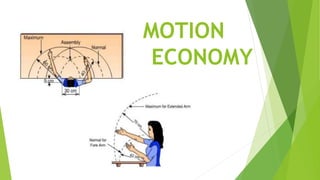
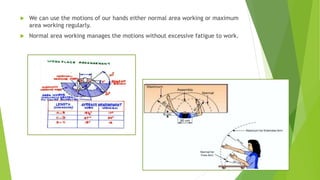
 We can use the motions of our hands either normal area working or maximum
area working regularly.
 Normal area working manages the motions without excessive fatigue to work.
Arrangement of the Work Place:
1. There should be a definite and fixed place for all tools and
materials.
2. Tools, materials, and controls should be located close in and
directly in front of the operator.
3. Drop delivers should be used whenever possible.
4. Materials and tools should be located to permit the best sequence
of motions.
5. Arrange the height of the workplace and chair for alternate sitting
and standing, when possible.
6. Provide a chair of the type and height to permit good posture.
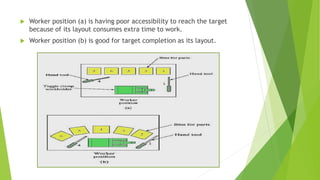
 Worker position (a) is having poor accessibility to reach the target
because of its layout consumes extra time to work.
 Worker position (b) is good for target completion as its layout.
Design of Tools and Equipment:
1. Combine tools whenever possible.
2. Preposition tools and materials.
3. Where each finger performs some specific movement, the load should
be distributed in accordance with the inherent capacities of the
fingers.
4. For light assembly, a screwdriver handle should be smaller at the
bottom.
5. Momentum should be used to help the worker in doing their task not
to increase their task.
 Equipment must help to reduce the motions, time and
energy.
 The Work schedule arranges easily and periodically with
equipments.
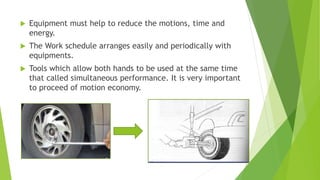
 Tools which allow both hands to be used at the same time
that called simultaneous performance. It is very important
to proceed of motion economy.
Applications of motion economy
principles
 Machining works
 Maintenance work
 Assembly jobs
 Servicing tasks
 Office works
 Commercial events
 Health services etc.
THANK YOU!

Motion economy

  • 1.
  • 2.
    WHAT’S MOTION ECONOMY? Motioneconomy is the process of minimizing the physical and perceptual loads imposed on people engaged in any type of work, whether it be in the workplace. Also, it facilitates a better layout of offices, warehouses, plants, and operating areas like office desk, work bench and aircraft etc.
  • 3.
    The Four Principlesof Motion Economy 1. Reduce the Number of Motions: ‰Eliminate or reduce the number of motions. 2. Perform Motions Simultaneously: ‰Design improvements in the methods and tools which allow both hands to be used at the same time. 3. Shorten Motion Distances: ‰Reduce - walking, reaching, stretching, squatting and turning, etc. 4. Make Motion Easier: ‰Work should be smooth and rhythmical, reduce fatigue and promote safety.
  • 4.
    Classification Of MotionEconomy Motion economy is built with requirements given below;  Principles related to the use of human body,  Principles related to the arrangement of the work place,  Principles related to the design of tools and equipment.  Principles related to time conservation.
  • 5.
    Use of HumanBody: 1. The two hands should begin motions at the same time. 2. The two hands should not be idle at the same time except during rest periods. 3. Motions of the arms should be made in opposite and symmetrical directions and should be made simultaneously 4. Hand motions should be confined to the lowest classification with which it is possible to perform the work satisfactorily:  Finger motions  Wrist motions  Forearm motions  Upper arm motions  Shoulder motions
  • 6.
     We canuse the motions of our hands either normal area working or maximum area working regularly.  Normal area working manages the motions without excessive fatigue to work.
  • 7.
    Arrangement of theWork Place: 1. There should be a definite and fixed place for all tools and materials. 2. Tools, materials, and controls should be located close in and directly in front of the operator. 3. Drop delivers should be used whenever possible. 4. Materials and tools should be located to permit the best sequence of motions. 5. Arrange the height of the workplace and chair for alternate sitting and standing, when possible. 6. Provide a chair of the type and height to permit good posture.
  • 8.
     Worker position(a) is having poor accessibility to reach the target because of its layout consumes extra time to work.  Worker position (b) is good for target completion as its layout.
  • 9.
    Design of Toolsand Equipment: 1. Combine tools whenever possible. 2. Preposition tools and materials. 3. Where each finger performs some specific movement, the load should be distributed in accordance with the inherent capacities of the fingers. 4. For light assembly, a screwdriver handle should be smaller at the bottom. 5. Momentum should be used to help the worker in doing their task not to increase their task.
  • 10.
     Equipment musthelp to reduce the motions, time and energy.  The Work schedule arranges easily and periodically with equipments.  Tools which allow both hands to be used at the same time that called simultaneous performance. It is very important to proceed of motion economy.
  • 11.
    Applications of motioneconomy principles  Machining works  Maintenance work  Assembly jobs  Servicing tasks  Office works  Commercial events  Health services etc.
  • 12.