
Introduction to the Strategy of
Game Theory

Jonathon Flegg
Manager
Outline


    Concept of game theory

    Static games

    Repeated games

    Sequential games

    Game theory in the real world
What is Game Theory?


 ○ it is not another useless theory
 ○ it is not just useful for trivial games
 ○ it is not just for mathematical egg heads


 ○ . “Game theory is a tool for exploring and
  understanding situations laced with strategic
                   reasoning”
  - Joe Harrington (Johns Hopkins University)


                KEY DEFINING WORDS:

        STRATEGIC AND INTERACTION
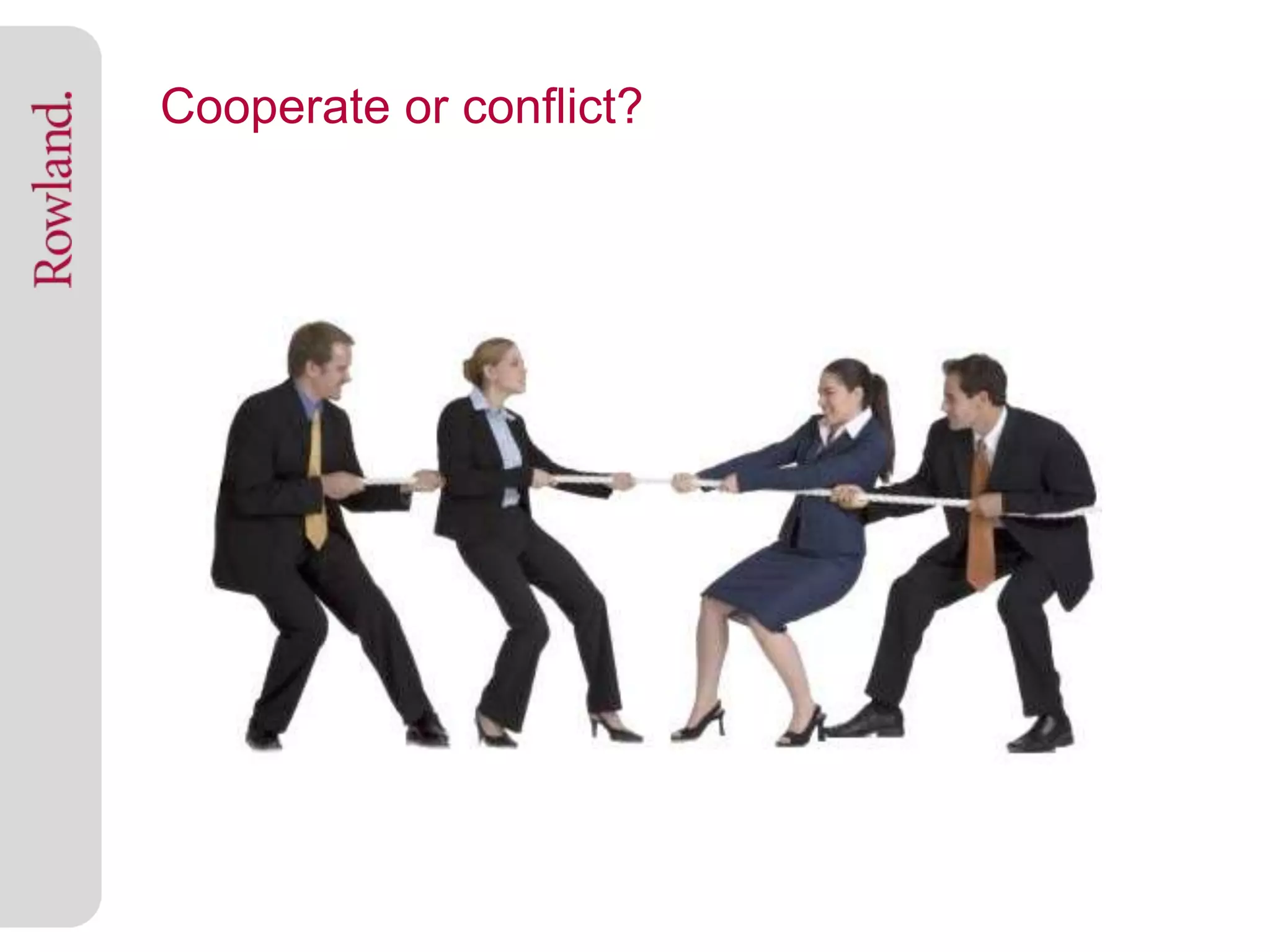
Cooperate or conflict?
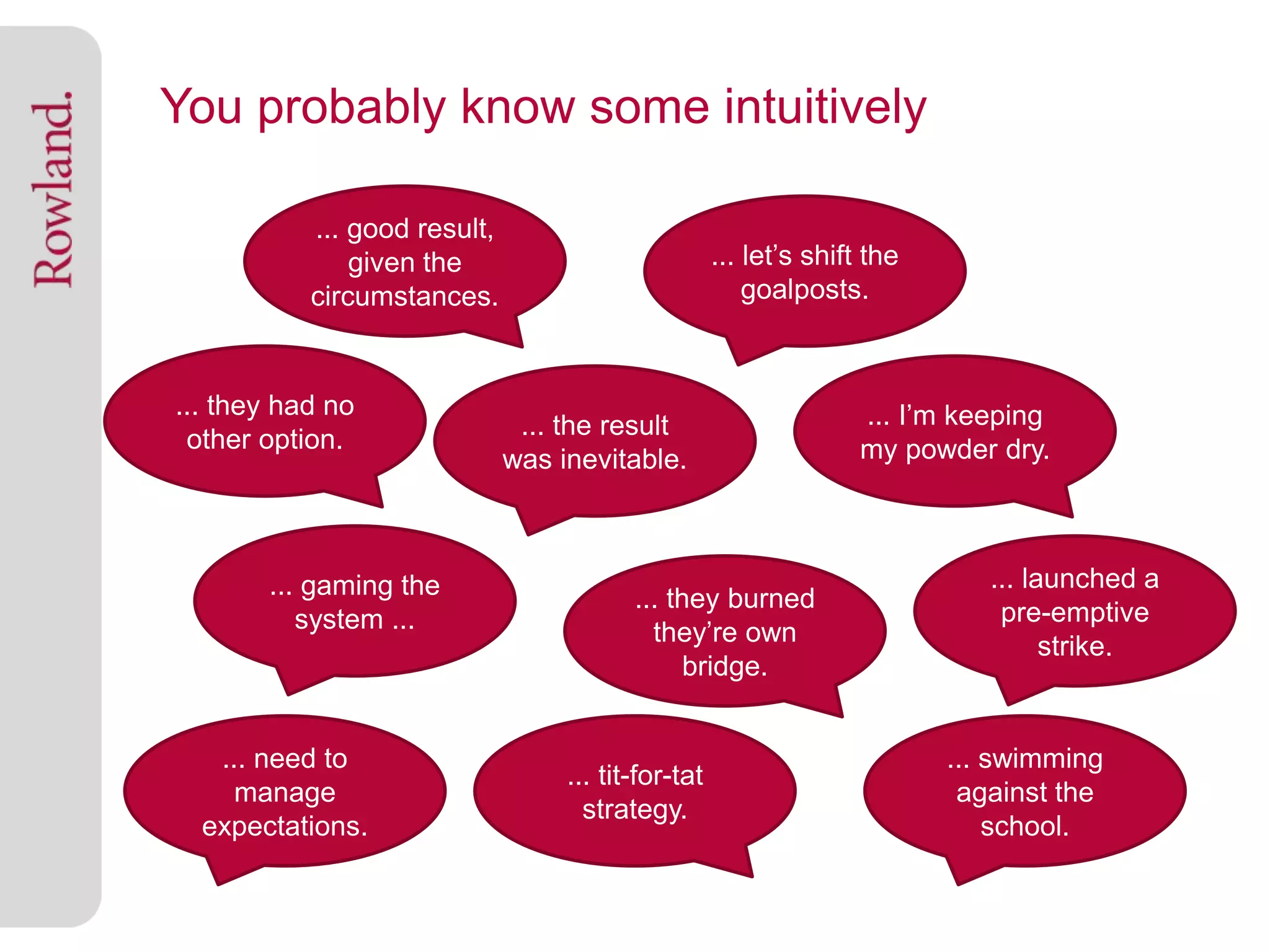
You probably know some intuitively

           ... good result,
               given the                             ... let’s shift the
           circumstances.                                goalposts.


... they had no                                                     ... I’m keeping
 other option.                 ... the result
                              was inevitable.                       my powder dry.


       ... gaming the                                                         ... launched a
                                          ... they burned                      pre-emptive
          system ...                        they’re own                             strike.
                                                bridge.


   ... need to                                                             ... swimming
                                   ... tit-for-tat
     manage                                                                 against the
                                     strategy.
  expectations.                                                                school.
Questions for game theory

● Why does the Westminster
  system of parliamentary
  democracy generate conflict?
● Why did Neville Chamberlain
  sign the Munich Agreement with
  Adolf Hitler?
● How hard should you work on a
  team project at university?
● In a penalty kick situation in
  soccer, is there any advantage
  from kicking the ball to the right
  or to the left?
A Game Theorist Plays Trump Card


Why would the CEO of Australia’s
biggest coal miner support a
carbon tax?

ANSWER: GAME THEORY
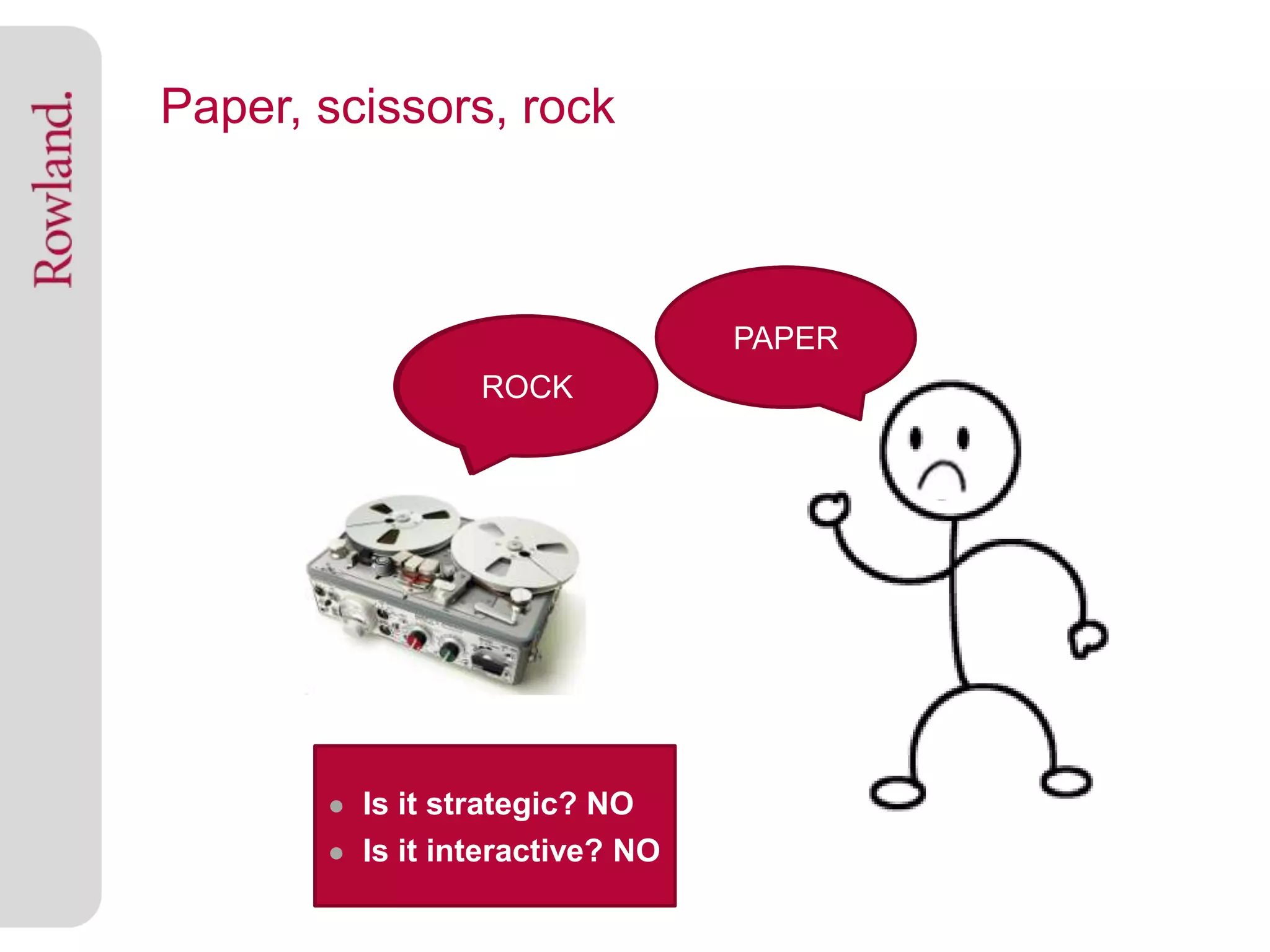
Paper, scissors, rock


                                 SCISSORS
                                  PAPER
                 ROCK
                 ROCK


       ● Is it strategic? NO
       ● Is it interactive? NO
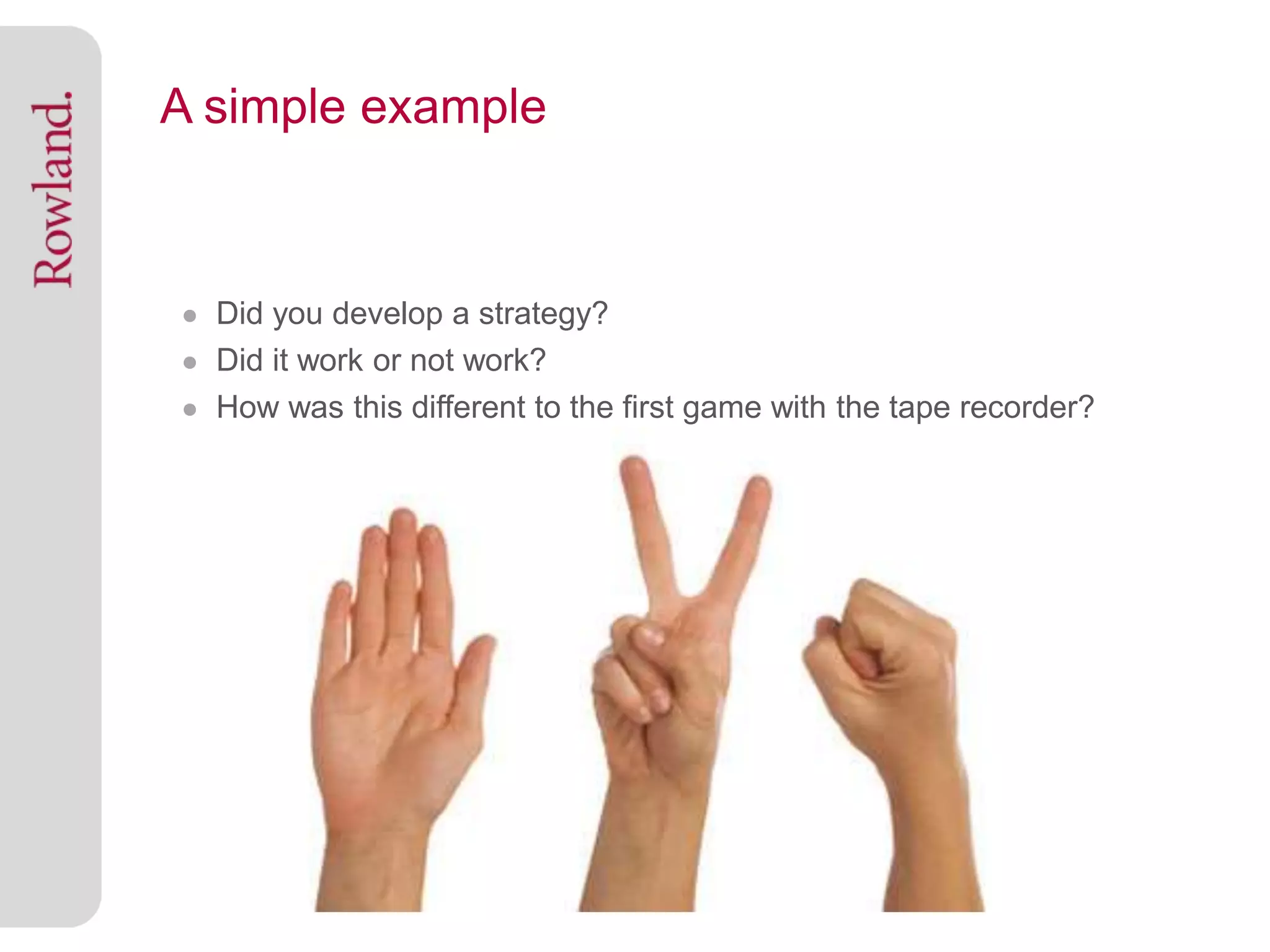
Paper, scissors, rock
A simple example


● Did you develop a strategy?
● Did it work or not work?
● How was this different to the first game with the tape recorder?
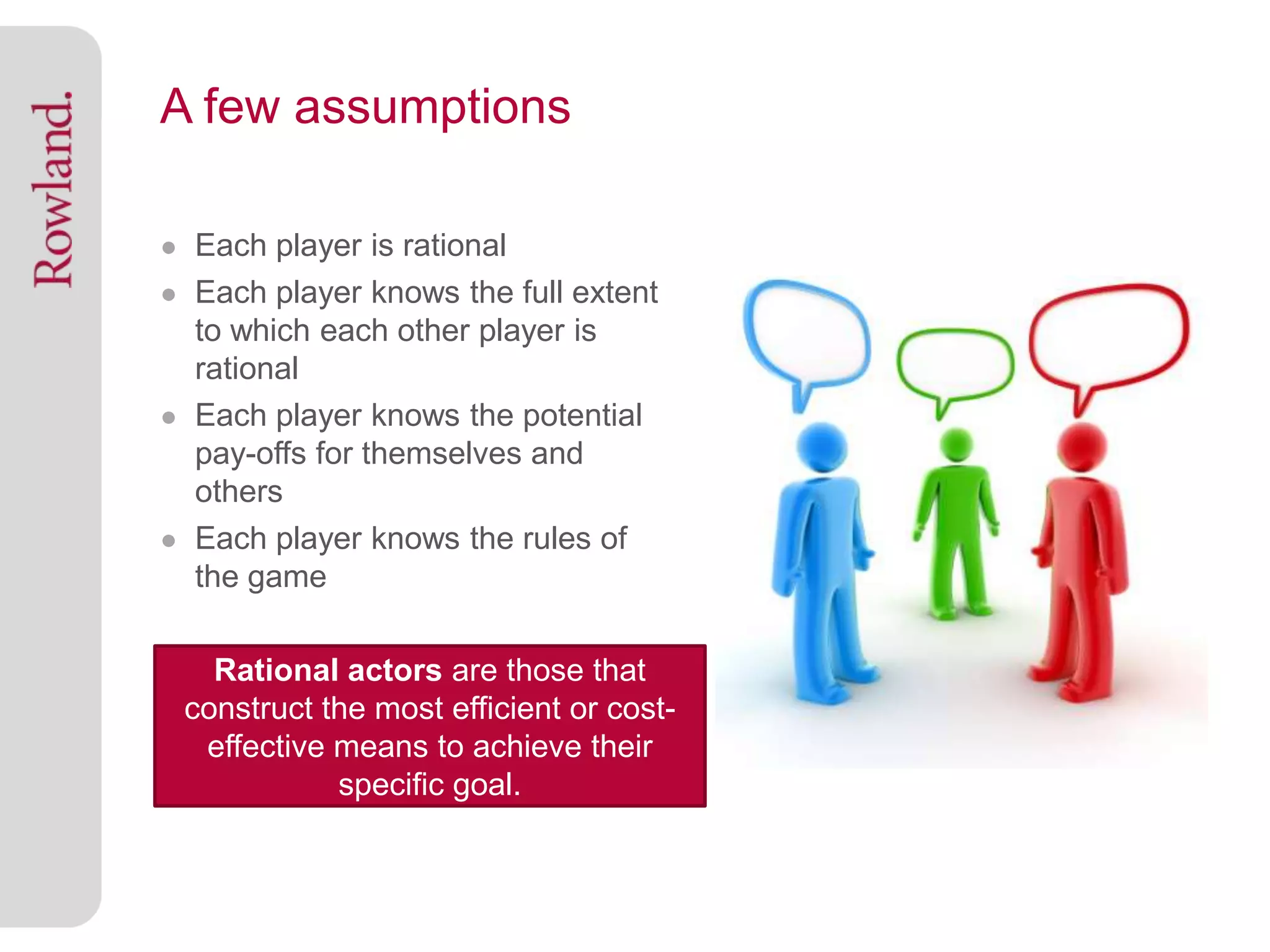
A few assumptions

● Each player is rational
● Each player knows the full extent
  to which each other player is
  rational
● Each player knows the potential
  pay-offs for themselves and
  others
● Each player knows the rules of
  the game

   Rational actors are those that
 construct the most efficient or cost-
  effective means to achieve their
            specific goal.
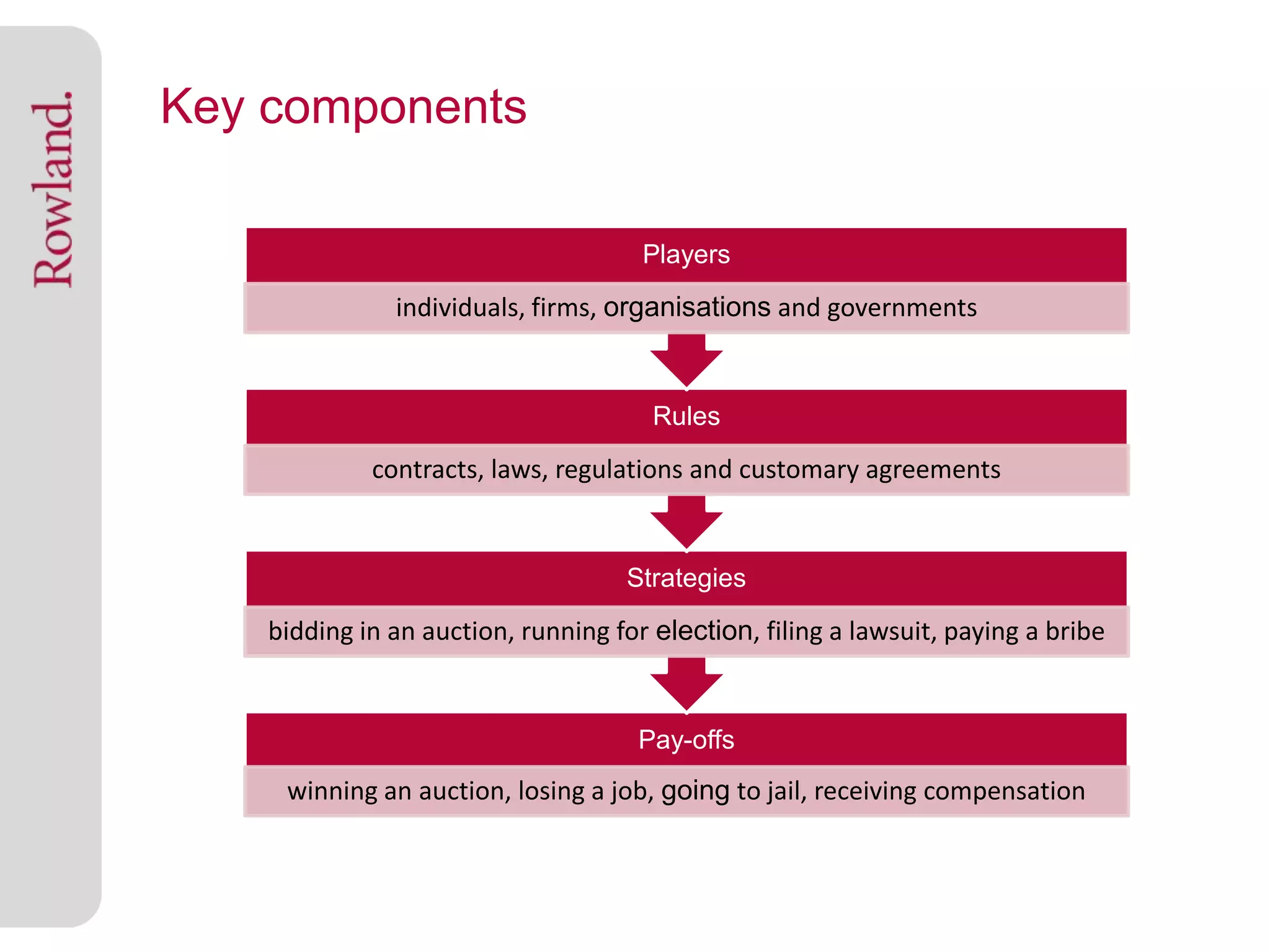
Key components

                                      Players

               individuals, firms, organisations and governments


                                       Rules

             contracts, laws, regulations and customary agreements


                                    Strategies

    bidding in an auction, running for election, filing a lawsuit, paying a bribe


                                      Pay-offs
     winning an auction, losing a job, going to jail, receiving compensation
Outline

   Concept of game theory
   Static games

   Repeated games

   Sequential games

   Game theory in the real world
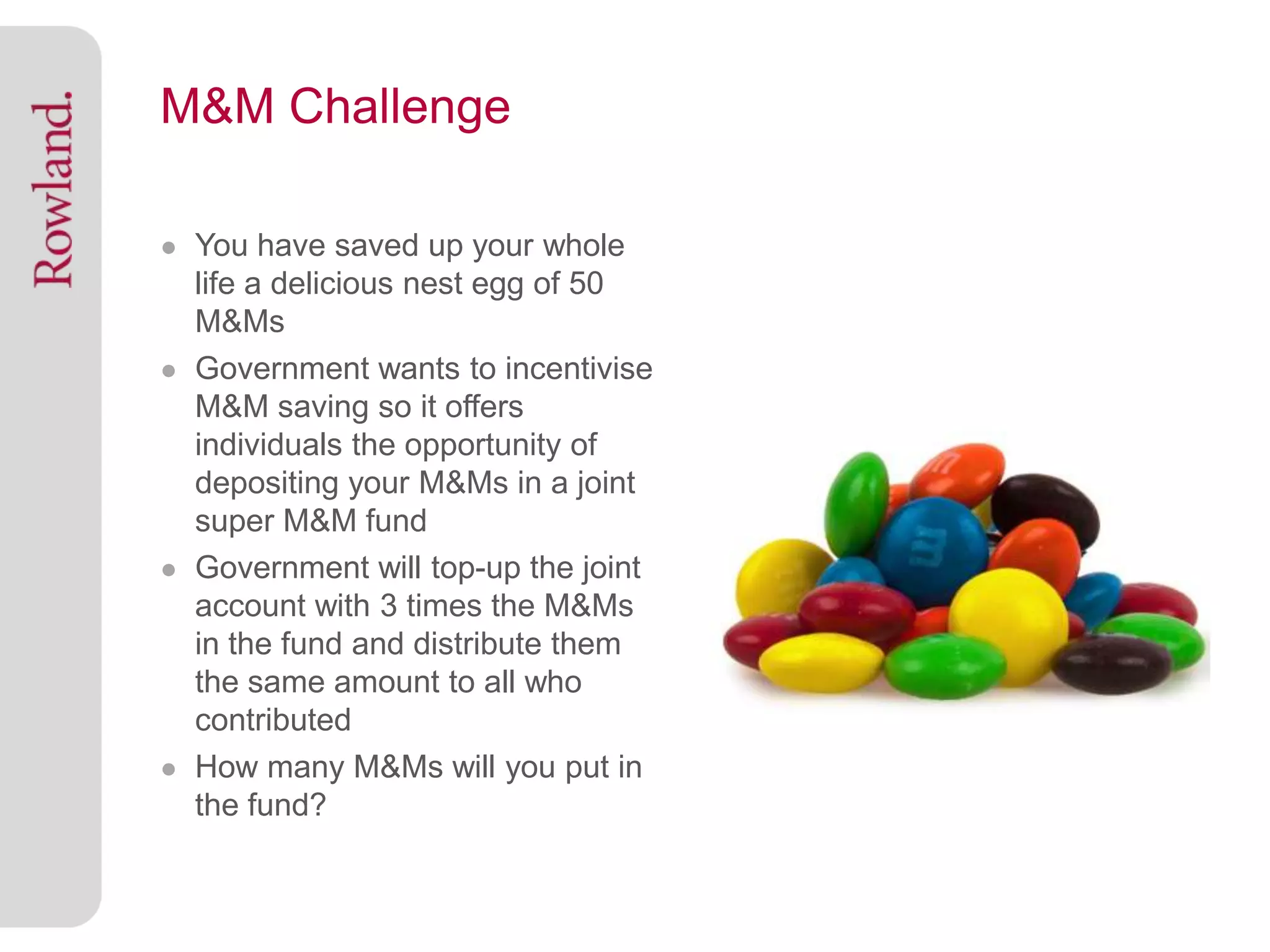
M&M Challenge

● You have saved up your whole
  life a delicious nest egg of 50
  M&Ms
● Government wants to incentivise
  M&M saving so it offers
  individuals the opportunity of
  depositing your M&Ms in a joint
  super M&M fund
● Government will top-up the joint
  account with 3 times the M&Ms
  in the fund and distribute them
  the same amount to all who
  contributed
● How many M&Ms will you put in
  the fund?
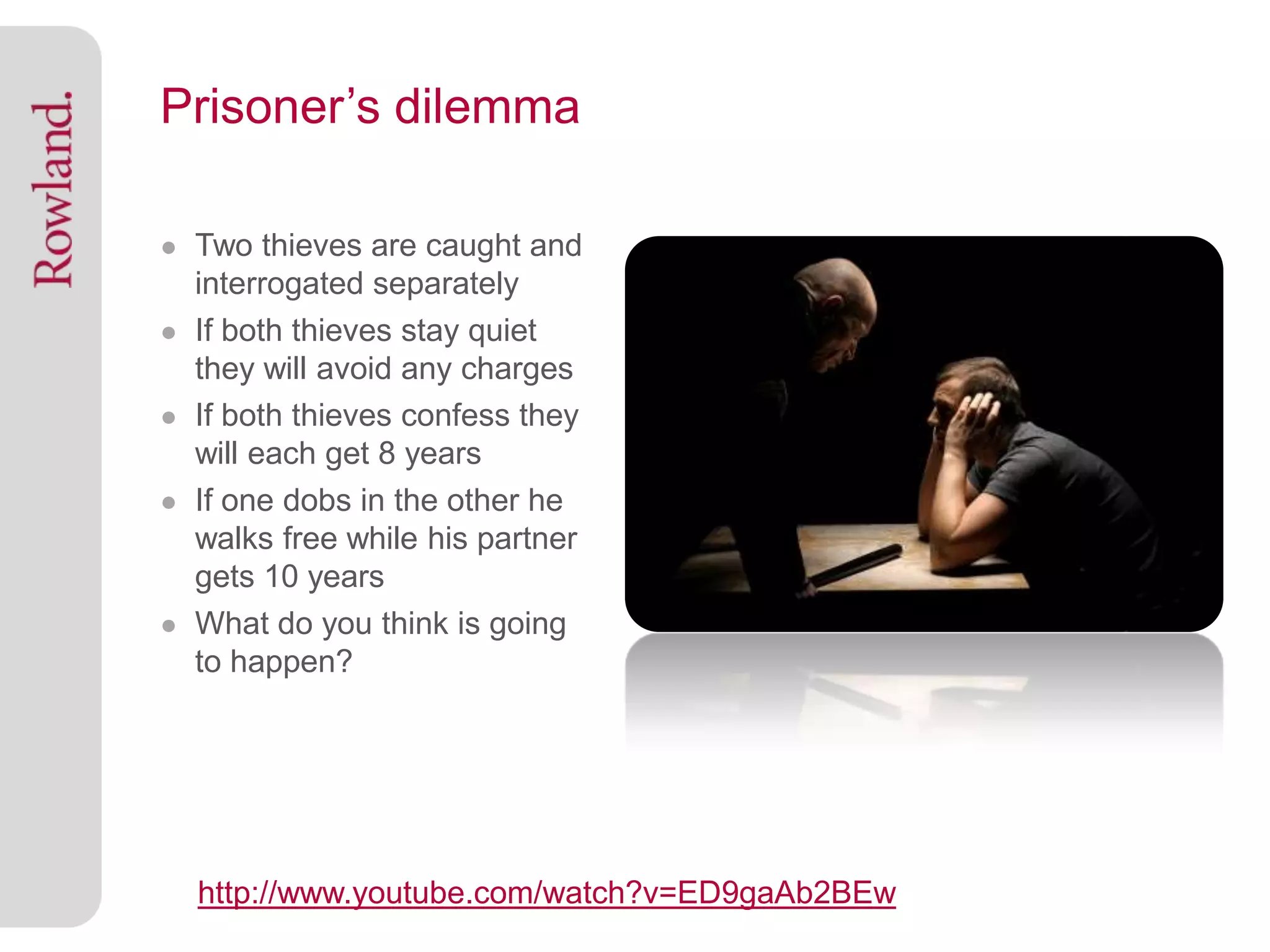
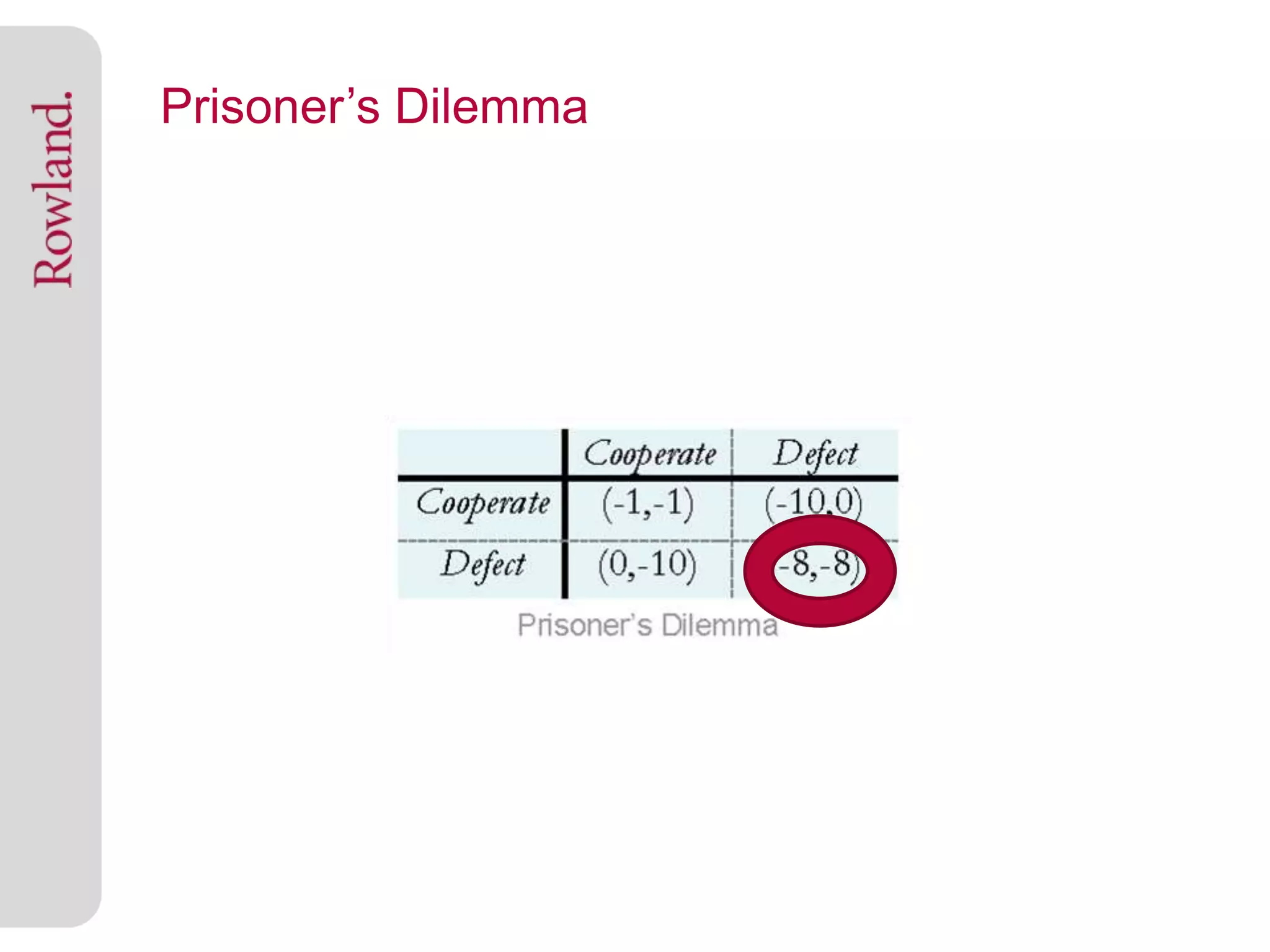
Prisoner’s dilemma

● Two thieves are caught and
    interrogated separately
●   If both thieves stay quiet
    they will avoid any charges
●   If both thieves confess they
    will each get 8 years
●   If one dobs in the other he
    walks free while his partner
    gets 10 years
●   What do you think is going
    to happen?


    http://www.youtube.com/watch?v=ED9gaAb2BEw
Prisoner’s Dilemma
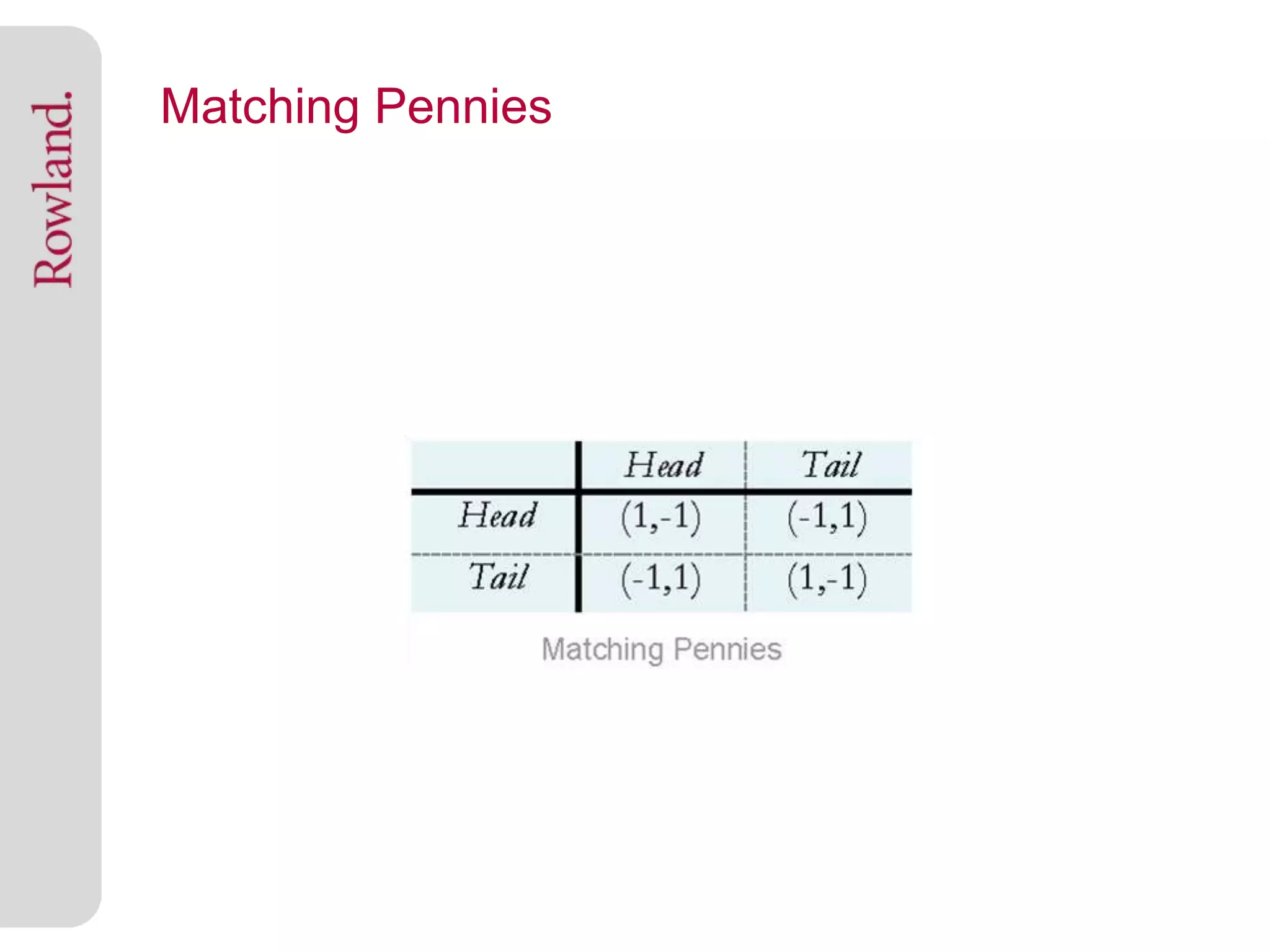
Matching Pennies
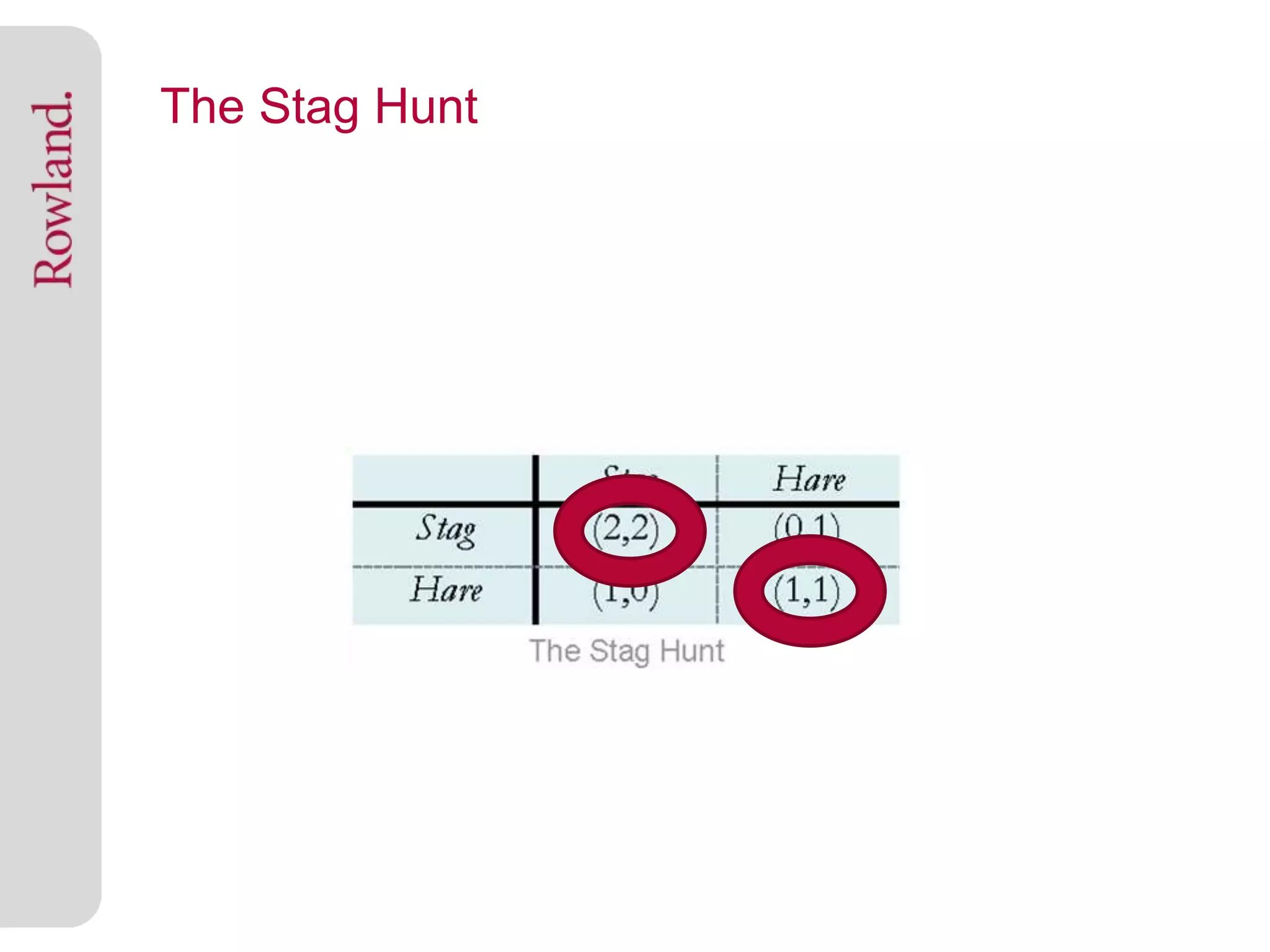
The Stag Hunt
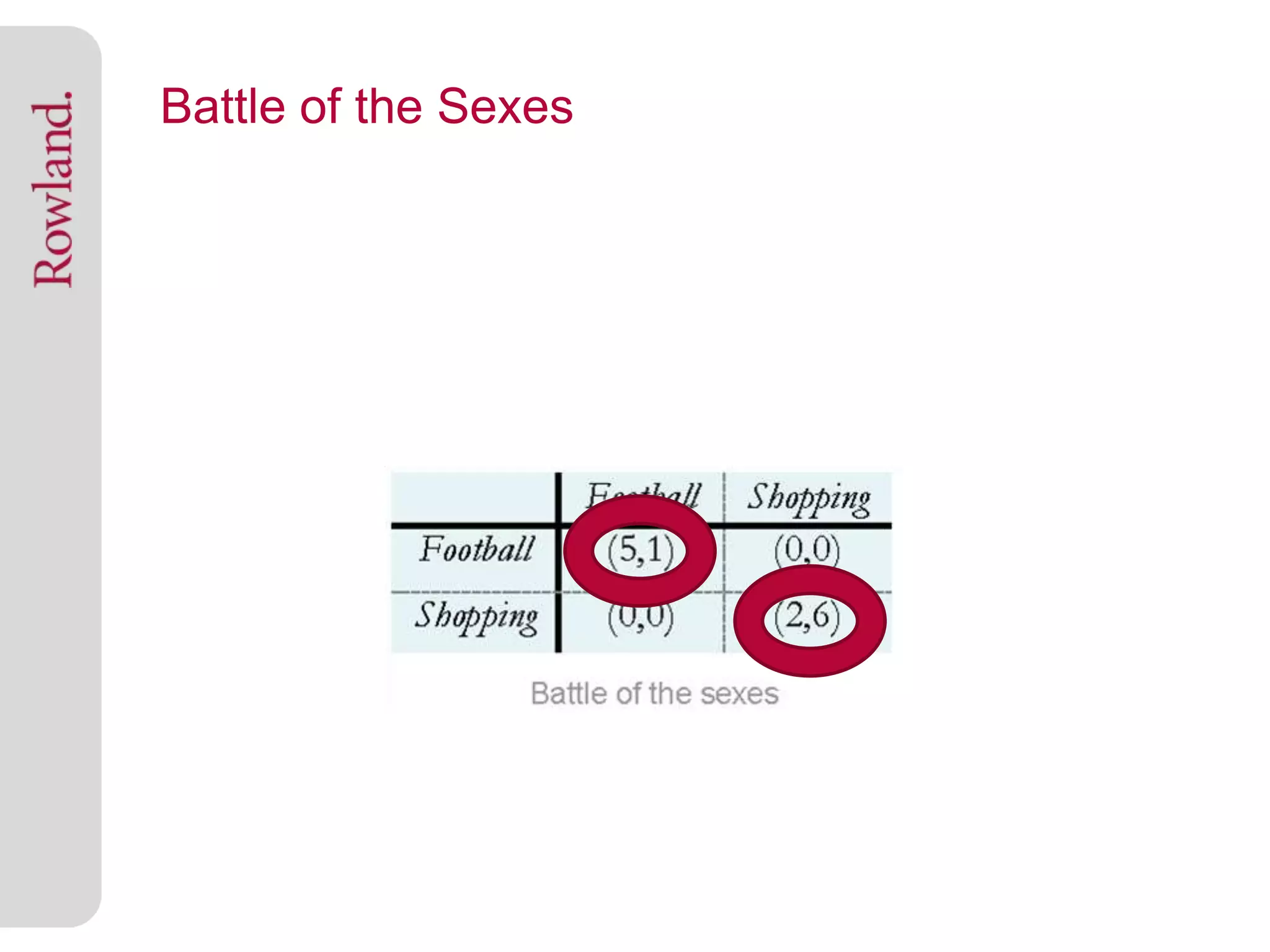
Battle of the Sexes
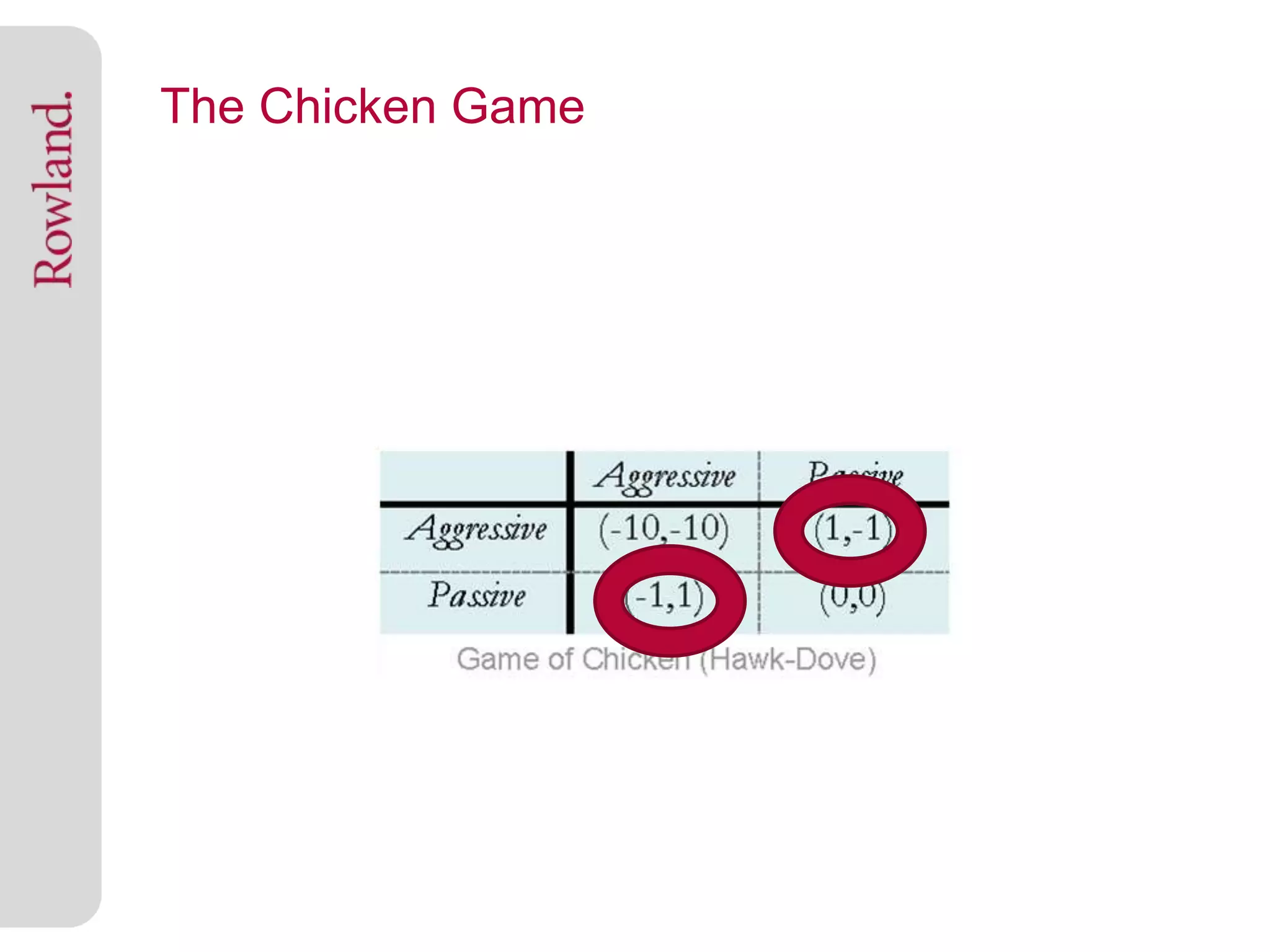
The Chicken Game
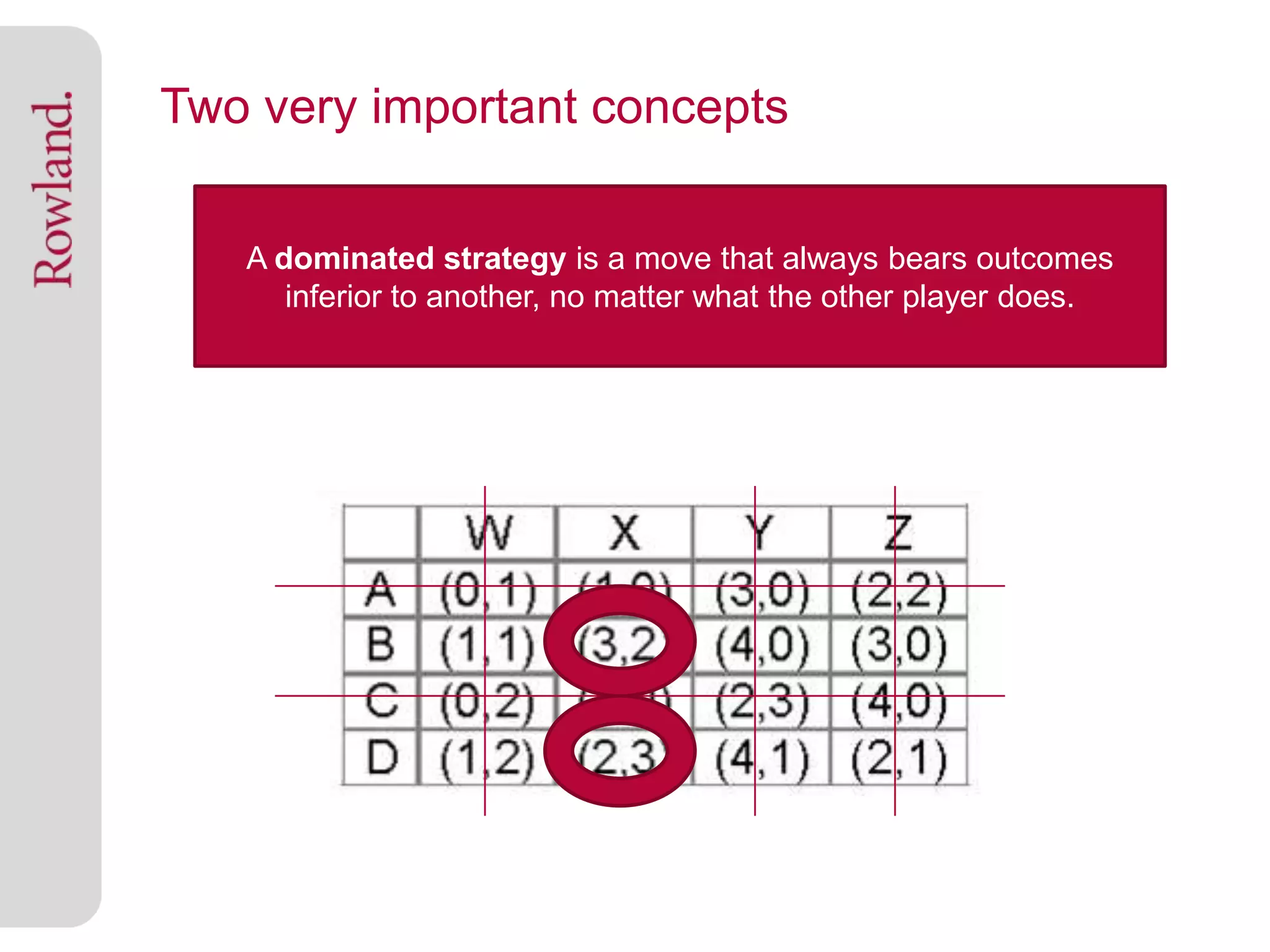
Two very important concepts

   A dominated strategy is a move that always bears outcomes
      inferior to another, no matter what the other player does.
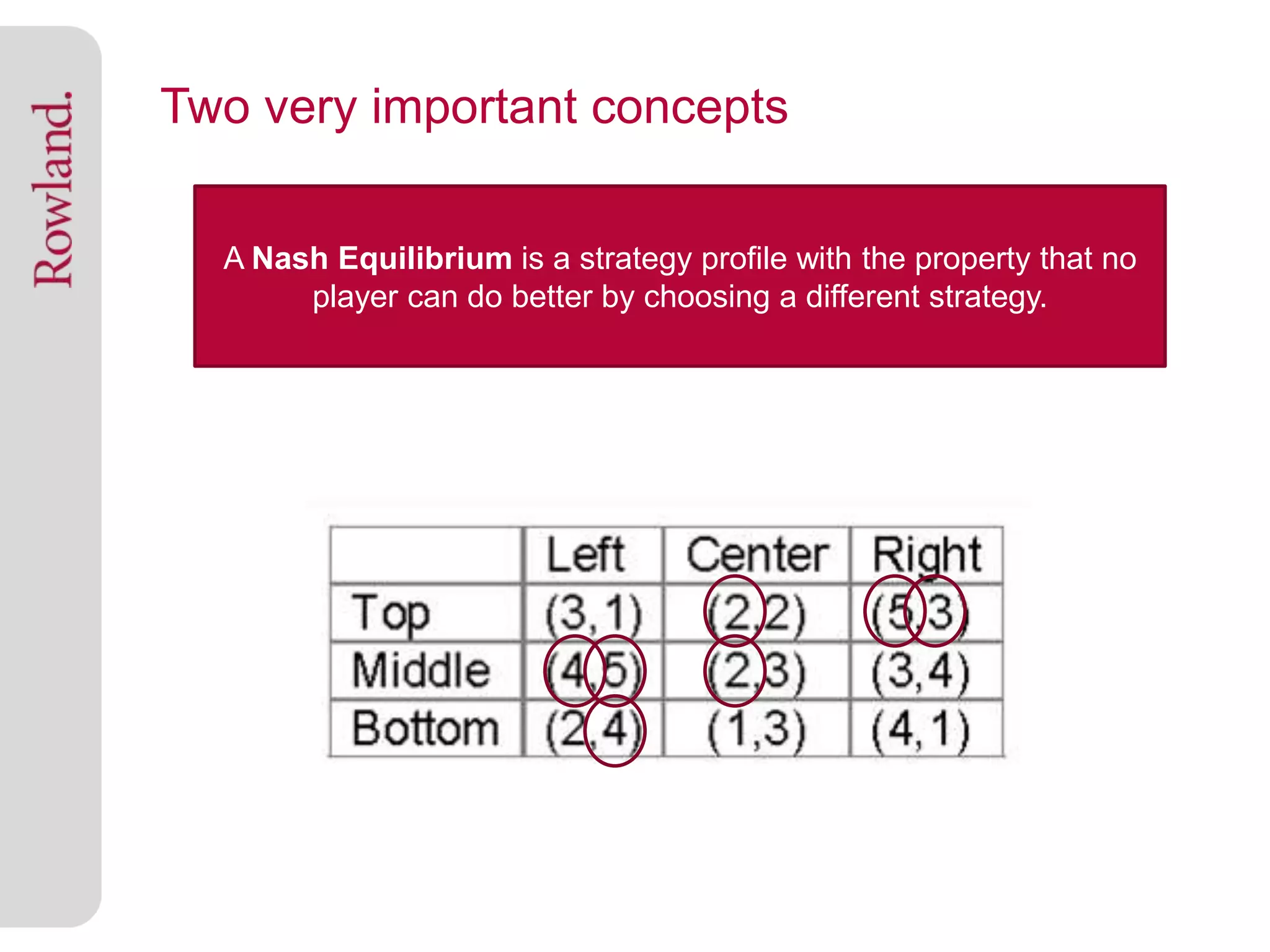
Two very important concepts

  A Nash Equilibrium is a strategy profile with the property that no
       player can do better by choosing a different strategy.
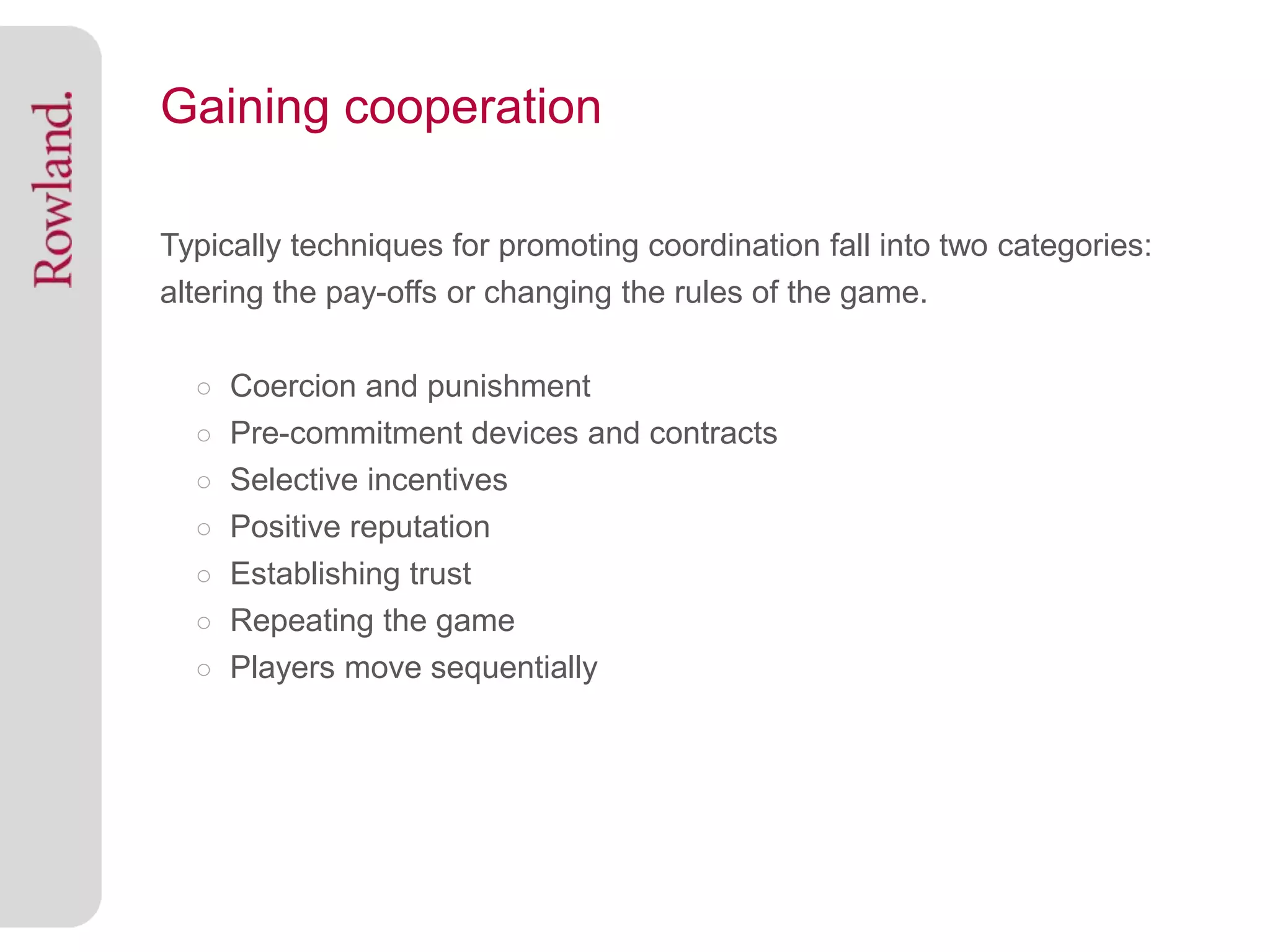
Gaining cooperation

Typically techniques for promoting coordination fall into two categories:
altering the pay-offs or changing the rules of the game.

  ○ Coercion and punishment
  ○ Pre-commitment devices and contracts
  ○ Selective incentives
  ○ Positive reputation
  ○ Establishing trust
  ○ Repeating the game
  ○ Players move sequentially
Outline

   Concept of game theory

   Static games

   Repeated games

   Sequential games

   Game theory in the real world
Repeated games

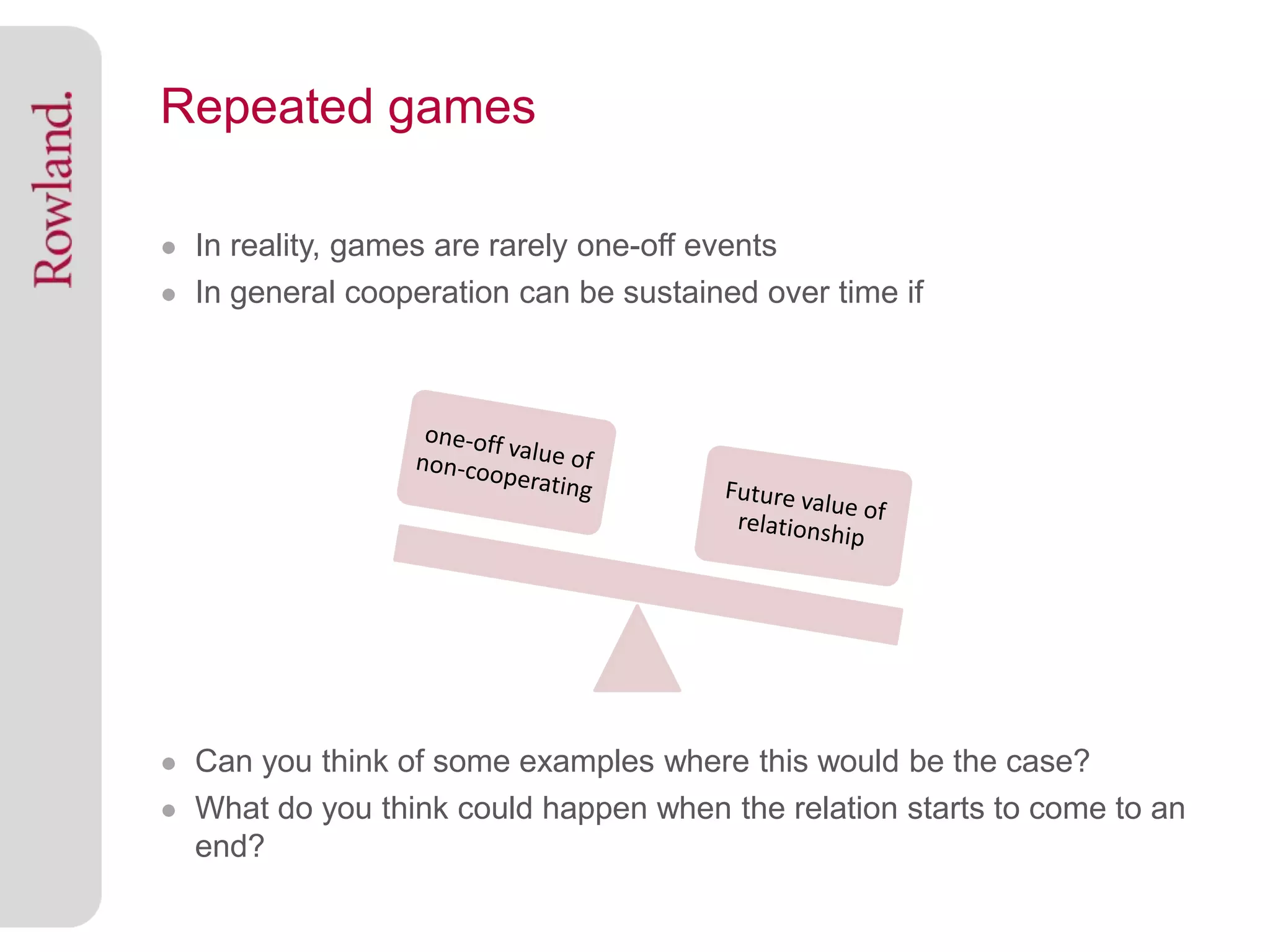
● In reality, games are rarely one-off events
● In general cooperation can be sustained over time if


● Can you think of some examples where this would be the case?
● What do you think could happen when the relation starts to come to an
  end?
Tit-for-tat strategy

● An academic tournament was held in
  1980 to test which strategy performs
  the best over repeated Prisoner’s
  Dilemmas
● The outstanding strategy was Robert
  Axelrod’s tit-for-tat strategy that follows
  some simple rules:
  ○ Unless provoked, a player will
     always cooperate
  ○ If provoked, a player will retaliate
  ○ The agent is quick to forgive
● Whilst defecting is the optimal solution
  in a one-off Prisoner’s Dilemma, the tit-
  for-tat strategy has a ‘disciplining’ effect
  on any other mindful player that
  encourages cooperation
Outline

   Concept of game theory

   Static games

   Repeated games

   Sequential games

   Game theory in the real world
Centipede Game

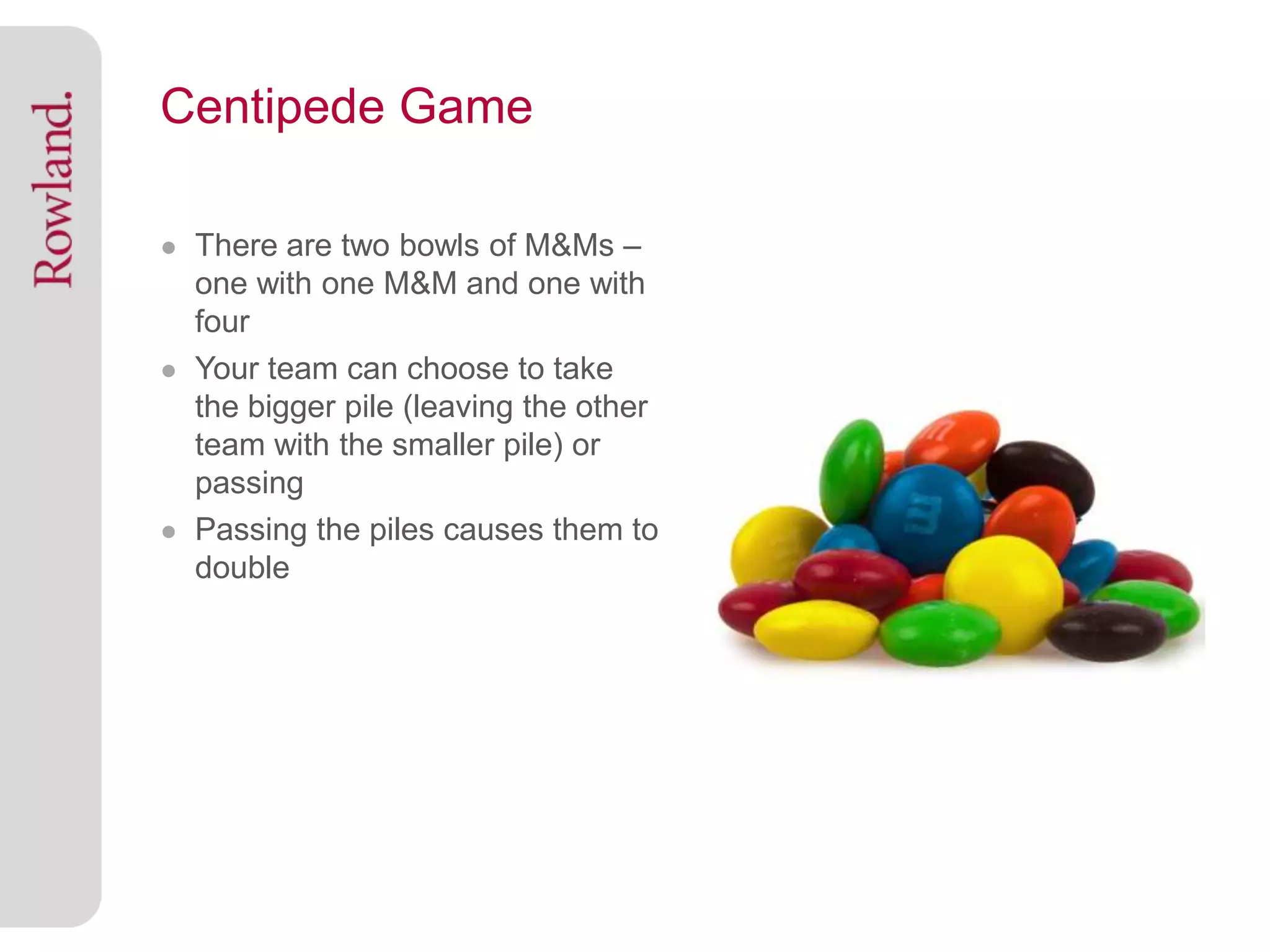
● There are two bowls of M&Ms –
  one with one M&M and one with
  four
● Your team can choose to take
  the bigger pile (leaving the other
  team with the smaller pile) or
  passing
● Passing the piles causes them to
  double
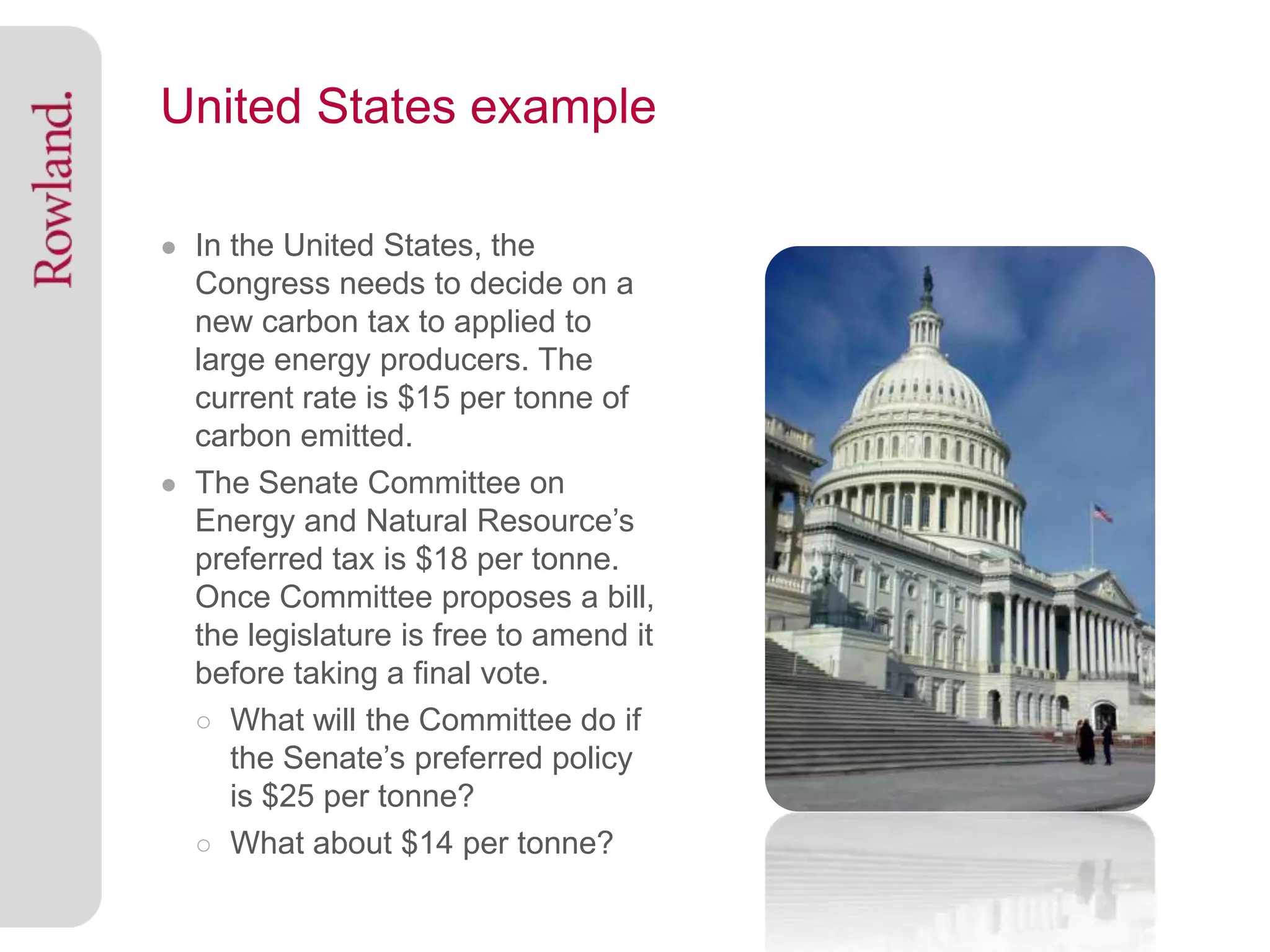
United States example

● In the United States, the
  Congress needs to decide on a
  new carbon tax to applied to
  large energy producers. The
  current rate is $15 per tonne of
  carbon emitted.
● The Senate Committee on
  Energy and Natural Resource’s
  preferred tax is $18 per tonne.
  Once Committee proposes a bill,
  the legislature is free to amend it
  before taking a final vote.
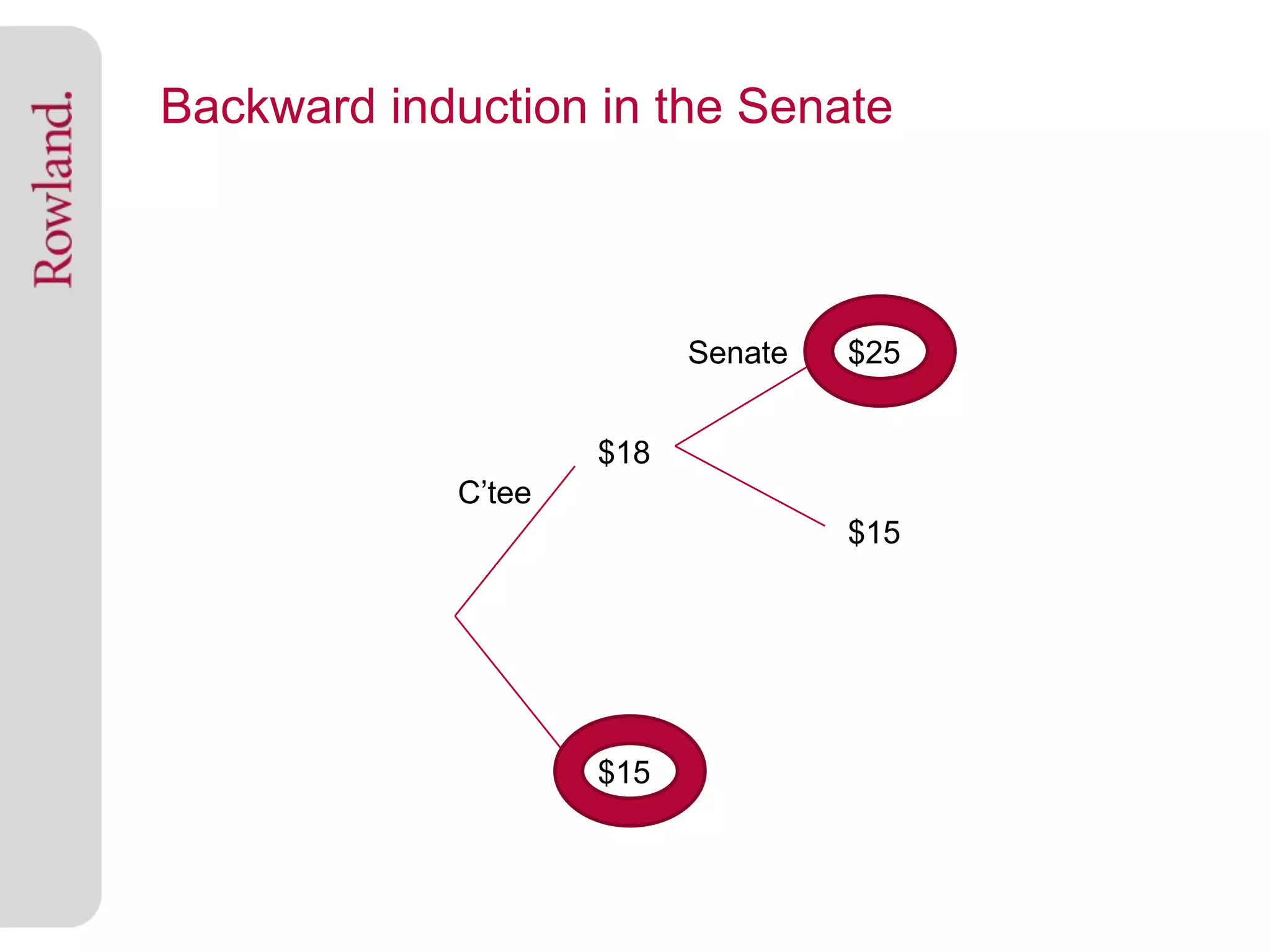
  ○ What will the Committee do if
     the Senate’s preferred policy
     is $25 per tonne?
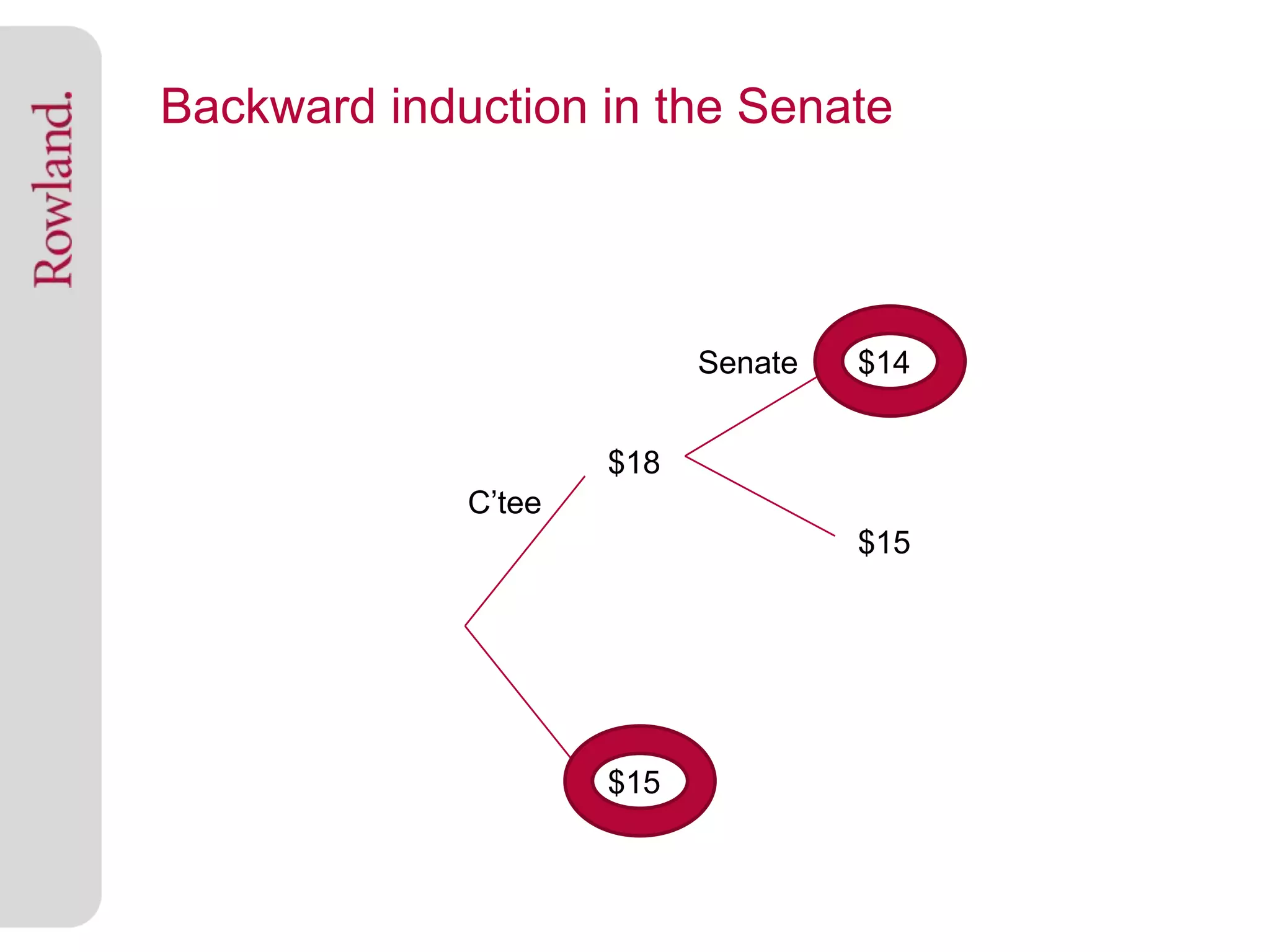
  ○ What about $14 per tonne?
Backward induction in the Senate


                          Senate   $25


                    $18
            C’tee
                                   $15


                    $15
Backward induction in the Senate


                           Senate   $14


                     $18
             C’tee
                                    $15


                     $15
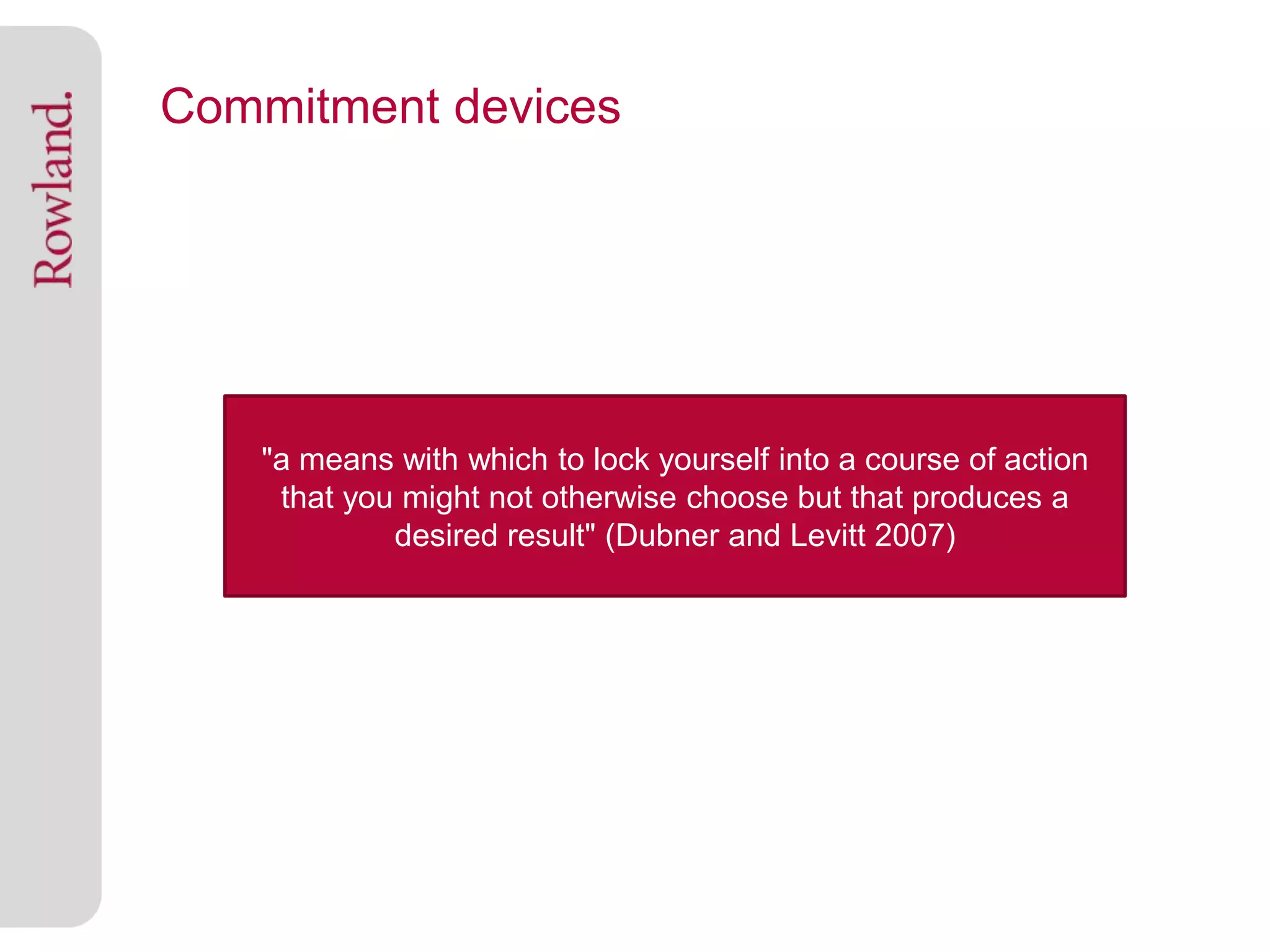
Commitment devices


   "a means with which to lock yourself into a course of action
    that you might not otherwise choose but that produces a
            desired result" (Dubner and Levitt 2007)
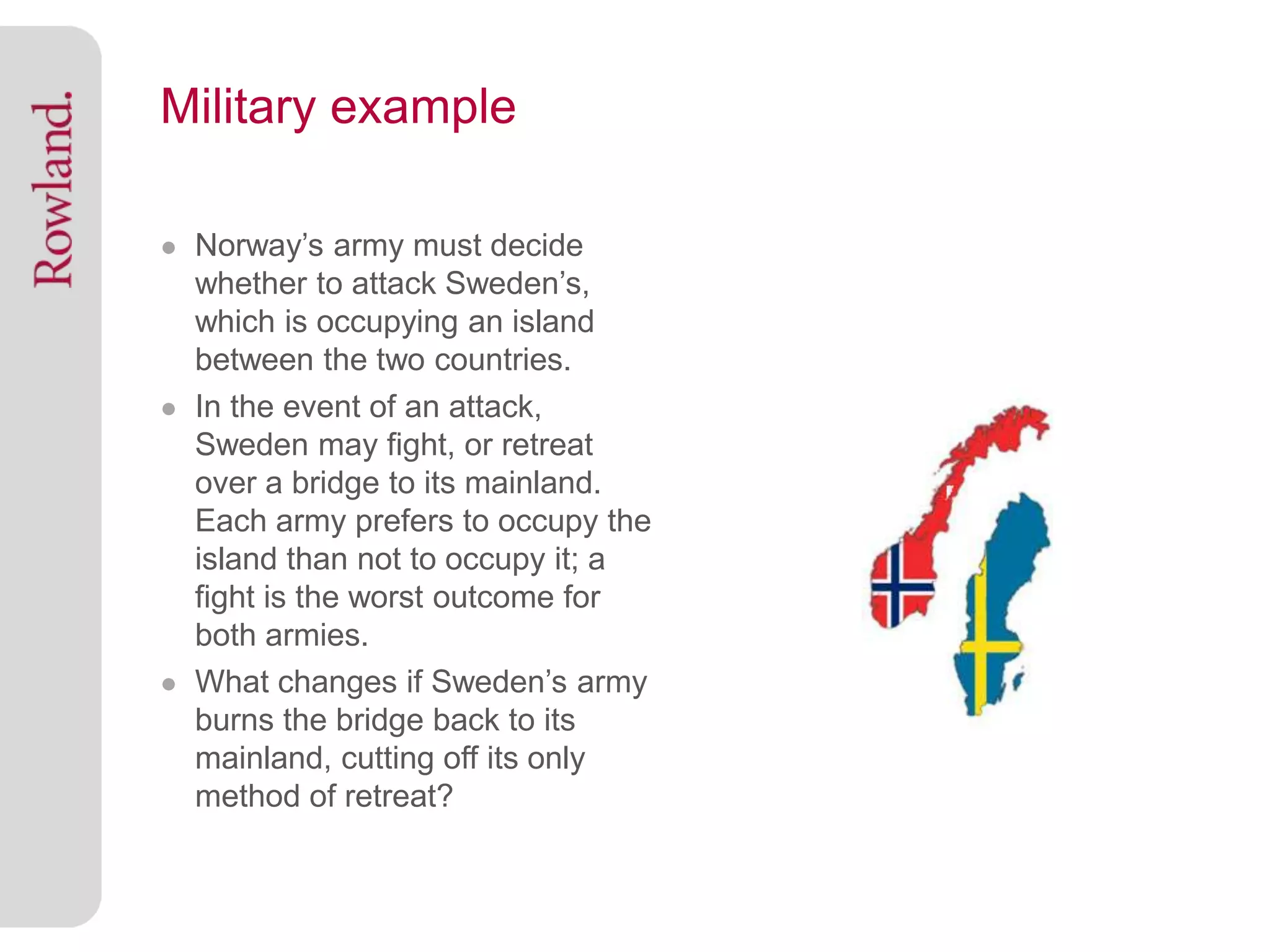
Military example

● Norway’s army must decide
  whether to attack Sweden’s,
  which is occupying an island
  between the two countries.
● In the event of an attack,
  Sweden may fight, or retreat
  over a bridge to its mainland.
  Each army prefers to occupy the
  island than not to occupy it; a
  fight is the worst outcome for
  both armies.
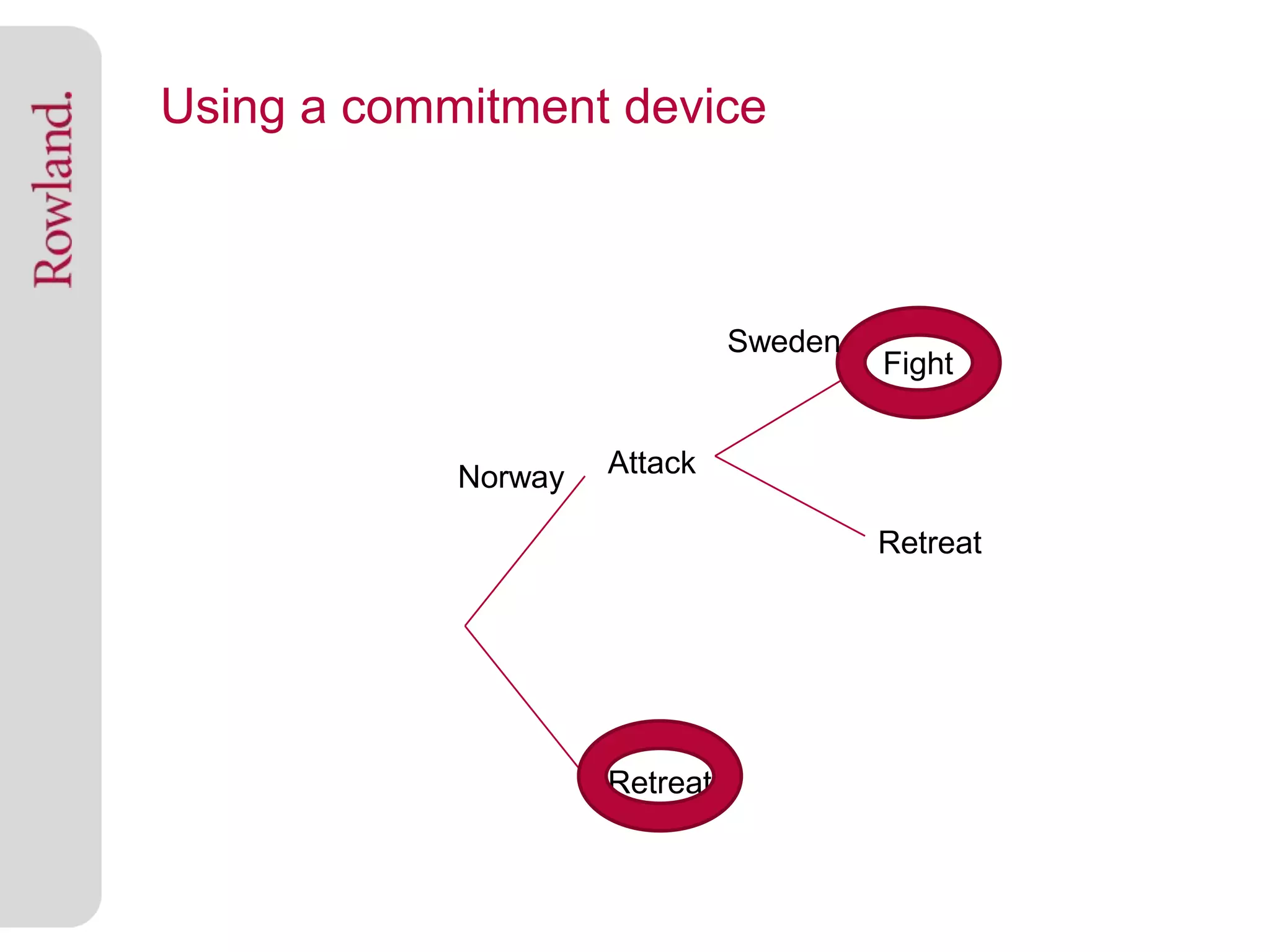
● What changes if Sweden’s army
  burns the bridge back to its
  mainland, cutting off its only
  method of retreat?
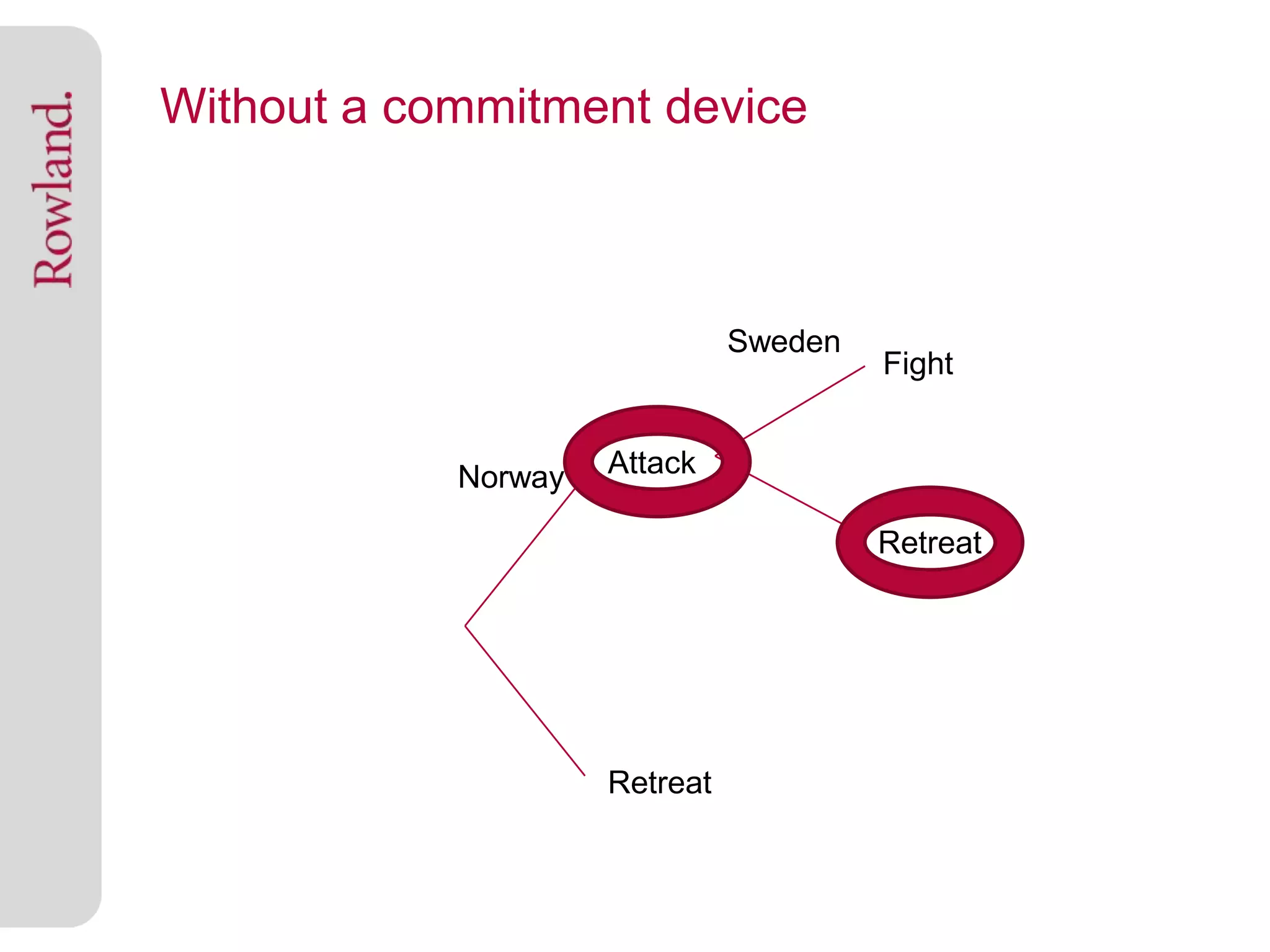
Without a commitment device


                               Sweden
                                        Fight


            Norway   Attack

                                        Retreat


                     Retreat
Using a commitment device


                               Sweden
                                        Fight


            Norway   Attack

                                        Retreat


                     Retreat
Outline

   Concept of game theory

   Static games

   Repeated games

   Sequential games

   Game theory in the real world
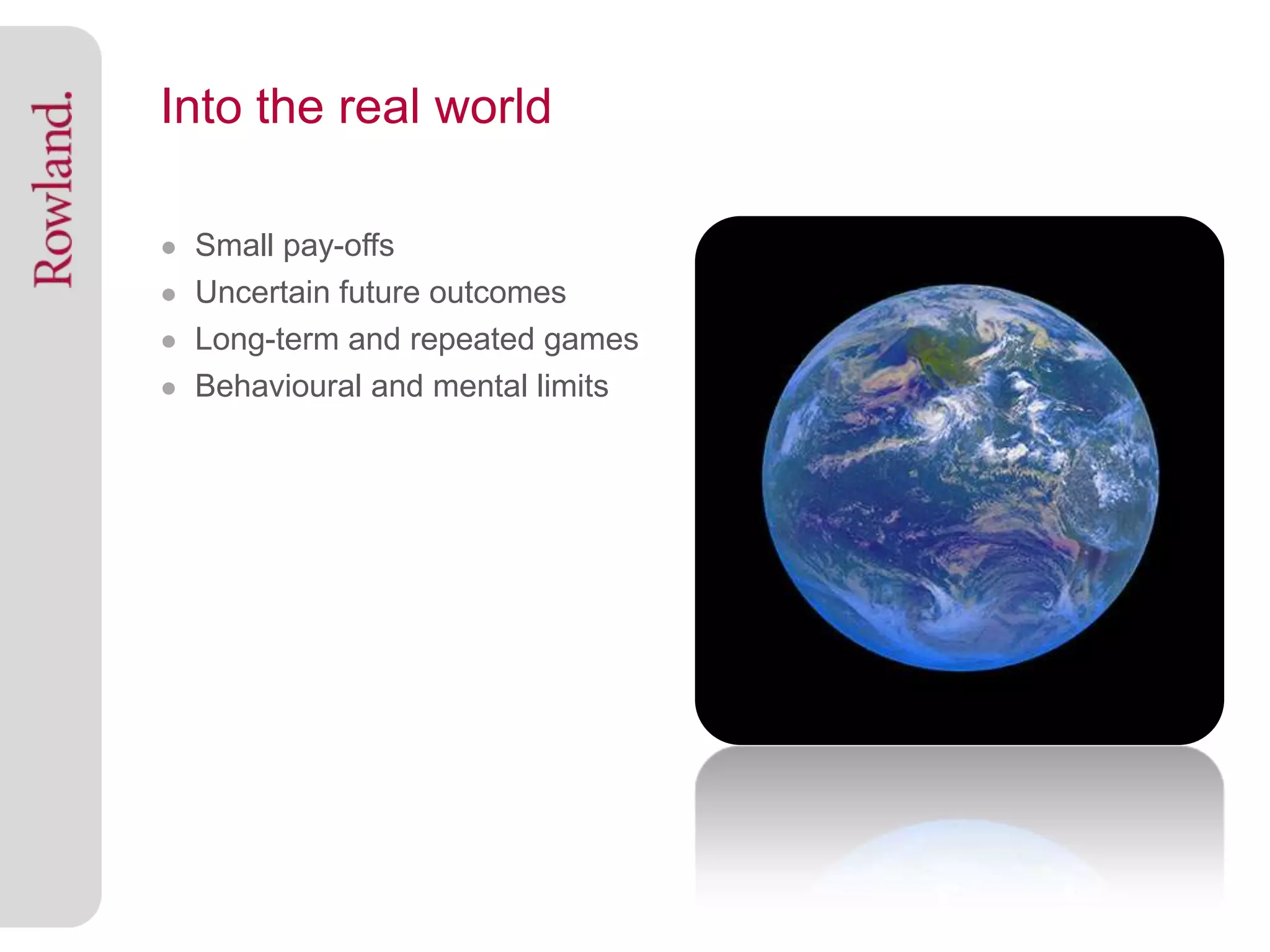
Into the real world

● Small pay-offs
● Uncertain future outcomes
● Long-term and repeated games
● Behavioural and mental limits
Fleggie’s final tips

● Consider others’ strategies before considering your own
● History means very little. Always be forward-looking and anticipatory
● Always consider how much actual ability you have to influence a final
  outcome
● Timing is everything, and it’s not always better to move second
● Change the rules, changes the outcome
Final tips on strategy

● Never forget the status quo is itself a strategy
● Look for dominated strategies that you can take off the table early
● Also look for inevitable outcomes. If you can embrace an inevitable
  outcome, albeit negative, you might be in a position to minimise its
  impact
● Be wary of other players’ publicly released comments. Often they have
  strong incentives to misrepresent their preferences
● Don’t be afraid to use a firm yet forgiving tit-for-tat strategy. It is a
  proven strategy for cooperation in a broad range of contexts
Discussion

Introduction to the Strategy of Game Theory

  • 1.
    Introduction to theStrategy of Game Theory Jonathon Flegg Manager
  • 2.
    Outline Concept of game theory Static games Repeated games Sequential games Game theory in the real world
  • 3.
    What is GameTheory? ○ it is not another useless theory ○ it is not just useful for trivial games ○ it is not just for mathematical egg heads ○ . “Game theory is a tool for exploring and understanding situations laced with strategic reasoning” - Joe Harrington (Johns Hopkins University) KEY DEFINING WORDS: STRATEGIC AND INTERACTION
  • 4.
  • 5.
    You probably knowsome intuitively ... good result, given the ... let’s shift the circumstances. goalposts. ... they had no ... I’m keeping other option. ... the result was inevitable. my powder dry. ... gaming the ... launched a ... they burned pre-emptive system ... they’re own strike. bridge. ... need to ... swimming ... tit-for-tat manage against the strategy. expectations. school.
  • 6.
    Questions for gametheory ● Why does the Westminster system of parliamentary democracy generate conflict? ● Why did Neville Chamberlain sign the Munich Agreement with Adolf Hitler? ● How hard should you work on a team project at university? ● In a penalty kick situation in soccer, is there any advantage from kicking the ball to the right or to the left?
  • 7.
    A Game TheoristPlays Trump Card Why would the CEO of Australia’s biggest coal miner support a carbon tax? ANSWER: GAME THEORY
  • 8.
    Paper, scissors, rock SCISSORS PAPER ROCK ROCK ● Is it strategic? NO ● Is it interactive? NO
  • 9.
  • 10.
    A simple example ●Did you develop a strategy? ● Did it work or not work? ● How was this different to the first game with the tape recorder?
  • 11.
    A few assumptions ●Each player is rational ● Each player knows the full extent to which each other player is rational ● Each player knows the potential pay-offs for themselves and others ● Each player knows the rules of the game Rational actors are those that construct the most efficient or cost- effective means to achieve their specific goal.
  • 12.
    Key components Players individuals, firms, organisations and governments Rules contracts, laws, regulations and customary agreements Strategies bidding in an auction, running for election, filing a lawsuit, paying a bribe Pay-offs winning an auction, losing a job, going to jail, receiving compensation
  • 13.
    Outline Concept of game theory Static games Repeated games Sequential games Game theory in the real world
  • 14.
    M&M Challenge ● Youhave saved up your whole life a delicious nest egg of 50 M&Ms ● Government wants to incentivise M&M saving so it offers individuals the opportunity of depositing your M&Ms in a joint super M&M fund ● Government will top-up the joint account with 3 times the M&Ms in the fund and distribute them the same amount to all who contributed ● How many M&Ms will you put in the fund?
  • 15.
    Prisoner’s dilemma ● Twothieves are caught and interrogated separately ● If both thieves stay quiet they will avoid any charges ● If both thieves confess they will each get 8 years ● If one dobs in the other he walks free while his partner gets 10 years ● What do you think is going to happen? http://www.youtube.com/watch?v=ED9gaAb2BEw
  • 16.
  • 17.
  • 18.
  • 19.
  • 20.
  • 21.
    Two very importantconcepts A dominated strategy is a move that always bears outcomes inferior to another, no matter what the other player does.
  • 22.
    Two very importantconcepts A Nash Equilibrium is a strategy profile with the property that no player can do better by choosing a different strategy.
  • 23.
    Gaining cooperation Typically techniquesfor promoting coordination fall into two categories: altering the pay-offs or changing the rules of the game. ○ Coercion and punishment ○ Pre-commitment devices and contracts ○ Selective incentives ○ Positive reputation ○ Establishing trust ○ Repeating the game ○ Players move sequentially
  • 24.
    Outline Concept of game theory Static games Repeated games Sequential games Game theory in the real world
  • 25.
    Repeated games ● Inreality, games are rarely one-off events ● In general cooperation can be sustained over time if ● Can you think of some examples where this would be the case? ● What do you think could happen when the relation starts to come to an end?
  • 26.
    Tit-for-tat strategy ● Anacademic tournament was held in 1980 to test which strategy performs the best over repeated Prisoner’s Dilemmas ● The outstanding strategy was Robert Axelrod’s tit-for-tat strategy that follows some simple rules: ○ Unless provoked, a player will always cooperate ○ If provoked, a player will retaliate ○ The agent is quick to forgive ● Whilst defecting is the optimal solution in a one-off Prisoner’s Dilemma, the tit- for-tat strategy has a ‘disciplining’ effect on any other mindful player that encourages cooperation
  • 27.
    Outline Concept of game theory Static games Repeated games Sequential games Game theory in the real world
  • 28.
    Centipede Game ● Thereare two bowls of M&Ms – one with one M&M and one with four ● Your team can choose to take the bigger pile (leaving the other team with the smaller pile) or passing ● Passing the piles causes them to double
  • 29.
    United States example ●In the United States, the Congress needs to decide on a new carbon tax to applied to large energy producers. The current rate is $15 per tonne of carbon emitted. ● The Senate Committee on Energy and Natural Resource’s preferred tax is $18 per tonne. Once Committee proposes a bill, the legislature is free to amend it before taking a final vote. ○ What will the Committee do if the Senate’s preferred policy is $25 per tonne? ○ What about $14 per tonne?
  • 30.
    Backward induction inthe Senate Senate $25 $18 C’tee $15 $15
  • 31.
    Backward induction inthe Senate Senate $14 $18 C’tee $15 $15
  • 32.
    Commitment devices "a means with which to lock yourself into a course of action that you might not otherwise choose but that produces a desired result" (Dubner and Levitt 2007)
  • 33.
    Military example ● Norway’sarmy must decide whether to attack Sweden’s, which is occupying an island between the two countries. ● In the event of an attack, Sweden may fight, or retreat over a bridge to its mainland. Each army prefers to occupy the island than not to occupy it; a fight is the worst outcome for both armies. ● What changes if Sweden’s army burns the bridge back to its mainland, cutting off its only method of retreat?
  • 34.
    Without a commitmentdevice Sweden Fight Norway Attack Retreat Retreat
  • 35.
    Using a commitmentdevice Sweden Fight Norway Attack Retreat Retreat
  • 36.
    Outline Concept of game theory Static games Repeated games Sequential games Game theory in the real world
  • 37.
    Into the realworld ● Small pay-offs ● Uncertain future outcomes ● Long-term and repeated games ● Behavioural and mental limits
  • 38.
    Fleggie’s final tips ●Consider others’ strategies before considering your own ● History means very little. Always be forward-looking and anticipatory ● Always consider how much actual ability you have to influence a final outcome ● Timing is everything, and it’s not always better to move second ● Change the rules, changes the outcome
  • 39.
    Final tips onstrategy ● Never forget the status quo is itself a strategy ● Look for dominated strategies that you can take off the table early ● Also look for inevitable outcomes. If you can embrace an inevitable outcome, albeit negative, you might be in a position to minimise its impact ● Be wary of other players’ publicly released comments. Often they have strong incentives to misrepresent their preferences ● Don’t be afraid to use a firm yet forgiving tit-for-tat strategy. It is a proven strategy for cooperation in a broad range of contexts
  • 40.

Editor's Notes

  • #5 We’ve all played Risk before.What is the goal of risk: world domination.How do you (hopefully) get there? By strategically deciding on when and with whom to cooperate and when and with whom to bring on conflict.
  • #8 The Government preferred ETS  TAX  NOTHING (Rudd and Gillard promising “no tax”) then it switched to TAXETSNOTHING. NOTHING was least likely. BHP preferred TAX  NOTHING  ETS (if it was without uranium it might have been NOTHING  TAX  ETS)A broad-based carbon tax, he said, would affect BHP's business if there was "no rebating for trade-exposed industries".A BHP spokesman confirmed that Mr Kloppers believed there should be "some form of treatment" to recognise export sector industries under the carbon tax, echoing growing calls for special deals across the economy, including from the steel industry, cement manufacturers, food and groceries, oil, gas and aluminium.
  • #15 What would happen if the depositors held personal accounts in the fund? What would change?
  • #17 EXAMPLES: arms race, global climate change agreements, fall in trade union membershipMany other examples. Can you think of some?
  • #18 Player A and Player B. Each player has a penny and must secretly turn the penny to heads or tails. The players then reveal their choices simultaneously. If the pennies match (both heads or both tails) Player A keeps both pennies, so wins one from Player B (+1 for A, -1 for B). If the pennies do not match (one heads and one tails) Player B keeps both pennies, so receives one from Player A (-1 for A, +1 for B). This is an example of a zero-sum game, where one player's gain is exactly equal to the other player's loss.This game has no pure strategyNash equilibrium since there is no pure strategy (heads or tails) that is a best response to a best response. EXAMPLE: paper, scissors, rock
  • #19 two individuals go out on a hunt. Each can individually choose to hunt a stag or hunt a hare. Each player must choose an action without knowing the choice of the other. If an individual hunts a stag, he must have the cooperation of his partner in order to succeed. An individual can get a hare by himself, but a hare is worth less than a stag. This is taken to be an important analogy for social cooperation.
  • #20 Imagine a couple that agreed to meet this evening, but cannot recall if they will be attending the opera or a football match. The husband would most of all like to go to the football game. The wife would like to go to the opera. Both would prefer to go to the same place rather than different ones. If they cannot communicate, where should they go?This game has two pure strategyNash equilibria, one where both go to the opera and another where both go to the football game.
  • #21 The game of chicken models two drivers, both headed for a single lane bridge from opposite directions. The first to swerve away yields the bridge to the other. If neither player swerves, the result is a potentially fatal head-on collision. It is presumed that the best thing for each driver is to stay straight while the other swerves (since the other is the "chicken" while a crash is avoided). Additionally, a crash is presumed to be the worst outcome for both players. This yields a situation where each player, in attempting to secure his best outcome, risks the worst.http://www.youtube.com/watch?v=rExm2FbY-BE&NR=1
  • #24 Coercion and punishment – tax evasion punishmentPre-commitment devices – coal purchase orders and airport/airlinesSelective incentives – Growcom Reputation – selling a lemon on ebay or a car (use reputation reporting highly effective - if the word gets out his business will dry up)Establishing trust – small communities
  • #26 Compare the risks in a one-off sale of a lemon car compared with a fruit wholesaler who sells to a restaurant every day?
  • #27 In 1980, Robert Axelrod, professor of political science at the University of Michigan, held a tournament of various strategies for the prisoner's dilemma. He invited a number of well-known game theorists to submit strategies to be run by computers. In the tournament, programs played games against each other and themselves repeatedly. Each strategy specified whether to cooperate or defect based on the previous moves of both the strategy and its opponent.
  • #29 Consider two players: Alice and Bob. Alice moves first. At the start of the game, Alice has two piles of coins in front of her: one pile contains 4 coins and the other pile contains 1 coin. Each player has two moves available: either "take" the larger pile of coins and give the smaller pile to the other player or "push" both piles across the table to the other player. Each time the piles of coins pass across the table, the quantity of coins in each pile doubles. For example, assume that Alice chooses to "push" the piles on her first move, handing the piles of 1 and 4 coins over to Bob, doubling them to 2 and 8. Bob could now use his first move to either "take" the pile of 8 coins and give 2 coins to Alice, or he can "push" the two piles back across the table again to Alice, again increasing the size of the piles to 4 and 16 coins. The game continues for a fixed number of rounds or until a player decides to end the game by pocketing a pile of coins.
  • #31 Why do you think is going to happen?
  • #32 What do you think is going to happen?Now you can see why the US Congressional committees are so incredibly powerful!
  • #35 What do you think is going to happen?Now you can see why the US Congressional committees are so incredibly powerful!
  • #36 What do you think is going to happen?Now you can see why the US Congressional committees are so incredibly powerful!