By:Asensio Bastida

THE SOLAR SYSTEM
The planets

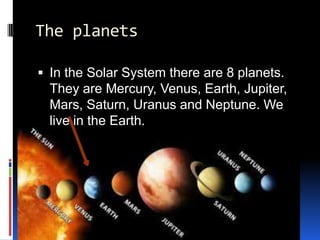
 In the Solar System there are 8 planets.
  They are Mercury, Venus, Earth, Jupiter,
  Mars, Saturn, Uranus and Neptune. We
  live in the Earth.
Astronomical bodies

 Luminous astronomical bodies: the most
  common are the stars. They give us light
  and heat.
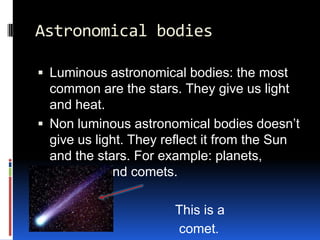
 Non luminous astronomical bodies doesn’t
  give us light. They reflect it from the Sun
  and the stars. For example: planets,
  satellites and comets.

                       This is a
                       comet.
The sun

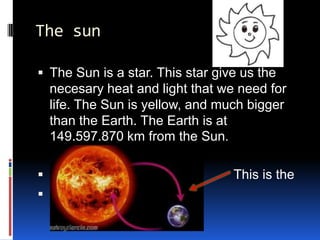
 The Sun is a star. This star give us the
    necesary heat and light that we need for
    life. The Sun is yellow, and much bigger
    than the Earth. The Earth is at
    149.597.870 km from the Sun.

                                  This is the

    distancy of the
The rotation of the earth
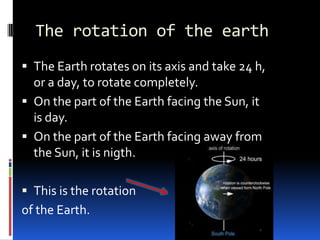
 The Earth rotates on its axis and take 24 h,
  or a day, to rotate completely.
 On the part of the Earth facing the Sun, it
  is day.
 On the part of the Earth facing away from
  the Sun, it is nigth.

 This is the rotation
of the Earth.
The seasons

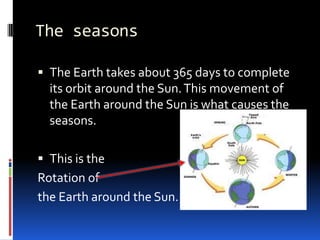
 The Earth takes about 365 days to complete
  its orbit around the Sun. This movement of
  the Earth around the Sun is what causes the
  seasons.

 This is the
Rotation of
the Earth around the Sun.

The solar system

  • 1.
  • 2.
    The planets  Inthe Solar System there are 8 planets. They are Mercury, Venus, Earth, Jupiter, Mars, Saturn, Uranus and Neptune. We live in the Earth.
  • 3.
    Astronomical bodies  Luminousastronomical bodies: the most common are the stars. They give us light and heat.  Non luminous astronomical bodies doesn’t give us light. They reflect it from the Sun and the stars. For example: planets, satellites and comets. This is a comet.
  • 4.
    The sun  TheSun is a star. This star give us the necesary heat and light that we need for life. The Sun is yellow, and much bigger than the Earth. The Earth is at 149.597.870 km from the Sun.  This is the  distancy of the
  • 5.
    The rotation ofthe earth  The Earth rotates on its axis and take 24 h, or a day, to rotate completely.  On the part of the Earth facing the Sun, it is day.  On the part of the Earth facing away from the Sun, it is nigth.  This is the rotation of the Earth.
  • 6.
    The seasons  TheEarth takes about 365 days to complete its orbit around the Sun. This movement of the Earth around the Sun is what causes the seasons.  This is the Rotation of the Earth around the Sun.