Introduction to
Cooperation Theory

  Catholic University of Quito
   Peter C. Newton-Evans
       February 2012
The Money Game
• Two players with envelopes receive 1 coin each.
  They can either:
    1. Keep it and return the envelope empty (1 point)
    2. Put it in the envelope for the other player, and the
       facilitator will add another coin to the contribution.
•   Facilitator hands the envelopes to each player.
•   The game repeats until all the coins are gone.
•   Goal: to accumulate as many coins as you can.
•   Note: The number of coins the other player gets
    will not affect your own performance.
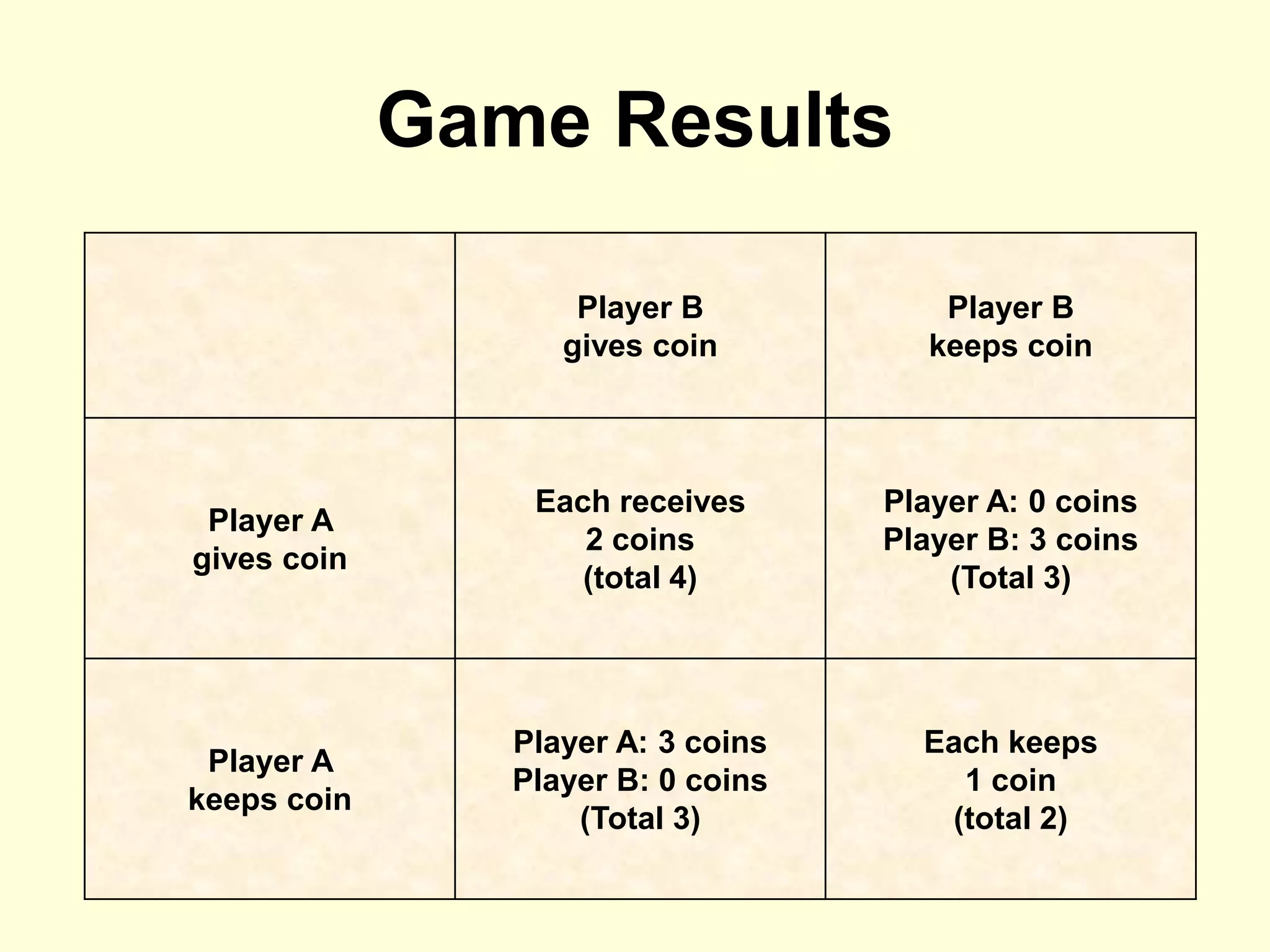
Game Results

                    Player B            Player B
                   gives coin          keeps coin


                 Each receives      Player A: 0 coins
 Player A
                    2 coins         Player B: 3 coins
gives coin
                    (total 4)           (Total 3)


                Player A: 3 coins     Each keeps
 Player A
                Player B: 0 coins       1 coin
keeps coin
                    (Total 3)          (total 2)
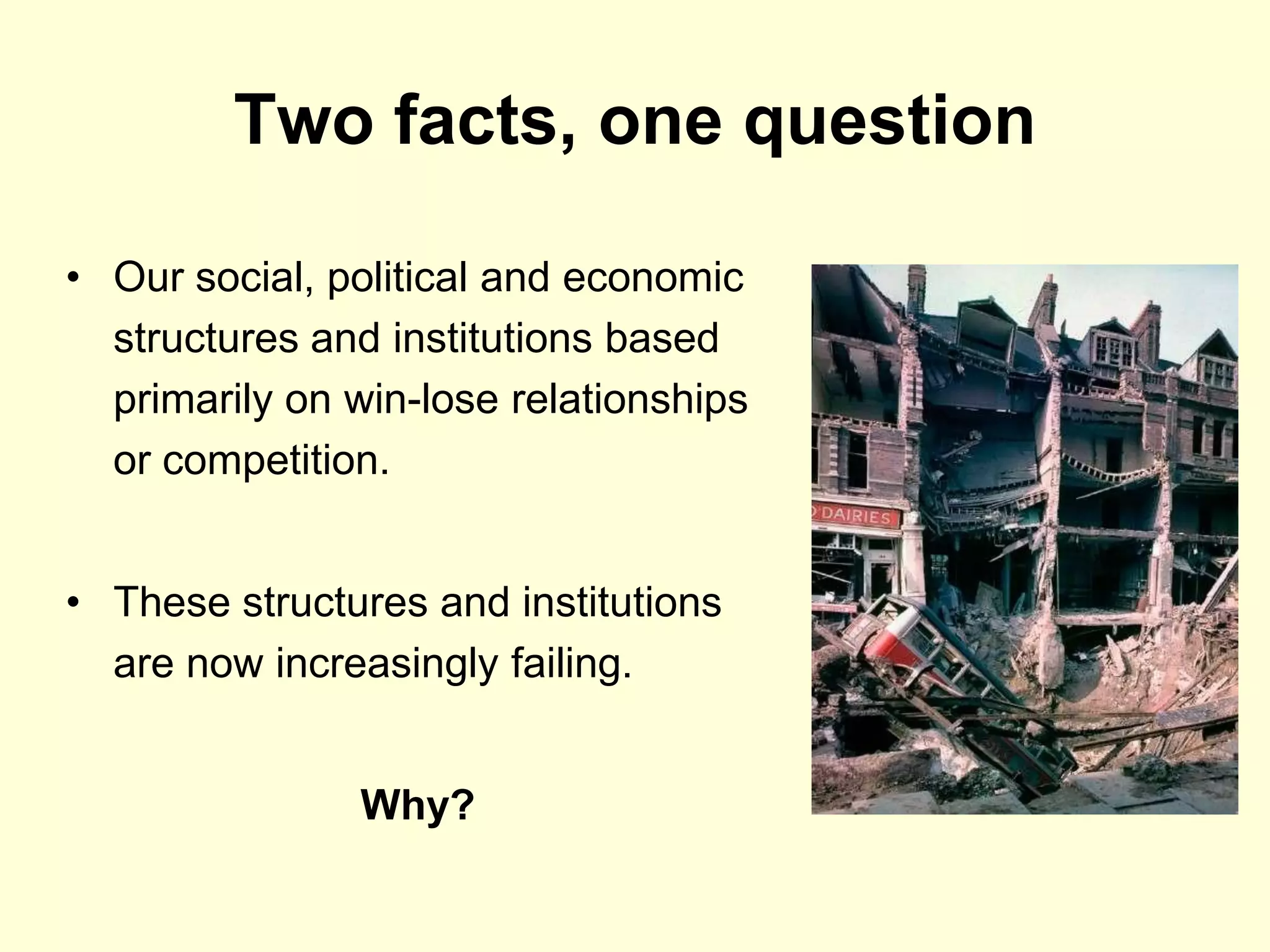
Two facts, one question

• Our social, political and economic
  structures and institutions based
  primarily on win-lose relationships
  or competition.


• These structures and institutions
  are now increasingly failing.


               Why?
Social Dilemmas
• When everyone acts as they are expected to according to the logic
  of the system, the dynamics inherent in the system's design will
  cause it to collapse:


• "Situations in which individual rationality adds up to collective
  irrationality. That is, individually responsible behavior leads to a
  situation in which everyone is worse off than they might have been
  otherwise." (Peter Kollock)


• "Situations that arise from the tension between self-interest and
  collective gain. Acting in one's self interest ends up damaging or
  failing to provide for the interests of everybody." (Howard Rheingold)
Examples
• Dyadic narrative stories: Prisoner's Dilemma,
  Assurance Game, Chicken, etc.
• Multi-person narrative myths: providing public
  goods, tragedy of the commons, etc.
• Social dilemmas in daily life: family life, busi-
  ness dealings, traffic jams, etc.
• Institutionalized dilemmas: capitalist
  accumulation, party politics, national security
  system, etc.
Types of Strategies
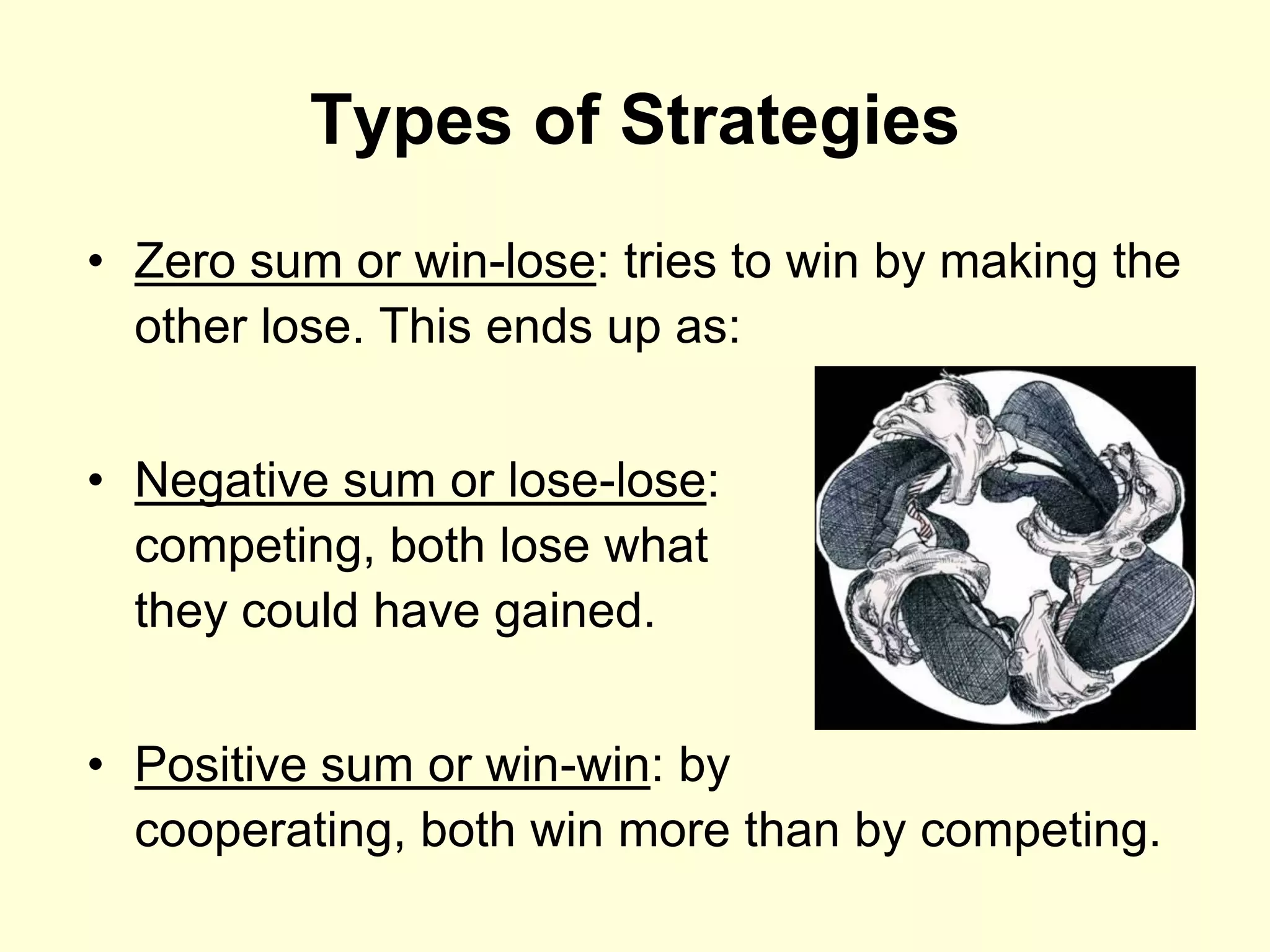
• Zero sum or win-lose: tries to win by making the
  other lose. This ends up as:


• Negative sum or lose-lose:                by
  competing, both lose what
  they could have gained.


• Positive sum or win-win: by
  cooperating, both win more than by competing.
Game Theory
• Models social relations as “games” for
  research with human subjects or with
  computer programs.
• Seeks to understand how and why people
  behave within these relations; and the best
  strategies for each situation.
• Conclusion: We need to reboot all the old
  models, approaches & structures of
  society, or risk paralysis or collapse.
Prisoner’s Dilemma
• 1950: Merrill Flood & Melvin Dreshner, RAND Corporation,
  created a 'game' for the simplest example of a 2-person
  social dilemma: when two people have a choice to
  cooperate or defect:
   – mutual defection brings a small benefit for both,
   – mutual cooperation brings a medium payoff for both, but
   – an unequal move has the most benefit for one and the least
     for the other.
• Alber Tucker, a mathematician, created a story to illustrate
  the game:
   – Two thieves are put in jail. Each is offered the chance to confess
     and shorten his sentence.
   – The one ratted on will get the full sentence. If neither rats on the
     other, both are set free.
The Story
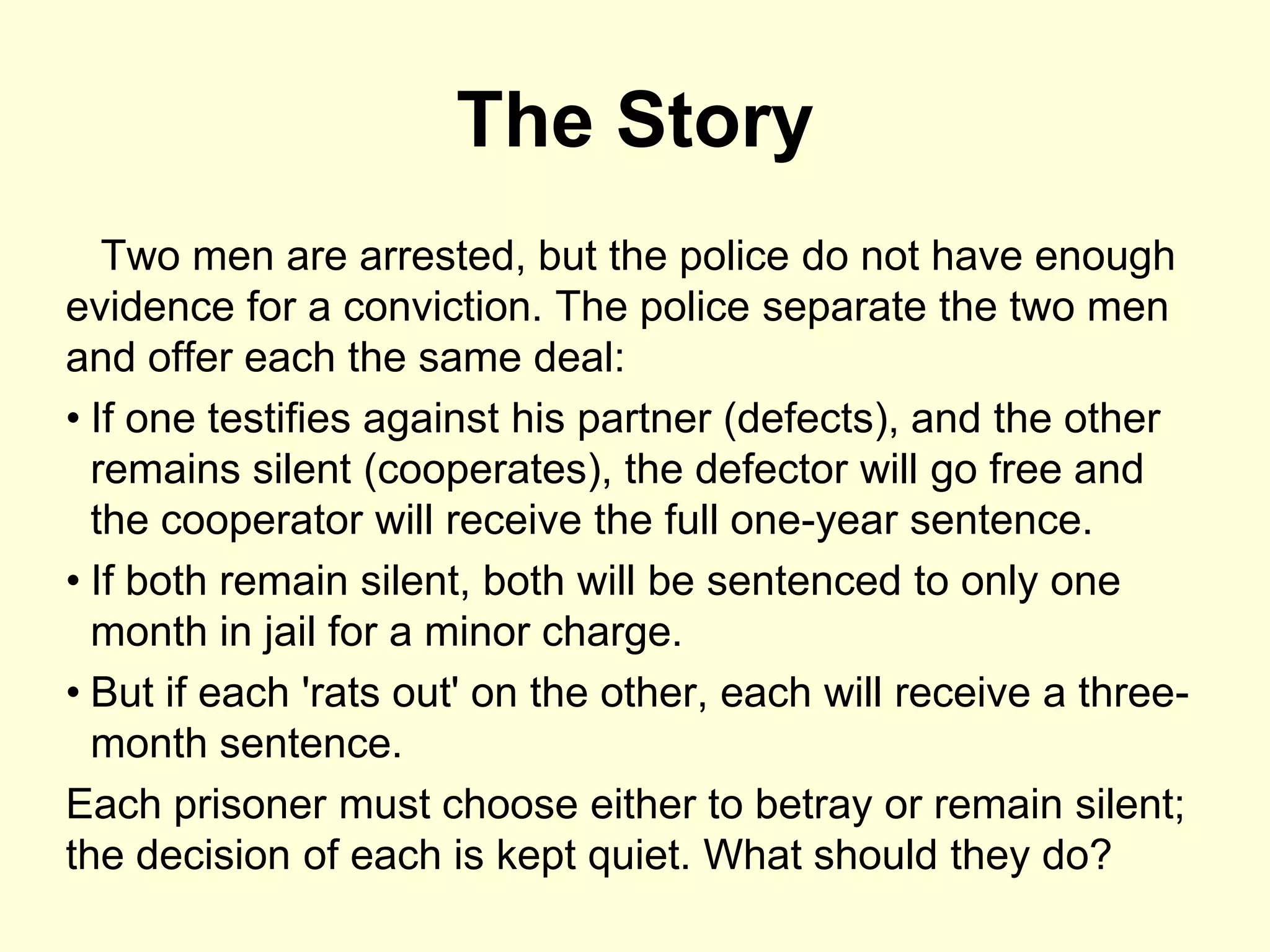
   Two men are arrested, but the police do not have enough
evidence for a conviction. The police separate the two men
and offer each the same deal:
• If one testifies against his partner (defects), and the other
  remains silent (cooperates), the defector will go free and
  the cooperator will receive the full one-year sentence.
• If both remain silent, both will be sentenced to only one
  month in jail for a minor charge.
• But if each 'rats out' on the other, each will receive a three-
  month sentence.
Each prisoner must choose either to betray or remain silent;
the decision of each is kept quiet. What should they do?
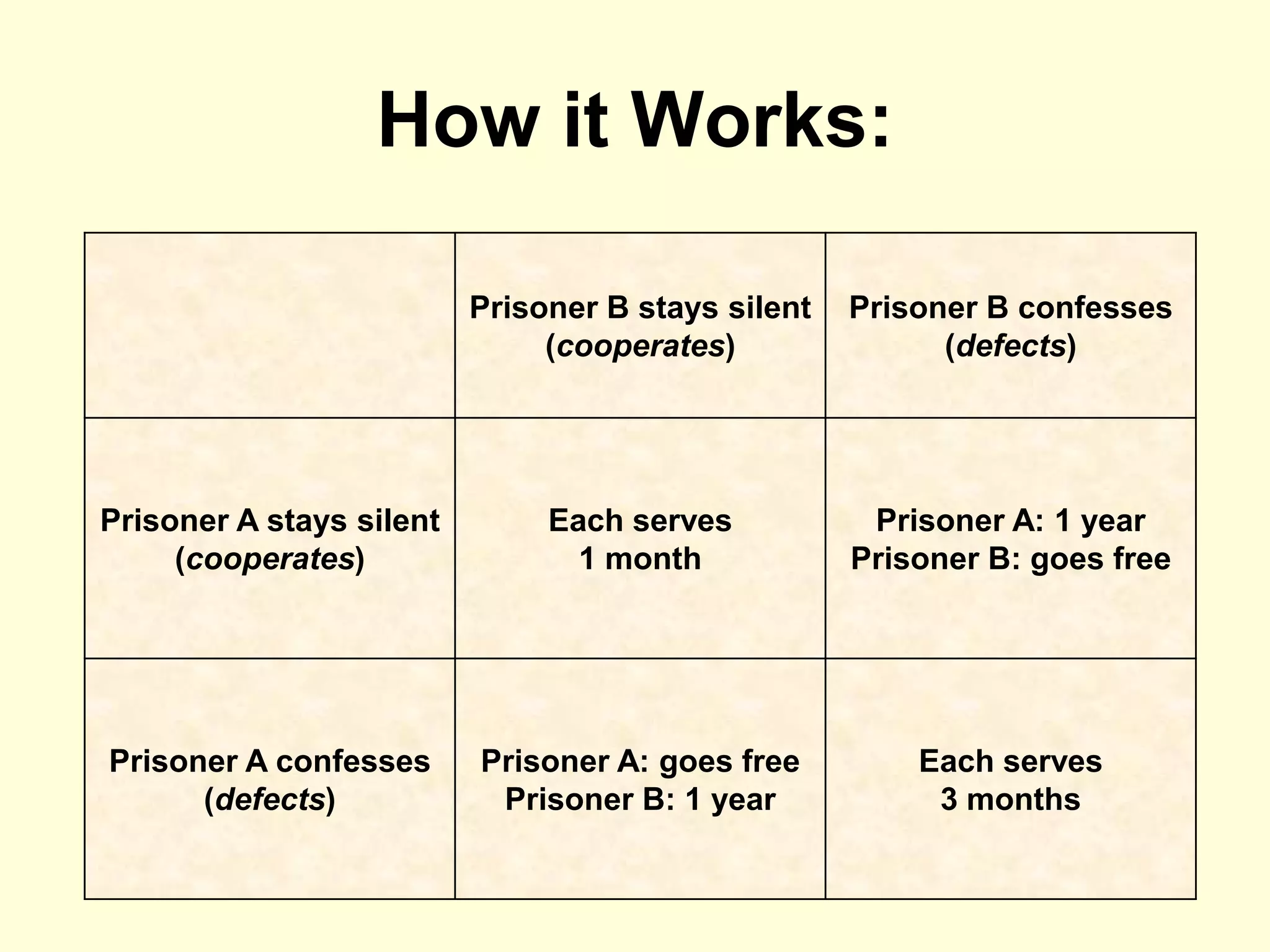
How it Works:

                          Prisoner B stays silent   Prisoner B confesses
                               (cooperates)               (defects)


Prisoner A stays silent        Each serves           Prisoner A: 1 year
     (cooperates)                1 month            Prisoner B: goes free


Prisoner A confesses      Prisoner A: goes free         Each serves
      (defects)            Prisoner B: 1 year            3 months
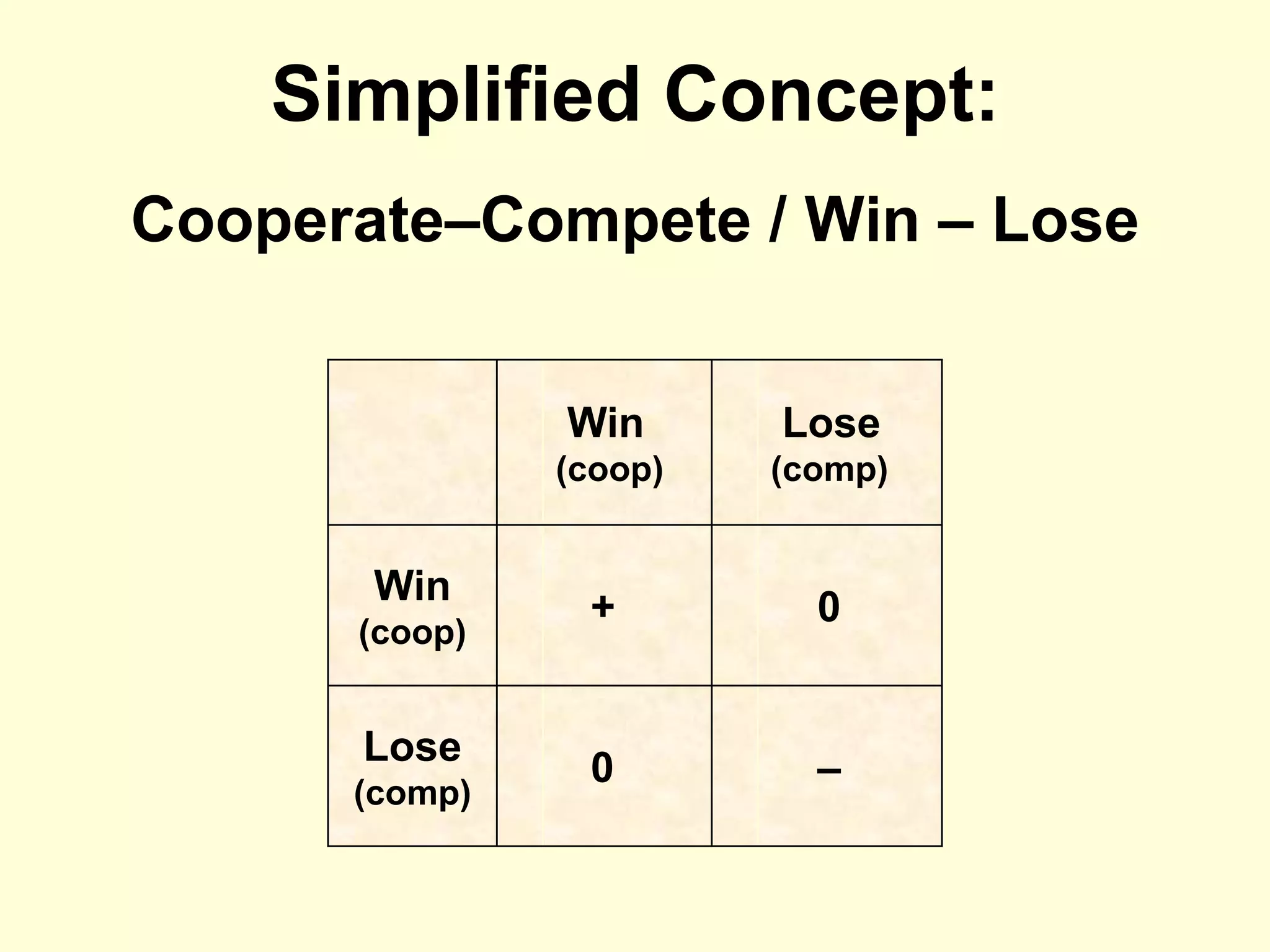
Simplified Concept:
Cooperate–Compete / Win – Lose


               Win      Lose
               (coop)   (comp)


       Win      +         0
      (coop)


      Lose
                0         –
      (comp)
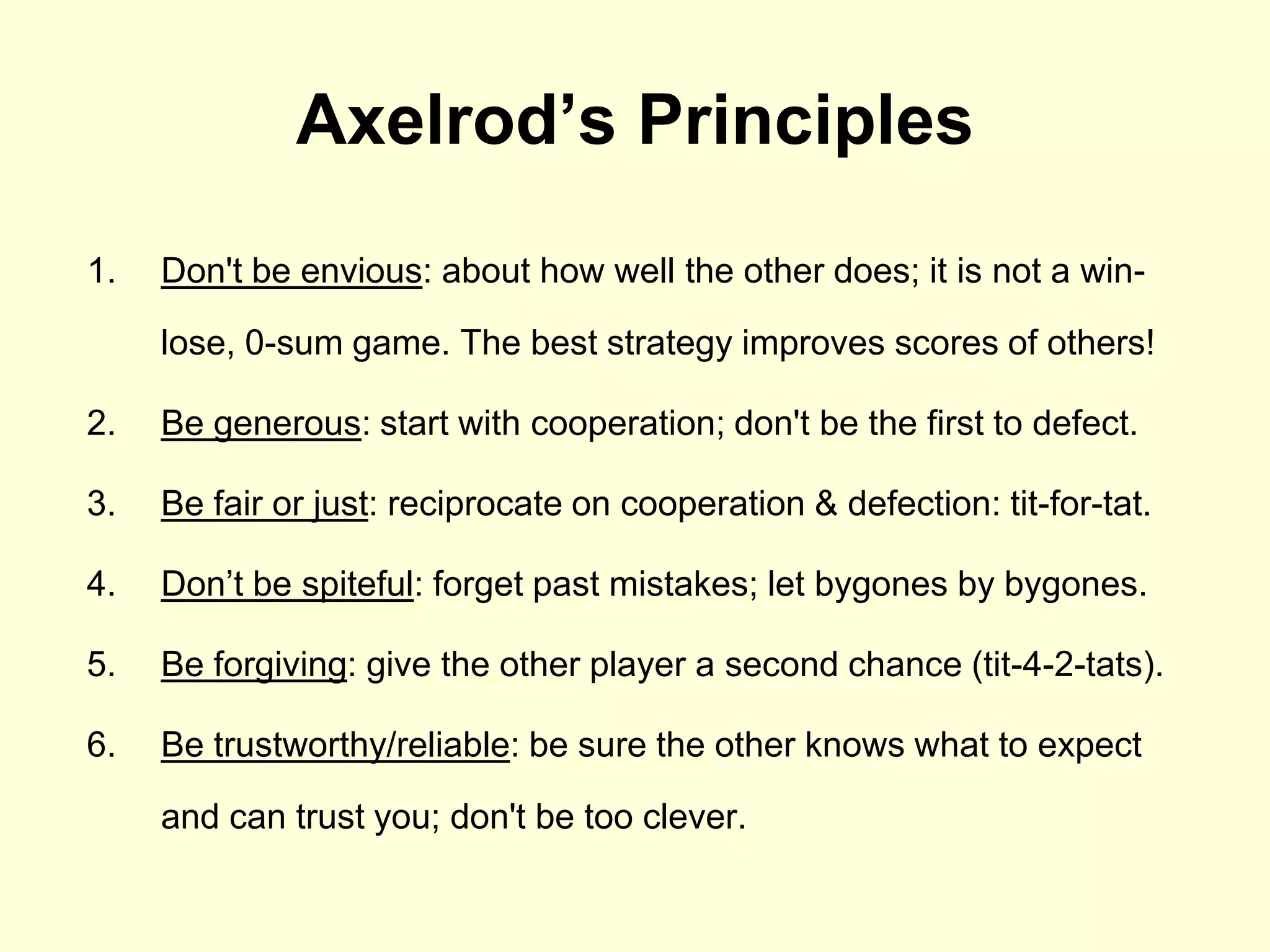
Axelrod’s Principles
1.   Don't be envious: about how well the other does; it is not a win-

     lose, 0-sum game. The best strategy improves scores of others!

2.   Be generous: start with cooperation; don't be the first to defect.

3.   Be fair or just: reciprocate on cooperation & defection: tit-for-tat.

4.   Don‟t be spiteful: forget past mistakes; let bygones by bygones.

5.   Be forgiving: give the other player a second chance (tit-4-2-tats).

6.   Be trustworthy/reliable: be sure the other knows what to expect

     and can trust you; don't be too clever.
Tragedy of the Commons
• Description: When people have unlimited access to
  common goods, they over-use and destroy them.
• History:
   – Early description by Aristotle in "Politics", Book II, Chapter 3.
   – Developed by Lloyd in "On the Checks to Population", 1832.
   – Made popular by Garrett Hardin in "Tragedy of the Commons,"
     Science, 162 (1968):1243-1248: "Freedom in the commons
     brings ruin to all." "Injustice is preferable to total ruin.“
   – Elinor Ostrom was awarded 2010 Nobel Prize in economics for
     demonstrating how people avoid or mitigate the tragedy of the
     commons by creating institutions for collective action.
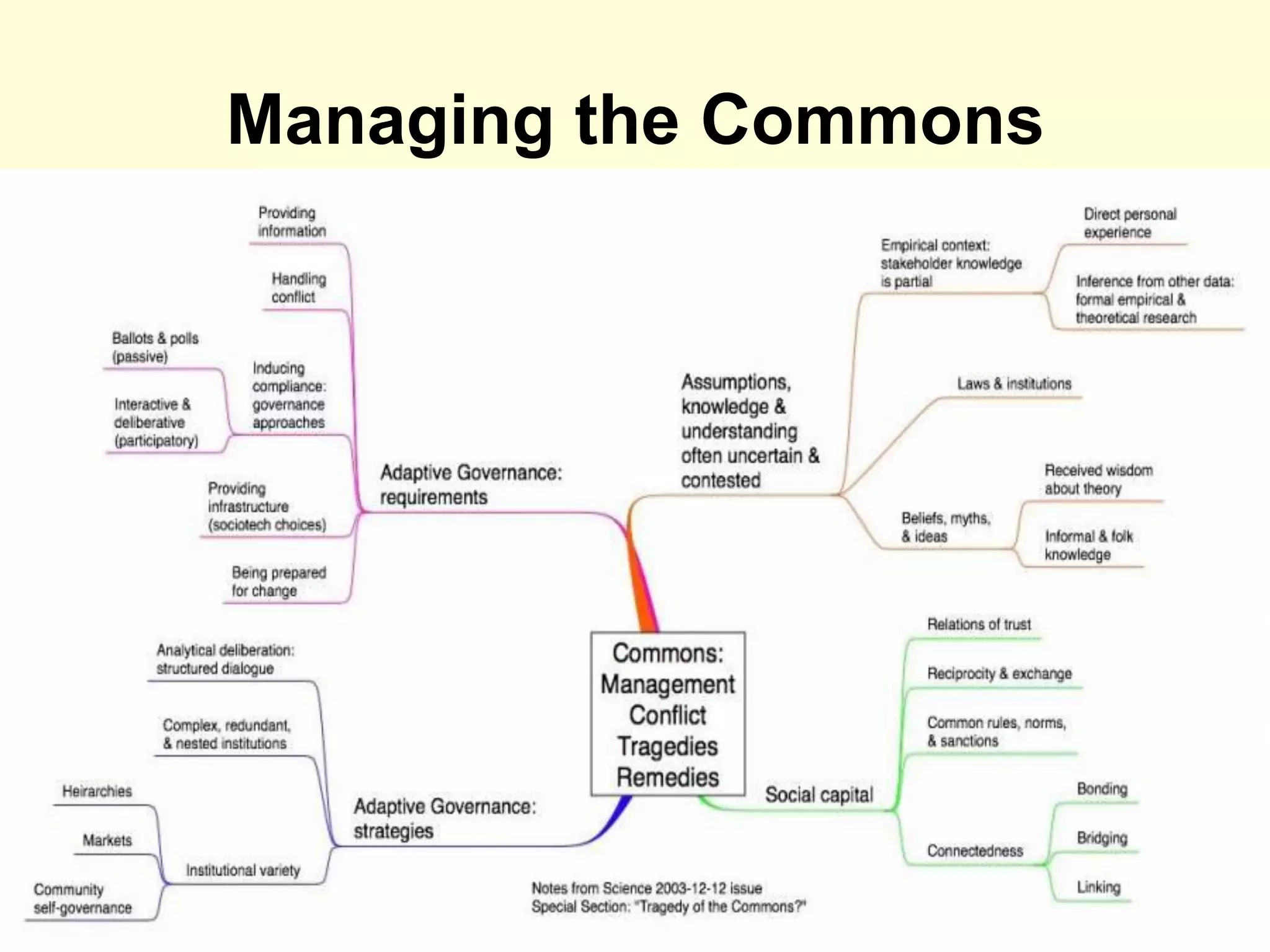
Managing the Commons
Ostrom’s Findings
• People are trapped by the Prisoner's Dilemma only if they
  treat themselves as prisoners by passively accepting the
  suboptimum strategy.
• Changing the rules of the game from 0-sum to non-0-sum
  may explain the arc of civilization for the past 8000 years.
• Social dilemmas of multiple dimensions are obstacles on
  the path to creating institutions for collective action.
• In comparing communities, Ostrom found that most groups
  that organize and govern their behavior successfully are
  marked by the same basic design principles:
Design Principles
• Group boundaries are clearly defined.
• Rules governing the use of collective goods are well
  matched to local needs and conditions.
• Those affected by rules can participate in modifying them.
• The rights of community members to devise their own
  rules is respected by external authorities.
• A system for monitoring member's behavior exists;
  community members undertake this monitoring.
• A graduated system of sanctions is used: soft to hard.
• Access to low-cost conflict resolution mechanisms.
• Appropriation, provision, monitoring, enforcement, conflict
  resolution, and governance activities are organized in
  multiple layers of nested enterprises.
Evolution of Cooperation
• Genetic Evolution
   – Lewontin: Cooperation is more adaptive than competition
   – Lynn Margulis: Evolution was primarily through symbiosis
   – Tomasello: Children begin cooperative, but adjust socially
• Strategic Evolution
   – Game theory, win/lose, prisoner‟s dilemma, etc.
   – Robert Axelrod: “The Evolution of Cooperation”
• Cultural Evolution
   – Hunter/gatherer era: The most cooperative and conciliatory
     people prevailed and prospered.
   – Agricultural era: Boundaries and private property changed
     mindset to win-lose (competition).
   – Knowledge era: The more I share with others, the more we
     all benefit, including myself. (William Ury, “The Third Side”)
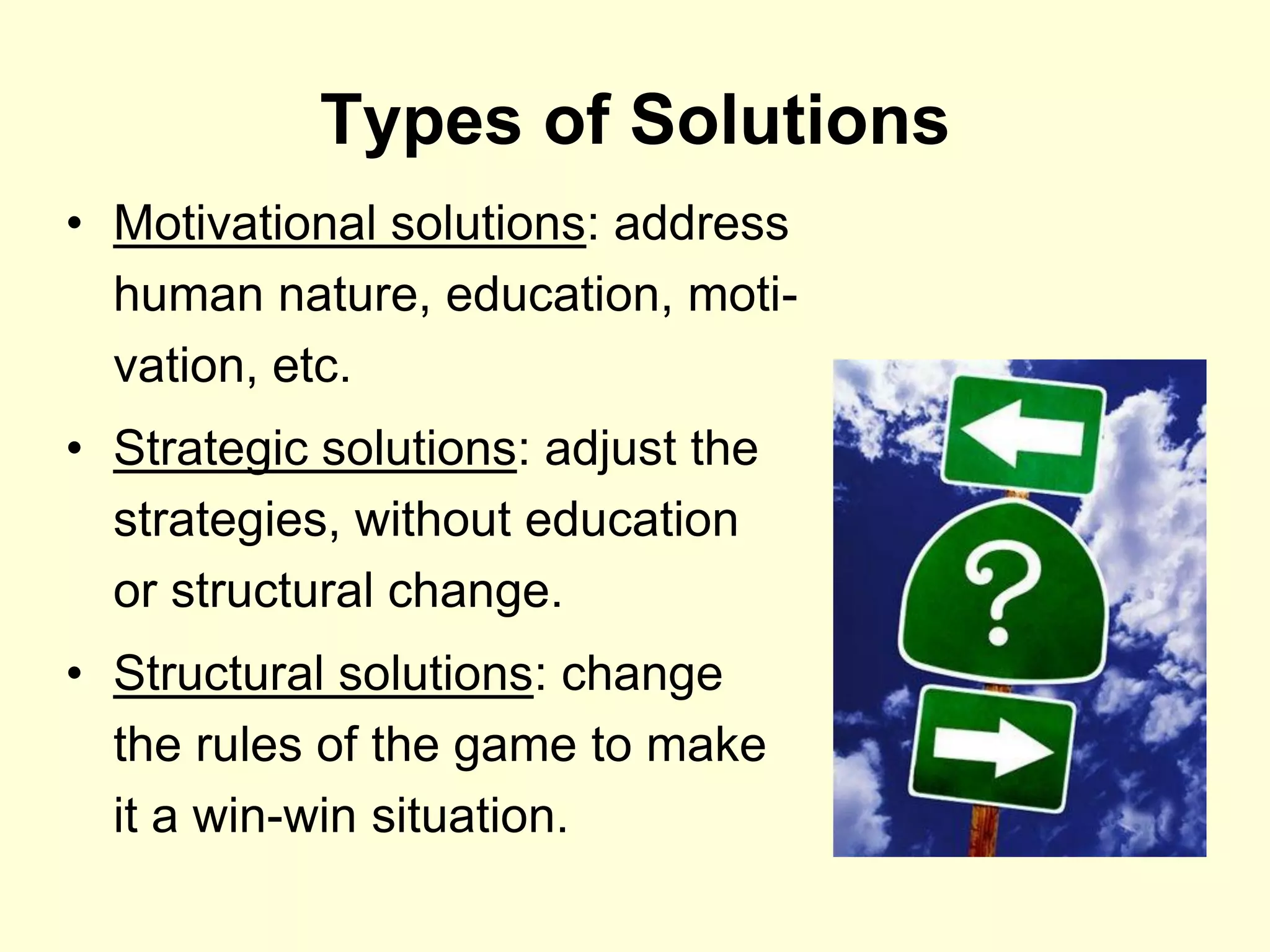
Types of Solutions
• Motivational solutions: address
  human nature, education, moti-
  vation, etc.
• Strategic solutions: adjust the
  strategies, without education
  or structural change.
• Structural solutions: change
  the rules of the game to make
  it a win-win situation.
Cooperation in Business
•   Cooperative Economics: political economy (Marxist, the „Third
    Way‟); religious (Christian, Islamic); African (Ujamaa)
•   Corporate values / principles / in strategic planning processes.
•   Teamwork in decision-making, administration and manufacture.
•   Coopetition or Coopertition: redefining competition in economics.
•   Corporate Social Responsibility: more than a corporate image?
•   Wikinomics / Macrowikinomics: “We need to reboot all the old
    models, approaches & structures, or risk paralysis or collapse.”
•   Social Entrepreneurship: attending to the “double bottom line”.
•   Etc.
Conclusions
• Competition (win-lose) leads to social dilemmas and collapse (lose-
  lose).
• Cooperation (win-win) leads to social progress for all (positive sum).
• Multidisciplinary study is needed and developing:
    – Sociology, anthropology, archeology
    – Biology, genetics, medicine
    – Economics, political science
    – Neurology, psychology, psychiatry
    – Mathematics, computer science
• “A formal theory of cooperation is increasingly needed.” “If the facts
  of cooperation theory are known by participants with foresight, the
  evolution of cooperation can be speeded up." (Axelrod)
Achieving unity and cooperation
“The profound and far-reaching changes, the
unity and unprecedented cooperation required to
reorient the world toward an environmentally
sustainable and just future, will only be possible
by touching the human spirit, by appealing to
those universal values which alone can empower
individuals and peoples to act in accordance with
the long-term interests of the planet and humanity
as a whole.”
                   (Earth Summit, NGO Statement, Río, 1992)
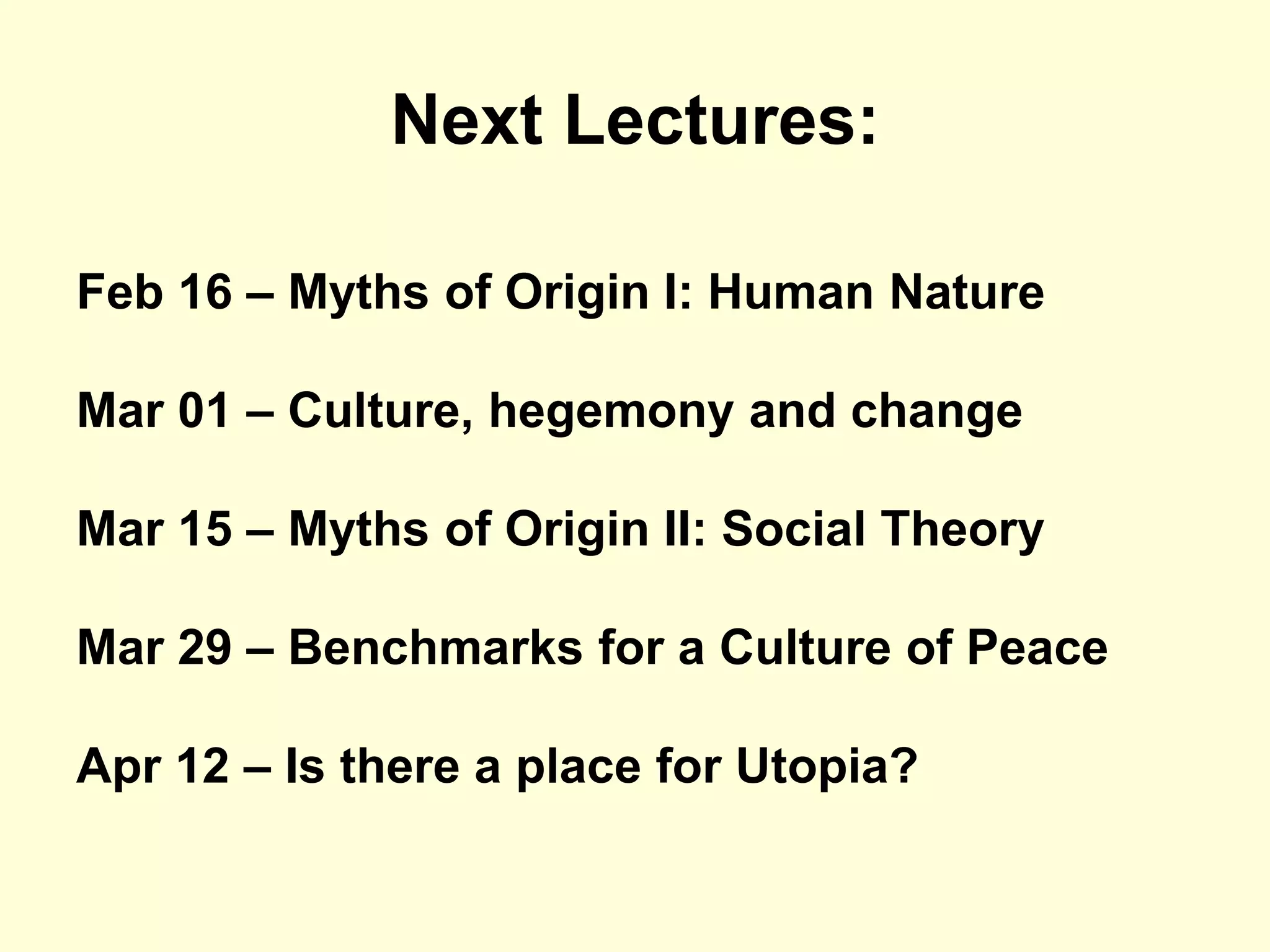
Next Lectures:

Feb 16 – Myths of Origin I: Human Nature

Mar 01 – Culture, hegemony and change

Mar 15 – Myths of Origin II: Social Theory

Mar 29 – Benchmarks for a Culture of Peace

Apr 12 – Is there a place for Utopia?
Thank you!

www.cultureofpeace.peternewton.biz

Cooperation theory

  • 1.
    Introduction to Cooperation Theory Catholic University of Quito Peter C. Newton-Evans February 2012
  • 2.
    The Money Game •Two players with envelopes receive 1 coin each. They can either: 1. Keep it and return the envelope empty (1 point) 2. Put it in the envelope for the other player, and the facilitator will add another coin to the contribution. • Facilitator hands the envelopes to each player. • The game repeats until all the coins are gone. • Goal: to accumulate as many coins as you can. • Note: The number of coins the other player gets will not affect your own performance.
  • 3.
    Game Results Player B Player B gives coin keeps coin Each receives Player A: 0 coins Player A 2 coins Player B: 3 coins gives coin (total 4) (Total 3) Player A: 3 coins Each keeps Player A Player B: 0 coins 1 coin keeps coin (Total 3) (total 2)
  • 4.
    Two facts, onequestion • Our social, political and economic structures and institutions based primarily on win-lose relationships or competition. • These structures and institutions are now increasingly failing. Why?
  • 5.
    Social Dilemmas • Wheneveryone acts as they are expected to according to the logic of the system, the dynamics inherent in the system's design will cause it to collapse: • "Situations in which individual rationality adds up to collective irrationality. That is, individually responsible behavior leads to a situation in which everyone is worse off than they might have been otherwise." (Peter Kollock) • "Situations that arise from the tension between self-interest and collective gain. Acting in one's self interest ends up damaging or failing to provide for the interests of everybody." (Howard Rheingold)
  • 6.
    Examples • Dyadic narrativestories: Prisoner's Dilemma, Assurance Game, Chicken, etc. • Multi-person narrative myths: providing public goods, tragedy of the commons, etc. • Social dilemmas in daily life: family life, busi- ness dealings, traffic jams, etc. • Institutionalized dilemmas: capitalist accumulation, party politics, national security system, etc.
  • 7.
    Types of Strategies •Zero sum or win-lose: tries to win by making the other lose. This ends up as: • Negative sum or lose-lose: by competing, both lose what they could have gained. • Positive sum or win-win: by cooperating, both win more than by competing.
  • 8.
    Game Theory • Modelssocial relations as “games” for research with human subjects or with computer programs. • Seeks to understand how and why people behave within these relations; and the best strategies for each situation. • Conclusion: We need to reboot all the old models, approaches & structures of society, or risk paralysis or collapse.
  • 9.
    Prisoner’s Dilemma • 1950:Merrill Flood & Melvin Dreshner, RAND Corporation, created a 'game' for the simplest example of a 2-person social dilemma: when two people have a choice to cooperate or defect: – mutual defection brings a small benefit for both, – mutual cooperation brings a medium payoff for both, but – an unequal move has the most benefit for one and the least for the other. • Alber Tucker, a mathematician, created a story to illustrate the game: – Two thieves are put in jail. Each is offered the chance to confess and shorten his sentence. – The one ratted on will get the full sentence. If neither rats on the other, both are set free.
  • 10.
    The Story Two men are arrested, but the police do not have enough evidence for a conviction. The police separate the two men and offer each the same deal: • If one testifies against his partner (defects), and the other remains silent (cooperates), the defector will go free and the cooperator will receive the full one-year sentence. • If both remain silent, both will be sentenced to only one month in jail for a minor charge. • But if each 'rats out' on the other, each will receive a three- month sentence. Each prisoner must choose either to betray or remain silent; the decision of each is kept quiet. What should they do?
  • 11.
    How it Works: Prisoner B stays silent Prisoner B confesses (cooperates) (defects) Prisoner A stays silent Each serves Prisoner A: 1 year (cooperates) 1 month Prisoner B: goes free Prisoner A confesses Prisoner A: goes free Each serves (defects) Prisoner B: 1 year 3 months
  • 12.
    Simplified Concept: Cooperate–Compete /Win – Lose Win Lose (coop) (comp) Win + 0 (coop) Lose 0 – (comp)
  • 13.
    Axelrod’s Principles 1. Don't be envious: about how well the other does; it is not a win- lose, 0-sum game. The best strategy improves scores of others! 2. Be generous: start with cooperation; don't be the first to defect. 3. Be fair or just: reciprocate on cooperation & defection: tit-for-tat. 4. Don‟t be spiteful: forget past mistakes; let bygones by bygones. 5. Be forgiving: give the other player a second chance (tit-4-2-tats). 6. Be trustworthy/reliable: be sure the other knows what to expect and can trust you; don't be too clever.
  • 14.
    Tragedy of theCommons • Description: When people have unlimited access to common goods, they over-use and destroy them. • History: – Early description by Aristotle in "Politics", Book II, Chapter 3. – Developed by Lloyd in "On the Checks to Population", 1832. – Made popular by Garrett Hardin in "Tragedy of the Commons," Science, 162 (1968):1243-1248: "Freedom in the commons brings ruin to all." "Injustice is preferable to total ruin.“ – Elinor Ostrom was awarded 2010 Nobel Prize in economics for demonstrating how people avoid or mitigate the tragedy of the commons by creating institutions for collective action.
  • 15.
  • 16.
    Ostrom’s Findings • Peopleare trapped by the Prisoner's Dilemma only if they treat themselves as prisoners by passively accepting the suboptimum strategy. • Changing the rules of the game from 0-sum to non-0-sum may explain the arc of civilization for the past 8000 years. • Social dilemmas of multiple dimensions are obstacles on the path to creating institutions for collective action. • In comparing communities, Ostrom found that most groups that organize and govern their behavior successfully are marked by the same basic design principles:
  • 17.
    Design Principles • Groupboundaries are clearly defined. • Rules governing the use of collective goods are well matched to local needs and conditions. • Those affected by rules can participate in modifying them. • The rights of community members to devise their own rules is respected by external authorities. • A system for monitoring member's behavior exists; community members undertake this monitoring. • A graduated system of sanctions is used: soft to hard. • Access to low-cost conflict resolution mechanisms. • Appropriation, provision, monitoring, enforcement, conflict resolution, and governance activities are organized in multiple layers of nested enterprises.
  • 18.
    Evolution of Cooperation •Genetic Evolution – Lewontin: Cooperation is more adaptive than competition – Lynn Margulis: Evolution was primarily through symbiosis – Tomasello: Children begin cooperative, but adjust socially • Strategic Evolution – Game theory, win/lose, prisoner‟s dilemma, etc. – Robert Axelrod: “The Evolution of Cooperation” • Cultural Evolution – Hunter/gatherer era: The most cooperative and conciliatory people prevailed and prospered. – Agricultural era: Boundaries and private property changed mindset to win-lose (competition). – Knowledge era: The more I share with others, the more we all benefit, including myself. (William Ury, “The Third Side”)
  • 19.
    Types of Solutions •Motivational solutions: address human nature, education, moti- vation, etc. • Strategic solutions: adjust the strategies, without education or structural change. • Structural solutions: change the rules of the game to make it a win-win situation.
  • 20.
    Cooperation in Business • Cooperative Economics: political economy (Marxist, the „Third Way‟); religious (Christian, Islamic); African (Ujamaa) • Corporate values / principles / in strategic planning processes. • Teamwork in decision-making, administration and manufacture. • Coopetition or Coopertition: redefining competition in economics. • Corporate Social Responsibility: more than a corporate image? • Wikinomics / Macrowikinomics: “We need to reboot all the old models, approaches & structures, or risk paralysis or collapse.” • Social Entrepreneurship: attending to the “double bottom line”. • Etc.
  • 21.
    Conclusions • Competition (win-lose)leads to social dilemmas and collapse (lose- lose). • Cooperation (win-win) leads to social progress for all (positive sum). • Multidisciplinary study is needed and developing: – Sociology, anthropology, archeology – Biology, genetics, medicine – Economics, political science – Neurology, psychology, psychiatry – Mathematics, computer science • “A formal theory of cooperation is increasingly needed.” “If the facts of cooperation theory are known by participants with foresight, the evolution of cooperation can be speeded up." (Axelrod)
  • 22.
    Achieving unity andcooperation “The profound and far-reaching changes, the unity and unprecedented cooperation required to reorient the world toward an environmentally sustainable and just future, will only be possible by touching the human spirit, by appealing to those universal values which alone can empower individuals and peoples to act in accordance with the long-term interests of the planet and humanity as a whole.” (Earth Summit, NGO Statement, Río, 1992)
  • 23.
    Next Lectures: Feb 16– Myths of Origin I: Human Nature Mar 01 – Culture, hegemony and change Mar 15 – Myths of Origin II: Social Theory Mar 29 – Benchmarks for a Culture of Peace Apr 12 – Is there a place for Utopia?
  • 24.