HOW INTERNET
WORKS ?
BY ANURAG KUMAR
12D173
Internet
• The Internet is a worldwide collection of computer networks, cooperating
with each other to exchange data using a common software standard.
• The Internet was created by the Advanced Research Projects Agency (ARPA)
and the U.S. Department of Defense for scientific and military
communications.
Internet
• Internet allows users to:
• connect easily through ordinary personal computers and local phone numbers;
• exchange electronic mail (E-mail) with friends and colleagues with accounts on the
Internet;
• post information for others to access, and update it frequently;
• access multimedia information that includes sound, photographic images and even
video; and
• access diverse perspectives from around the world.
How the Internet Works
• TCP/IP
• Routing Traffic Across the Internet
• Network Layers on Client & Server end
How the Internet Works - TCP/IP
• Every computer and network on the Internet uses the same protocols (rules
and procedures) to control timing and data format
• The protocol used by the Internet is the Transmission Control
Protocol/Internet Protocol, or TCP/IP.
• No matter what type of computer system you connect to the Internet, if it
uses TCP/IP, it can exchange data with any other type of computer.
How the Internet Works -
Routing Traffic Across the Internet
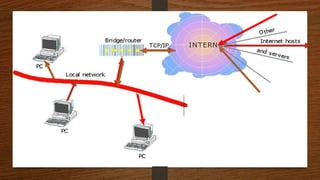
• Most computers don't connect directly to the Internet. Instead, they
connect to a smaller network that is connected to the Internet backbone.
• The Internet includes thousands of host computers (servers), which
provide data and services as requested by client systems.
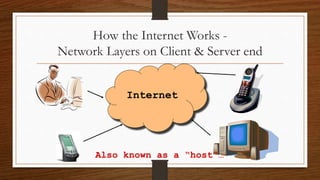
• When you use the Internet, your PC (a client) requests data from a host
system. The request and data are broken into packets and travel across
multiple networks before being reassembled at their destination.
How the Internet Works -
Network Layers on Client & Server end
Internet
Also known as a “host”…
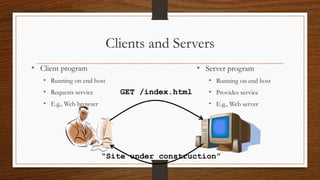
Clients and Servers
• Client program
• Running on end host
• Requests service
• E.g., Web browser
GET /index.html
Clients and Servers
• Client program
• Running on end host
• Requests service
• E.g., Web browser
• Server program
• Running on end host
• Provides service
• E.g., Web server
GET /index.html
“Site under construction”
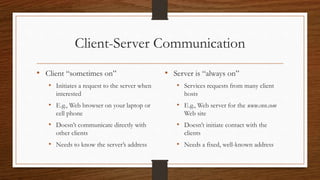
Client-Server Communication
• Client “sometimes on”
• Initiates a request to the server when
interested
• E.g., Web browser on your laptop or
cell phone
• Doesn’t communicate directly with
other clients
• Needs to know the server’s address
• Server is “always on”
• Services requests from many client
hosts
• E.g., Web server for the www.cnn.com
Web site
• Doesn’t initiate contact with the
clients
• Needs a fixed, well-known address
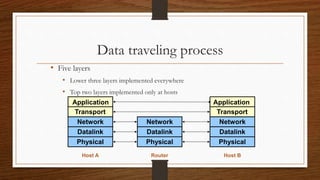
Data traveling process
• Five layers
• Lower three layers implemented everywhere
• Top two layers implemented only at hosts
Transport
Network
Datalink
Physical
Transport
Network
Datalink
Physical
Network
Datalink
Physical
Application Application
Host A Host BRouter
Logical Communication
• Layers interacts with peer’s corresponding layer
Transport
Network
Datalink
Physical
Transport
Network
Datalink
Physical
Network
Datalink
Physical
Application Application
Host A Host BRouter
Physical Communication
• Communication goes down to physical network
• Then from network peer to peer
• Then up to relevant layer
Transport
Network
Datalink
Physical
Transport
Network
Datalink
Physical
Network
Datalink
Physical
Application Application
Host A Host BRouter

How internet works

  • 1.
    HOW INTERNET WORKS ? BYANURAG KUMAR 12D173
  • 2.
    Internet • The Internetis a worldwide collection of computer networks, cooperating with each other to exchange data using a common software standard. • The Internet was created by the Advanced Research Projects Agency (ARPA) and the U.S. Department of Defense for scientific and military communications.
  • 3.
    Internet • Internet allowsusers to: • connect easily through ordinary personal computers and local phone numbers; • exchange electronic mail (E-mail) with friends and colleagues with accounts on the Internet; • post information for others to access, and update it frequently; • access multimedia information that includes sound, photographic images and even video; and • access diverse perspectives from around the world.
  • 4.
    How the InternetWorks • TCP/IP • Routing Traffic Across the Internet • Network Layers on Client & Server end
  • 5.
    How the InternetWorks - TCP/IP • Every computer and network on the Internet uses the same protocols (rules and procedures) to control timing and data format • The protocol used by the Internet is the Transmission Control Protocol/Internet Protocol, or TCP/IP. • No matter what type of computer system you connect to the Internet, if it uses TCP/IP, it can exchange data with any other type of computer.
  • 6.
    How the InternetWorks - Routing Traffic Across the Internet • Most computers don't connect directly to the Internet. Instead, they connect to a smaller network that is connected to the Internet backbone. • The Internet includes thousands of host computers (servers), which provide data and services as requested by client systems. • When you use the Internet, your PC (a client) requests data from a host system. The request and data are broken into packets and travel across multiple networks before being reassembled at their destination.
  • 8.
    How the InternetWorks - Network Layers on Client & Server end Internet Also known as a “host”…
  • 9.
    Clients and Servers •Client program • Running on end host • Requests service • E.g., Web browser GET /index.html
  • 10.
    Clients and Servers •Client program • Running on end host • Requests service • E.g., Web browser • Server program • Running on end host • Provides service • E.g., Web server GET /index.html “Site under construction”
  • 11.
    Client-Server Communication • Client“sometimes on” • Initiates a request to the server when interested • E.g., Web browser on your laptop or cell phone • Doesn’t communicate directly with other clients • Needs to know the server’s address • Server is “always on” • Services requests from many client hosts • E.g., Web server for the www.cnn.com Web site • Doesn’t initiate contact with the clients • Needs a fixed, well-known address
  • 12.
    Data traveling process •Five layers • Lower three layers implemented everywhere • Top two layers implemented only at hosts Transport Network Datalink Physical Transport Network Datalink Physical Network Datalink Physical Application Application Host A Host BRouter
  • 13.
    Logical Communication • Layersinteracts with peer’s corresponding layer Transport Network Datalink Physical Transport Network Datalink Physical Network Datalink Physical Application Application Host A Host BRouter
  • 14.
    Physical Communication • Communicationgoes down to physical network • Then from network peer to peer • Then up to relevant layer Transport Network Datalink Physical Transport Network Datalink Physical Network Datalink Physical Application Application Host A Host BRouter