SAS founded in 2013 in Paris | http://linkurio.us | @linkurious
Introduction to the
graph
technologies
landscape.
Introduction.
“At Linkurious we believe graph technologies can
have a powerful impact in the way we think about
data and turn it into new products. This small
report is meant to give you a glimpse into the
emerging graph ecosystem. May it inspire you to
join, use or launch graph projects.”
Sébastien Heymann
CEO of Linkurious
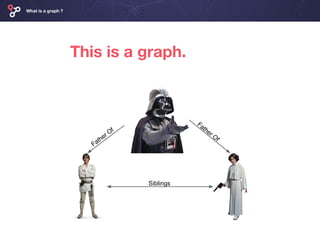
Father Of
Father Of
Siblings
What is a graph ?
This is a graph.
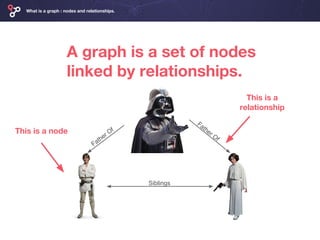
Father Of
Father Of
Siblings
This is a node
This is a
relationship
What is a graph ? / Nodes & relationshipsWhat is a graph : nodes and relationships.
A graph is a set of nodes
linked by relationships.
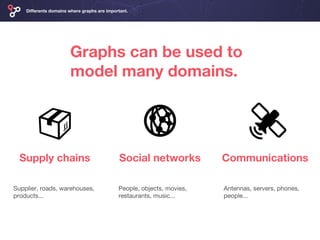
People, objects, movies,
restaurants, music...
Antennas, servers, phones,
people...
Supplier, roads, warehouses,
products...
Supply chains Social networks Communications
Differents domains where graphs are important.
Graphs can be used to
model many domains.
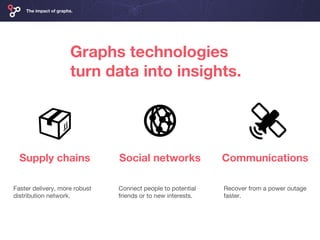
Connect people to potential
friends or to new interests.
Graphs technologies
turn data into insights.
Supply chains Social networks Communications
The impact of graphs.
Faster delivery, more robust
distribution network.
Recover from a power outage
faster.
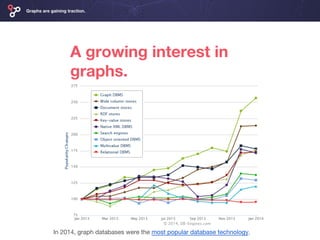
A growing interest in
graphs.
Graphs are gaining traction.
In 2014, graph databases were the most popular database technology.
Do you know the graph
landscape?
The graph technologies landscape.
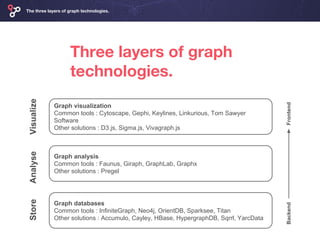
The three layers of graph technologies.
Graph visualization
Common tools : Cytoscape, Gephi, Keylines, Linkurious, Tom Sawyer
Software
Other solutions : D3.js, Sigma.js, Vivagraph.js
Graph analysis
Common tools : Faunus, Giraph, GraphLab, Graphx
Other solutions : Pregel
Graph databases
Common tools : InfiniteGraph, Neo4j, OrientDB, Sparksee, Titan
Other solutions : Accumulo, Cayley, HBase, HypergraphDB, Sqrrl, YarcData
Store
Three layers of graph
technologies.
Backend
VisualizeAnalyse
Frontend
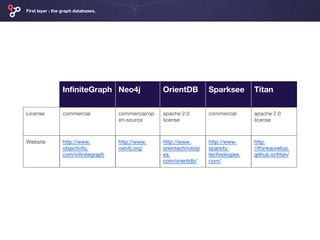
First layer : the graph databases.
InfiniteGraph Neo4j OrientDB Sparksee Titan
License commercial commercial/op
en-source
apache 2.0
license
commercial apache 2.0
license
Website http://www.
objectivity.
com/infinitegraph
http://www.
neo4j.org/
http://www.
orientechnologi
es.
com/orientdb/
http://www.
sparsity-
technologies.
com/
http:
//thinkaurelius.
github.io/titan/
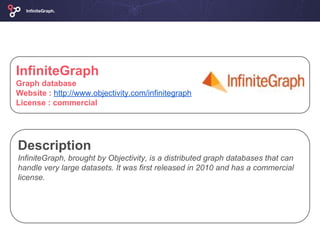
InfiniteGraph
Graph database
Website : http://www.objectivity.com/infinitegraph
License : commercial
InfiniteGraph.
Description
InfiniteGraph, brought by Objectivity, is a distributed graph databases that can
handle very large datasets. It was first released in 2010 and has a commercial
license.
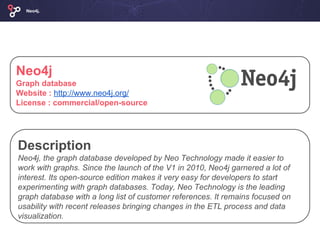
Neo4j
Graph database
Website : http://www.neo4j.org/
License : commercial/open-source
Neo4j.
Description
Neo4j, the graph database developed by Neo Technology made it easier to
work with graphs. Since the launch of the V1 in 2010, Neo4j garnered a lot of
interest. Its open-source edition makes it very easy for developers to start
experimenting with graph databases. Today, Neo Technology is the leading
graph database with a long list of customer references. It remains focused on
usability with recent releases bringing changes in the ETL process and data
visualization.
Description
OrientDB is an Open Source database with the features of both Document and
Graph databases. OrientDB is written completely in Java and can run on any
platform without configuration and installation.
OrientDB
Graph database
Website : http://www.orientechnologies.com/orientdb/
License : Apache 2.0 license
OrientDB.
Description
Sparksee (formerly known as DEX) is a proprietary graph database built for
performance. It has a small footprint, is natively available for .Net, C++, Python
and Java. Sparksee mobile is the first graph database available for iOS and
Android.
Sparksee
Graph database
Website : http://www.sparsity-technologies.com/
License : commercial
Sparksee.
Description
Titan, an other open-source project has been gaining a lot of attention lately.
Though still in early stage, Titan is an ambitious project. It is a distributed graph
database built to store and query graphs in the hundreds of billions of vertices
and edges.
Titan
Graph database
Website : http://thinkaurelius.github.io/titan/
License : Apache 2.0 license
Titan.
A growing need to store
large graphs.
Key tendencies for graph databases.
Here are a few key tendencies for graph databases :
● graph databases are still a small niche within the NoSQL space but they are coming into
their own ;
● choose the right graph database for your particular use case ;
● other big data solutions are sometimes used to store large graphs : Accumulo, HBase ;
● there exist a few integrated products that mix storage capabilities and advanced
functionalities : Sqrrl, YarcData ;
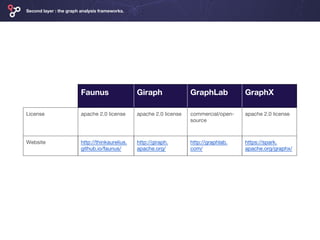
Faunus Giraph GraphLab GraphX
License apache 2.0 license apache 2.0 license commercial/open-
source
apache 2.0 license
Website http://thinkaurelius.
github.io/faunus/
http://giraph.
apache.org/
http://graphlab.
com/
https://spark.
apache.org/graphx/
Second layer : the graph analysis frameworks.
Description
The team behind the Titan graph database has also released Faunus. Faunus is
a Hadoop-based graph analytics engine for analyzing graphs represented
across a multi-machine compute cluster. It is compatible with HBase,
Cassandra or Hadoop.
Faunus.
Faunus
Graph analysis
Website : http://thinkaurelius.github.io/faunus/
License : Apache 2.0 license
Description
Giraph, the Apache project, is an iterative graph processing system built for high
scalability. It is currently used at Facebook to power its famous Graph Search.
At Facebook, Giraph can process a graph with trillions of connections between
people, places, likes and interests in minutes. It is compatible with Hadoop.
Giraph.
Giraph
Graph analysis
Website : http://giraph.apache.org/
License : Apache 2.0 license
Description
People interested in Machine Learning can turn to GraphLab to analyse their
graph data. GraphLab was started as an open-source project by Prof. Carlos
Guestrin of Carnegie Mellon University in 2009. Recently it has evolved in a
data science toolbox but remains very useful for graph analytics.
GaphLab.
GraphLab
Graph analysis
Website : http://graphlab.com/
License : Commercial/Open-source
Description
Another popular solution for graph computing is Graphx. It is integrated to
Apache Spark, an open-source data analytics cluster computing framework.
GraphX has a built in library of algorithms and include ETL functionalities. It
doesn’t offer the same performances as Giraph but is easier to use.
GraphX.
GraphX
Graph analysis
Website : https://spark.apache.org/graphx/
License : Apache 2.0 license
Graph computation is part
of the big data toolset.
Here are a few key tendencies for the graph analysis frameworks :
● most graph databases have their own query language (ex : Cypher for Neo4j and Faunus
for Titan ) ;
● GraphX and Giraph are bringing graph paradigms to HBase, Cassandra and Hadoop ;
● GraphBuilder, an Intel project can help transform tabular data into graphs ;
Key tendencies for graph analysis frameworks.
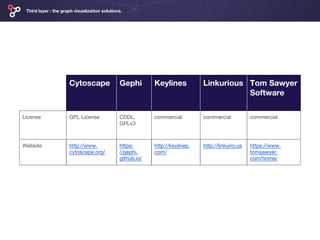
Third layer : the graph visualization solutions.
Cytoscape Gephi Keylines Linkurious Tom Sawyer
Software
License GPL License CDDL,
GPLv3
commercial commercial commercial
Website http://www.
cytoscape.org/
https:
//gephi.
github.io/
http://keylines.
com/
http://linkurio.us https://www.
tomsawyer.
com/home/
Description
Another graph visualization solution is Cytoscape. Mostly used by biologists at
first, it has progressively evolved in a general platform for complex network
analysis and visualization. It is desktop-based and is supported by a large
community.
Cytoscape.
Cytoscape
Graph visualization
Website : http://www.cytoscape.org/
License : GPL License
Gephi.
Gephi
Graph visualization
Website : https://gephi.github.io/
License : CDDL, GPLv3
Description
Gephi has played a key role in this process. It is an open-source graph
visualization solution. It packs a powerful set of SNA algorithms and
visualization options. Used by a wide community of scientists and data
scientists, it is akin to a “Photoshop for graphs”.
Description
KeyLines is a software library for graph visualization. Developed by Cambridge
Intelligence, it is designed to help developers create interactive web applications
around graphs.
Keylines.
Keylines
Graph visualization
Website : http://keylines.com/
License : commercial
Description
Graph visualization is going beyond the world of scientists. Linkurious is a
commercial graph visualization solution that aims to democratize graph
visualization. Its interface is designed for the interactive exploration of large
graphs and comes directly with features common in traditional business
intelligence applications (security, user management, etc).
Linkurious.
Linkurious
Graph visualization
Website : http://linkurio.us
License : commercial
Description
Tom Sawyer Software sells a collection of software development kits for graph
visualization and analysis. Its products are used by established companies like
NASA and Oracle. It is compatible with ActiveX, C++, Java, and .NET.
Tom Sawyer Software.
Tom Sawyer Software
Graph visualization
Website : https://www.tomsawyer.com/home/
License : commercial
Here are a few key tendencies for graph databases :
● traditional graph visualization solutions were targeted at developers and data scientists :
Cytoscape, Gephi ;
● companies like Cambridge Intelligence and Linkurious are making graphs easier to
understand for business people, not just data scientists ;
● a few projects try to integrate the different layers of the graph technologies into complete
products : Dendrite, Linkurious, Tom Sawyer Software ;
Graph visualization
moving to the enterprise.
Key tendencies for graph visualization solutions.
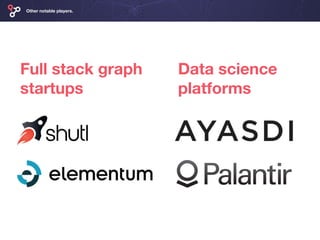
Other notable players.
Full stack graph
startups
Data science
platforms
Contact us to discuss your projects
at contact@linkurio.us
Conclusion

Introduction to the graph technologies landscape

  • 1.
    SAS founded in2013 in Paris | http://linkurio.us | @linkurious Introduction to the graph technologies landscape.
  • 2.
    Introduction. “At Linkurious webelieve graph technologies can have a powerful impact in the way we think about data and turn it into new products. This small report is meant to give you a glimpse into the emerging graph ecosystem. May it inspire you to join, use or launch graph projects.” Sébastien Heymann CEO of Linkurious
  • 3.
    Father Of Father Of Siblings Whatis a graph ? This is a graph.
  • 4.
    Father Of Father Of Siblings Thisis a node This is a relationship What is a graph ? / Nodes & relationshipsWhat is a graph : nodes and relationships. A graph is a set of nodes linked by relationships.
  • 5.
    People, objects, movies, restaurants,music... Antennas, servers, phones, people... Supplier, roads, warehouses, products... Supply chains Social networks Communications Differents domains where graphs are important. Graphs can be used to model many domains.
  • 6.
    Connect people topotential friends or to new interests. Graphs technologies turn data into insights. Supply chains Social networks Communications The impact of graphs. Faster delivery, more robust distribution network. Recover from a power outage faster.
  • 7.
    A growing interestin graphs. Graphs are gaining traction. In 2014, graph databases were the most popular database technology.
  • 8.
    Do you knowthe graph landscape? The graph technologies landscape.
  • 9.
    The three layersof graph technologies. Graph visualization Common tools : Cytoscape, Gephi, Keylines, Linkurious, Tom Sawyer Software Other solutions : D3.js, Sigma.js, Vivagraph.js Graph analysis Common tools : Faunus, Giraph, GraphLab, Graphx Other solutions : Pregel Graph databases Common tools : InfiniteGraph, Neo4j, OrientDB, Sparksee, Titan Other solutions : Accumulo, Cayley, HBase, HypergraphDB, Sqrrl, YarcData Store Three layers of graph technologies. Backend VisualizeAnalyse Frontend
  • 10.
    First layer :the graph databases. InfiniteGraph Neo4j OrientDB Sparksee Titan License commercial commercial/op en-source apache 2.0 license commercial apache 2.0 license Website http://www. objectivity. com/infinitegraph http://www. neo4j.org/ http://www. orientechnologi es. com/orientdb/ http://www. sparsity- technologies. com/ http: //thinkaurelius. github.io/titan/
  • 11.
    InfiniteGraph Graph database Website :http://www.objectivity.com/infinitegraph License : commercial InfiniteGraph. Description InfiniteGraph, brought by Objectivity, is a distributed graph databases that can handle very large datasets. It was first released in 2010 and has a commercial license.
  • 12.
    Neo4j Graph database Website :http://www.neo4j.org/ License : commercial/open-source Neo4j. Description Neo4j, the graph database developed by Neo Technology made it easier to work with graphs. Since the launch of the V1 in 2010, Neo4j garnered a lot of interest. Its open-source edition makes it very easy for developers to start experimenting with graph databases. Today, Neo Technology is the leading graph database with a long list of customer references. It remains focused on usability with recent releases bringing changes in the ETL process and data visualization.
  • 13.
    Description OrientDB is anOpen Source database with the features of both Document and Graph databases. OrientDB is written completely in Java and can run on any platform without configuration and installation. OrientDB Graph database Website : http://www.orientechnologies.com/orientdb/ License : Apache 2.0 license OrientDB.
  • 14.
    Description Sparksee (formerly knownas DEX) is a proprietary graph database built for performance. It has a small footprint, is natively available for .Net, C++, Python and Java. Sparksee mobile is the first graph database available for iOS and Android. Sparksee Graph database Website : http://www.sparsity-technologies.com/ License : commercial Sparksee.
  • 15.
    Description Titan, an otheropen-source project has been gaining a lot of attention lately. Though still in early stage, Titan is an ambitious project. It is a distributed graph database built to store and query graphs in the hundreds of billions of vertices and edges. Titan Graph database Website : http://thinkaurelius.github.io/titan/ License : Apache 2.0 license Titan.
  • 16.
    A growing needto store large graphs. Key tendencies for graph databases. Here are a few key tendencies for graph databases : ● graph databases are still a small niche within the NoSQL space but they are coming into their own ; ● choose the right graph database for your particular use case ; ● other big data solutions are sometimes used to store large graphs : Accumulo, HBase ; ● there exist a few integrated products that mix storage capabilities and advanced functionalities : Sqrrl, YarcData ;
  • 17.
    Faunus Giraph GraphLabGraphX License apache 2.0 license apache 2.0 license commercial/open- source apache 2.0 license Website http://thinkaurelius. github.io/faunus/ http://giraph. apache.org/ http://graphlab. com/ https://spark. apache.org/graphx/ Second layer : the graph analysis frameworks.
  • 18.
    Description The team behindthe Titan graph database has also released Faunus. Faunus is a Hadoop-based graph analytics engine for analyzing graphs represented across a multi-machine compute cluster. It is compatible with HBase, Cassandra or Hadoop. Faunus. Faunus Graph analysis Website : http://thinkaurelius.github.io/faunus/ License : Apache 2.0 license
  • 19.
    Description Giraph, the Apacheproject, is an iterative graph processing system built for high scalability. It is currently used at Facebook to power its famous Graph Search. At Facebook, Giraph can process a graph with trillions of connections between people, places, likes and interests in minutes. It is compatible with Hadoop. Giraph. Giraph Graph analysis Website : http://giraph.apache.org/ License : Apache 2.0 license
  • 20.
    Description People interested inMachine Learning can turn to GraphLab to analyse their graph data. GraphLab was started as an open-source project by Prof. Carlos Guestrin of Carnegie Mellon University in 2009. Recently it has evolved in a data science toolbox but remains very useful for graph analytics. GaphLab. GraphLab Graph analysis Website : http://graphlab.com/ License : Commercial/Open-source
  • 21.
    Description Another popular solutionfor graph computing is Graphx. It is integrated to Apache Spark, an open-source data analytics cluster computing framework. GraphX has a built in library of algorithms and include ETL functionalities. It doesn’t offer the same performances as Giraph but is easier to use. GraphX. GraphX Graph analysis Website : https://spark.apache.org/graphx/ License : Apache 2.0 license
  • 22.
    Graph computation ispart of the big data toolset. Here are a few key tendencies for the graph analysis frameworks : ● most graph databases have their own query language (ex : Cypher for Neo4j and Faunus for Titan ) ; ● GraphX and Giraph are bringing graph paradigms to HBase, Cassandra and Hadoop ; ● GraphBuilder, an Intel project can help transform tabular data into graphs ; Key tendencies for graph analysis frameworks.
  • 23.
    Third layer :the graph visualization solutions. Cytoscape Gephi Keylines Linkurious Tom Sawyer Software License GPL License CDDL, GPLv3 commercial commercial commercial Website http://www. cytoscape.org/ https: //gephi. github.io/ http://keylines. com/ http://linkurio.us https://www. tomsawyer. com/home/
  • 24.
    Description Another graph visualizationsolution is Cytoscape. Mostly used by biologists at first, it has progressively evolved in a general platform for complex network analysis and visualization. It is desktop-based and is supported by a large community. Cytoscape. Cytoscape Graph visualization Website : http://www.cytoscape.org/ License : GPL License
  • 25.
    Gephi. Gephi Graph visualization Website :https://gephi.github.io/ License : CDDL, GPLv3 Description Gephi has played a key role in this process. It is an open-source graph visualization solution. It packs a powerful set of SNA algorithms and visualization options. Used by a wide community of scientists and data scientists, it is akin to a “Photoshop for graphs”.
  • 26.
    Description KeyLines is asoftware library for graph visualization. Developed by Cambridge Intelligence, it is designed to help developers create interactive web applications around graphs. Keylines. Keylines Graph visualization Website : http://keylines.com/ License : commercial
  • 27.
    Description Graph visualization isgoing beyond the world of scientists. Linkurious is a commercial graph visualization solution that aims to democratize graph visualization. Its interface is designed for the interactive exploration of large graphs and comes directly with features common in traditional business intelligence applications (security, user management, etc). Linkurious. Linkurious Graph visualization Website : http://linkurio.us License : commercial
  • 28.
    Description Tom Sawyer Softwaresells a collection of software development kits for graph visualization and analysis. Its products are used by established companies like NASA and Oracle. It is compatible with ActiveX, C++, Java, and .NET. Tom Sawyer Software. Tom Sawyer Software Graph visualization Website : https://www.tomsawyer.com/home/ License : commercial
  • 29.
    Here are afew key tendencies for graph databases : ● traditional graph visualization solutions were targeted at developers and data scientists : Cytoscape, Gephi ; ● companies like Cambridge Intelligence and Linkurious are making graphs easier to understand for business people, not just data scientists ; ● a few projects try to integrate the different layers of the graph technologies into complete products : Dendrite, Linkurious, Tom Sawyer Software ; Graph visualization moving to the enterprise. Key tendencies for graph visualization solutions.
  • 30.
    Other notable players. Fullstack graph startups Data science platforms
  • 31.
    Contact us todiscuss your projects at contact@linkurio.us Conclusion