SAS founded in 2013 in Paris | http://linkurio.us | @linkurious
Graph-based Product
Lifecycle Management
Graph visualization and analysis
startup founded in 2013.
40+ clients in 20+ countries (NASA,
Cisco, French Ministry of Finances).
Linkurious Enterprise and Linkurious
SDK.
About Linkurious
What is graph technology?
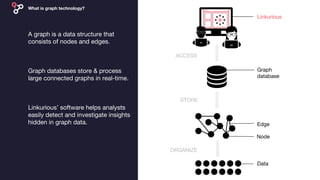
A graph is a data structure that
consists of nodes and edges.
Graph databases store & process
large connected graphs in real-time.
Linkurious’ software helps analysts
easily detect and investigate insights
hidden in graph data.
Node
STORE
ACCESS
Data
Graph
database
Linkurious
ORGANIZE
Edge
Some use cases
Cyber-security
Servers, switches, routers,
applications, etc.
Suspicious activity patterns,
identify impact of a compromised
asset.
IT Operations
Servers, switches, routers,
applications, etc.
Impact analysis, root cause
analysis.
Intelligence
People, emails, transactions,
phone call records, social.
Detecting and investigating
criminal or terrorist networks.
AML
People, transactions, watch-lists,
companies, organizations.
Detecting suspicious
transactions, identify beneficiary
owners.
Fraud
Claims, people, financial records,
personal data.
Detecting and investigating
criminal networks.
Life Sciences
Proteins, publications,
researchers, patents, topics.
Understanding protein
interactions, new drugs.
Enterprise
Architecture
Servers, applications, metadata,
business objectives.
Data lineage, curating enterprise
architecture.
Product Lifecycle
Management (PLM)
is the process of
managing the entire
lifecycle of a product
from design stage to
development to
go-to-market to
retirement to
disposal.
Quality & Compliance
management
Requirement
management
Manufacturing process
management
Maintenance & repair
management
Source and supply chain
management
Portfolio
management
Document
management
Component
management
Configuration/BOM
management
Classification
management
Workflow/Process
management
Change
management
The stakes of PLM
↗ Productivity
↗ Product quality
↘ Costs
↘ Risks
The field of PLM technology today
Existing PLM systems rely on
RDBMS.
Siloed data, inability to model
real-life complexities and to adapt to
changes.
Performance issues with multi-level
queries (impact analysis).
id: b8953
t$:v52
id: b8953
t$:b88
Components
id: b8953
Bike
Product
t$: v52
t$: b88
Jaycon
Blueline
Sub-components
Limitations of the relational approach
Inability to scale data model without
costs and risks as business evolves.
Searching for information is
time-consuming, 12-30% of
engineer’s time.
Missing insights regarding
dependencies leads to poor decisions
and increases risks.
The advantages of graph technology for PLM
Process changes
quickly
Graph technology are more
flexible and scalable than
relational technology and let
you adapt to change.
Reduce search
time
Easily and quickly find
information from large
datasets with interactive
graph data visualizations.
Access hidden insights
about dependencies
Don’t miss any of the
complex dependencies
between elements even on
multiple levels.
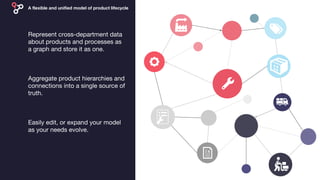
Represent cross-department data
about products and processes as
a graph and store it as one.
Aggregate product hierarchies and
connections into a single source of
truth.
Easily edit, or expand your model
as your needs evolve.
A flexible and unified model of product lifecycle
Save time by searching and
exploring your data through
interactive visualizations.
Filter visualizations to work on
specific elements or specific
sections of the data.
Visually track dependencies between
entities and get contextual insights.
Access hidden insights with graph visualization
Demo: PLM with Linkurious.
- Modeling your product data as a graph
- Visualizing your data in Linkurious Enterprise
- Running impact analysis
Modeling multi-level BOM data into a graph.
Exploring component hierarchy and interdependencies in Linkurious Enterprise
Finding patterns of components counting more than 9 dependencies to subcomponents
Load data into one of the graph or
RDF DB supported by Linkurious:
Neo4j, DataStax, Titan, AllegroGraph.
Windows / Linux / Mac, on-premise
or in the cloud, supports all modern
browsers.
Use Linkurious Enterprise
off-the-shelf interface or build your
custom application with Linkurious
SDK.
How it works.
DMS or DBMS
Synchronize
automatically
ERP (SAP, Oracle
Applications, IFS
Applications…)
Graph DB (Neo4j,
AllegroGraph,
Titan, DataStax..)
Background
International vehicle manufacturer.
Problem
Complex products with many
subcomponents make it hard to
conduct change management.
Benefit
Graph approach breaks silos and
enables easy impact analysis.
Project planning and impact analysis (confidential).
Background
International industrial
manufacturer.
Problem
Numerous BOMs to keep track of.
Hard to understand dependencies
between components.
Benefit
Visualization helps communicate
complex results and drive action.
BOM & component management (confidential).
Our partners
Questions?
www.linkurio.us
contact@linkurio.us
Bibliography :
● Bruggen Blog. Using Neo4j to Manage and Calculate Hierarchies. Available:
http://blog.bruggen.com/2014/03/using-neo4j-to-manage-and-calculate.html [September 2017]
● Product lifecycle management. PLM models. Available:
http://www.product-lifecycle-management.info/plm-elements/plm-models.html [September 2017]
● Beyond PLM. PLM graph-aware architecture and search for data. Available
http://beyondplm.com/2017/05/10/plm-graph-aware-architecture-search-relevant-data/
[September 2017]
● PLM Book. What is the right data model for PLM. Available
http://plmbook.com/what-is-right-data-model-for-plm/
Images:
● Istock
● Data visualization icon by Creative Outlet from the Noun Project
● Browser Analytics icon by Oliviu Stoian from the Noun Project
Sources and links

Graph-based Product Lifecycle Management

  • 1.
    SAS founded in2013 in Paris | http://linkurio.us | @linkurious Graph-based Product Lifecycle Management
  • 2.
    Graph visualization andanalysis startup founded in 2013. 40+ clients in 20+ countries (NASA, Cisco, French Ministry of Finances). Linkurious Enterprise and Linkurious SDK. About Linkurious
  • 3.
    What is graphtechnology? A graph is a data structure that consists of nodes and edges. Graph databases store & process large connected graphs in real-time. Linkurious’ software helps analysts easily detect and investigate insights hidden in graph data. Node STORE ACCESS Data Graph database Linkurious ORGANIZE Edge
  • 4.
    Some use cases Cyber-security Servers,switches, routers, applications, etc. Suspicious activity patterns, identify impact of a compromised asset. IT Operations Servers, switches, routers, applications, etc. Impact analysis, root cause analysis. Intelligence People, emails, transactions, phone call records, social. Detecting and investigating criminal or terrorist networks. AML People, transactions, watch-lists, companies, organizations. Detecting suspicious transactions, identify beneficiary owners. Fraud Claims, people, financial records, personal data. Detecting and investigating criminal networks. Life Sciences Proteins, publications, researchers, patents, topics. Understanding protein interactions, new drugs. Enterprise Architecture Servers, applications, metadata, business objectives. Data lineage, curating enterprise architecture.
  • 5.
    Product Lifecycle Management (PLM) isthe process of managing the entire lifecycle of a product from design stage to development to go-to-market to retirement to disposal.
  • 6.
    Quality & Compliance management Requirement management Manufacturingprocess management Maintenance & repair management Source and supply chain management Portfolio management Document management Component management Configuration/BOM management Classification management Workflow/Process management Change management The stakes of PLM ↗ Productivity ↗ Product quality ↘ Costs ↘ Risks
  • 7.
    The field ofPLM technology today Existing PLM systems rely on RDBMS. Siloed data, inability to model real-life complexities and to adapt to changes. Performance issues with multi-level queries (impact analysis). id: b8953 t$:v52 id: b8953 t$:b88 Components id: b8953 Bike Product t$: v52 t$: b88 Jaycon Blueline Sub-components
  • 8.
    Limitations of therelational approach Inability to scale data model without costs and risks as business evolves. Searching for information is time-consuming, 12-30% of engineer’s time. Missing insights regarding dependencies leads to poor decisions and increases risks.
  • 9.
    The advantages ofgraph technology for PLM Process changes quickly Graph technology are more flexible and scalable than relational technology and let you adapt to change. Reduce search time Easily and quickly find information from large datasets with interactive graph data visualizations. Access hidden insights about dependencies Don’t miss any of the complex dependencies between elements even on multiple levels.
  • 10.
    Represent cross-department data aboutproducts and processes as a graph and store it as one. Aggregate product hierarchies and connections into a single source of truth. Easily edit, or expand your model as your needs evolve. A flexible and unified model of product lifecycle
  • 11.
    Save time bysearching and exploring your data through interactive visualizations. Filter visualizations to work on specific elements or specific sections of the data. Visually track dependencies between entities and get contextual insights. Access hidden insights with graph visualization
  • 12.
    Demo: PLM withLinkurious. - Modeling your product data as a graph - Visualizing your data in Linkurious Enterprise - Running impact analysis
  • 13.
    Modeling multi-level BOMdata into a graph.
  • 14.
    Exploring component hierarchyand interdependencies in Linkurious Enterprise
  • 15.
    Finding patterns ofcomponents counting more than 9 dependencies to subcomponents
  • 16.
    Load data intoone of the graph or RDF DB supported by Linkurious: Neo4j, DataStax, Titan, AllegroGraph. Windows / Linux / Mac, on-premise or in the cloud, supports all modern browsers. Use Linkurious Enterprise off-the-shelf interface or build your custom application with Linkurious SDK. How it works. DMS or DBMS Synchronize automatically ERP (SAP, Oracle Applications, IFS Applications…) Graph DB (Neo4j, AllegroGraph, Titan, DataStax..)
  • 17.
    Background International vehicle manufacturer. Problem Complexproducts with many subcomponents make it hard to conduct change management. Benefit Graph approach breaks silos and enables easy impact analysis. Project planning and impact analysis (confidential).
  • 18.
    Background International industrial manufacturer. Problem Numerous BOMsto keep track of. Hard to understand dependencies between components. Benefit Visualization helps communicate complex results and drive action. BOM & component management (confidential).
  • 19.
  • 20.
  • 21.
    Bibliography : ● BruggenBlog. Using Neo4j to Manage and Calculate Hierarchies. Available: http://blog.bruggen.com/2014/03/using-neo4j-to-manage-and-calculate.html [September 2017] ● Product lifecycle management. PLM models. Available: http://www.product-lifecycle-management.info/plm-elements/plm-models.html [September 2017] ● Beyond PLM. PLM graph-aware architecture and search for data. Available http://beyondplm.com/2017/05/10/plm-graph-aware-architecture-search-relevant-data/ [September 2017] ● PLM Book. What is the right data model for PLM. Available http://plmbook.com/what-is-right-data-model-for-plm/ Images: ● Istock ● Data visualization icon by Creative Outlet from the Noun Project ● Browser Analytics icon by Oliviu Stoian from the Noun Project Sources and links