Lesson 1: Introduction to Technology for
Teaching and Learning
What is Technology?
Basic Concepts
What is Technology?
- refers to the advancements in the methods
and tools people use to solve problems and
achieve a goal.
What is Technology?
- refers to the advancements in the methods and
tools people use to solve problems and achieve a
goal.
10 reasons why technology should be implemented in
the classroom. - Wainwright (2016)
What is Technology?
- refers to the advancements in the methods and
tools people use to solve problems and achieve a
goal.
10 reasons why technology should be implemented in
the classroom. - Wainwright (2016)
Technology will help students in the
future career especially those who
need wireless technology.
What is Technology?
- refers to the advancements in the methods and
tools people use to solve problems and achieve a
goal.
10 reasons why technology should be implemented in
the classroom. - Wainwright (2016)
Technology addresses diversity in
learning styles.
What is Technology?
- refers to the advancements in the methods and
tools people use to solve problems and achieve a
goal.
10 reasons why technology should be implemented in
the classroom. - Wainwright (2016)
Technology gives students the chance
to interact.
What is Technology?
- refers to the advancements in the methods and
tools people use to solve problems and achieve a
goal.
10 reasons why technology should be implemented in
the classroom. - Wainwright (2016)
Technology helps teachers
prepare students for the real
world environment.
What is Technology?
- refers to the advancements in the methods and
tools people use to solve problems and achieve a
goal.
10 reasons why technology should be implemented in
the classroom. - Wainwright (2016)
Technology keeps students
engaged.
What is Technology?
- refers to the advancements in the methods and
tools people use to solve problems and achieve a
goal.
10 reasons why technology should be implemented in
the classroom. - Wainwright (2016)
Technology makes the classroom
a happier place.
What is Technology?
- refers to the advancements in the methods and
tools people use to solve problems and achieve a
goal.
10 reasons why technology should be implemented in
the classroom. - Wainwright (2016)
Technology allows students to
access updated information faster
than before
What is Technology?
- refers to the advancements in the methods and
tools people use to solve problems and achieve a
goal.
10 reasons why technology should be implemented in
the classroom. - Wainwright (2016)
Technology makes students more
responsible.
What is Technology?
- refers to the advancements in the methods and
tools people use to solve problems and achieve a
goal.
10 reasons why technology should be implemented in
the classroom. - Wainwright (2016)
Technology breaks the tradition of
passive learning.
What is Technology?
- refers to the advancements in the methods and
tools people use to solve problems and achieve a
goal.
10 reasons why technology should be implemented in
the classroom. - Wainwright (2016)
1. Technology will help students in the future career especially those who need wireless technology. 2. Technology addresses
diversity in learning styles. EDUC 30033 Technology for Teaching and Learning P 1 P a g e | 7 3. Technology gives students the
chance to interact. 4. Technology helps teachers prepare students for the real world environment. 5. Technology keeps
students engaged. 6. Technology makes the classroom a happier place. 7. Technology allows students to access updated
information faster than before. 8. Technology makes students more responsible. 9. Technology breaks the tradition of passive
learning. 10. Technology allows students to access digital materials and databases
Technology allows students to access
digital materials and databases.
What is Technology?
- refers to the advancements in the methods and
tools people use to solve problems and achieve a
goal.
10 reasons why technology should be implemented in
the classroom. - Wainwright (2016)
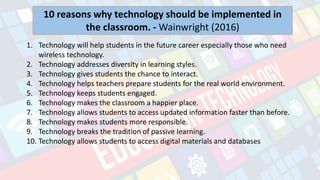
1. Technology will help students in the future career especially those who need
wireless technology.
2. Technology addresses diversity in learning styles.
3. Technology gives students the chance to interact.
4. Technology helps teachers prepare students for the real world environment.
5. Technology keeps students engaged.
6. Technology makes the classroom a happier place.
7. Technology allows students to access updated information faster than before.
8. Technology makes students more responsible.
9. Technology breaks the tradition of passive learning.
10. Technology allows students to access digital materials and databases
Information Communication Technology
Phases
Emerging, Applying, Infusing, and Transforming
Information Communication Technology
Phases
Emerging, Applying, Infusing, and Transforming
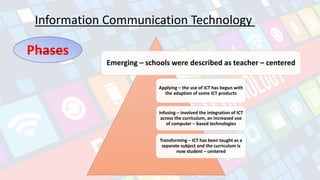
Emerging – schools were described as teacher – centered
Applying – the use of ICT has begun with
the adaption of some ICT products
Infusing – involved the integration of ICT
across the curriculum, an increased use
of computer – based technologies
Transforming – ICT has been taught as a
separate subject and the curriculum is
now student – centered
Information Communication Technology
Phases
Emerging, Applying, Infusing, and Transforming
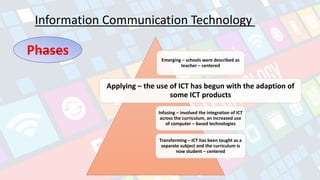
Emerging – schools were described as
teacher – centered
Applying – the use of ICT has begun with the adaption of
some ICT products
Infusing – involved the integration of ICT
across the curriculum, an increased use
of computer – based technologies
Transforming – ICT has been taught as a
separate subject and the curriculum is
now student – centered
Information Communication Technology
Phases
Emerging, Applying, Infusing, and Transforming
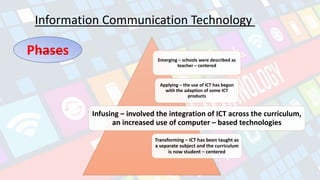
Emerging – schools were described as
teacher – centered
Applying – the use of ICT has begun
with the adaption of some ICT
products
Infusing – involved the integration of ICT across the curriculum,
an increased use of computer – based technologies
Transforming – ICT has been taught as
a separate subject and the curriculum
is now student – centered
Information Communication Technology
Phases
Emerging, Applying, Infusing, and Transforming
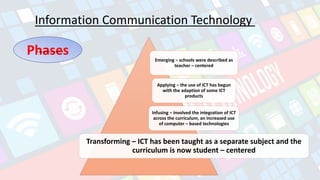
Emerging – schools were described as
teacher – centered
Applying – the use of ICT has begun
with the adaption of some ICT
products
Infusing – involved the integration of ICT
across the curriculum, an increased use
of computer – based technologies
Transforming – ICT has been taught as a separate subject and the
curriculum is now student – centered
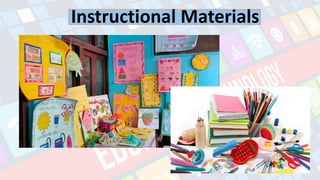
Instructional Materials
Digital
EVOLUTION OF
TECHNOLOGY FOR
INSTRUCTION
EVOLUTION OF
TECHNOLOGY FOR
INSTRUCTION
EVOLUTION OF TECHNOLOGY FOR INSTRUCTION
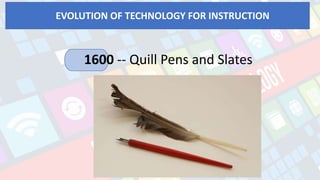
1600 -- Quill Pens and Slates
EVOLUTION OF TECHNOLOGY FOR INSTRUCTION
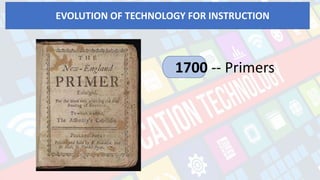
1700 -- Primers
EVOLUTION OF TECHNOLOGY FOR INSTRUCTION
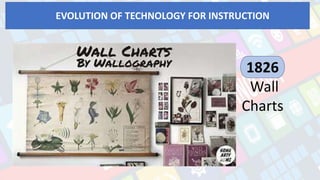
1826
Wall
Charts
EVOLUTION OF TECHNOLOGY FOR INSTRUCTION
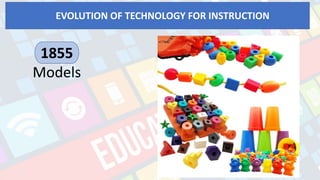
1855
Models
EVOLUTION OF TECHNOLOGY FOR INSTRUCTION
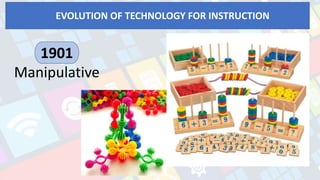
1901
Manipulative
EVOLUTION OF TECHNOLOGY FOR INSTRUCTION
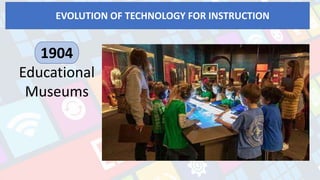
1904
Educational
Museums
EVOLUTION OF TECHNOLOGY FOR INSTRUCTION
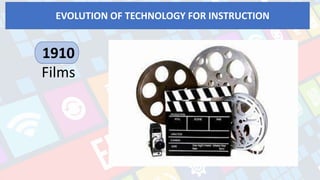
1910
Films
EVOLUTION OF TECHNOLOGY FOR INSTRUCTION
1914
Behaviorism
Theory
John Watson helped
establish behaviorism,
which became one of the
theoretical foundations of
learning.
EVOLUTION OF TECHNOLOGY FOR INSTRUCTION
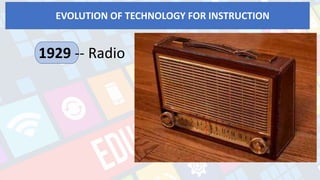
1929 -- Radio
John Watson helped
establish behaviorism,
which became one of the
theoretical foundations of
learning.
EVOLUTION OF TECHNOLOGY FOR INSTRUCTION
1933
Objectives in
Education
Ralph Tyler at Ohio State
University developed and
refined procedures for
writing objectives.
EVOLUTION OF TECHNOLOGY FOR INSTRUCTION
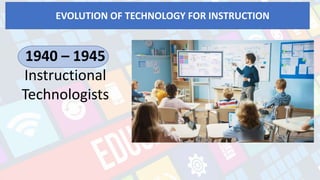
With the role of technology in learning increasing, the need for
expertise in both education and technology grew, and
professional instructional technologists emerged
1940 – 1945
Instructional
Technologists
EVOLUTION OF TECHNOLOGY FOR INSTRUCTION
films, sound, graphics,
models, and print to help
prepare recruits for war.
1945
Multiple
Media used
by Military
Armed Forces
EVOLUTION OF TECHNOLOGY FOR INSTRUCTION
films, sound, graphics, models, and print to
help prepare recruits for war.
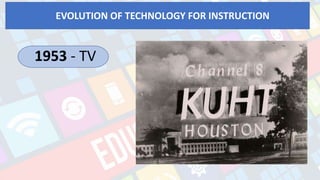
1953 - TV
EVOLUTION OF TECHNOLOGY FOR INSTRUCTION
films, sound,
graphics,
models, and
print to help
prepare
recruits for
war.
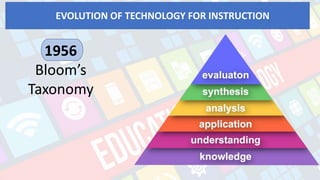
1956
Bloom’s
Taxonomy
EVOLUTION OF TECHNOLOGY FOR INSTRUCTION
films, sound, graphics,
models, and print to help
prepare recruits for war.
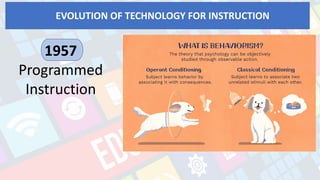
1957
Programmed
Instruction
films,
sound,
graphics,
models,
and print
to help
prepare
recruits
for war.
EVOLUTION OF TECHNOLOGY FOR INSTRUCTION
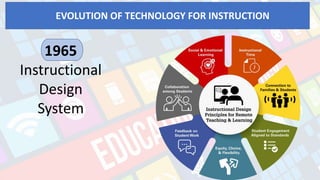
1965
Instructional
Design
System
EVOLUTION OF TECHNOLOGY FOR INSTRUCTION
films, sound, graphics,
models, and print to help
prepare recruits for war.
1967
PBS and NER
EVOLUTION OF TECHNOLOGY FOR INSTRUCTION
films, sound, graphics,
models, and print to help
prepare recruits for war.
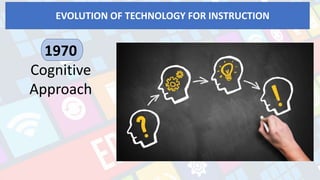
1970
Cognitive
Approach
EVOLUTION OF TECHNOLOGY FOR INSTRUCTION
films, sound, graphics,
models, and print to help
prepare recruits for war.
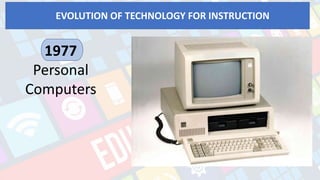
1977
Personal
Computers
EVOLUTION OF TECHNOLOGY FOR INSTRUCTION
Computer Assisted
Instruction on personal
computers reached its
peak of popularity.
1980 -- CAI
EVOLUTION OF TECHNOLOGY FOR INSTRUCTION
computer – assisted
instruction on personal
computers reached its
peak of popularity.
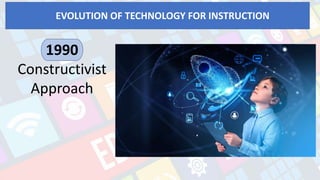
1990
Constructivist
Approach
EVOLUTION OF TECHNOLOGY FOR INSTRUCTION
computer – assisted
instruction on personal
computers reached its
peak of popularity.
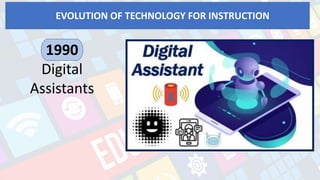
1990
Digital
Assistants
EVOLUTION OF TECHNOLOGY FOR INSTRUCTION
computer – assisted
instruction on personal
computers reached its
peak of popularity.
1991
EVOLUTION OF TECHNOLOGY FOR INSTRUCTION
computer – assisted
instruction on personal
computers reached its
peak of popularity.
2003
Mobile
Devices
EVOLUTION OF TECHNOLOGY FOR INSTRUCTION
computer – assisted
instruction on personal
computers reached its
peak of popularity.
Gain attention -- technology’s visual and interactive qualities can easily motivate and
direct students’ attention toward learning tasks. o Support manual operations during
high – level learning – students are more motivated to learn complex skills when
technology tools help them do the low – level skills involved o Illustrate real world
relevance through highly visual presentations – students are more likely to learn skills
that have clear real – life applications to their future work. o Engage through production
work – students who learn by creating their own products with technologies such as
word processing, multimedia, hypermedia and other technology products report higher
engagement in learning and a greater sense of pride in their achievements. o Collaborate
students with audience for their communication – students get to be more motivated to
write and do their best production work when they publish it on the Web, since others
outside the classroom will see their work. o Supply self – paced learning for capable
students – students who can learn on their own with software tutorials and / or distance
educational materials can be directed to take topics ahead of others. o Allow access to
learning opportunities – students with disabilities depend on technology to compensate
for vision, hearing, or manual dexterity they need to read, interact in class, and do
products to show what they have learned. o Provide faster access to information –
integrated learning systems can help teachers quickly assess and track students’
progress, also, collection of submitted data online can be gathered easily.
2008 and beyond
Gain attention -- technology’s visual and interactive qualities can easily motivate and direct students’ attention toward learning tasks. o Support manual operations during high – level learning – students are more motivated to learn complex skills when technology tools help them do the low – level skills involved o Illustrate real world
relevance through highly visual presentations – students are more likely to learn skills that have clear real – life applications to their future work. o Engage through production work – students who learn by creating their own products with technologies such as word processing, multimedia, hypermedia and other technology products report
higher engagement in learning and a greater sense of pride in their achievements. o Collaborate students with audience for their communication – students get to be more motivated to write and do their best production work when they publish it on the Web, since others outside the classroom will see their work. o Supply self – paced
learning for capable students – students who can learn on their own with software tutorials and / or distance educational materials can be directed to take topics ahead of others. o Allow access to learning opportunities – students with disabilities depend on technology to compensate for vision, hearing, or manual dexterity they need to
read, interact in class, and do products to show what they have learned. o Provide faster access to information – integrated learning systems can help teachers quickly assess and track students’ progress, also, collection of submitted data online can be gathered easily.
EVOLUTION OF TECHNOLOGY FOR INSTRUCTION
Gain attention o Supportmanual operationsduring high –level learning – studentsaremore motivated tolearn complex skills when technology tools help them do thelow –level skills involved o Illustratereal world relevance through highly visual presentations –studentsaremore likely to learn skills that haveclear real – life applications to their futurework. o Engage through productionwork –students wholearn by creating their own productswith technologies suchas word processing, multimedia, hypermedia and other technology productsreport higher engagement in learning and a greater senseof pride in their achievements. o Collaborate studentswithaudiencefor their communication –students get to bemoremotivated to writeand do their best production workwhen
they publishit on theWeb, sinceothers outsidetheclassroom will seetheir work. o Supply self –paced learning for capable students–studentswhocan learn on their own with softwaretutorials and / or distanceeducational materials can be directed to taketopics ahead of others. o Allow access to learning opportunities –studentswith disabilities depend on technology to compensatefor vision, hearing, or manual dexterity they need to read, interact in class, and do productsto showwhat they have learned. o Providefaster access to information –integrated learning systems can help teachers quickly assess and track students’ progress, also, collection of submitted data onlinecan begathered easily.
EVOLUTION OF TECHNOLOGY FOR INSTRUCTION
Gain attention
Support manual operations during high – level learning
Illustrate real world relevance through highly visual presentations – students are more likely to learn skills that have clear real – life applications to their future work.
o Engage through production work – students who learn by creating their own products with technologies such as word processing, multimedia, hypermedia and other technology products report higher engagement in learning and a greater sense of pride in their achievements. o Collaborate students with audience for their communication – students get to be more motivated to write and do their best production work when they publish it on the Web, since others outside the classroom will see their work. o Supply self – paced learning for capable students – students who can learn on their own with software tutorials and / or distance educational materials can be directed to take topics ahead of others. o Allow access to learning opportunities – students with disabilities depend on technology to compensate for vision, hearing, or manual dexterity they need to read, interact in class, and do products to show what they have learned. o Provide faster access to information – integrated learning systems can help teachers quickly assess and track students’ progress, also, collection of submitted data online can be gathered easily.
EVOLUTION OF TECHNOLOGY FOR INSTRUCTION
Gain attention
Support manual operations during high – level learning
Illustrate real world relevance through highly visual
presentations
o Engage through production work – students who learn by creating their own products with technologies such as word processing, multimedia, hypermedia and other technology products report higher engagement in learning and a greater sense of pride in their achievements. o Collaborate students with audience for their communication – students get to be more motivated to write and do their best production work when they publish it on the Web, since others outside the classroom will see their work. o Supply self – paced learning for capable students – students who can learn on their own with software tutorials and / or distance educational materials can be directed to take topics ahead of others. o Allow access to learning opportunities – students with disabilities depend on technology to compensate for vision, hearing, or manual dexterity they need to read, interact in class, and do products to show what they have learned. o Provide faster access to information – integrated learning systems can help teachers quickly assess and track students’ progress, also, collection of submitted data online can be gathered easily.
EVOLUTION OF TECHNOLOGY FOR INSTRUCTION
Gain attention
Support manual operations during high – level learning
Illustrate real world relevance through highly visual
presentations
Engage through production work.
o Collaborate students with audience for their communication – students get to be more motivated to write and do their best production work when they publish it on the Web, since others outside the classroom will see their work. o Supply self – paced learning for capable students – students who can learn on their own with software tutorials and / or distance educational materials can be directed to take topics ahead of others. o Allow access to learning opportunities – students with disabilities depend on technology to compensate for vision, hearing, or manual dexterity they need to read, interact in class, and do products to show what they have learned. o Provide faster access to information – integrated learning systems can help teachers quickly assess and track students’ progress, also, collection of submitted data online can be gathered easily.
EVOLUTION OF TECHNOLOGY FOR INSTRUCTION
Gain attention
Support manual operations during high – level learning
Illustrate real world relevance through highly visual
presentations
Engage through production work.
Collaborate students with audience for their communication
Supply self – paced learning for capable students – students who can learn on their own with software tutorials and / or distance educational materials can be directed to take topics ahead of others. o Allow access to learning opportunities – students with disabilities depend on technology to compensate for vision, hearing, or manual dexterity they need to read, interact in class, and do products to show what they have learned. o Provide faster access to information – integrated learning systems can help teachers quickly assess and track students’ progress, also, collection of submitted data online can be gathered easily.
EVOLUTION OF TECHNOLOGY FOR INSTRUCTION
Gain attention
Support manual operations during high – level learning
Illustrate real world relevance through highly visual
presentations
Engage through production work.
Collaborate students with audience for their communication
Supply self. o Allow access to learning opportunities – students with disabilities depend on technology to compensate for vision, hearing, or manual dexterity they need to read, interact in class, and do products to show what they have learned. o Provide faster access to information – integrated learning systems can help teachers quickly assess and track students’ progress, also, collection of submitted data online can be gathered easily.
EVOLUTION OF TECHNOLOGY FOR INSTRUCTION
Gain attention
Support manual operations during high – level learning
Illustrate real world relevance through highly visual
presentations
Engage through production work.
Collaborate students with audience for their communication
Supply self.
Allow access to learning opportunities
o Provide faster access to information – integrated learning systems can help teachers quickly assess and track students’ progress, also, collection of submitted data online can be gathered easily.
EVOLUTION OF TECHNOLOGY FOR INSTRUCTION
Gain attention
Support manual operations during high – level learning
Illustrate real world relevance through highly visual
presentations
Engage through production work.
Collaborate students with audience for their communication
Supply self.
Allow access to learning opportunities
Provide faster access to information
EVOLUTION OF TECHNOLOGY FOR INSTRUCTION
APPLICATION / ASSESSMENT
Reflective Writing
• Which among the instructional technology
being developed would you consider as the
“most beneficial in the learning process”?
• Is technology a “boon” or a “bane”? Justify
your answer.
Introduction to Technology for Teaching and Learning.pptx

Introduction to Technology for Teaching and Learning.pptx

  • 1.
    Lesson 1: Introductionto Technology for Teaching and Learning
  • 2.
  • 3.
    Basic Concepts What isTechnology? - refers to the advancements in the methods and tools people use to solve problems and achieve a goal.
  • 4.
    What is Technology? -refers to the advancements in the methods and tools people use to solve problems and achieve a goal. 10 reasons why technology should be implemented in the classroom. - Wainwright (2016)
  • 5.
    What is Technology? -refers to the advancements in the methods and tools people use to solve problems and achieve a goal. 10 reasons why technology should be implemented in the classroom. - Wainwright (2016) Technology will help students in the future career especially those who need wireless technology.
  • 6.
    What is Technology? -refers to the advancements in the methods and tools people use to solve problems and achieve a goal. 10 reasons why technology should be implemented in the classroom. - Wainwright (2016) Technology addresses diversity in learning styles.
  • 7.
    What is Technology? -refers to the advancements in the methods and tools people use to solve problems and achieve a goal. 10 reasons why technology should be implemented in the classroom. - Wainwright (2016) Technology gives students the chance to interact.
  • 8.
    What is Technology? -refers to the advancements in the methods and tools people use to solve problems and achieve a goal. 10 reasons why technology should be implemented in the classroom. - Wainwright (2016) Technology helps teachers prepare students for the real world environment.
  • 9.
    What is Technology? -refers to the advancements in the methods and tools people use to solve problems and achieve a goal. 10 reasons why technology should be implemented in the classroom. - Wainwright (2016) Technology keeps students engaged.
  • 10.
    What is Technology? -refers to the advancements in the methods and tools people use to solve problems and achieve a goal. 10 reasons why technology should be implemented in the classroom. - Wainwright (2016) Technology makes the classroom a happier place.
  • 11.
    What is Technology? -refers to the advancements in the methods and tools people use to solve problems and achieve a goal. 10 reasons why technology should be implemented in the classroom. - Wainwright (2016) Technology allows students to access updated information faster than before
  • 12.
    What is Technology? -refers to the advancements in the methods and tools people use to solve problems and achieve a goal. 10 reasons why technology should be implemented in the classroom. - Wainwright (2016) Technology makes students more responsible.
  • 13.
    What is Technology? -refers to the advancements in the methods and tools people use to solve problems and achieve a goal. 10 reasons why technology should be implemented in the classroom. - Wainwright (2016) Technology breaks the tradition of passive learning.
  • 14.
    What is Technology? -refers to the advancements in the methods and tools people use to solve problems and achieve a goal. 10 reasons why technology should be implemented in the classroom. - Wainwright (2016) 1. Technology will help students in the future career especially those who need wireless technology. 2. Technology addresses diversity in learning styles. EDUC 30033 Technology for Teaching and Learning P 1 P a g e | 7 3. Technology gives students the chance to interact. 4. Technology helps teachers prepare students for the real world environment. 5. Technology keeps students engaged. 6. Technology makes the classroom a happier place. 7. Technology allows students to access updated information faster than before. 8. Technology makes students more responsible. 9. Technology breaks the tradition of passive learning. 10. Technology allows students to access digital materials and databases Technology allows students to access digital materials and databases.
  • 15.
    What is Technology? -refers to the advancements in the methods and tools people use to solve problems and achieve a goal. 10 reasons why technology should be implemented in the classroom. - Wainwright (2016) 1. Technology will help students in the future career especially those who need wireless technology. 2. Technology addresses diversity in learning styles. 3. Technology gives students the chance to interact. 4. Technology helps teachers prepare students for the real world environment. 5. Technology keeps students engaged. 6. Technology makes the classroom a happier place. 7. Technology allows students to access updated information faster than before. 8. Technology makes students more responsible. 9. Technology breaks the tradition of passive learning. 10. Technology allows students to access digital materials and databases
  • 16.
  • 17.
    Information Communication Technology Phases Emerging,Applying, Infusing, and Transforming
  • 18.
    Information Communication Technology Phases Emerging,Applying, Infusing, and Transforming Emerging – schools were described as teacher – centered Applying – the use of ICT has begun with the adaption of some ICT products Infusing – involved the integration of ICT across the curriculum, an increased use of computer – based technologies Transforming – ICT has been taught as a separate subject and the curriculum is now student – centered
  • 19.
    Information Communication Technology Phases Emerging,Applying, Infusing, and Transforming Emerging – schools were described as teacher – centered Applying – the use of ICT has begun with the adaption of some ICT products Infusing – involved the integration of ICT across the curriculum, an increased use of computer – based technologies Transforming – ICT has been taught as a separate subject and the curriculum is now student – centered
  • 20.
    Information Communication Technology Phases Emerging,Applying, Infusing, and Transforming Emerging – schools were described as teacher – centered Applying – the use of ICT has begun with the adaption of some ICT products Infusing – involved the integration of ICT across the curriculum, an increased use of computer – based technologies Transforming – ICT has been taught as a separate subject and the curriculum is now student – centered
  • 21.
    Information Communication Technology Phases Emerging,Applying, Infusing, and Transforming Emerging – schools were described as teacher – centered Applying – the use of ICT has begun with the adaption of some ICT products Infusing – involved the integration of ICT across the curriculum, an increased use of computer – based technologies Transforming – ICT has been taught as a separate subject and the curriculum is now student – centered
  • 22.
  • 23.
  • 24.
  • 25.
  • 26.
    EVOLUTION OF TECHNOLOGYFOR INSTRUCTION 1600 -- Quill Pens and Slates
  • 27.
    EVOLUTION OF TECHNOLOGYFOR INSTRUCTION 1700 -- Primers
  • 28.
    EVOLUTION OF TECHNOLOGYFOR INSTRUCTION 1826 Wall Charts
  • 29.
    EVOLUTION OF TECHNOLOGYFOR INSTRUCTION 1855 Models
  • 30.
    EVOLUTION OF TECHNOLOGYFOR INSTRUCTION 1901 Manipulative
  • 31.
    EVOLUTION OF TECHNOLOGYFOR INSTRUCTION 1904 Educational Museums
  • 32.
    EVOLUTION OF TECHNOLOGYFOR INSTRUCTION 1910 Films
  • 33.
    EVOLUTION OF TECHNOLOGYFOR INSTRUCTION 1914 Behaviorism Theory John Watson helped establish behaviorism, which became one of the theoretical foundations of learning.
  • 34.
    EVOLUTION OF TECHNOLOGYFOR INSTRUCTION 1929 -- Radio John Watson helped establish behaviorism, which became one of the theoretical foundations of learning.
  • 35.
    EVOLUTION OF TECHNOLOGYFOR INSTRUCTION 1933 Objectives in Education Ralph Tyler at Ohio State University developed and refined procedures for writing objectives.
  • 36.
    EVOLUTION OF TECHNOLOGYFOR INSTRUCTION With the role of technology in learning increasing, the need for expertise in both education and technology grew, and professional instructional technologists emerged 1940 – 1945 Instructional Technologists
  • 37.
    EVOLUTION OF TECHNOLOGYFOR INSTRUCTION films, sound, graphics, models, and print to help prepare recruits for war. 1945 Multiple Media used by Military Armed Forces
  • 38.
    EVOLUTION OF TECHNOLOGYFOR INSTRUCTION films, sound, graphics, models, and print to help prepare recruits for war. 1953 - TV
  • 39.
    EVOLUTION OF TECHNOLOGYFOR INSTRUCTION films, sound, graphics, models, and print to help prepare recruits for war. 1956 Bloom’s Taxonomy
  • 40.
    EVOLUTION OF TECHNOLOGYFOR INSTRUCTION films, sound, graphics, models, and print to help prepare recruits for war. 1957 Programmed Instruction
  • 41.
    films, sound, graphics, models, and print to help prepare recruits forwar. EVOLUTION OF TECHNOLOGY FOR INSTRUCTION 1965 Instructional Design System
  • 42.
    EVOLUTION OF TECHNOLOGYFOR INSTRUCTION films, sound, graphics, models, and print to help prepare recruits for war. 1967 PBS and NER
  • 43.
    EVOLUTION OF TECHNOLOGYFOR INSTRUCTION films, sound, graphics, models, and print to help prepare recruits for war. 1970 Cognitive Approach
  • 44.
    EVOLUTION OF TECHNOLOGYFOR INSTRUCTION films, sound, graphics, models, and print to help prepare recruits for war. 1977 Personal Computers
  • 45.
    EVOLUTION OF TECHNOLOGYFOR INSTRUCTION Computer Assisted Instruction on personal computers reached its peak of popularity. 1980 -- CAI
  • 46.
    EVOLUTION OF TECHNOLOGYFOR INSTRUCTION computer – assisted instruction on personal computers reached its peak of popularity. 1990 Constructivist Approach
  • 47.
    EVOLUTION OF TECHNOLOGYFOR INSTRUCTION computer – assisted instruction on personal computers reached its peak of popularity. 1990 Digital Assistants
  • 48.
    EVOLUTION OF TECHNOLOGYFOR INSTRUCTION computer – assisted instruction on personal computers reached its peak of popularity. 1991
  • 49.
    EVOLUTION OF TECHNOLOGYFOR INSTRUCTION computer – assisted instruction on personal computers reached its peak of popularity. 2003 Mobile Devices
  • 50.
    EVOLUTION OF TECHNOLOGYFOR INSTRUCTION computer – assisted instruction on personal computers reached its peak of popularity. Gain attention -- technology’s visual and interactive qualities can easily motivate and direct students’ attention toward learning tasks. o Support manual operations during high – level learning – students are more motivated to learn complex skills when technology tools help them do the low – level skills involved o Illustrate real world relevance through highly visual presentations – students are more likely to learn skills that have clear real – life applications to their future work. o Engage through production work – students who learn by creating their own products with technologies such as word processing, multimedia, hypermedia and other technology products report higher engagement in learning and a greater sense of pride in their achievements. o Collaborate students with audience for their communication – students get to be more motivated to write and do their best production work when they publish it on the Web, since others outside the classroom will see their work. o Supply self – paced learning for capable students – students who can learn on their own with software tutorials and / or distance educational materials can be directed to take topics ahead of others. o Allow access to learning opportunities – students with disabilities depend on technology to compensate for vision, hearing, or manual dexterity they need to read, interact in class, and do products to show what they have learned. o Provide faster access to information – integrated learning systems can help teachers quickly assess and track students’ progress, also, collection of submitted data online can be gathered easily. 2008 and beyond
  • 51.
    Gain attention --technology’s visual and interactive qualities can easily motivate and direct students’ attention toward learning tasks. o Support manual operations during high – level learning – students are more motivated to learn complex skills when technology tools help them do the low – level skills involved o Illustrate real world relevance through highly visual presentations – students are more likely to learn skills that have clear real – life applications to their future work. o Engage through production work – students who learn by creating their own products with technologies such as word processing, multimedia, hypermedia and other technology products report higher engagement in learning and a greater sense of pride in their achievements. o Collaborate students with audience for their communication – students get to be more motivated to write and do their best production work when they publish it on the Web, since others outside the classroom will see their work. o Supply self – paced learning for capable students – students who can learn on their own with software tutorials and / or distance educational materials can be directed to take topics ahead of others. o Allow access to learning opportunities – students with disabilities depend on technology to compensate for vision, hearing, or manual dexterity they need to read, interact in class, and do products to show what they have learned. o Provide faster access to information – integrated learning systems can help teachers quickly assess and track students’ progress, also, collection of submitted data online can be gathered easily. EVOLUTION OF TECHNOLOGY FOR INSTRUCTION
  • 52.
    Gain attention oSupportmanual operationsduring high –level learning – studentsaremore motivated tolearn complex skills when technology tools help them do thelow –level skills involved o Illustratereal world relevance through highly visual presentations –studentsaremore likely to learn skills that haveclear real – life applications to their futurework. o Engage through productionwork –students wholearn by creating their own productswith technologies suchas word processing, multimedia, hypermedia and other technology productsreport higher engagement in learning and a greater senseof pride in their achievements. o Collaborate studentswithaudiencefor their communication –students get to bemoremotivated to writeand do their best production workwhen they publishit on theWeb, sinceothers outsidetheclassroom will seetheir work. o Supply self –paced learning for capable students–studentswhocan learn on their own with softwaretutorials and / or distanceeducational materials can be directed to taketopics ahead of others. o Allow access to learning opportunities –studentswith disabilities depend on technology to compensatefor vision, hearing, or manual dexterity they need to read, interact in class, and do productsto showwhat they have learned. o Providefaster access to information –integrated learning systems can help teachers quickly assess and track students’ progress, also, collection of submitted data onlinecan begathered easily. EVOLUTION OF TECHNOLOGY FOR INSTRUCTION
  • 53.
    Gain attention Support manualoperations during high – level learning Illustrate real world relevance through highly visual presentations – students are more likely to learn skills that have clear real – life applications to their future work. o Engage through production work – students who learn by creating their own products with technologies such as word processing, multimedia, hypermedia and other technology products report higher engagement in learning and a greater sense of pride in their achievements. o Collaborate students with audience for their communication – students get to be more motivated to write and do their best production work when they publish it on the Web, since others outside the classroom will see their work. o Supply self – paced learning for capable students – students who can learn on their own with software tutorials and / or distance educational materials can be directed to take topics ahead of others. o Allow access to learning opportunities – students with disabilities depend on technology to compensate for vision, hearing, or manual dexterity they need to read, interact in class, and do products to show what they have learned. o Provide faster access to information – integrated learning systems can help teachers quickly assess and track students’ progress, also, collection of submitted data online can be gathered easily. EVOLUTION OF TECHNOLOGY FOR INSTRUCTION
  • 54.
    Gain attention Support manualoperations during high – level learning Illustrate real world relevance through highly visual presentations o Engage through production work – students who learn by creating their own products with technologies such as word processing, multimedia, hypermedia and other technology products report higher engagement in learning and a greater sense of pride in their achievements. o Collaborate students with audience for their communication – students get to be more motivated to write and do their best production work when they publish it on the Web, since others outside the classroom will see their work. o Supply self – paced learning for capable students – students who can learn on their own with software tutorials and / or distance educational materials can be directed to take topics ahead of others. o Allow access to learning opportunities – students with disabilities depend on technology to compensate for vision, hearing, or manual dexterity they need to read, interact in class, and do products to show what they have learned. o Provide faster access to information – integrated learning systems can help teachers quickly assess and track students’ progress, also, collection of submitted data online can be gathered easily. EVOLUTION OF TECHNOLOGY FOR INSTRUCTION
  • 55.
    Gain attention Support manualoperations during high – level learning Illustrate real world relevance through highly visual presentations Engage through production work. o Collaborate students with audience for their communication – students get to be more motivated to write and do their best production work when they publish it on the Web, since others outside the classroom will see their work. o Supply self – paced learning for capable students – students who can learn on their own with software tutorials and / or distance educational materials can be directed to take topics ahead of others. o Allow access to learning opportunities – students with disabilities depend on technology to compensate for vision, hearing, or manual dexterity they need to read, interact in class, and do products to show what they have learned. o Provide faster access to information – integrated learning systems can help teachers quickly assess and track students’ progress, also, collection of submitted data online can be gathered easily. EVOLUTION OF TECHNOLOGY FOR INSTRUCTION
  • 56.
    Gain attention Support manualoperations during high – level learning Illustrate real world relevance through highly visual presentations Engage through production work. Collaborate students with audience for their communication Supply self – paced learning for capable students – students who can learn on their own with software tutorials and / or distance educational materials can be directed to take topics ahead of others. o Allow access to learning opportunities – students with disabilities depend on technology to compensate for vision, hearing, or manual dexterity they need to read, interact in class, and do products to show what they have learned. o Provide faster access to information – integrated learning systems can help teachers quickly assess and track students’ progress, also, collection of submitted data online can be gathered easily. EVOLUTION OF TECHNOLOGY FOR INSTRUCTION
  • 57.
    Gain attention Support manualoperations during high – level learning Illustrate real world relevance through highly visual presentations Engage through production work. Collaborate students with audience for their communication Supply self. o Allow access to learning opportunities – students with disabilities depend on technology to compensate for vision, hearing, or manual dexterity they need to read, interact in class, and do products to show what they have learned. o Provide faster access to information – integrated learning systems can help teachers quickly assess and track students’ progress, also, collection of submitted data online can be gathered easily. EVOLUTION OF TECHNOLOGY FOR INSTRUCTION
  • 58.
    Gain attention Support manualoperations during high – level learning Illustrate real world relevance through highly visual presentations Engage through production work. Collaborate students with audience for their communication Supply self. Allow access to learning opportunities o Provide faster access to information – integrated learning systems can help teachers quickly assess and track students’ progress, also, collection of submitted data online can be gathered easily. EVOLUTION OF TECHNOLOGY FOR INSTRUCTION
  • 59.
    Gain attention Support manualoperations during high – level learning Illustrate real world relevance through highly visual presentations Engage through production work. Collaborate students with audience for their communication Supply self. Allow access to learning opportunities Provide faster access to information EVOLUTION OF TECHNOLOGY FOR INSTRUCTION
  • 60.
    APPLICATION / ASSESSMENT ReflectiveWriting • Which among the instructional technology being developed would you consider as the “most beneficial in the learning process”? • Is technology a “boon” or a “bane”? Justify your answer.

Editor's Notes

  • #3 refers to the advancements in the methods and tools people use to solve problems and achieve a goal. In the classroom, technology can encompass all kinds of tools from low –
  • #4 In the classroom, technology can encompass all kinds of tools from low – tech (pencil, paper, chalkboard) to high – tech (presentation software, tablets, computer, etc.)
  • #17 much sought breakthrough that changed many aspects of human’s life most essentially the educational realm. (David Warlick: as cited by Torlakson and Pletka, 2014) ICT underpins the success of the educational domains as it adds to the processes of learning. It helps gain competencies in critical thinking, generalist competencies, decision – making, handling of difficult situations, working as a team, and communicating effectively. (UNESCO, 2002)
  • #18 The use of ICT in education evolved in four phases: emerging, applying, infusing, and transforming
  • #19 The use of ICT in education evolved in four phases: emerging, applying, infusing, and transforming
  • #20 The use of ICT in education evolved in four phases: emerging, applying, infusing, and transforming
  • #21 The use of ICT in education evolved in four phases: emerging, applying, infusing, and transforming
  • #22 The use of ICT in education evolved in four phases: emerging, applying, infusing, and transforming
  • #23 designed for use in the teaching and learning process that will help learners acquire facts, skills, or opinions or develop cognitive processes.
  • #24 Involving or relating to the use of computer technology (Oxford Dictionary, 2017); electronic technology that generates, stores, and processes data in terms of the two states: positive, expressed in 1 string and non – positive, expressed in 0 string. (Whatls, 2017)
  • #27  – Early one –room schoolhouses in the 1700s and 1800s used these materials to teach students how to write and cipher.
  • #28 – The New England Primer remained the basic school text for 100 years after its publication
  • #29 1826 -- Wall Charts – to save the cost of individual books, passages were sometimes printed in large letters and hung for all to see in Lancastrian schools.
  • #30 1855 -- Models – with the introduction of kindergarten in Wisconsin, models and materials were given to students to manipulate and to learn from
  • #31 1901 -- Manipulative – Maria Montessori’s kinesthetic approach offered a variety of manipulative from which students could learn.
  • #32 1904 -- Educational Museums – the visual – education movement resulted in educational museums with abundant visual displays.
  • #33 1910 -- Films – Edison declared after inventing motion pictures that books would soon be obsolete. Public schools in New York City implemented films for instruction for the first time. Edward Thorndike - helped established education as a science.
  • #34 1914 -- Behaviorism Theory – John Watson helped establish behaviorism, which became one of the theoretical foundations of learning.
  • #35 1929 -- Radio – The Ohio “School of the Air” broadcast instructions to homes.
  • #36 1933 -- Objectives in Education – Ralph Tyler at Ohio State University developed and refined procedures for writing objectives.
  • #37 1940 – 1945 -- Instructional Technologists – with the role of technology in learning increasing, the need for expertise in both education and technology grew, and professional instructional technologists emerged
  • #38 1945 -- Multiple Media used by Military Armed Forces – training used films, sound, graphics, models, and print to help prepare recruits for war.
  • #39 1953 -- ITV – The University of Houston launches KUHT, the first non-commercial education station.
  • #40 1956 -- Bloom’s Taxonomy – a team led by Benjamin Bloom identified and articulated levels of cognition.
  • #41 1957 -- Programmed Instruction – instruction materials based on Skinner’s behaviorism were used at the Mystic School in Winchester, Massachusetts.
  • #42 1965 -- Instructional Design System – Robert Gagné introduced a model for a systems approach to designing instruction.truction materials based on Skinner’s behaviorism were used at the Mystic School in Winchester, Massachusetts.
  • #43 1967 -- PBS and NER – The Public Broadcasting Act established the Public Broadcasting Service and National Educational Radio.
  • #44 1970 -- Cognitive Approach – cognitivists including Ausubel, Bruner, Gagné, and others dominated thinking about learning.
  • #45 1977 - Personal Computers – the first microcomputer, the Apple, was created by Steve Wozniak & Steve Jobs
  • #46 1980 -- CAI – computer – assisted instruction on personal computers reached its peak of popularity.
  • #47 1990 -- Constructivist Approach – the influence of Dewey, Piaget, Vygotsky, and others led to the emergence of the constructivist view of learning. Computer – based technologies – video discs, CD – ROMs, multimedia, digital presentations, interactive video, teleconferencing, compressed video, and the Internet combined to greatly increase the technologies available to enhance teaching and learning. Virtual Reality – digital representations of a given reality let teacher and student “experience” it.
  • #48 1990 - Digital Assistants – intelligent agents help people interact with the equipment and cyberspace
  • #49 1991 - World Wide Web – the Internet became accessible to all with the creation of the Web by Tim Berners – Lee.
  • #50 2003 - Mobile Devices – smart phones, netbooks, and handheld PCs joined with wireless networking to make mobile computing commonplace everywhere, including in the classroom.
  • #51 2008 and beyond -- Online Life – the Internet expands to include the Web 2.0, featuring social networking, audio and video streaming and options, for interaction leading to instruction anytime, anywhere. The Grid – using distributed computing technology, the Grid will make it possible to dynamically pool and share computer resources, making unprecedented computing power available to everyone on the Grid
  • #52 =
  • #53 technology’s visual and interactive qualities can easily motivate and direct students’ attention toward learning tasks.
  • #54 students are more motivated to learn complex skills when technology tools help them do the low – level skills involved
  • #55 – students are more likely to learn skills that have clear real – life applications to their future work.
  • #56 – students who learn by creating their own products with technologies such as word processing, multimedia, hypermedia and other technology products report higher engagement in learning and a greater sense of pride in their achievements
  • #57 students get to be more motivated to write and do their best production work when they publish it on the Web, since others outside the classroom will see their work.
  • #58 – paced learning for capable students – students who can learn on their own with software tutorials and / or distance educational materials can be directed to take topics ahead of others
  • #59 – students with disabilities depend on technology to compensate for vision, hearing, or manual dexterity they need to read, interact in class, and do products to show what they have learned.
  • #60 – integrated learning systems can help teachers quickly assess and track students’ progress, also, collection of submitted data online can be gathered easily.