Basic Business Statistics, 10e © 2006 Prentice-Hall, Inc.. Chap 7-1
Chapter 7
Sampling Distributions
Basic Business Statistics
10th Edition
Basic Business Statistics, 10e © 2006 Prentice-Hall, Inc. Chap 7-2
Learning Objectives
In this chapter, you learn:
 The concept of the sampling distribution
 To compute probabilities related to the sample mean
and the sample proportion
 The importance of the Central Limit Theorem
 To distinguish between different survey sampling
methods
 To evaluate survey worthiness and survey errors
Basic Business Statistics, 10e © 2006 Prentice-Hall, Inc. Chap 7-3
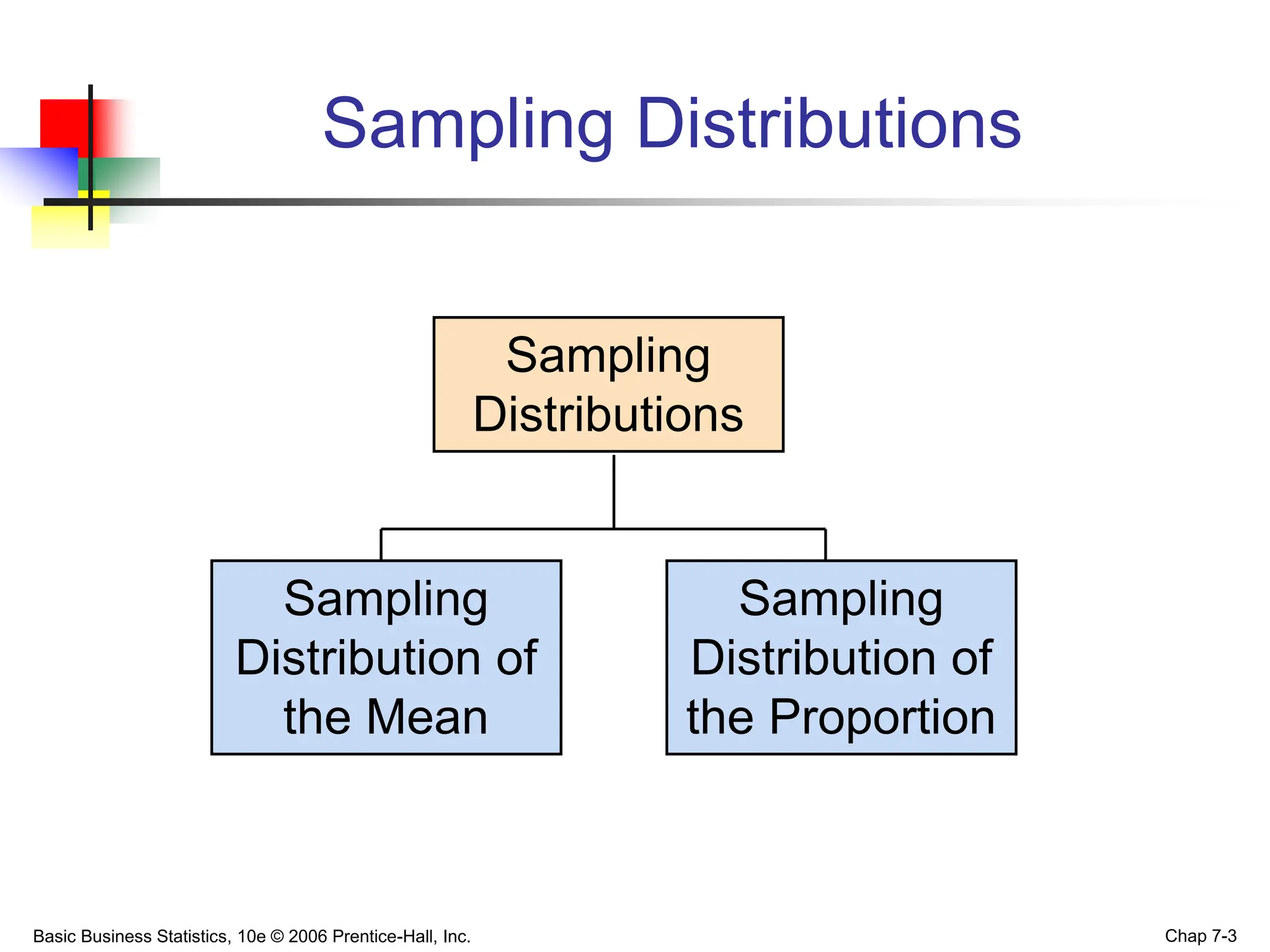
Sampling Distributions
Sampling
Distributions
Sampling
Distribution of
the Mean
Sampling
Distribution of
the Proportion
Basic Business Statistics, 10e © 2006 Prentice-Hall, Inc. Chap 7-4
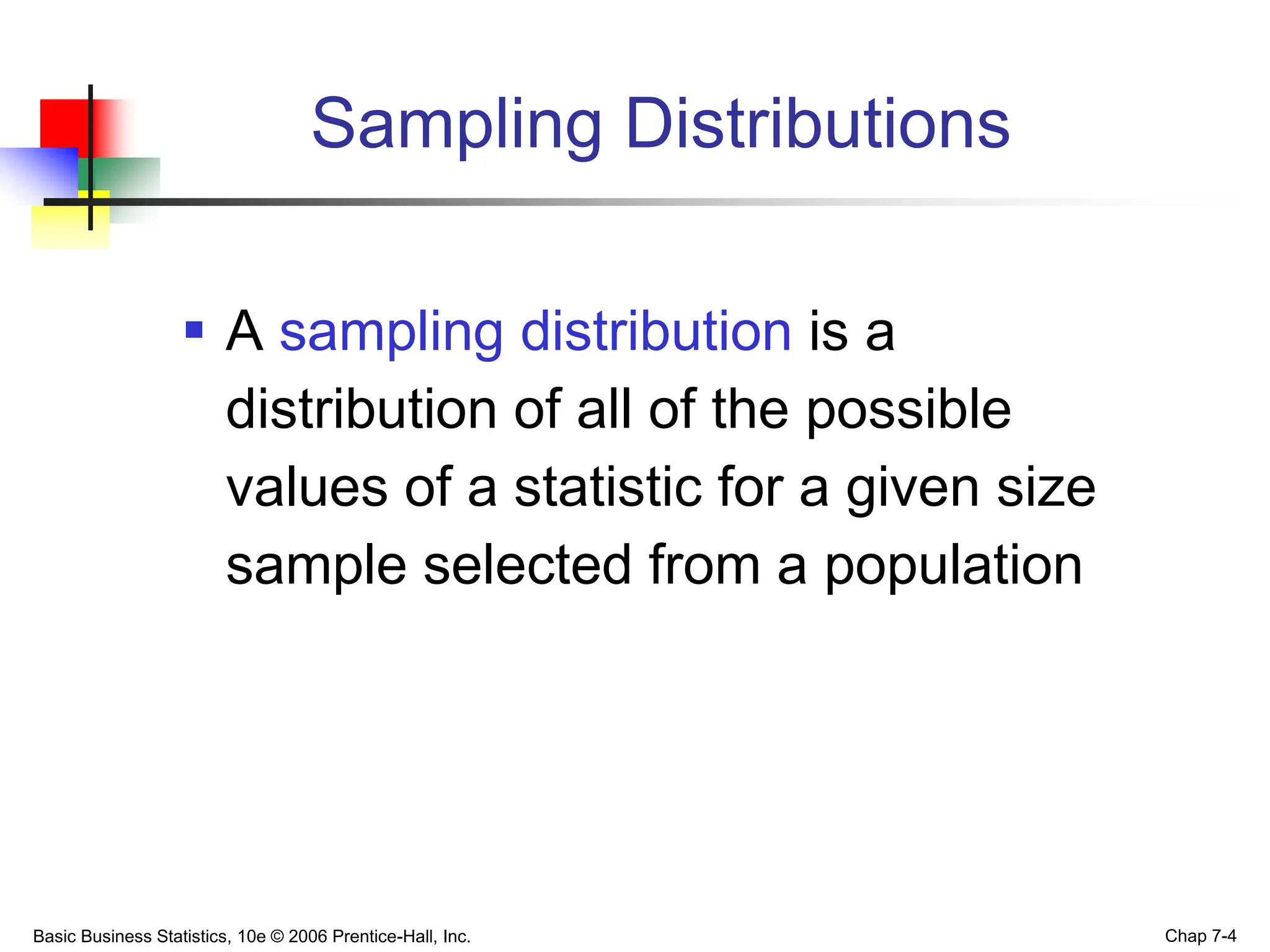
Sampling Distributions
 A sampling distribution is a
distribution of all of the possible
values of a statistic for a given size
sample selected from a population
Basic Business Statistics, 10e © 2006 Prentice-Hall, Inc. Chap 7-5
Developing a
Sampling Distribution
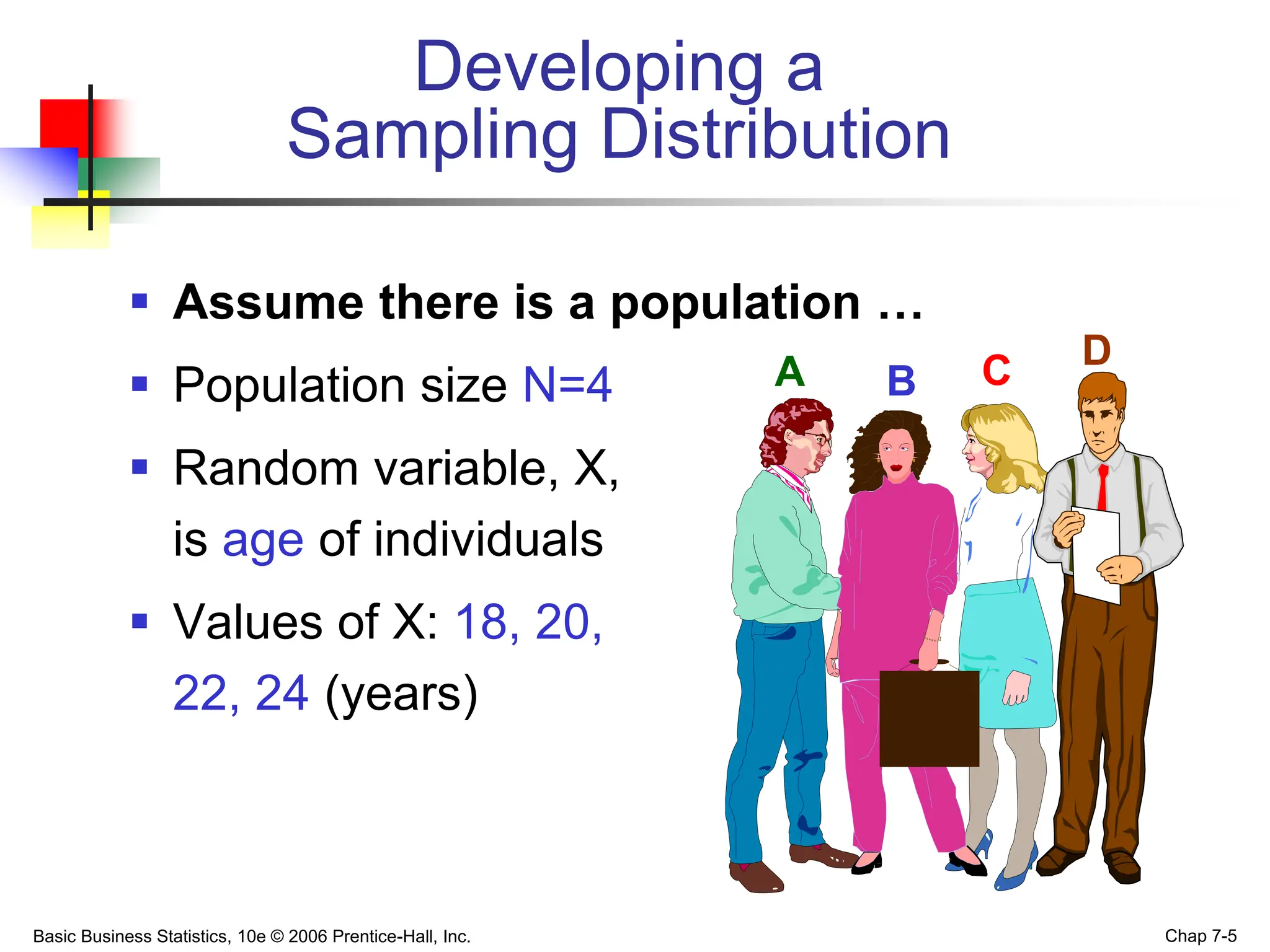
 Assume there is a population …
 Population size N=4
 Random variable, X,
is age of individuals
 Values of X: 18, 20,
22, 24 (years)
A B C D
Basic Business Statistics, 10e © 2006 Prentice-Hall, Inc. Chap 7-6
.3
.2
.1
0
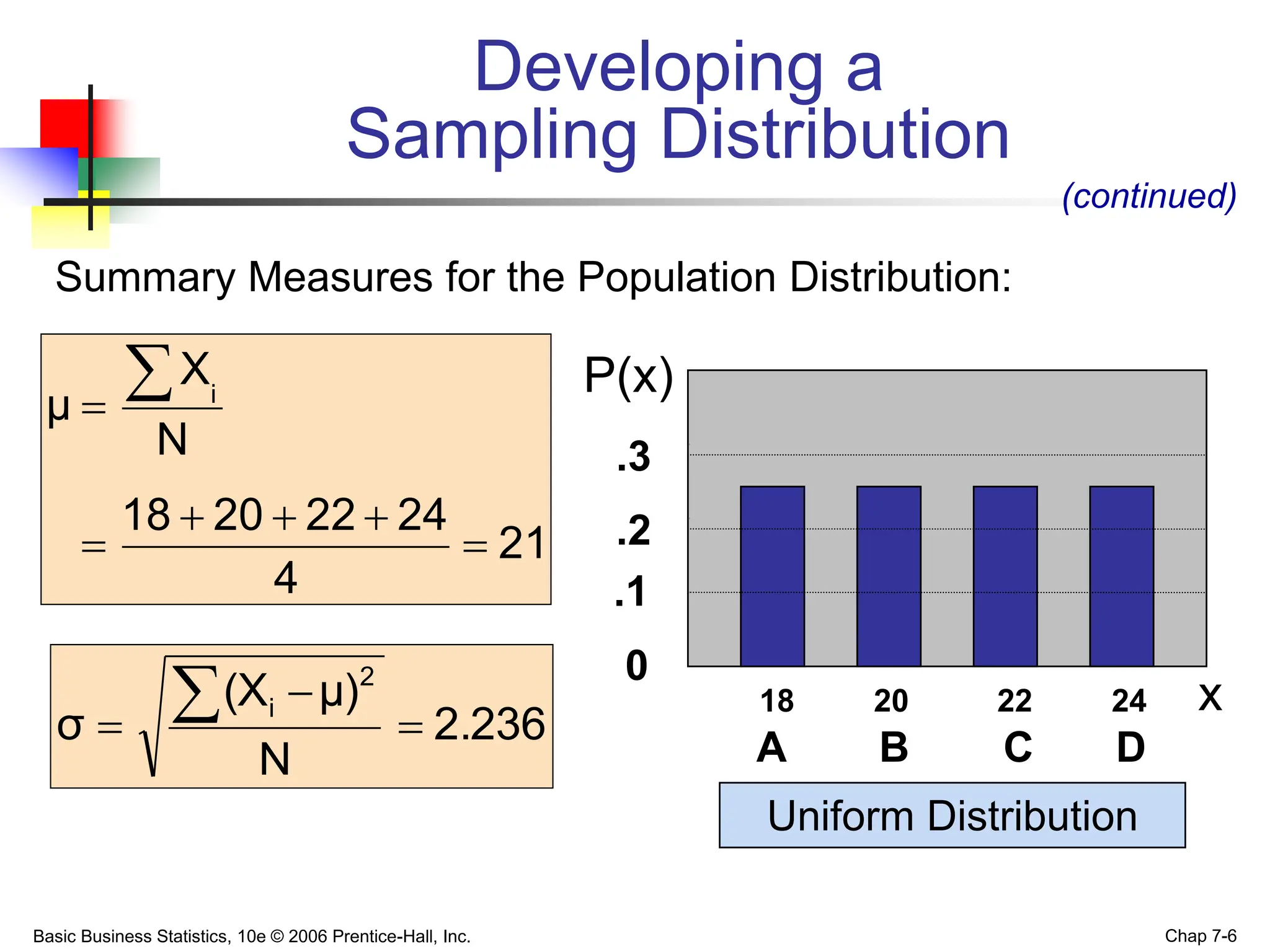
18 20 22 24
A B C D
Uniform Distribution
P(x)
x
(continued)
Summary Measures for the Population Distribution:
Developing a
Sampling Distribution
21
4
24
22
20
18
N
X
μ i







2.236
N
μ)
(X
σ
2
i




Basic Business Statistics, 10e © 2006 Prentice-Hall, Inc. Chap 7-7
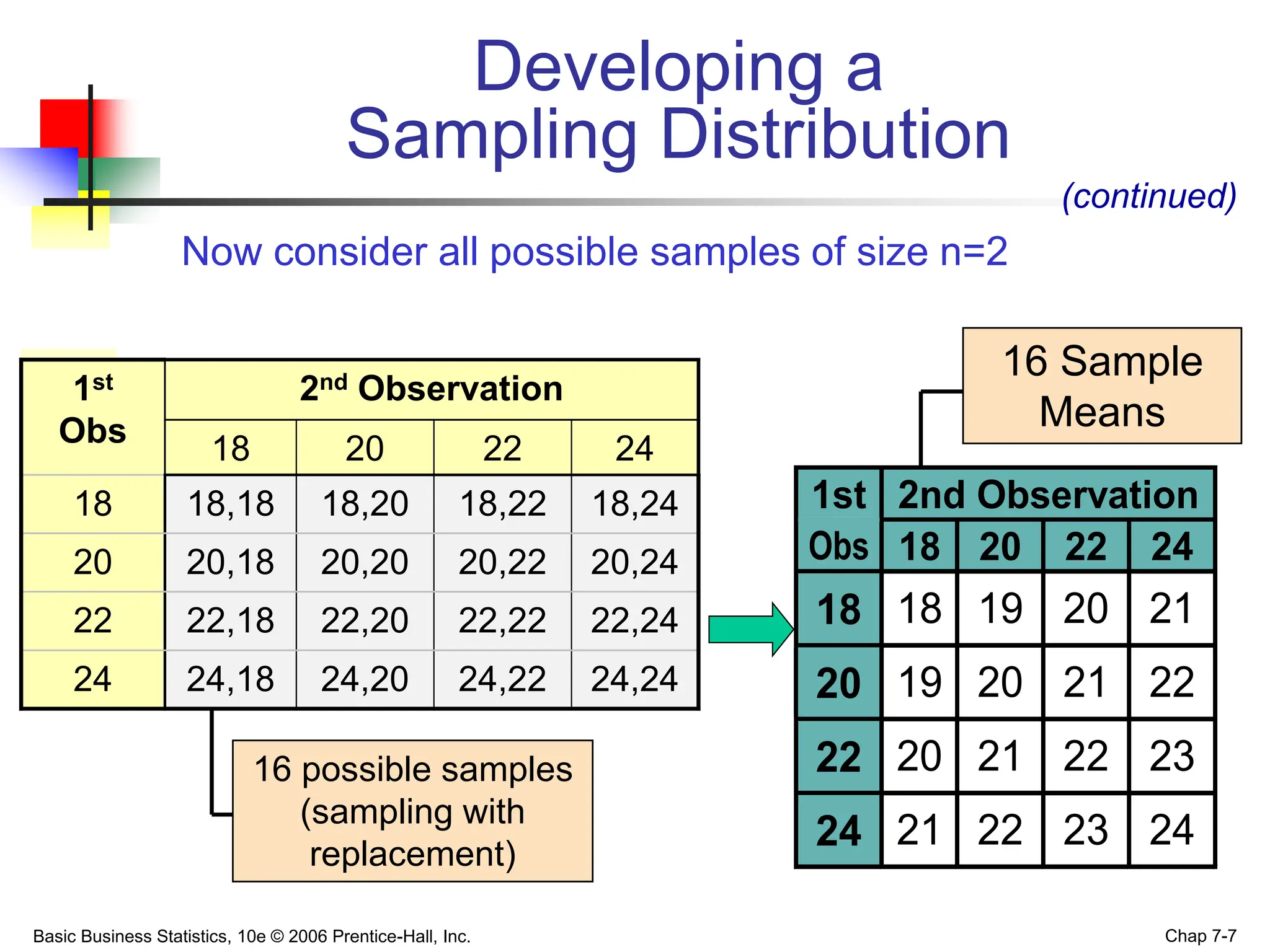
16 possible samples
(sampling with
replacement)
Now consider all possible samples of size n=2
1st 2nd Observation
Obs 18 20 22 24
18 18 19 20 21
20 19 20 21 22
22 20 21 22 23
24 21 22 23 24
(continued)
Developing a
Sampling Distribution
16 Sample
Means
1st
Obs
2nd Observation
18 20 22 24
18 18,18 18,20 18,22 18,24
20 20,18 20,20 20,22 20,24
22 22,18 22,20 22,22 22,24
24 24,18 24,20 24,22 24,24
Basic Business Statistics, 10e © 2006 Prentice-Hall, Inc. Chap 7-8
1st 2nd Observation
Obs 18 20 22 24
18 18 19 20 21
20 19 20 21 22
22 20 21 22 23
24 21 22 23 24
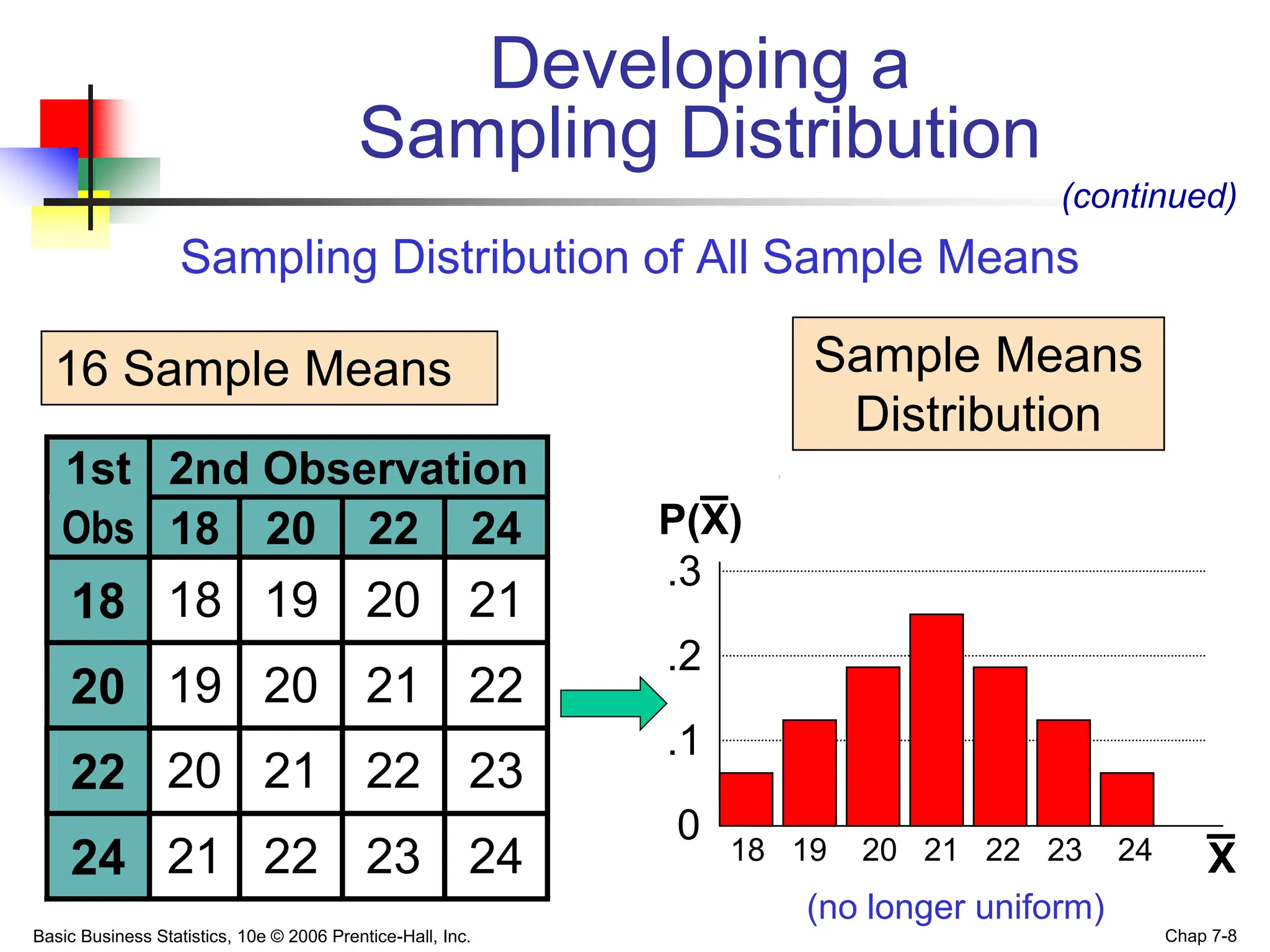
Sampling Distribution of All Sample Means
18 19 20 21 22 23 24
0
.1
.2
.3
P(X)
X
Sample Means
Distribution
16 Sample Means
_
Developing a
Sampling Distribution
(continued)
(no longer uniform)
_
Basic Business Statistics, 10e © 2006 Prentice-Hall, Inc. Chap 7-9
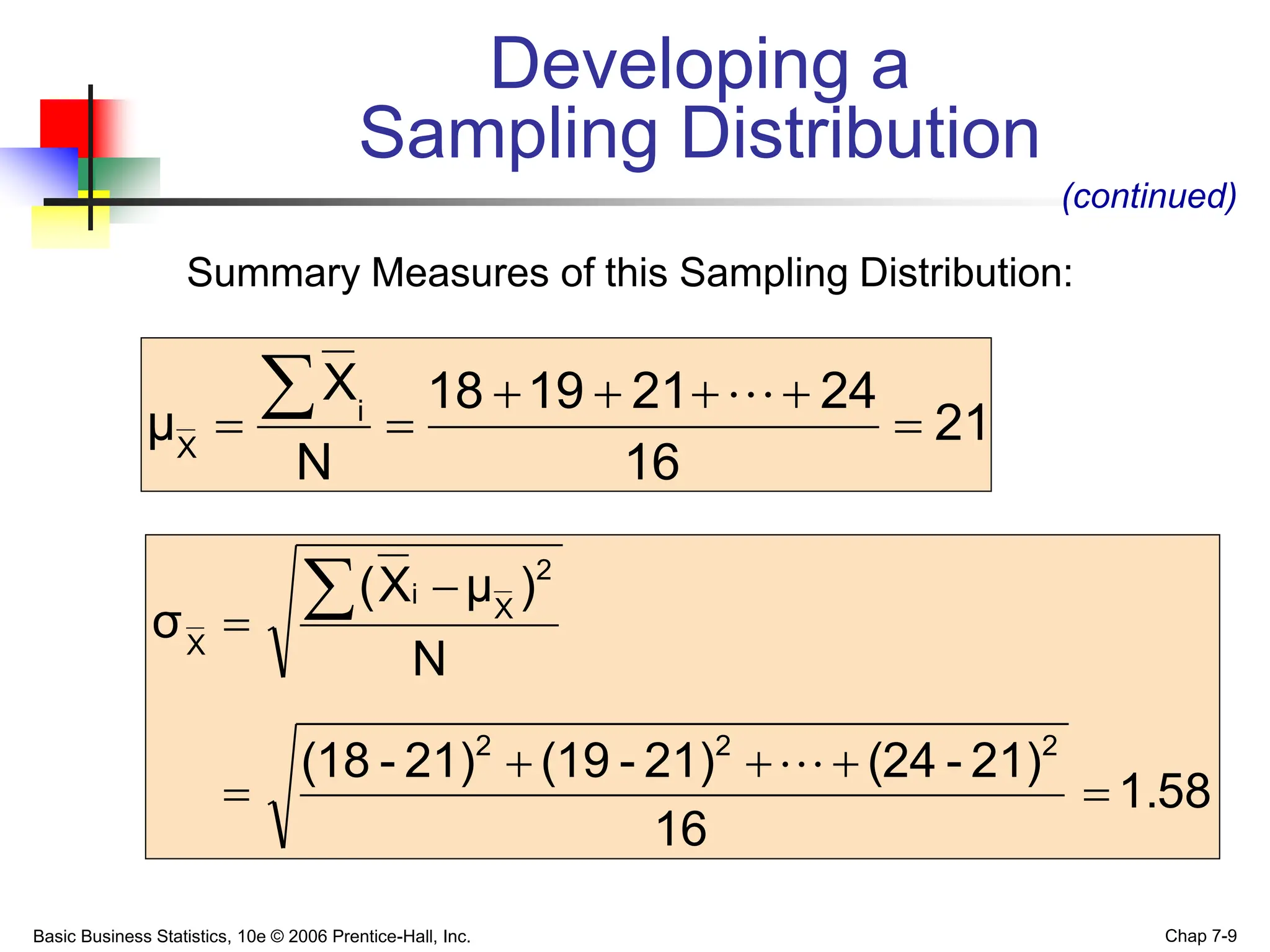
Summary Measures of this Sampling Distribution:
Developing a
Sampling Distribution
(continued)
21
16
24
21
19
18
N
X
μ i
X







 
1.58
16
21)
-
(24
21)
-
(19
21)
-
(18
N
)
μ
X
(
σ
2
2
2
2
X
i
X









Basic Business Statistics, 10e © 2006 Prentice-Hall, Inc. Chap 7-10
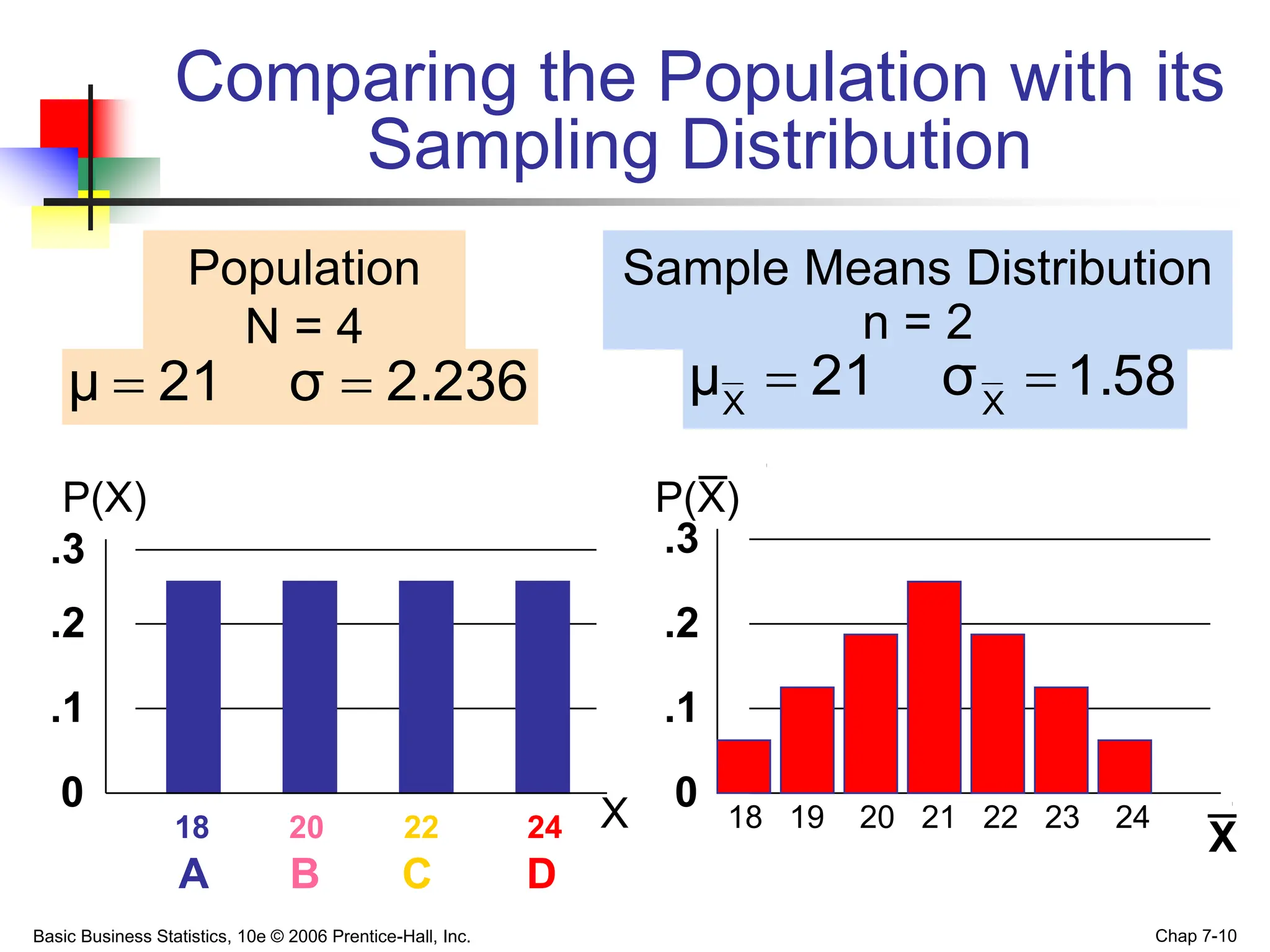
Comparing the Population with its
Sampling Distribution
18 19 20 21 22 23 24
0
.1
.2
.3
P(X)
X
18 20 22 24
A B C D
0
.1
.2
.3
Population
N = 4
P(X)
X _
1.58
σ
21
μ X
X


2.236
σ
21
μ 

Sample Means Distribution
n = 2
_
Basic Business Statistics, 10e © 2006 Prentice-Hall, Inc. Chap 7-11
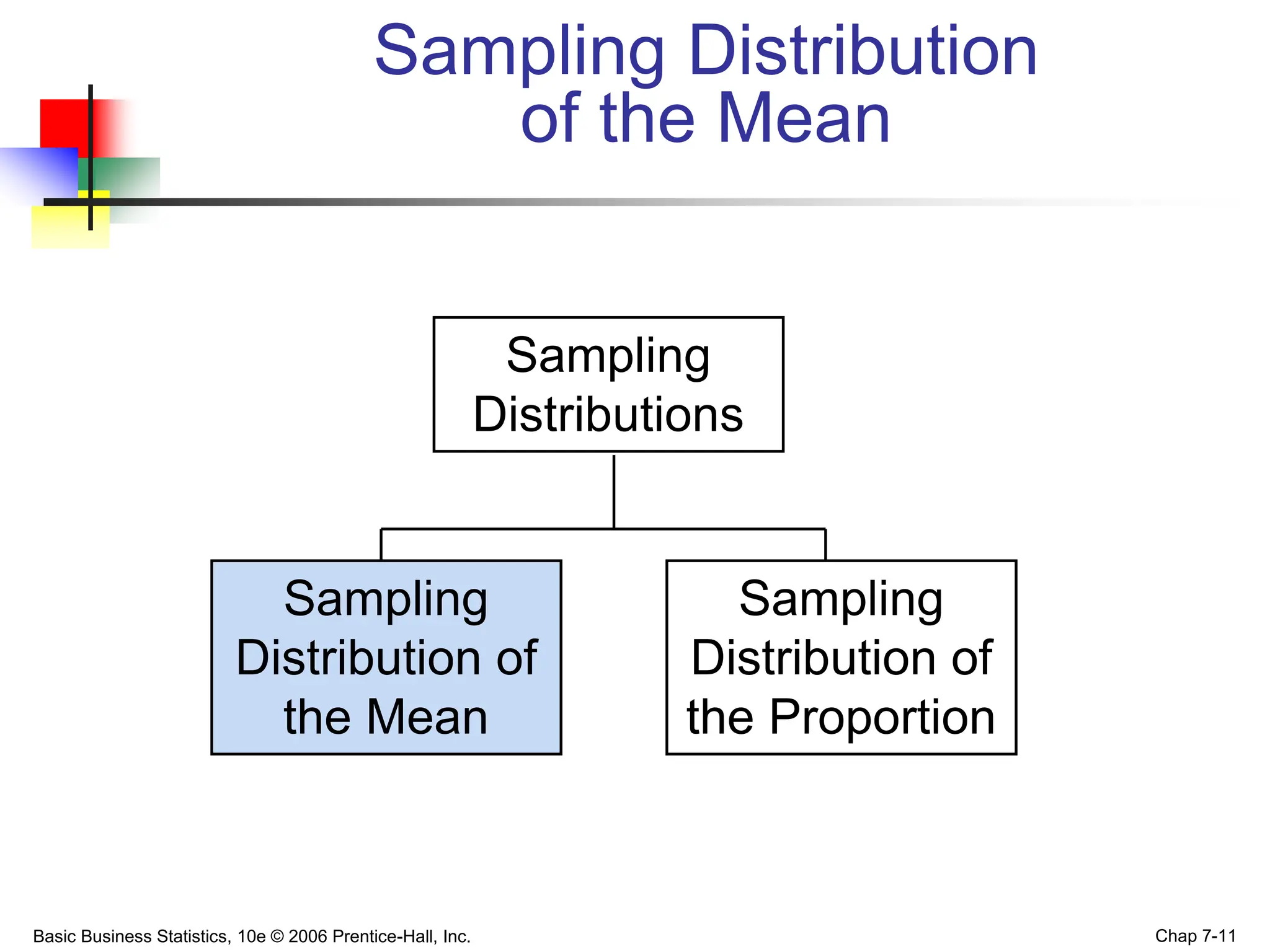
Sampling Distribution
of the Mean
Sampling
Distributions
Sampling
Distribution of
the Mean
Sampling
Distribution of
the Proportion
Basic Business Statistics, 10e © 2006 Prentice-Hall, Inc. Chap 7-12
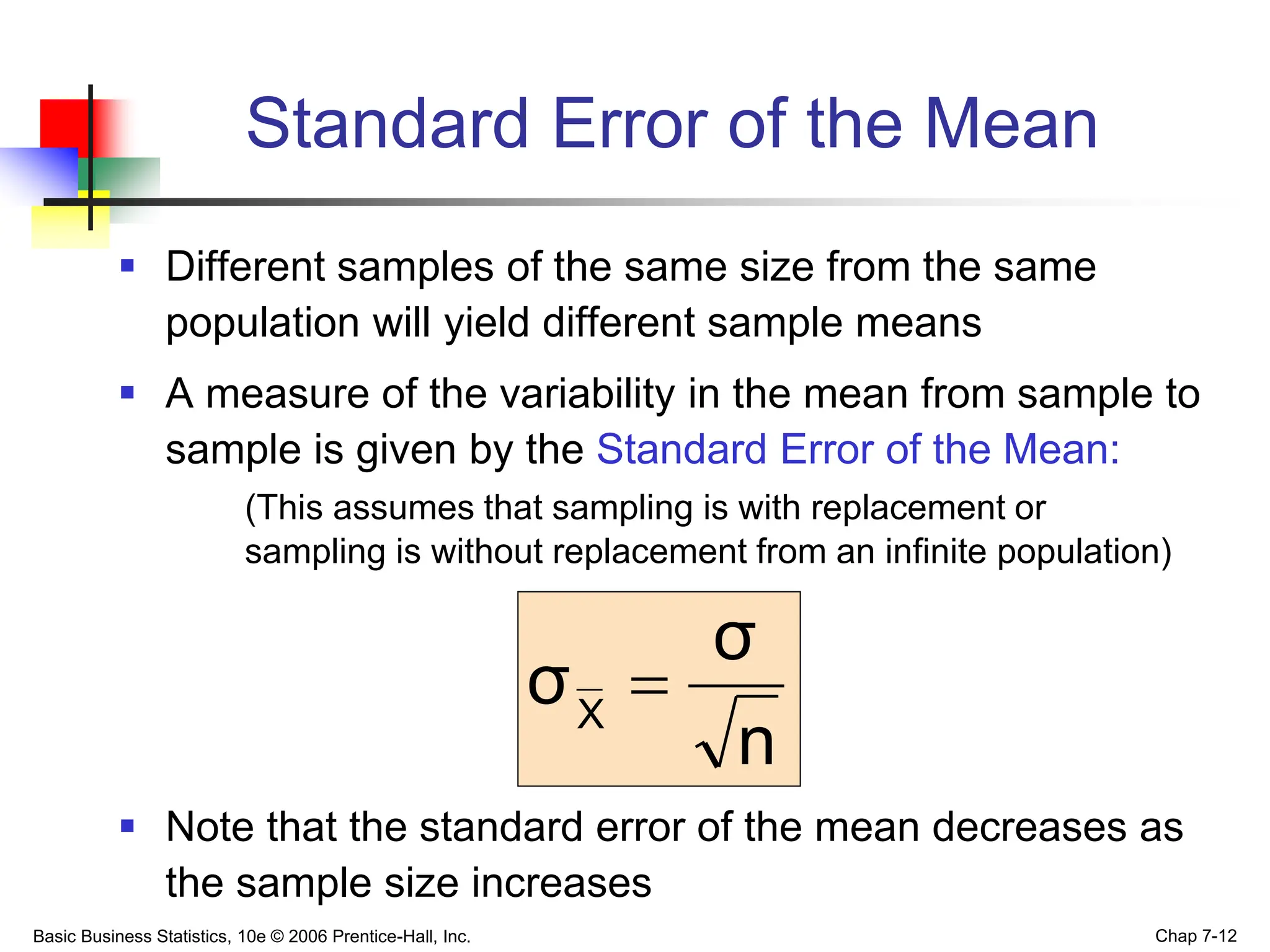
Standard Error of the Mean
 Different samples of the same size from the same
population will yield different sample means
 A measure of the variability in the mean from sample to
sample is given by the Standard Error of the Mean:
(This assumes that sampling is with replacement or
sampling is without replacement from an infinite population)
 Note that the standard error of the mean decreases as
the sample size increases
n
σ
σX

Basic Business Statistics, 10e © 2006 Prentice-Hall, Inc. Chap 7-13
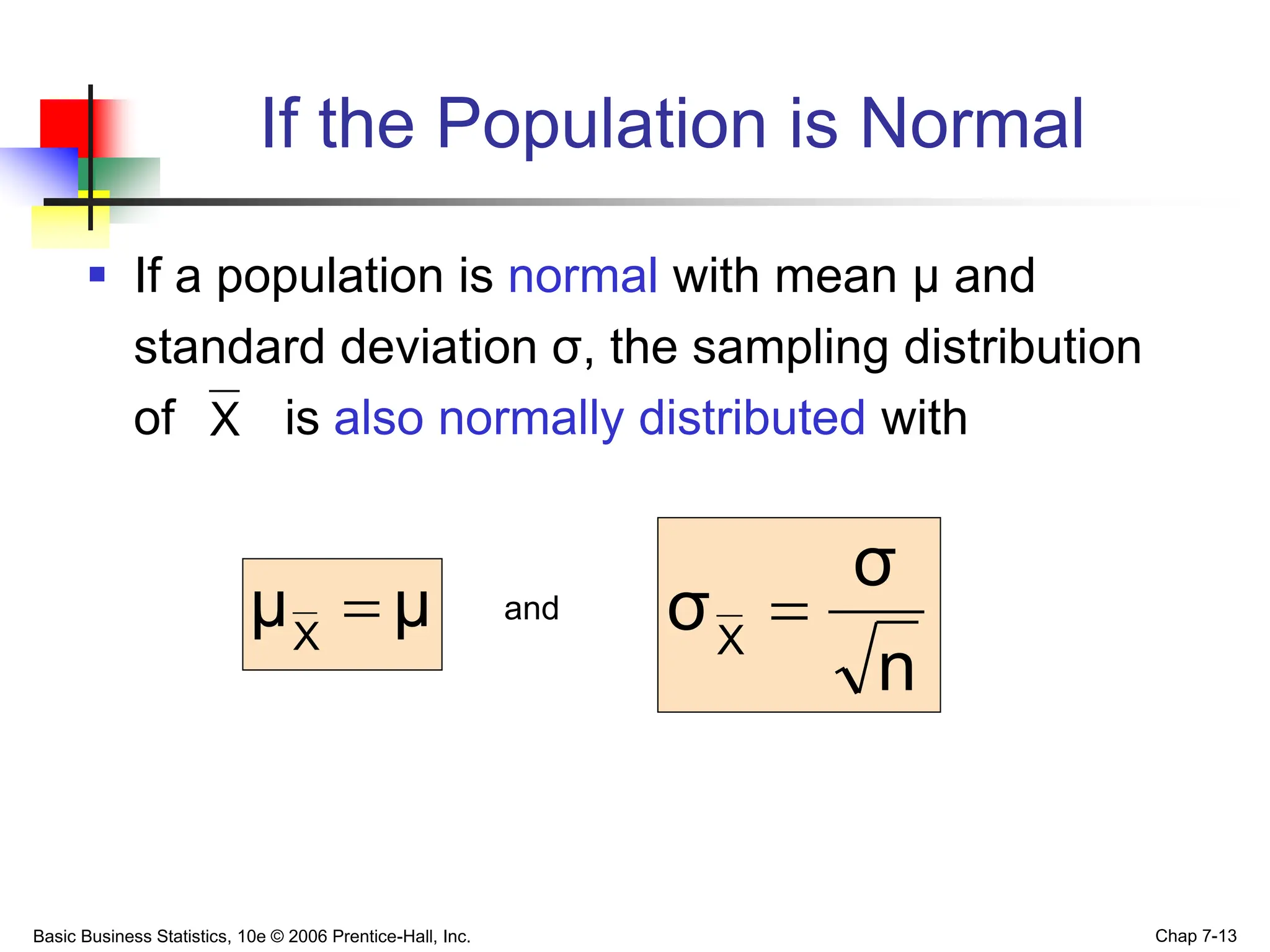
If the Population is Normal
 If a population is normal with mean μ and
standard deviation σ, the sampling distribution
of is also normally distributed with
and
X
μ
μX

n
σ
σX

Basic Business Statistics, 10e © 2006 Prentice-Hall, Inc. Chap 7-14
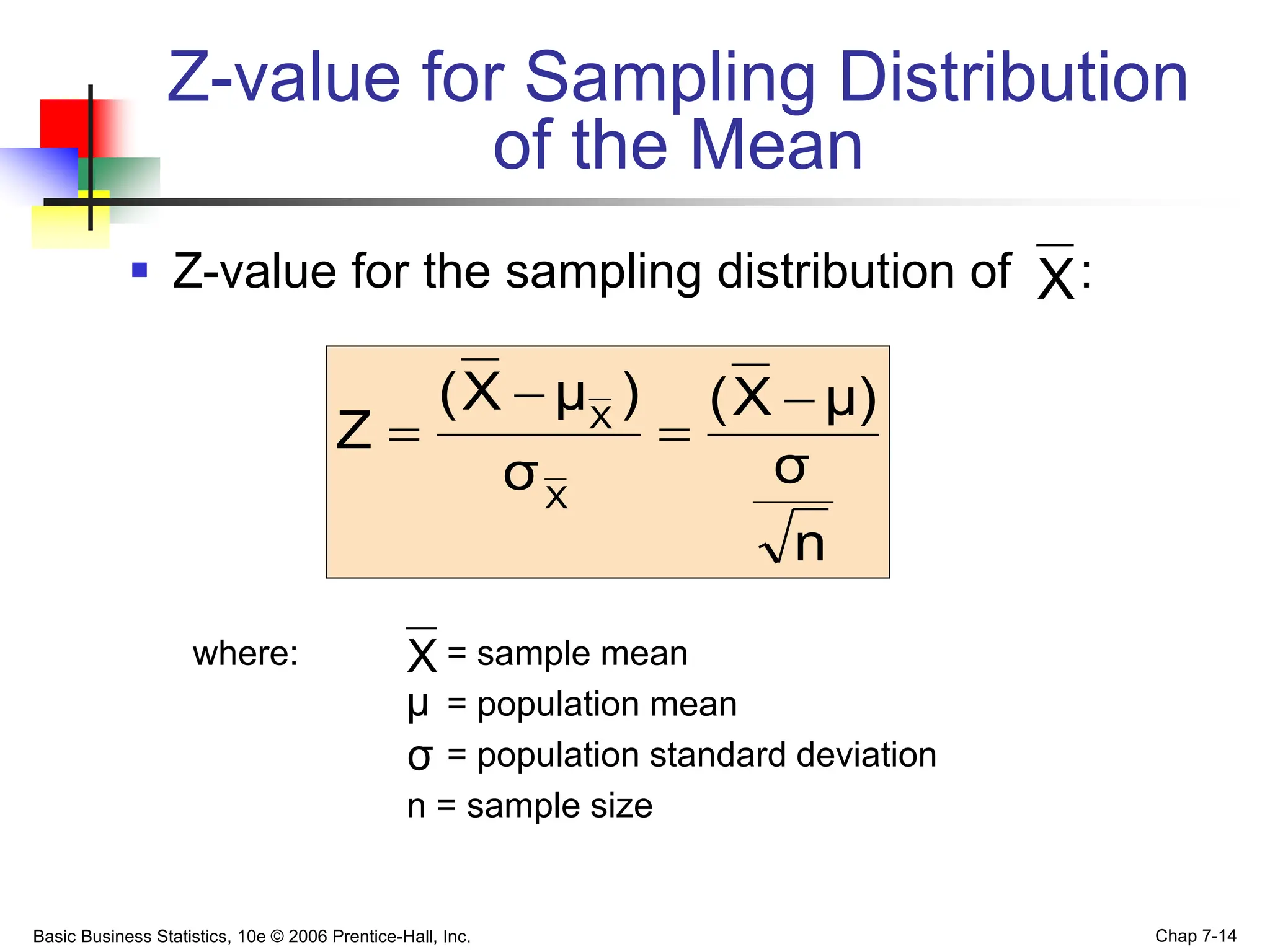
Z-value for Sampling Distribution
of the Mean
 Z-value for the sampling distribution of :
where: = sample mean
= population mean
= population standard deviation
n = sample size
X
μ
σ
n
σ
μ)
X
(
σ
)
μ
X
(
Z
X
X 



X
Basic Business Statistics, 10e © 2006 Prentice-Hall, Inc. Chap 7-15
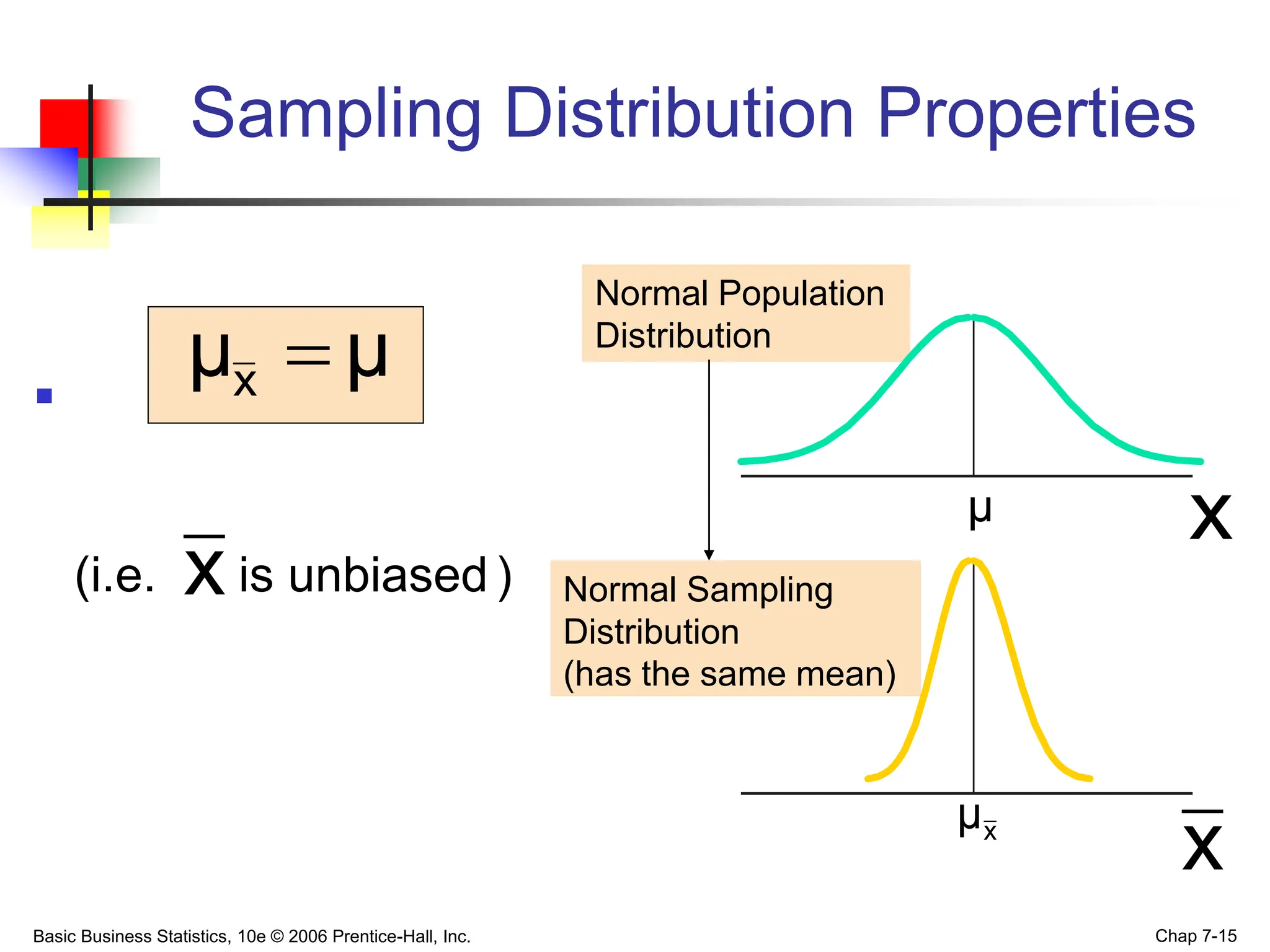
Normal Population
Distribution
Normal Sampling
Distribution
(has the same mean)
Sampling Distribution Properties

(i.e. is unbiased )
x
x
x
μ
μx 
μ
x
μ
Basic Business Statistics, 10e © 2006 Prentice-Hall, Inc. Chap 7-16
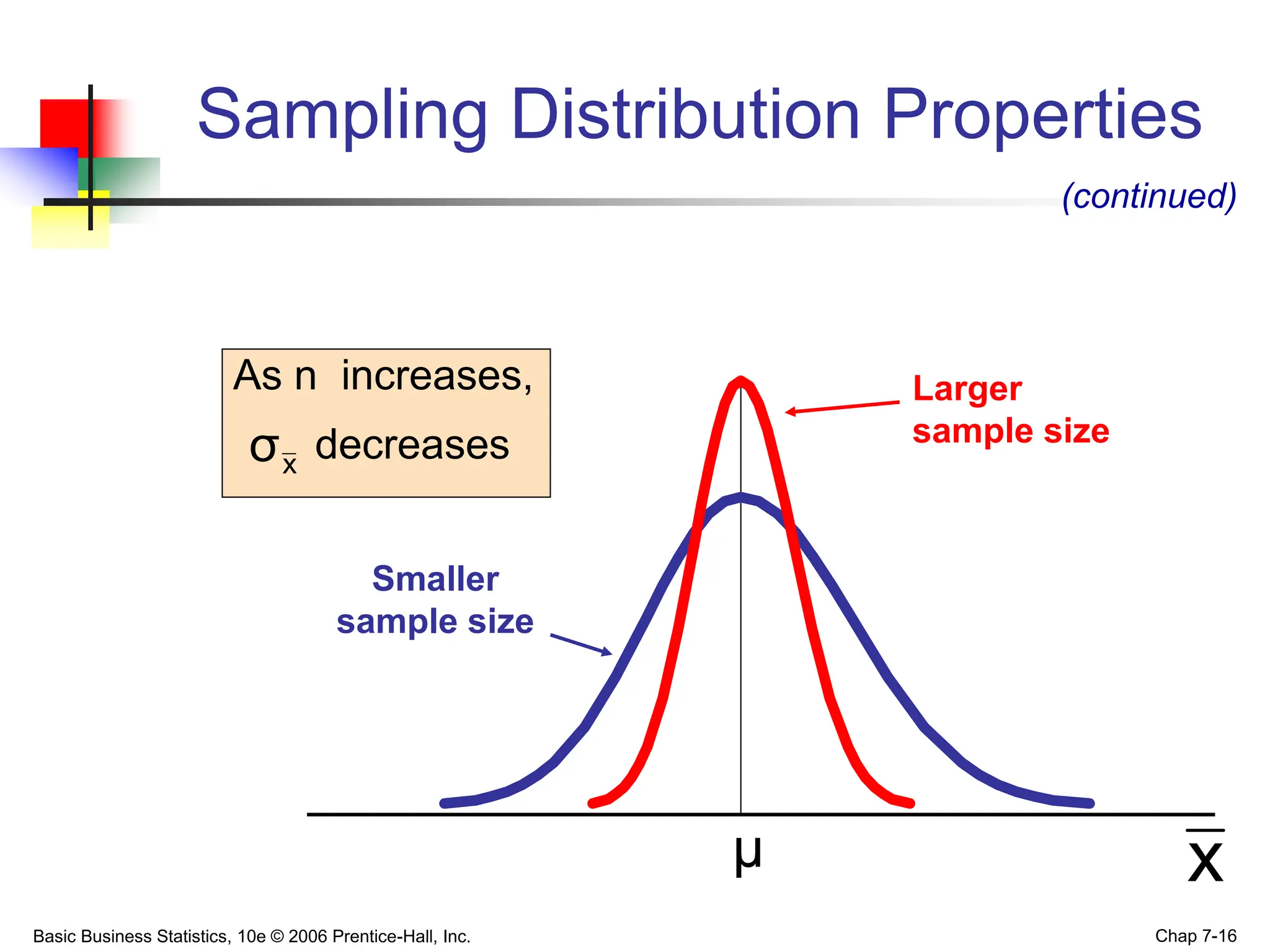
Sampling Distribution Properties
As n increases,
decreases
Larger
sample size
Smaller
sample size
x
(continued)
x
σ
μ
Basic Business Statistics, 10e © 2006 Prentice-Hall, Inc. Chap 7-17
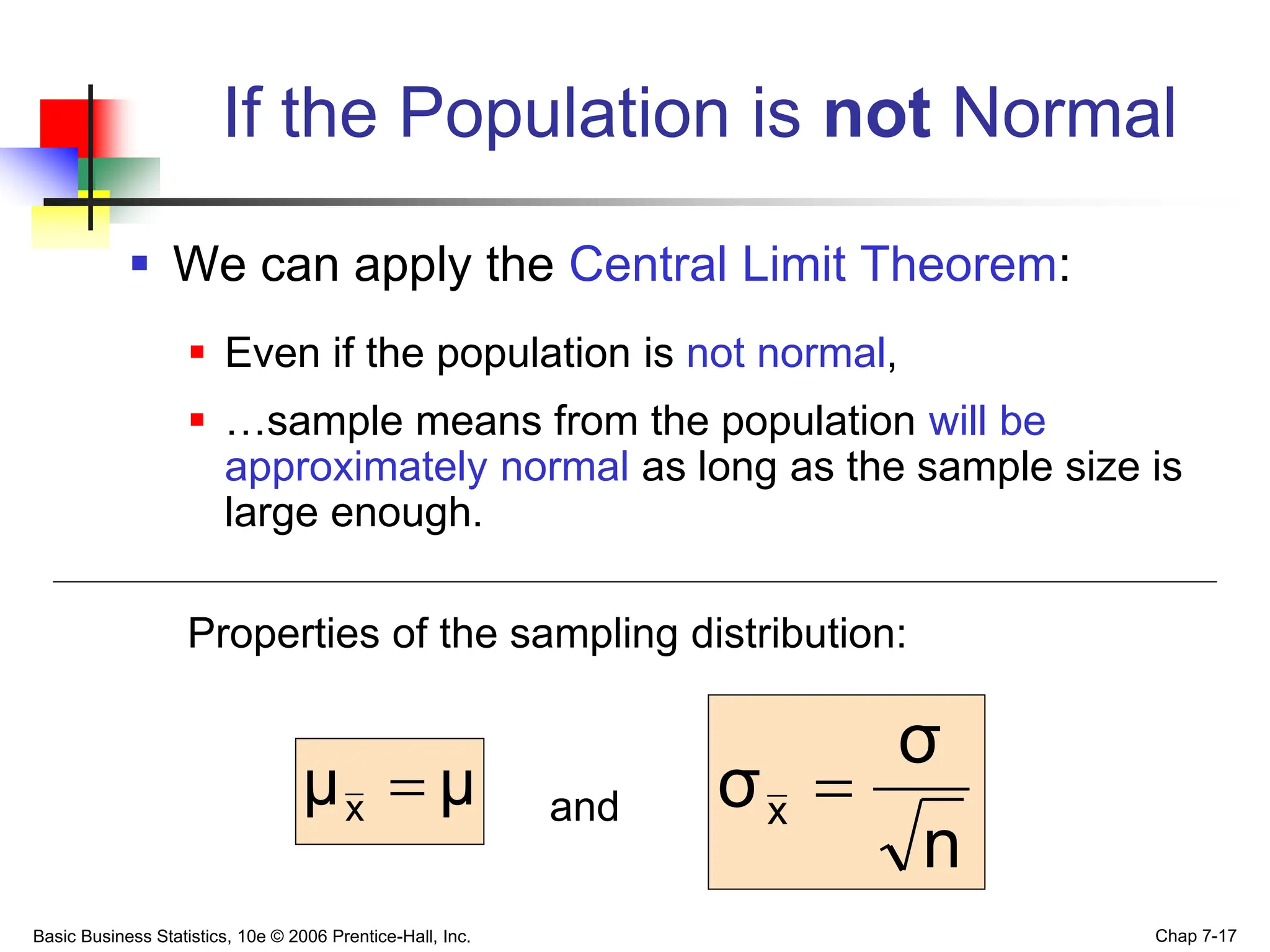
If the Population is not Normal
 We can apply the Central Limit Theorem:
 Even if the population is not normal,
 …sample means from the population will be
approximately normal as long as the sample size is
large enough.
Properties of the sampling distribution:
and
μ
μx 
n
σ
σx 
Basic Business Statistics, 10e © 2006 Prentice-Hall, Inc. Chap 7-18
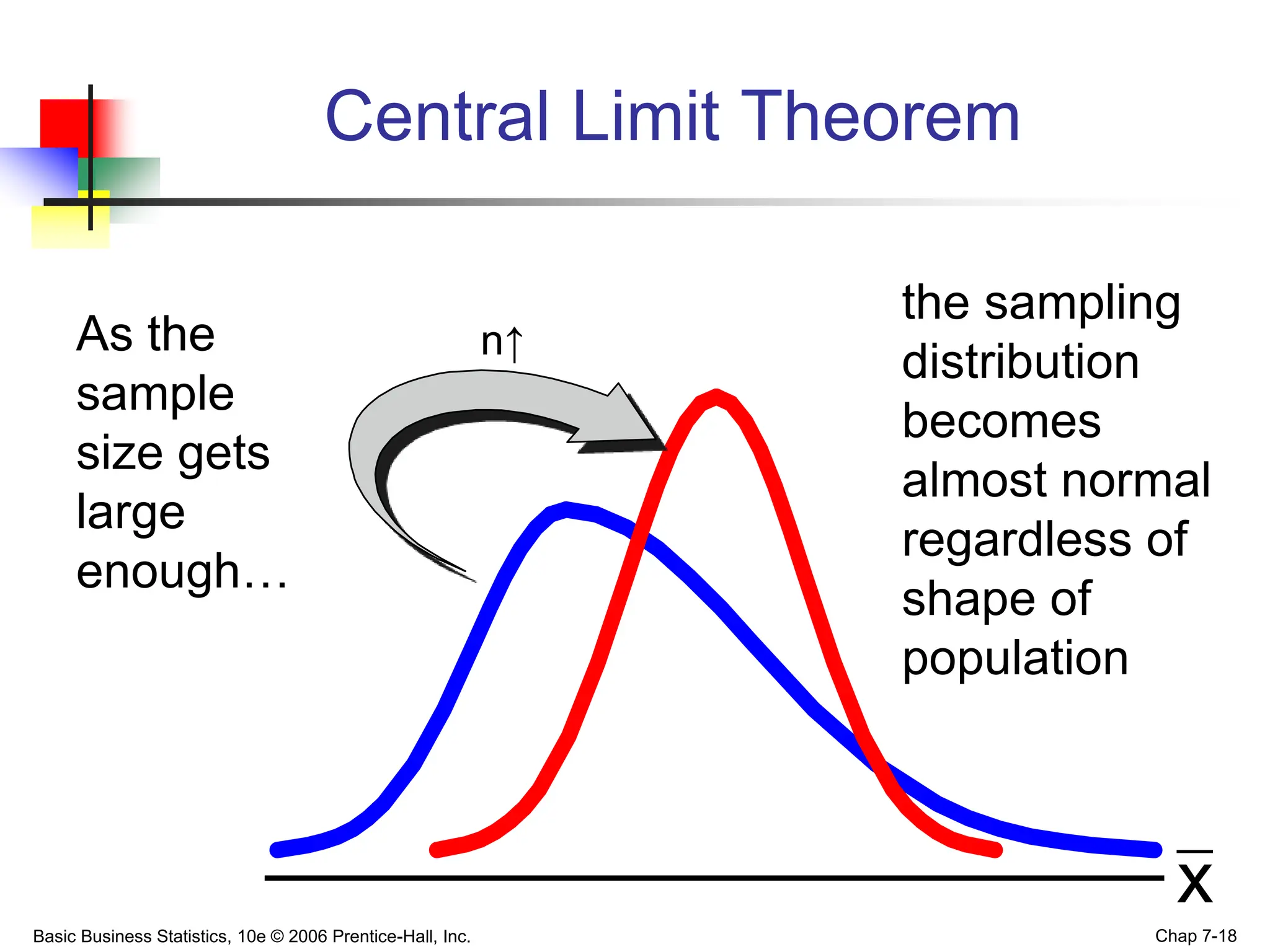
n↑
Central Limit Theorem
As the
sample
size gets
large
enough…
the sampling
distribution
becomes
almost normal
regardless of
shape of
population
x
Basic Business Statistics, 10e © 2006 Prentice-Hall, Inc. Chap 7-19
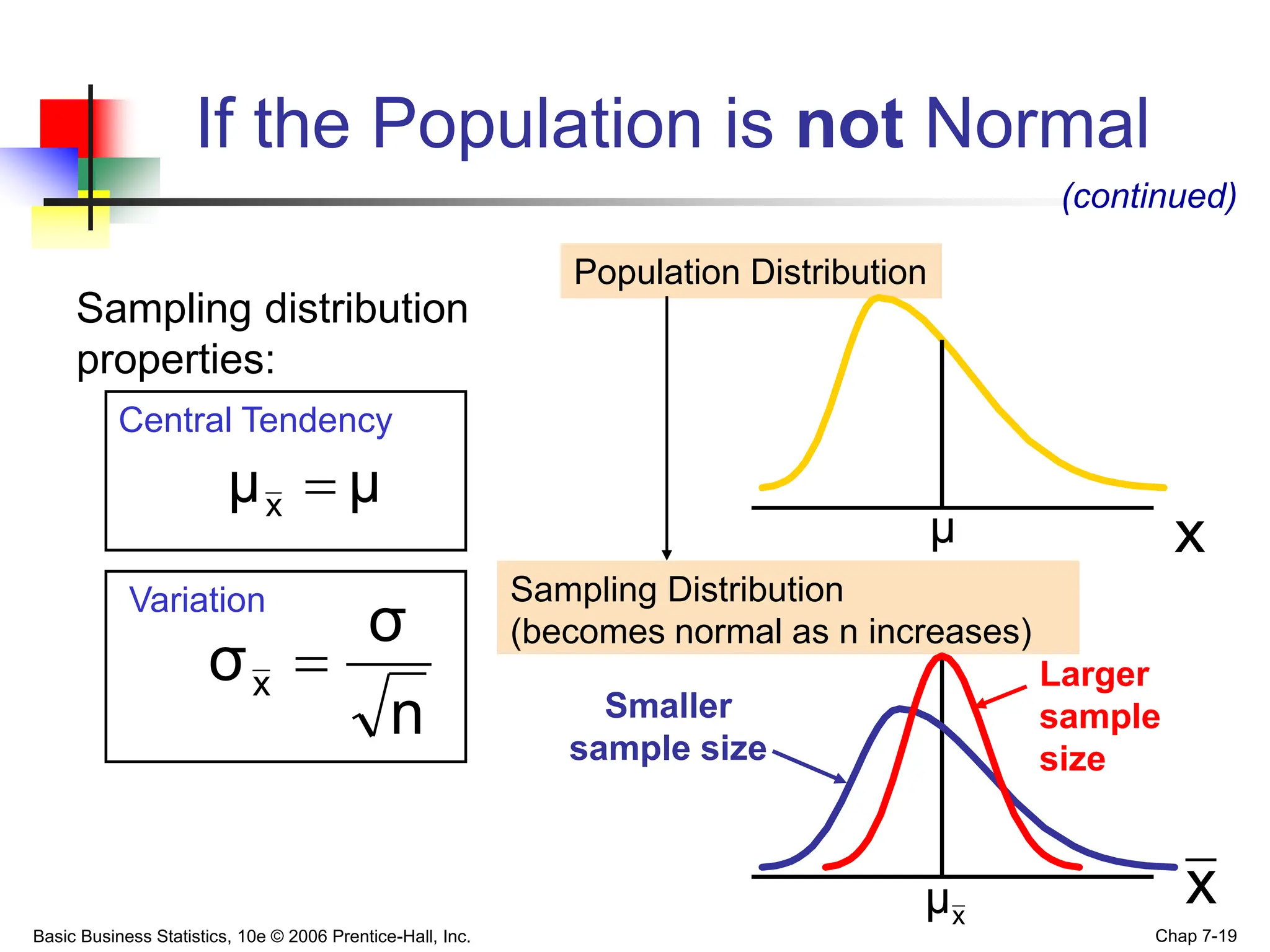
Population Distribution
Sampling Distribution
(becomes normal as n increases)
Central Tendency
Variation
x
x
Larger
sample
size
Smaller
sample size
If the Population is not Normal
(continued)
Sampling distribution
properties:
μ
μx 
n
σ
σx 
x
μ
μ
Basic Business Statistics, 10e © 2006 Prentice-Hall, Inc. Chap 7-20
How Large is Large Enough?
 For most distributions, n > 30 will give a
sampling distribution that is nearly normal
 For fairly symmetric distributions, n > 15
 For normal population distributions, the
sampling distribution of the mean is always
normally distributed
Basic Business Statistics, 10e © 2006 Prentice-Hall, Inc. Chap 7-21
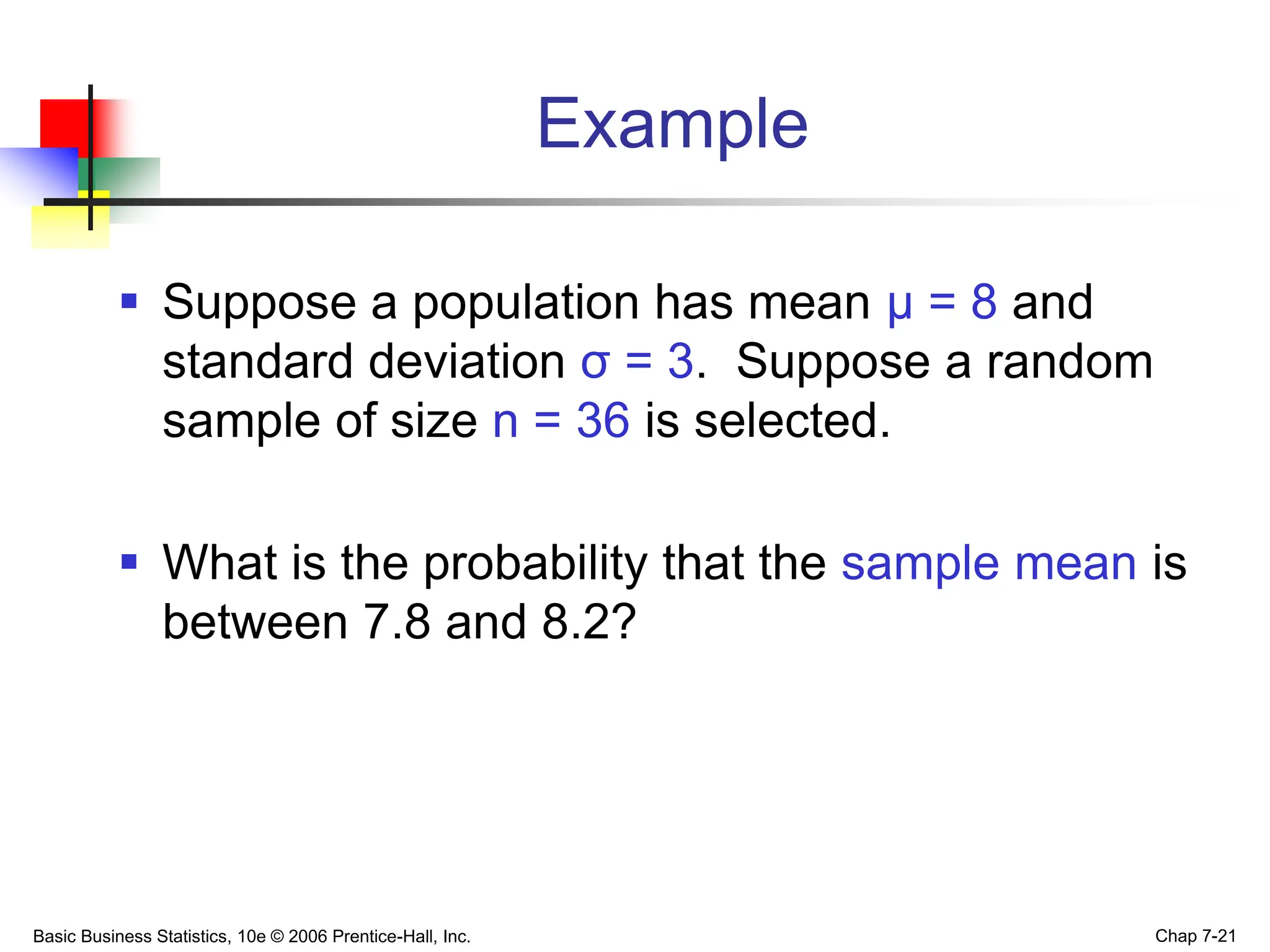
Example
 Suppose a population has mean μ = 8 and
standard deviation σ = 3. Suppose a random
sample of size n = 36 is selected.
 What is the probability that the sample mean is
between 7.8 and 8.2?
Basic Business Statistics, 10e © 2006 Prentice-Hall, Inc. Chap 7-22
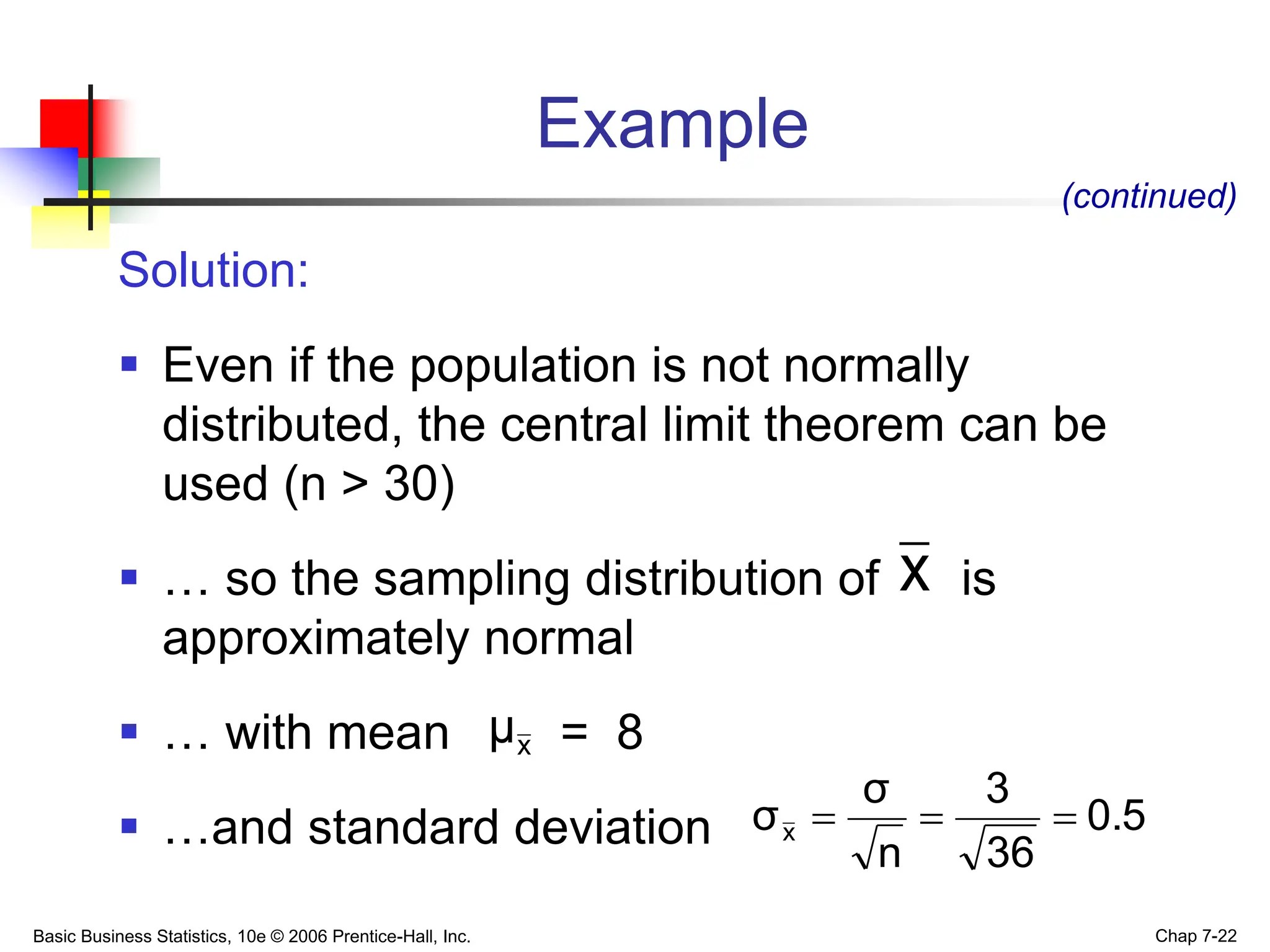
Example
Solution:
 Even if the population is not normally
distributed, the central limit theorem can be
used (n > 30)
 … so the sampling distribution of is
approximately normal
 … with mean = 8
 …and standard deviation
(continued)
x
x
μ
0.5
36
3
n
σ
σx 


Basic Business Statistics, 10e © 2006 Prentice-Hall, Inc. Chap 7-23
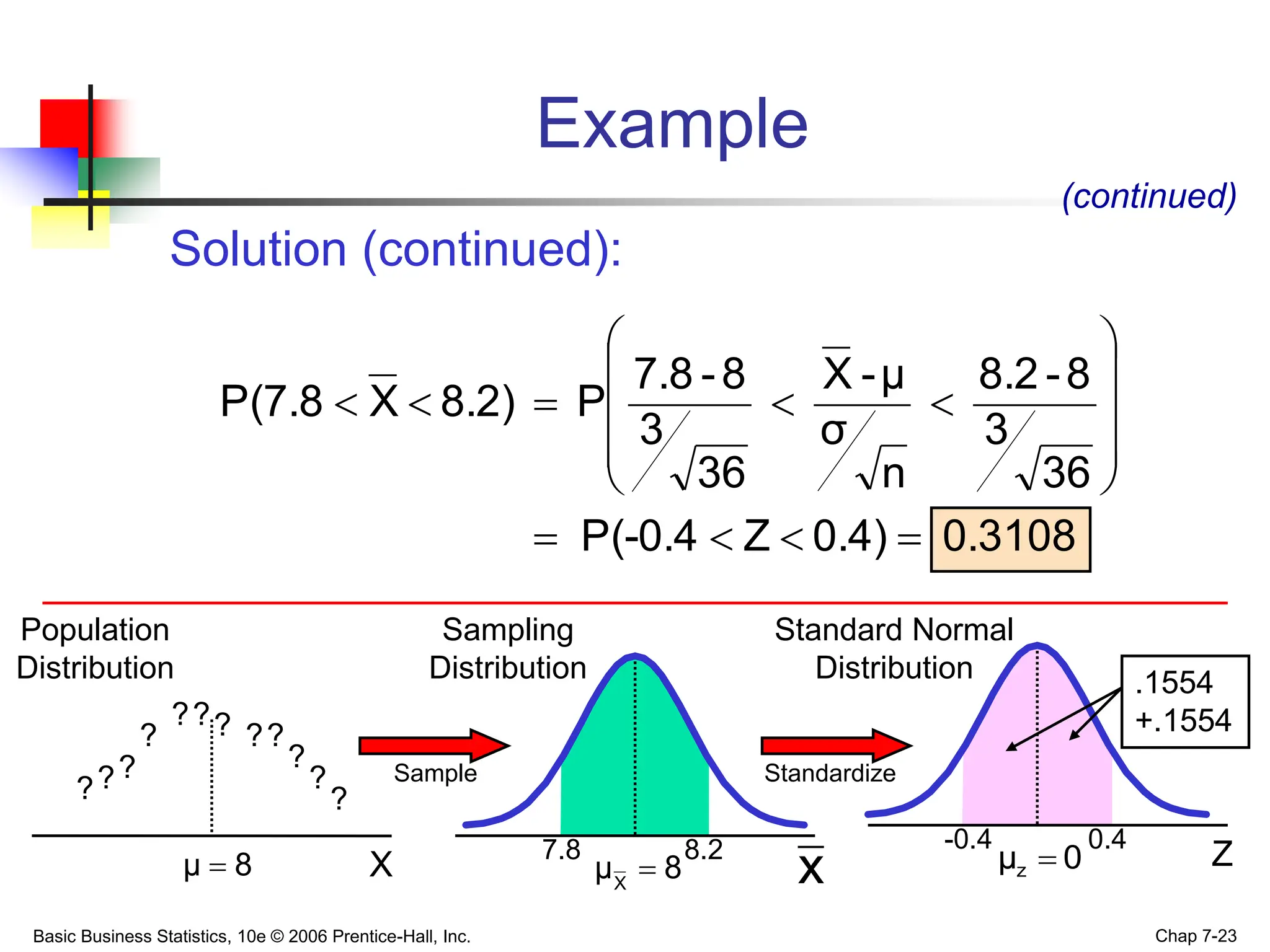
Example
Solution (continued):
(continued)
0.3108
0.4)
Z
P(-0.4
36
3
8
-
8.2
n
σ
μ
-
X
36
3
8
-
7.8
P
8.2)
X
P(7.8



















Z
7.8 8.2 -0.4 0.4
Sampling
Distribution
Standard Normal
Distribution .1554
+.1554
Population
Distribution
?
?
?
?
?
?
?
?
?
?
?
?
Sample Standardize
8
μ  8
μX
 0
μz 
x
X
Basic Business Statistics, 10e © 2006 Prentice-Hall, Inc. Chap 7-24
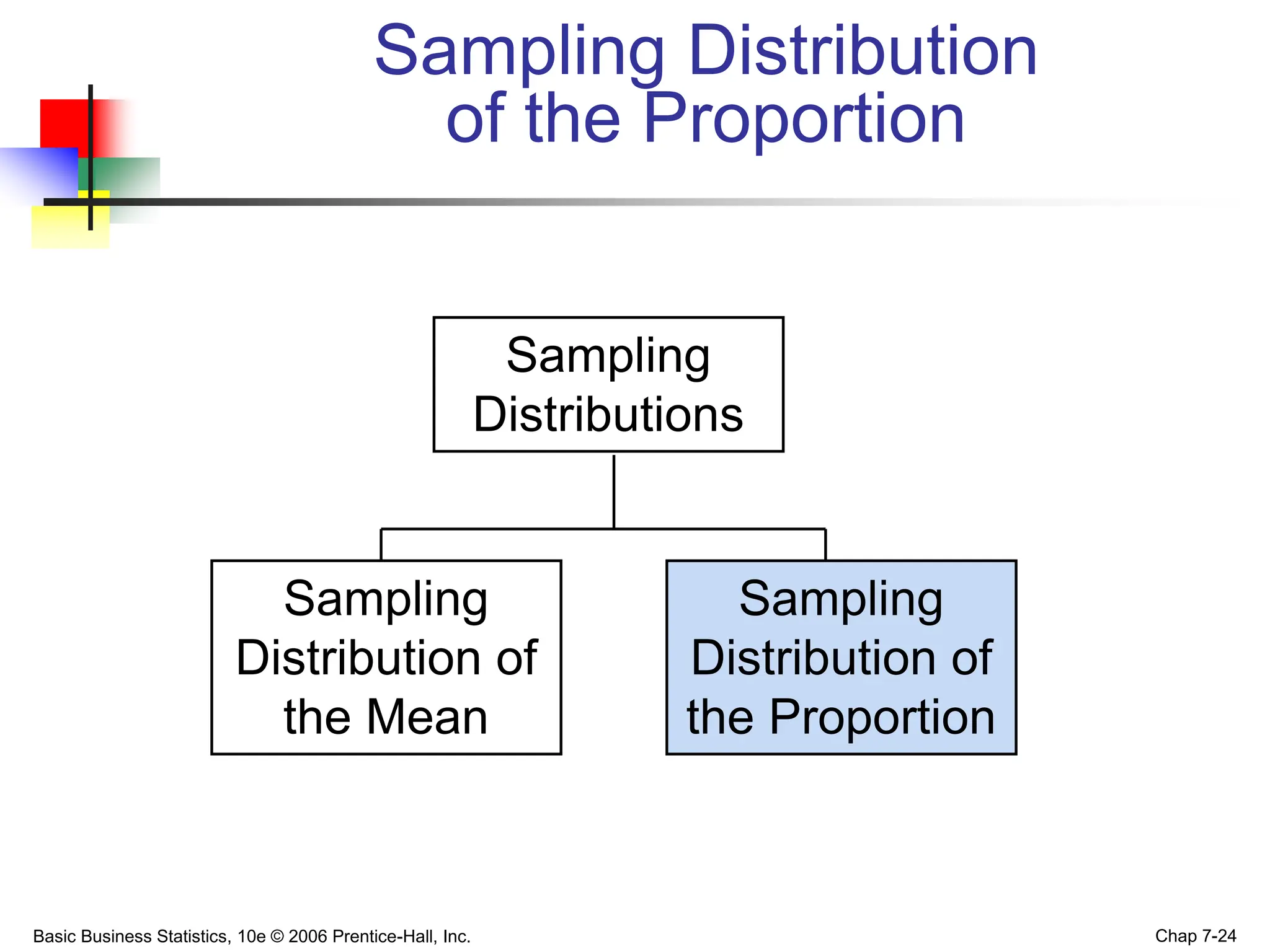
Sampling Distribution
of the Proportion
Sampling
Distributions
Sampling
Distribution of
the Mean
Sampling
Distribution of
the Proportion
Basic Business Statistics, 10e © 2006 Prentice-Hall, Inc. Chap 7-25
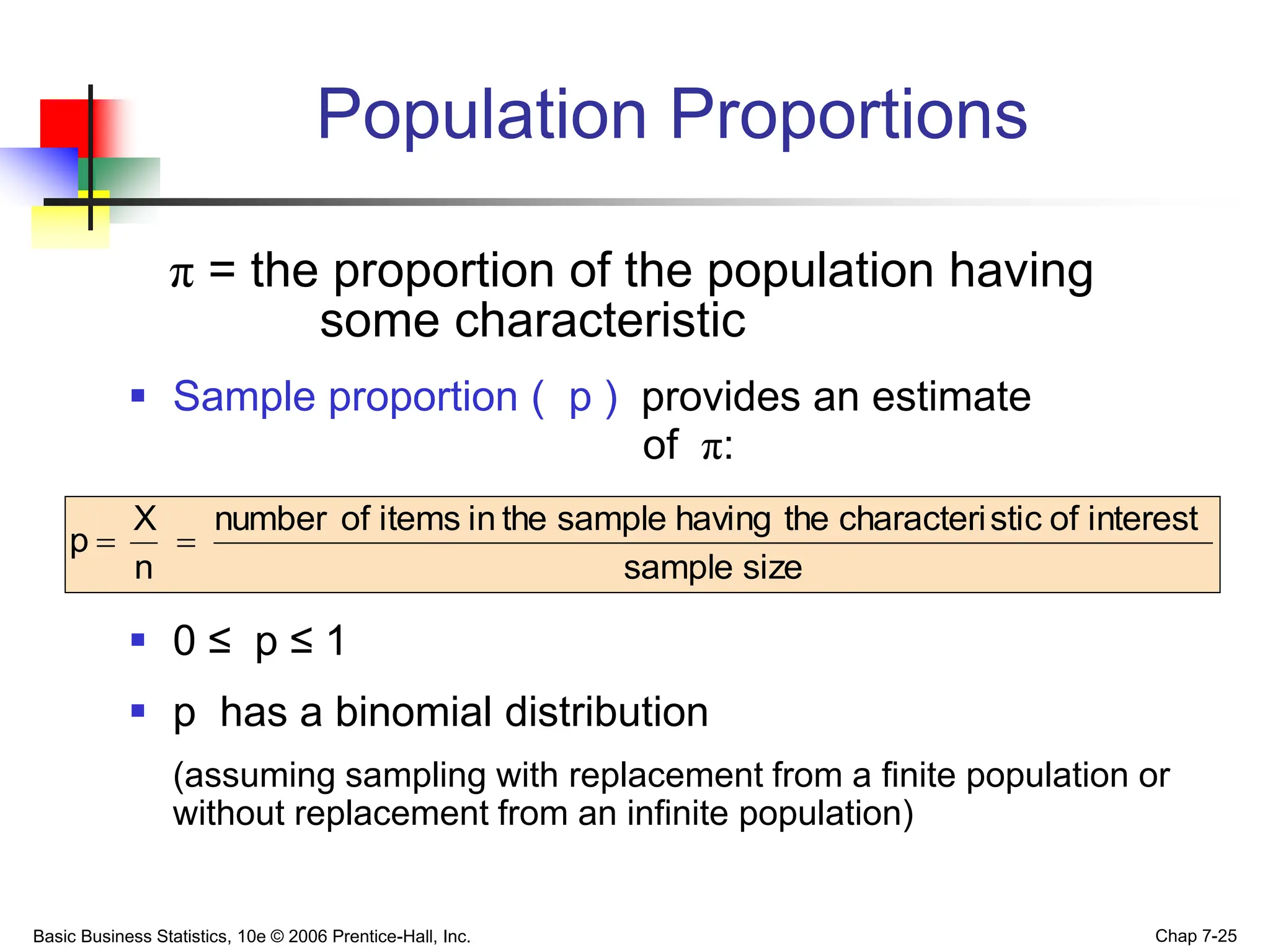
Population Proportions
π = the proportion of the population having
some characteristic
 Sample proportion ( p ) provides an estimate
of π:
 0 ≤ p ≤ 1
 p has a binomial distribution
(assuming sampling with replacement from a finite population or
without replacement from an infinite population)
size
sample
interest
of
stic
characteri
the
having
sample
the
in
items
of
number
n
X
p 

Basic Business Statistics, 10e © 2006 Prentice-Hall, Inc. Chap 7-26
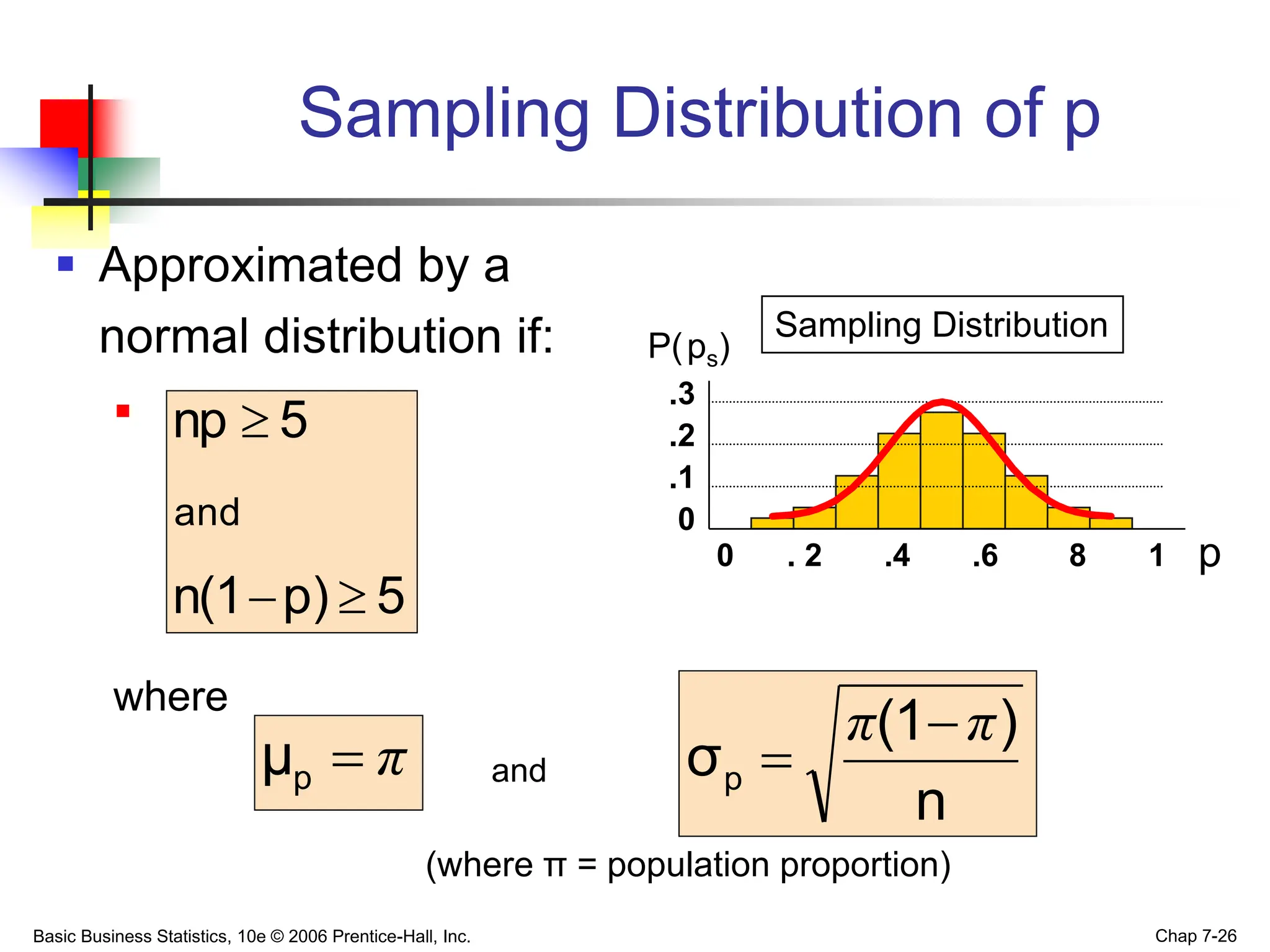
Sampling Distribution of p
 Approximated by a
normal distribution if:

where
and
(where π = population proportion)
Sampling Distribution
P(ps)
.3
.2
.1
0
0 . 2 .4 .6 8 1 p
π

p
μ
n
)
(1
σp
π
π 

5
p)
n(1
5
np
and



Basic Business Statistics, 10e © 2006 Prentice-Hall, Inc. Chap 7-27
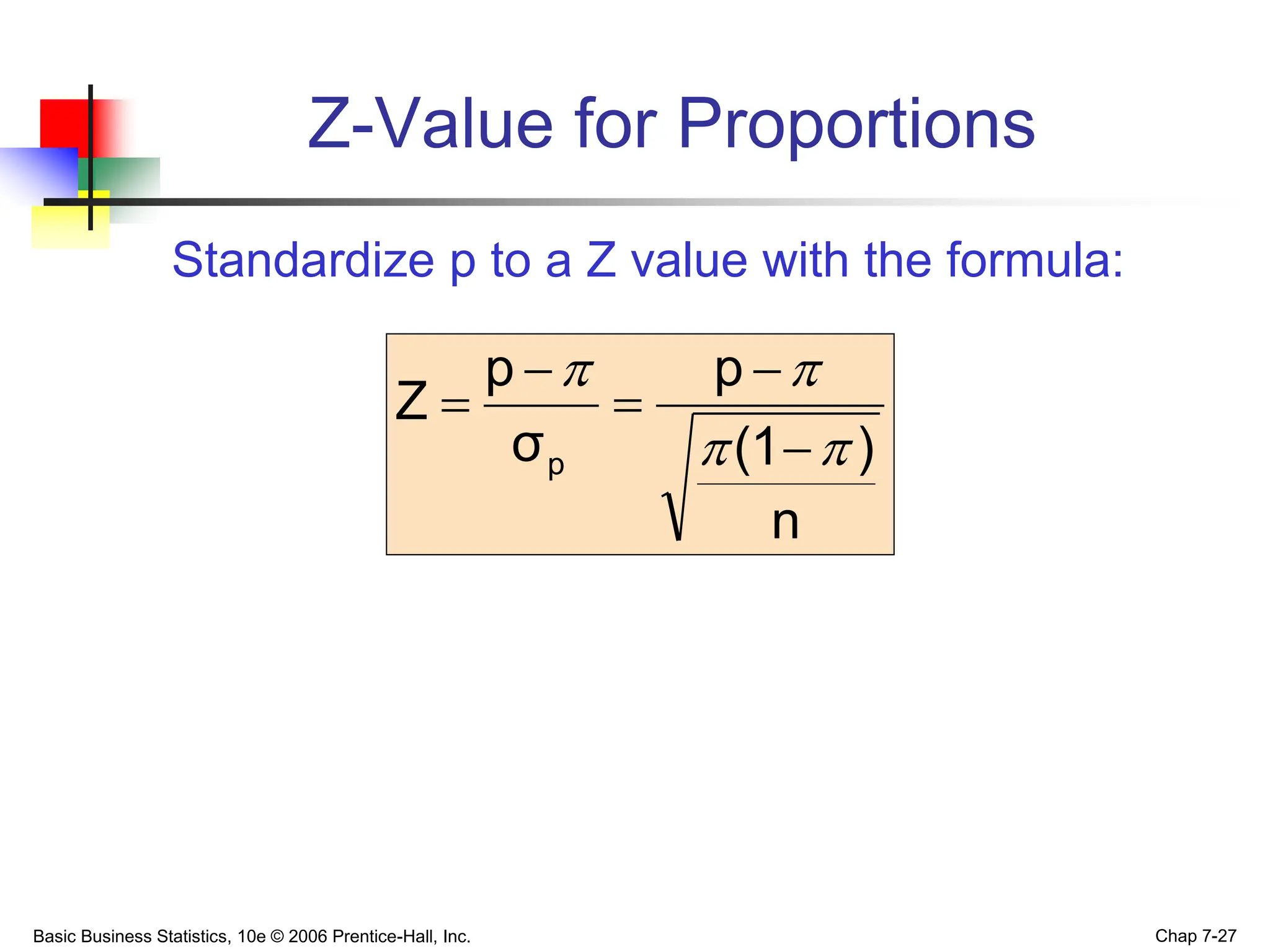
Z-Value for Proportions
n
)
(1
p
σ
p
Z
p 








Standardize p to a Z value with the formula:
Basic Business Statistics, 10e © 2006 Prentice-Hall, Inc. Chap 7-28
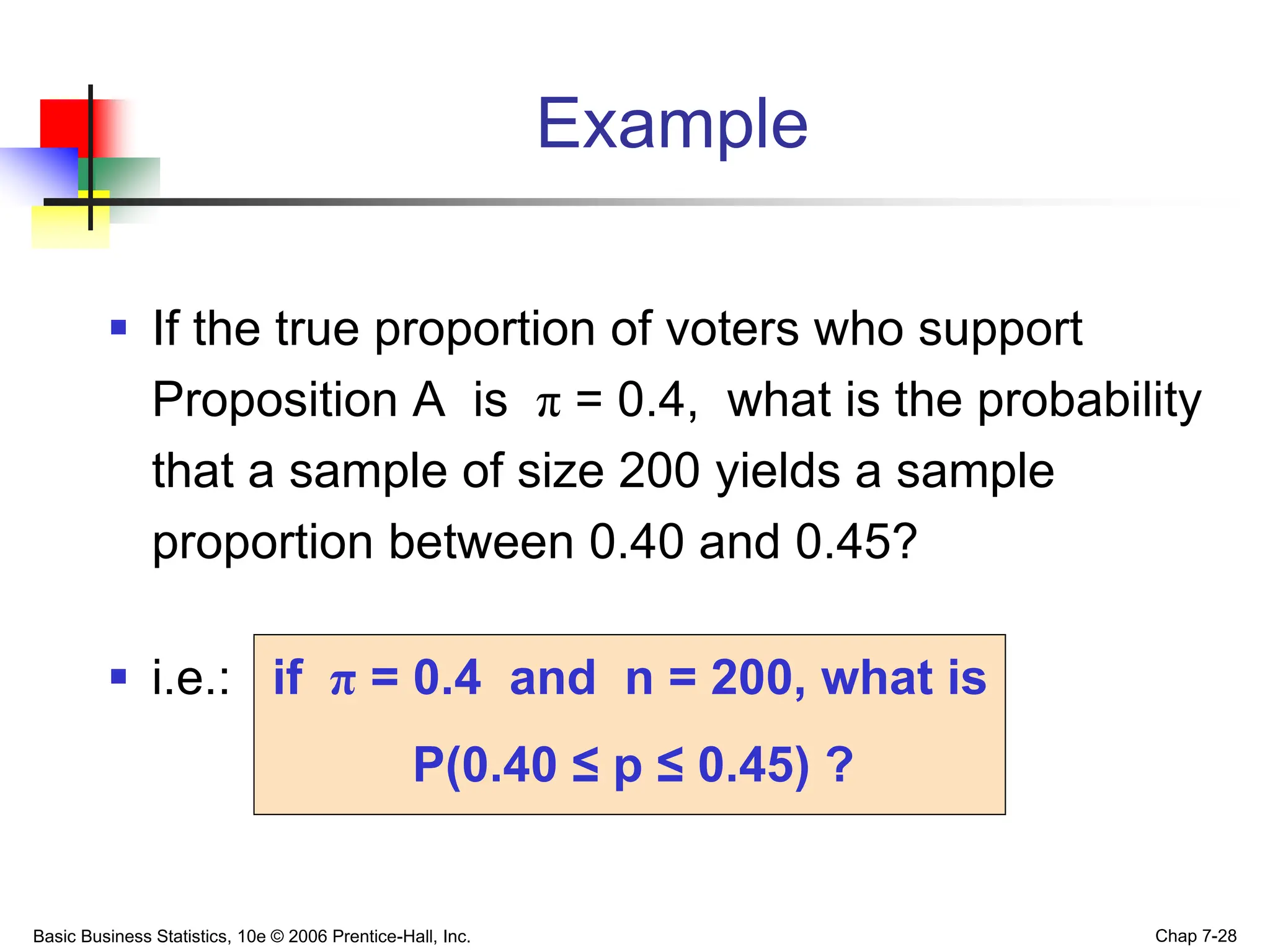
Example
 If the true proportion of voters who support
Proposition A is π = 0.4, what is the probability
that a sample of size 200 yields a sample
proportion between 0.40 and 0.45?
 i.e.: if π = 0.4 and n = 200, what is
P(0.40 ≤ p ≤ 0.45) ?
Basic Business Statistics, 10e © 2006 Prentice-Hall, Inc. Chap 7-29
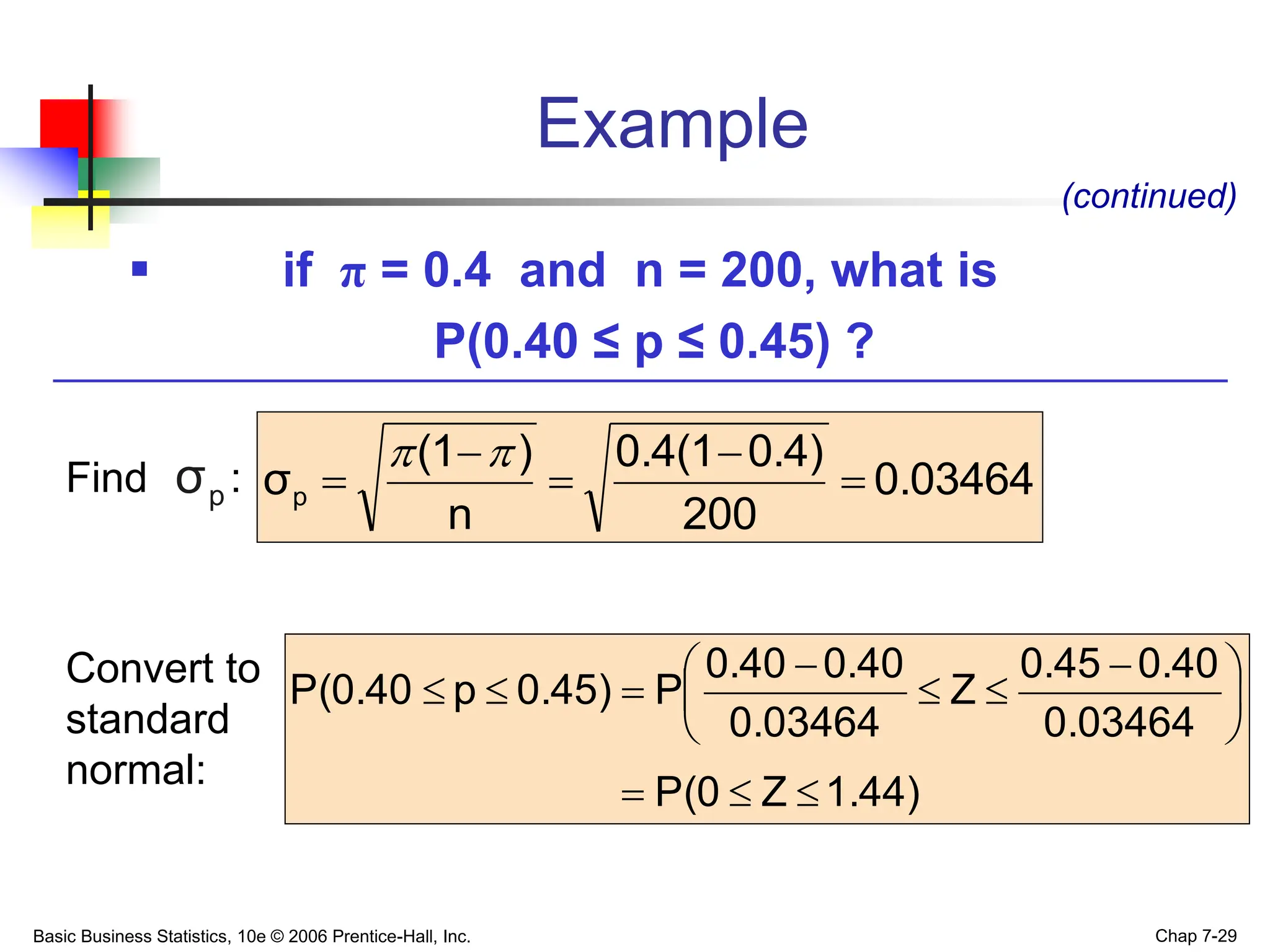
Example
 if π = 0.4 and n = 200, what is
P(0.40 ≤ p ≤ 0.45) ?
(continued)
0.03464
200
0.4)
0.4(1
n
)
(1
σp 






1.44)
Z
P(0
0.03464
0.40
0.45
Z
0.03464
0.40
0.40
P
0.45)
p
P(0.40








 






Find :
Convert to
standard
normal:
p
σ
Basic Business Statistics, 10e © 2006 Prentice-Hall, Inc. Chap 7-30
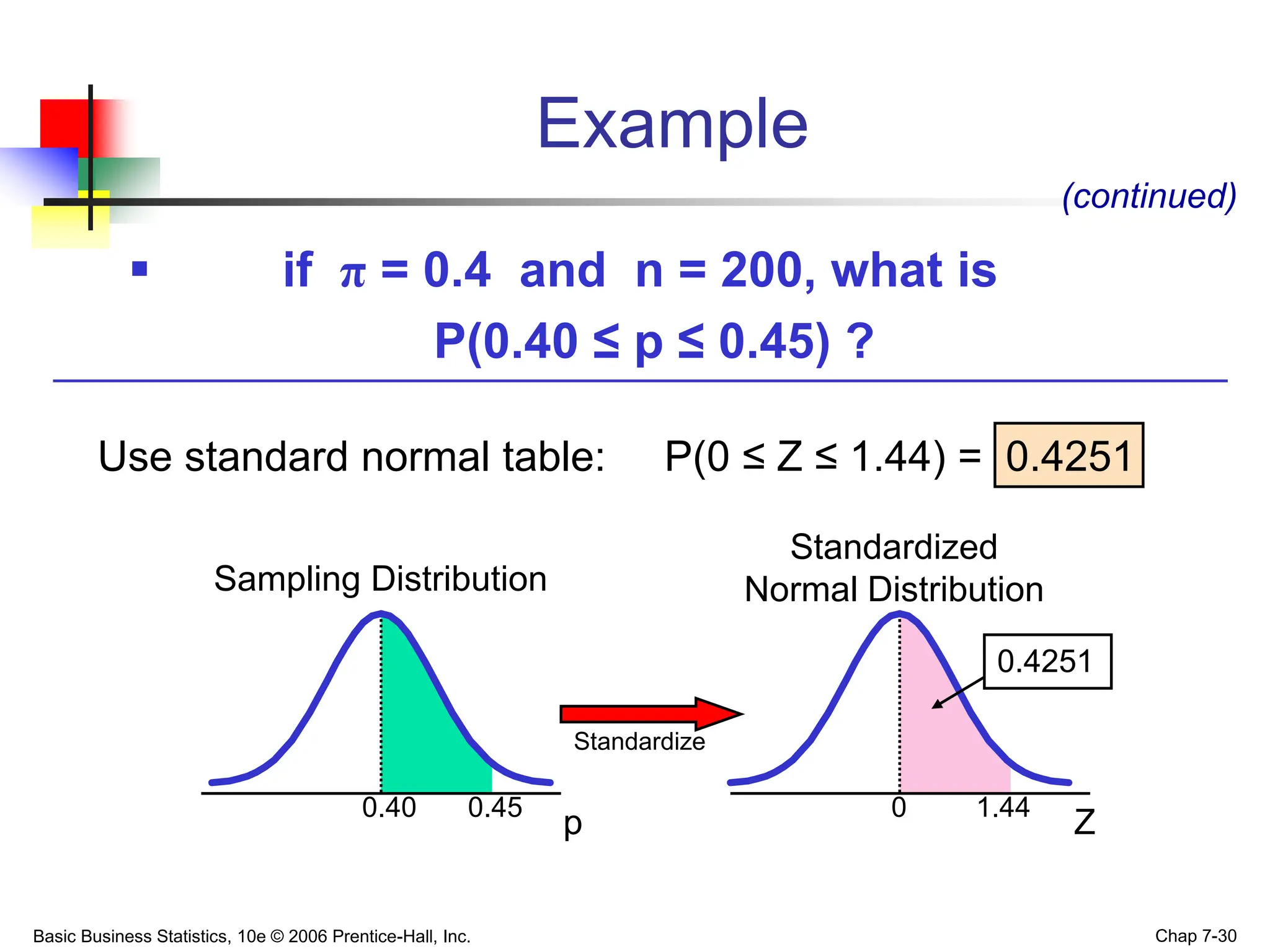
Example
Z
0.45 1.44
0.4251
Standardize
Sampling Distribution
Standardized
Normal Distribution
 if π = 0.4 and n = 200, what is
P(0.40 ≤ p ≤ 0.45) ?
(continued)
Use standard normal table: P(0 ≤ Z ≤ 1.44) = 0.4251
0.40 0
p
Basic Business Statistics, 10e © 2006 Prentice-Hall, Inc. Chap 7-31
Reasons for Drawing a Sample
 Less time consuming than a census
 Less costly to administer than a census
 Less cumbersome and more practical to
administer than a census of the targeted
population
Basic Business Statistics, 10e © 2006 Prentice-Hall, Inc. Chap 7-32
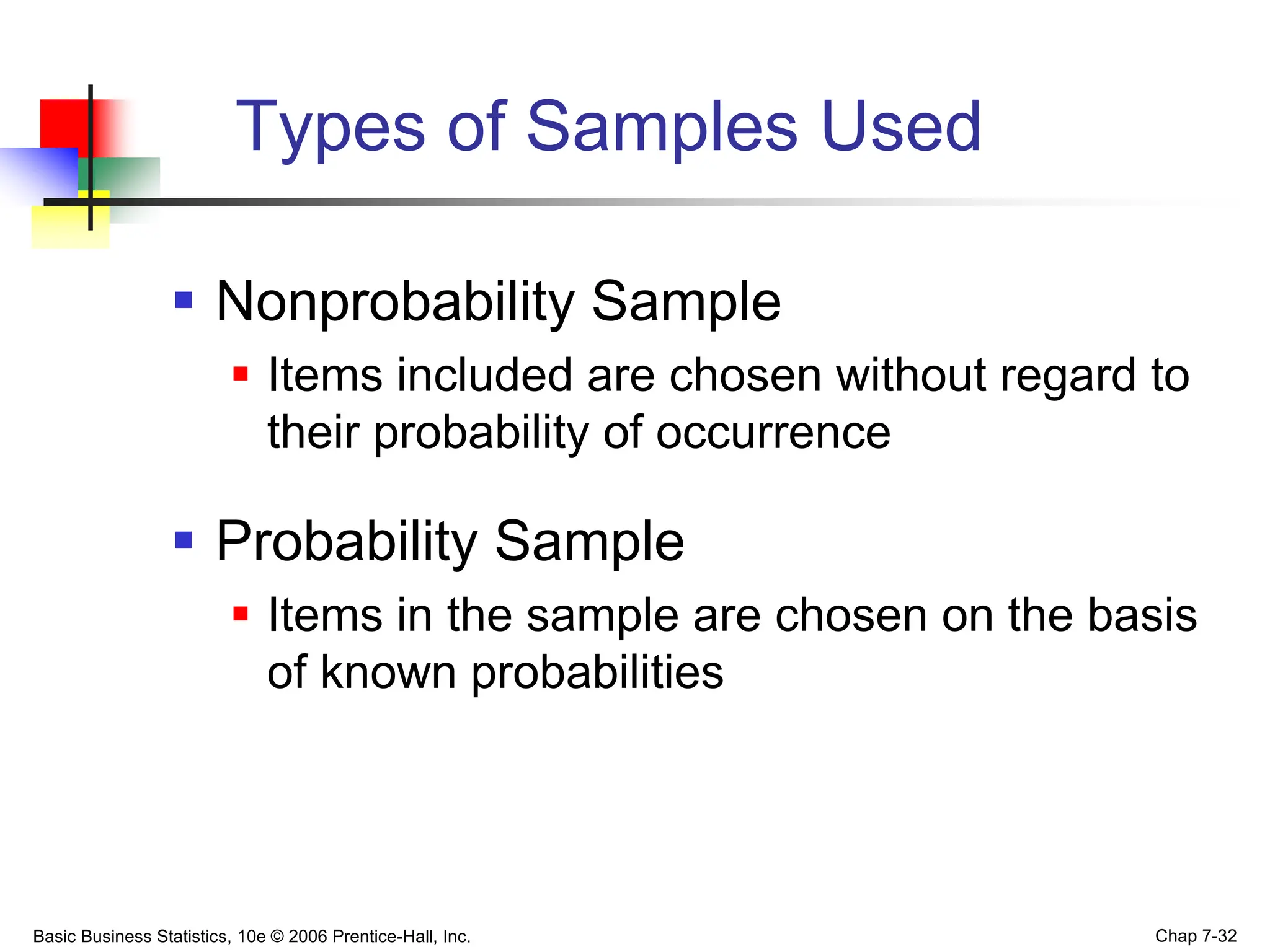
 Nonprobability Sample
 Items included are chosen without regard to
their probability of occurrence
 Probability Sample
 Items in the sample are chosen on the basis
of known probabilities
Types of Samples Used
Basic Business Statistics, 10e © 2006 Prentice-Hall, Inc. Chap 7-33
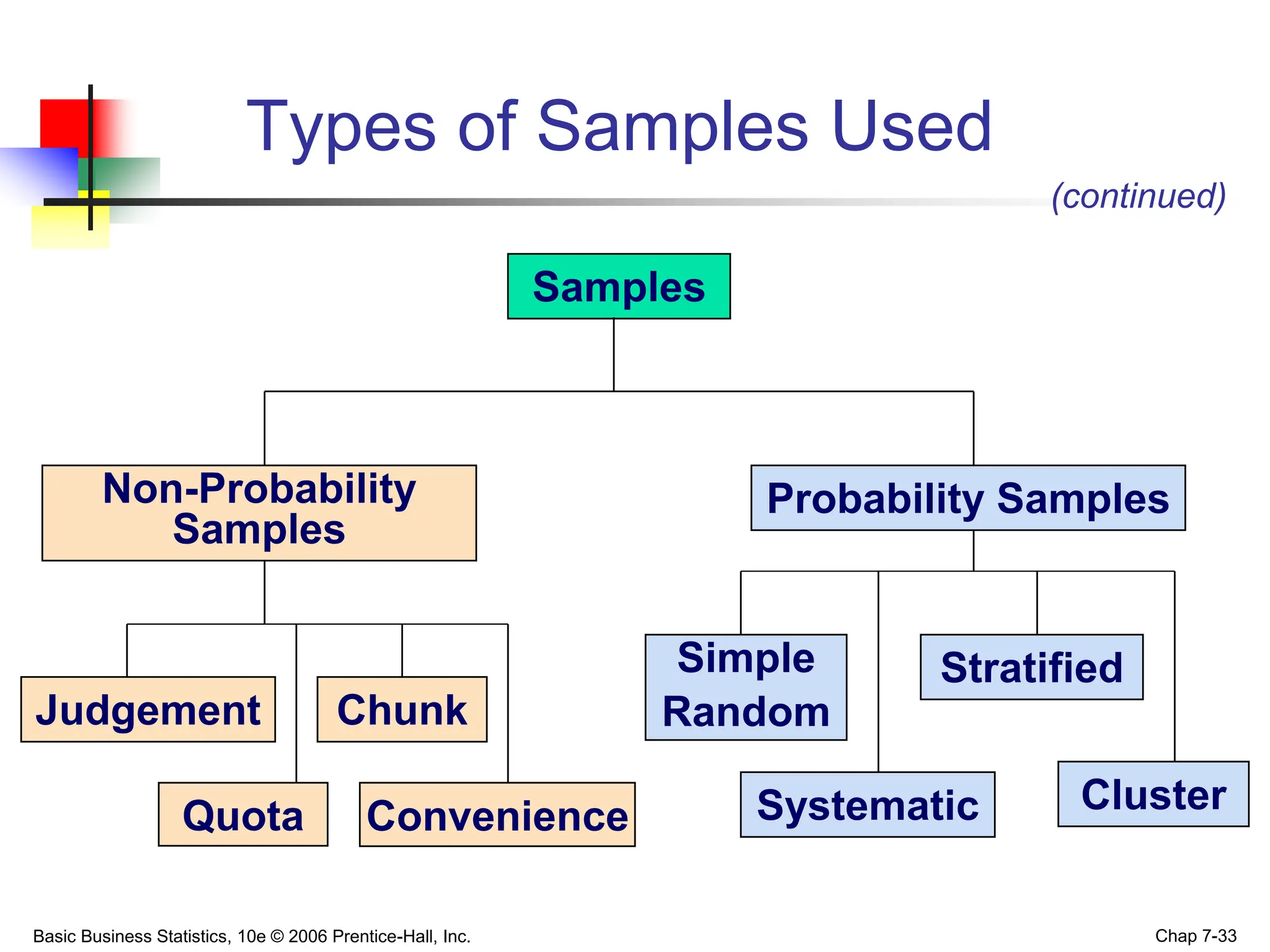
Types of Samples Used
Quota
Samples
Non-Probability
Samples
Judgement Chunk
Probability Samples
Simple
Random
Systematic
Stratified
Cluster
Convenience
(continued)
Basic Business Statistics, 10e © 2006 Prentice-Hall, Inc. Chap 7-34
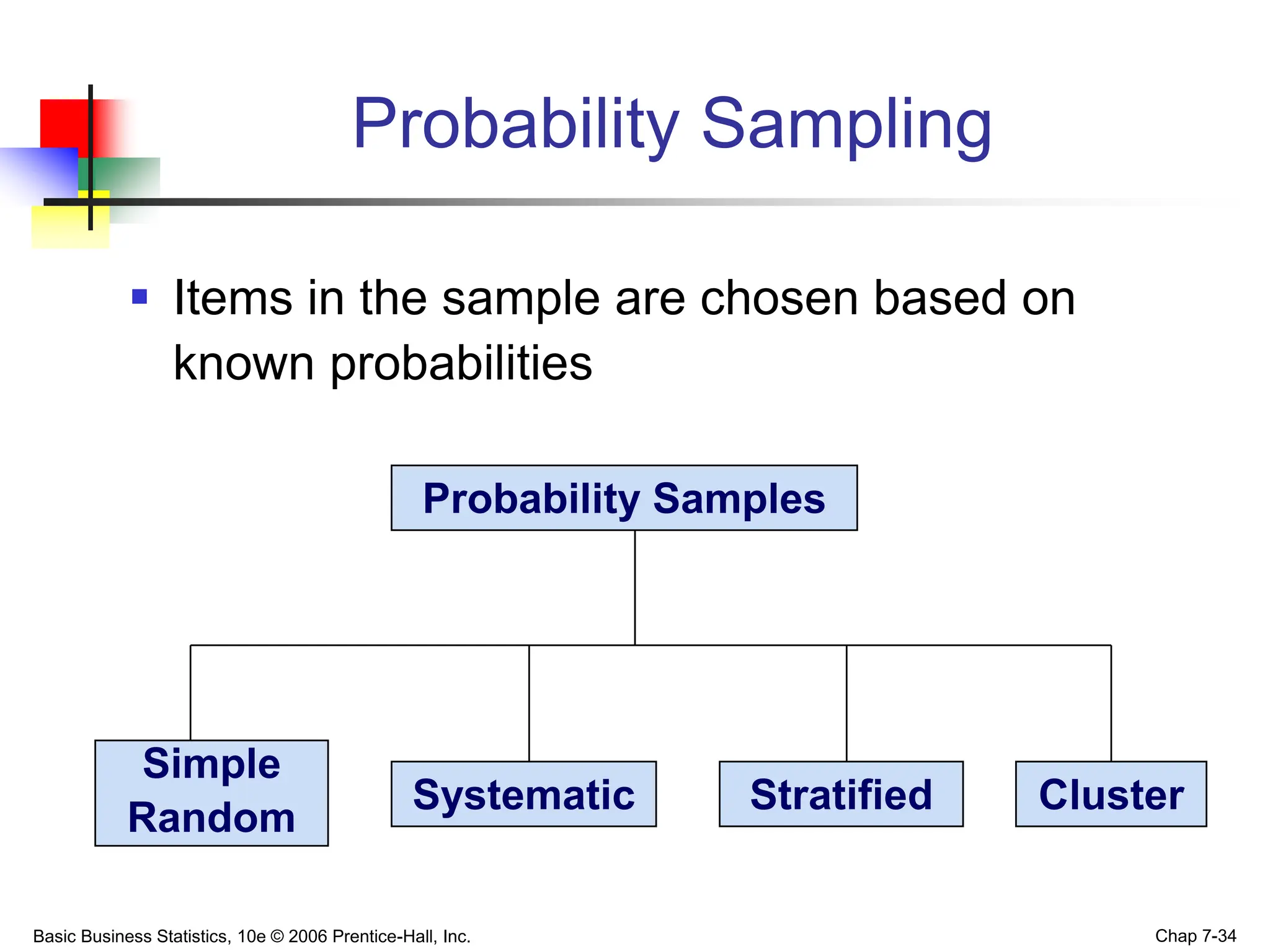
Probability Sampling
 Items in the sample are chosen based on
known probabilities
Probability Samples
Simple
Random
Systematic Stratified Cluster
Basic Business Statistics, 10e © 2006 Prentice-Hall, Inc. Chap 7-35
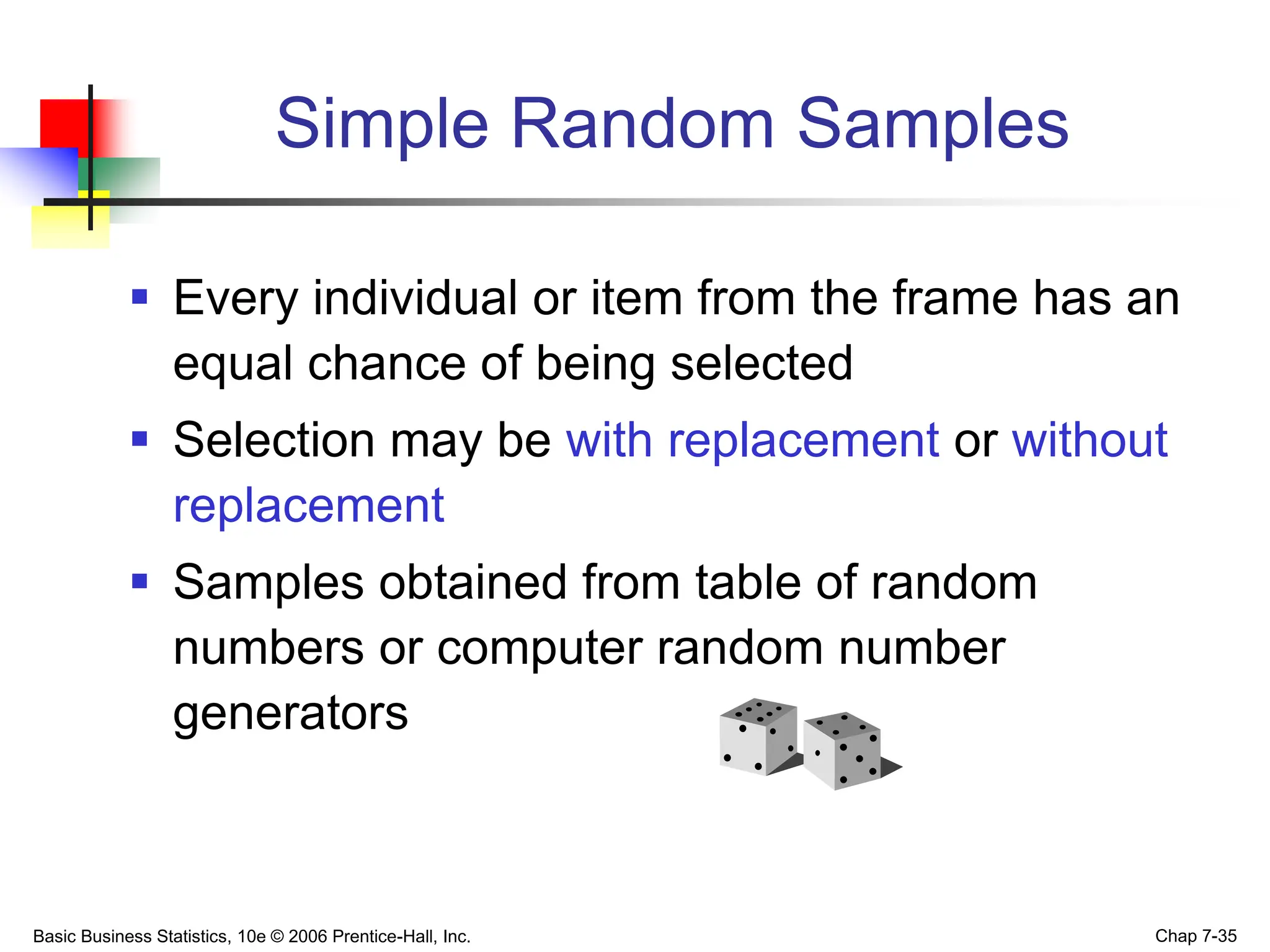
Simple Random Samples
 Every individual or item from the frame has an
equal chance of being selected
 Selection may be with replacement or without
replacement
 Samples obtained from table of random
numbers or computer random number
generators
Basic Business Statistics, 10e © 2006 Prentice-Hall, Inc. Chap 7-36
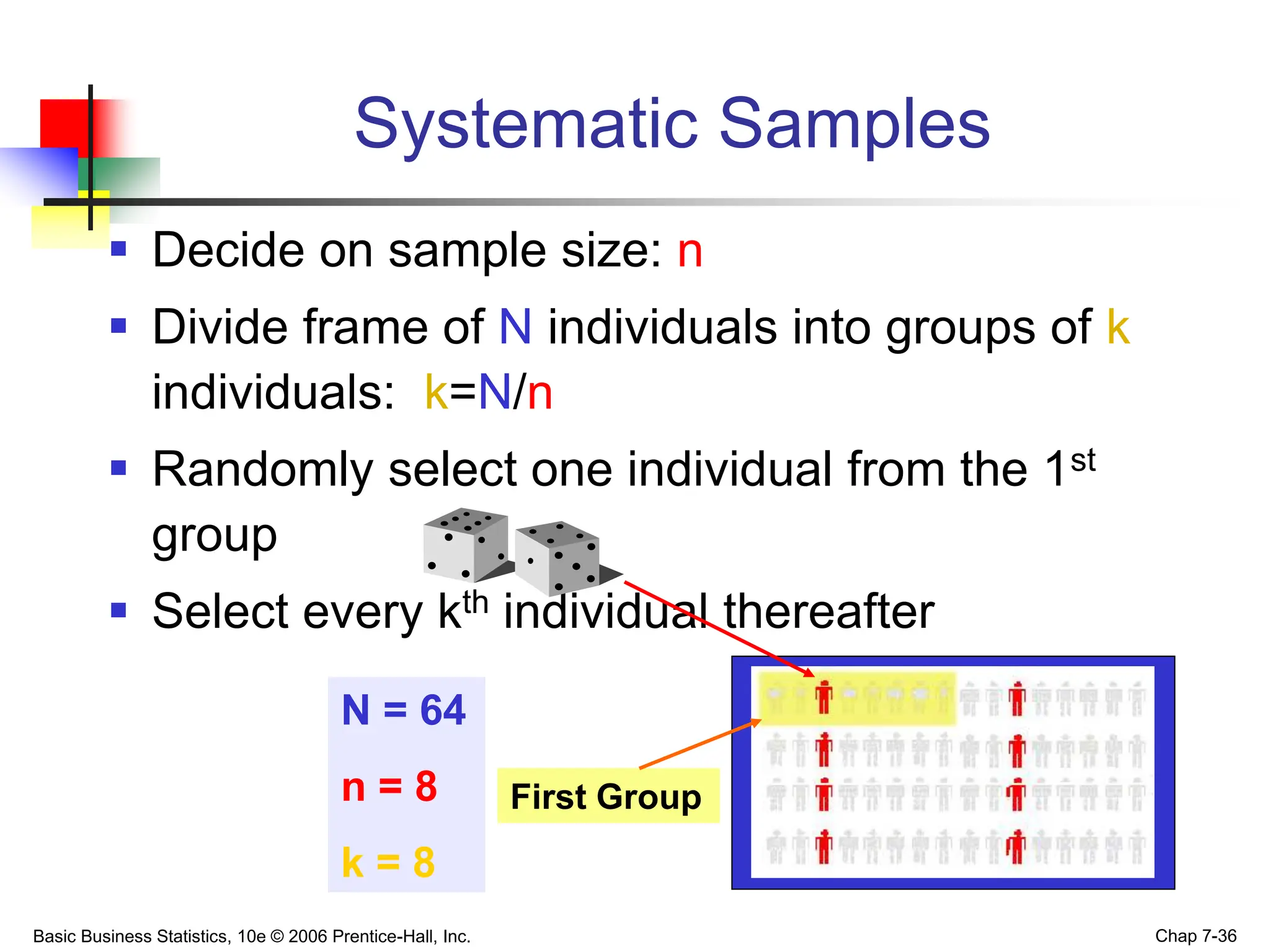
 Decide on sample size: n
 Divide frame of N individuals into groups of k
individuals: k=N/n
 Randomly select one individual from the 1st
group
 Select every kth individual thereafter
Systematic Samples
N = 64
n = 8
k = 8
First Group
Basic Business Statistics, 10e © 2006 Prentice-Hall, Inc. Chap 7-37
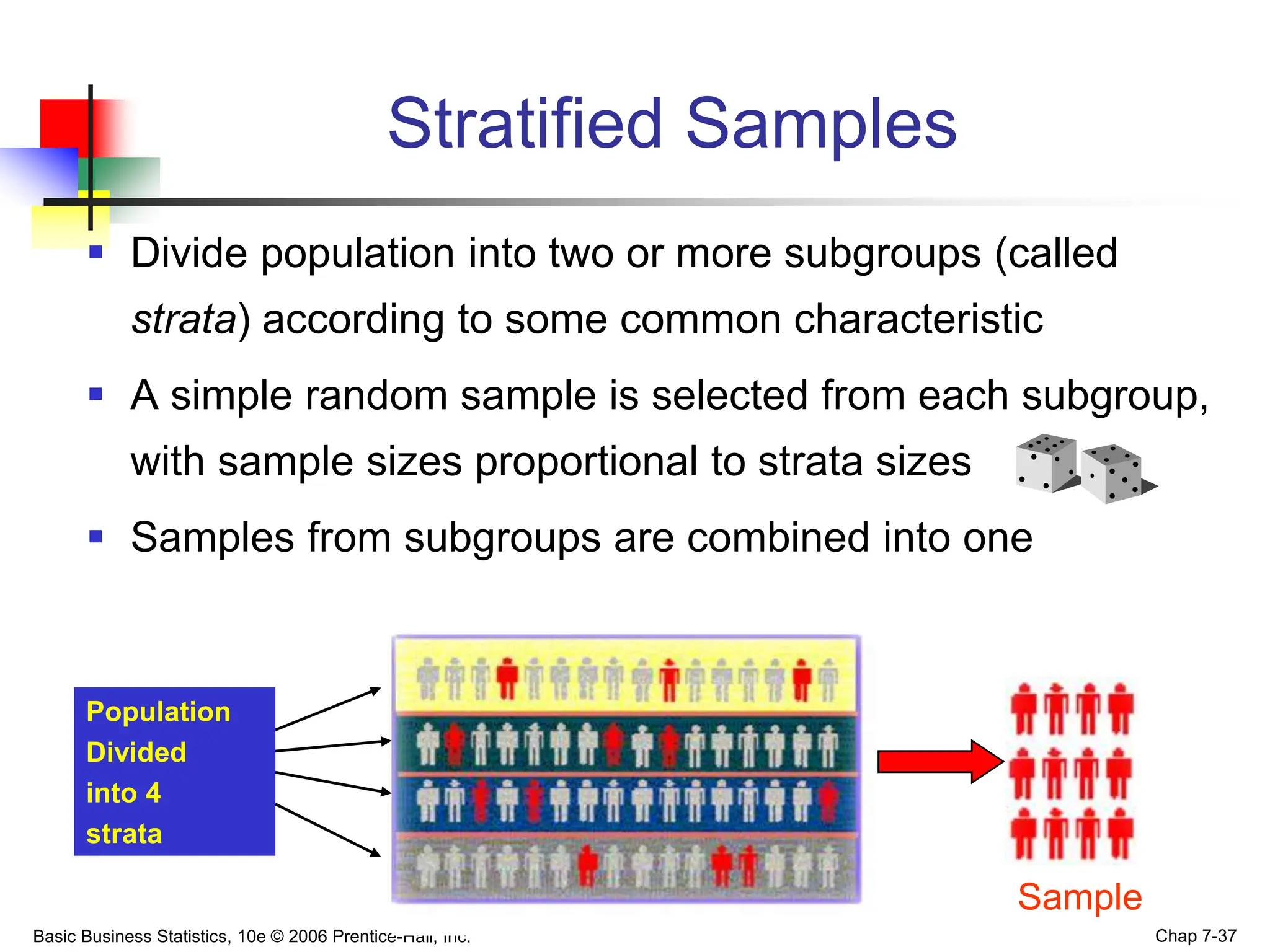
Stratified Samples
 Divide population into two or more subgroups (called
strata) according to some common characteristic
 A simple random sample is selected from each subgroup,
with sample sizes proportional to strata sizes
 Samples from subgroups are combined into one
Population
Divided
into 4
strata
Sample
Basic Business Statistics, 10e © 2006 Prentice-Hall, Inc. Chap 7-38
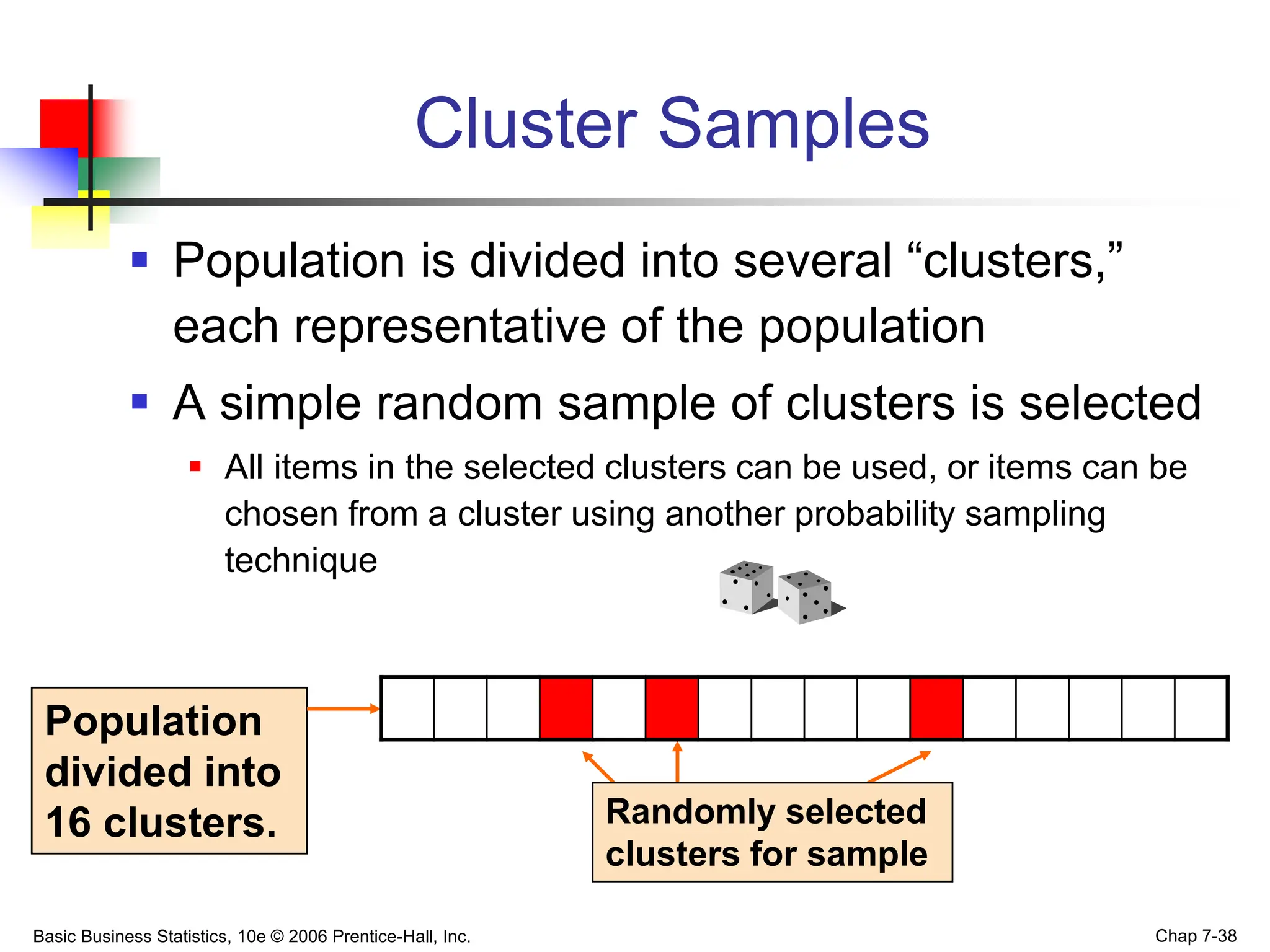
Cluster Samples
 Population is divided into several “clusters,”
each representative of the population
 A simple random sample of clusters is selected
 All items in the selected clusters can be used, or items can be
chosen from a cluster using another probability sampling
technique
Population
divided into
16 clusters. Randomly selected
clusters for sample
Basic Business Statistics, 10e © 2006 Prentice-Hall, Inc. Chap 7-39
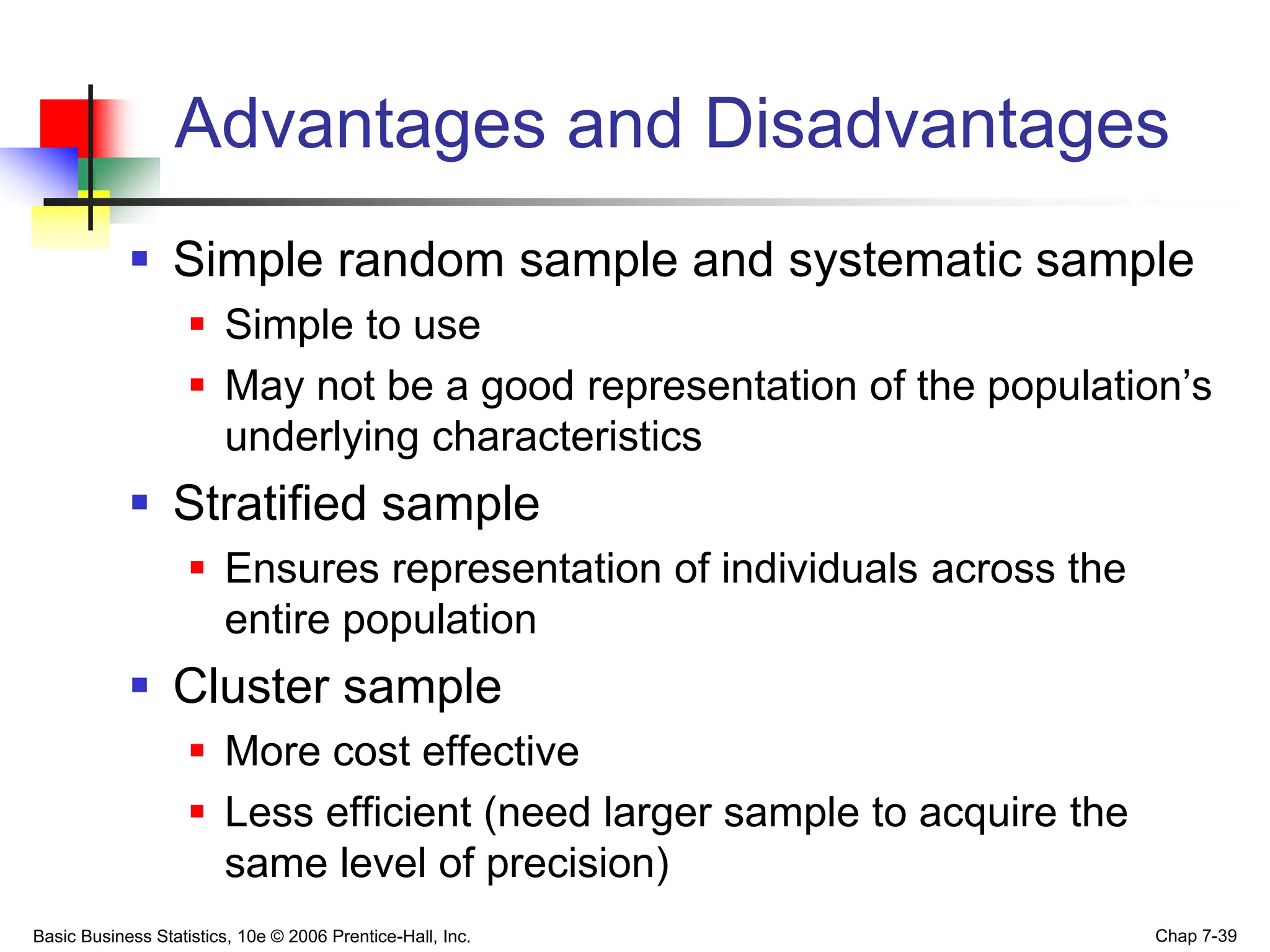
Advantages and Disadvantages
 Simple random sample and systematic sample
 Simple to use
 May not be a good representation of the population’s
underlying characteristics
 Stratified sample
 Ensures representation of individuals across the
entire population
 Cluster sample
 More cost effective
 Less efficient (need larger sample to acquire the
same level of precision)
Basic Business Statistics, 10e © 2006 Prentice-Hall, Inc. Chap 7-40
Evaluating Survey Worthiness
 What is the purpose of the survey?
 Is the survey based on a probability sample?
 Coverage error – appropriate frame?
 Nonresponse error – follow up
 Measurement error – good questions elicit good
responses
 Sampling error – always exists
Basic Business Statistics, 10e © 2006 Prentice-Hall, Inc. Chap 7-41
Types of Survey Errors
 Coverage error or selection bias
 Exists if some groups are excluded from the frame and
have no chance of being selected
 Nonresponse error or bias
 People who do not respond may be different from those
who do respond
 Sampling error
 Variation from sample to sample will always exist
 Measurement error
 Due to weaknesses in question design, respondent
error, and interviewer’s effects on the respondent
Basic Business Statistics, 10e © 2006 Prentice-Hall, Inc. Chap 7-42
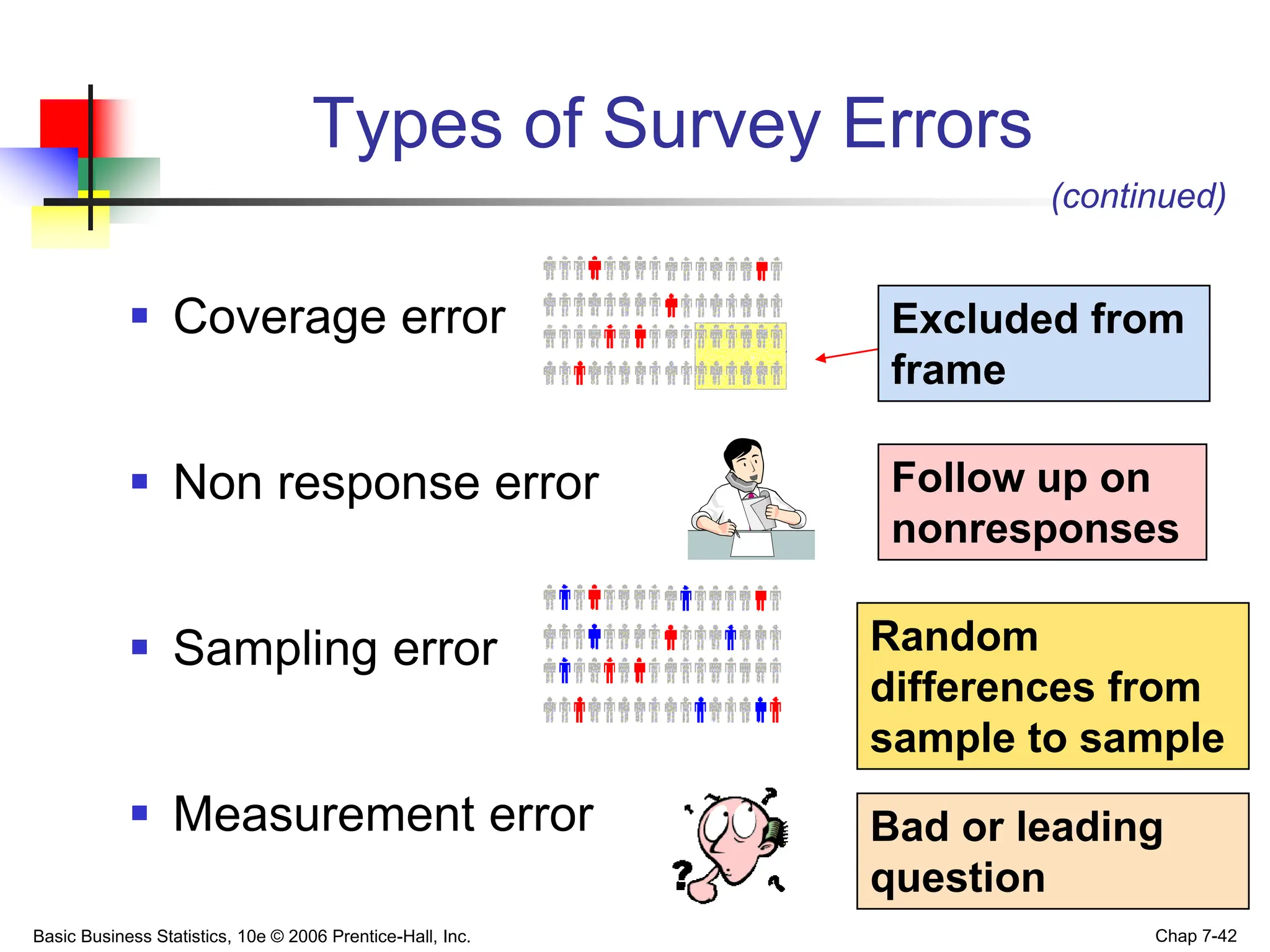
Types of Survey Errors
 Coverage error
 Non response error
 Sampling error
 Measurement error
Excluded from
frame
Follow up on
nonresponses
Random
differences from
sample to sample
Bad or leading
question
(continued)
Basic Business Statistics, 10e © 2006 Prentice-Hall, Inc. Chap 7-43
Chapter Summary
 Introduced sampling distributions
 Described the sampling distribution of the mean
 For normal populations
 Using the Central Limit Theorem
 Described the sampling distribution of a proportion
 Calculated probabilities using sampling distributions
 Described different types of samples and sampling
techniques
 Examined survey worthiness and types of survey
errors

BBS10_ppt_ch07_Sampling_Distribution.ppt

  • 1.
    Basic Business Statistics,10e © 2006 Prentice-Hall, Inc.. Chap 7-1 Chapter 7 Sampling Distributions Basic Business Statistics 10th Edition
  • 2.
    Basic Business Statistics,10e © 2006 Prentice-Hall, Inc. Chap 7-2 Learning Objectives In this chapter, you learn:  The concept of the sampling distribution  To compute probabilities related to the sample mean and the sample proportion  The importance of the Central Limit Theorem  To distinguish between different survey sampling methods  To evaluate survey worthiness and survey errors
  • 3.
    Basic Business Statistics,10e © 2006 Prentice-Hall, Inc. Chap 7-3 Sampling Distributions Sampling Distributions Sampling Distribution of the Mean Sampling Distribution of the Proportion
  • 4.
    Basic Business Statistics,10e © 2006 Prentice-Hall, Inc. Chap 7-4 Sampling Distributions  A sampling distribution is a distribution of all of the possible values of a statistic for a given size sample selected from a population
  • 5.
    Basic Business Statistics,10e © 2006 Prentice-Hall, Inc. Chap 7-5 Developing a Sampling Distribution  Assume there is a population …  Population size N=4  Random variable, X, is age of individuals  Values of X: 18, 20, 22, 24 (years) A B C D
  • 6.
    Basic Business Statistics,10e © 2006 Prentice-Hall, Inc. Chap 7-6 .3 .2 .1 0 18 20 22 24 A B C D Uniform Distribution P(x) x (continued) Summary Measures for the Population Distribution: Developing a Sampling Distribution 21 4 24 22 20 18 N X μ i        2.236 N μ) (X σ 2 i    
  • 7.
    Basic Business Statistics,10e © 2006 Prentice-Hall, Inc. Chap 7-7 16 possible samples (sampling with replacement) Now consider all possible samples of size n=2 1st 2nd Observation Obs 18 20 22 24 18 18 19 20 21 20 19 20 21 22 22 20 21 22 23 24 21 22 23 24 (continued) Developing a Sampling Distribution 16 Sample Means 1st Obs 2nd Observation 18 20 22 24 18 18,18 18,20 18,22 18,24 20 20,18 20,20 20,22 20,24 22 22,18 22,20 22,22 22,24 24 24,18 24,20 24,22 24,24
  • 8.
    Basic Business Statistics,10e © 2006 Prentice-Hall, Inc. Chap 7-8 1st 2nd Observation Obs 18 20 22 24 18 18 19 20 21 20 19 20 21 22 22 20 21 22 23 24 21 22 23 24 Sampling Distribution of All Sample Means 18 19 20 21 22 23 24 0 .1 .2 .3 P(X) X Sample Means Distribution 16 Sample Means _ Developing a Sampling Distribution (continued) (no longer uniform) _
  • 9.
    Basic Business Statistics,10e © 2006 Prentice-Hall, Inc. Chap 7-9 Summary Measures of this Sampling Distribution: Developing a Sampling Distribution (continued) 21 16 24 21 19 18 N X μ i X          1.58 16 21) - (24 21) - (19 21) - (18 N ) μ X ( σ 2 2 2 2 X i X         
  • 10.
    Basic Business Statistics,10e © 2006 Prentice-Hall, Inc. Chap 7-10 Comparing the Population with its Sampling Distribution 18 19 20 21 22 23 24 0 .1 .2 .3 P(X) X 18 20 22 24 A B C D 0 .1 .2 .3 Population N = 4 P(X) X _ 1.58 σ 21 μ X X   2.236 σ 21 μ   Sample Means Distribution n = 2 _
  • 11.
    Basic Business Statistics,10e © 2006 Prentice-Hall, Inc. Chap 7-11 Sampling Distribution of the Mean Sampling Distributions Sampling Distribution of the Mean Sampling Distribution of the Proportion
  • 12.
    Basic Business Statistics,10e © 2006 Prentice-Hall, Inc. Chap 7-12 Standard Error of the Mean  Different samples of the same size from the same population will yield different sample means  A measure of the variability in the mean from sample to sample is given by the Standard Error of the Mean: (This assumes that sampling is with replacement or sampling is without replacement from an infinite population)  Note that the standard error of the mean decreases as the sample size increases n σ σX 
  • 13.
    Basic Business Statistics,10e © 2006 Prentice-Hall, Inc. Chap 7-13 If the Population is Normal  If a population is normal with mean μ and standard deviation σ, the sampling distribution of is also normally distributed with and X μ μX  n σ σX 
  • 14.
    Basic Business Statistics,10e © 2006 Prentice-Hall, Inc. Chap 7-14 Z-value for Sampling Distribution of the Mean  Z-value for the sampling distribution of : where: = sample mean = population mean = population standard deviation n = sample size X μ σ n σ μ) X ( σ ) μ X ( Z X X     X
  • 15.
    Basic Business Statistics,10e © 2006 Prentice-Hall, Inc. Chap 7-15 Normal Population Distribution Normal Sampling Distribution (has the same mean) Sampling Distribution Properties  (i.e. is unbiased ) x x x μ μx  μ x μ
  • 16.
    Basic Business Statistics,10e © 2006 Prentice-Hall, Inc. Chap 7-16 Sampling Distribution Properties As n increases, decreases Larger sample size Smaller sample size x (continued) x σ μ
  • 17.
    Basic Business Statistics,10e © 2006 Prentice-Hall, Inc. Chap 7-17 If the Population is not Normal  We can apply the Central Limit Theorem:  Even if the population is not normal,  …sample means from the population will be approximately normal as long as the sample size is large enough. Properties of the sampling distribution: and μ μx  n σ σx 
  • 18.
    Basic Business Statistics,10e © 2006 Prentice-Hall, Inc. Chap 7-18 n↑ Central Limit Theorem As the sample size gets large enough… the sampling distribution becomes almost normal regardless of shape of population x
  • 19.
    Basic Business Statistics,10e © 2006 Prentice-Hall, Inc. Chap 7-19 Population Distribution Sampling Distribution (becomes normal as n increases) Central Tendency Variation x x Larger sample size Smaller sample size If the Population is not Normal (continued) Sampling distribution properties: μ μx  n σ σx  x μ μ
  • 20.
    Basic Business Statistics,10e © 2006 Prentice-Hall, Inc. Chap 7-20 How Large is Large Enough?  For most distributions, n > 30 will give a sampling distribution that is nearly normal  For fairly symmetric distributions, n > 15  For normal population distributions, the sampling distribution of the mean is always normally distributed
  • 21.
    Basic Business Statistics,10e © 2006 Prentice-Hall, Inc. Chap 7-21 Example  Suppose a population has mean μ = 8 and standard deviation σ = 3. Suppose a random sample of size n = 36 is selected.  What is the probability that the sample mean is between 7.8 and 8.2?
  • 22.
    Basic Business Statistics,10e © 2006 Prentice-Hall, Inc. Chap 7-22 Example Solution:  Even if the population is not normally distributed, the central limit theorem can be used (n > 30)  … so the sampling distribution of is approximately normal  … with mean = 8  …and standard deviation (continued) x x μ 0.5 36 3 n σ σx   
  • 23.
    Basic Business Statistics,10e © 2006 Prentice-Hall, Inc. Chap 7-23 Example Solution (continued): (continued) 0.3108 0.4) Z P(-0.4 36 3 8 - 8.2 n σ μ - X 36 3 8 - 7.8 P 8.2) X P(7.8                    Z 7.8 8.2 -0.4 0.4 Sampling Distribution Standard Normal Distribution .1554 +.1554 Population Distribution ? ? ? ? ? ? ? ? ? ? ? ? Sample Standardize 8 μ  8 μX  0 μz  x X
  • 24.
    Basic Business Statistics,10e © 2006 Prentice-Hall, Inc. Chap 7-24 Sampling Distribution of the Proportion Sampling Distributions Sampling Distribution of the Mean Sampling Distribution of the Proportion
  • 25.
    Basic Business Statistics,10e © 2006 Prentice-Hall, Inc. Chap 7-25 Population Proportions π = the proportion of the population having some characteristic  Sample proportion ( p ) provides an estimate of π:  0 ≤ p ≤ 1  p has a binomial distribution (assuming sampling with replacement from a finite population or without replacement from an infinite population) size sample interest of stic characteri the having sample the in items of number n X p  
  • 26.
    Basic Business Statistics,10e © 2006 Prentice-Hall, Inc. Chap 7-26 Sampling Distribution of p  Approximated by a normal distribution if:  where and (where π = population proportion) Sampling Distribution P(ps) .3 .2 .1 0 0 . 2 .4 .6 8 1 p π  p μ n ) (1 σp π π   5 p) n(1 5 np and   
  • 27.
    Basic Business Statistics,10e © 2006 Prentice-Hall, Inc. Chap 7-27 Z-Value for Proportions n ) (1 p σ p Z p          Standardize p to a Z value with the formula:
  • 28.
    Basic Business Statistics,10e © 2006 Prentice-Hall, Inc. Chap 7-28 Example  If the true proportion of voters who support Proposition A is π = 0.4, what is the probability that a sample of size 200 yields a sample proportion between 0.40 and 0.45?  i.e.: if π = 0.4 and n = 200, what is P(0.40 ≤ p ≤ 0.45) ?
  • 29.
    Basic Business Statistics,10e © 2006 Prentice-Hall, Inc. Chap 7-29 Example  if π = 0.4 and n = 200, what is P(0.40 ≤ p ≤ 0.45) ? (continued) 0.03464 200 0.4) 0.4(1 n ) (1 σp        1.44) Z P(0 0.03464 0.40 0.45 Z 0.03464 0.40 0.40 P 0.45) p P(0.40                 Find : Convert to standard normal: p σ
  • 30.
    Basic Business Statistics,10e © 2006 Prentice-Hall, Inc. Chap 7-30 Example Z 0.45 1.44 0.4251 Standardize Sampling Distribution Standardized Normal Distribution  if π = 0.4 and n = 200, what is P(0.40 ≤ p ≤ 0.45) ? (continued) Use standard normal table: P(0 ≤ Z ≤ 1.44) = 0.4251 0.40 0 p
  • 31.
    Basic Business Statistics,10e © 2006 Prentice-Hall, Inc. Chap 7-31 Reasons for Drawing a Sample  Less time consuming than a census  Less costly to administer than a census  Less cumbersome and more practical to administer than a census of the targeted population
  • 32.
    Basic Business Statistics,10e © 2006 Prentice-Hall, Inc. Chap 7-32  Nonprobability Sample  Items included are chosen without regard to their probability of occurrence  Probability Sample  Items in the sample are chosen on the basis of known probabilities Types of Samples Used
  • 33.
    Basic Business Statistics,10e © 2006 Prentice-Hall, Inc. Chap 7-33 Types of Samples Used Quota Samples Non-Probability Samples Judgement Chunk Probability Samples Simple Random Systematic Stratified Cluster Convenience (continued)
  • 34.
    Basic Business Statistics,10e © 2006 Prentice-Hall, Inc. Chap 7-34 Probability Sampling  Items in the sample are chosen based on known probabilities Probability Samples Simple Random Systematic Stratified Cluster
  • 35.
    Basic Business Statistics,10e © 2006 Prentice-Hall, Inc. Chap 7-35 Simple Random Samples  Every individual or item from the frame has an equal chance of being selected  Selection may be with replacement or without replacement  Samples obtained from table of random numbers or computer random number generators
  • 36.
    Basic Business Statistics,10e © 2006 Prentice-Hall, Inc. Chap 7-36  Decide on sample size: n  Divide frame of N individuals into groups of k individuals: k=N/n  Randomly select one individual from the 1st group  Select every kth individual thereafter Systematic Samples N = 64 n = 8 k = 8 First Group
  • 37.
    Basic Business Statistics,10e © 2006 Prentice-Hall, Inc. Chap 7-37 Stratified Samples  Divide population into two or more subgroups (called strata) according to some common characteristic  A simple random sample is selected from each subgroup, with sample sizes proportional to strata sizes  Samples from subgroups are combined into one Population Divided into 4 strata Sample
  • 38.
    Basic Business Statistics,10e © 2006 Prentice-Hall, Inc. Chap 7-38 Cluster Samples  Population is divided into several “clusters,” each representative of the population  A simple random sample of clusters is selected  All items in the selected clusters can be used, or items can be chosen from a cluster using another probability sampling technique Population divided into 16 clusters. Randomly selected clusters for sample
  • 39.
    Basic Business Statistics,10e © 2006 Prentice-Hall, Inc. Chap 7-39 Advantages and Disadvantages  Simple random sample and systematic sample  Simple to use  May not be a good representation of the population’s underlying characteristics  Stratified sample  Ensures representation of individuals across the entire population  Cluster sample  More cost effective  Less efficient (need larger sample to acquire the same level of precision)
  • 40.
    Basic Business Statistics,10e © 2006 Prentice-Hall, Inc. Chap 7-40 Evaluating Survey Worthiness  What is the purpose of the survey?  Is the survey based on a probability sample?  Coverage error – appropriate frame?  Nonresponse error – follow up  Measurement error – good questions elicit good responses  Sampling error – always exists
  • 41.
    Basic Business Statistics,10e © 2006 Prentice-Hall, Inc. Chap 7-41 Types of Survey Errors  Coverage error or selection bias  Exists if some groups are excluded from the frame and have no chance of being selected  Nonresponse error or bias  People who do not respond may be different from those who do respond  Sampling error  Variation from sample to sample will always exist  Measurement error  Due to weaknesses in question design, respondent error, and interviewer’s effects on the respondent
  • 42.
    Basic Business Statistics,10e © 2006 Prentice-Hall, Inc. Chap 7-42 Types of Survey Errors  Coverage error  Non response error  Sampling error  Measurement error Excluded from frame Follow up on nonresponses Random differences from sample to sample Bad or leading question (continued)
  • 43.
    Basic Business Statistics,10e © 2006 Prentice-Hall, Inc. Chap 7-43 Chapter Summary  Introduced sampling distributions  Described the sampling distribution of the mean  For normal populations  Using the Central Limit Theorem  Described the sampling distribution of a proportion  Calculated probabilities using sampling distributions  Described different types of samples and sampling techniques  Examined survey worthiness and types of survey errors