General Knowledge of Spreadsheet
Applications
Ms Excel
What is spreadsheet? A spreadsheet is a
table of values arranged in rows and
columns. This lesson covers some basic
spreadsheet concepts, but also will
introduce you to the common screen
elements (features in the Spreadsheet
window) found in this application.
Ms Excel
What is spreadsheet? Cont’d
The following are some examples of
spreadsheet applications: Microsoft Excel,
Lotus 1 2 3, Quattro pro, Ability Spread,
Xoom Office, Google Docs, EditGrid,
Smartsheet Boeing Calc.
Ms Excel
Active Cell: The worksheet cell with a
dark border; text or numbers you type
appear in this cell and in the formula bar.
Alignment: The placement of cell data in a
cell.
Auto Fill: A feature that enables you to fill
in a series of numbers, dates, or other
items automatically in a specified range.
Ms Excel
 Auto Sum: A feature that enables insertion of
a formula to sums up a range of cells
automatically.
 Bar Chart: Compares individual items.
Categories are organized vertically, values
horizontally to place more emphasis on
comparing values than on time.
 Cell: The intersection of a row and column.
 Cell Reference: identifies the location of a
cell or group of cells in the spreadsheet.
Ms Excel
 Absolute Reference: A cell reference that
does not adjust when the formula is pasted to
a new location.
 Relative Reference: A cell reference that
adjust to reflect the current location in
formula.
 Chart: Graphic representation of worksheet
data.
 Chart Title: Identifies the purpose of the
chart.
Ms Excel
 Chart Wizard: A series of dialog boxes that
lets you create a chart and customize it.
 Column Chart: Shows changes in data over
a period of time or comparisons among items.
 Data Label: Identifies specific points or
series.
 Data Series: A group of related data points
plotted in a chart that originates from rows or
columns on a single worksheet.
Ms Excel
 Fill Handle: The small black square on the
bottom right corner of a selected cell.
 Formula: A sequence of values, cell
references and operators used to produce a
new value from existing cells.
 Formula Bar: Displays the contents of the
current or active cell, located above the
worksheet column headings.
 Function: built-in formulae that enable users
perform common calculations on data without
the need to write entire formulae from
scratch.
Ms Excel
Gridlines: Optional lines on a chart.
Insert Function: A button located on the
formula bar that allows quick access to the
Insert Function dialog box.
Legend: Key to the data represented by a
chart.
Line Chart: Shows trends in data at equal
interv
Ms Excel
 Merge and Center: To combine adjacent, or
contiguous, cells into one large cell and
center the data.
 Operators: Addition (+), Subtraction (-),
Multiplication (*), and Division (/), also the
colon (:) that separates cells in a range.
 Order of Precedence: The order in which
Excel processes operations in a formula
containing more than one operation.
 Pie Chart: Shows the relationship of items
that make up data series to the sum of the
items.
Ms Excel
 Range: A range is a group of cells in a
worksheet that have been highlighted or
specified in a formula. In a formula, it is
denoted by “colon” (:) usually placed between
two cell references
 Sheet Tab: A means to access the different
sheets in a workbook, located at the bottom
of the spreadsheet.
 Spreadsheet: A table of values arranged in
rows and columns.
Ms Excel
 Task Pane: Provides a quick means to
execute commands. Displays when you start
Excel and enables you to create new
workbooks or open and existing one.
 Templates: ready-made pages format,
complete with margins, fonts, headers and
footers, numbering, logos or any other kind of
formatting the designer wants to appear on
each page.
 Toolbars: A series of buttons and menus in
an application, which allows the user to
perform functions quickly using the mouse.
Ms Excel
Workbook: An Excel file that contains one
or more worksheets.
Worksheet: A work area comprised of
rows and columns, also known as a
spreadsheet.
Value: The number resulting from the
execution of a formula.
Ms Excel
Spreadsheet applications contain
predefined data types for specific
purposes. The type of data used depends
on the type or the category (Financial, date
& time, statistical, database etc) of
document being processed.
Ms Excel
Commonly used predefined data types
used in spreadsheet: cont’d
• Number – for documents in which there is the
need to perform calculations using numerical
figures
• Date – used for a field or cell that is supposed to
contain date
• Text – Defined for a cells that is supposed to
contain textual string data
• Currency – Defined for cells that are supposed to
hold value for money
Ms Excel
 Commonly used predefined data types used
in spreadsheet: cont’d
• Fraction – defined for fields that are supposed to hold
fractional numbers
• Time – defined for cells that supposed to contain time
values
• Integer – defined for fields that are supposed to hold
whole numbers
• Float – defined for fields that are supposed to contain
floating point (decimal) numbers
• Boolean – defined for cells containing true/false
values
Ms Excel
 1. …………………………: The worksheet cell with
a dark border; text or numbers you type appear in
this cell and in the formula bar.
 2. ………………………….: A feature that enables
you to fill in a series of numbers, dates, or other
items automatically in a specified range.
 3. …………………………: A feature that you can
use to insert a formula that sums a range of cells
automatically.
 4. ……………………………...: The intersection of a
row and column.
 5. ………………………….: Identifies a particular
cell on a spreadsheet or worksheet.
Ms Excel
gen
Col a Col b
Ms Excel
1. …………………………: The worksheet
cell with a dark border; text or numbers
you type appear in it and also inside the
formula bar
Ms Excel
2. ………………………….: A feature that
enables you to fill in a series of numbers,
dates, or other items automatically in a
specified range.
Ms Excel
3. …………………….: An Excel file that
contains one or more worksheets.
Ms Excel
4. Ms Excel, Quattro Pro, lotus 1, 2, 3 and
Ms Access are all examples of
spreadsheet applications except
………………………………….
Ms Excel
5. The following formula contains relative
cell references, convert them to absolute
cells references: =SUM(A2:B2)
Ms Excel
1. ………………………..Key to the data
represented by a chart.
Ms Excel
2. Which of the following is not a function
as applied in Ms Excel? A. Sum B. IF
C. Product D. Currency
Ms Excel
3. In spreadsheet applications, every
formula must be preceded
with……………………….
Ms Excel
4. ……………………. key on the keyboard
helps you to navigate your worksheet
downwards along a column but across
rows on the page?
Ms Excel
5. Which of the following is not a correct cell
reference?
A. 2B B. $B$3 C. $B1 D. A2
Ms Excel
 1. What key on the keyboard helps you to
navigate your worksheet to the right hand
side of the page?
Ms Excel
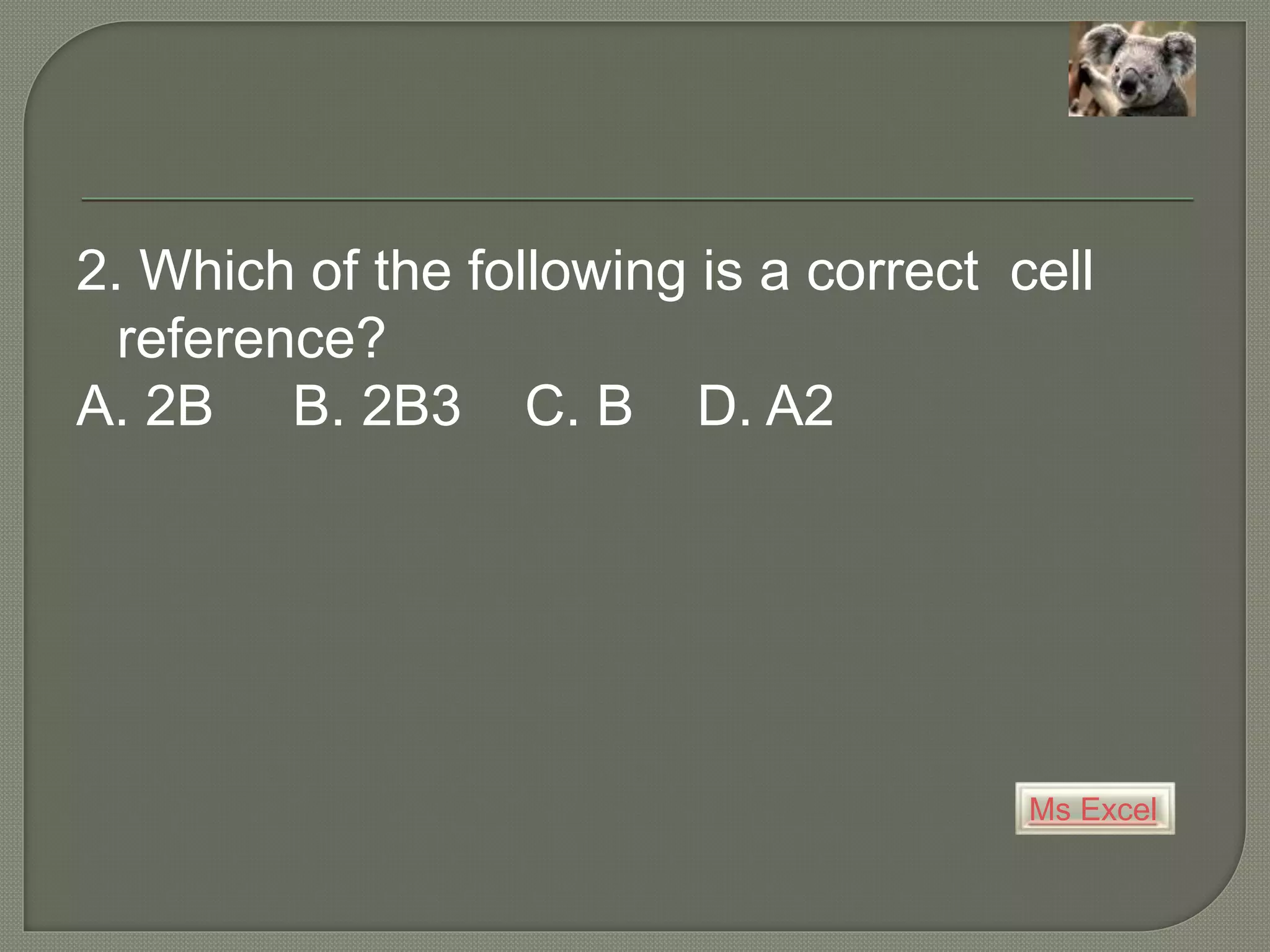
2. Which of the following is a correct cell
reference?
A. 2B B. 2B3 C. B D. A2

Introduction to Spreadsheet Applications

  • 1.
    General Knowledge ofSpreadsheet Applications
  • 2.
    Ms Excel What isspreadsheet? A spreadsheet is a table of values arranged in rows and columns. This lesson covers some basic spreadsheet concepts, but also will introduce you to the common screen elements (features in the Spreadsheet window) found in this application.
  • 3.
    Ms Excel What isspreadsheet? Cont’d The following are some examples of spreadsheet applications: Microsoft Excel, Lotus 1 2 3, Quattro pro, Ability Spread, Xoom Office, Google Docs, EditGrid, Smartsheet Boeing Calc.
  • 4.
    Ms Excel Active Cell:The worksheet cell with a dark border; text or numbers you type appear in this cell and in the formula bar. Alignment: The placement of cell data in a cell. Auto Fill: A feature that enables you to fill in a series of numbers, dates, or other items automatically in a specified range.
  • 5.
    Ms Excel  AutoSum: A feature that enables insertion of a formula to sums up a range of cells automatically.  Bar Chart: Compares individual items. Categories are organized vertically, values horizontally to place more emphasis on comparing values than on time.  Cell: The intersection of a row and column.  Cell Reference: identifies the location of a cell or group of cells in the spreadsheet.
  • 6.
    Ms Excel  AbsoluteReference: A cell reference that does not adjust when the formula is pasted to a new location.  Relative Reference: A cell reference that adjust to reflect the current location in formula.  Chart: Graphic representation of worksheet data.  Chart Title: Identifies the purpose of the chart.
  • 7.
    Ms Excel  ChartWizard: A series of dialog boxes that lets you create a chart and customize it.  Column Chart: Shows changes in data over a period of time or comparisons among items.  Data Label: Identifies specific points or series.  Data Series: A group of related data points plotted in a chart that originates from rows or columns on a single worksheet.
  • 8.
    Ms Excel  FillHandle: The small black square on the bottom right corner of a selected cell.  Formula: A sequence of values, cell references and operators used to produce a new value from existing cells.  Formula Bar: Displays the contents of the current or active cell, located above the worksheet column headings.  Function: built-in formulae that enable users perform common calculations on data without the need to write entire formulae from scratch.
  • 9.
    Ms Excel Gridlines: Optionallines on a chart. Insert Function: A button located on the formula bar that allows quick access to the Insert Function dialog box. Legend: Key to the data represented by a chart. Line Chart: Shows trends in data at equal interv
  • 10.
    Ms Excel  Mergeand Center: To combine adjacent, or contiguous, cells into one large cell and center the data.  Operators: Addition (+), Subtraction (-), Multiplication (*), and Division (/), also the colon (:) that separates cells in a range.  Order of Precedence: The order in which Excel processes operations in a formula containing more than one operation.  Pie Chart: Shows the relationship of items that make up data series to the sum of the items.
  • 11.
    Ms Excel  Range:A range is a group of cells in a worksheet that have been highlighted or specified in a formula. In a formula, it is denoted by “colon” (:) usually placed between two cell references  Sheet Tab: A means to access the different sheets in a workbook, located at the bottom of the spreadsheet.  Spreadsheet: A table of values arranged in rows and columns.
  • 12.
    Ms Excel  TaskPane: Provides a quick means to execute commands. Displays when you start Excel and enables you to create new workbooks or open and existing one.  Templates: ready-made pages format, complete with margins, fonts, headers and footers, numbering, logos or any other kind of formatting the designer wants to appear on each page.  Toolbars: A series of buttons and menus in an application, which allows the user to perform functions quickly using the mouse.
  • 13.
    Ms Excel Workbook: AnExcel file that contains one or more worksheets. Worksheet: A work area comprised of rows and columns, also known as a spreadsheet. Value: The number resulting from the execution of a formula.
  • 14.
    Ms Excel Spreadsheet applicationscontain predefined data types for specific purposes. The type of data used depends on the type or the category (Financial, date & time, statistical, database etc) of document being processed.
  • 15.
    Ms Excel Commonly usedpredefined data types used in spreadsheet: cont’d • Number – for documents in which there is the need to perform calculations using numerical figures • Date – used for a field or cell that is supposed to contain date • Text – Defined for a cells that is supposed to contain textual string data • Currency – Defined for cells that are supposed to hold value for money
  • 16.
    Ms Excel  Commonlyused predefined data types used in spreadsheet: cont’d • Fraction – defined for fields that are supposed to hold fractional numbers • Time – defined for cells that supposed to contain time values • Integer – defined for fields that are supposed to hold whole numbers • Float – defined for fields that are supposed to contain floating point (decimal) numbers • Boolean – defined for cells containing true/false values
  • 17.
    Ms Excel  1.…………………………: The worksheet cell with a dark border; text or numbers you type appear in this cell and in the formula bar.  2. ………………………….: A feature that enables you to fill in a series of numbers, dates, or other items automatically in a specified range.  3. …………………………: A feature that you can use to insert a formula that sums a range of cells automatically.  4. ……………………………...: The intersection of a row and column.  5. ………………………….: Identifies a particular cell on a spreadsheet or worksheet.
  • 18.
  • 19.
    Ms Excel 1. …………………………:The worksheet cell with a dark border; text or numbers you type appear in it and also inside the formula bar
  • 20.
    Ms Excel 2. ………………………….:A feature that enables you to fill in a series of numbers, dates, or other items automatically in a specified range.
  • 21.
    Ms Excel 3. …………………….:An Excel file that contains one or more worksheets.
  • 22.
    Ms Excel 4. MsExcel, Quattro Pro, lotus 1, 2, 3 and Ms Access are all examples of spreadsheet applications except ………………………………….
  • 23.
    Ms Excel 5. Thefollowing formula contains relative cell references, convert them to absolute cells references: =SUM(A2:B2)
  • 24.
    Ms Excel 1. ………………………..Keyto the data represented by a chart.
  • 25.
    Ms Excel 2. Whichof the following is not a function as applied in Ms Excel? A. Sum B. IF C. Product D. Currency
  • 26.
    Ms Excel 3. Inspreadsheet applications, every formula must be preceded with……………………….
  • 27.
    Ms Excel 4. …………………….key on the keyboard helps you to navigate your worksheet downwards along a column but across rows on the page?
  • 28.
    Ms Excel 5. Whichof the following is not a correct cell reference? A. 2B B. $B$3 C. $B1 D. A2
  • 29.
    Ms Excel  1.What key on the keyboard helps you to navigate your worksheet to the right hand side of the page?
  • 30.
    Ms Excel 2. Whichof the following is a correct cell reference? A. 2B B. 2B3 C. B D. A2