
Sericulture
Submitted by-
Nisha Arya
MSc 4th Semster
Kumaun University
Introduction
Types
1) Mulberry Silk Worm
2) Tasar Silk Worm
3) Eri Silk Worm
4) Muga Silk Worm
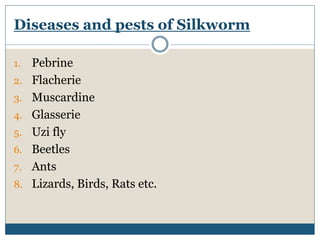
 Diseases and pests of Silkworm
Importance of sericulture
References
contents
Introduction
 The rearing of silkworms for the production of silk
is called sericulture.
 India is the second largest silk producing country in
the world next to China.
 Silk is the secretion from the salivary glands which
are found on both sides of the alimentary canal of
silkworm larvae and this secretion hardens into fine
threads called silk.
Types of Silkworms
1) Mulberry Silk Worm
2) Tasar Silk Worm
3) Eri Silk Worm
4) Muga Silk Worm
Mulberry Silk Worm
 It is the most important silkworm and reared
extensively in various part of India.
 It is found in West Bengal, Assam and Karnataka.
Life cycle of Silkworm
Tasar Silk Worm
 Antheraea mylitta is commonly known as Tasar
silk worm.
 It is generally found in the forests of West Bengal,
Assam, UP and is not domesticated.
 Important host trees are Sal, Ber, Asan, and Arjun.
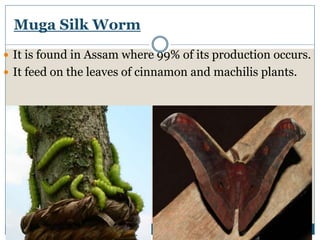
Muga Silk Worm
 It is found in Assam where 99% of its production occurs.
 It feed on the leaves of cinnamon and machilis plants.
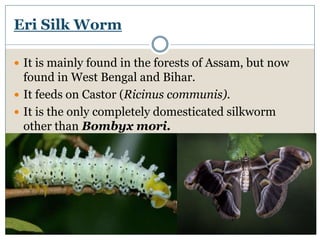
Eri Silk Worm
 It is mainly found in the forests of Assam, but now
found in West Bengal and Bihar.
 It feeds on Castor (Ricinus communis).
 It is the only completely domesticated silkworm
other than Bombyx mori.
Diseases and pests of Silkworm
1. Pebrine
2. Flacherie
3. Muscardine
4. Glasserie
5. Uzi fly
6. Beetles
7. Ants
8. Lizards, Birds, Rats etc.
Importance of Sericulture
 In business
 As source of employment
 Clothing
 Preparation of fishing line and elastic webs
 Used in insulation coils for telephone and wireless
receivers
References
 Srivastava K. P. Dhaliwal G. S., A Textbook Of
Applied Entomology
Thank you

Sericulture

  • 1.
    Sericulture Submitted by- Nisha Arya MSc4th Semster Kumaun University
  • 2.
    Introduction Types 1) Mulberry SilkWorm 2) Tasar Silk Worm 3) Eri Silk Worm 4) Muga Silk Worm  Diseases and pests of Silkworm Importance of sericulture References contents
  • 3.
    Introduction  The rearingof silkworms for the production of silk is called sericulture.  India is the second largest silk producing country in the world next to China.  Silk is the secretion from the salivary glands which are found on both sides of the alimentary canal of silkworm larvae and this secretion hardens into fine threads called silk.
  • 4.
    Types of Silkworms 1)Mulberry Silk Worm 2) Tasar Silk Worm 3) Eri Silk Worm 4) Muga Silk Worm
  • 5.
    Mulberry Silk Worm It is the most important silkworm and reared extensively in various part of India.  It is found in West Bengal, Assam and Karnataka.
  • 6.
    Life cycle ofSilkworm
  • 7.
    Tasar Silk Worm Antheraea mylitta is commonly known as Tasar silk worm.  It is generally found in the forests of West Bengal, Assam, UP and is not domesticated.  Important host trees are Sal, Ber, Asan, and Arjun.
  • 8.
    Muga Silk Worm It is found in Assam where 99% of its production occurs.  It feed on the leaves of cinnamon and machilis plants.
  • 9.
    Eri Silk Worm It is mainly found in the forests of Assam, but now found in West Bengal and Bihar.  It feeds on Castor (Ricinus communis).  It is the only completely domesticated silkworm other than Bombyx mori.
  • 10.
    Diseases and pestsof Silkworm 1. Pebrine 2. Flacherie 3. Muscardine 4. Glasserie 5. Uzi fly 6. Beetles 7. Ants 8. Lizards, Birds, Rats etc.
  • 11.
    Importance of Sericulture In business  As source of employment  Clothing  Preparation of fishing line and elastic webs  Used in insulation coils for telephone and wireless receivers
  • 12.
    References  Srivastava K.P. Dhaliwal G. S., A Textbook Of Applied Entomology
  • 13.