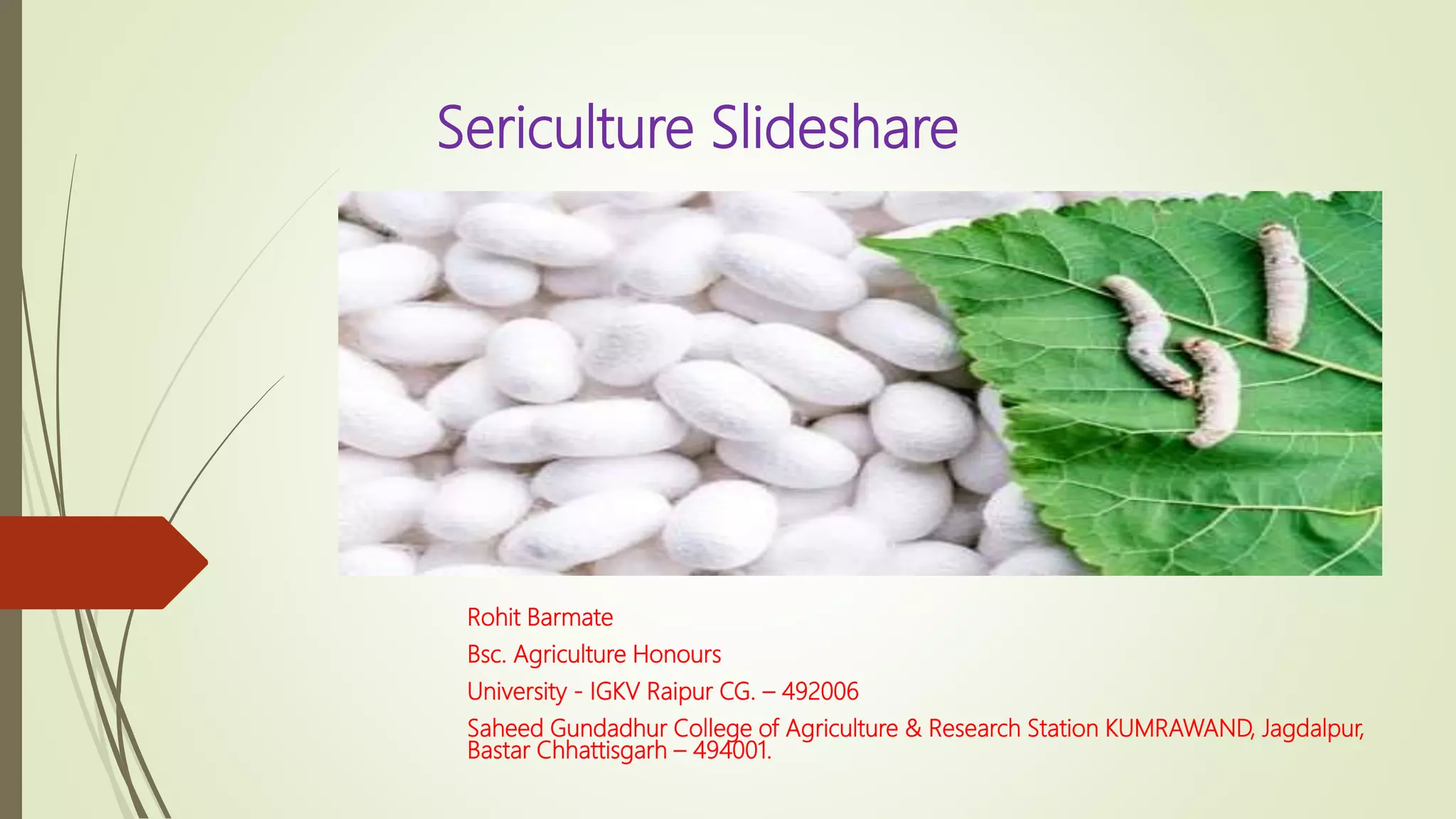
Sericulture Slideshare
Rohit Barmate
Bsc. Agriculture Honours
University - IGKV Raipur CG. – 492006
Saheed Gundadhur College of Agriculture & Research Station KUMRAWAND, Jagdalpur,
Bastar Chhattisgarh – 494001.
Welcome
Contents
 Tools and materialsericulture definition
 History
 Silkworm
 Species of Silkworm
 Types of silk
 Silkworm species distribution
 Sericulture – stages of production
 Silkworm life cycle
 Disease and pest
 Management
 Toils and materials
 Technical division
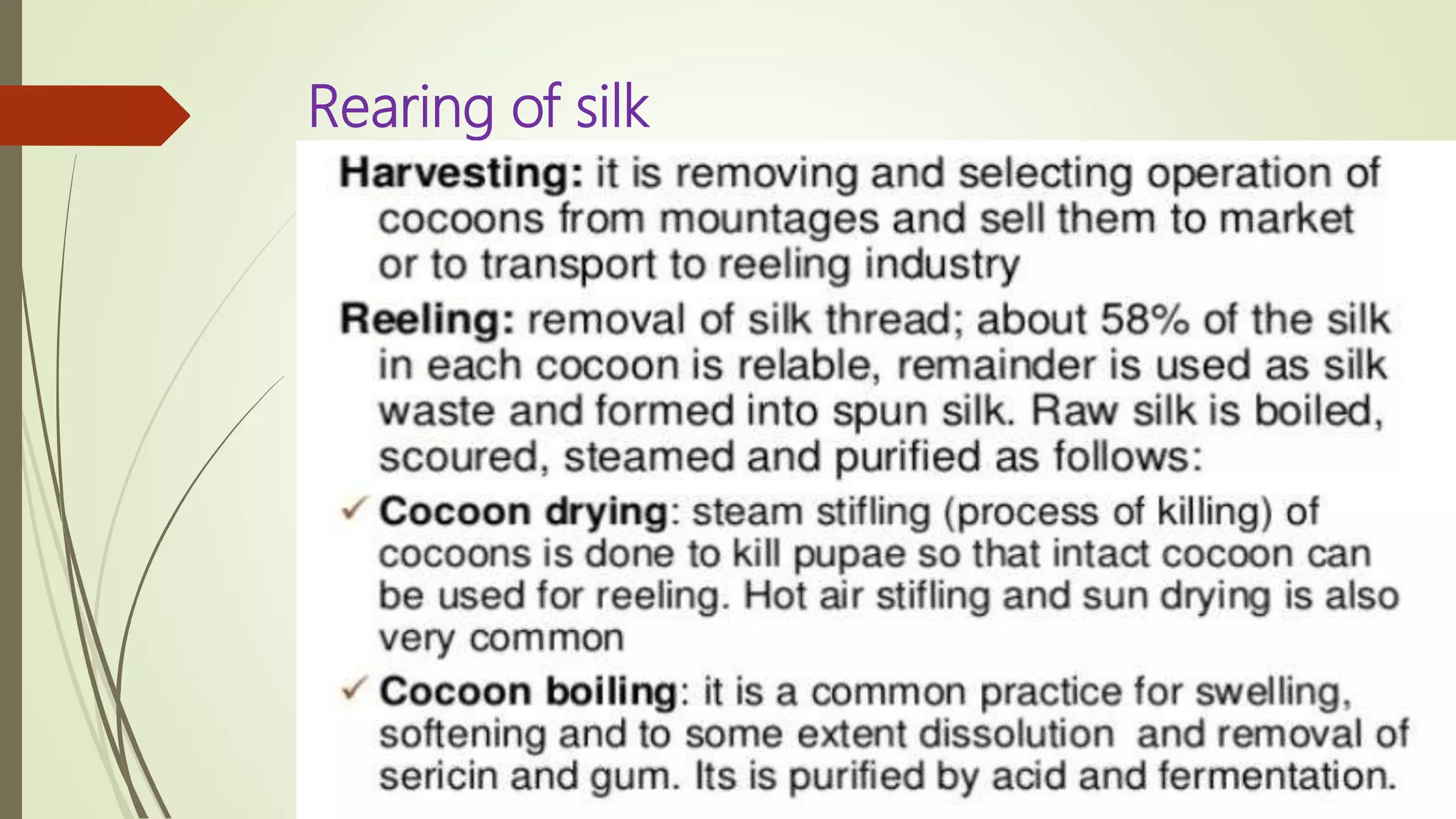
 Rearing of silk
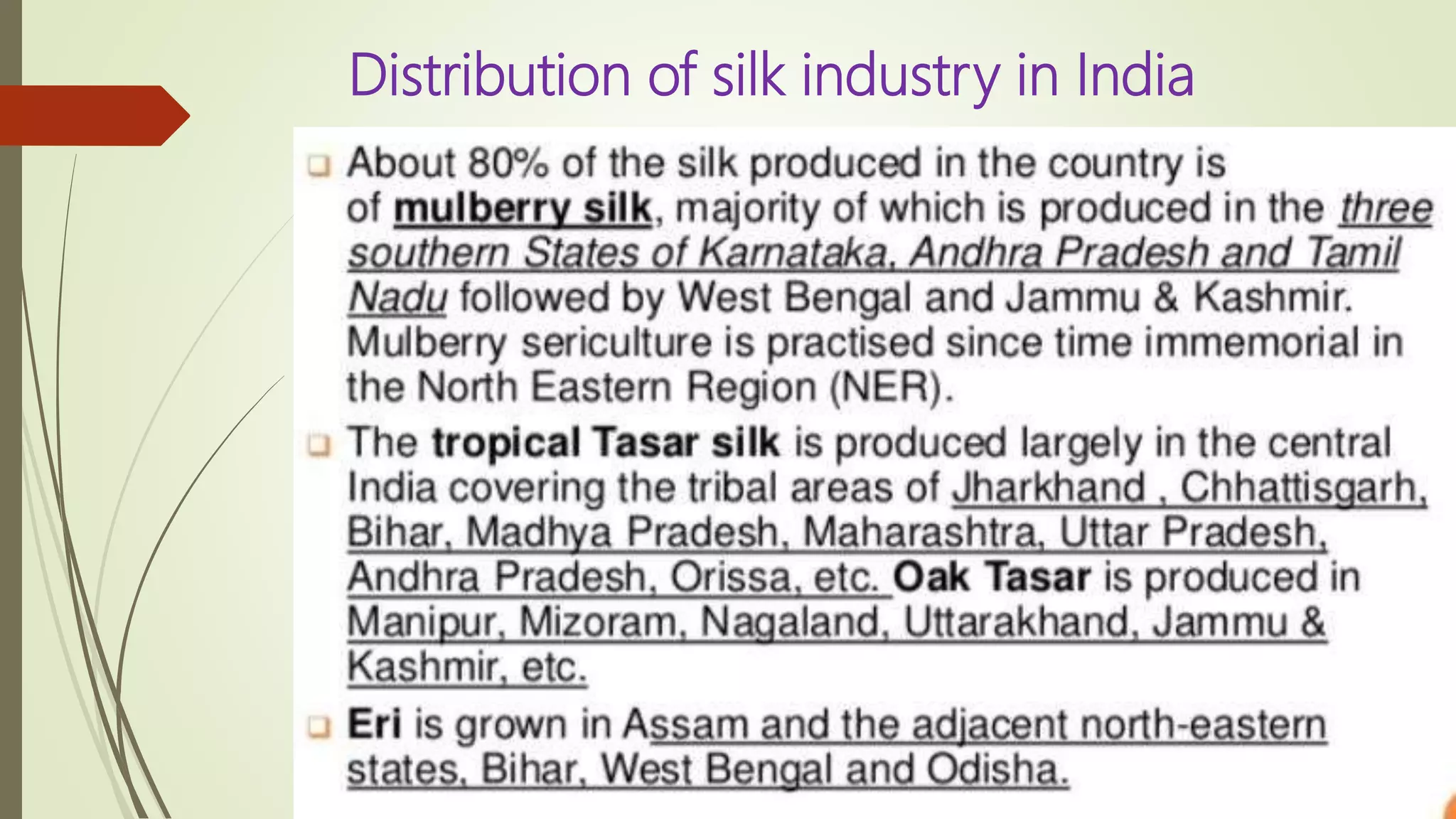
 Distribution of silk industry
 CSB
 Production
 Advantages of silk
 Disadvantages of silk
Sericulture:- definition
 The production of raw silk by raising silkworms.
 The production of silk and the rearing of silkworms for this purpose.
 Sericulture, or silk farming, is the cultivation of silkworms to produce silk.
Although there are several commercial species of silkworms, Bombyx mori (the
caterpillar of the domestic silkmoth) is the most widely used and intensively
studied silkworm.
History:-
 There is no authentic information regarding the origin and use of silk. The ancient literature gives
two views. According to one view, silk industry originated for the first time in India at the foot of
the Himalayas, and from there it spread to other countries of the world.
 The production of silk originated in Neolithic period China within the Yangshao culture (4th
millennium BC).
 Introduced sericulture in-
 World First- China
 According to Chinese legend, silk was first discovered in 2640 BC by Xilingji (Hsi-ling-chi), the 14-
year-old wife of China’s third emperor, Huangdi (Huang-Ti).
 India- Vishveshwaraiah(1913).
 Vishveshwaraiah, gave much importance to Sericulture in rural development. He hired the
services of Signor Washington Mari from Italy to organize and develop the silk industry in Mysore
in 1913. He made available 12 varieties of pure European and Chinese silkworm to conduct
experiments in Mysore State (now Karnataka).
Silkworm:-
 The silkworm is the larva( the active immature form of an insect)or caterpillar of the Bombyx
mori moth.
 A silkworm is the young form of a Chinese moth and it produces silk.
 Larva of a saturniid moth; spins a large amount of strong silk in constructing its
cocoon
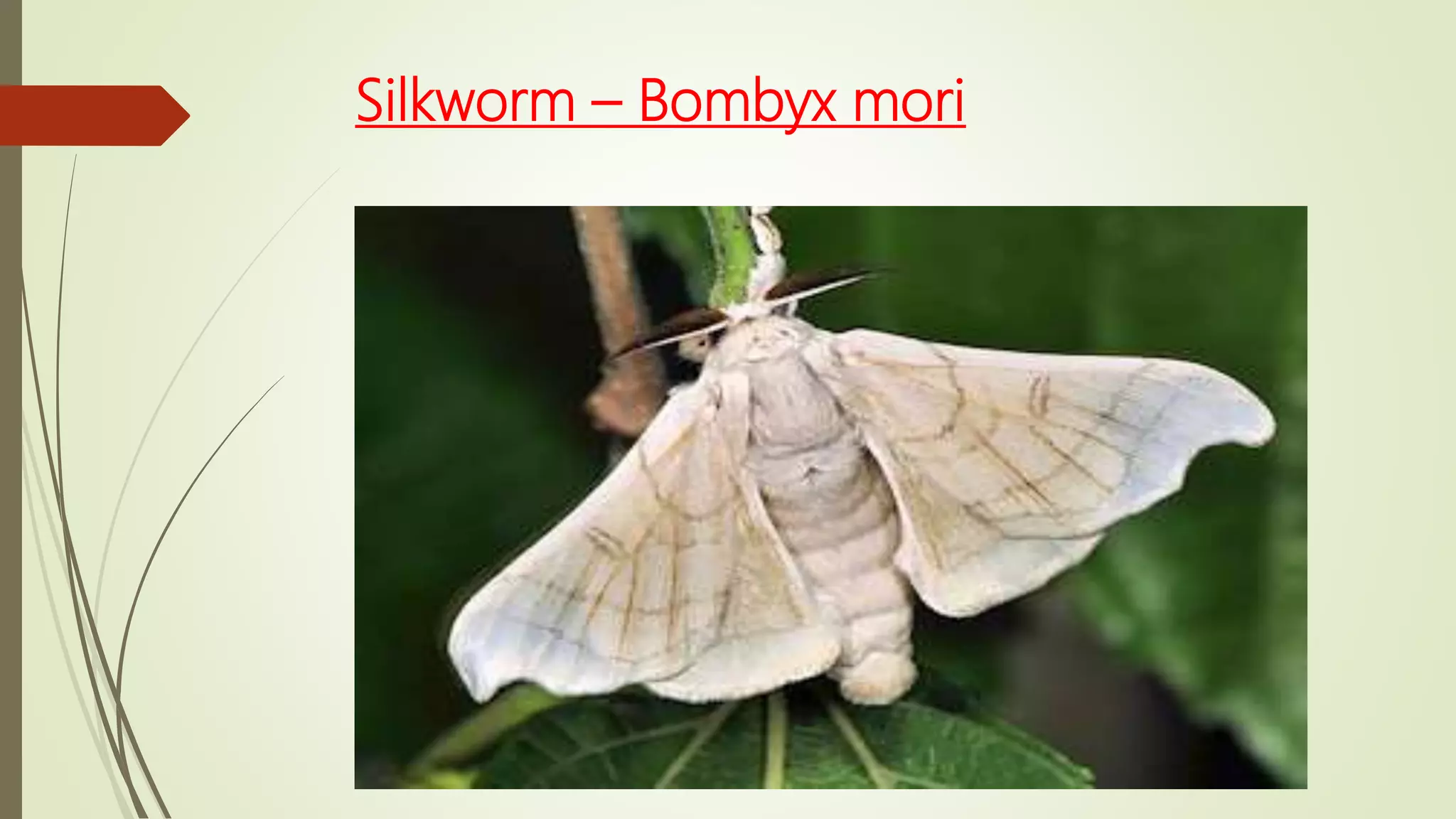
Silkworm – Bombyx mori
Species of Silkworm
 Mulberry silkworm
 Tasar silkworm
 Muga silkworm
 Eri silkworm
 Oak silkworm
 Gaint silkworm
Types of silk
 Tasar – Old and Traditional silk; Rural areas
 Eri – Eastern parts of India
 Mulberry – Non traditional silk
 Muga – Golden silk
Order - Lepidoptera
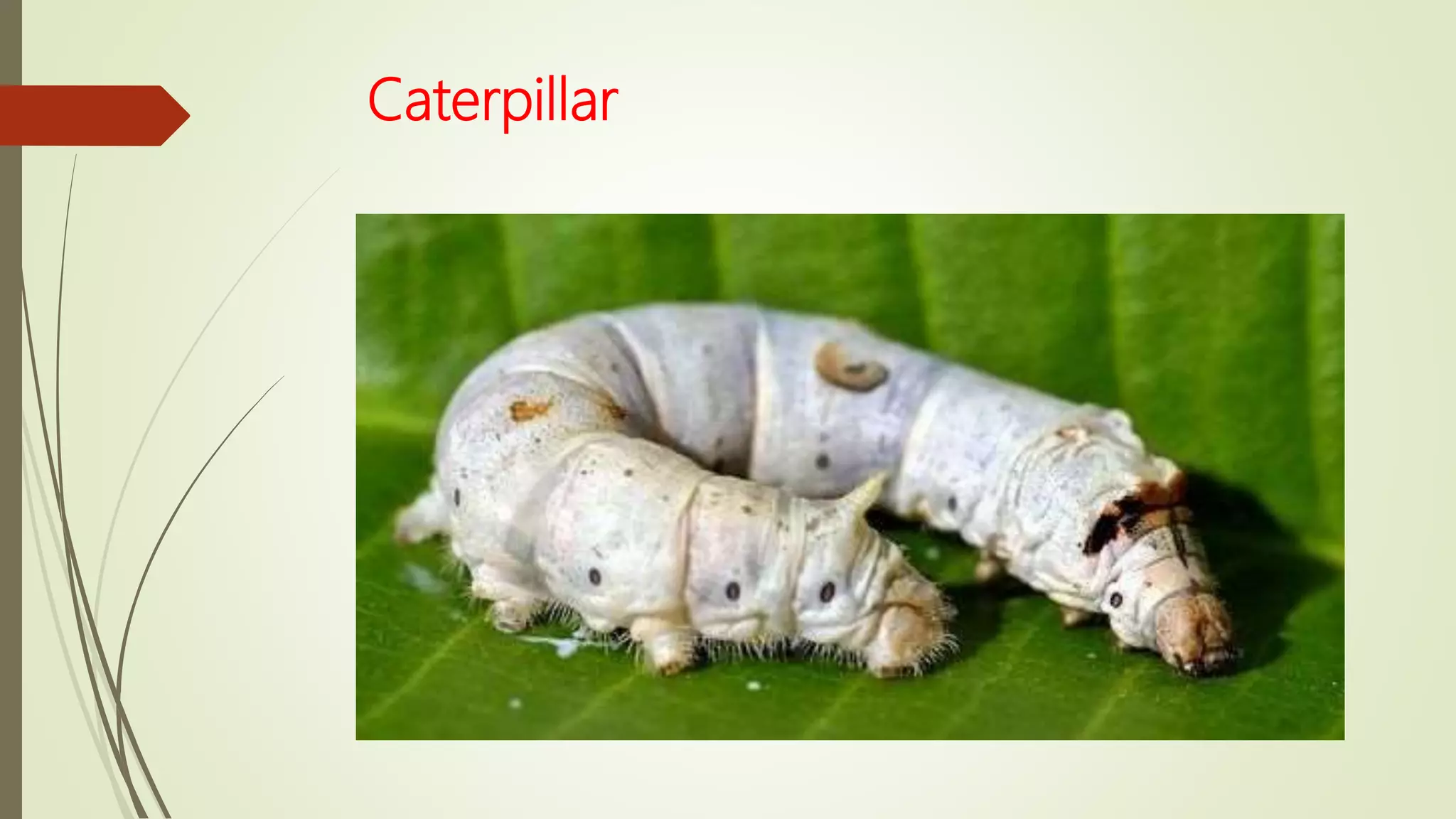
Caterpillar
Differential silk
Caterpillar
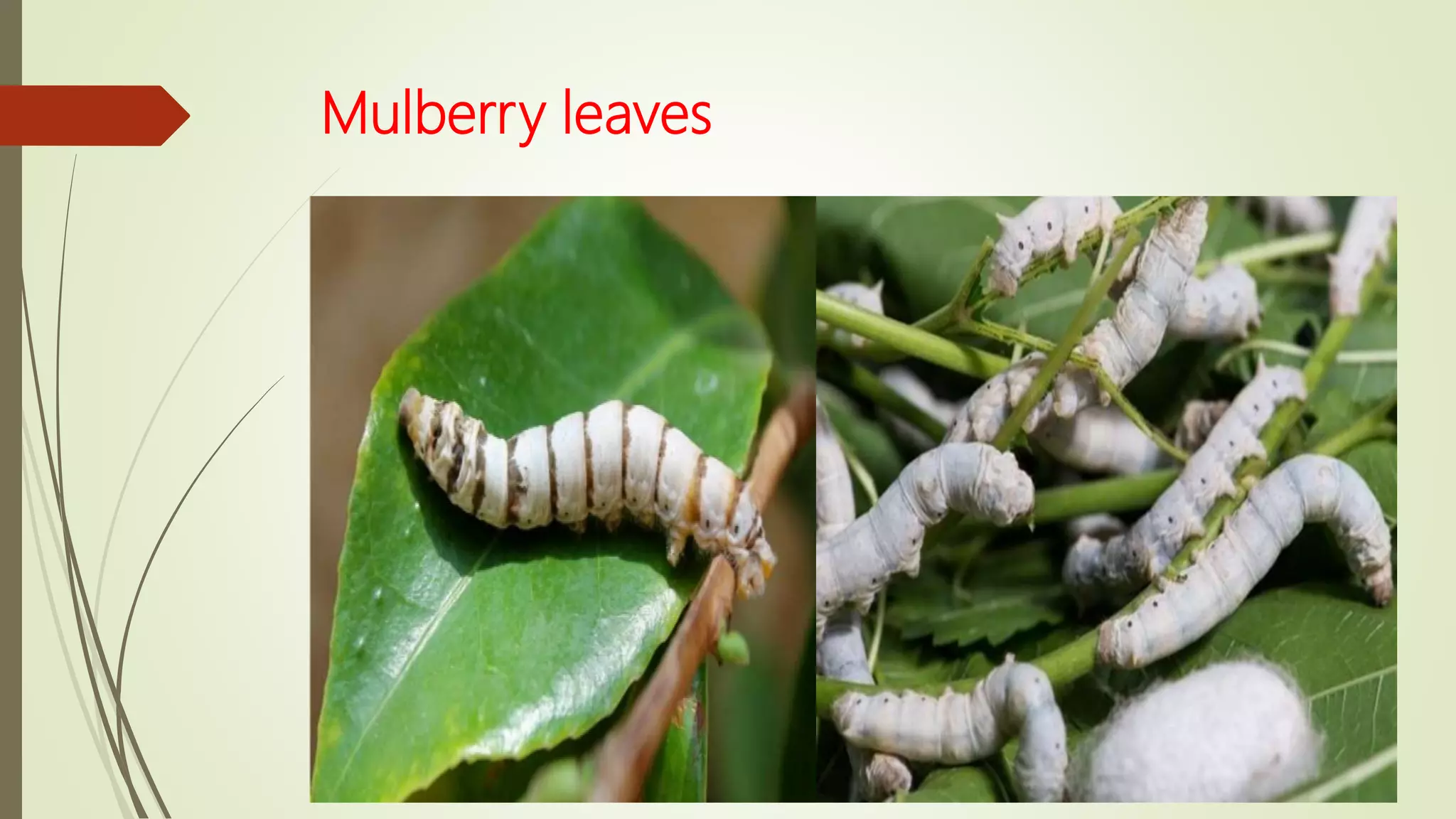
Mulberry leaves
Silkworm Species Discription
Sericulture – stages of production
 The stages of production are as follows:-
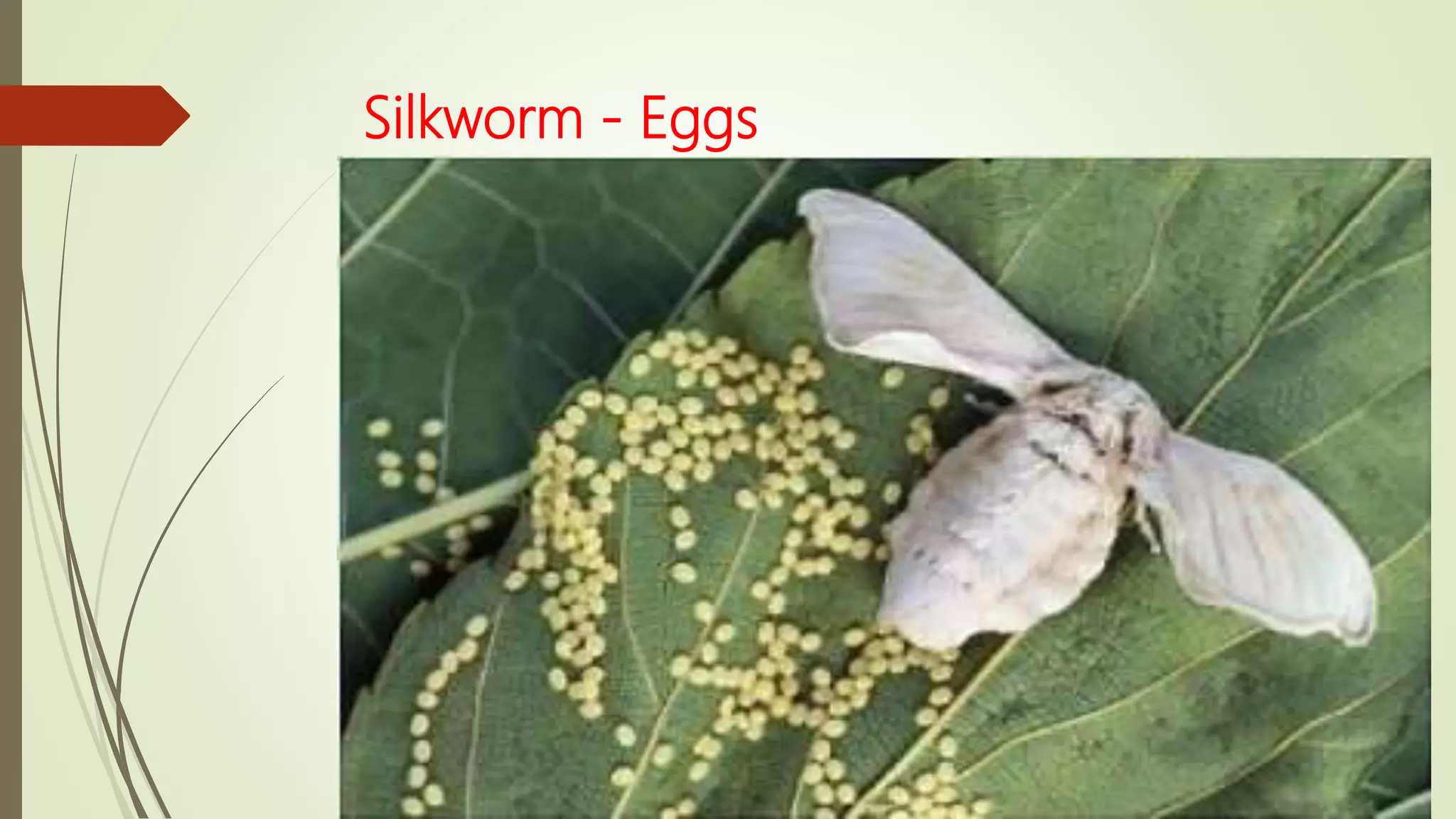
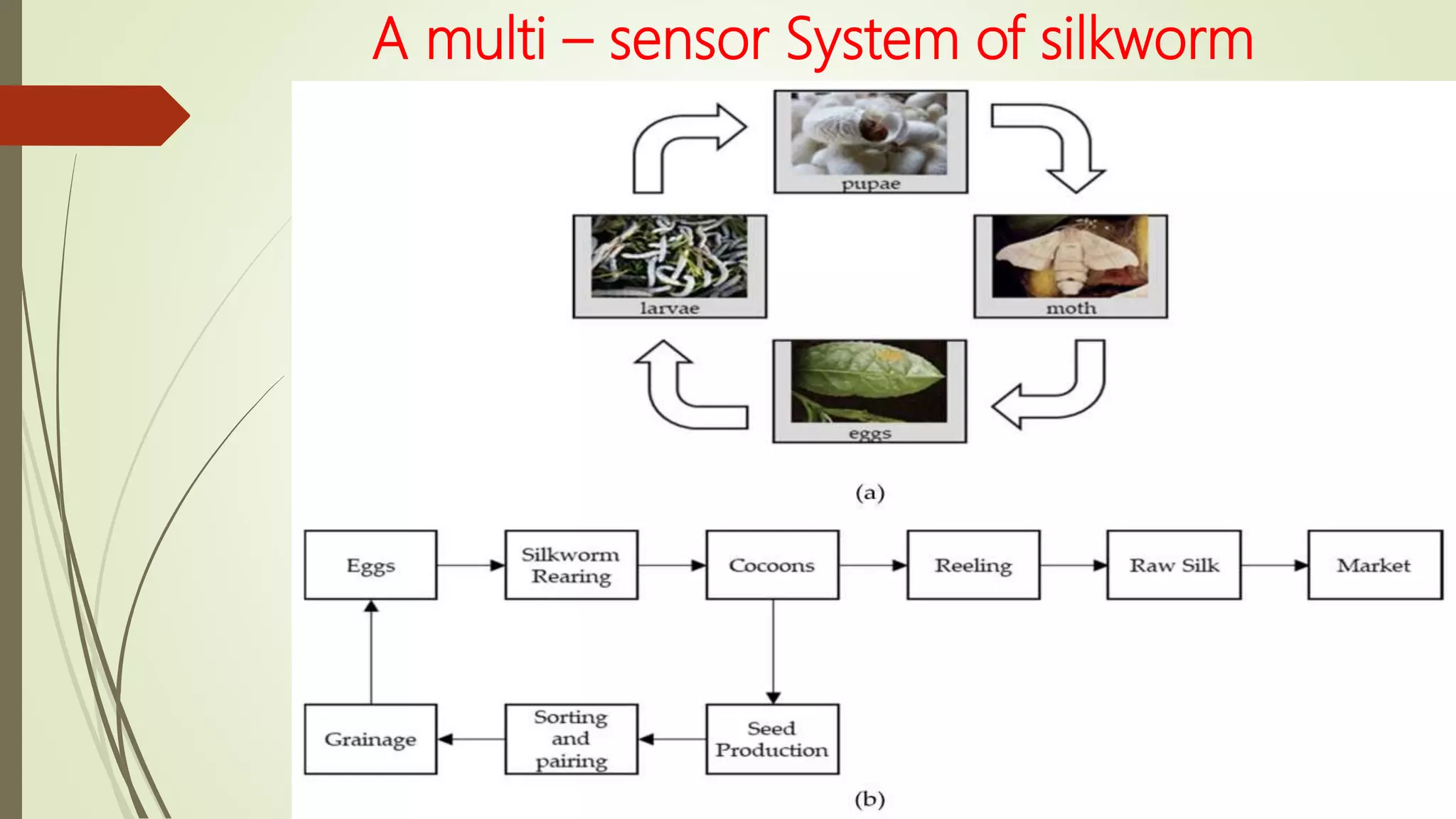
 1-The silk moth lays thousands of eggs.
 2-The silk moth eggs hatch to form larvae or caterpillars, known as silkworms.
 3-The larvae feed on mulberry leaves.
 4-Having grown and moulted several times silkworm weaves a net to hold itself
 5-It swings its head from side to side in a figure '8' distributing the salivar that will form
silk.
 6-The silk solidifies when it contacts the air
 7-The silkworm spins approximately one mile of filament and completely encloses itself in
a cocoon in about two or three days. The amount of usable quality silk in each cocoon is
small. As a result, about 2500 silkworms are required to produce a pound of raw silk)
 8-The silk is obtained by brushing the undamaged cocoon to find the outside end of the
filament.
 9-The silk filaments are then wound on a reel. One cocoon contains approximately 1,000
yards of silk filament. The silk at this stage is known as raw silk. One thread comprises up
to 48 individual silk filaments.
Bombex mori
Disease Management of silkworm
 Practice disinfection of rearing appliances before use.
 During rearing, test the faecal matters, unequal/ lethargic/ unsettled/ irregular
moulters periodically.
 If pebrine spores are detected, reject the entire infected crop.
 Ensure the measures for destruction of diseased silkworm
larvae/cocoons/moths/eggs.
Pest management
 1. Uzi fly –
 Physical (using uzi trap)
 Biological
 Release Nesolynx thymus (a pupal parasitoid of the uzi fly) inside rearing house
on 2nd day of V instar.
 After mounting of all spinning worms transfer the same pouches near the
chandrikes.
 After harvesting of cocoons keep the same pouches near the manure pit.
 Two pouches are required for 100 dfls.
 Proper disposal of silkworm litter after cocoon harvest
 2. Dermestid beetles -
 Mechanical control: Collect the grubs and adults by sweeping or by
using a vacuum cleaner, destroy by burning or dipping in soap water.
 Chemical control:
 Store pierced cocoons in Deltamethrin treated bags ie., soak the bags
in 0.028% Deltamethrin solution (1 ltr : 100 ltr water) and dry in
shade.
 Spray 0.028% Deltamethrin solution on walls and floor of PC room
once in 3 months.
 Sprinkle bleaching powder (200 gm/sq.mt) all around inner wall of
PC room to prevent crawling of grubs from PC room.
Tools and materials
Technical division
Silkworm - Eggs
Cocoon - silkworm
Rearing of silk
A multi – sensor System of silkworm
Distribution of silk industry in India
Central silk board of India (CSB)
Production
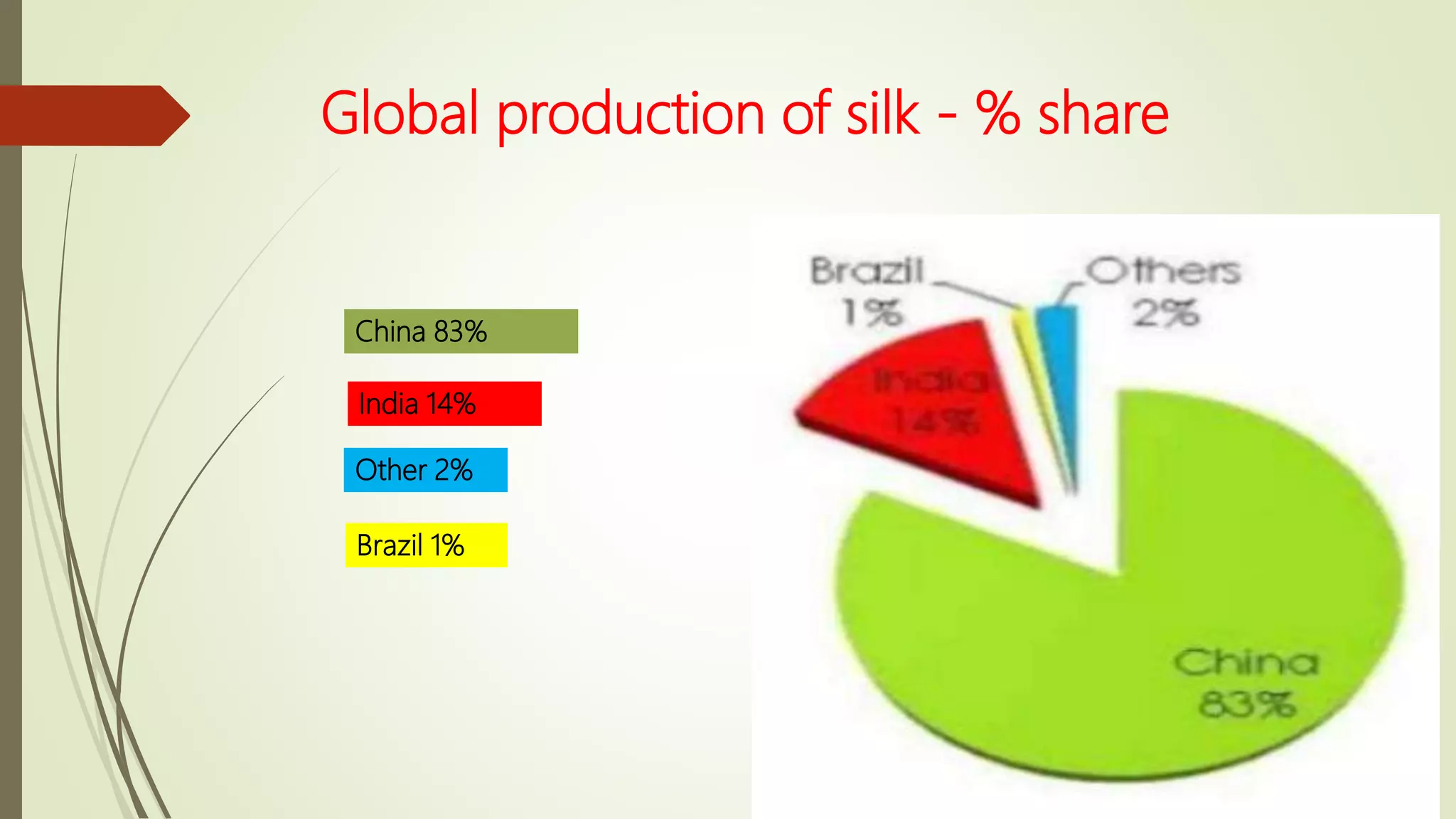
Global production of silk - % share
China 83%
India 14%
Other 2%
Brazil 1%
Advantages of silk
 Lightweight, soft, smooth
 Drapes well
 Dyse and prints well
 Bright & colourful
 Resist soil, mildew and moth
 Comfortable
 Absorbent
Disadvantages of silk
 Expensive
 Stains with water
 Yellow with age
 Weakened by perspiration, sun, soap
 Need special care, dry cleaning
 Easy to wrinkle, love to stick on skin, but not burly,
easy to fade
Thank you....🐛

Presentation of sericulture

  • 1.
    Sericulture Slideshare Rohit Barmate Bsc.Agriculture Honours University - IGKV Raipur CG. – 492006 Saheed Gundadhur College of Agriculture & Research Station KUMRAWAND, Jagdalpur, Bastar Chhattisgarh – 494001.
  • 2.
  • 3.
    Contents  Tools andmaterialsericulture definition  History  Silkworm  Species of Silkworm  Types of silk  Silkworm species distribution  Sericulture – stages of production  Silkworm life cycle  Disease and pest  Management  Toils and materials  Technical division  Rearing of silk  Distribution of silk industry  CSB  Production  Advantages of silk  Disadvantages of silk
  • 4.
    Sericulture:- definition  Theproduction of raw silk by raising silkworms.  The production of silk and the rearing of silkworms for this purpose.  Sericulture, or silk farming, is the cultivation of silkworms to produce silk. Although there are several commercial species of silkworms, Bombyx mori (the caterpillar of the domestic silkmoth) is the most widely used and intensively studied silkworm.
  • 5.
    History:-  There isno authentic information regarding the origin and use of silk. The ancient literature gives two views. According to one view, silk industry originated for the first time in India at the foot of the Himalayas, and from there it spread to other countries of the world.  The production of silk originated in Neolithic period China within the Yangshao culture (4th millennium BC).  Introduced sericulture in-  World First- China  According to Chinese legend, silk was first discovered in 2640 BC by Xilingji (Hsi-ling-chi), the 14- year-old wife of China’s third emperor, Huangdi (Huang-Ti).  India- Vishveshwaraiah(1913).  Vishveshwaraiah, gave much importance to Sericulture in rural development. He hired the services of Signor Washington Mari from Italy to organize and develop the silk industry in Mysore in 1913. He made available 12 varieties of pure European and Chinese silkworm to conduct experiments in Mysore State (now Karnataka).
  • 6.
    Silkworm:-  The silkwormis the larva( the active immature form of an insect)or caterpillar of the Bombyx mori moth.  A silkworm is the young form of a Chinese moth and it produces silk.  Larva of a saturniid moth; spins a large amount of strong silk in constructing its cocoon
  • 7.
  • 8.
    Species of Silkworm Mulberry silkworm  Tasar silkworm  Muga silkworm  Eri silkworm  Oak silkworm  Gaint silkworm
  • 9.
    Types of silk Tasar – Old and Traditional silk; Rural areas  Eri – Eastern parts of India  Mulberry – Non traditional silk  Muga – Golden silk
  • 10.
  • 11.
  • 12.
  • 13.
  • 14.
  • 15.
  • 16.
    Sericulture – stagesof production  The stages of production are as follows:-  1-The silk moth lays thousands of eggs.  2-The silk moth eggs hatch to form larvae or caterpillars, known as silkworms.  3-The larvae feed on mulberry leaves.  4-Having grown and moulted several times silkworm weaves a net to hold itself  5-It swings its head from side to side in a figure '8' distributing the salivar that will form silk.  6-The silk solidifies when it contacts the air  7-The silkworm spins approximately one mile of filament and completely encloses itself in a cocoon in about two or three days. The amount of usable quality silk in each cocoon is small. As a result, about 2500 silkworms are required to produce a pound of raw silk)  8-The silk is obtained by brushing the undamaged cocoon to find the outside end of the filament.  9-The silk filaments are then wound on a reel. One cocoon contains approximately 1,000 yards of silk filament. The silk at this stage is known as raw silk. One thread comprises up to 48 individual silk filaments.
  • 17.
  • 20.
    Disease Management ofsilkworm  Practice disinfection of rearing appliances before use.  During rearing, test the faecal matters, unequal/ lethargic/ unsettled/ irregular moulters periodically.  If pebrine spores are detected, reject the entire infected crop.  Ensure the measures for destruction of diseased silkworm larvae/cocoons/moths/eggs.
  • 21.
    Pest management  1.Uzi fly –  Physical (using uzi trap)  Biological  Release Nesolynx thymus (a pupal parasitoid of the uzi fly) inside rearing house on 2nd day of V instar.  After mounting of all spinning worms transfer the same pouches near the chandrikes.  After harvesting of cocoons keep the same pouches near the manure pit.  Two pouches are required for 100 dfls.  Proper disposal of silkworm litter after cocoon harvest
  • 22.
     2. Dermestidbeetles -  Mechanical control: Collect the grubs and adults by sweeping or by using a vacuum cleaner, destroy by burning or dipping in soap water.  Chemical control:  Store pierced cocoons in Deltamethrin treated bags ie., soak the bags in 0.028% Deltamethrin solution (1 ltr : 100 ltr water) and dry in shade.  Spray 0.028% Deltamethrin solution on walls and floor of PC room once in 3 months.  Sprinkle bleaching powder (200 gm/sq.mt) all around inner wall of PC room to prevent crawling of grubs from PC room.
  • 23.
  • 24.
  • 25.
  • 26.
  • 27.
  • 29.
    A multi –sensor System of silkworm
  • 30.
    Distribution of silkindustry in India
  • 31.
    Central silk boardof India (CSB)
  • 32.
  • 33.
    Global production ofsilk - % share China 83% India 14% Other 2% Brazil 1%
  • 34.
    Advantages of silk Lightweight, soft, smooth  Drapes well  Dyse and prints well  Bright & colourful  Resist soil, mildew and moth  Comfortable  Absorbent
  • 35.
    Disadvantages of silk Expensive  Stains with water  Yellow with age  Weakened by perspiration, sun, soap  Need special care, dry cleaning  Easy to wrinkle, love to stick on skin, but not burly, easy to fade
  • 36.