PRESENTED
BY:-
ANKIT VIKRAM
SINGH
APICULTURE
Albert Einstein once said:
“If the bee disappears from the surface of the
earth, man would have no more than four years
to live. No more bees, no more pollination …......
no more men!”
 2
INTRODUCTION:-
 Apiculture (bee keeping) is the maintenance of honey bee
colonies, commonly in man- made hives. Apiculture is
taken from the Latin word apis which means Bee.
 A beekeeper or (Apiarist) keeps bees in order to collect
honey and beewax, to pollinate crop, or to produce bees
for sale to other beekeepers. The location where the bees
are kept is called an Apiary. The main products are
Honey, Beewax, Propolis, Pollens, Bee venom and Royal
jelly.
3
HONEY BEE CLASSIFICATION:-
kingdom - Animalia
Phylum - Arthropoda
Class - Insecta
Order - Hymenoptera
Family - Apidae
Genus - Apis
4
HISTORY OF APICULTURE:-
1- At some point humans attempt to domestic wild bees in
artificial hive made from hollow logs, wooden boxes, pottery
vessels and woven straw baskets.
2-Beekeeping in india has been mentioned in ancient vedas
and buddisht scriptures.
3- In India first attempt to keep bees in movable frame hives
was made in 1882 in Bengal then in 1883-84 in punjab
4-Before BC 2422 in Egypt Apiculture is started in sun temple
of nyuserein.
{THE BEEKEEPERS,1568,BY PETER BRUEGEL,ARTIST}
5
BEEKEEPING IN INDIA:-
1-In India first attempt to keep bees in movable frame hives was made in 1882 in
Bengal and then in 1883-84 in Punjab
2- Beekeeping was also started in the Travancore state (now Cochin) in 1917 and
in mysore in 1925
3- In Himachal Pradesh modern beekeeping with indigenous honey bee A. cerana
started in 1934 at Kullu and in 1936 at Kangra.
4- The exotic bee A. mellifera was successfully introduced for the first time in
india in 1962 at NagrotaBagwan (then in Punjab state and now in Himachal
Pradesh),because this bee has potential to produce more honey
5- At present both the hive bee species are being used in modern beekeeping and
lot of honey is also being collected from the wild bees viz. A. dorsata and
A. florea.
6- India is producing approximately 90000 metric tons of honey annually from all
the four species of honey bees.(2016-17)
6
DIFFERENT SPECIES OF HONEY BEES:--
There are four well known species of true honey bees (belonging to genus Apis) in the
world:
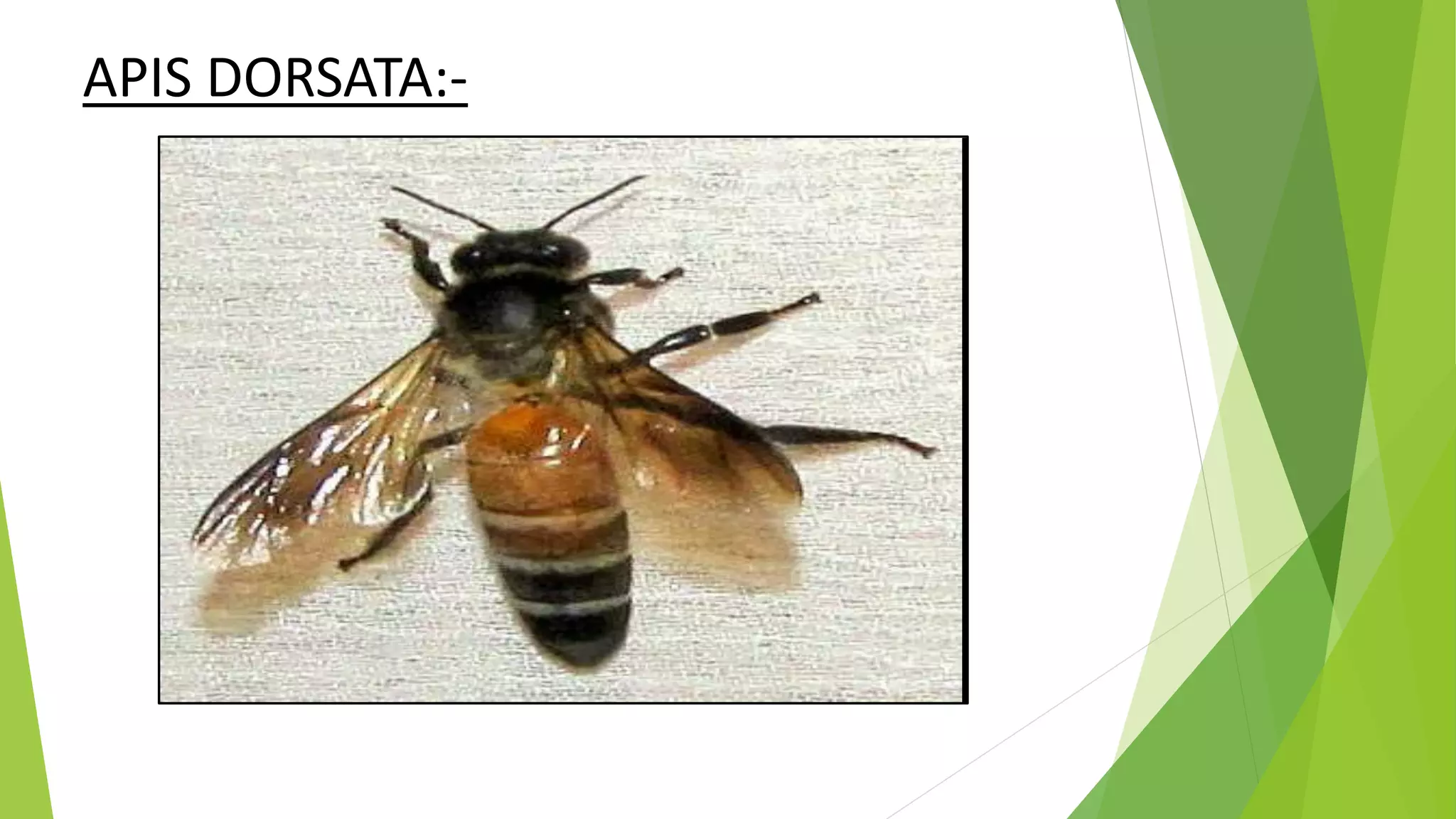
1- Rock bee, Apisdorsata F. (Fig. 2.1)
2- Little bee, A. florea F. (fig.2.2)
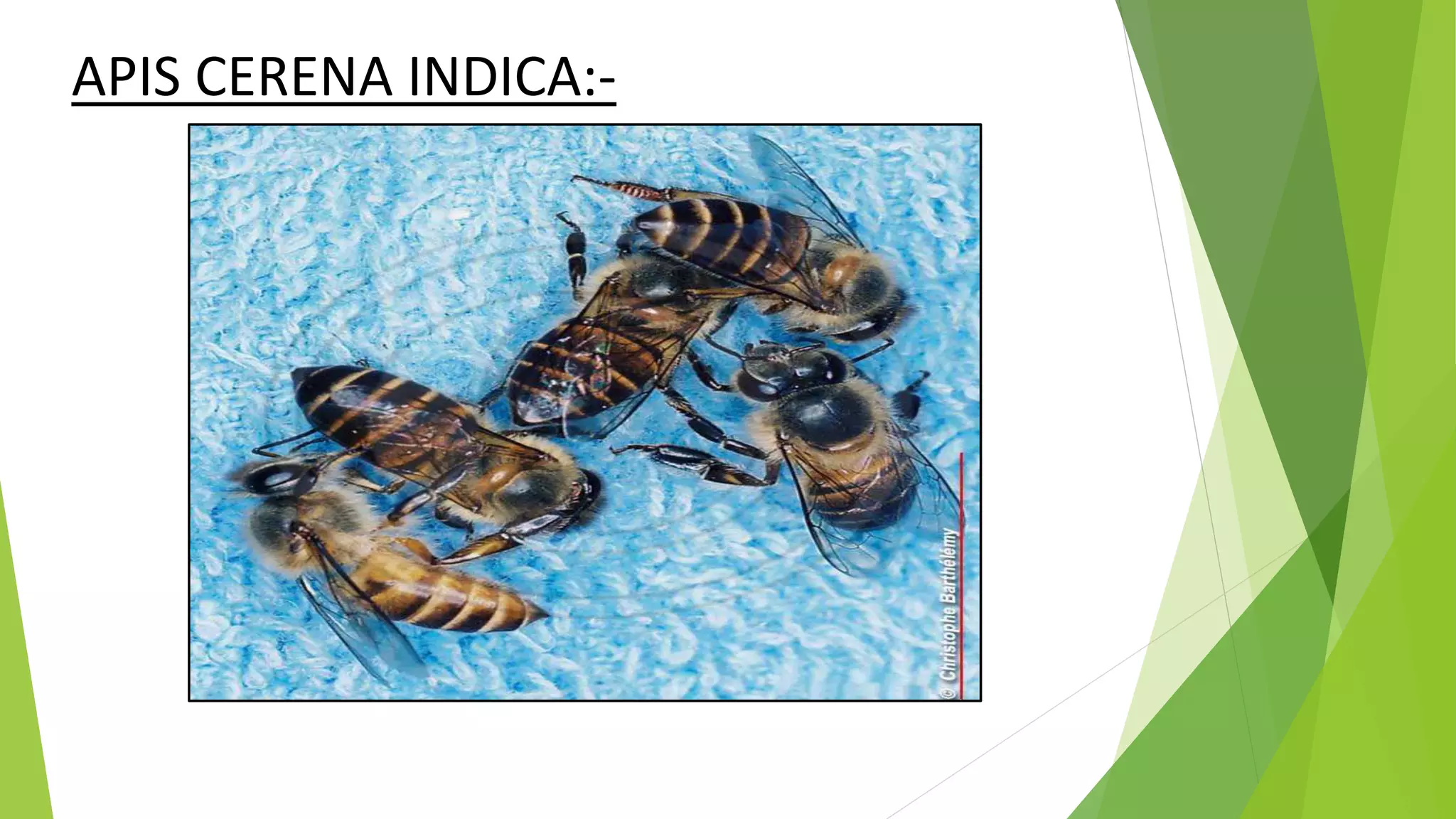
3- Asian bee, A. cerana F. (fig.2.3
4- European bee, A. mellifera L.(fig.2.4)
APIS DORSATA:-
CHARACTERS:-
 Commonly called rock bee
 Largest bee of about 20mm, called the GIANT HONEY BEE
 A single comb makes 60 pounds of honey,which is
maximum amount of a comb
 Workers pollinate 12,000 flowers daily.
 Workers are very small and active , and due to their
ferocious nature they are NON-DOMESTICABLE
 They are efficient pollinator of agricultural and
horticulture crops and produce 35-40kg of honey per comb
APIS CERENA INDICA:-
CHARACTERS:-
 Commonly called as Indian bee or Asian bee
 Slightly smaller than A.dorsata.
 Prefer to live in dark places by making parallel
combs of one foot in protected areas
 This Is very gentle species so can be
DOMESTICATED EASILY
 They have very high swarming tendency
 It produces about 8-10kg of honey per hive
APIS FLOREA:-
CHARACTERS:-
 Commonly called as little bee
 There comb is small vertical exposed nest in tree and
shrubs
 They are very less harmful to humans so the hives can be
handled with minimum protection
 Due to high absconding tendency they cannot be kept in
artificial hives
 They produce 0.5kg to 1kg honey per comb
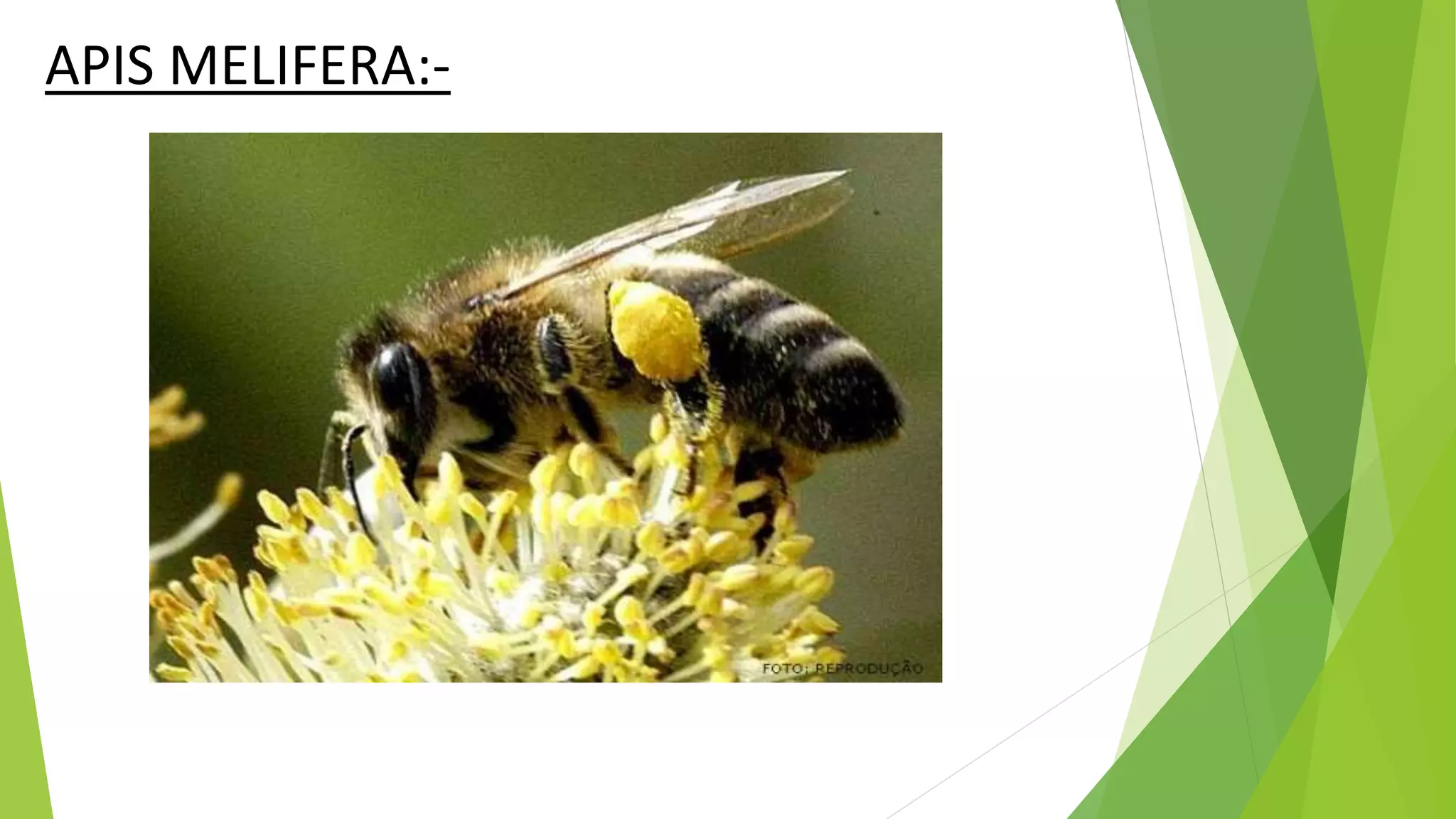
APIS MELIFERA:-
CHARACTERS
 It is called as EUROPEAN BEE
 They are originated from Italy
 Although bee produces less honey but it is the BEST
SPECIES for COMMERCIAL point of view
 It has very less swarming tendency and gentle
temperament with good honey gathering capabilities
 The average production of honey 50-60kg per hive
APIS MELIFERA
GENERAL MORPHOLOGY:-
body of honey bee can be distinguished in to three parts
1-HEAD
2-THORAX
3-ABDOMEN
COLONY ORGANIZATION AND DIVISION OF LABOUR:-
Honey bees are social insects and live in colonies. A normal colony, during
active season is composed of 3 kinds of individuals: one queen, thousands of
workers (10000 to 30000 or even more) and few hundreds of drones, which
vary in size .In addition, each colony has different developmental stages viz
eggs, larvae and pupae which are collectivelyknown as brood.
QUEEN:-
 Only one queen is found in a colony except under supersedure or
swarming instinct
 She is the mother of the whole colony producing workers and drones
and is the only perfectly developed female member of the colony
 A good queen can lay 1500-2000 eggs per day
 The queen lays both fertilized and unfertilized eggs. Fertilized eggs
produce workers(also queens) and unfertilized eggs produce drones
 A good mated queen may work satisfactorily for 2 or more years,
although queens canlive eight years or longer. However, in commercial
beekeeping, queen is replaced every year to keep high brood rearing
in a colony.
 Queen releases queen substance (pheromone) which helps in the
colony organization. It acts as worker attractant and inhibits ovary
development in worker bees as well as raising new queen. Absence of
queen pheromone is detected after about 30 minutes of queen loss
and colony may start raising new queen.
*Development of different castes of honey bees based on quality and quantity
of food and whether fertilized or unfertilized
WORKER:-
 Workers are imperfect females. They are unable to mate though may start egg laying if a
colony remains queen less for long period
 Duties of workers include:
Age of Worker Bee Duties performed
a) Till 3rd day of
emergence
Maintain wax cells in sanitary state, cleaning their walls and floors
after the emergence of young bees.
b) From 4th-6th day
of
emergence
Feed older larvae with mixture of honey and pollen and making
flights around the hive for getting layout of the hive,
c) From 7th-11th day
of
emergence
Hypopharyngeal glands (food glands) get developed and start
secreting royal jelly and feed younger larvae.
d) From 12th to 18th
day
The bees develop wax glands and work on building of comb,
construction of cells etc., Receive the nectar, pollen, water, propolis
etc., from field gatherers and deposit in the comb cells and help in
keeping the brood warm.
e) From 18th to
20thday
Perform guard duty
f) From 20th day
onwards
The worker bees take the duty of field i.e. exploring or foraging for
nectar and pollen; collecting water and propolis.
DRONE:-
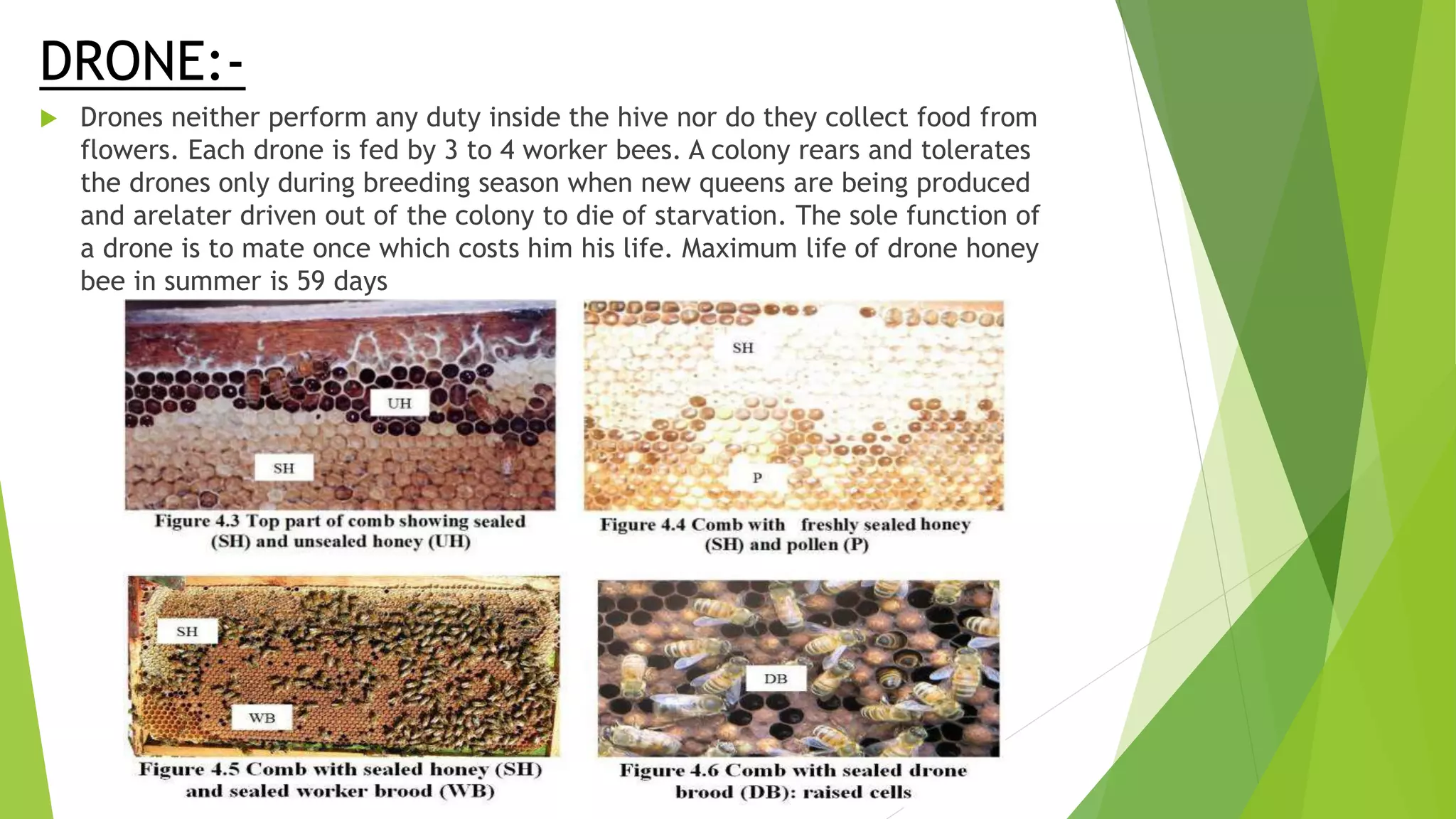
 Drones neither perform any duty inside the hive nor do they collect food from
flowers. Each drone is fed by 3 to 4 worker bees. A colony rears and tolerates
the drones only during breeding season when new queens are being produced
and arelater driven out of the colony to die of starvation. The sole function of
a drone is to mate once which costs him his life. Maximum life of drone honey
bee in summer is 59 days
BEE PRODUCTS AND THEIR USES
HONEY:-
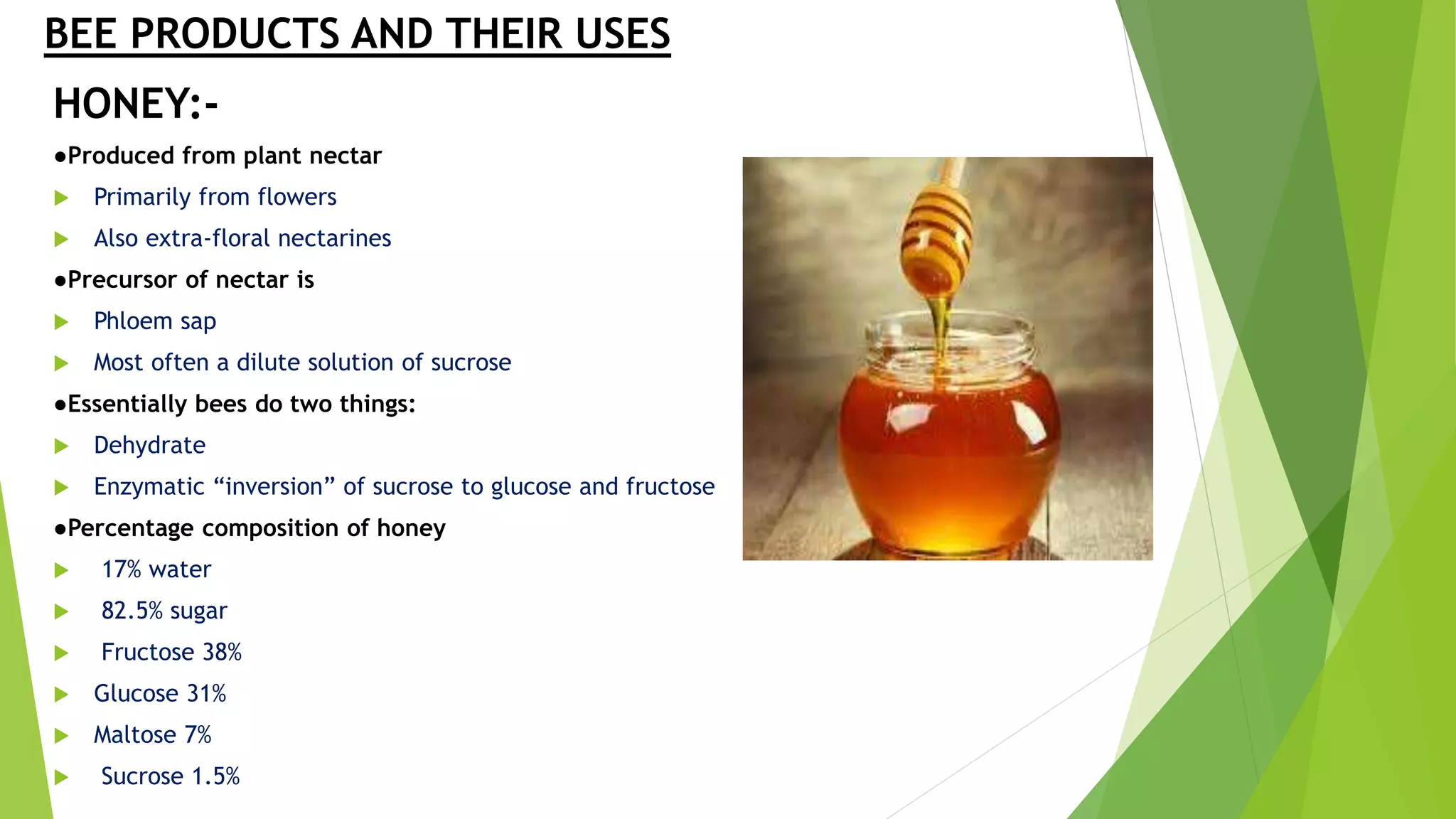
●Produced from plant nectar
 Primarily from flowers
 Also extra-floral nectarines
●Precursor of nectar is
 Phloem sap
 Most often a dilute solution of sucrose
●Essentially bees do two things:
 Dehydrate
 Enzymatic “inversion” of sucrose to glucose and fructose
●Percentage composition of honey
 17% water
 82.5% sugar
 Fructose 38%
 Glucose 31%
 Maltose 7%
 Sucrose 1.5%
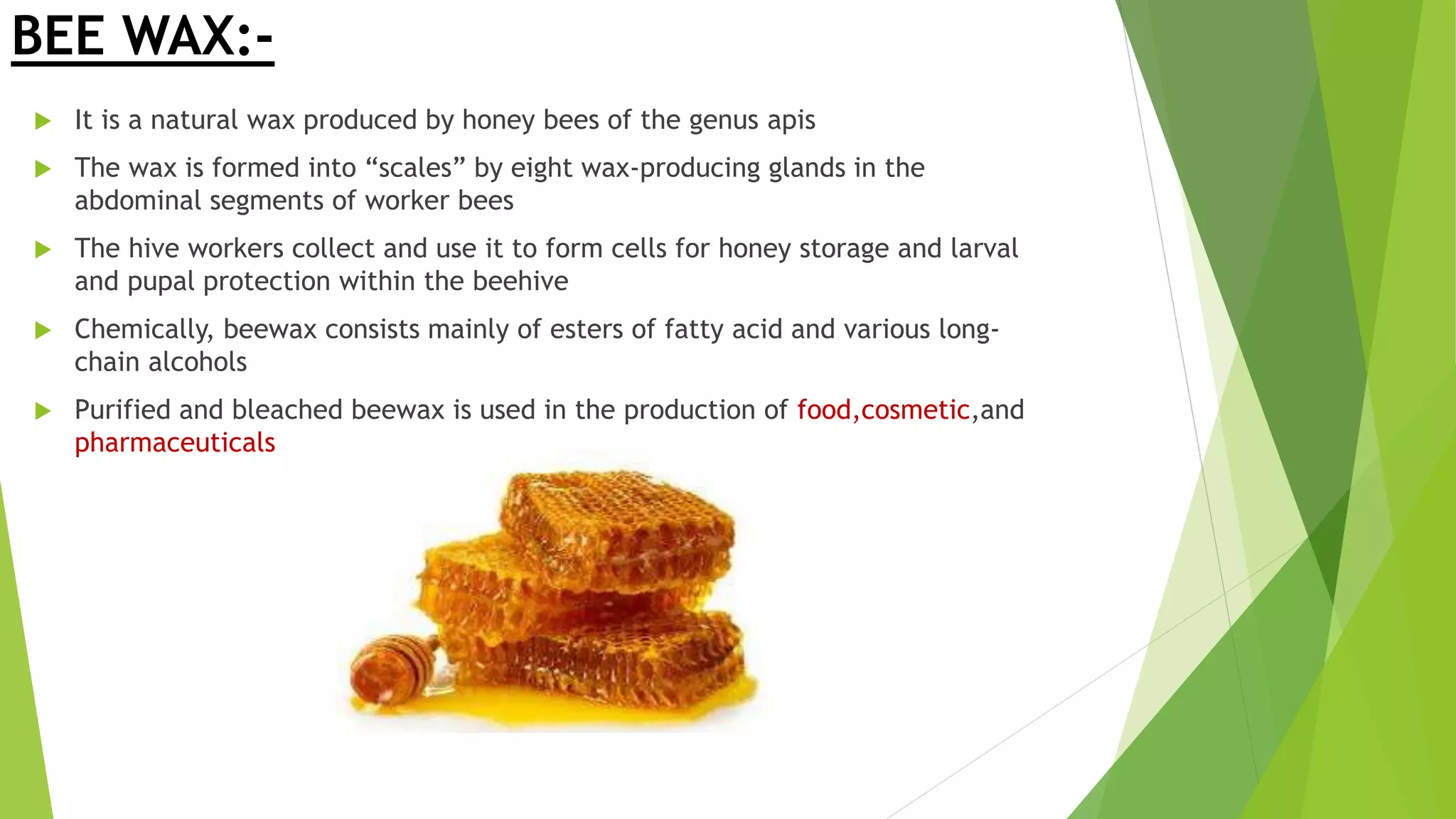
BEE WAX:-
 It is a natural wax produced by honey bees of the genus apis
 The wax is formed into “scales” by eight wax-producing glands in the
abdominal segments of worker bees
 The hive workers collect and use it to form cells for honey storage and larval
and pupal protection within the beehive
 Chemically, beewax consists mainly of esters of fatty acid and various long-
chain alcohols
 Purified and bleached beewax is used in the production of food,cosmetic,and
pharmaceuticals
ROYAL JELLY:-
1-The glandular secretions of young worker bees(4-10 days old), produced by the
hypo-pharyngeal in the head, used as food for eggs and the queen bee
Composition
* 66% water
* 14% protein
* 14% carbohydrate
* 5% lipids(fats and sterols)
POLLEN:-
 Plant male gametophyte
• *a reproductive structure that carries sperm
 A primary food substance for bees
*Directly as food to older larvae
*Indirectly as the precursor for royal jelly
MAIN ACTIVITIES OF HONEY BEE:-
1-Combing
2-Swarming
3-Migration or Absconding
4-Air conditioning
MODERN METHOD OF APICULTURE
They are divided into 5 types:
 Typical Movable Hive
 Queen Excluder
 Honey Extractor
 Uncapping Knife
 Other Equipments
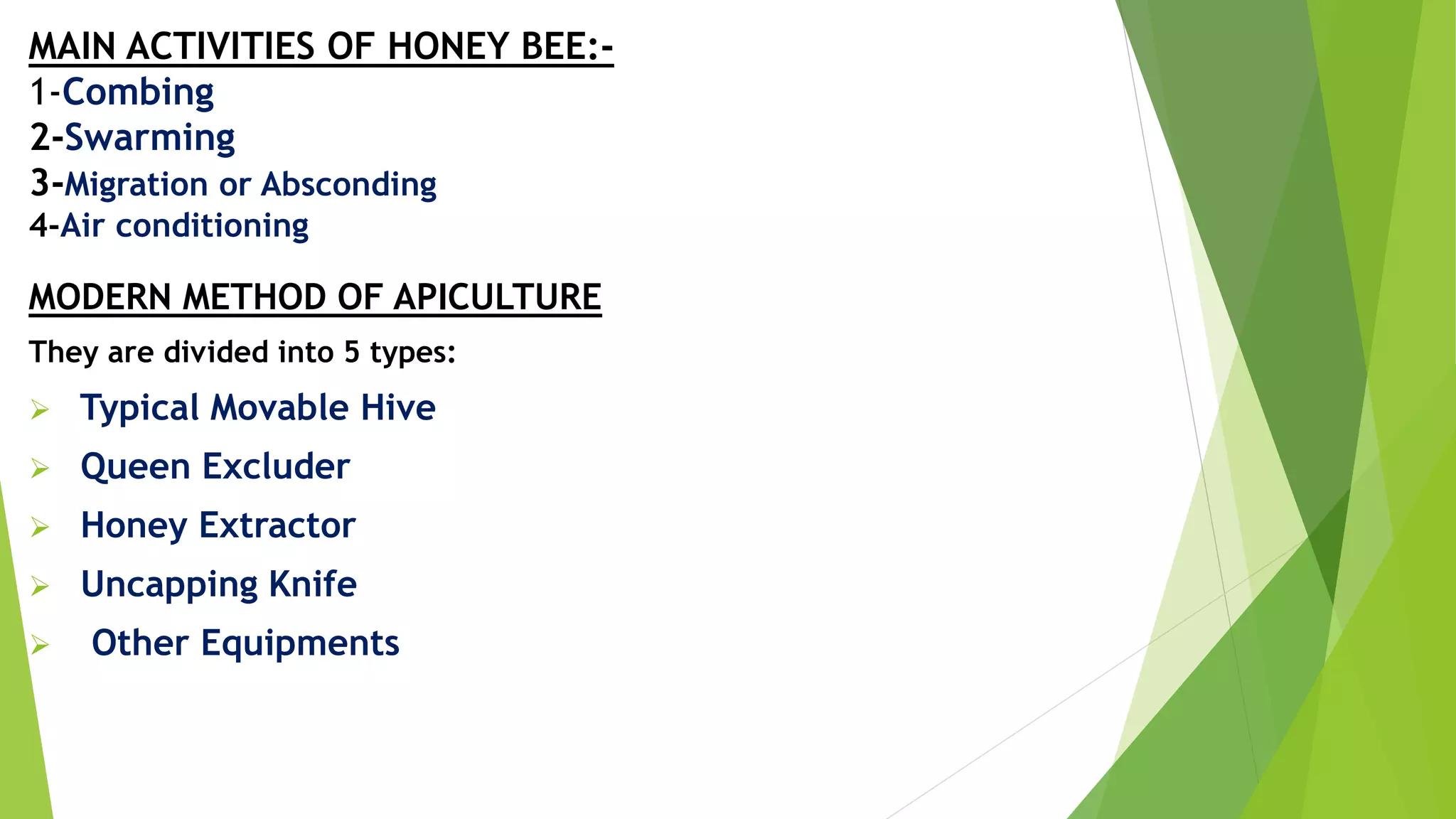
TYPICAL MOVABLE HIVE
 Size and number of frames are variable according to the need.
 The perforation size of zinc sheet is only 0.375 cm but the thorax of queen is
0.43 to 0.45cm so queen cannot pass through the pore.
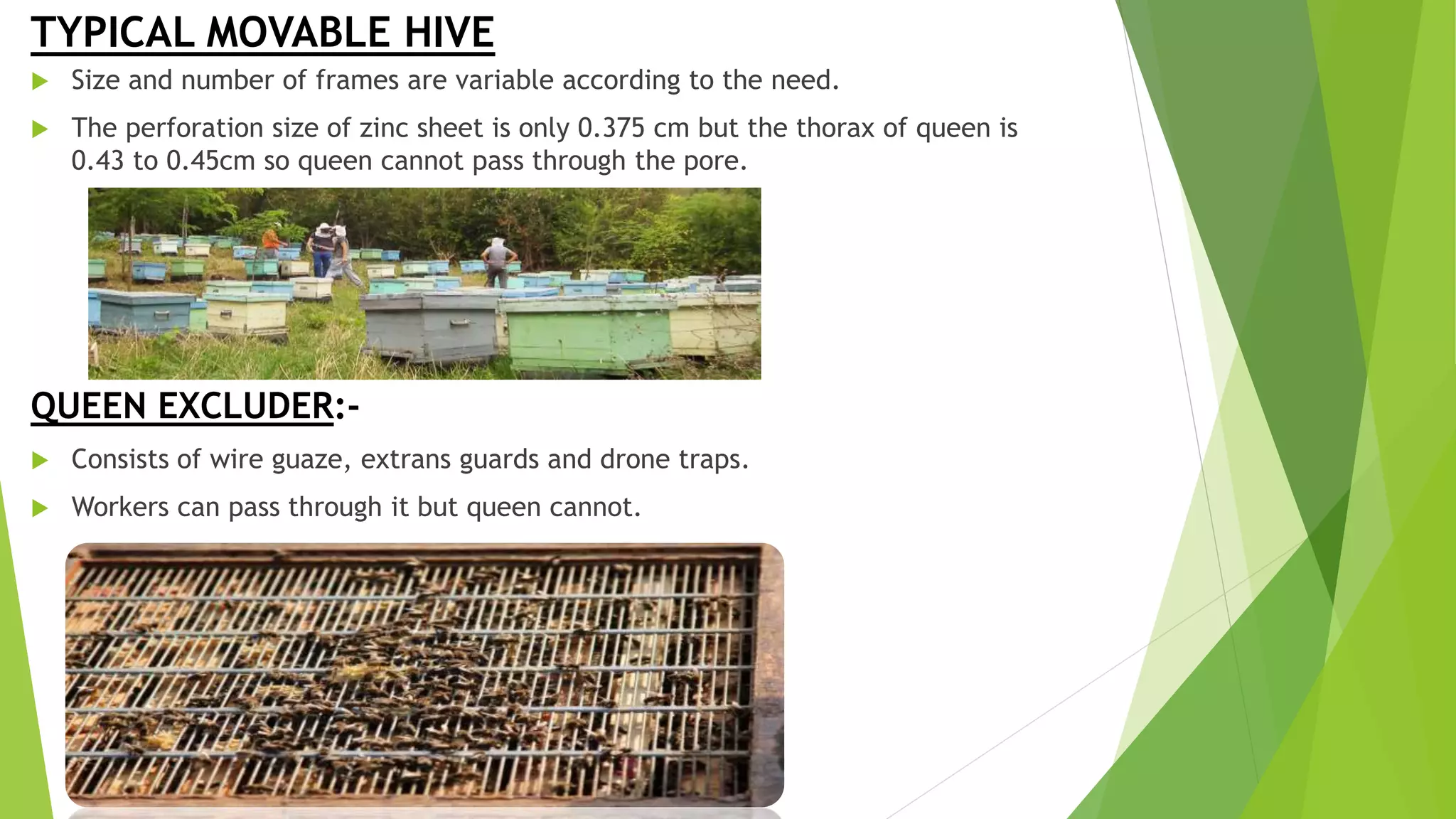
QUEEN EXCLUDER:-
 Consists of wire guaze, extrans guards and drone traps.
 Workers can pass through it but queen cannot.
HONEY EXTRACTOR:-
 It functions on principle of centrifugal force.
 By centrifugation , pure honey is thrown out without any
damage to the comb.
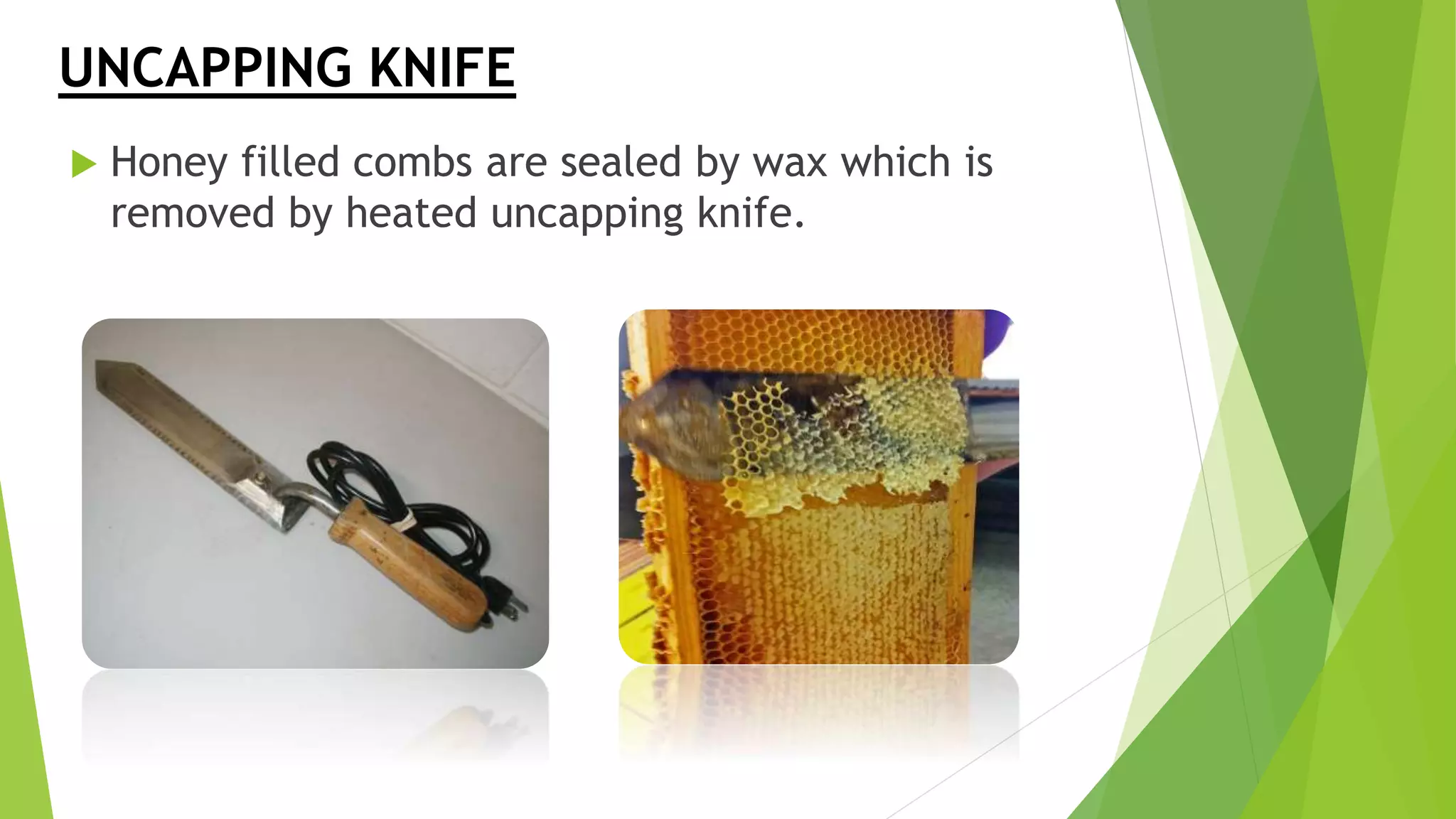
UNCAPPING KNIFE
 Honey filled combs are sealed by wax which is
removed by heated uncapping knife.
Other Bee keeping equipments
 Hive Bodies and Covers
 Frames
 Bottom Boards
 Protective Clothing
 Smoker
 Hive Tool
 Feeder
 Uncapping Knife
 Extractor and Containers
 Electric Fence
DISEASES & ENEMY OF HONEY BEE
Honey bees also suffer from several diseases and are attacked by different
enemies.. The diseases in brood and adult honey bees are caused by bacteria,
fungi, viruses, rickettsiae and protozoa.
Nosema disease:-
 disease is caused by the spore forming microsporidian, Nosema
apis. Disease.
 high proportion of eggs laid by the queen of a infected colony may
fail to produce mature larvae
TREATMENT:-
Nosema disease is treated by increasing the ventilation through the
hive. Some beekeepers treat hives with antibiotics such as fumagillin
Stone Brood:-This disease is caused by
Aspergillus flavus
Management:- 1- Removal of mummies by bees results
in natural control of the diseases.
2- Improve ventilation and reduce humidity.
American Foulbrood:It is caused by spore forming
bacterium, Paenibacillus larvae.
Management:Sterilize the combs with ethylene oxide
@ 1 g/l for 48 h at 43°C in fumigation chambers.
Wax moths:- Galleria mellonella (greater wax moths)
do not attack the bees directly, but feed on
the wax used by the bees to build their honeycomb.
Management:- Wax moths can be controlled in stored
comb by application of the aizawai variety of Bacillus
thuringiensis spores by spraying.
ECONOMIC IMPORTANCE OF HONEY
Food value:-
 Used in the formation of cakes and bread .
Medicinal value:-
 it is laxative, antiseptic and sedative and used in Ayurvedic and Unani
medicinal systems.
 Act as a curative of ulcers on tongue and alimentary canal.
 Typhoid germs are killed by it.
Other uses:-
 It is used as preservative, in brewing industry, in poultry and fishing
industries.
 It is used to stimulate the growth of plants, the bacterial culture, in insect
diet.
THANK YOU

Apiculture ppt

  • 1.
  • 2.
    Albert Einstein oncesaid: “If the bee disappears from the surface of the earth, man would have no more than four years to live. No more bees, no more pollination …...... no more men!”  2
  • 3.
    INTRODUCTION:-  Apiculture (beekeeping) is the maintenance of honey bee colonies, commonly in man- made hives. Apiculture is taken from the Latin word apis which means Bee.  A beekeeper or (Apiarist) keeps bees in order to collect honey and beewax, to pollinate crop, or to produce bees for sale to other beekeepers. The location where the bees are kept is called an Apiary. The main products are Honey, Beewax, Propolis, Pollens, Bee venom and Royal jelly. 3
  • 4.
    HONEY BEE CLASSIFICATION:- kingdom- Animalia Phylum - Arthropoda Class - Insecta Order - Hymenoptera Family - Apidae Genus - Apis 4
  • 5.
    HISTORY OF APICULTURE:- 1-At some point humans attempt to domestic wild bees in artificial hive made from hollow logs, wooden boxes, pottery vessels and woven straw baskets. 2-Beekeeping in india has been mentioned in ancient vedas and buddisht scriptures. 3- In India first attempt to keep bees in movable frame hives was made in 1882 in Bengal then in 1883-84 in punjab 4-Before BC 2422 in Egypt Apiculture is started in sun temple of nyuserein. {THE BEEKEEPERS,1568,BY PETER BRUEGEL,ARTIST} 5
  • 6.
    BEEKEEPING IN INDIA:- 1-InIndia first attempt to keep bees in movable frame hives was made in 1882 in Bengal and then in 1883-84 in Punjab 2- Beekeeping was also started in the Travancore state (now Cochin) in 1917 and in mysore in 1925 3- In Himachal Pradesh modern beekeeping with indigenous honey bee A. cerana started in 1934 at Kullu and in 1936 at Kangra. 4- The exotic bee A. mellifera was successfully introduced for the first time in india in 1962 at NagrotaBagwan (then in Punjab state and now in Himachal Pradesh),because this bee has potential to produce more honey 5- At present both the hive bee species are being used in modern beekeeping and lot of honey is also being collected from the wild bees viz. A. dorsata and A. florea. 6- India is producing approximately 90000 metric tons of honey annually from all the four species of honey bees.(2016-17) 6
  • 7.
    DIFFERENT SPECIES OFHONEY BEES:-- There are four well known species of true honey bees (belonging to genus Apis) in the world: 1- Rock bee, Apisdorsata F. (Fig. 2.1) 2- Little bee, A. florea F. (fig.2.2) 3- Asian bee, A. cerana F. (fig.2.3 4- European bee, A. mellifera L.(fig.2.4)
  • 8.
  • 9.
    CHARACTERS:-  Commonly calledrock bee  Largest bee of about 20mm, called the GIANT HONEY BEE  A single comb makes 60 pounds of honey,which is maximum amount of a comb  Workers pollinate 12,000 flowers daily.  Workers are very small and active , and due to their ferocious nature they are NON-DOMESTICABLE  They are efficient pollinator of agricultural and horticulture crops and produce 35-40kg of honey per comb
  • 10.
  • 11.
    CHARACTERS:-  Commonly calledas Indian bee or Asian bee  Slightly smaller than A.dorsata.  Prefer to live in dark places by making parallel combs of one foot in protected areas  This Is very gentle species so can be DOMESTICATED EASILY  They have very high swarming tendency  It produces about 8-10kg of honey per hive
  • 12.
  • 13.
    CHARACTERS:-  Commonly calledas little bee  There comb is small vertical exposed nest in tree and shrubs  They are very less harmful to humans so the hives can be handled with minimum protection  Due to high absconding tendency they cannot be kept in artificial hives  They produce 0.5kg to 1kg honey per comb
  • 14.
  • 15.
    CHARACTERS  It iscalled as EUROPEAN BEE  They are originated from Italy  Although bee produces less honey but it is the BEST SPECIES for COMMERCIAL point of view  It has very less swarming tendency and gentle temperament with good honey gathering capabilities  The average production of honey 50-60kg per hive
  • 16.
  • 17.
    GENERAL MORPHOLOGY:- body ofhoney bee can be distinguished in to three parts 1-HEAD 2-THORAX 3-ABDOMEN
  • 18.
    COLONY ORGANIZATION ANDDIVISION OF LABOUR:- Honey bees are social insects and live in colonies. A normal colony, during active season is composed of 3 kinds of individuals: one queen, thousands of workers (10000 to 30000 or even more) and few hundreds of drones, which vary in size .In addition, each colony has different developmental stages viz eggs, larvae and pupae which are collectivelyknown as brood.
  • 19.
    QUEEN:-  Only onequeen is found in a colony except under supersedure or swarming instinct  She is the mother of the whole colony producing workers and drones and is the only perfectly developed female member of the colony  A good queen can lay 1500-2000 eggs per day  The queen lays both fertilized and unfertilized eggs. Fertilized eggs produce workers(also queens) and unfertilized eggs produce drones  A good mated queen may work satisfactorily for 2 or more years, although queens canlive eight years or longer. However, in commercial beekeeping, queen is replaced every year to keep high brood rearing in a colony.  Queen releases queen substance (pheromone) which helps in the colony organization. It acts as worker attractant and inhibits ovary development in worker bees as well as raising new queen. Absence of queen pheromone is detected after about 30 minutes of queen loss and colony may start raising new queen.
  • 20.
    *Development of differentcastes of honey bees based on quality and quantity of food and whether fertilized or unfertilized
  • 21.
    WORKER:-  Workers areimperfect females. They are unable to mate though may start egg laying if a colony remains queen less for long period  Duties of workers include: Age of Worker Bee Duties performed a) Till 3rd day of emergence Maintain wax cells in sanitary state, cleaning their walls and floors after the emergence of young bees. b) From 4th-6th day of emergence Feed older larvae with mixture of honey and pollen and making flights around the hive for getting layout of the hive, c) From 7th-11th day of emergence Hypopharyngeal glands (food glands) get developed and start secreting royal jelly and feed younger larvae. d) From 12th to 18th day The bees develop wax glands and work on building of comb, construction of cells etc., Receive the nectar, pollen, water, propolis etc., from field gatherers and deposit in the comb cells and help in keeping the brood warm. e) From 18th to 20thday Perform guard duty f) From 20th day onwards The worker bees take the duty of field i.e. exploring or foraging for nectar and pollen; collecting water and propolis.
  • 22.
    DRONE:-  Drones neitherperform any duty inside the hive nor do they collect food from flowers. Each drone is fed by 3 to 4 worker bees. A colony rears and tolerates the drones only during breeding season when new queens are being produced and arelater driven out of the colony to die of starvation. The sole function of a drone is to mate once which costs him his life. Maximum life of drone honey bee in summer is 59 days
  • 23.
    BEE PRODUCTS ANDTHEIR USES HONEY:- ●Produced from plant nectar  Primarily from flowers  Also extra-floral nectarines ●Precursor of nectar is  Phloem sap  Most often a dilute solution of sucrose ●Essentially bees do two things:  Dehydrate  Enzymatic “inversion” of sucrose to glucose and fructose ●Percentage composition of honey  17% water  82.5% sugar  Fructose 38%  Glucose 31%  Maltose 7%  Sucrose 1.5%
  • 24.
    BEE WAX:-  Itis a natural wax produced by honey bees of the genus apis  The wax is formed into “scales” by eight wax-producing glands in the abdominal segments of worker bees  The hive workers collect and use it to form cells for honey storage and larval and pupal protection within the beehive  Chemically, beewax consists mainly of esters of fatty acid and various long- chain alcohols  Purified and bleached beewax is used in the production of food,cosmetic,and pharmaceuticals
  • 25.
    ROYAL JELLY:- 1-The glandularsecretions of young worker bees(4-10 days old), produced by the hypo-pharyngeal in the head, used as food for eggs and the queen bee Composition * 66% water * 14% protein * 14% carbohydrate * 5% lipids(fats and sterols) POLLEN:-  Plant male gametophyte • *a reproductive structure that carries sperm  A primary food substance for bees *Directly as food to older larvae *Indirectly as the precursor for royal jelly
  • 26.
    MAIN ACTIVITIES OFHONEY BEE:- 1-Combing 2-Swarming 3-Migration or Absconding 4-Air conditioning MODERN METHOD OF APICULTURE They are divided into 5 types:  Typical Movable Hive  Queen Excluder  Honey Extractor  Uncapping Knife  Other Equipments
  • 27.
    TYPICAL MOVABLE HIVE Size and number of frames are variable according to the need.  The perforation size of zinc sheet is only 0.375 cm but the thorax of queen is 0.43 to 0.45cm so queen cannot pass through the pore. QUEEN EXCLUDER:-  Consists of wire guaze, extrans guards and drone traps.  Workers can pass through it but queen cannot.
  • 28.
    HONEY EXTRACTOR:-  Itfunctions on principle of centrifugal force.  By centrifugation , pure honey is thrown out without any damage to the comb.
  • 29.
    UNCAPPING KNIFE  Honeyfilled combs are sealed by wax which is removed by heated uncapping knife.
  • 30.
    Other Bee keepingequipments  Hive Bodies and Covers  Frames  Bottom Boards  Protective Clothing  Smoker  Hive Tool  Feeder  Uncapping Knife  Extractor and Containers  Electric Fence
  • 31.
    DISEASES & ENEMYOF HONEY BEE Honey bees also suffer from several diseases and are attacked by different enemies.. The diseases in brood and adult honey bees are caused by bacteria, fungi, viruses, rickettsiae and protozoa. Nosema disease:-  disease is caused by the spore forming microsporidian, Nosema apis. Disease.  high proportion of eggs laid by the queen of a infected colony may fail to produce mature larvae TREATMENT:- Nosema disease is treated by increasing the ventilation through the hive. Some beekeepers treat hives with antibiotics such as fumagillin
  • 32.
    Stone Brood:-This diseaseis caused by Aspergillus flavus Management:- 1- Removal of mummies by bees results in natural control of the diseases. 2- Improve ventilation and reduce humidity. American Foulbrood:It is caused by spore forming bacterium, Paenibacillus larvae. Management:Sterilize the combs with ethylene oxide @ 1 g/l for 48 h at 43°C in fumigation chambers. Wax moths:- Galleria mellonella (greater wax moths) do not attack the bees directly, but feed on the wax used by the bees to build their honeycomb. Management:- Wax moths can be controlled in stored comb by application of the aizawai variety of Bacillus thuringiensis spores by spraying.
  • 33.
    ECONOMIC IMPORTANCE OFHONEY Food value:-  Used in the formation of cakes and bread . Medicinal value:-  it is laxative, antiseptic and sedative and used in Ayurvedic and Unani medicinal systems.  Act as a curative of ulcers on tongue and alimentary canal.  Typhoid germs are killed by it. Other uses:-  It is used as preservative, in brewing industry, in poultry and fishing industries.  It is used to stimulate the growth of plants, the bacterial culture, in insect diet.
  • 34.