Master Seminar
on
Bee-keeping
Seminar incharge :
Dr.Gaje Singh
Dr.D.V.Singh
Dr. RajendraSingh
Dept.of Entomology
Speaker:
Sushant Kumar
M.Sc. (Ag) (Entomology)
Id.No. - PG/ A 3935/17-18
 Honey bee is a social & beneficial insect. They lives in hive.
 They are flying insect & close relatives of wasp.
Beekeeping
The science that aims to study the life, behavior & activity
of honey bee in order to obtain bee products and crop
pollination.
Maintenance of honey bee colonies, commonly in
hives, by humans.
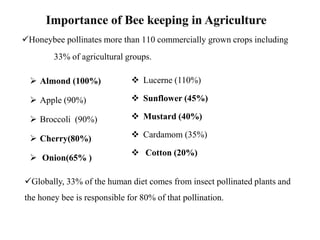
Honeybee pollinates more than 110 commercially grown crops including
33% of agricultural groups.
 Almond (100%)
 Apple (90%)
 Broccoli (90%)
 Cherry(80%)
 Onion(65% )
 Lucerne (110%)
 Sunflower (45%)
 Mustard (40%)
 Cardamom (35%)
 Cotton (20%)
Globally, 33% of the human diet comes from insect pollinated plants and
the honey bee is responsible for 80% of that pollination.
World scenario of Beekeeping
 About 50 million bee colonies, mostly, Apis mellifera, maintained all over the world.
 World production of honey estimated 13.88 lakh M.T.
 15 countries in world account for 90% of world honey production.
 Major honey producing countries are China, USA(85000MTs), Mexico, Argentina,
Ukraine, Turkey, Russia & India.
 China is only Asian country producing nearly 1.6 lakh M. T. of honey, 12800 M.T. of
beeswax against 43400 M. T. of world production.
 China also produces 1000 M. T. of pollen and 800 M.T. of royal jelly and biggest
exporter of honey, beeswax and other bee products.
 70 lakh A.mellifera bee colonies and 30 lakh A.cerana bee colonies in China and they
have a plan to increase this number to 5 times in next few decades.
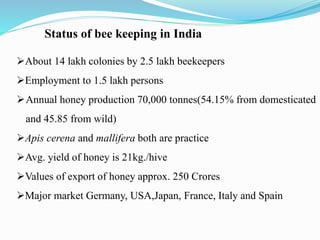
Status of bee keeping in India
About 14 lakh colonies by 2.5 lakh beekeepers
Employment to 1.5 lakh persons
Annual honey production 70,000 tonnes(54.15% from domesticated
and 45.85 from wild)
Apis cerena and mallifera both are practice
Avg. yield of honey is 21kg./hive
Values of export of honey approx. 250 Crores
Major market Germany, USA,Japan, France, Italy and Spain
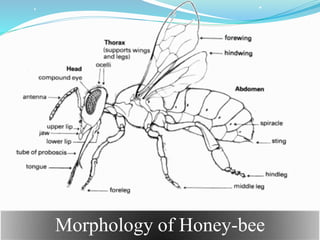
Morphology of Honey-bee
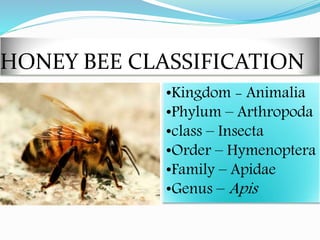
•Kingdom - Animalia
•Phylum – Arthropoda
•class – Insecta
•Order – Hymenoptera
•Family – Apidae
•Genus – Apis
HONEY BEE CLASSIFICATION
Important species of Honey-bee in Bee keeping
Open nesting. Builds single large comb
attached to branches of trees or rocks etc.
Found in plains as well as hills up to 1600 meters
above sea level. Highly migratory.
Biggest honey bee (16-18mm)
Swarming/ Absconding tendency Strong
Furious in Temperament
40 kg Honey
wild bees, cannot be domesticated
Apis dorsata
Apis cerena indica
Cavity nesting. Builds many
parallel combs in cavities of
tree trunks, hollows of rocks,
poles and other Covered
places.
Found throughout India
Medium size (14-15mm)
Strong tendency of
Swarming
Furious in temperament
5 kg (Hive bees;
can be domesticated
Apis mellifera
Cavity nesting and similar in
habits to Apis cerana.
builds parallel combs.
Exotic bee to India, Introduced
successfully in 1962
Medium size (14-16mm)
Swarming only in African sub
species
Gentle in temperament
15 kg honey
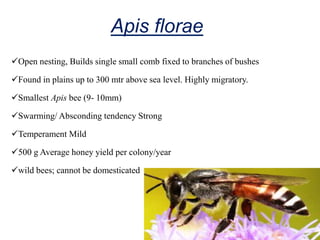
Apis florae
Open nesting, Builds single small comb fixed to branches of bushes
Found in plains up to 300 mtr above sea level. Highly migratory.
Smallest Apis bee (9- 10mm)
Swarming/ Absconding tendency Strong
Temperament Mild
500 g Average honey yield per colony/year
wild bees; cannot be domesticated
Site Selection for Bee Keeping
 Availability of Flower
 Availability of water
 Accessibility and topography
 Shelter or Shady area
 Proximity of human activities
 Presence of pest and use of pesticides
 Drainage
Swarming, Supersedure,Absconding
Nuptial or flight marriage
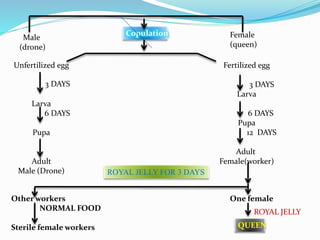
Male
(drone)
Female
(queen)
Copulation
Unfertilized egg
Larva
6 DAYS
Pupa
Adult
Male (Drone)
Fertilized egg
3 DAYS
Larva
6 DAYS
Pupa
12 DAYS
Adult
Female(worker)
Other workers
NORMAL FOOD
Sterile female workers
One female
QUEEN
ROYAL JELLY
3 DAYS
ROYAL JELLY FOR 3 DAYS
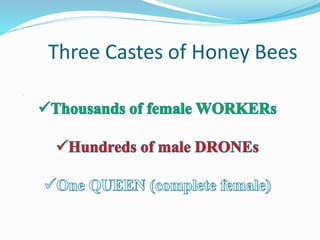
Three Castes of Honey Bees
.
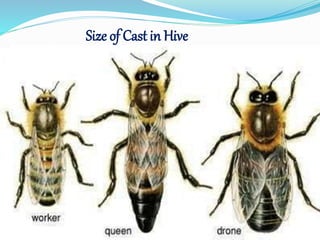
Size of Cast in Hive
The Queen Profile
The queen is a mature, fertile
female. She lays thousands of eggs
during her life time.
A queen has the longest live span in
the colony living for years versus
months.
She is normally larger than the other
bees in the hive and has a slim torpedo
shape.
She does have a stinger, but uses it to kill other queens.
Only actively reproducing female
Can produce 1,500 eggs per day or more at the height of the brood
season
She develops from a fertilized egg.
She mates with many drones to produce fertilized eggs.
She is the mother of all the bees in the hive.
Her role in the hive is to produce eggs and to release pheromone
signals within the hive.
Worker Profile
Female but typically not
able to reproduce
A colony will have 20,000 -
60,000
Live for 4-6 weeks in
summer, 4-5 months in
winter
Develops from a fertilized
egg
 Worker bees are sexually underdeveloped females.
 They may number as many as 60,000 in a colony.
 They are called workers because that is what they do.
 Female worker bees under certain conditions can lay eggs but
because they are not mated, they produce eggs that only develop into
drones.
 A worker bee spends its first 20 days in the hive performing various
task – cleaning cells, feeding young larva, building wax comb, etc.
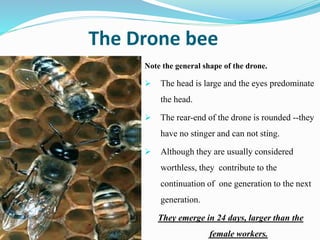
The Drone bee
Note the general shape of the drone.
 The head is large and the eyes predominate
the head.
 The rear-end of the drone is rounded --they
have no stinger and can not sting.
 Although they are usually considered
worthless, they contribute to the
continuation of one generation to the next
generation.
They emerge in 24 days, larger than the
female workers.
The drone is the male bee in the hive.
He develops from an unfertilized egg. Meaning he is
passing on genetic material from his mother only.
He provides ½ of the genetic material in worker bees.
His life span depends on the health of the colony.
During poor honey flows and honey shortages, drones
may be driven from the hive. This happens at the onset of
winter as well.
The process of leaving the colony by the queen with a large
group of worker bees is called swarming.
when the egg laying capacity of the old queen is lost, it
dies or new queen takes the position of the old queen.
Migration of the complete colony from one place to
another due to some unfavorable conditions.
Communication
When food source is
< 50 m from hive
Waggle dance When food source
is > 50 meters away
Round dance
Waggle dance used during swarming to communicate
possible nest sites
Two types of hives are used in indigenous method of bee keeping
e.g. wall or fixed and movable hive .
(a) WALL OR FIXED HIVE:
•It is purely natural type of comb because the bees
themselves prepare the hive at any space on the wall
or trees.
•There is an opening on one side through which bees
come out of the hive.
(b) MOVABLE HIVE
•It comprises of hollow wood logs, empty boxes and earthen pots etc. placed in
verandas of houses.
•There exist two holes one is for entrance and the other for exit of the bees.
•The swarmed bees usually come to the box on their own accord.
•Some bee keepers use to take the clusters of the swarms from a tree and keep them in
the hive
For honey extraction, burning fire is brought near the bee hive at the
night as a result of which bees are either killed or they escape off.
Further the hive full of honey is being removed, cut into pieces and
squeezed to get honey.
Sometimes smoking is done so that the bees may escape from their
hives.
An advanced method based on scientific facts
Use of Scientifically made artificial Bee hive
First artificial comb was introduced by R. L. L. Langstroth
in 1851 in America
There are 3 type of artificial Bee hive used in INDIA..
1. Jeolikot model
2. Newton model
3. Langstroth model
Appliances of modern method
A
Spring season Management
Cleaning
Avoid Starvation
Timely disease inspection
Re- queening
Removal of honey crop
Creating space for expansion within the hive swarm
control
Summer season Management
Provide shade to hives
Provide clean water
Provide sugar syrup to honey bees
Sprinkle cold water over hive
Re-queening
Winter season Management
Place the colony under sun rays
Plug all openings
Unite weaker colony with stronger colony
Keep the entrance gate opposite to wind
Off season Management
Enough honey may left in the hive to keep colony alive
Protect from rain and wind
Protect from enemies
Take care of unhygienic condition
When nectar is not available , colony should be given
300 to 500 ml warm sugar syrup in evening
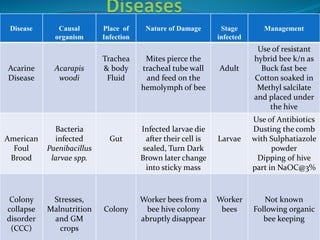
Disease Causal
organism
Place of
Infection
Nature of Damage Stage
infected
Management
Acarine
Disease
Acarapis
woodi
Trachea
& body
Fluid
Mites pierce the
tracheal tube wall
and feed on the
hemolymph of bee
Adult
Use of resistant
hybrid bee k/n as
Buck fast bee
Cotton soaked in
Methyl salcilate
and placed under
the hive
American
Foul
Brood
Bacteria
infected
Paenibacillus
larvae spp.
Gut
Infected larvae die
after their cell is
sealed, Turn Dark
Brown later change
into sticky mass
Larvae
Use of Antibiotics
Dusting the comb
with Sulphatiazole
powder
Dipping of hive
part in NaOC@3%
Colony
collapse
disorder
(CCC)
Stresses,
Malnutrition
and GM
crops
Colony
Worker bees from a
bee hive colony
abruptly disappear
Worker
bees
Not known
Following organic
bee keeping
Sac
Brood
Morator
aetatulas
(Virus)
Skin
Larvae changes from
white to gray , finally
black, Retarded
Growth, Died before
Pupation
Larvae Destruction of
affective hives
Sanitation of bee
hive
Nosema
Disease
Nosema apis Stomach
Intestinal tracts of
adult bees and
causes nosemosis
and dysentery
Adult Increase Ventilation
Amoebic
disease
Malphigamo
-eba
mellifera
Malphig
-ian
tubules
Causes to dysentery
in healthy bees
Adult Sterilization of brood
box & frames with
formalin @ 40%
European
Foul
brood
Melissoccou
s plutonius,
Bacillus
pluton
Mid Gut
Affected larvae
becomes discolored
and found in coiled
position, Larvae
turns in to yellow to
brown color, Tracheal
system visible
Larvae
Use of oxy-
tetracycline
hydrochloride
Chalk
Brood
Ascosphaera
apis
Gut Fungus will consume
the body of larvae,
White and Chalky
appearance.
Larvae Increase Ventilation
Transfer of healthy
bee into another hive
during wet springs
Scientific name - Vespa orientalis
Nature of Damage
Prey on Bees
Wasp macerate the bees and feed
on their Larvae
Management
Destruction of wasp nests by
burning or using insecticides
1.Greater wax Moth
Scientific Name – Galleria mellonella
Nature of Damage
The caterpillar make tunnels through near
midribs of a comb during stress. Feed on
the Wax.
Management
Para dichlorobenzene
Application of the aizawai variety of Bt
Bees also kill them, cleaning is needed
Removal of the Moth from the colony
Scientific name - Dorylas labiatus,
componotus. Compressus
Nature of Damage - Steal to the honey and brood,
Weaken and destroy to the bee
colony.
Management - Destruction of ant nest by fumigation or by insecticides
Honey
Antiseptic product, increase in Hemoglobin, killed germ of
pneumonia, typhoid and use in baking industry, wine industry
Beeswax
used in a multitude of products including: beauty products
and cosmetics, soaps, shampoos, moisturizers.
Royal Jelly
used for a wide variety of general health conditions such as
asthma, hay fever, insomnia, stomach ulcers, skin disorders and for
boosting the immune system.
Bee pollen
consumed to boost energy, aid digestion, and reduce symptoms
caused by air-born allergens. Consider as “super food”.
Bee venom
 Given as a shot for arthritis, nerve pain
Benefits of Beekeeping
 Bees help in cross pollination thus they increase the productivity of
crops.
 Proper utilization of natural resources.
 Unemployed youth can start this business with minimal funds.
 73,000 man-days to manufacture appliances / equipments.
 Net income from 100 Bee colonies is around Rs. 1.70 lakhs/annum
 It helps in rural development and promotes small village industry.
 Infrastructure for producing genetically superior queen bees for
supply to beekeepers;
 technical knowledge for efficient management of bee colonies for
higher honey yield;
 awareness about yield increase in crops by BK through pollination;
 research for disease management & control;
 financial institutional support
 consumer awareness about honey and its products;
 Poor quality control for production of honey and De-forestation;
 Indiscriminate use of insecticides, pesticides, weedicides etc.; and
 Global warming & unforeseen changes in climatic conditions.
Constraints in Beekeeping
• Production of honey has been the major
aim of the industry.
• About 10,000 tons of forest honey are
produced annually.
• Trends towards industrial bee keeping
• More sustainable option.
Apiculture

Apiculture

  • 2.
    Master Seminar on Bee-keeping Seminar incharge: Dr.Gaje Singh Dr.D.V.Singh Dr. RajendraSingh Dept.of Entomology Speaker: Sushant Kumar M.Sc. (Ag) (Entomology) Id.No. - PG/ A 3935/17-18
  • 3.
     Honey beeis a social & beneficial insect. They lives in hive.  They are flying insect & close relatives of wasp. Beekeeping The science that aims to study the life, behavior & activity of honey bee in order to obtain bee products and crop pollination. Maintenance of honey bee colonies, commonly in hives, by humans.
  • 4.
    Honeybee pollinates morethan 110 commercially grown crops including 33% of agricultural groups.  Almond (100%)  Apple (90%)  Broccoli (90%)  Cherry(80%)  Onion(65% )  Lucerne (110%)  Sunflower (45%)  Mustard (40%)  Cardamom (35%)  Cotton (20%) Globally, 33% of the human diet comes from insect pollinated plants and the honey bee is responsible for 80% of that pollination.
  • 5.
    World scenario ofBeekeeping  About 50 million bee colonies, mostly, Apis mellifera, maintained all over the world.  World production of honey estimated 13.88 lakh M.T.  15 countries in world account for 90% of world honey production.  Major honey producing countries are China, USA(85000MTs), Mexico, Argentina, Ukraine, Turkey, Russia & India.  China is only Asian country producing nearly 1.6 lakh M. T. of honey, 12800 M.T. of beeswax against 43400 M. T. of world production.  China also produces 1000 M. T. of pollen and 800 M.T. of royal jelly and biggest exporter of honey, beeswax and other bee products.  70 lakh A.mellifera bee colonies and 30 lakh A.cerana bee colonies in China and they have a plan to increase this number to 5 times in next few decades.
  • 6.
    Status of beekeeping in India About 14 lakh colonies by 2.5 lakh beekeepers Employment to 1.5 lakh persons Annual honey production 70,000 tonnes(54.15% from domesticated and 45.85 from wild) Apis cerena and mallifera both are practice Avg. yield of honey is 21kg./hive Values of export of honey approx. 250 Crores Major market Germany, USA,Japan, France, Italy and Spain
  • 7.
  • 8.
    •Kingdom - Animalia •Phylum– Arthropoda •class – Insecta •Order – Hymenoptera •Family – Apidae •Genus – Apis HONEY BEE CLASSIFICATION
  • 9.
    Important species ofHoney-bee in Bee keeping
  • 10.
    Open nesting. Buildssingle large comb attached to branches of trees or rocks etc. Found in plains as well as hills up to 1600 meters above sea level. Highly migratory. Biggest honey bee (16-18mm) Swarming/ Absconding tendency Strong Furious in Temperament 40 kg Honey wild bees, cannot be domesticated Apis dorsata
  • 11.
    Apis cerena indica Cavitynesting. Builds many parallel combs in cavities of tree trunks, hollows of rocks, poles and other Covered places. Found throughout India Medium size (14-15mm) Strong tendency of Swarming Furious in temperament 5 kg (Hive bees; can be domesticated
  • 12.
    Apis mellifera Cavity nestingand similar in habits to Apis cerana. builds parallel combs. Exotic bee to India, Introduced successfully in 1962 Medium size (14-16mm) Swarming only in African sub species Gentle in temperament 15 kg honey
  • 13.
    Apis florae Open nesting,Builds single small comb fixed to branches of bushes Found in plains up to 300 mtr above sea level. Highly migratory. Smallest Apis bee (9- 10mm) Swarming/ Absconding tendency Strong Temperament Mild 500 g Average honey yield per colony/year wild bees; cannot be domesticated
  • 14.
    Site Selection forBee Keeping  Availability of Flower  Availability of water  Accessibility and topography  Shelter or Shady area  Proximity of human activities  Presence of pest and use of pesticides  Drainage
  • 15.
  • 16.
    Male (drone) Female (queen) Copulation Unfertilized egg Larva 6 DAYS Pupa Adult Male(Drone) Fertilized egg 3 DAYS Larva 6 DAYS Pupa 12 DAYS Adult Female(worker) Other workers NORMAL FOOD Sterile female workers One female QUEEN ROYAL JELLY 3 DAYS ROYAL JELLY FOR 3 DAYS
  • 17.
    Three Castes ofHoney Bees .
  • 18.
    Size of Castin Hive
  • 19.
    The Queen Profile Thequeen is a mature, fertile female. She lays thousands of eggs during her life time. A queen has the longest live span in the colony living for years versus months. She is normally larger than the other bees in the hive and has a slim torpedo shape.
  • 20.
    She does havea stinger, but uses it to kill other queens. Only actively reproducing female Can produce 1,500 eggs per day or more at the height of the brood season She develops from a fertilized egg. She mates with many drones to produce fertilized eggs. She is the mother of all the bees in the hive. Her role in the hive is to produce eggs and to release pheromone signals within the hive.
  • 21.
    Worker Profile Female buttypically not able to reproduce A colony will have 20,000 - 60,000 Live for 4-6 weeks in summer, 4-5 months in winter Develops from a fertilized egg
  • 22.
     Worker beesare sexually underdeveloped females.  They may number as many as 60,000 in a colony.  They are called workers because that is what they do.  Female worker bees under certain conditions can lay eggs but because they are not mated, they produce eggs that only develop into drones.  A worker bee spends its first 20 days in the hive performing various task – cleaning cells, feeding young larva, building wax comb, etc.
  • 23.
    The Drone bee Notethe general shape of the drone.  The head is large and the eyes predominate the head.  The rear-end of the drone is rounded --they have no stinger and can not sting.  Although they are usually considered worthless, they contribute to the continuation of one generation to the next generation. They emerge in 24 days, larger than the female workers.
  • 24.
    The drone isthe male bee in the hive. He develops from an unfertilized egg. Meaning he is passing on genetic material from his mother only. He provides ½ of the genetic material in worker bees. His life span depends on the health of the colony. During poor honey flows and honey shortages, drones may be driven from the hive. This happens at the onset of winter as well.
  • 25.
    The process ofleaving the colony by the queen with a large group of worker bees is called swarming. when the egg laying capacity of the old queen is lost, it dies or new queen takes the position of the old queen. Migration of the complete colony from one place to another due to some unfavorable conditions.
  • 27.
    Communication When food sourceis < 50 m from hive Waggle dance When food source is > 50 meters away Round dance Waggle dance used during swarming to communicate possible nest sites
  • 28.
    Two types ofhives are used in indigenous method of bee keeping e.g. wall or fixed and movable hive . (a) WALL OR FIXED HIVE: •It is purely natural type of comb because the bees themselves prepare the hive at any space on the wall or trees. •There is an opening on one side through which bees come out of the hive.
  • 29.
    (b) MOVABLE HIVE •Itcomprises of hollow wood logs, empty boxes and earthen pots etc. placed in verandas of houses. •There exist two holes one is for entrance and the other for exit of the bees. •The swarmed bees usually come to the box on their own accord. •Some bee keepers use to take the clusters of the swarms from a tree and keep them in the hive For honey extraction, burning fire is brought near the bee hive at the night as a result of which bees are either killed or they escape off. Further the hive full of honey is being removed, cut into pieces and squeezed to get honey. Sometimes smoking is done so that the bees may escape from their hives.
  • 30.
    An advanced methodbased on scientific facts Use of Scientifically made artificial Bee hive First artificial comb was introduced by R. L. L. Langstroth in 1851 in America There are 3 type of artificial Bee hive used in INDIA.. 1. Jeolikot model 2. Newton model 3. Langstroth model
  • 31.
  • 32.
  • 34.
    Spring season Management Cleaning AvoidStarvation Timely disease inspection Re- queening Removal of honey crop Creating space for expansion within the hive swarm control
  • 35.
    Summer season Management Provideshade to hives Provide clean water Provide sugar syrup to honey bees Sprinkle cold water over hive Re-queening
  • 36.
    Winter season Management Placethe colony under sun rays Plug all openings Unite weaker colony with stronger colony Keep the entrance gate opposite to wind
  • 37.
    Off season Management Enoughhoney may left in the hive to keep colony alive Protect from rain and wind Protect from enemies Take care of unhygienic condition When nectar is not available , colony should be given 300 to 500 ml warm sugar syrup in evening
  • 39.
    Disease Causal organism Place of Infection Natureof Damage Stage infected Management Acarine Disease Acarapis woodi Trachea & body Fluid Mites pierce the tracheal tube wall and feed on the hemolymph of bee Adult Use of resistant hybrid bee k/n as Buck fast bee Cotton soaked in Methyl salcilate and placed under the hive American Foul Brood Bacteria infected Paenibacillus larvae spp. Gut Infected larvae die after their cell is sealed, Turn Dark Brown later change into sticky mass Larvae Use of Antibiotics Dusting the comb with Sulphatiazole powder Dipping of hive part in NaOC@3% Colony collapse disorder (CCC) Stresses, Malnutrition and GM crops Colony Worker bees from a bee hive colony abruptly disappear Worker bees Not known Following organic bee keeping
  • 40.
    Sac Brood Morator aetatulas (Virus) Skin Larvae changes from whiteto gray , finally black, Retarded Growth, Died before Pupation Larvae Destruction of affective hives Sanitation of bee hive Nosema Disease Nosema apis Stomach Intestinal tracts of adult bees and causes nosemosis and dysentery Adult Increase Ventilation Amoebic disease Malphigamo -eba mellifera Malphig -ian tubules Causes to dysentery in healthy bees Adult Sterilization of brood box & frames with formalin @ 40% European Foul brood Melissoccou s plutonius, Bacillus pluton Mid Gut Affected larvae becomes discolored and found in coiled position, Larvae turns in to yellow to brown color, Tracheal system visible Larvae Use of oxy- tetracycline hydrochloride Chalk Brood Ascosphaera apis Gut Fungus will consume the body of larvae, White and Chalky appearance. Larvae Increase Ventilation Transfer of healthy bee into another hive during wet springs
  • 41.
    Scientific name -Vespa orientalis Nature of Damage Prey on Bees Wasp macerate the bees and feed on their Larvae Management Destruction of wasp nests by burning or using insecticides 1.Greater wax Moth Scientific Name – Galleria mellonella Nature of Damage The caterpillar make tunnels through near midribs of a comb during stress. Feed on the Wax. Management Para dichlorobenzene Application of the aizawai variety of Bt Bees also kill them, cleaning is needed
  • 42.
    Removal of theMoth from the colony Scientific name - Dorylas labiatus, componotus. Compressus Nature of Damage - Steal to the honey and brood, Weaken and destroy to the bee colony. Management - Destruction of ant nest by fumigation or by insecticides
  • 43.
    Honey Antiseptic product, increasein Hemoglobin, killed germ of pneumonia, typhoid and use in baking industry, wine industry Beeswax used in a multitude of products including: beauty products and cosmetics, soaps, shampoos, moisturizers.
  • 44.
    Royal Jelly used fora wide variety of general health conditions such as asthma, hay fever, insomnia, stomach ulcers, skin disorders and for boosting the immune system. Bee pollen consumed to boost energy, aid digestion, and reduce symptoms caused by air-born allergens. Consider as “super food”. Bee venom  Given as a shot for arthritis, nerve pain
  • 45.
    Benefits of Beekeeping Bees help in cross pollination thus they increase the productivity of crops.  Proper utilization of natural resources.  Unemployed youth can start this business with minimal funds.  73,000 man-days to manufacture appliances / equipments.  Net income from 100 Bee colonies is around Rs. 1.70 lakhs/annum  It helps in rural development and promotes small village industry.
  • 46.
     Infrastructure forproducing genetically superior queen bees for supply to beekeepers;  technical knowledge for efficient management of bee colonies for higher honey yield;  awareness about yield increase in crops by BK through pollination;  research for disease management & control;  financial institutional support  consumer awareness about honey and its products;  Poor quality control for production of honey and De-forestation;  Indiscriminate use of insecticides, pesticides, weedicides etc.; and  Global warming & unforeseen changes in climatic conditions. Constraints in Beekeeping
  • 47.
    • Production ofhoney has been the major aim of the industry. • About 10,000 tons of forest honey are produced annually. • Trends towards industrial bee keeping • More sustainable option.