Intro to Yuri Lotman’s Semiosphere


by Dimitar Trendafilov, semiotic researcher at New Bulgarian University – Sofia.
                                                                   your name
                       Made for teaching purposes, 2010
The Notion of Semiosphere /1


• Global, abstract model of culture, demonstrating its non-
  material aspect and its characteristic as an environment in
  which communication could be generated.
• Semiotic reality (an universum) in which several semiotic
  systems function, interact, and produce information. A
  semiotic process (semiosis) is impossible outside the
  Semiosphere.
• A “macroeconomic” theory of nature and mechanism of
  culture/s. (К. Bankov)                            your name
The Notion of Semiosphere /2

• Synonymous sign systems are immersed in a semiotic
  continuum, filled with diverse formations, which are placed on
  different levels of one organization (like living organism, for
  example, which is compounded by various systems).
• Totality (a mechanism of existence) of various texts or
  separate languages, whose value is provided by the
  wholeness, not by the detached units themselves.
• “...the complex of semiotic formations precedes (…) the
  particular isolated language and this is a condition for the
  existence of the latter.” (as a calf is entire body before being
  chopped up, while the reverse process is impossible,
  because steaks are meant to be consumed separately).
                                                         your name
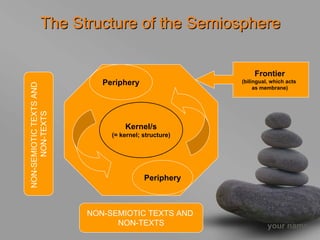
The Basic Elements

• Center (kernel) – more dense place, where grammar rules.

• Periphery – a space composed of less structured semiotic
  world (less dense, with flexible structures in it).

• Frontier (membrane) – a bilingual mechanism by which the
  an external [data] is been filtered and translated from non-
  messages to messages (i.e. to information); the frontier
  means demarcation between proper and alien, inner and
  outer.
                                                        your name
The Structure of the Semiosphere

                                                           Frontier
                            Periphery                 (bilingual, which acts
NON-SEMIOTIC TEXTS AND


                                                           as membrane)
      NON-TEXTS


                                  Kernel/s
                              (= kernel; structure)


                                         Periphery


                         NON-SEMIOTIC TEXTS AND
                               NON-TEXTS                        your name
Basic Characteristics

• “The Semiosphere has diachronic depth because it is
  loaded with complicated system of memory and it could not
  work without memory. The mechanisms of memory exist not
  only in separate semiotic substructures but in the
  Semiosphere as a whole.”
• The intrinsic dynamics of the Semiosphere does not lead it
  to collapse because in the basis of the communication
  processes, flowing between the elements, “lies the invariant
  principle which makes them similar” (= myths, collective
  memory, and so forth).
• This principle is a combination between symmetry and
  asymmetry (F. de Saussure calls it “a mechanism of
  similarity and difference”).                       your name
Demarcation of the Semiosphere

• Homogeneity and individuality – the Semiosphere is
  separated from 1/ outer chaos and 2/ other semiotic space.
  It realizes its own specificity, its contradistinction towards
  other spheres.
• Reticence – the Semiosphere does not start up direct
  contact with outer “world/s” but must firstly to semiotize (to
  re-code, to translate into its own language) non-semiotic
  texts and non-texts. [“Culture creates not only its own inner
  organization but its own outer disorganization as well.”]

                                                        your name
Unevenness of the Semiosphere

• Availability of structural Kernels (the dominant semiotic
  systems are placed in them).
• One of the Kernels takes a dominant position and reaches to
  a stage of self-description as well as of description of the
  parts belonging to the Periphery (this is a level of perfect
  unity of/in the Semiosphere).
• The Kernels are slowly developing zones, which are in
  contrast to the dynamics in the peripheral areas.
• Often the Kernels go into the Periphery and vise versa.
• Each part of the Sphere is distinct entity - closed and
  independent.
                                                      your name
Generation of Information /1

• “The structural heterogeneity of the semiotic space creates
  some reserves of dynamic processes and this is one of the
  mechanisms by which new information could be generated
  in the interior of the sphere.”
• The translation of information between the inner elements,
  the play between different structures and sub-structures, the
  permanent semiotic “incursions” from one structure to
  another generate new meaning, new information comes into
  being.
                                                      your name
Generation of Information /2

• The existing vertical isomorphism - between the structures of
  the semiotic system, which are placed onto different
  hierarchical levels in it [i.e. each element is a part of the
  whole, but in the same time it is an analogy of the whole in
  question] - breeds quantitative increase of the messages.
  Just like an object reflected in a mirror that generates
  hundreds of pieces of itself, the message in the same
  manner, introduced in the integral semiotic structure, starts
  diffusing itself towards the lower levels. The system is
  capable to convert one text into avalanche of texts.   your name
The Notion (Process) of Dialogue /1


• This is the process of creation of completely new text.

• Since here we mean not an ordinary act of transmission, but
 of exchange between the participating elements, then there
 should be not only relation of similarity between them, but of
 difference. The participating in this semiosis substructures
 are supposed to be isomorphic not in between, but one by
 one to be isomorphic towards third party elements of higher
 level, in whose system they enter.                     your name
Dialogue /2

• “The availability of two similar and simultaneously different
  partners in communication is extremely important… The
  dialogue includes reciprocity and unity in information
  exchange.”
• There are some pauses in transmission of information, i.e.
  some alternation exists between the time of delivering and
  the time of reception. In the history of culture there are
  periods when given “art, finding itself in the highest point of
  its activity, translates its own texts into other semiotic
  systems.”
                                                        your name
Dialogue /3


• “In the real tissue of culture the lack of synchronization is
  not casual diversion, but orderly law. Translating art, which
  is at zenith of its activity, meanwhile displays traits of
  innovation   and    dynamism.     As   a     rule,   addressees
  experience the transitional cultural stage.”

• The translated text and the answer received by third party
  should constitute unified/integrated text.

                                                          your name
Dialogue /4


• The unevenness of the message exchange between the texts
 is universal law.
• The same system acts at other diverse dialogues as well –
 between the center (kernel) and peripheral formations of
 culture, between its top and bottom.
• “The chance for dialogues to be accomplished presupposes
 simultaneous availability of heterogeneity and homogeneity
 of the elements. In this respect, the diversity of the structure
 is the foundation of its mechanism.”                  your name
Dialogue /5

• Enandiomorphism – mirror-symmetry: both parts are alike as
 two images in a mirror, but when we juxtapose them
 becomes evident that they are actually not alike (they have
 relation as left-hand side and right-hand side do).

• This symmetry creates relations of structural variety and in
 the same time - of similarity, by which the dialogue is
 possible (see the mechanism of palindrome – word or
 phrase which may be read in the same way in either
 directions).                                          your name
Based on:
Lotman, Yuri, On the Semiosphere (an essay on semiotic nature of culture;
translation in English and adaptation is mine – D.T.)
Bankov, Kristian, Semiotic notebooks (Part I)


Author of the presentation:
Dimitar Trendafilov – assistant-professor and researcher
at Socio-semiotic Studies Laboratory, New Bulgarian University – Sofia
Member of South-East European Center for Semiotic Studies, NBU
www.advertisingandbrandmanagement.org
www.semionaut.net
trendafilov.dim@gmail.com
                                                                            your name

Introduction to Semiosphere - 2010

  • 1.
    Intro to YuriLotman’s Semiosphere by Dimitar Trendafilov, semiotic researcher at New Bulgarian University – Sofia. your name Made for teaching purposes, 2010
  • 2.
    The Notion ofSemiosphere /1 • Global, abstract model of culture, demonstrating its non- material aspect and its characteristic as an environment in which communication could be generated. • Semiotic reality (an universum) in which several semiotic systems function, interact, and produce information. A semiotic process (semiosis) is impossible outside the Semiosphere. • A “macroeconomic” theory of nature and mechanism of culture/s. (К. Bankov) your name
  • 3.
    The Notion ofSemiosphere /2 • Synonymous sign systems are immersed in a semiotic continuum, filled with diverse formations, which are placed on different levels of one organization (like living organism, for example, which is compounded by various systems). • Totality (a mechanism of existence) of various texts or separate languages, whose value is provided by the wholeness, not by the detached units themselves. • “...the complex of semiotic formations precedes (…) the particular isolated language and this is a condition for the existence of the latter.” (as a calf is entire body before being chopped up, while the reverse process is impossible, because steaks are meant to be consumed separately). your name
  • 4.
    The Basic Elements •Center (kernel) – more dense place, where grammar rules. • Periphery – a space composed of less structured semiotic world (less dense, with flexible structures in it). • Frontier (membrane) – a bilingual mechanism by which the an external [data] is been filtered and translated from non- messages to messages (i.e. to information); the frontier means demarcation between proper and alien, inner and outer. your name
  • 5.
    The Structure ofthe Semiosphere Frontier Periphery (bilingual, which acts NON-SEMIOTIC TEXTS AND as membrane) NON-TEXTS Kernel/s (= kernel; structure) Periphery NON-SEMIOTIC TEXTS AND NON-TEXTS your name
  • 6.
    Basic Characteristics • “TheSemiosphere has diachronic depth because it is loaded with complicated system of memory and it could not work without memory. The mechanisms of memory exist not only in separate semiotic substructures but in the Semiosphere as a whole.” • The intrinsic dynamics of the Semiosphere does not lead it to collapse because in the basis of the communication processes, flowing between the elements, “lies the invariant principle which makes them similar” (= myths, collective memory, and so forth). • This principle is a combination between symmetry and asymmetry (F. de Saussure calls it “a mechanism of similarity and difference”). your name
  • 7.
    Demarcation of theSemiosphere • Homogeneity and individuality – the Semiosphere is separated from 1/ outer chaos and 2/ other semiotic space. It realizes its own specificity, its contradistinction towards other spheres. • Reticence – the Semiosphere does not start up direct contact with outer “world/s” but must firstly to semiotize (to re-code, to translate into its own language) non-semiotic texts and non-texts. [“Culture creates not only its own inner organization but its own outer disorganization as well.”] your name
  • 8.
    Unevenness of theSemiosphere • Availability of structural Kernels (the dominant semiotic systems are placed in them). • One of the Kernels takes a dominant position and reaches to a stage of self-description as well as of description of the parts belonging to the Periphery (this is a level of perfect unity of/in the Semiosphere). • The Kernels are slowly developing zones, which are in contrast to the dynamics in the peripheral areas. • Often the Kernels go into the Periphery and vise versa. • Each part of the Sphere is distinct entity - closed and independent. your name
  • 9.
    Generation of Information/1 • “The structural heterogeneity of the semiotic space creates some reserves of dynamic processes and this is one of the mechanisms by which new information could be generated in the interior of the sphere.” • The translation of information between the inner elements, the play between different structures and sub-structures, the permanent semiotic “incursions” from one structure to another generate new meaning, new information comes into being. your name
  • 10.
    Generation of Information/2 • The existing vertical isomorphism - between the structures of the semiotic system, which are placed onto different hierarchical levels in it [i.e. each element is a part of the whole, but in the same time it is an analogy of the whole in question] - breeds quantitative increase of the messages. Just like an object reflected in a mirror that generates hundreds of pieces of itself, the message in the same manner, introduced in the integral semiotic structure, starts diffusing itself towards the lower levels. The system is capable to convert one text into avalanche of texts. your name
  • 11.
    The Notion (Process)of Dialogue /1 • This is the process of creation of completely new text. • Since here we mean not an ordinary act of transmission, but of exchange between the participating elements, then there should be not only relation of similarity between them, but of difference. The participating in this semiosis substructures are supposed to be isomorphic not in between, but one by one to be isomorphic towards third party elements of higher level, in whose system they enter. your name
  • 12.
    Dialogue /2 • “Theavailability of two similar and simultaneously different partners in communication is extremely important… The dialogue includes reciprocity and unity in information exchange.” • There are some pauses in transmission of information, i.e. some alternation exists between the time of delivering and the time of reception. In the history of culture there are periods when given “art, finding itself in the highest point of its activity, translates its own texts into other semiotic systems.” your name
  • 13.
    Dialogue /3 • “Inthe real tissue of culture the lack of synchronization is not casual diversion, but orderly law. Translating art, which is at zenith of its activity, meanwhile displays traits of innovation and dynamism. As a rule, addressees experience the transitional cultural stage.” • The translated text and the answer received by third party should constitute unified/integrated text. your name
  • 14.
    Dialogue /4 • Theunevenness of the message exchange between the texts is universal law. • The same system acts at other diverse dialogues as well – between the center (kernel) and peripheral formations of culture, between its top and bottom. • “The chance for dialogues to be accomplished presupposes simultaneous availability of heterogeneity and homogeneity of the elements. In this respect, the diversity of the structure is the foundation of its mechanism.” your name
  • 15.
    Dialogue /5 • Enandiomorphism– mirror-symmetry: both parts are alike as two images in a mirror, but when we juxtapose them becomes evident that they are actually not alike (they have relation as left-hand side and right-hand side do). • This symmetry creates relations of structural variety and in the same time - of similarity, by which the dialogue is possible (see the mechanism of palindrome – word or phrase which may be read in the same way in either directions). your name
  • 16.
    Based on: Lotman, Yuri,On the Semiosphere (an essay on semiotic nature of culture; translation in English and adaptation is mine – D.T.) Bankov, Kristian, Semiotic notebooks (Part I) Author of the presentation: Dimitar Trendafilov – assistant-professor and researcher at Socio-semiotic Studies Laboratory, New Bulgarian University – Sofia Member of South-East European Center for Semiotic Studies, NBU www.advertisingandbrandmanagement.org www.semionaut.net trendafilov.dim@gmail.com your name