40
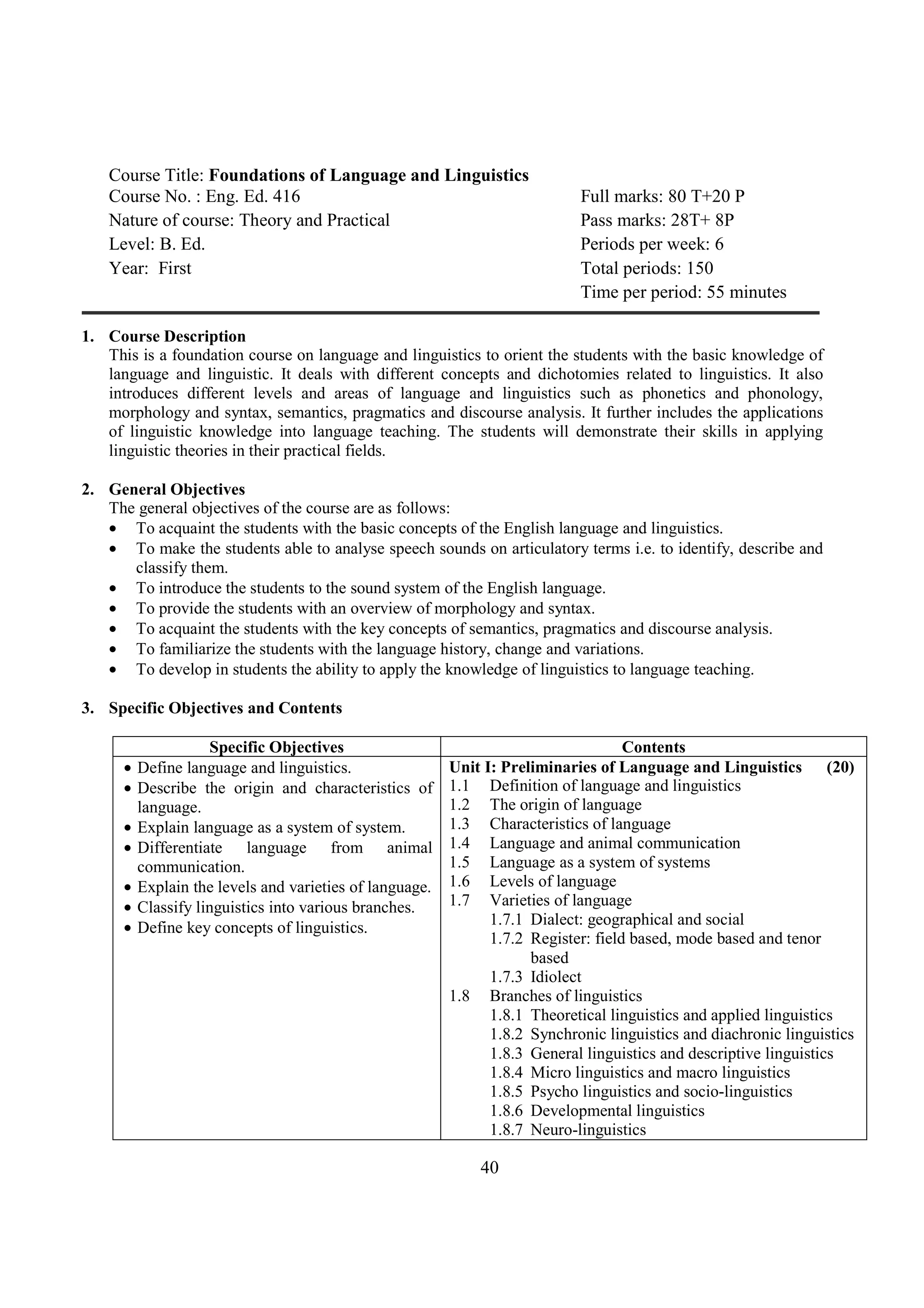
Course Title: Foundations of Language and Linguistics
Course No. : Eng. Ed. 416 Full marks: 80 T+20 P
Nature of course: Theory and Practical Pass marks: 28T+ 8P
Level: B. Ed. Periods per week: 6
Year: First Total periods: 150
Time per period: 55 minutes
1. Course Description
This is a foundation course on language and linguistics to orient the students with the basic knowledge of
language and linguistic. It deals with different concepts and dichotomies related to linguistics. It also
introduces different levels and areas of language and linguistics such as phonetics and phonology,
morphology and syntax, semantics, pragmatics and discourse analysis. It further includes the applications
of linguistic knowledge into language teaching. The students will demonstrate their skills in applying
linguistic theories in their practical fields.
2. General Objectives
The general objectives of the course are as follows:
• To acquaint the students with the basic concepts of the English language and linguistics.
• To make the students able to analyse speech sounds on articulatory terms i.e. to identify, describe and
classify them.
• To introduce the students to the sound system of the English language.
• To provide the students with an overview of morphology and syntax.
• To acquaint the students with the key concepts of semantics, pragmatics and discourse analysis.
• To familiarize the students with the language history, change and variations.
• To develop in students the ability to apply the knowledge of linguistics to language teaching.
3. Specific Objectives and Contents
Specific Objectives Contents
• Define language and linguistics.
• Describe the origin and characteristics of
language.
• Explain language as a system of system.
• Differentiate language from animal
communication.
• Explain the levels and varieties of language.
• Classify linguistics into various branches.
• Define key concepts of linguistics.
Unit I: Preliminaries of Language and Linguistics (20)
1.1 Definition of language and linguistics
1.2 The origin of language
1.3 Characteristics of language
1.4 Language and animal communication
1.5 Language as a system of systems
1.6 Levels of language
1.7 Varieties of language
1.7.1 Dialect: geographical and social
1.7.2 Register: field based, mode based and tenor
based
1.7.3 Idiolect
1.8 Branches of linguistics
1.8.1 Theoretical linguistics and applied linguistics
1.8.2 Synchronic linguistics and diachronic linguistics
1.8.3 General linguistics and descriptive linguistics
1.8.4 Micro linguistics and macro linguistics
1.8.5 Psycho linguistics and socio-linguistics
1.8.6 Developmental linguistics
1.8.7 Neuro-linguistics
41
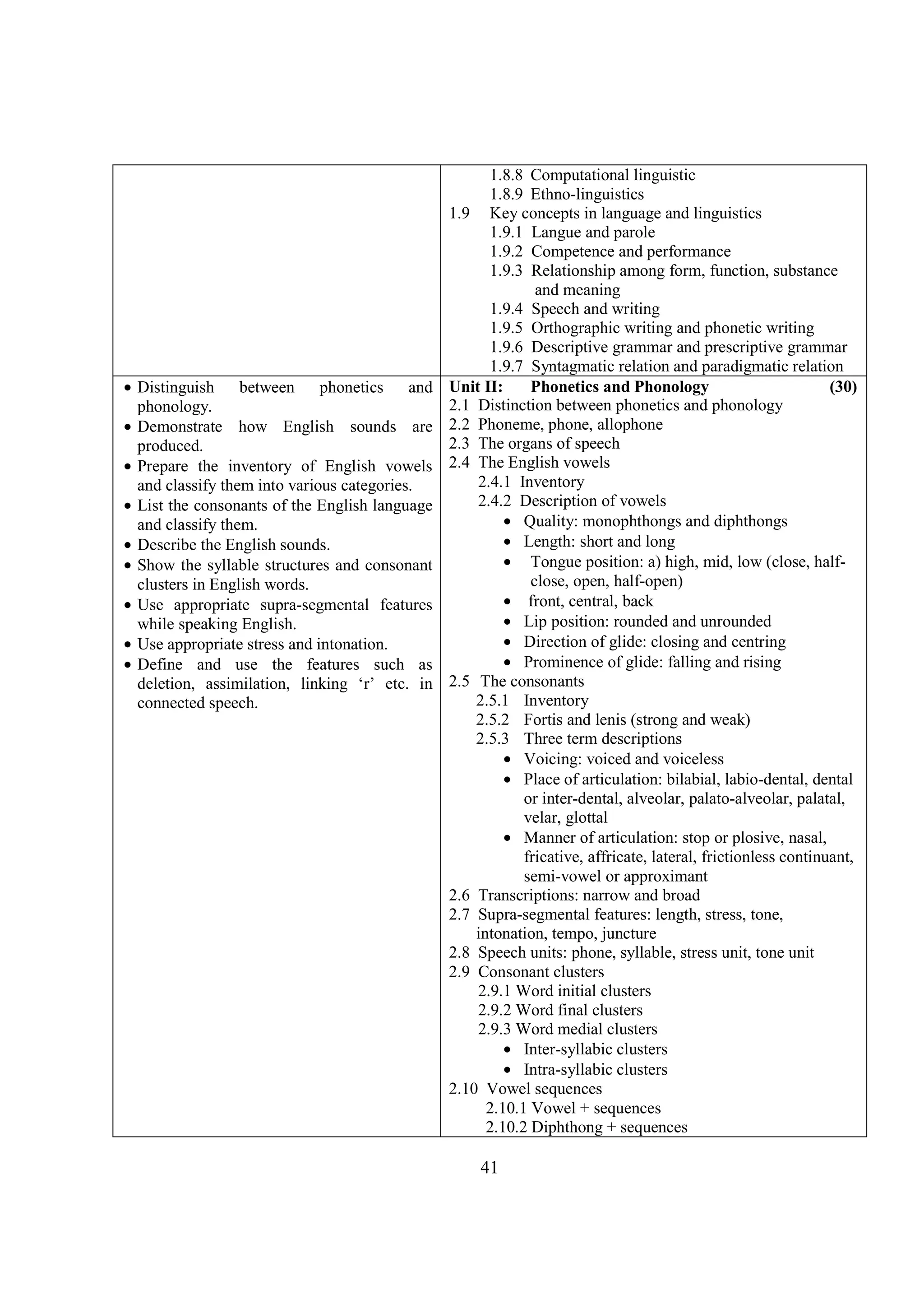
1.8.8 Computational linguistic
1.8.9 Ethno-linguistics
1.9 Key concepts in language and linguistics
1.9.1 Langue and parole
1.9.2 Competence and performance
1.9.3 Relationship among form, function, substance
and meaning
1.9.4 Speech and writing
1.9.5 Orthographic writing and phonetic writing
1.9.6 Descriptive grammar and prescriptive grammar
1.9.7 Syntagmatic relation and paradigmatic relation
• Distinguish between phonetics and
phonology.
• Demonstrate how English sounds are
produced.
• Prepare the inventory of English vowels
and classify them into various categories.
• List the consonants of the English language
and classify them.
• Describe the English sounds.
• Show the syllable structures and consonant
clusters in English words.
• Use appropriate supra-segmental features
while speaking English.
• Use appropriate stress and intonation.
• Define and use the features such as
deletion, assimilation, linking ‘r’ etc. in
connected speech.
Unit II: Phonetics and Phonology (30)
2.1 Distinction between phonetics and phonology
2.2 Phoneme, phone, allophone
2.3 The organs of speech
2.4 The English vowels
2.4.1 Inventory
2.4.2 Description of vowels
• Quality: monophthongs and diphthongs
• Length: short and long
• Tongue position: a) high, mid, low (close, half-
close, open, half-open)
• front, central, back
• Lip position: rounded and unrounded
• Direction of glide: closing and centring
• Prominence of glide: falling and rising
2.5 The consonants
2.5.1 Inventory
2.5.2 Fortis and lenis (strong and weak)
2.5.3 Three term descriptions
• Voicing: voiced and voiceless
• Place of articulation: bilabial, labio-dental, dental
or inter-dental, alveolar, palato-alveolar, palatal,
velar, glottal
• Manner of articulation: stop or plosive, nasal,
fricative, affricate, lateral, frictionless continuant,
semi-vowel or approximant
2.6 Transcriptions: narrow and broad
2.7 Supra-segmental features: length, stress, tone,
intonation, tempo, juncture
2.8 Speech units: phone, syllable, stress unit, tone unit
2.9 Consonant clusters
2.9.1 Word initial clusters
2.9.2 Word final clusters
2.9.3 Word medial clusters
• Inter-syllabic clusters
• Intra-syllabic clusters
2.10 Vowel sequences
2.10.1 Vowel + sequences
2.10.2 Diphthong + sequences
42
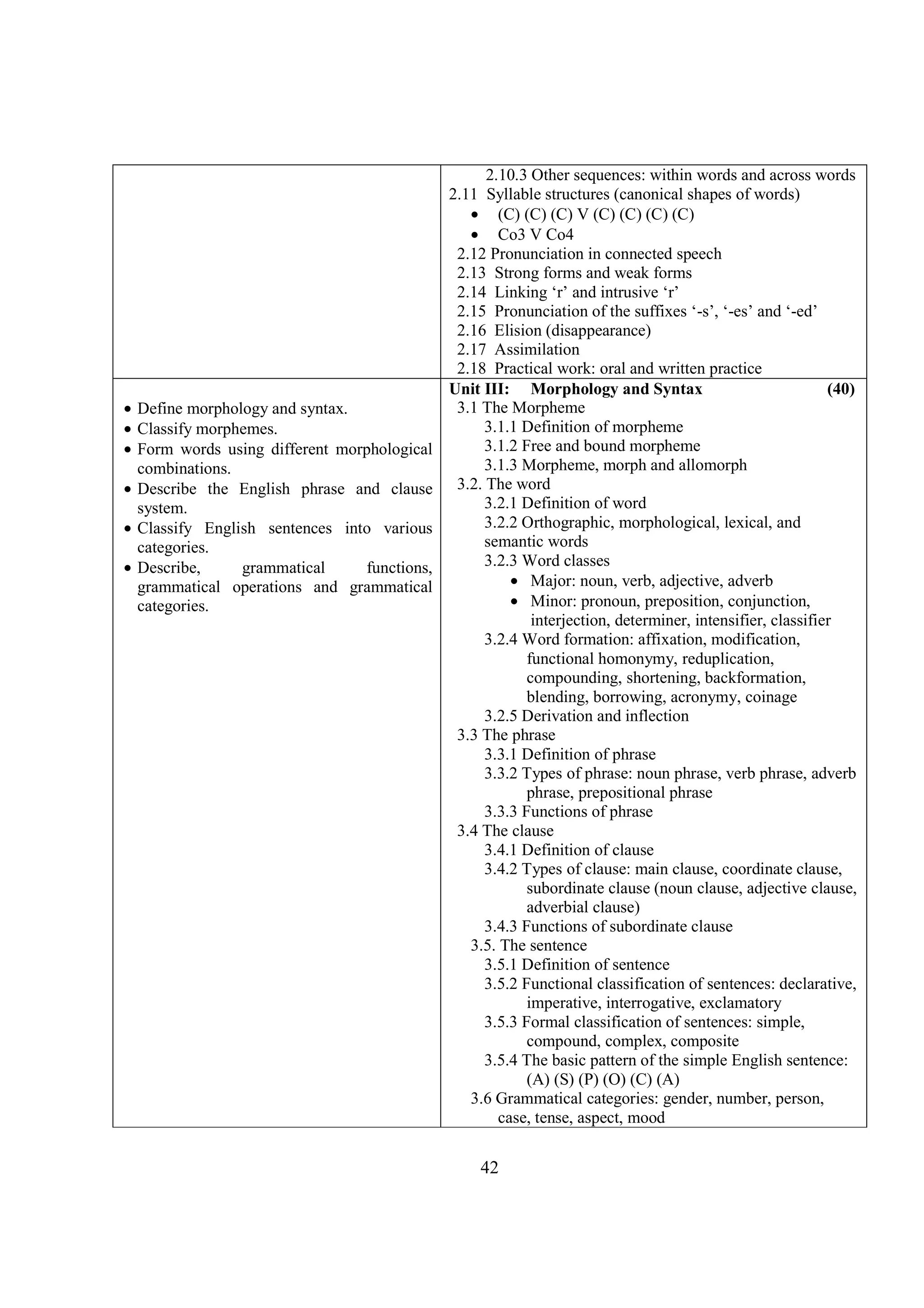
2.10.3 Other sequences: within words and across words
2.11 Syllable structures (canonical shapes of words)
• (C) (C) (C) V (C) (C) (C) (C)
• Co3 V Co4
2.12 Pronunciation in connected speech
2.13 Strong forms and weak forms
2.14 Linking ‘r’ and intrusive ‘r’
2.15 Pronunciation of the suffixes ‘-s’, ‘-es’ and ‘-ed’
2.16 Elision (disappearance)
2.17 Assimilation
2.18 Practical work: oral and written practice
• Define morphology and syntax.
• Classify morphemes.
• Form words using different morphological
combinations.
• Describe the English phrase and clause
system.
• Classify English sentences into various
categories.
• Describe, grammatical functions,
grammatical operations and grammatical
categories.
Unit III: Morphology and Syntax (40)
3.1 The Morpheme
3.1.1 Definition of morpheme
3.1.2 Free and bound morpheme
3.1.3 Morpheme, morph and allomorph
3.2. The word
3.2.1 Definition of word
3.2.2 Orthographic, morphological, lexical, and
semantic words
3.2.3 Word classes
• Major: noun, verb, adjective, adverb
• Minor: pronoun, preposition, conjunction,
interjection, determiner, intensifier, classifier
3.2.4 Word formation: affixation, modification,
functional homonymy, reduplication,
compounding, shortening, backformation,
blending, borrowing, acronymy, coinage
3.2.5 Derivation and inflection
3.3 The phrase
3.3.1 Definition of phrase
3.3.2 Types of phrase: noun phrase, verb phrase, adverb
phrase, prepositional phrase
3.3.3 Functions of phrase
3.4 The clause
3.4.1 Definition of clause
3.4.2 Types of clause: main clause, coordinate clause,
subordinate clause (noun clause, adjective clause,
adverbial clause)
3.4.3 Functions of subordinate clause
3.5. The sentence
3.5.1 Definition of sentence
3.5.2 Functional classification of sentences: declarative,
imperative, interrogative, exclamatory
3.5.3 Formal classification of sentences: simple,
compound, complex, composite
3.5.4 The basic pattern of the simple English sentence:
(A) (S) (P) (O) (C) (A)
3.6 Grammatical categories: gender, number, person,
case, tense, aspect, mood
43
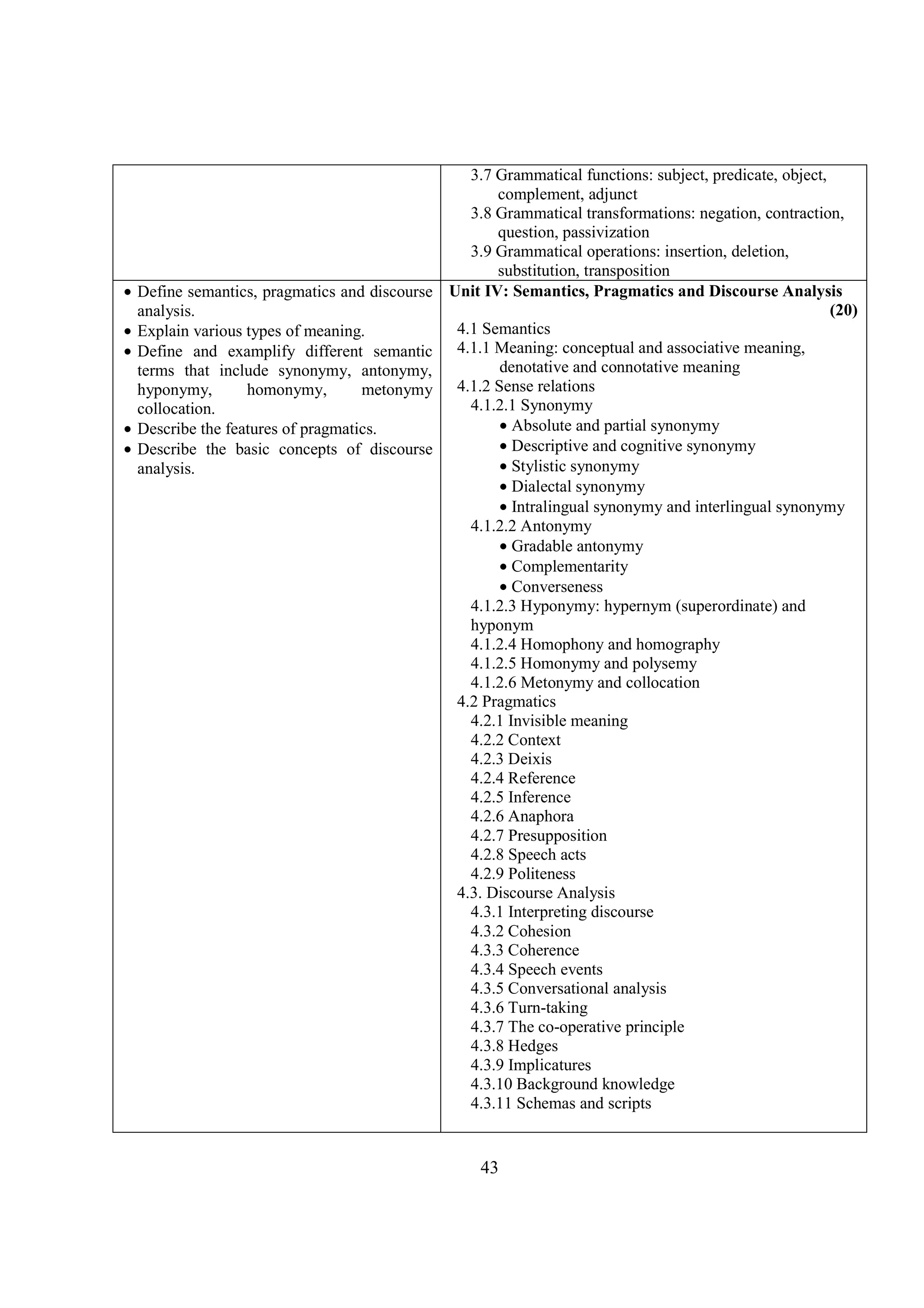
3.7 Grammatical functions: subject, predicate, object,
complement, adjunct
3.8 Grammatical transformations: negation, contraction,
question, passivization
3.9 Grammatical operations: insertion, deletion,
substitution, transposition
• Define semantics, pragmatics and discourse
analysis.
• Explain various types of meaning.
• Define and examplify different semantic
terms that include synonymy, antonymy,
hyponymy, homonymy, metonymy
collocation.
• Describe the features of pragmatics.
• Describe the basic concepts of discourse
analysis.
Unit IV: Semantics, Pragmatics and Discourse Analysis
(20)
4.1 Semantics
4.1.1 Meaning: conceptual and associative meaning,
denotative and connotative meaning
4.1.2 Sense relations
4.1.2.1 Synonymy
• Absolute and partial synonymy
• Descriptive and cognitive synonymy
• Stylistic synonymy
• Dialectal synonymy
• Intralingual synonymy and interlingual synonymy
4.1.2.2 Antonymy
• Gradable antonymy
• Complementarity
• Converseness
4.1.2.3 Hyponymy: hypernym (superordinate) and
hyponym
4.1.2.4 Homophony and homography
4.1.2.5 Homonymy and polysemy
4.1.2.6 Metonymy and collocation
4.2 Pragmatics
4.2.1 Invisible meaning
4.2.2 Context
4.2.3 Deixis
4.2.4 Reference
4.2.5 Inference
4.2.6 Anaphora
4.2.7 Presupposition
4.2.8 Speech acts
4.2.9 Politeness
4.3. Discourse Analysis
4.3.1 Interpreting discourse
4.3.2 Cohesion
4.3.3 Coherence
4.3.4 Speech events
4.3.5 Conversational analysis
4.3.6 Turn-taking
4.3.7 The co-operative principle
4.3.8 Hedges
4.3.9 Implicatures
4.3.10 Background knowledge
4.3.11 Schemas and scripts
44
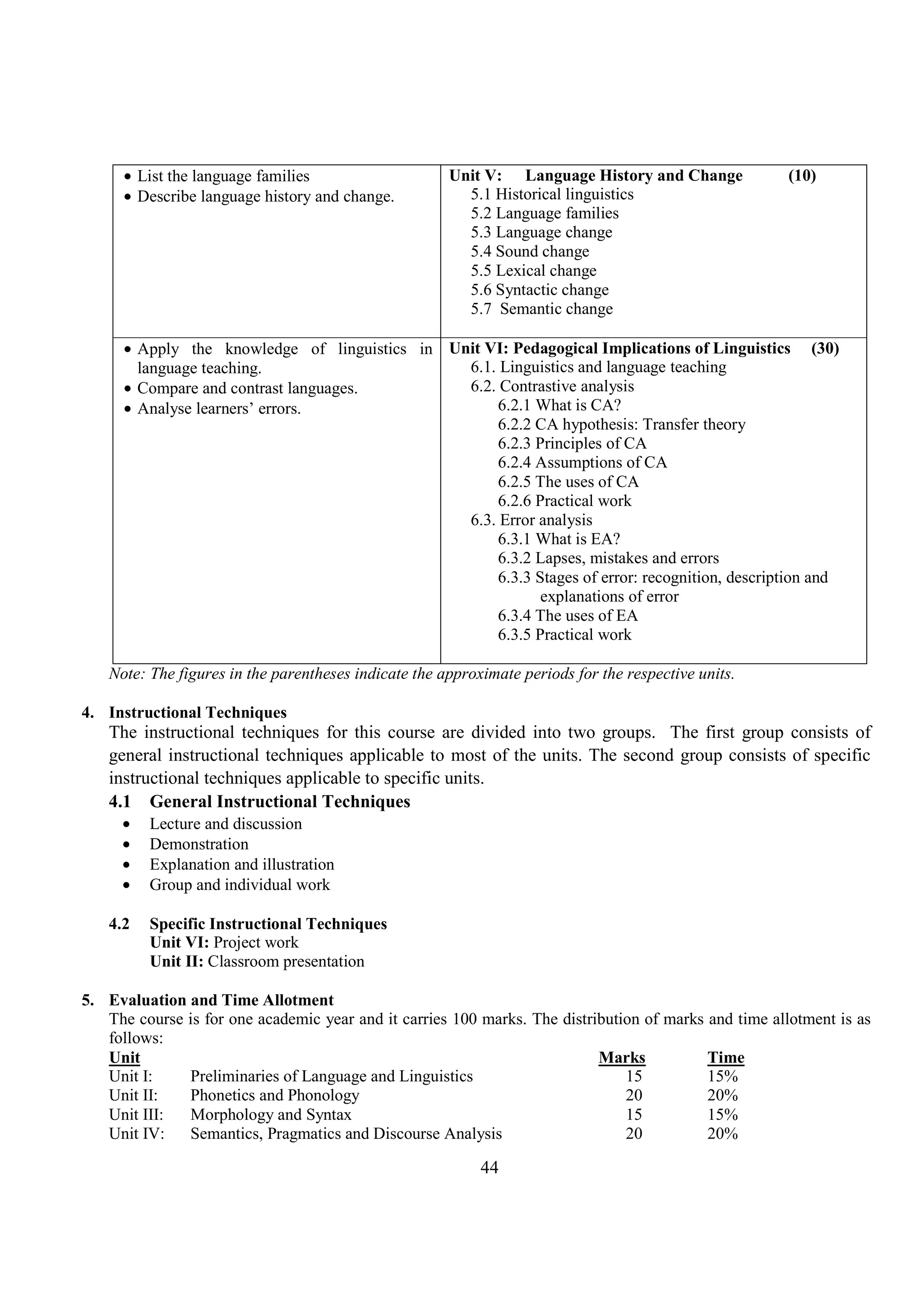
• List the language families
• Describe language history and change.
Unit V: Language History and Change (10)
5.1 Historical linguistics
5.2 Language families
5.3 Language change
5.4 Sound change
5.5 Lexical change
5.6 Syntactic change
5.7 Semantic change
• Apply the knowledge of linguistics in
language teaching.
• Compare and contrast languages.
• Analyse learners’ errors.
Unit VI: Pedagogical Implications of Linguistics (30)
6.1. Linguistics and language teaching
6.2. Contrastive analysis
6.2.1 What is CA?
6.2.2 CA hypothesis: Transfer theory
6.2.3 Principles of CA
6.2.4 Assumptions of CA
6.2.5 The uses of CA
6.2.6 Practical work
6.3. Error analysis
6.3.1 What is EA?
6.3.2 Lapses, mistakes and errors
6.3.3 Stages of error: recognition, description and
explanations of error
6.3.4 The uses of EA
6.3.5 Practical work
Note: The figures in the parentheses indicate the approximate periods for the respective units.
4. Instructional Techniques
The instructional techniques for this course are divided into two groups. The first group consists of
general instructional techniques applicable to most of the units. The second group consists of specific
instructional techniques applicable to specific units.
4.1 General Instructional Techniques
• Lecture and discussion
• Demonstration
• Explanation and illustration
• Group and individual work
4.2 Specific Instructional Techniques
Unit VI: Project work
Unit II: Classroom presentation
5. Evaluation and Time Allotment
The course is for one academic year and it carries 100 marks. The distribution of marks and time allotment is as
follows:
Unit Marks Time
Unit I: Preliminaries of Language and Linguistics 15 15%
Unit II: Phonetics and Phonology 20 20%
Unit III: Morphology and Syntax 15 15%
Unit IV: Semantics, Pragmatics and Discourse Analysis 20 20%
45
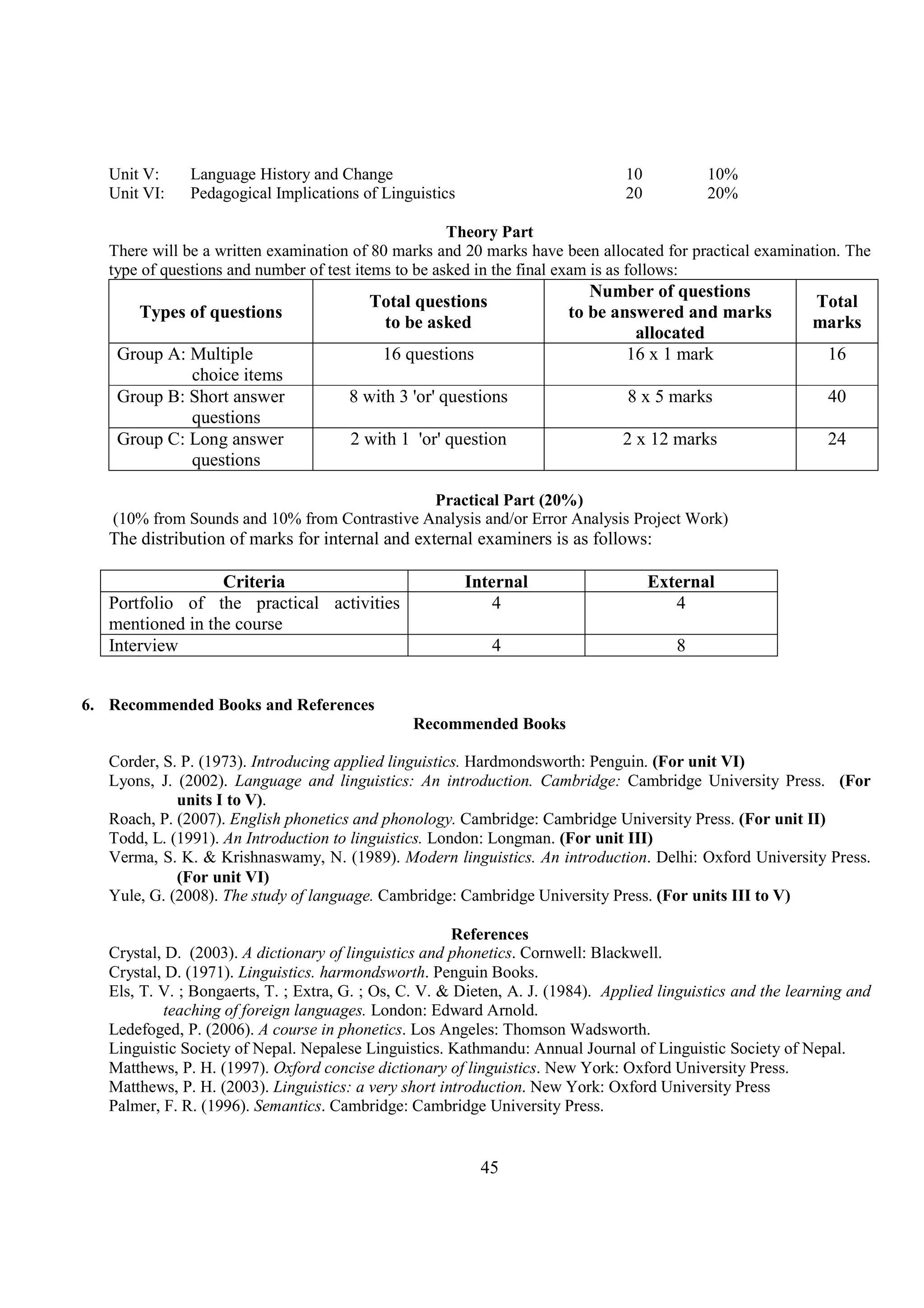
Unit V: Language History and Change 10 10%
Unit VI: Pedagogical Implications of Linguistics 20 20%
Theory Part
There will be a written examination of 80 marks and 20 marks have been allocated for practical examination. The
type of questions and number of test items to be asked in the final exam is as follows:
Types of questions
Total questions
to be asked
Number of questions
to be answered and marks
allocated
Total
marks
Group A: Multiple
choice items
16 questions 16 x 1 mark 16
Group B: Short answer
questions
8 with 3 'or' questions 8 x 5 marks 40
Group C: Long answer
questions
2 with 1 'or' question 2 x 12 marks 24
Practical Part (20%)
(10% from Sounds and 10% from Contrastive Analysis and/or Error Analysis Project Work)
The distribution of marks for internal and external examiners is as follows:
Criteria Internal External
Portfolio of the practical activities
mentioned in the course
4 4
Interview 4 8
6. Recommended Books and References
Recommended Books
Corder, S. P. (1973). Introducing applied linguistics. Hardmondsworth: Penguin. (For unit VI)
Lyons, J. (2002). Language and linguistics: An introduction. Cambridge: Cambridge University Press. (For
units I to V).
Roach, P. (2007). English phonetics and phonology. Cambridge: Cambridge University Press. (For unit II)
Todd, L. (1991). An Introduction to linguistics. London: Longman. (For unit III)
Verma, S. K. & Krishnaswamy, N. (1989). Modern linguistics. An introduction. Delhi: Oxford University Press.
(For unit VI)
Yule, G. (2008). The study of language. Cambridge: Cambridge University Press. (For units III to V)
References
Crystal, D. (2003). A dictionary of linguistics and phonetics. Cornwell: Blackwell.
Crystal, D. (1971). Linguistics. harmondsworth. Penguin Books.
Els, T. V. ; Bongaerts, T. ; Extra, G. ; Os, C. V. & Dieten, A. J. (1984). Applied linguistics and the learning and
teaching of foreign languages. London: Edward Arnold.
Ledefoged, P. (2006). A course in phonetics. Los Angeles: Thomson Wadsworth.
Linguistic Society of Nepal. Nepalese Linguistics. Kathmandu: Annual Journal of Linguistic Society of Nepal.
Matthews, P. H. (1997). Oxford concise dictionary of linguistics. New York: Oxford University Press.
Matthews, P. H. (2003). Linguistics: a very short introduction. New York: Oxford University Press
Palmer, F. R. (1996). Semantics. Cambridge: Cambridge University Press.
46
Procter, P. (2006). Cambridge advanced learner’s dictionary. Third Edition. Cambridge. Cambridge University
Press.
Radford, A., Atkinson, M., Britain, D., Clahsen, H. & Spencer, A. (2002). Linguistics: An introduction.
Cambridge: Cambridge University Press.

Eng. ed. 416 foundations of language and linguistics

  • 1.
    40 Course Title: Foundationsof Language and Linguistics Course No. : Eng. Ed. 416 Full marks: 80 T+20 P Nature of course: Theory and Practical Pass marks: 28T+ 8P Level: B. Ed. Periods per week: 6 Year: First Total periods: 150 Time per period: 55 minutes 1. Course Description This is a foundation course on language and linguistics to orient the students with the basic knowledge of language and linguistic. It deals with different concepts and dichotomies related to linguistics. It also introduces different levels and areas of language and linguistics such as phonetics and phonology, morphology and syntax, semantics, pragmatics and discourse analysis. It further includes the applications of linguistic knowledge into language teaching. The students will demonstrate their skills in applying linguistic theories in their practical fields. 2. General Objectives The general objectives of the course are as follows: • To acquaint the students with the basic concepts of the English language and linguistics. • To make the students able to analyse speech sounds on articulatory terms i.e. to identify, describe and classify them. • To introduce the students to the sound system of the English language. • To provide the students with an overview of morphology and syntax. • To acquaint the students with the key concepts of semantics, pragmatics and discourse analysis. • To familiarize the students with the language history, change and variations. • To develop in students the ability to apply the knowledge of linguistics to language teaching. 3. Specific Objectives and Contents Specific Objectives Contents • Define language and linguistics. • Describe the origin and characteristics of language. • Explain language as a system of system. • Differentiate language from animal communication. • Explain the levels and varieties of language. • Classify linguistics into various branches. • Define key concepts of linguistics. Unit I: Preliminaries of Language and Linguistics (20) 1.1 Definition of language and linguistics 1.2 The origin of language 1.3 Characteristics of language 1.4 Language and animal communication 1.5 Language as a system of systems 1.6 Levels of language 1.7 Varieties of language 1.7.1 Dialect: geographical and social 1.7.2 Register: field based, mode based and tenor based 1.7.3 Idiolect 1.8 Branches of linguistics 1.8.1 Theoretical linguistics and applied linguistics 1.8.2 Synchronic linguistics and diachronic linguistics 1.8.3 General linguistics and descriptive linguistics 1.8.4 Micro linguistics and macro linguistics 1.8.5 Psycho linguistics and socio-linguistics 1.8.6 Developmental linguistics 1.8.7 Neuro-linguistics
  • 2.
    41 1.8.8 Computational linguistic 1.8.9Ethno-linguistics 1.9 Key concepts in language and linguistics 1.9.1 Langue and parole 1.9.2 Competence and performance 1.9.3 Relationship among form, function, substance and meaning 1.9.4 Speech and writing 1.9.5 Orthographic writing and phonetic writing 1.9.6 Descriptive grammar and prescriptive grammar 1.9.7 Syntagmatic relation and paradigmatic relation • Distinguish between phonetics and phonology. • Demonstrate how English sounds are produced. • Prepare the inventory of English vowels and classify them into various categories. • List the consonants of the English language and classify them. • Describe the English sounds. • Show the syllable structures and consonant clusters in English words. • Use appropriate supra-segmental features while speaking English. • Use appropriate stress and intonation. • Define and use the features such as deletion, assimilation, linking ‘r’ etc. in connected speech. Unit II: Phonetics and Phonology (30) 2.1 Distinction between phonetics and phonology 2.2 Phoneme, phone, allophone 2.3 The organs of speech 2.4 The English vowels 2.4.1 Inventory 2.4.2 Description of vowels • Quality: monophthongs and diphthongs • Length: short and long • Tongue position: a) high, mid, low (close, half- close, open, half-open) • front, central, back • Lip position: rounded and unrounded • Direction of glide: closing and centring • Prominence of glide: falling and rising 2.5 The consonants 2.5.1 Inventory 2.5.2 Fortis and lenis (strong and weak) 2.5.3 Three term descriptions • Voicing: voiced and voiceless • Place of articulation: bilabial, labio-dental, dental or inter-dental, alveolar, palato-alveolar, palatal, velar, glottal • Manner of articulation: stop or plosive, nasal, fricative, affricate, lateral, frictionless continuant, semi-vowel or approximant 2.6 Transcriptions: narrow and broad 2.7 Supra-segmental features: length, stress, tone, intonation, tempo, juncture 2.8 Speech units: phone, syllable, stress unit, tone unit 2.9 Consonant clusters 2.9.1 Word initial clusters 2.9.2 Word final clusters 2.9.3 Word medial clusters • Inter-syllabic clusters • Intra-syllabic clusters 2.10 Vowel sequences 2.10.1 Vowel + sequences 2.10.2 Diphthong + sequences
  • 3.
    42 2.10.3 Other sequences:within words and across words 2.11 Syllable structures (canonical shapes of words) • (C) (C) (C) V (C) (C) (C) (C) • Co3 V Co4 2.12 Pronunciation in connected speech 2.13 Strong forms and weak forms 2.14 Linking ‘r’ and intrusive ‘r’ 2.15 Pronunciation of the suffixes ‘-s’, ‘-es’ and ‘-ed’ 2.16 Elision (disappearance) 2.17 Assimilation 2.18 Practical work: oral and written practice • Define morphology and syntax. • Classify morphemes. • Form words using different morphological combinations. • Describe the English phrase and clause system. • Classify English sentences into various categories. • Describe, grammatical functions, grammatical operations and grammatical categories. Unit III: Morphology and Syntax (40) 3.1 The Morpheme 3.1.1 Definition of morpheme 3.1.2 Free and bound morpheme 3.1.3 Morpheme, morph and allomorph 3.2. The word 3.2.1 Definition of word 3.2.2 Orthographic, morphological, lexical, and semantic words 3.2.3 Word classes • Major: noun, verb, adjective, adverb • Minor: pronoun, preposition, conjunction, interjection, determiner, intensifier, classifier 3.2.4 Word formation: affixation, modification, functional homonymy, reduplication, compounding, shortening, backformation, blending, borrowing, acronymy, coinage 3.2.5 Derivation and inflection 3.3 The phrase 3.3.1 Definition of phrase 3.3.2 Types of phrase: noun phrase, verb phrase, adverb phrase, prepositional phrase 3.3.3 Functions of phrase 3.4 The clause 3.4.1 Definition of clause 3.4.2 Types of clause: main clause, coordinate clause, subordinate clause (noun clause, adjective clause, adverbial clause) 3.4.3 Functions of subordinate clause 3.5. The sentence 3.5.1 Definition of sentence 3.5.2 Functional classification of sentences: declarative, imperative, interrogative, exclamatory 3.5.3 Formal classification of sentences: simple, compound, complex, composite 3.5.4 The basic pattern of the simple English sentence: (A) (S) (P) (O) (C) (A) 3.6 Grammatical categories: gender, number, person, case, tense, aspect, mood
  • 4.
    43 3.7 Grammatical functions:subject, predicate, object, complement, adjunct 3.8 Grammatical transformations: negation, contraction, question, passivization 3.9 Grammatical operations: insertion, deletion, substitution, transposition • Define semantics, pragmatics and discourse analysis. • Explain various types of meaning. • Define and examplify different semantic terms that include synonymy, antonymy, hyponymy, homonymy, metonymy collocation. • Describe the features of pragmatics. • Describe the basic concepts of discourse analysis. Unit IV: Semantics, Pragmatics and Discourse Analysis (20) 4.1 Semantics 4.1.1 Meaning: conceptual and associative meaning, denotative and connotative meaning 4.1.2 Sense relations 4.1.2.1 Synonymy • Absolute and partial synonymy • Descriptive and cognitive synonymy • Stylistic synonymy • Dialectal synonymy • Intralingual synonymy and interlingual synonymy 4.1.2.2 Antonymy • Gradable antonymy • Complementarity • Converseness 4.1.2.3 Hyponymy: hypernym (superordinate) and hyponym 4.1.2.4 Homophony and homography 4.1.2.5 Homonymy and polysemy 4.1.2.6 Metonymy and collocation 4.2 Pragmatics 4.2.1 Invisible meaning 4.2.2 Context 4.2.3 Deixis 4.2.4 Reference 4.2.5 Inference 4.2.6 Anaphora 4.2.7 Presupposition 4.2.8 Speech acts 4.2.9 Politeness 4.3. Discourse Analysis 4.3.1 Interpreting discourse 4.3.2 Cohesion 4.3.3 Coherence 4.3.4 Speech events 4.3.5 Conversational analysis 4.3.6 Turn-taking 4.3.7 The co-operative principle 4.3.8 Hedges 4.3.9 Implicatures 4.3.10 Background knowledge 4.3.11 Schemas and scripts
  • 5.
    44 • List thelanguage families • Describe language history and change. Unit V: Language History and Change (10) 5.1 Historical linguistics 5.2 Language families 5.3 Language change 5.4 Sound change 5.5 Lexical change 5.6 Syntactic change 5.7 Semantic change • Apply the knowledge of linguistics in language teaching. • Compare and contrast languages. • Analyse learners’ errors. Unit VI: Pedagogical Implications of Linguistics (30) 6.1. Linguistics and language teaching 6.2. Contrastive analysis 6.2.1 What is CA? 6.2.2 CA hypothesis: Transfer theory 6.2.3 Principles of CA 6.2.4 Assumptions of CA 6.2.5 The uses of CA 6.2.6 Practical work 6.3. Error analysis 6.3.1 What is EA? 6.3.2 Lapses, mistakes and errors 6.3.3 Stages of error: recognition, description and explanations of error 6.3.4 The uses of EA 6.3.5 Practical work Note: The figures in the parentheses indicate the approximate periods for the respective units. 4. Instructional Techniques The instructional techniques for this course are divided into two groups. The first group consists of general instructional techniques applicable to most of the units. The second group consists of specific instructional techniques applicable to specific units. 4.1 General Instructional Techniques • Lecture and discussion • Demonstration • Explanation and illustration • Group and individual work 4.2 Specific Instructional Techniques Unit VI: Project work Unit II: Classroom presentation 5. Evaluation and Time Allotment The course is for one academic year and it carries 100 marks. The distribution of marks and time allotment is as follows: Unit Marks Time Unit I: Preliminaries of Language and Linguistics 15 15% Unit II: Phonetics and Phonology 20 20% Unit III: Morphology and Syntax 15 15% Unit IV: Semantics, Pragmatics and Discourse Analysis 20 20%
  • 6.
    45 Unit V: LanguageHistory and Change 10 10% Unit VI: Pedagogical Implications of Linguistics 20 20% Theory Part There will be a written examination of 80 marks and 20 marks have been allocated for practical examination. The type of questions and number of test items to be asked in the final exam is as follows: Types of questions Total questions to be asked Number of questions to be answered and marks allocated Total marks Group A: Multiple choice items 16 questions 16 x 1 mark 16 Group B: Short answer questions 8 with 3 'or' questions 8 x 5 marks 40 Group C: Long answer questions 2 with 1 'or' question 2 x 12 marks 24 Practical Part (20%) (10% from Sounds and 10% from Contrastive Analysis and/or Error Analysis Project Work) The distribution of marks for internal and external examiners is as follows: Criteria Internal External Portfolio of the practical activities mentioned in the course 4 4 Interview 4 8 6. Recommended Books and References Recommended Books Corder, S. P. (1973). Introducing applied linguistics. Hardmondsworth: Penguin. (For unit VI) Lyons, J. (2002). Language and linguistics: An introduction. Cambridge: Cambridge University Press. (For units I to V). Roach, P. (2007). English phonetics and phonology. Cambridge: Cambridge University Press. (For unit II) Todd, L. (1991). An Introduction to linguistics. London: Longman. (For unit III) Verma, S. K. & Krishnaswamy, N. (1989). Modern linguistics. An introduction. Delhi: Oxford University Press. (For unit VI) Yule, G. (2008). The study of language. Cambridge: Cambridge University Press. (For units III to V) References Crystal, D. (2003). A dictionary of linguistics and phonetics. Cornwell: Blackwell. Crystal, D. (1971). Linguistics. harmondsworth. Penguin Books. Els, T. V. ; Bongaerts, T. ; Extra, G. ; Os, C. V. & Dieten, A. J. (1984). Applied linguistics and the learning and teaching of foreign languages. London: Edward Arnold. Ledefoged, P. (2006). A course in phonetics. Los Angeles: Thomson Wadsworth. Linguistic Society of Nepal. Nepalese Linguistics. Kathmandu: Annual Journal of Linguistic Society of Nepal. Matthews, P. H. (1997). Oxford concise dictionary of linguistics. New York: Oxford University Press. Matthews, P. H. (2003). Linguistics: a very short introduction. New York: Oxford University Press Palmer, F. R. (1996). Semantics. Cambridge: Cambridge University Press.
  • 7.
    46 Procter, P. (2006).Cambridge advanced learner’s dictionary. Third Edition. Cambridge. Cambridge University Press. Radford, A., Atkinson, M., Britain, D., Clahsen, H. & Spencer, A. (2002). Linguistics: An introduction. Cambridge: Cambridge University Press.