Understanding Spatial Metaphors Lotman’s ‘notion of boundary ’
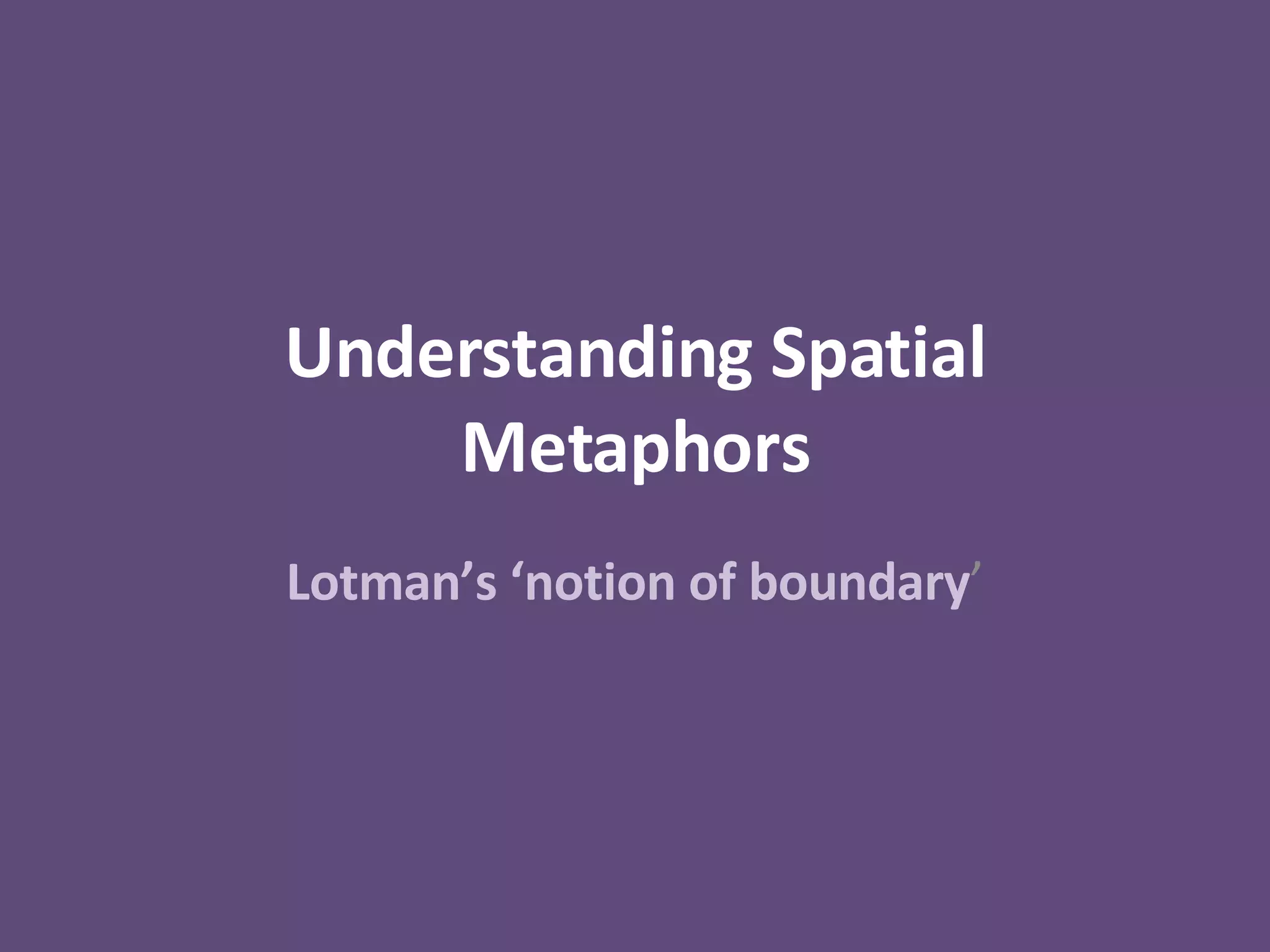
Say what you see…
Say what you see…
Say what you see…
Say what you see…
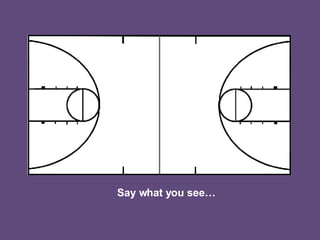
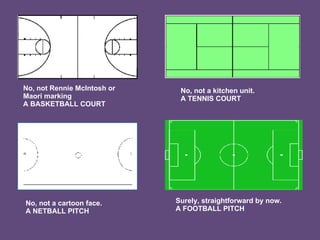
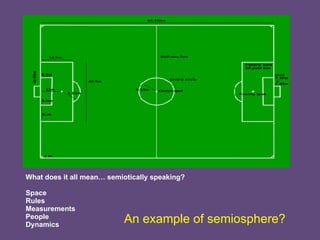
No, not Rennie McIntosh or Maori marking A BASKETBALL COURT No, not a kitchen unit. A TENNIS COURT No, not a cartoon face. A NETBALL PITCH Surely, straightforward by now. A FOOTBALL PITCH
What does it all mean… semiotically speaking? Space Rules Measurements People Dynamics An example of semiosphere?
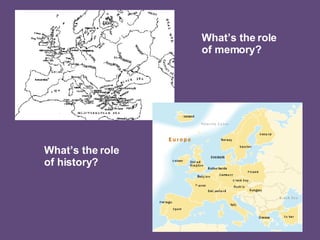
What’s the role of history? What’s the role  of memory?
Notion of Boundary A key feature of Lotman’s semiotic theory of culture and his concept of semiosphere as ‘meaning space’ is his  ‘ notion of boundary ’.  Integral to this concept are the supplementary concepts of  ‘ core ’  (the dominant semiotic mechanism) and  ‘ periphery ’  (the ‘innovative’ or ‘disruptive’ mechanism).
Nature of Lotman’s Boundary The boundary  is not a fixed, solid, linear structure but a chaotic, fractal organism that ‘lies between’ the organised world of the internal semiotic (core) and the chaotic extra- or non-semiotic world (periphery) beyond. As such the boundary, for Lotman,  is  both  dynamic and permeable .
Semiotic Individuation One of the primary mechanisms of  semiotic individuation  is the boundary, and the boundary can be defined as the outer limit of the first-person form.  This space is ‘ours’, ‘my own’, it is ‘cultured’, ‘safe’, ‘harmoniously organized’, and so on. By contrast ‘their space’ is ‘other’, ‘hostile’, ‘dangerous’, ‘chaotic’.
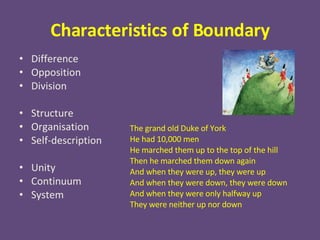
Characteristics of Boundary Difference Opposition Division Structure Organisation Self-description Unity Continuum System  The grand old Duke of York He had 10,000 men He marched them up to the top of the hill Then he marched them down again And when they were up, they were up And when they were down, they were down And when they were only halfway up They were neither up nor down
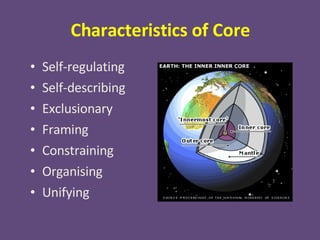
Characteristics of Core Self-regulating Self-describing Exclusionary Framing Constraining Organising Unifying
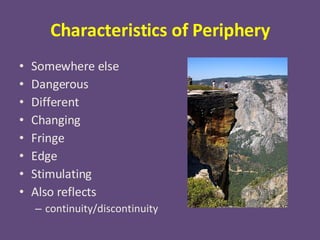
Characteristics of Periphery Somewhere else Dangerous Different Changing Fringe Edge Stimulating  Also reflects continuity/discontinuity
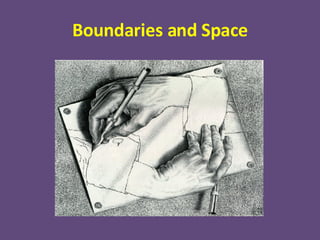
Boundaries and Space
The Boundary The hottest spots for semioticizing processes are the boundaries of the semiosphere. The notion of boundary is an ambivalent one: it both separates and unites. It is always the boundary of something and so belongs to both frontier cultures, to both contiguous semiospheres. It is bilingual and polylingual. It is a mechanism for translation alien texts into texts of ‘our’ language. It is the place where what is ‘external’ is transformed into what is ‘internal’. It is a filtering membrane
Innovation Innovation comes about when the texts of one genre (culture) invade the space of another genre. This happens when the principles (rules) of one genre are restructured according to the rules of another, and this ‘other’ genre organically enters the new structure (culture) and at the same time preserves the memory of its other (previous) system of encoding.
Boundary and Semiosphere The notion of boundary is a rough primary distinction.  The entire space of the semiosphere is transected by boundaries of different levels The internal space of  each of these sub-semiospheres has its own semiotic ‘I’  which is realized as the relationship of any language, group of texts, or separate text to a metastructural space which describes them, always bearing in mind that languages and texts are hierarchically disposed on different levels.
Semiotic Personality The notion of ‘personality’ is only identified with a physical individual in certain cultural and semiotic conditions. The subject of a given system is important in this respect. The ‘personality’ may be an individual or a group. The boundary of the personality is a semiotic boundary. Disturbances and rebellion arise when two methods of encoding are in conflict: for instance when the socio-semiotic structure describes an individual as a  part  but that person feels him or herself to be an autonomous unit, a semiotic subject not an object.

Understanding Spatial Metaphors

  • 1.
    Understanding Spatial MetaphorsLotman’s ‘notion of boundary ’
  • 2.
  • 3.
  • 4.
  • 5.
  • 6.
    No, not RennieMcIntosh or Maori marking A BASKETBALL COURT No, not a kitchen unit. A TENNIS COURT No, not a cartoon face. A NETBALL PITCH Surely, straightforward by now. A FOOTBALL PITCH
  • 7.
    What does itall mean… semiotically speaking? Space Rules Measurements People Dynamics An example of semiosphere?
  • 8.
    What’s the roleof history? What’s the role of memory?
  • 9.
    Notion of BoundaryA key feature of Lotman’s semiotic theory of culture and his concept of semiosphere as ‘meaning space’ is his ‘ notion of boundary ’. Integral to this concept are the supplementary concepts of ‘ core ’ (the dominant semiotic mechanism) and ‘ periphery ’ (the ‘innovative’ or ‘disruptive’ mechanism).
  • 10.
    Nature of Lotman’sBoundary The boundary is not a fixed, solid, linear structure but a chaotic, fractal organism that ‘lies between’ the organised world of the internal semiotic (core) and the chaotic extra- or non-semiotic world (periphery) beyond. As such the boundary, for Lotman, is both dynamic and permeable .
  • 11.
    Semiotic Individuation Oneof the primary mechanisms of semiotic individuation is the boundary, and the boundary can be defined as the outer limit of the first-person form. This space is ‘ours’, ‘my own’, it is ‘cultured’, ‘safe’, ‘harmoniously organized’, and so on. By contrast ‘their space’ is ‘other’, ‘hostile’, ‘dangerous’, ‘chaotic’.
  • 12.
    Characteristics of BoundaryDifference Opposition Division Structure Organisation Self-description Unity Continuum System The grand old Duke of York He had 10,000 men He marched them up to the top of the hill Then he marched them down again And when they were up, they were up And when they were down, they were down And when they were only halfway up They were neither up nor down
  • 13.
    Characteristics of CoreSelf-regulating Self-describing Exclusionary Framing Constraining Organising Unifying
  • 14.
    Characteristics of PeripherySomewhere else Dangerous Different Changing Fringe Edge Stimulating Also reflects continuity/discontinuity
  • 15.
  • 16.
    The Boundary Thehottest spots for semioticizing processes are the boundaries of the semiosphere. The notion of boundary is an ambivalent one: it both separates and unites. It is always the boundary of something and so belongs to both frontier cultures, to both contiguous semiospheres. It is bilingual and polylingual. It is a mechanism for translation alien texts into texts of ‘our’ language. It is the place where what is ‘external’ is transformed into what is ‘internal’. It is a filtering membrane
  • 17.
    Innovation Innovation comesabout when the texts of one genre (culture) invade the space of another genre. This happens when the principles (rules) of one genre are restructured according to the rules of another, and this ‘other’ genre organically enters the new structure (culture) and at the same time preserves the memory of its other (previous) system of encoding.
  • 18.
    Boundary and SemiosphereThe notion of boundary is a rough primary distinction. The entire space of the semiosphere is transected by boundaries of different levels The internal space of each of these sub-semiospheres has its own semiotic ‘I’ which is realized as the relationship of any language, group of texts, or separate text to a metastructural space which describes them, always bearing in mind that languages and texts are hierarchically disposed on different levels.
  • 19.
    Semiotic Personality Thenotion of ‘personality’ is only identified with a physical individual in certain cultural and semiotic conditions. The subject of a given system is important in this respect. The ‘personality’ may be an individual or a group. The boundary of the personality is a semiotic boundary. Disturbances and rebellion arise when two methods of encoding are in conflict: for instance when the socio-semiotic structure describes an individual as a part but that person feels him or herself to be an autonomous unit, a semiotic subject not an object.