QUEUING
THEORY
Waiting Line Management
What is queuing theory?
• It is the study of waiting lines.
• One of the oldest and most widely used Operations Research techniques
• Develop by Agner Krarup Erlang in his efforts to analyze telephone traffic
congestion with a view to satisfying the randomly arising demand for the
services of the Corpenhagen automatic telephone system, in the year 1909.
• Applicable to situation where the customers arrive at some service stations to
acquire a service; wait (occasionally not); and then leave the system after getting
the service.
Common examples of Waiting lines/Queues
• Customers buying at a convenience store and fast food chains (Ex. 7/11,
Jollibee)
• machines waiting to be repaired
• Vehicles waiting to be served at a gas station
• Patients in the hospital
These examples if you have observed, tend to develop waiting lines or
customers line up before actually acquiring the service.
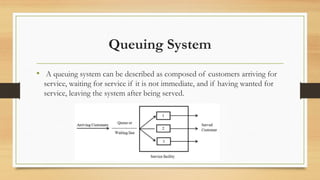
Queuing System
• A queuing system can be described as composed of customers arriving for
service, waiting for service if it is not immediate, and if having wanted for
service, leaving the system after being served.
Component of a Queuing System
• Input process (or Arrival pattern)- This is considered with the pattern in
which the customers arrive and join the system. An input source is
characterized by:
• a) Size of the calling population.
• b) Pattern of arrivals at the system.
• c) Behavior of the arrivals.
Component of a Queuing System
• Size of the calling population- The size represents the total number of potential customers
who will require service. The source of customers can be either finite or infinite. It is considered
infinite if the number of people being very large e.g. all people of a city or municipality (and
others) could be the potential customers.
• Pattern of arrivals at the system-Customers arrive in the system at a service facility according
to some known schedule (for example one patient every 15 minutes or a candidate for interview
every half hour) or else they arrive randomly. Arrivals are considered at random when they are
independent of one another and their occurrence cannot be predicted exactly
This can either be static (constant or random arrival) or dynamic (the system will adjust to
the rate of arrival by doing flexi-scheduling during peak periods)
Component of a Queuing System
• Service Mechanism (or Service Pattern)- include one person or several
people operating as a team. There are two aspects of a service system
• a) the configuration of the service system
• b) the speed of the service.
Component of a Queuing System
• Configuration of the service system
• Single Server Single Queue
• Single Server Several Queues
• Several (Parallel) Servers Single Queue
• Several Servers Several Queues
• Service facilities in a series In this, a customer enters the first station and gets a
portion of service and then moves on to the next station. (Ex. National ID
processing, LTO services)
Customer’s behavior- an important aspect to
Consider for Queues/Waiting Lines
• the customers may be classified as being patient, or impatient
• Balking: A customer may leave the queue because the queue is too long or the estimated waiting
time is too long or waiting space is inadequate, for desired service and may decide to return for
service at a later time.
• Reneging: A customer, after joining the queue, waits for some time and leaves the service system
due to intolerable delay or due to impatience.
• Jockeying: A customer who switches from one queue to another, hoping to receive service more
quickly.
• Priorities: In certain applications some customers are served before others regardless of their
order of arrival. (Ex. Senior Citizen)
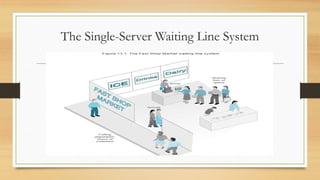
The Single-Server Waiting Line System
The most important factors to consider in
analyzing a queuing system.
• The queue discipline (in what order customers are served )
• The nature of the calling population (where customers come from)
• The arrival rate (how often customers arrive at the queue)
• The service rate (how fast customers are served)
Note: In any queuing system it must be noted that the service rate must be greater
than the arrival rate, otherwise an infinitely large queue will start to build up.
The Single-Server Model
The Fast Shop Market checkout counter is an example of a single-server
queuing system with the following characteristics:
• An infinite calling population
• A first-come, first-served queue discipline
• Poisson arrival rate – Poisson distribution in statistics is used to model the number
of events occurring within a given time interval.
• Exponential service times- Like arrival rate, service time is assumed to be defined
by a probability distribution.
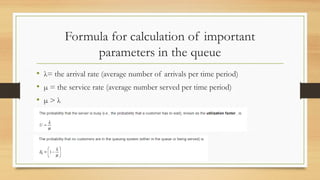
Formula for calculation of important
parameters in the queue
• λ= the arrival rate (average number of arrivals per time period)
• µ = the service rate (average number served per time period)
• µ > λ
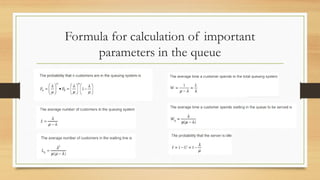
Formula for calculation of important
parameters in the queue
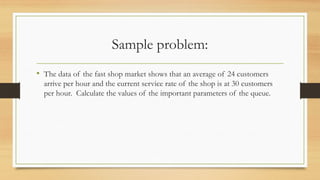
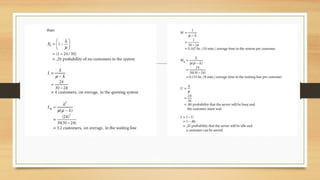
Sample problem:
• The data of the fast shop market shows that an average of 24 customers
arrive per hour and the current service rate of the shop is at 30 customers
per hour. Calculate the values of the important parameters of the queue.
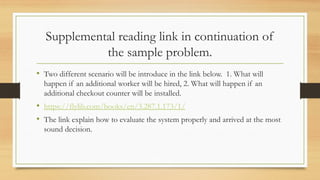
Supplemental reading link in continuation of
the sample problem.
• Two different scenario will be introduce in the link below. 1. What will
happen if an additional worker will be hired, 2. What will happen if an
additional checkout counter will be installed.
• https://flylib.com/books/en/3.287.1.173/1/
• The link explain how to evaluate the system properly and arrived at the most
sound decision.
FOR ATTENDING OUR
ONLINE SESSION

Lesson-4-Queuing-Theory-Student-copy.pptx

  • 1.
  • 2.
    What is queuingtheory? • It is the study of waiting lines. • One of the oldest and most widely used Operations Research techniques • Develop by Agner Krarup Erlang in his efforts to analyze telephone traffic congestion with a view to satisfying the randomly arising demand for the services of the Corpenhagen automatic telephone system, in the year 1909. • Applicable to situation where the customers arrive at some service stations to acquire a service; wait (occasionally not); and then leave the system after getting the service.
  • 3.
    Common examples ofWaiting lines/Queues • Customers buying at a convenience store and fast food chains (Ex. 7/11, Jollibee) • machines waiting to be repaired • Vehicles waiting to be served at a gas station • Patients in the hospital These examples if you have observed, tend to develop waiting lines or customers line up before actually acquiring the service.
  • 4.
    Queuing System • Aqueuing system can be described as composed of customers arriving for service, waiting for service if it is not immediate, and if having wanted for service, leaving the system after being served.
  • 5.
    Component of aQueuing System • Input process (or Arrival pattern)- This is considered with the pattern in which the customers arrive and join the system. An input source is characterized by: • a) Size of the calling population. • b) Pattern of arrivals at the system. • c) Behavior of the arrivals.
  • 6.
    Component of aQueuing System • Size of the calling population- The size represents the total number of potential customers who will require service. The source of customers can be either finite or infinite. It is considered infinite if the number of people being very large e.g. all people of a city or municipality (and others) could be the potential customers. • Pattern of arrivals at the system-Customers arrive in the system at a service facility according to some known schedule (for example one patient every 15 minutes or a candidate for interview every half hour) or else they arrive randomly. Arrivals are considered at random when they are independent of one another and their occurrence cannot be predicted exactly This can either be static (constant or random arrival) or dynamic (the system will adjust to the rate of arrival by doing flexi-scheduling during peak periods)
  • 7.
    Component of aQueuing System • Service Mechanism (or Service Pattern)- include one person or several people operating as a team. There are two aspects of a service system • a) the configuration of the service system • b) the speed of the service.
  • 8.
    Component of aQueuing System • Configuration of the service system • Single Server Single Queue • Single Server Several Queues • Several (Parallel) Servers Single Queue • Several Servers Several Queues • Service facilities in a series In this, a customer enters the first station and gets a portion of service and then moves on to the next station. (Ex. National ID processing, LTO services)
  • 9.
    Customer’s behavior- animportant aspect to Consider for Queues/Waiting Lines • the customers may be classified as being patient, or impatient • Balking: A customer may leave the queue because the queue is too long or the estimated waiting time is too long or waiting space is inadequate, for desired service and may decide to return for service at a later time. • Reneging: A customer, after joining the queue, waits for some time and leaves the service system due to intolerable delay or due to impatience. • Jockeying: A customer who switches from one queue to another, hoping to receive service more quickly. • Priorities: In certain applications some customers are served before others regardless of their order of arrival. (Ex. Senior Citizen)
  • 10.
  • 11.
    The most importantfactors to consider in analyzing a queuing system. • The queue discipline (in what order customers are served ) • The nature of the calling population (where customers come from) • The arrival rate (how often customers arrive at the queue) • The service rate (how fast customers are served) Note: In any queuing system it must be noted that the service rate must be greater than the arrival rate, otherwise an infinitely large queue will start to build up.
  • 12.
    The Single-Server Model TheFast Shop Market checkout counter is an example of a single-server queuing system with the following characteristics: • An infinite calling population • A first-come, first-served queue discipline • Poisson arrival rate – Poisson distribution in statistics is used to model the number of events occurring within a given time interval. • Exponential service times- Like arrival rate, service time is assumed to be defined by a probability distribution.
  • 13.
    Formula for calculationof important parameters in the queue • λ= the arrival rate (average number of arrivals per time period) • µ = the service rate (average number served per time period) • µ > λ
  • 14.
    Formula for calculationof important parameters in the queue
  • 15.
    Sample problem: • Thedata of the fast shop market shows that an average of 24 customers arrive per hour and the current service rate of the shop is at 30 customers per hour. Calculate the values of the important parameters of the queue.
  • 17.
    Supplemental reading linkin continuation of the sample problem. • Two different scenario will be introduce in the link below. 1. What will happen if an additional worker will be hired, 2. What will happen if an additional checkout counter will be installed. • https://flylib.com/books/en/3.287.1.173/1/ • The link explain how to evaluate the system properly and arrived at the most sound decision.
  • 18.