Delays at DDM International AirportRyan HessTonisha MorrisSandra NasilowskiPhil Sampona
Queuing TheoryQueuing= waiting lines	Orderly fashionElements of a queueArrivals that need service of some kind.Service facilities that take care of the arrivals.The queue, where the arrivals wait until they can be serviced.
Queuing TheoryExamples of QueuingM/M/1:This is the simplest queuing system to analyze. Here the arrival and service time are negative exponentially distributed (Poisson process). The system consists of only one server. This queuing system can be applied to a wide variety of problems as any system with a very large number of independent customers can be approximated as a Poisson processM/D/n:Here the arrival process is Poisson and the service time distribution is deterministic. The system has n servers. (e.g. a ticket booking counter with n cashiers) Here the service time can be assumed to be same for all customers)G/G/n:This is the most general queuing system where the arrival and service time processes are both arbitrary. The system has n servers. No analytical solution is known for this queuing system
Queuing TheoryExamples of QueuingArrivalsShoppersPatientsCustomersMachine breakdownsFinished goodsPharmaceuticalsAirplanesTelephone callsArrivals FactorsArrival distribution When do new customers arrive? At random? In groups or singly?Size of population from which customers are drawn Is the population effectively infinite or is it small enough that each arrival means one less new customer in the future?
Queuing TheoryExamples of QueuingServersClerksDoctorOperating teamsStockRepair personsDealerPharmacy in hospitalRunwaysCircuitsFire fightersService factorsService time distribution – how long it takes to serve an arrivalNumber of parallel channels or servers how many checkout counters at the grocery storeHow many stages of service there are
Queuing TheoryExamples of QueuingThe QueueCheckout lineIn waiting roomWaiting listBack ordersBroken machinesInventoryStack in airUncompleted callsBurning buildingsQueue factorsHow many queues -- one or more than one?Service priority among customers. Possibilities include first come first served
Airport Conditions in Good Weather Capacity of 120 planes per hour# of arrivals = # of departures3 runways in operation, 2 runways used for arrivals45-60 arrivals per hourCost of Delays$350 per plane per hour for a 19 seat plane$1500 for a 150 seat plane$600 for regional jetsPassenger cost of waiting is $25 per hour
Delayed flight is one arriving or departing 15 minutes past schedule70% plane capacity Describe the operating conditions, average delay times (i.e. waiting times), and operational and passenger delay costs What proportion of flights will be delayed?
Inclement WeatherIn bad weather2 runways for both arrival and departureCapacity of 45 planes per hourSevere Weather10 days per year1 runway for both arrivals and departuresCapacity of 30 planes per hour
ProblemDescribe relevant operating conditions for these moderate and severe weather conditions and associated costs for the three types of planes. proportion of flights will be delayed? What would happen if an additional runway costing $1 million was builtShould it be built?Most efficient use of it?Assuming 18 hour days and 365 operating days
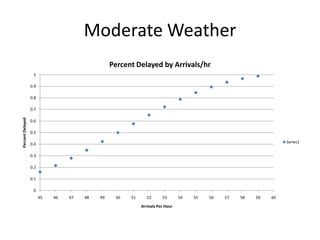
RESULTSMODERATE WEATHERArrival Rate: 45 – 59Service Rate: 30Servers: 2
Moderate Weather
Moderate Weather
Moderate Weather
Inclement WeatherArrival Rate: 35 – 44Service Rate: 22.5Servers: 2
Inclement Weather
Inclement Weather
Inclement Weather
SEVERE INCLEMENT WEATHERArrival Rate: 20 – 29Service Rate: 30Servers: 1
Severe Weather
Severe Weather
Severe Weather
Costs
RecommendationsWith the savings being nearly $2 million per year, it is a no-brainer to add another runway.The most efficient way to use the new runway would be for departures when all runways are in use.During inclement weather it would be use for both arrivals and departures.

516 Queuing

  • 1.
    Delays at DDMInternational AirportRyan HessTonisha MorrisSandra NasilowskiPhil Sampona
  • 2.
    Queuing TheoryQueuing= waitinglines Orderly fashionElements of a queueArrivals that need service of some kind.Service facilities that take care of the arrivals.The queue, where the arrivals wait until they can be serviced.
  • 3.
    Queuing TheoryExamples ofQueuingM/M/1:This is the simplest queuing system to analyze. Here the arrival and service time are negative exponentially distributed (Poisson process). The system consists of only one server. This queuing system can be applied to a wide variety of problems as any system with a very large number of independent customers can be approximated as a Poisson processM/D/n:Here the arrival process is Poisson and the service time distribution is deterministic. The system has n servers. (e.g. a ticket booking counter with n cashiers) Here the service time can be assumed to be same for all customers)G/G/n:This is the most general queuing system where the arrival and service time processes are both arbitrary. The system has n servers. No analytical solution is known for this queuing system
  • 4.
    Queuing TheoryExamples ofQueuingArrivalsShoppersPatientsCustomersMachine breakdownsFinished goodsPharmaceuticalsAirplanesTelephone callsArrivals FactorsArrival distribution When do new customers arrive? At random? In groups or singly?Size of population from which customers are drawn Is the population effectively infinite or is it small enough that each arrival means one less new customer in the future?
  • 5.
    Queuing TheoryExamples ofQueuingServersClerksDoctorOperating teamsStockRepair personsDealerPharmacy in hospitalRunwaysCircuitsFire fightersService factorsService time distribution – how long it takes to serve an arrivalNumber of parallel channels or servers how many checkout counters at the grocery storeHow many stages of service there are
  • 6.
    Queuing TheoryExamples ofQueuingThe QueueCheckout lineIn waiting roomWaiting listBack ordersBroken machinesInventoryStack in airUncompleted callsBurning buildingsQueue factorsHow many queues -- one or more than one?Service priority among customers. Possibilities include first come first served
  • 7.
    Airport Conditions inGood Weather Capacity of 120 planes per hour# of arrivals = # of departures3 runways in operation, 2 runways used for arrivals45-60 arrivals per hourCost of Delays$350 per plane per hour for a 19 seat plane$1500 for a 150 seat plane$600 for regional jetsPassenger cost of waiting is $25 per hour
  • 8.
    Delayed flight isone arriving or departing 15 minutes past schedule70% plane capacity Describe the operating conditions, average delay times (i.e. waiting times), and operational and passenger delay costs What proportion of flights will be delayed?
  • 9.
    Inclement WeatherIn badweather2 runways for both arrival and departureCapacity of 45 planes per hourSevere Weather10 days per year1 runway for both arrivals and departuresCapacity of 30 planes per hour
  • 10.
    ProblemDescribe relevant operatingconditions for these moderate and severe weather conditions and associated costs for the three types of planes. proportion of flights will be delayed? What would happen if an additional runway costing $1 million was builtShould it be built?Most efficient use of it?Assuming 18 hour days and 365 operating days
  • 11.
    RESULTSMODERATE WEATHERArrival Rate:45 – 59Service Rate: 30Servers: 2
  • 12.
  • 13.
  • 14.
  • 15.
    Inclement WeatherArrival Rate:35 – 44Service Rate: 22.5Servers: 2
  • 16.
  • 17.
  • 18.
  • 19.
    SEVERE INCLEMENT WEATHERArrivalRate: 20 – 29Service Rate: 30Servers: 1
  • 20.
  • 21.
  • 22.
  • 23.
  • 24.
    RecommendationsWith the savingsbeing nearly $2 million per year, it is a no-brainer to add another runway.The most efficient way to use the new runway would be for departures when all runways are in use.During inclement weather it would be use for both arrivals and departures.