

Keda
Analysis
ITM - Group 6
Akrati Chauhan
Arpan Chhabra
Girish Khatri
Rachna Gupta
Shrivas Dheriya
Vaikunth Kossambe
2020006
2020016
2020026
2020046
2020036
2020056
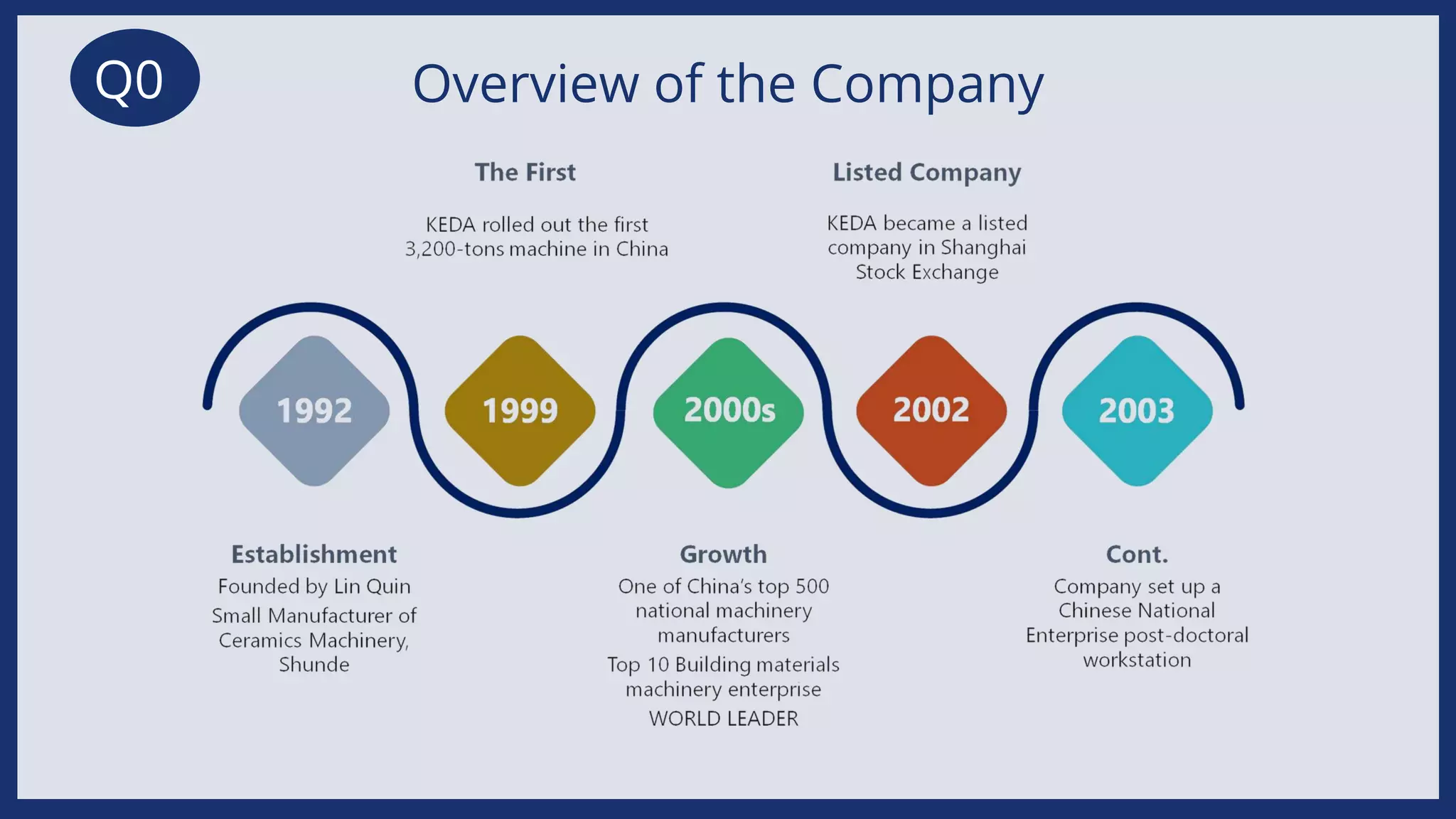
Overview of the Company
Q0
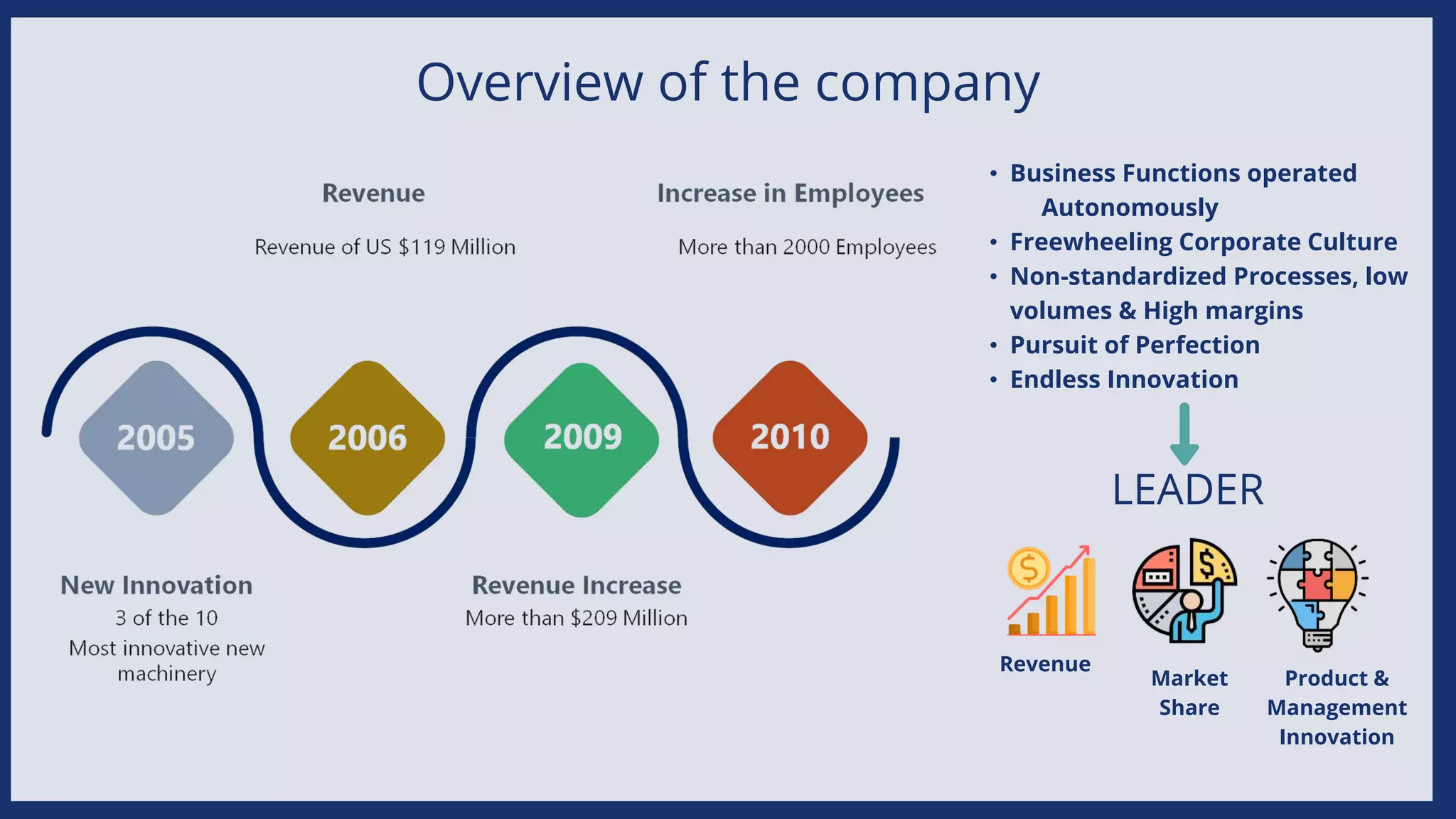
• Business Functions operated
Autonomously
• Freewheeling Corporate Culture
• Non-standardized Processes, low
volumes & High margins
• Pursuit of Perfection
• Endless Innovation
Overview of the company
Revenue
Market
Share
Product &
Management
Innovation
LEADER
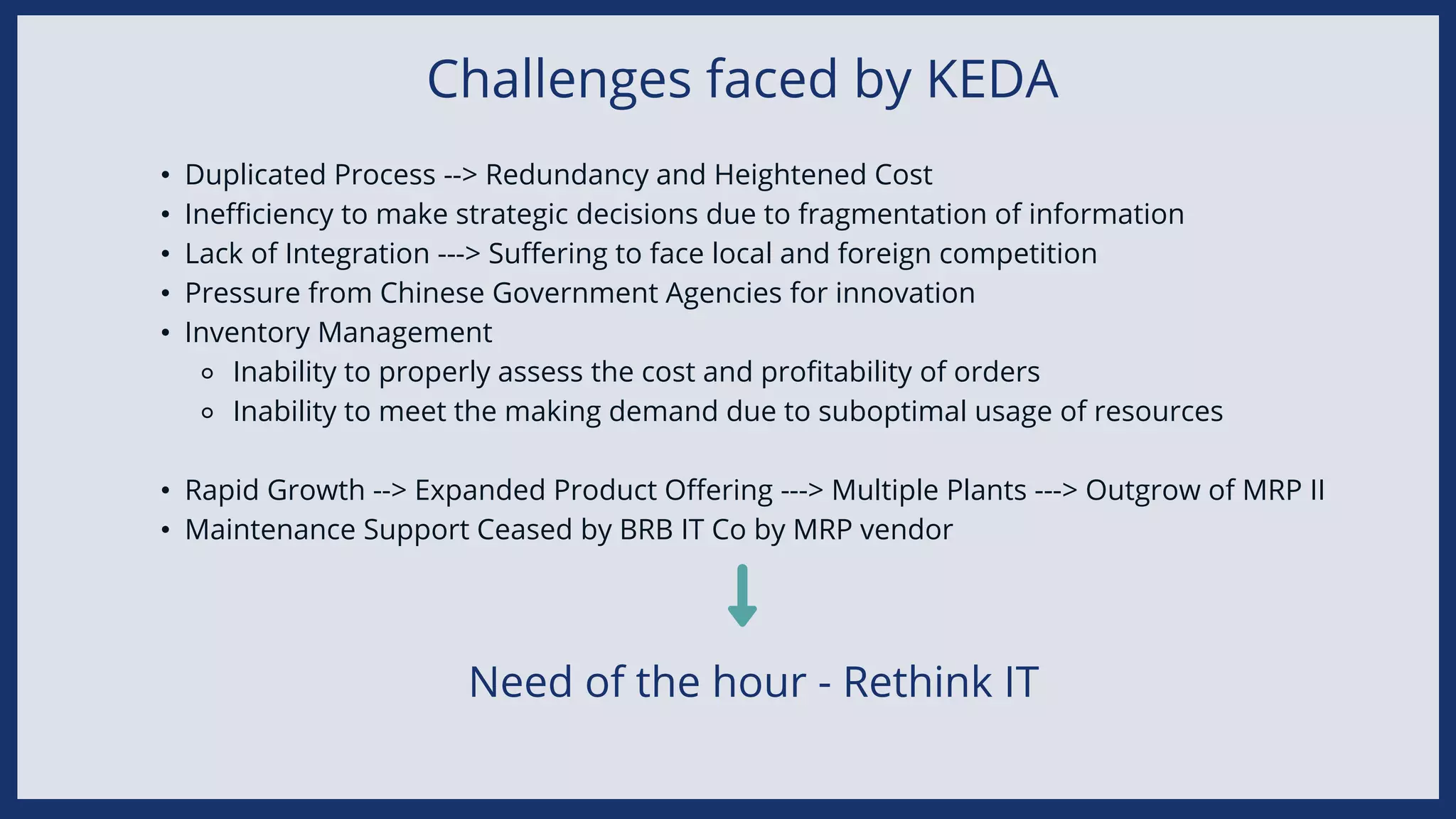
Challenges faced by KEDA
• Duplicated Process --> Redundancy and Heightened Cost
• Inefficiency to make strategic decisions due to fragmentation of information
• Lack of Integration ---> Suffering to face local and foreign competition
• Pressure from Chinese Government Agencies for innovation
• Inventory Management
⚬ Inability to properly assess the cost and profitability of orders
⚬ Inability to meet the making demand due to suboptimal usage of resources
• Rapid Growth --> Expanded Product Offering ---> Multiple Plants ---> Outgrow of MRP II
• Maintenance Support Ceased by BRB IT Co by MRP vendor
Need of the hour - Rethink IT
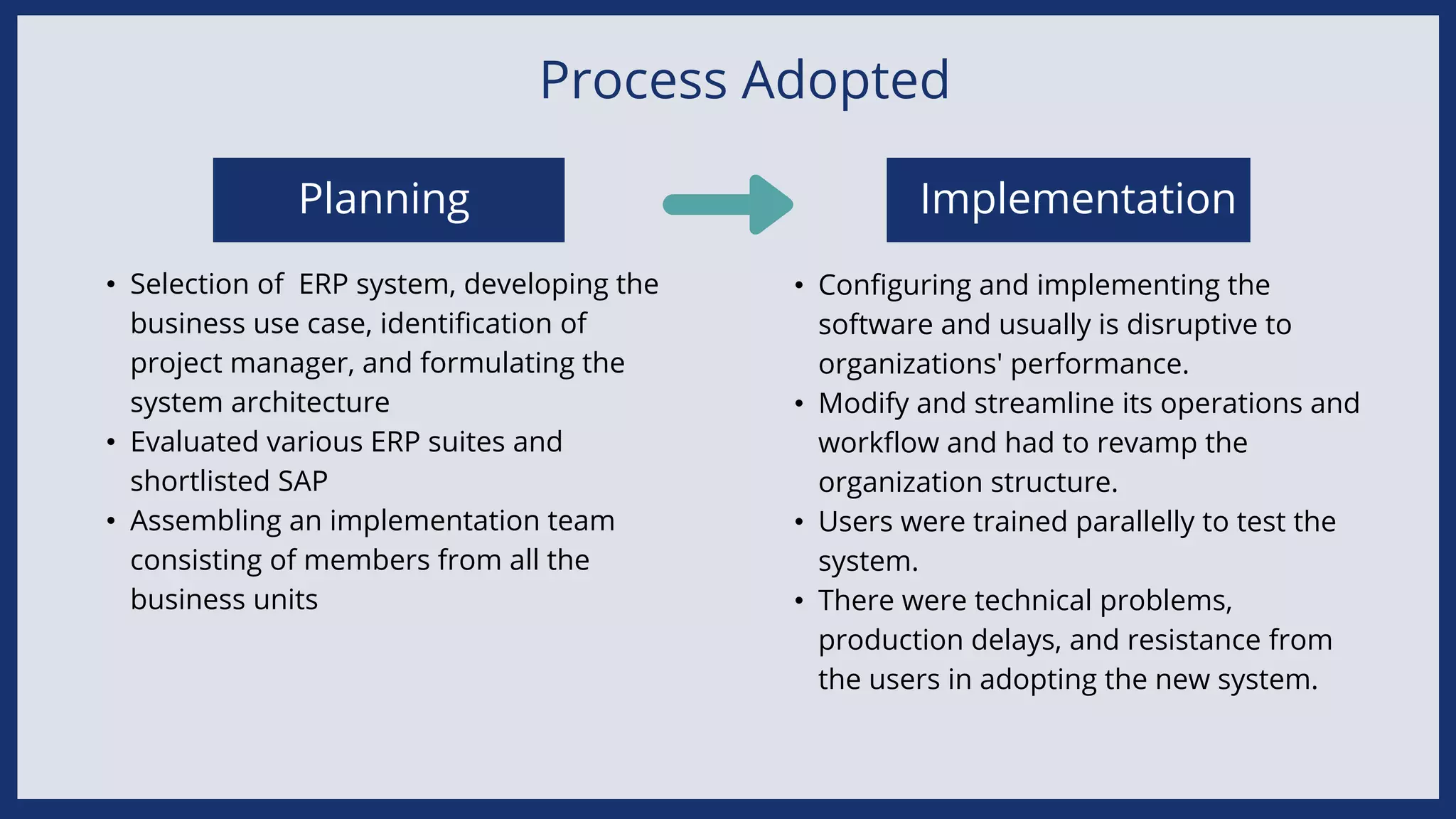
• Selection of ERP system, developing the
business use case, identification of
project manager, and formulating the
system architecture
• Evaluated various ERP suites and
shortlisted SAP
• Assembling an implementation team
consisting of members from all the
business units
• Configuring and implementing the
software and usually is disruptive to
organizations' performance.
• Modify and streamline its operations and
workflow and had to revamp the
organization structure.
• Users were trained parallelly to test the
system.
• There were technical problems,
production delays, and resistance from
the users in adopting the new system.
Process Adopted
Planning Implementation
Process Adopted Cont....
• The organization sees incremental
improvements in its performance.
• After one year of ERP implementation, able
to produce 30 machines per month
compared to 6 per month previously.
• Implementation problems are fixed and the
company’s performance improves in this
case.
• Any further requests from the users were
rejected until the project was stable.
Stabilization Improvement
Q1 IT plan and Business plan Relation
• There was inefficiency in inventory management and discrepancies in profit/loss accounts. These were overcome by
the use of SAP’s MM module
• The optimality in the utilization of resources was improved by using production planning in ERP
• There was a lack of integration on many fronts compared to the competitors and there was pressure from Chinese
Govt agencies to promote innovation. Keda’s ERP implementation is seen as a reaction to this.
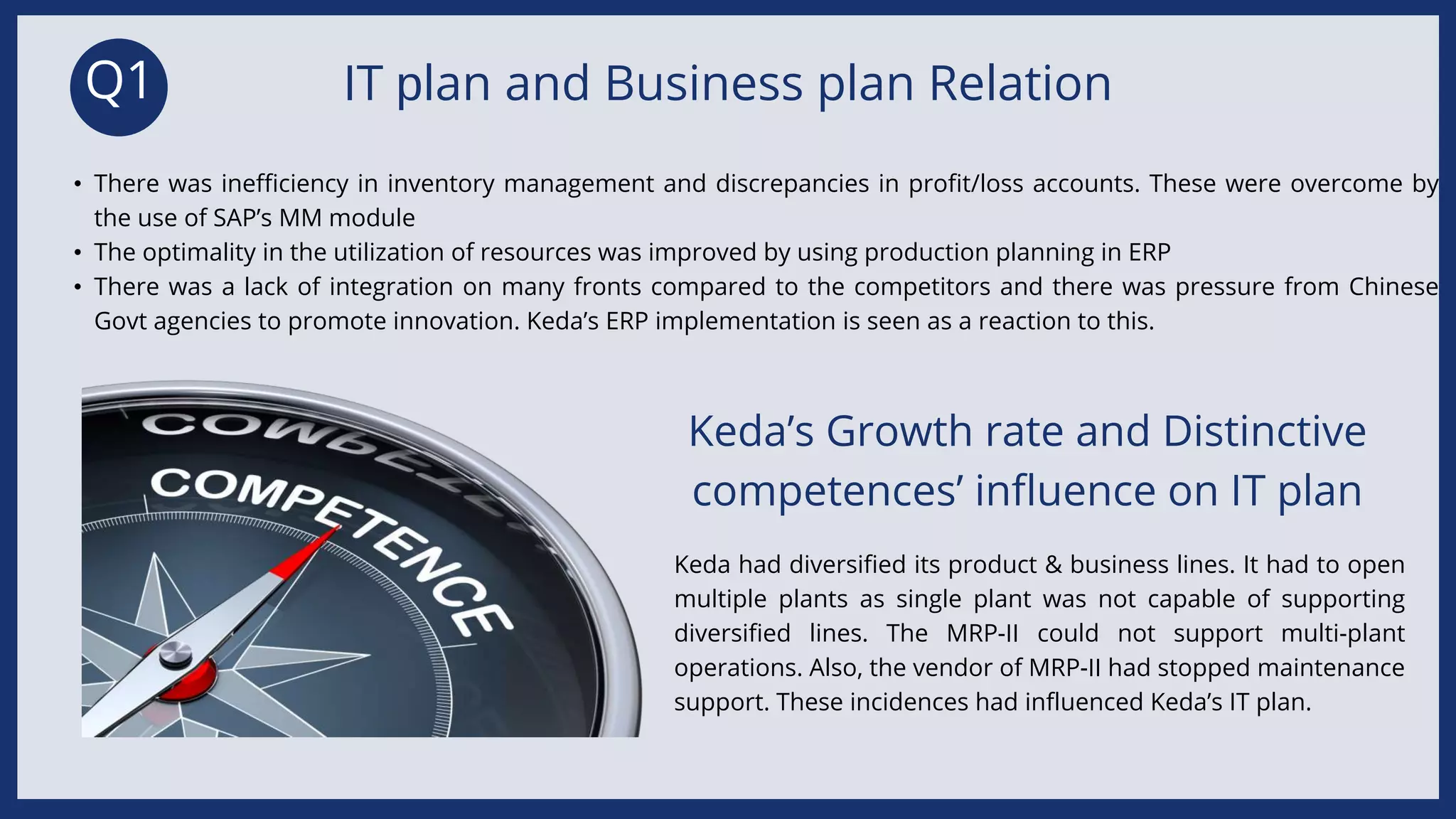
Keda’s Growth rate and Distinctive
competences’ influence on IT plan
Keda had diversified its product & business lines. It had to open
multiple plants as single plant was not capable of supporting
diversified lines. The MRP-II could not support multi-plant
operations. Also, the vendor of MRP-II had stopped maintenance
support. These incidences had influenced Keda’s IT plan.
Why was packaged ERP chosen in place of
developing software?
• Keda was out of time
• There was an urgent need for a replacement system as their MRP-II vendor had
ceased providing maintenance support
• The company lacked IT expertise
• It would be expensive and time-consuming to build a large team for such
development
• Successful implementation was far from guaranteed
• Customising an existing system would be faster, cheaper and of higher quality than
building one from scratch
Q2
• Keda contacted 20 software vendors- both local and
global
• They were invited to visit Keda for detailed
assessments
• Keda visited their existing clients for crosschecking,
to compare real production environments in the
industry, and to understand the possible
complications in the implementation process
• 9 vendors were shortlisted for an RFP so that Keda
could compare vendor offerings
• These vendor offerings were rated according to the
company’s strategic management goals
• SAP emerged as the winner as it was sophisticated,
feature-rich, and supported complex operational
processes across multiple production plants
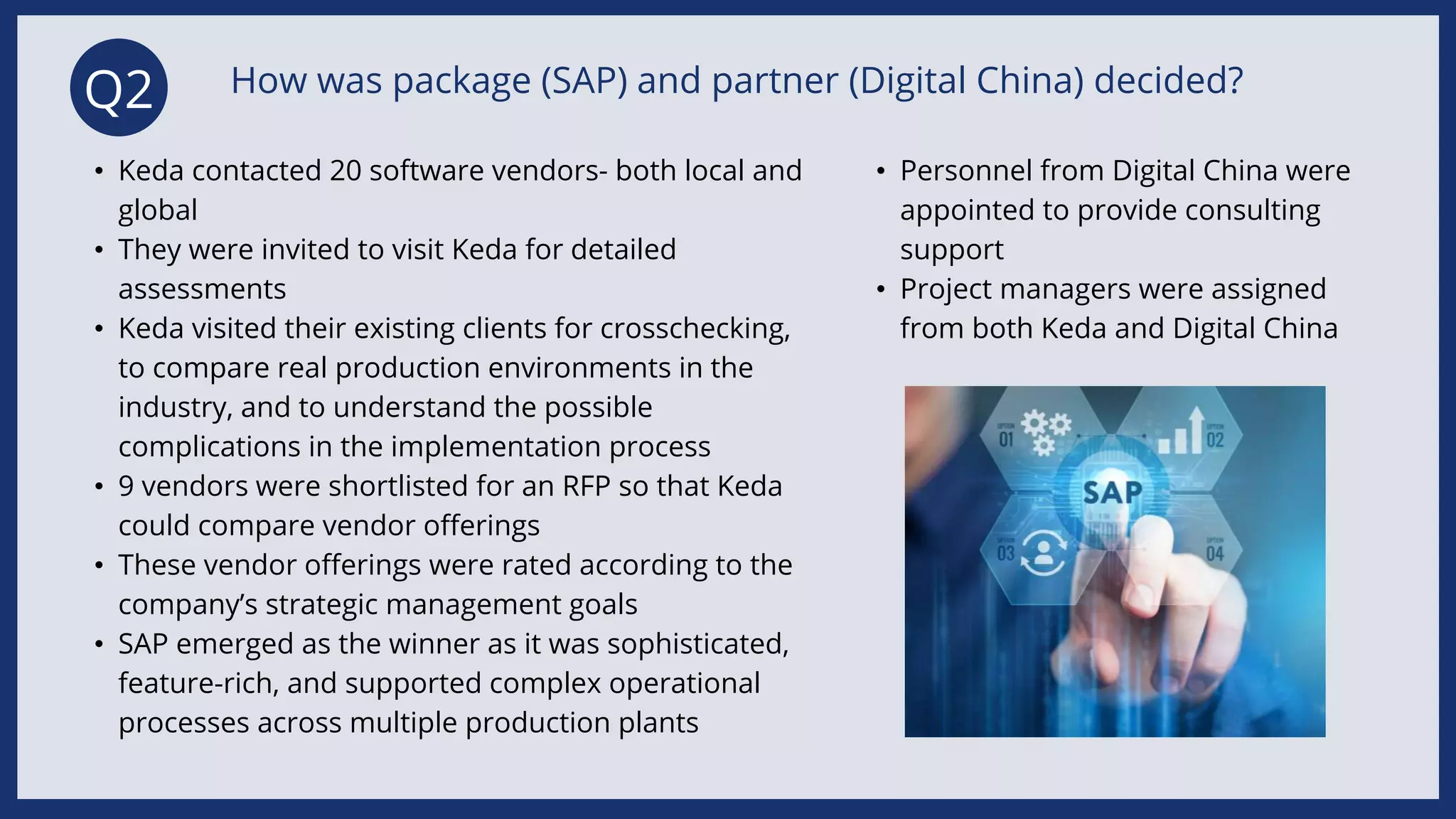
How was package (SAP) and partner (Digital China) decided?
Q2
• Personnel from Digital China were
appointed to provide consulting
support
• Project managers were assigned
from both Keda and Digital China
• Resistance from personnel to use the new system, fearing that it
would lessen their authority.​
• Conflict-of-interest among departments while designing and
implementing the ERP.​
• Ensuring participation of departmental managers by posing forced
compliance actions.​
• Production delays, technical problems after the implementation of
ERP.​
• Data in an organization is huge. Transferring the data to the ERP
system is very tedious and easily prone to error​
• Some redundant activities were made compulsory to comply with the
ERP system. ​
Challenges faced in implementing ERP in KEDA
Q3
Q4
Zhu decided to expedite the
implementation process and used
an aggressive big-bang approach
to integrate the system. And even
though the company faced a few
problems initially, the company
soon realized the benefits.
Implementation
• Data accuracy, including that for production
planning and inventory management, improved
from 85% to 98%. As the information was more
accessible, it was easy to trace prices for materials
purchased. The company was able to do price
analysis conveniently.
• The improved information flow enabled enhanced
market responsiveness for the company,
decreased stock holdings, significantly better
delivery time, and a faster monthly financial
reconciliation.
• Machine press production jumped from 6 presses
per month to 30. Information is power. The
streamlined flow of information allowed the
company to ramp up production and reduce
waste.
ERP Implementation and Benefits
• The company also had a great revelation.
Through cost analysis enabled by ERP, they
realized that the cost of a polishing machine
they sold in US markets at US $50,000 was
actually US $52,512.
• Now capable of making better decisions, the
company opted to focus on controlling costs
instead of pushing their product in the
foreign market.
Q4
Q5 Recommendations for the future course of action for IT department of
Keda of ERP
• Detailed Communication Plan
A common platform for business heads of different departments to share their decisions,
feedbacks, and other updates fortnightly.
⚬ Increase access to information for everyone, especially in the new normal.
⚬ Will allow managers to share new ideas for the business
• Training and Development of employees to have more expertise in software testing
• Need to regress testing strategy
• Hiring the right personnel for any ERP project implementation. For Eg., Dr. Fan Zu played a
key role in the success of the project
• Technology is ever-changing, the IT department needs to keep up. In this case, KEDA needs
to be ahead in adopting new software and their versions to tackle competition
• ERP implementation project - Part of a
bigger computerization plan to
improve the company‘s productivity.
• Keda remained committed to the
computerization plan originally set out.
For instance, the Manufacturing
Execution System.
• Keda with the help of ERP is
strategically positioned to reap the
benefits of computerization.
Future of ERP
Q5
Conclusion
• Involvement of key users right from initial stages, commitment of higher management,
seamless communication between different participants, efficient selection of proper option,
defining and sticking to a timeline are some ofthe key factors which ensure success of
implementation of an IT project.
• Cultural context can be used to ensure success of a project
• Keeping senior management informed proactively can avoid bigger problems and also their
involvement can be used to drive success of a project without facing resistance from key
stakeholders.
• Information is power. The streamlined flow of information allowed the company to ramp up
production and reduce waste.
Takeaways from the case study
From Group 6

Keda case analysis- ERP Implementation

  • 1.
    Keda Analysis ITM - Group6 Akrati Chauhan Arpan Chhabra Girish Khatri Rachna Gupta Shrivas Dheriya Vaikunth Kossambe 2020006 2020016 2020026 2020046 2020036 2020056
  • 2.
    Overview of theCompany Q0
  • 3.
    • Business Functionsoperated Autonomously • Freewheeling Corporate Culture • Non-standardized Processes, low volumes & High margins • Pursuit of Perfection • Endless Innovation Overview of the company Revenue Market Share Product & Management Innovation LEADER
  • 4.
    Challenges faced byKEDA • Duplicated Process --> Redundancy and Heightened Cost • Inefficiency to make strategic decisions due to fragmentation of information • Lack of Integration ---> Suffering to face local and foreign competition • Pressure from Chinese Government Agencies for innovation • Inventory Management ⚬ Inability to properly assess the cost and profitability of orders ⚬ Inability to meet the making demand due to suboptimal usage of resources • Rapid Growth --> Expanded Product Offering ---> Multiple Plants ---> Outgrow of MRP II • Maintenance Support Ceased by BRB IT Co by MRP vendor Need of the hour - Rethink IT
  • 5.
    • Selection ofERP system, developing the business use case, identification of project manager, and formulating the system architecture • Evaluated various ERP suites and shortlisted SAP • Assembling an implementation team consisting of members from all the business units • Configuring and implementing the software and usually is disruptive to organizations' performance. • Modify and streamline its operations and workflow and had to revamp the organization structure. • Users were trained parallelly to test the system. • There were technical problems, production delays, and resistance from the users in adopting the new system. Process Adopted Planning Implementation
  • 6.
    Process Adopted Cont.... •The organization sees incremental improvements in its performance. • After one year of ERP implementation, able to produce 30 machines per month compared to 6 per month previously. • Implementation problems are fixed and the company’s performance improves in this case. • Any further requests from the users were rejected until the project was stable. Stabilization Improvement
  • 7.
    Q1 IT planand Business plan Relation • There was inefficiency in inventory management and discrepancies in profit/loss accounts. These were overcome by the use of SAP’s MM module • The optimality in the utilization of resources was improved by using production planning in ERP • There was a lack of integration on many fronts compared to the competitors and there was pressure from Chinese Govt agencies to promote innovation. Keda’s ERP implementation is seen as a reaction to this. Keda’s Growth rate and Distinctive competences’ influence on IT plan Keda had diversified its product & business lines. It had to open multiple plants as single plant was not capable of supporting diversified lines. The MRP-II could not support multi-plant operations. Also, the vendor of MRP-II had stopped maintenance support. These incidences had influenced Keda’s IT plan.
  • 8.
    Why was packagedERP chosen in place of developing software? • Keda was out of time • There was an urgent need for a replacement system as their MRP-II vendor had ceased providing maintenance support • The company lacked IT expertise • It would be expensive and time-consuming to build a large team for such development • Successful implementation was far from guaranteed • Customising an existing system would be faster, cheaper and of higher quality than building one from scratch Q2
  • 9.
    • Keda contacted20 software vendors- both local and global • They were invited to visit Keda for detailed assessments • Keda visited their existing clients for crosschecking, to compare real production environments in the industry, and to understand the possible complications in the implementation process • 9 vendors were shortlisted for an RFP so that Keda could compare vendor offerings • These vendor offerings were rated according to the company’s strategic management goals • SAP emerged as the winner as it was sophisticated, feature-rich, and supported complex operational processes across multiple production plants How was package (SAP) and partner (Digital China) decided? Q2 • Personnel from Digital China were appointed to provide consulting support • Project managers were assigned from both Keda and Digital China
  • 10.
    • Resistance frompersonnel to use the new system, fearing that it would lessen their authority.​ • Conflict-of-interest among departments while designing and implementing the ERP.​ • Ensuring participation of departmental managers by posing forced compliance actions.​ • Production delays, technical problems after the implementation of ERP.​ • Data in an organization is huge. Transferring the data to the ERP system is very tedious and easily prone to error​ • Some redundant activities were made compulsory to comply with the ERP system. ​ Challenges faced in implementing ERP in KEDA Q3
  • 11.
    Q4 Zhu decided toexpedite the implementation process and used an aggressive big-bang approach to integrate the system. And even though the company faced a few problems initially, the company soon realized the benefits. Implementation
  • 12.
    • Data accuracy,including that for production planning and inventory management, improved from 85% to 98%. As the information was more accessible, it was easy to trace prices for materials purchased. The company was able to do price analysis conveniently. • The improved information flow enabled enhanced market responsiveness for the company, decreased stock holdings, significantly better delivery time, and a faster monthly financial reconciliation. • Machine press production jumped from 6 presses per month to 30. Information is power. The streamlined flow of information allowed the company to ramp up production and reduce waste. ERP Implementation and Benefits • The company also had a great revelation. Through cost analysis enabled by ERP, they realized that the cost of a polishing machine they sold in US markets at US $50,000 was actually US $52,512. • Now capable of making better decisions, the company opted to focus on controlling costs instead of pushing their product in the foreign market. Q4
  • 13.
    Q5 Recommendations forthe future course of action for IT department of Keda of ERP • Detailed Communication Plan A common platform for business heads of different departments to share their decisions, feedbacks, and other updates fortnightly. ⚬ Increase access to information for everyone, especially in the new normal. ⚬ Will allow managers to share new ideas for the business • Training and Development of employees to have more expertise in software testing • Need to regress testing strategy • Hiring the right personnel for any ERP project implementation. For Eg., Dr. Fan Zu played a key role in the success of the project • Technology is ever-changing, the IT department needs to keep up. In this case, KEDA needs to be ahead in adopting new software and their versions to tackle competition
  • 14.
    • ERP implementationproject - Part of a bigger computerization plan to improve the company‘s productivity. • Keda remained committed to the computerization plan originally set out. For instance, the Manufacturing Execution System. • Keda with the help of ERP is strategically positioned to reap the benefits of computerization. Future of ERP Q5
  • 15.
    Conclusion • Involvement ofkey users right from initial stages, commitment of higher management, seamless communication between different participants, efficient selection of proper option, defining and sticking to a timeline are some ofthe key factors which ensure success of implementation of an IT project. • Cultural context can be used to ensure success of a project • Keeping senior management informed proactively can avoid bigger problems and also their involvement can be used to drive success of a project without facing resistance from key stakeholders. • Information is power. The streamlined flow of information allowed the company to ramp up production and reduce waste. Takeaways from the case study
  • 16.