An Introduction to Photography
So you want to win the competition? How do you do it?Go out and take pictures!The best way to learn photography is through trial and error!See what you think is best!But since you’re here why don’t we go through some basic rules of photography to get you going?
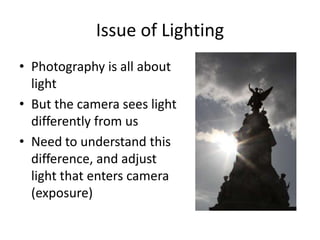
Issue of LightingPhotography is all about lightBut the camera sees light differently from usNeed to understand this difference, and adjust light that enters camera (exposure)
ExposureExposure the most important technical aspect of photographyThis is controlled by 3 variables- Aperture, Shutter speed and ISO (sensitivity)The scene modes on your camera just plays around with different combinations of these!You can do it yourself through Shutter Priority (S), Aperture Priority (P) and full manual (M)
What is correct exposure?There’s no such thing!Technically, correct exposure means all light values fall within the range that your camera sensor (or film) can capture.Which works fine, but it might not give you the look you’re trying to achieve.
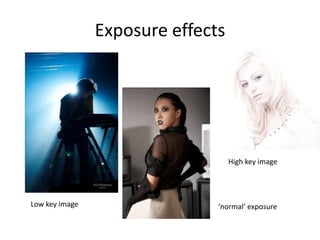
Exposure effectsHigh key imageLow key image‘normal’ exposure
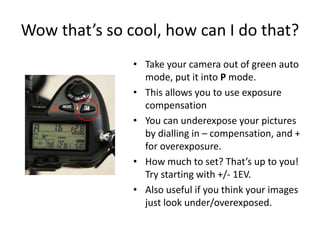
Wow that’s so cool, how can I do that?Take your camera out of green auto mode, put it into P mode.This allows you to use exposure compensationYou can underexpose your pictures by dialling in – compensation, and + for overexposure.How much to set? That’s up to you! Try starting with +/- 1EV.Also useful if you think your images just look under/overexposed.
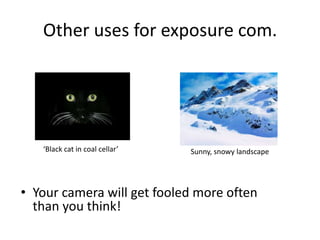
Other uses for exposure com.‘Black cat in coal cellar’Sunny, snowy landscapeYour camera will get fooled more often than you think!
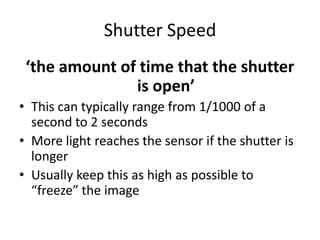
Shutter Speed‘the amount of time that the shutter is open’This can typically range from 1/1000 of a second to 2 secondsMore light reaches the sensor if the shutter is longer Usually keep this as high as possible to “freeze” the image
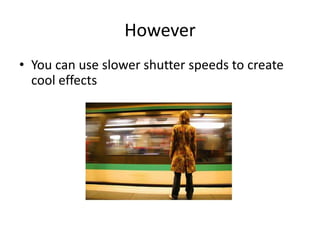
HoweverYou can use slower shutter speeds to create cool effects
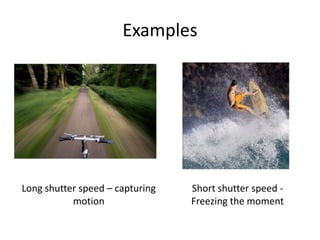
ExamplesLong shutter speed – capturing motionShort shutter speed - Freezing the moment
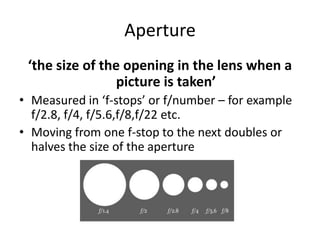
Aperture‘the size of the opening in the lens when a picture is taken’Measured in ‘f-stops’ or f/number – for example f/2.8, f/4, f/5.6,f/8,f/22 etc. Moving from one f-stop to the next doubles or halves the size of the aperture
Some more thingsThe aperture scale is the ‘wrong’ way around:Larger number means smaller size holeLandscape photography usually needs a small aperture (big number) so that the whole scene is in focusLess light gets in with large apertures (small numbers) so slower shutter speeds will be needed and vice versa
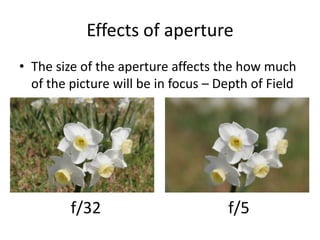
Effects of apertureThe size of the aperture affects the how much of the picture will be in focus – Depth of Fieldf/32f/5
ISO‘The sensitivity of the image sensor’Typical values: 100, 200, 400, 800, 1600Higher ISO means more sensitive – so can take pictures in lower lightHowever high ISO also means more grain (degradation of image quality)So if you have lots of light or your shooting on a tripod always use a low ISO
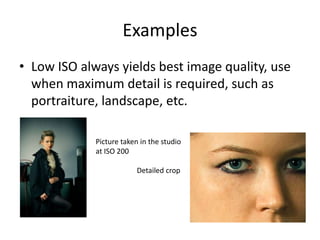
ExamplesLow ISO always yields best image quality, use when maximum detail is required, such as portraiture, landscape, etc.Picture taken in the studio at ISO 200	     Detailed crop
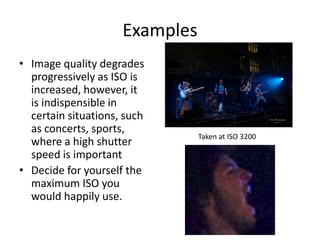
ExamplesImage quality degrades progressively as ISO is increased, however, it is indispensible in certain situations, such as concerts, sports, where a high shutter speed is important
Decide for yourself the maximum ISO you would happily use.Taken at ISO 3200
CompositionGetting the technical things right with photography is trivial, but getting nice looking pictures isn’t!Some rules that you can follow when it comes to composition, but rules are there to be broken! So don’t follow it blindly....Subject bang in the middle usually doesn’t look good though!
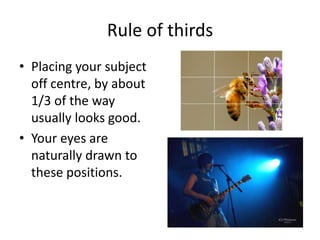
Rule of thirdsPlacing your subject off centre, by about 1/3 of the way usually looks good.Your eyes are naturally drawn to these positions.
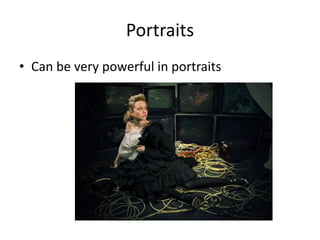
PortraitsCan be very powerful in portraits
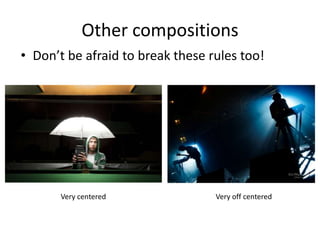
Other compositionsDon’t be afraid to break these rules too!Very centeredVery off centered
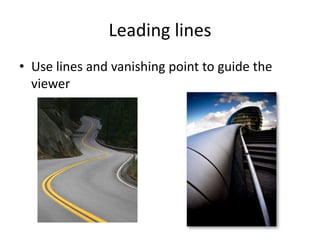
Leading linesUse lines and vanishing point to guide the viewer
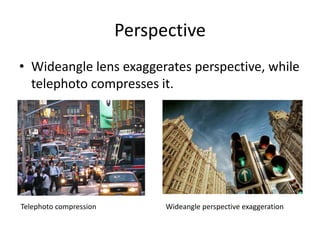
PerspectiveWideangle lens exaggerates perspective, while telephoto compresses it.Telephoto compressionWideangle perspective exaggeration
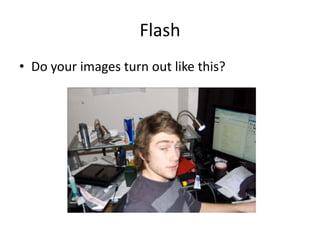
FlashDo your images turn out like this?
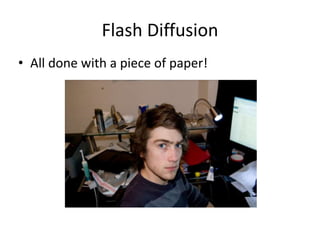
Flash DiffusionAll done with a piece of paper!
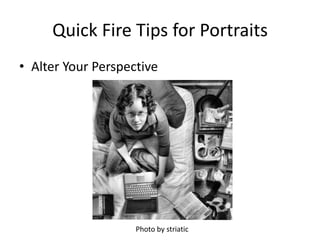
Quick Fire Tips for PortraitsAlter Your PerspectivePhoto by striatic
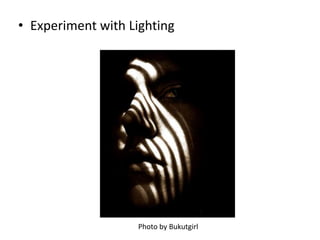
Experiment with LightingPhoto by Bukutgirl
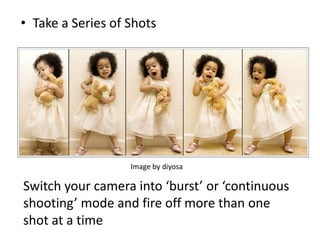
Take a Series of ShotsImage by diyosaSwitch your camera into ‘burst’ or ‘continuous shooting’ mode and fire off more than one shot at a time
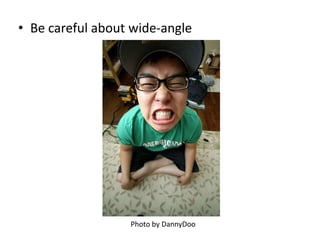
Be careful about wide-anglePhoto by DannyDoo
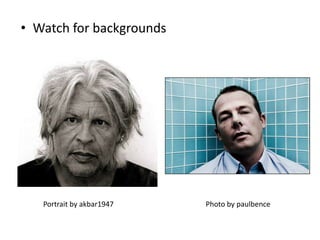
Watch for backgroundsPortrait by akbar1947Photo by paulbence
ConclusionSo much to explore with photography, go out and have fun!Practice and experimentation makes perfect! Develop your own style!

Introduction To Photography (Wset)

  • 1.
  • 2.
    So you wantto win the competition? How do you do it?Go out and take pictures!The best way to learn photography is through trial and error!See what you think is best!But since you’re here why don’t we go through some basic rules of photography to get you going?
  • 3.
    Issue of LightingPhotographyis all about lightBut the camera sees light differently from usNeed to understand this difference, and adjust light that enters camera (exposure)
  • 4.
    ExposureExposure the mostimportant technical aspect of photographyThis is controlled by 3 variables- Aperture, Shutter speed and ISO (sensitivity)The scene modes on your camera just plays around with different combinations of these!You can do it yourself through Shutter Priority (S), Aperture Priority (P) and full manual (M)
  • 5.
    What is correctexposure?There’s no such thing!Technically, correct exposure means all light values fall within the range that your camera sensor (or film) can capture.Which works fine, but it might not give you the look you’re trying to achieve.
  • 6.
    Exposure effectsHigh keyimageLow key image‘normal’ exposure
  • 7.
    Wow that’s socool, how can I do that?Take your camera out of green auto mode, put it into P mode.This allows you to use exposure compensationYou can underexpose your pictures by dialling in – compensation, and + for overexposure.How much to set? That’s up to you! Try starting with +/- 1EV.Also useful if you think your images just look under/overexposed.
  • 8.
    Other uses forexposure com.‘Black cat in coal cellar’Sunny, snowy landscapeYour camera will get fooled more often than you think!
  • 9.
    Shutter Speed‘the amountof time that the shutter is open’This can typically range from 1/1000 of a second to 2 secondsMore light reaches the sensor if the shutter is longer Usually keep this as high as possible to “freeze” the image
  • 10.
    HoweverYou can useslower shutter speeds to create cool effects
  • 11.
    ExamplesLong shutter speed– capturing motionShort shutter speed - Freezing the moment
  • 12.
    Aperture‘the size ofthe opening in the lens when a picture is taken’Measured in ‘f-stops’ or f/number – for example f/2.8, f/4, f/5.6,f/8,f/22 etc. Moving from one f-stop to the next doubles or halves the size of the aperture
  • 13.
    Some more thingsTheaperture scale is the ‘wrong’ way around:Larger number means smaller size holeLandscape photography usually needs a small aperture (big number) so that the whole scene is in focusLess light gets in with large apertures (small numbers) so slower shutter speeds will be needed and vice versa
  • 14.
    Effects of apertureThesize of the aperture affects the how much of the picture will be in focus – Depth of Fieldf/32f/5
  • 15.
    ISO‘The sensitivity ofthe image sensor’Typical values: 100, 200, 400, 800, 1600Higher ISO means more sensitive – so can take pictures in lower lightHowever high ISO also means more grain (degradation of image quality)So if you have lots of light or your shooting on a tripod always use a low ISO
  • 16.
    ExamplesLow ISO alwaysyields best image quality, use when maximum detail is required, such as portraiture, landscape, etc.Picture taken in the studio at ISO 200 Detailed crop
  • 17.
    ExamplesImage quality degradesprogressively as ISO is increased, however, it is indispensible in certain situations, such as concerts, sports, where a high shutter speed is important
  • 18.
    Decide for yourselfthe maximum ISO you would happily use.Taken at ISO 3200
  • 19.
    CompositionGetting the technicalthings right with photography is trivial, but getting nice looking pictures isn’t!Some rules that you can follow when it comes to composition, but rules are there to be broken! So don’t follow it blindly....Subject bang in the middle usually doesn’t look good though!
  • 20.
    Rule of thirdsPlacingyour subject off centre, by about 1/3 of the way usually looks good.Your eyes are naturally drawn to these positions.
  • 21.
    PortraitsCan be verypowerful in portraits
  • 22.
    Other compositionsDon’t beafraid to break these rules too!Very centeredVery off centered
  • 23.
    Leading linesUse linesand vanishing point to guide the viewer
  • 24.
    PerspectiveWideangle lens exaggeratesperspective, while telephoto compresses it.Telephoto compressionWideangle perspective exaggeration
  • 25.
    FlashDo your imagesturn out like this?
  • 26.
    Flash DiffusionAll donewith a piece of paper!
  • 27.
    Quick Fire Tipsfor PortraitsAlter Your PerspectivePhoto by striatic
  • 28.
  • 29.
    Take a Seriesof ShotsImage by diyosaSwitch your camera into ‘burst’ or ‘continuous shooting’ mode and fire off more than one shot at a time
  • 30.
    Be careful aboutwide-anglePhoto by DannyDoo
  • 31.
    Watch for backgroundsPortraitby akbar1947Photo by paulbence
  • 32.
    ConclusionSo much toexplore with photography, go out and have fun!Practice and experimentation makes perfect! Develop your own style!