What do you want to learn  from this class?
Digital Photography Getting Sharp Photos
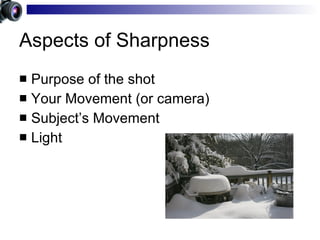
Aspects of Sharpness Purpose of the shot Your Movement (or camera) Subject’s Movement  Light
Your Movement Use a tripod/monopod Cable release Lean on something Use “The Death Grip” Hold your breath
Subject Movement Stills or stop action Focus on your subject and wait for the shot Take a lot of pictures Multi-shot Take the picture from  faraway – so subject  is not reacting to you
Light Lighting Indoors vs Outdoors Time of Day Weather Bright Lighting Back Lighting Low Lighting White balance Using a Flash Too dark is better than too light
Exercise 1 – Your Pictures What do you typically take pictures of? How do your pictures usually come out? What do you think the issues are?
Fill That Bucket! A bucket is of fixed size and needs a certain amount of water to fill it, just like film, which is of a set film speed and needs a certain amount of light to capture an image.  To fill your bucket, you can pour a small stream of water for a long time or a fast stream of water for a short time. Either way, you end up with the same amount of water.  In photography, the size of the stream of the water is analogous to the  f/stop , the length of time you pour is analogous to the  shutter speed , and the size of the bucket is analogous to the  film speed .  Broadly speaking, from the bucket's point of view, it doesn't matter which combination of stream size and length of time you choose as long as the right amount of water ends up coming in.  Film is the same; within limits, it is indifferent to the combination of time and amount of light as long as the right amount of light eventually arrives.
Exposure Shutter speed, combined with film speed and aperture, will give you an exposure. To get a perfect exposure, your aperture and shutter speed must be aligned.
Film Speed Film speed is a measurement that indicates a film’s sensitivity to light. The higher the film speed, the faster or more sensitive it is to light Which translates to: Higher Film Speed -> less light needed, or faster shutter speed for action Lower Film Speed -> bright daylight shots, static subjects, longer shutter time
Quick Guide to Film Speeds ISO 100: “Slow” film, good for sunny, outdoor conditions  ISO 200: “Slow” film, good for overcast outdoor conditions  ISO 400: “Fast” film, good compromise for indoor/outdoor use  ISO 800 & up: “Fast” film,  good for indoor use,  low light conditions,  or action shots ISO  1600 and ISO 3200:  for extremely low-light  situations when you  just can’t use a flash
Shutter Speed The shutter is the “curtain” that covers your film, and either  a) keeps light from hitting the film, or  b) opens to let light hit your film.  A faster shutter speed lets less light hit your film than a slower shutter speed.  For example, if your shutter speed is  “ 1/125″ that means the shutter will be open for one one-hundred and twenty fifth of a second.  A shutter speed of “1/60″ is one sixtieth of a second, and  “ 1″ is one full second, and  “ 30″ is 30 seconds.  Rule of Thumb (1/60 th  of a sec)
Effects of Shutter Speed Fast Shutter Speed Slow Shutter Speed
Depth of Field Fuzzy background or a sharp background in your photo…  Set the aperture bigger (smaller number) to get fuzzier backgrounds.  For sharper images, you need a smaller aperture (bigger number) so that your lens focuses across a larger space.  Videos on YouTube http://www.youtube.com/watch?v=uzedefUXARE http://www.youtube.com/watch?v=kEfL6t4MZfI
Aperture/Fstop The bigger the f-number, the smaller the aperture. The smaller the f-number, the bigger the aperture. image borrowed from Wikipedia
Fill That Bucket! A bucket is of fixed size and needs a certain amount of water to fill it, just like film, which is of a set film speed and needs a certain amount of light to capture an image.  To fill your bucket, you can pour a small stream of water for a long time or a fast stream of water for a short time. Either way, you end up with the same amount of water.  In photography, the size of the stream of the water is analogous to the  f/stop , the length of time you pour is analogous to the  shutter speed , and the size of the bucket is analogous to the  film speed .  Broadly speaking, from the bucket's point of view, it doesn't matter which combination of stream size and length of time you choose as long as the right amount of water ends up coming in.  Film is the same; within limits, it is indifferent to the combination of time and amount of light as long as the right amount of light eventually arrives.
Exercise 2 – Your Camera  (15 mins) Find the settings for adjusting priority for the following on your camera  Auto Aperture Priority Shutter Speed Priority Manual Programmed Auto Hint – TV, AV, P, M
What is important in each of these situations? Settings on camera Indoor Foliage Snow Beach Fireworks  Underwater  Night Snapshot Kids Pets
SLR and Compact Cameras Only some offer manual controls — the rest are completely automatic All offer complete manual control Very few can use an external flash All can use an external flash unit The camera of choice for the photography-for-fun consumer The camera of choice for professional photographers Sleek and small Bulky and heavy Can be the size of a credit card — some have a grip for you hand but most don't. Large camera body, molded grip The viewfinder is separate from the lens and shows you an image of the scene in front of you. The lens can be out of focus, but your view in the viewfinder will be sharp. TTL ( T hrough  T he  L ens) viewfinder — when you look through the viewfinder of a digital SLR, you are seeing what the lens sees. If the image is out of focus, the photo will be out of focus. One attached lens Interchangeable lenses (hundreds to choose from) Compact Digital SLR
A Few More Tips  Take lots of pictures of the same thing – it is digital so you can feel free at no cost Zoom in to check the sharpness Handheld sharpness Lean on something solid “ The Death Grip” Have a plan for recharging and always carry extra batteries Always carry an extra memory card
Homework Experiment with each of the  settings in different situations. Next time bring your favorite  photo or biggest disaster to share.
Shutterspeed is key, but depending on level of natural light the shutter speed may not be able to work Flash – limited distance - about 15 feet  Lense fstop matters – this is what costs more Versatility of lenses is what costs more Large lense with low fstop is highest cost Milky effect – longer exposure time close lense to let less light in shutter speed will go down and leave the shutter open longer  When you go inside you immediately lower the amount of light Downside of using a flash is that it creates hard shadows behind the subject and can skew the color of the subject
Cameras and Features SLR Right type of camera for you Portability Complexity Lenses
Cameras and Features Optical zoom is real zoom Digital zoom is the same as cropping the picture – effectiveness depends on the number of megapixels you camera is capable of Flash Range
Continuous Shooting Approx. 2.4 shots/sec.
White Balance White Balance Auto, Preset (Daylight, Cloudy, Tungsten, Fluorescent, Fluorescent H, Underwater), Custom
Other Equipment Overall Camera Stillness Tripod Ballhead Stillness while taking the picture Cable Release Self Timer Lenses Image Stabilization (IS) – internals float in a cradle and are not affected by small motions
Information Setting Space the shot will take on your computer Resolution of shot Speed at which shot was taken F stop of shot Histogram
Histogram - Examples
Summary Preparation Equipment Environment Camera Shutter Speed (1/60 th  of a sec) Film Speed  Aperture Exposure Execution Stillness of Camera Movement Editing
Editing for Sharpness Once you have followed all of the above advice and taken your pictures you have one more chance to make them the best they can be. Our next class will show you how you can improve your photos once you get home.

Sharp Photos

  • 1.
    What do youwant to learn from this class?
  • 2.
  • 3.
    Aspects of SharpnessPurpose of the shot Your Movement (or camera) Subject’s Movement Light
  • 4.
    Your Movement Usea tripod/monopod Cable release Lean on something Use “The Death Grip” Hold your breath
  • 5.
    Subject Movement Stillsor stop action Focus on your subject and wait for the shot Take a lot of pictures Multi-shot Take the picture from faraway – so subject is not reacting to you
  • 6.
    Light Lighting Indoorsvs Outdoors Time of Day Weather Bright Lighting Back Lighting Low Lighting White balance Using a Flash Too dark is better than too light
  • 7.
    Exercise 1 –Your Pictures What do you typically take pictures of? How do your pictures usually come out? What do you think the issues are?
  • 8.
    Fill That Bucket!A bucket is of fixed size and needs a certain amount of water to fill it, just like film, which is of a set film speed and needs a certain amount of light to capture an image. To fill your bucket, you can pour a small stream of water for a long time or a fast stream of water for a short time. Either way, you end up with the same amount of water. In photography, the size of the stream of the water is analogous to the f/stop , the length of time you pour is analogous to the shutter speed , and the size of the bucket is analogous to the film speed . Broadly speaking, from the bucket's point of view, it doesn't matter which combination of stream size and length of time you choose as long as the right amount of water ends up coming in. Film is the same; within limits, it is indifferent to the combination of time and amount of light as long as the right amount of light eventually arrives.
  • 9.
    Exposure Shutter speed,combined with film speed and aperture, will give you an exposure. To get a perfect exposure, your aperture and shutter speed must be aligned.
  • 10.
    Film Speed Filmspeed is a measurement that indicates a film’s sensitivity to light. The higher the film speed, the faster or more sensitive it is to light Which translates to: Higher Film Speed -> less light needed, or faster shutter speed for action Lower Film Speed -> bright daylight shots, static subjects, longer shutter time
  • 11.
    Quick Guide toFilm Speeds ISO 100: “Slow” film, good for sunny, outdoor conditions ISO 200: “Slow” film, good for overcast outdoor conditions ISO 400: “Fast” film, good compromise for indoor/outdoor use ISO 800 & up: “Fast” film, good for indoor use, low light conditions, or action shots ISO 1600 and ISO 3200: for extremely low-light situations when you just can’t use a flash
  • 12.
    Shutter Speed Theshutter is the “curtain” that covers your film, and either a) keeps light from hitting the film, or b) opens to let light hit your film. A faster shutter speed lets less light hit your film than a slower shutter speed. For example, if your shutter speed is “ 1/125″ that means the shutter will be open for one one-hundred and twenty fifth of a second. A shutter speed of “1/60″ is one sixtieth of a second, and “ 1″ is one full second, and “ 30″ is 30 seconds. Rule of Thumb (1/60 th of a sec)
  • 13.
    Effects of ShutterSpeed Fast Shutter Speed Slow Shutter Speed
  • 14.
    Depth of FieldFuzzy background or a sharp background in your photo… Set the aperture bigger (smaller number) to get fuzzier backgrounds. For sharper images, you need a smaller aperture (bigger number) so that your lens focuses across a larger space. Videos on YouTube http://www.youtube.com/watch?v=uzedefUXARE http://www.youtube.com/watch?v=kEfL6t4MZfI
  • 15.
    Aperture/Fstop The biggerthe f-number, the smaller the aperture. The smaller the f-number, the bigger the aperture. image borrowed from Wikipedia
  • 16.
    Fill That Bucket!A bucket is of fixed size and needs a certain amount of water to fill it, just like film, which is of a set film speed and needs a certain amount of light to capture an image. To fill your bucket, you can pour a small stream of water for a long time or a fast stream of water for a short time. Either way, you end up with the same amount of water. In photography, the size of the stream of the water is analogous to the f/stop , the length of time you pour is analogous to the shutter speed , and the size of the bucket is analogous to the film speed . Broadly speaking, from the bucket's point of view, it doesn't matter which combination of stream size and length of time you choose as long as the right amount of water ends up coming in. Film is the same; within limits, it is indifferent to the combination of time and amount of light as long as the right amount of light eventually arrives.
  • 17.
    Exercise 2 –Your Camera (15 mins) Find the settings for adjusting priority for the following on your camera Auto Aperture Priority Shutter Speed Priority Manual Programmed Auto Hint – TV, AV, P, M
  • 18.
    What is importantin each of these situations? Settings on camera Indoor Foliage Snow Beach Fireworks Underwater Night Snapshot Kids Pets
  • 19.
    SLR and CompactCameras Only some offer manual controls — the rest are completely automatic All offer complete manual control Very few can use an external flash All can use an external flash unit The camera of choice for the photography-for-fun consumer The camera of choice for professional photographers Sleek and small Bulky and heavy Can be the size of a credit card — some have a grip for you hand but most don't. Large camera body, molded grip The viewfinder is separate from the lens and shows you an image of the scene in front of you. The lens can be out of focus, but your view in the viewfinder will be sharp. TTL ( T hrough T he L ens) viewfinder — when you look through the viewfinder of a digital SLR, you are seeing what the lens sees. If the image is out of focus, the photo will be out of focus. One attached lens Interchangeable lenses (hundreds to choose from) Compact Digital SLR
  • 20.
    A Few MoreTips Take lots of pictures of the same thing – it is digital so you can feel free at no cost Zoom in to check the sharpness Handheld sharpness Lean on something solid “ The Death Grip” Have a plan for recharging and always carry extra batteries Always carry an extra memory card
  • 21.
    Homework Experiment witheach of the settings in different situations. Next time bring your favorite photo or biggest disaster to share.
  • 22.
    Shutterspeed is key,but depending on level of natural light the shutter speed may not be able to work Flash – limited distance - about 15 feet Lense fstop matters – this is what costs more Versatility of lenses is what costs more Large lense with low fstop is highest cost Milky effect – longer exposure time close lense to let less light in shutter speed will go down and leave the shutter open longer When you go inside you immediately lower the amount of light Downside of using a flash is that it creates hard shadows behind the subject and can skew the color of the subject
  • 23.
    Cameras and FeaturesSLR Right type of camera for you Portability Complexity Lenses
  • 24.
    Cameras and FeaturesOptical zoom is real zoom Digital zoom is the same as cropping the picture – effectiveness depends on the number of megapixels you camera is capable of Flash Range
  • 25.
  • 26.
    White Balance WhiteBalance Auto, Preset (Daylight, Cloudy, Tungsten, Fluorescent, Fluorescent H, Underwater), Custom
  • 27.
    Other Equipment OverallCamera Stillness Tripod Ballhead Stillness while taking the picture Cable Release Self Timer Lenses Image Stabilization (IS) – internals float in a cradle and are not affected by small motions
  • 28.
    Information Setting Spacethe shot will take on your computer Resolution of shot Speed at which shot was taken F stop of shot Histogram
  • 29.
  • 30.
    Summary Preparation EquipmentEnvironment Camera Shutter Speed (1/60 th of a sec) Film Speed Aperture Exposure Execution Stillness of Camera Movement Editing
  • 31.
    Editing for SharpnessOnce you have followed all of the above advice and taken your pictures you have one more chance to make them the best they can be. Our next class will show you how you can improve your photos once you get home.