




PhotoSession 2013.1
Introduction to Photography
“You don't make a photograph just with a camera. You bring to
the act of photography all the pictures you have seen, the
books you have read, the music you have heard, the people you
have loved.”
― Ansel Adams

In photography there is a reality so
subtle that it becomes more real
than reality.
Types of Cameras
Do they make any difference?
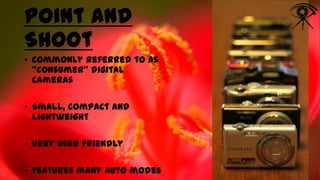
Point and
Shoot
• Commonly referred to as
“consumer” digital
cameras
• Small, compact and
lightweight
• Very user friendly
• Features many auto modes
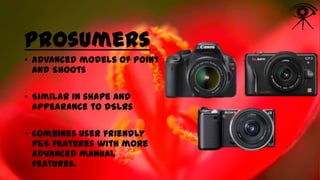
Prosumers
• Advanced models of Point
and Shoots
• Similar in shape and
appearance to dSLRs
• Combines user friendly
P&S features with more
advanced manual
features.
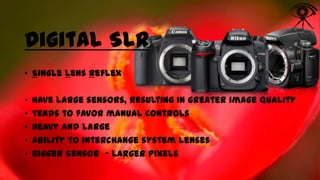
Digital SLR
• Single Lens Reflex
•
•
•
•
•

Have large sensors, resulting in greater image quality
Tends to favor manual controls
Heavy and large
Ability to interchange system lenses
Bigger Sensor - Larger Pixels
Are they really
different? Point and
dSLR

Shoot

• Image Quality – Less
grains due to bigger
pixels
• Adaptability – Variety of
interchangeable lenses
available
• Manual Controls
• Depth of Field
• Shooting in the Dark

• Grainy pictures due to
smaller pixels
• Will have to stick to the
lens you have bought
• Lacks manual controls
• Poor control over depth
of Field
• Difficulty in shooting in
the Dark
Styles of Photographs
The three basic categories of photographs
Landscape

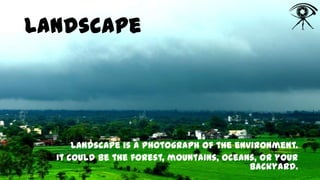
Landscape is a photograph of the environment.
It could be the forest, mountains, oceans, or your
backyard.
Portrait

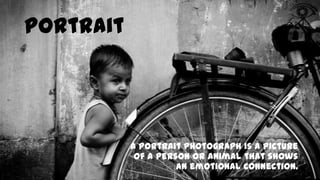
A portrait photograph is a picture
of a person or animal that shows
an emotional connection.
Documentary

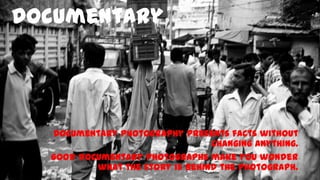
Documentary photography presents facts without
changing anything.
Good documentary photographs make you wonder
what the story is behind the photograph.
Some Major Genres
• Documentary/Documentation, Evidence
• Reportage, Photojournalism
• Narrative (can use any other genre)
• Landscape, Nature
• Portrait
• Family history and rituals, snapshots
• Street photography
• Studio and staged photographs
• Advertising
• Fashion
• Fantasy images, Surrealism
• Erotica, fetish, porn
Creating a Photograph
What all does it involve?
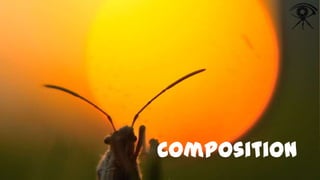
Composition
Light
Subject
Focus
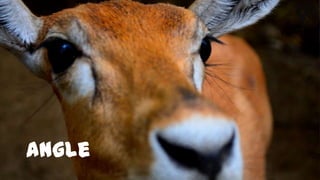
Angle
Composition
The basic rules
Creating the Mood
• Overall feel of a picture
• Created by
1.
2.
3.
4.

Perspective
Color
Focus (isolation and distance)
Weather and light
a) Sunrise/sunset
b) Misty, rainy days
c) Sun vs. overcast
Characteristics of a
good photo
• Shape
• Line
• Pattern
• Texture
• Size and space
Shape
• Tends to be noticed first, before texture
and pattern
• Easiest and most recognizable
composition tool
Shape helps create a mood/character for
the picture
Line
• Creates Shape, Pattern, Depth, Perspective
• Lines into the horizon show depth and
perspective for the viewer
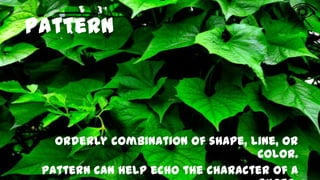
Pattern

Orderly combination of shape, line, or
color.
Pattern can help echo the character of a
Texture
• Adds realism (sense of touch)
• Sharp (hard) light highlights texture
• Especially important for close-up and
b/w shots
• Side lighting highlights texture
• Most portraits use front lighting to
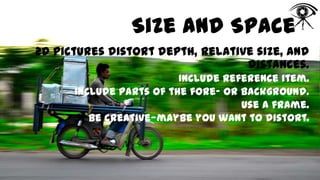
Size and Space
2D pictures distort depth, relative size, and
distances.
Include reference item.
Include parts of the fore- or background.
Use a frame.
Be creative—maybe you want to distort.
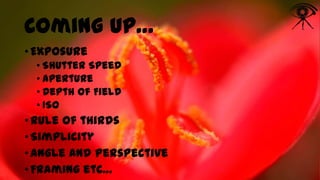
Coming up…
• Exposure
• Shutter Speed
• Aperture
• Depth of Field
• ISO

• Rule of thirds
• Simplicity
• Angle and perspective
• Framing etc…
THANK YOU

Introduction to Photography

  • 1.
  • 2.
    “You don't makea photograph just with a camera. You bring to the act of photography all the pictures you have seen, the books you have read, the music you have heard, the people you have loved.” ― Ansel Adams In photography there is a reality so subtle that it becomes more real than reality.
  • 3.
    Types of Cameras Dothey make any difference?
  • 4.
    Point and Shoot • Commonlyreferred to as “consumer” digital cameras • Small, compact and lightweight • Very user friendly • Features many auto modes
  • 5.
    Prosumers • Advanced modelsof Point and Shoots • Similar in shape and appearance to dSLRs • Combines user friendly P&S features with more advanced manual features.
  • 6.
    Digital SLR • SingleLens Reflex • • • • • Have large sensors, resulting in greater image quality Tends to favor manual controls Heavy and large Ability to interchange system lenses Bigger Sensor - Larger Pixels
  • 7.
    Are they really different?Point and dSLR Shoot • Image Quality – Less grains due to bigger pixels • Adaptability – Variety of interchangeable lenses available • Manual Controls • Depth of Field • Shooting in the Dark • Grainy pictures due to smaller pixels • Will have to stick to the lens you have bought • Lacks manual controls • Poor control over depth of Field • Difficulty in shooting in the Dark
  • 8.
    Styles of Photographs Thethree basic categories of photographs
  • 9.
    Landscape Landscape is aphotograph of the environment. It could be the forest, mountains, oceans, or your backyard.
  • 10.
    Portrait A portrait photographis a picture of a person or animal that shows an emotional connection.
  • 11.
    Documentary Documentary photography presentsfacts without changing anything. Good documentary photographs make you wonder what the story is behind the photograph.
  • 12.
    Some Major Genres •Documentary/Documentation, Evidence • Reportage, Photojournalism • Narrative (can use any other genre) • Landscape, Nature • Portrait • Family history and rituals, snapshots • Street photography • Studio and staged photographs • Advertising • Fashion • Fantasy images, Surrealism • Erotica, fetish, porn
  • 13.
    Creating a Photograph Whatall does it involve?
  • 14.
  • 15.
  • 16.
  • 17.
  • 18.
  • 19.
  • 20.
    Creating the Mood •Overall feel of a picture • Created by 1. 2. 3. 4. Perspective Color Focus (isolation and distance) Weather and light a) Sunrise/sunset b) Misty, rainy days c) Sun vs. overcast
  • 21.
    Characteristics of a goodphoto • Shape • Line • Pattern • Texture • Size and space
  • 22.
    Shape • Tends tobe noticed first, before texture and pattern • Easiest and most recognizable composition tool Shape helps create a mood/character for the picture
  • 23.
    Line • Creates Shape,Pattern, Depth, Perspective • Lines into the horizon show depth and perspective for the viewer
  • 24.
    Pattern Orderly combination ofshape, line, or color. Pattern can help echo the character of a
  • 25.
    Texture • Adds realism(sense of touch) • Sharp (hard) light highlights texture • Especially important for close-up and b/w shots • Side lighting highlights texture • Most portraits use front lighting to
  • 26.
    Size and Space 2Dpictures distort depth, relative size, and distances. Include reference item. Include parts of the fore- or background. Use a frame. Be creative—maybe you want to distort.
  • 27.
    Coming up… • Exposure •Shutter Speed • Aperture • Depth of Field • ISO • Rule of thirds • Simplicity • Angle and perspective • Framing etc…
  • 28.

Editor's Notes

  • #8 Each digital image is made from millions of tiny squares, known as pixels.Essentially, an image is recorded by tiny microlenses (pixels) which make up the cameras sensor Pixels are analog devices which record light and color data
  • #23 Creating Shape: Silhouette: the dark shape and outline of someone or something visible against a lighter background, esp. in dim light.Under Expose
  • #24 Vanishing pointPoint at which lines converge and vanish in to the horizonClose-ups decrease perspective while wide-angles can exaggerate it
  • #27 Aerial perspective—atmosphere creates haze, which lightens objects farther awayOverlapping forms—overlapping objects in a picture create depth and distanceSelective focusing—focusing on the foreground and blurring the background