Movie Technology
CGI
in
Presented By :
Soumyajit Adhya 2011-1038
 CGI stands for computer generated
imagery.
 It is the application of computer graphics
to create or contribute to images in art, printed
media, video games, films, television programs,
commercials, videos, and simulators.
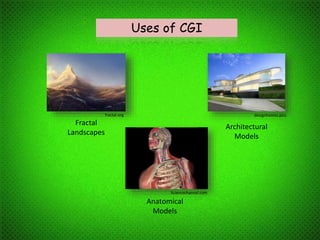
Uses of CGI
Fractal
Landscapes
Architectural
Models
Anatomical
Models
fractal.org designhomes.pics
Sciencechannel.com
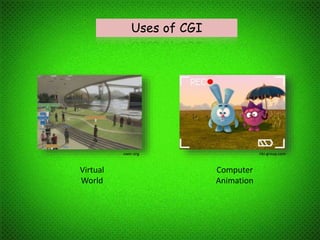
Uses of CGI
Virtual
World
Computer
Animation
vwer.org riki-group.com
CGI is used in movies in many ways.
All kinds of visual effects and animations are kinds of
computer generated imagery.
CGI can easily implement some virtual scenes which may
not possible in reality to get.
CGI & Science fiction go hand in hand.
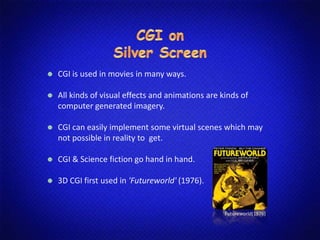
3D CGI first used in 'Futureworld' (1976).
Futureworld(1976)
There are two kinds of uses of CGI in the course of movie
technology
Realistic CGI
Physical Realism,
Photo Realism,
Functional Realism.
Realistic animation
2D Animation,
3D Animation.
Three mainly used methods for animation are
Tweening – Morphing – Rendering.
 Physical Realism
In which the image provides
the same visual stimulation as the
scene.
The image is almost accurate
as a human holding a drawing of a
cartoon. This can introduce a
feelings of reality in human mind. The Adventures of Tintin(2011)
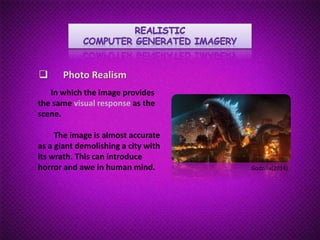
 Photo Realism
In which the image provides
the same visual response as the
scene.
The image is almost accurate
as a giant demolishing a city with
its wrath. This can introduce
horror and awe in human mind. Godzilla(2014)
 Functional Realism
In which the image provides
the same visual information as
the scene.
The image shows that an
astronaut floating in the space.
This can elaborate the scene of
outer space and the view of earth
from space.
Gravity(2014)
 Computer Animation only refers to moving images.
 Digital successor to Stop Motion Techniques.
 Though animation is vastly classified in two parts a) 2D-Animation,
& b) 3D-Animation.
 But most popularly used by three methods Tweening – Morphing
– Rendering.
 Tweening and morphing is used as 2D-Animation and Rendering is
used as 3D-Animation.
 2D-Animation
2D-Animation figures are
created and/or edited on the
computer using 2D bitmap
graphics or created and edited
using 2D vector graphics.
This is the kind of traditional animation technique using paper drawings,
later it is adopted with the computer to make it more realistic. This version is
known as Digital 2D-Animation. Used softwares are Toon Boom Studio, Adobe
After Effects etc.
s3images.coroflot.com
 3D-Animation
3D animation is digitally modeled
and manipulated by an animator. The
animator usually starts by creating a
3D polygon mesh to manipulate. A mesh
typically includes many vertices that are
associated by edges and faces, to give
the visual appearance of form to a 3D
object or 3D environment.
Used softwares are Autodesk
Maya, Adobe Photoshop etc.
animationinsider.com
Other popular methods are as follows…
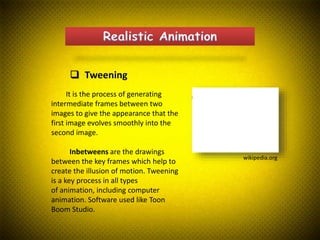
 Tweening
wikipedia.org
It is the process of generating
intermediate frames between two
images to give the appearance that the
first image evolves smoothly into the
second image.
Inbetweens are the drawings
between the key frames which help to
create the illusion of motion. Tweening
is a key process in all types
of animation, including computer
animation. Software used like Toon
Boom Studio.
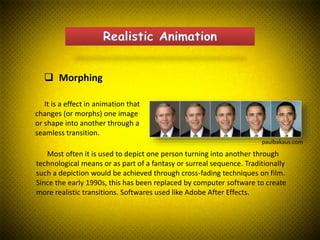
 Morphing
paulbakaus.com
It is a effect in animation that
changes (or morphs) one image
or shape into another through a
seamless transition.
Most often it is used to depict one person turning into another through
technological means or as part of a fantasy or surreal sequence. Traditionally
such a depiction would be achieved through cross-fading techniques on film.
Since the early 1990s, this has been replaced by computer software to create
more realistic transitions. Softwares used like Adobe After Effects.
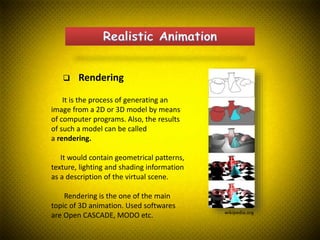
 Rendering
wikipedia.org
It is the process of generating an
image from a 2D or 3D model by means
of computer programs. Also, the results
of such a model can be called
a rendering.
It would contain geometrical patterns,
texture, lighting and shading information
as a description of the virtual scene.
Rendering is the one of the main
topic of 3D animation. Used softwares
are Open CASCADE, MODO etc.
 Motion Capture
Motion capture (Mo-
cap for short) is the process of
recording the movement of
objects or people.
It is mainly used in
game development but these
days it is the most popular CGI
method used in movie
technology.
nward.com
 Much more detailed realism in world of animation.
 Hyper-realistic CGI : These days it itself become a course
of study and experimentation.
 The world of movie maniacs are trending towards more
virtuality and sci-fi movies which is unbiased focused on
3D CGI techniques can lead us to Virtual Reality.
 Though 3D-Animation is advancing tremendously, there
is no question of forgetting 2D-Animation cause some
traditional studios like Disney, Dreamworks are still
focused on it.
 As the technologies are evolving, the techniques and
uses of CGI is changing too. So we can keep expecting
more new techniques in the sector of computer generated
imagery.
CGI technology in movie

CGI technology in movie

  • 1.
    Movie Technology CGI in Presented By: Soumyajit Adhya 2011-1038
  • 2.
     CGI standsfor computer generated imagery.  It is the application of computer graphics to create or contribute to images in art, printed media, video games, films, television programs, commercials, videos, and simulators.
  • 3.
  • 4.
  • 5.
    CGI is usedin movies in many ways. All kinds of visual effects and animations are kinds of computer generated imagery. CGI can easily implement some virtual scenes which may not possible in reality to get. CGI & Science fiction go hand in hand. 3D CGI first used in 'Futureworld' (1976). Futureworld(1976)
  • 6.
    There are twokinds of uses of CGI in the course of movie technology Realistic CGI Physical Realism, Photo Realism, Functional Realism. Realistic animation 2D Animation, 3D Animation. Three mainly used methods for animation are Tweening – Morphing – Rendering.
  • 7.
     Physical Realism Inwhich the image provides the same visual stimulation as the scene. The image is almost accurate as a human holding a drawing of a cartoon. This can introduce a feelings of reality in human mind. The Adventures of Tintin(2011)
  • 8.
     Photo Realism Inwhich the image provides the same visual response as the scene. The image is almost accurate as a giant demolishing a city with its wrath. This can introduce horror and awe in human mind. Godzilla(2014)
  • 9.
     Functional Realism Inwhich the image provides the same visual information as the scene. The image shows that an astronaut floating in the space. This can elaborate the scene of outer space and the view of earth from space. Gravity(2014)
  • 10.
     Computer Animationonly refers to moving images.  Digital successor to Stop Motion Techniques.  Though animation is vastly classified in two parts a) 2D-Animation, & b) 3D-Animation.  But most popularly used by three methods Tweening – Morphing – Rendering.  Tweening and morphing is used as 2D-Animation and Rendering is used as 3D-Animation.
  • 11.
     2D-Animation 2D-Animation figuresare created and/or edited on the computer using 2D bitmap graphics or created and edited using 2D vector graphics. This is the kind of traditional animation technique using paper drawings, later it is adopted with the computer to make it more realistic. This version is known as Digital 2D-Animation. Used softwares are Toon Boom Studio, Adobe After Effects etc. s3images.coroflot.com
  • 12.
     3D-Animation 3D animationis digitally modeled and manipulated by an animator. The animator usually starts by creating a 3D polygon mesh to manipulate. A mesh typically includes many vertices that are associated by edges and faces, to give the visual appearance of form to a 3D object or 3D environment. Used softwares are Autodesk Maya, Adobe Photoshop etc. animationinsider.com Other popular methods are as follows…
  • 13.
     Tweening wikipedia.org It isthe process of generating intermediate frames between two images to give the appearance that the first image evolves smoothly into the second image. Inbetweens are the drawings between the key frames which help to create the illusion of motion. Tweening is a key process in all types of animation, including computer animation. Software used like Toon Boom Studio.
  • 14.
     Morphing paulbakaus.com It isa effect in animation that changes (or morphs) one image or shape into another through a seamless transition. Most often it is used to depict one person turning into another through technological means or as part of a fantasy or surreal sequence. Traditionally such a depiction would be achieved through cross-fading techniques on film. Since the early 1990s, this has been replaced by computer software to create more realistic transitions. Softwares used like Adobe After Effects.
  • 15.
     Rendering wikipedia.org It isthe process of generating an image from a 2D or 3D model by means of computer programs. Also, the results of such a model can be called a rendering. It would contain geometrical patterns, texture, lighting and shading information as a description of the virtual scene. Rendering is the one of the main topic of 3D animation. Used softwares are Open CASCADE, MODO etc.
  • 16.
     Motion Capture Motioncapture (Mo- cap for short) is the process of recording the movement of objects or people. It is mainly used in game development but these days it is the most popular CGI method used in movie technology. nward.com
  • 17.
     Much moredetailed realism in world of animation.  Hyper-realistic CGI : These days it itself become a course of study and experimentation.  The world of movie maniacs are trending towards more virtuality and sci-fi movies which is unbiased focused on 3D CGI techniques can lead us to Virtual Reality.  Though 3D-Animation is advancing tremendously, there is no question of forgetting 2D-Animation cause some traditional studios like Disney, Dreamworks are still focused on it.  As the technologies are evolving, the techniques and uses of CGI is changing too. So we can keep expecting more new techniques in the sector of computer generated imagery.