Recent Advances in Motion Capture Aswathi Suresh
Contents Introduction History of motion capture Key frame Animation Vs Motion Capture Technology Applications Advantages Conclusion References
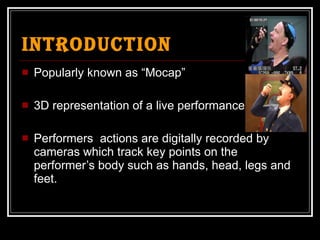
Introduction Popularly known as “Mocap” 3D representation of a live performance Performers  actions are digitally recorded by cameras which track key points on the performer’s body such as hands, head, legs and feet.
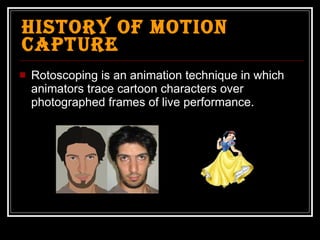
History of motion capture Rotoscoping is an animation technique in which animators trace cartoon characters over photographed frames of live performance.
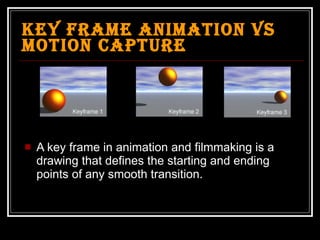
Key frame Animation Vs Motion Capture A key frame in animation and filmmaking is a drawing that defines the starting and ending points of any smooth transition.
Facial work primarily depend on key frame animation. Body movements and for quicker actions, one largely use mocap. The amount of work does not vary with the complexity of the sequence. Using mocap, a single actor can play multiple characters in the same film.
Technology Behind Motion Capture Mechanical Motion Capture Optical Motion Capture Magnetic Motion Capture
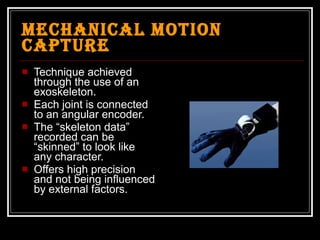
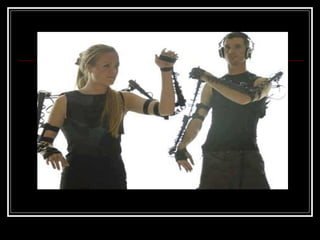
Mechanical Motion Capture Technique achieved through the use of an exoskeleton. Each joint is connected to an angular encoder. The “skeleton data” recorded can be “skinned” to look like any character.  Offers high precision and not being influenced by external factors.
 
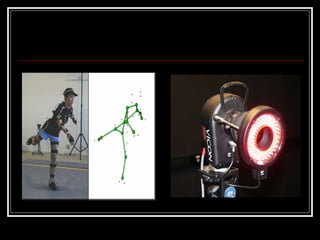
Optical Motion Capture Optical shooting with several synchronised cameras The cameras emit radiation reflected by the markers and then returned to the same cameras. The markers will be viewed as white spots and the position in virtual space can be determined.
 
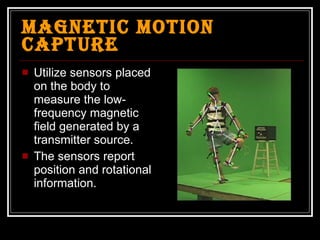
Magnetic Motion Capture Utilize sensors placed on the body to measure the low-frequency magnetic field generated by a transmitter source. The sensors report position and rotational information.
Applications Entertainment Medicine Sports
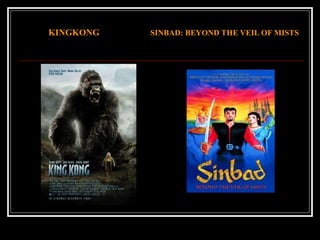
Entertainment Motion capture represents the future of digital content creation.  Film, television and interactive media all use motion capture in a growing number of its productions. In the game industry, manufacturers are using motion capture systems.
KINGKONG  SINBAD: BEYOND THE VEIL OF MISTS
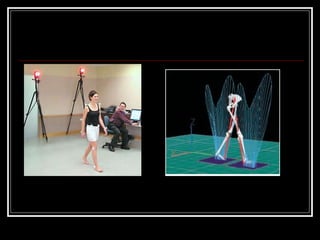
Medicine Gait analysis is the major application of motion capture in clinical medicine. Motion capture allows clinicians to evaluate human motion, without burdening patients with body suits or tracking devices.
 
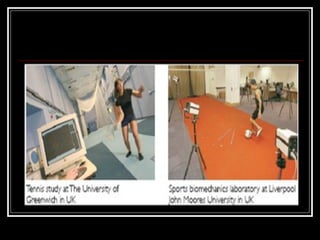
Sports Motion capture is ideal for a wide range of sports applications in research, rehabilitation, physical education and practice. Also allows to learn more about injury mechanisms and prevention.
 
advantages More rapid, sometimes even real time results can be obtained. Complex movement and realistic physical interactions can be recreated in a physically accurate manner. Costumes, make-up, body size and age can be changed to whatever is needed. The versatility and flexibility of the mocap system makes it suitable for many applications within psychology.
 
Conclusion The purpose of these technologies is to allow us to create characters and effects that we could not do before, and do it more realistically and efficiently than ever before. They allow us to create and interact with virtual worlds and blend the lines between reality and fantasy. Motion capture tools are becoming more flexible and more powerful these days.
References Rastegari,M.; Gheissari,N Multi-scale Cartoon Motion Capture and Retargeting without Shape Matching Computing; techniques and Applications,2008, Dec.2008. Maureen Furniss. Motion Capture. Available from URL:  http://web.mit.edu David J. Sturman. A Brief History of motion capture for computer Character Animation. Available from URL:  http://www.siggraph.org Available from URL:  http://www.metamotion.com Available from URL:  http://www.postmagazine.com
 

Motion Capture

  • 1.
    Recent Advances inMotion Capture Aswathi Suresh
  • 2.
    Contents Introduction Historyof motion capture Key frame Animation Vs Motion Capture Technology Applications Advantages Conclusion References
  • 3.
    Introduction Popularly knownas “Mocap” 3D representation of a live performance Performers actions are digitally recorded by cameras which track key points on the performer’s body such as hands, head, legs and feet.
  • 4.
    History of motioncapture Rotoscoping is an animation technique in which animators trace cartoon characters over photographed frames of live performance.
  • 5.
    Key frame AnimationVs Motion Capture A key frame in animation and filmmaking is a drawing that defines the starting and ending points of any smooth transition.
  • 6.
    Facial work primarilydepend on key frame animation. Body movements and for quicker actions, one largely use mocap. The amount of work does not vary with the complexity of the sequence. Using mocap, a single actor can play multiple characters in the same film.
  • 7.
    Technology Behind MotionCapture Mechanical Motion Capture Optical Motion Capture Magnetic Motion Capture
  • 8.
    Mechanical Motion CaptureTechnique achieved through the use of an exoskeleton. Each joint is connected to an angular encoder. The “skeleton data” recorded can be “skinned” to look like any character. Offers high precision and not being influenced by external factors.
  • 9.
  • 10.
    Optical Motion CaptureOptical shooting with several synchronised cameras The cameras emit radiation reflected by the markers and then returned to the same cameras. The markers will be viewed as white spots and the position in virtual space can be determined.
  • 11.
  • 12.
    Magnetic Motion CaptureUtilize sensors placed on the body to measure the low-frequency magnetic field generated by a transmitter source. The sensors report position and rotational information.
  • 13.
  • 14.
    Entertainment Motion capturerepresents the future of digital content creation. Film, television and interactive media all use motion capture in a growing number of its productions. In the game industry, manufacturers are using motion capture systems.
  • 15.
    KINGKONG SINBAD:BEYOND THE VEIL OF MISTS
  • 16.
    Medicine Gait analysisis the major application of motion capture in clinical medicine. Motion capture allows clinicians to evaluate human motion, without burdening patients with body suits or tracking devices.
  • 17.
  • 18.
    Sports Motion captureis ideal for a wide range of sports applications in research, rehabilitation, physical education and practice. Also allows to learn more about injury mechanisms and prevention.
  • 19.
  • 20.
    advantages More rapid,sometimes even real time results can be obtained. Complex movement and realistic physical interactions can be recreated in a physically accurate manner. Costumes, make-up, body size and age can be changed to whatever is needed. The versatility and flexibility of the mocap system makes it suitable for many applications within psychology.
  • 21.
  • 22.
    Conclusion The purposeof these technologies is to allow us to create characters and effects that we could not do before, and do it more realistically and efficiently than ever before. They allow us to create and interact with virtual worlds and blend the lines between reality and fantasy. Motion capture tools are becoming more flexible and more powerful these days.
  • 23.
    References Rastegari,M.; Gheissari,NMulti-scale Cartoon Motion Capture and Retargeting without Shape Matching Computing; techniques and Applications,2008, Dec.2008. Maureen Furniss. Motion Capture. Available from URL: http://web.mit.edu David J. Sturman. A Brief History of motion capture for computer Character Animation. Available from URL: http://www.siggraph.org Available from URL: http://www.metamotion.com Available from URL: http://www.postmagazine.com
  • 24.