Dr. Fintan Bracken
Librarian, Research Services & Bibliometrics
University of Limerick
Introduction to Metrics and
Impact Tracking
Inbhear: Publishing and Disseminating Arts and Humanities Research
19th January 2017
Presentation Outline
• What is Impact?
• Assessing Research Impact
• Maximising Your Research Impact
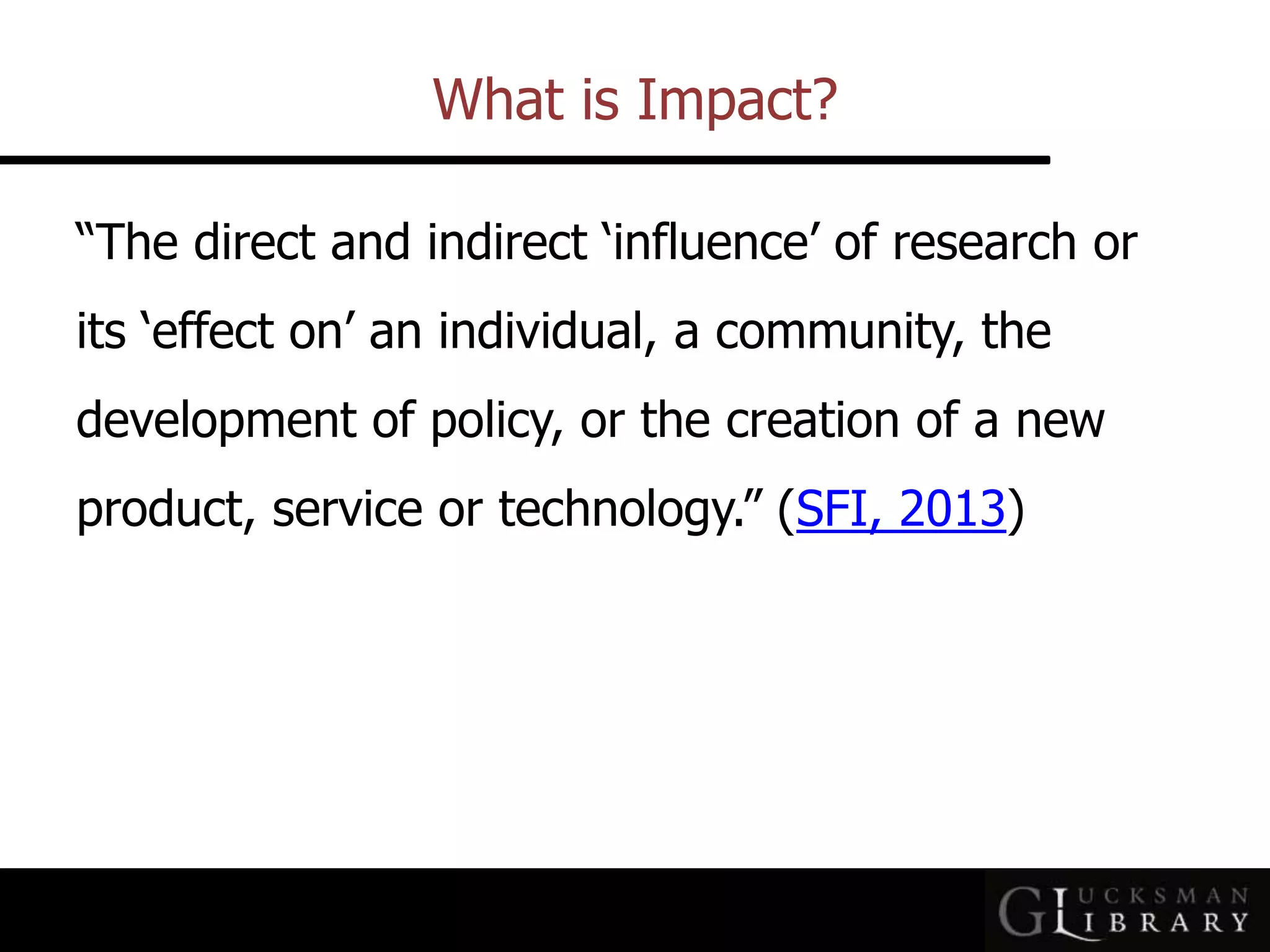
What is Impact?
“The direct and indirect ‘influence’ of research or
its ‘effect on’ an individual, a community, the
development of policy, or the creation of a new
product, service or technology.” (SFI, 2013)
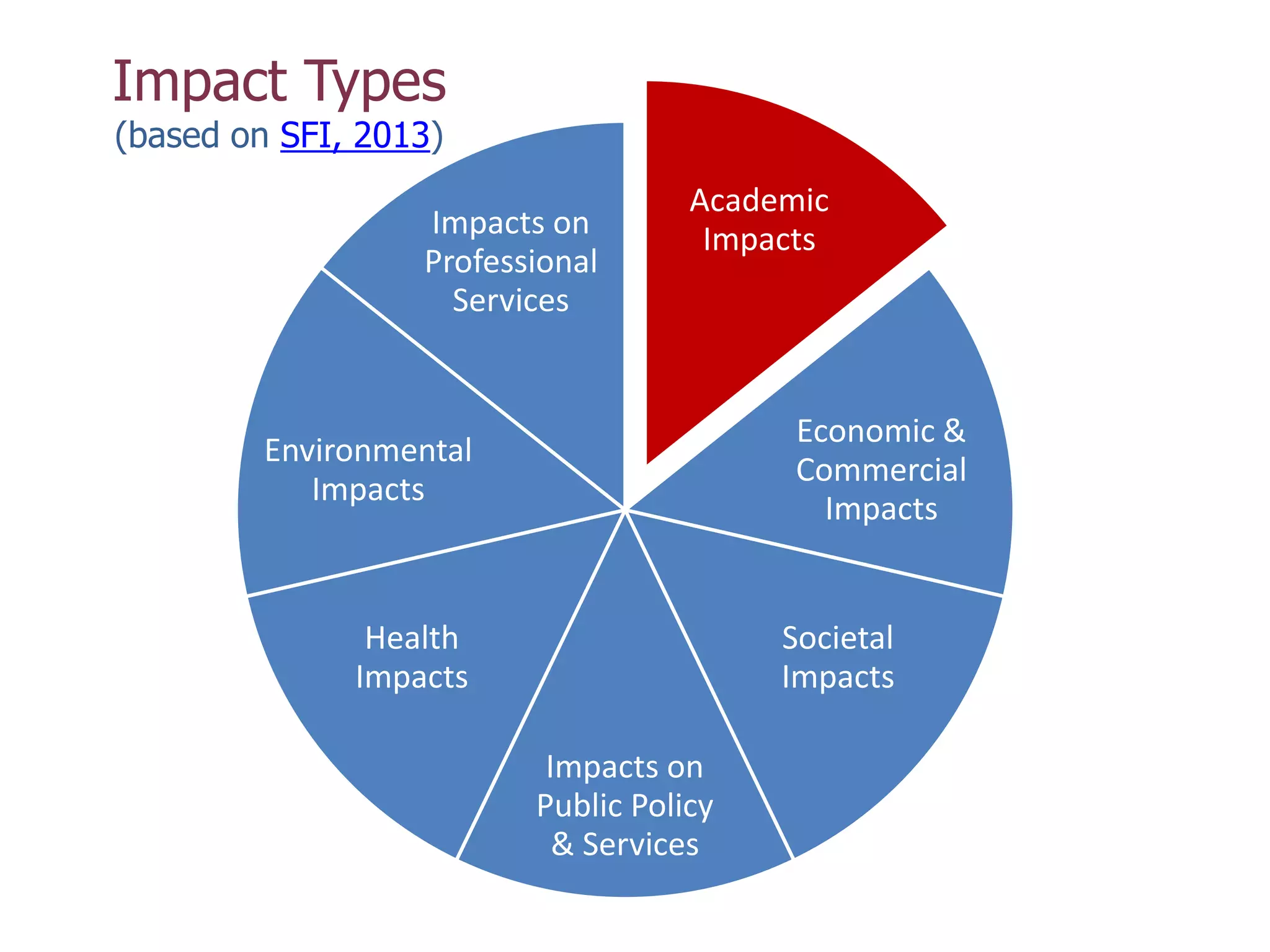
Academic
Impacts
Economic &
Commercial
Impacts
Societal
Impacts
Impacts on
Public Policy
& Services
Health
Impacts
Environmental
Impacts
Impacts on
Professional
Services
Impact Types
(based on SFI, 2013)
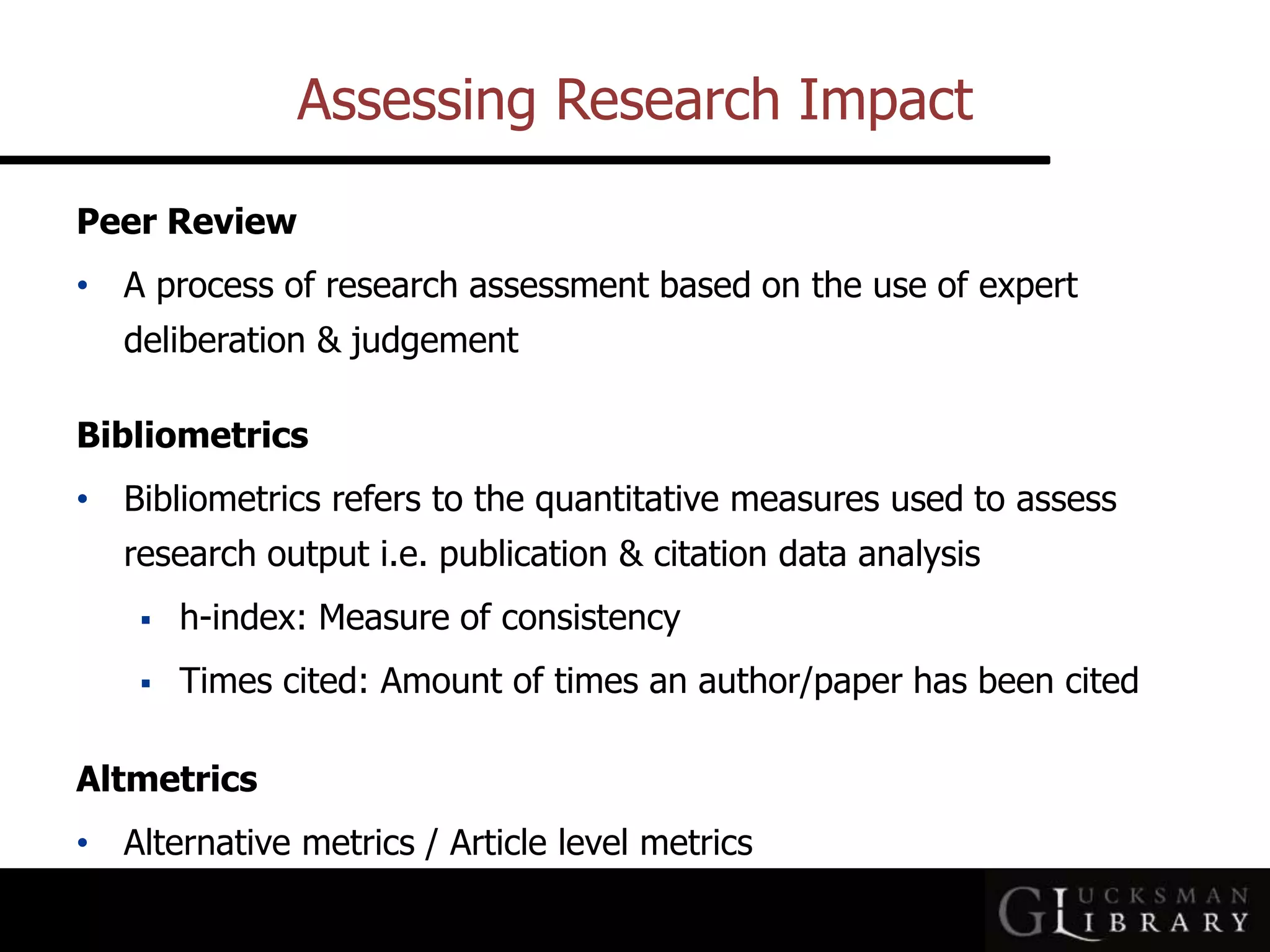
Assessing Research Impact
Peer Review
• A process of research assessment based on the use of expert
deliberation & judgement
Bibliometrics
• Bibliometrics refers to the quantitative measures used to assess
research output i.e. publication & citation data analysis
 h-index: Measure of consistency
 Times cited: Amount of times an author/paper has been cited
Altmetrics
• Alternative metrics / Article level metrics
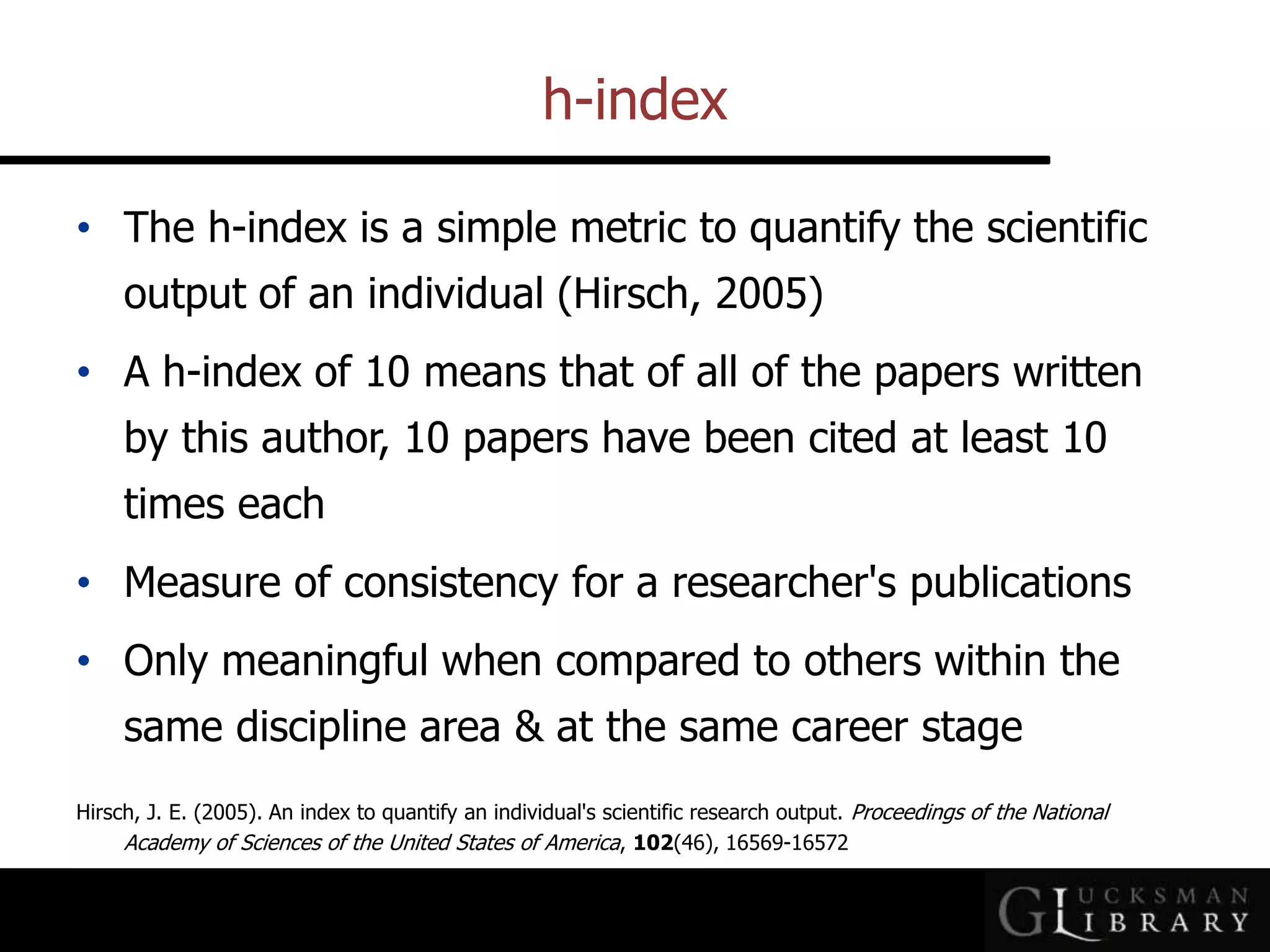
h-index
• The h-index is a simple metric to quantify the scientific
output of an individual (Hirsch, 2005)
• A h-index of 10 means that of all of the papers written
by this author, 10 papers have been cited at least 10
times each
• Measure of consistency for a researcher's publications
• Only meaningful when compared to others within the
same discipline area & at the same career stage
Hirsch, J. E. (2005). An index to quantify an individual's scientific research output. Proceedings of the National
Academy of Sciences of the United States of America, 102(46), 16569-16572
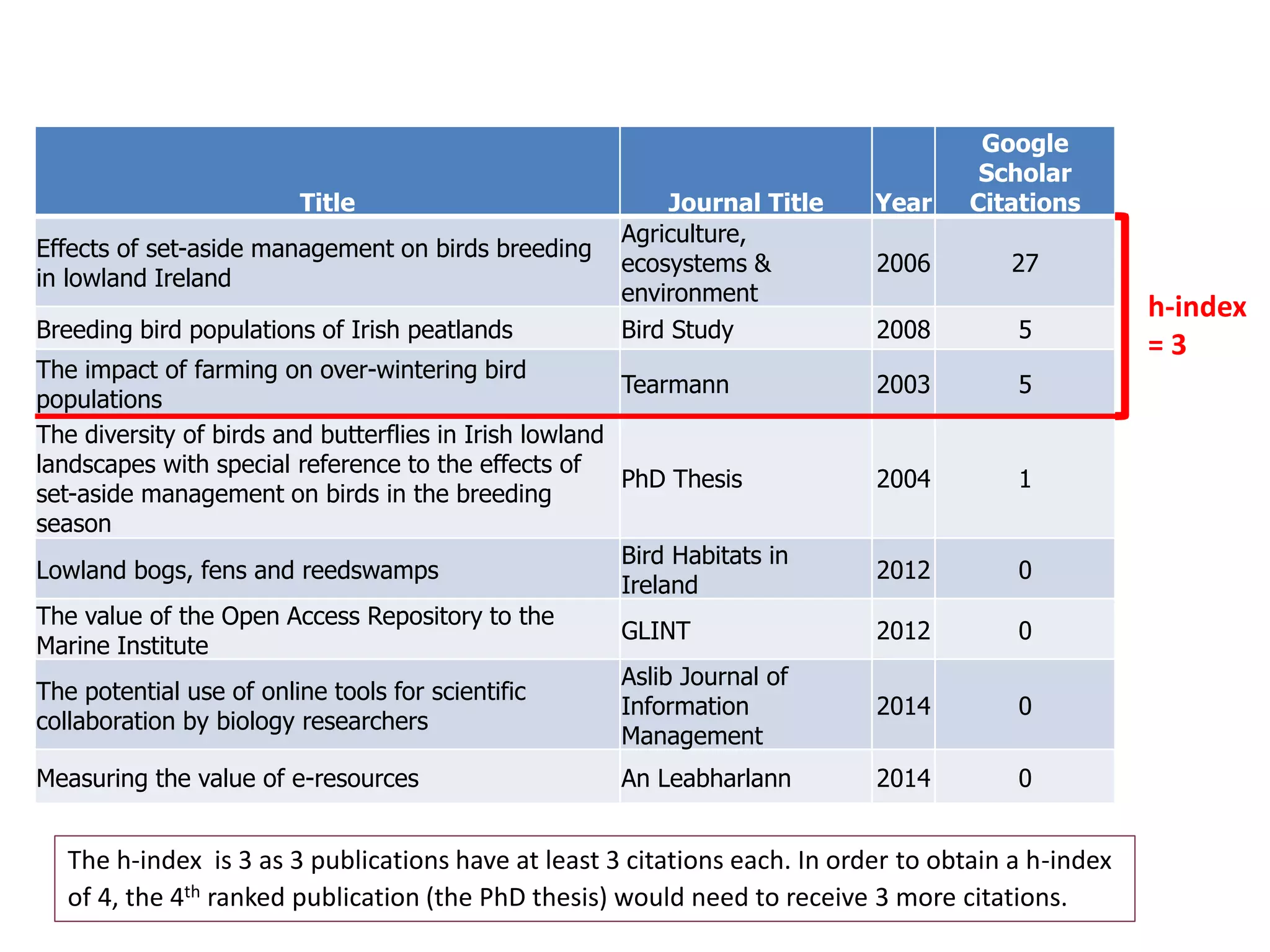
Title Journal Title Year
Google
Scholar
Citations
Effects of set-aside management on birds breeding
in lowland Ireland
Agriculture,
ecosystems &
environment
2006 27
Breeding bird populations of Irish peatlands Bird Study 2008 5
The impact of farming on over-wintering bird
populations
Tearmann 2003 5
The diversity of birds and butterflies in Irish lowland
landscapes with special reference to the effects of
set-aside management on birds in the breeding
season
PhD Thesis 2004 1
Lowland bogs, fens and reedswamps
Bird Habitats in
Ireland
2012 0
The value of the Open Access Repository to the
Marine Institute
GLINT 2012 0
The potential use of online tools for scientific
collaboration by biology researchers
Aslib Journal of
Information
Management
2014 0
Measuring the value of e-resources An Leabharlann 2014 0
h-index
= 3
The h-index is 3 as 3 publications have at least 3 citations each. In order to obtain a h-index
of 4, the 4th ranked publication (the PhD thesis) would need to receive 3 more citations.
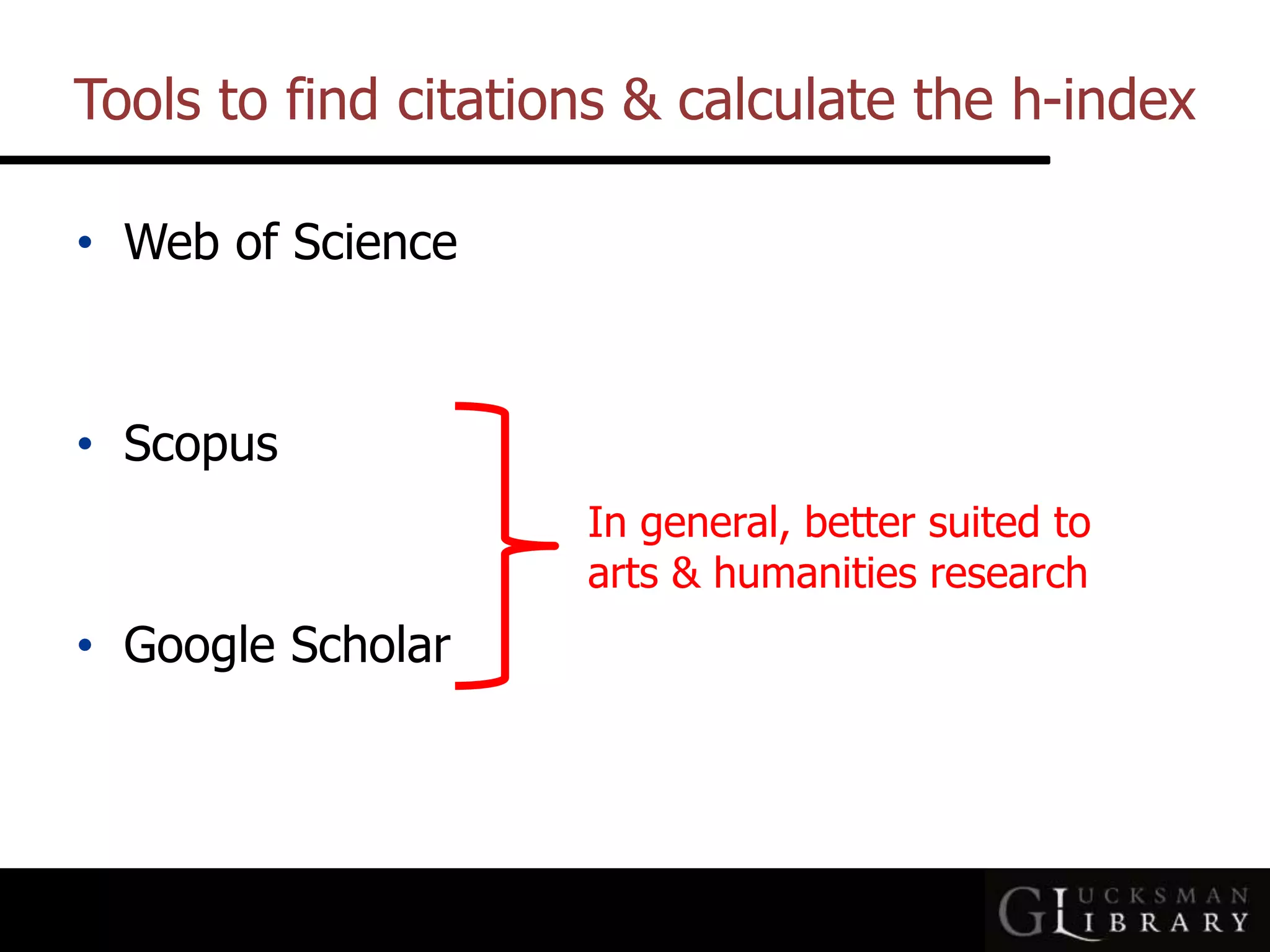
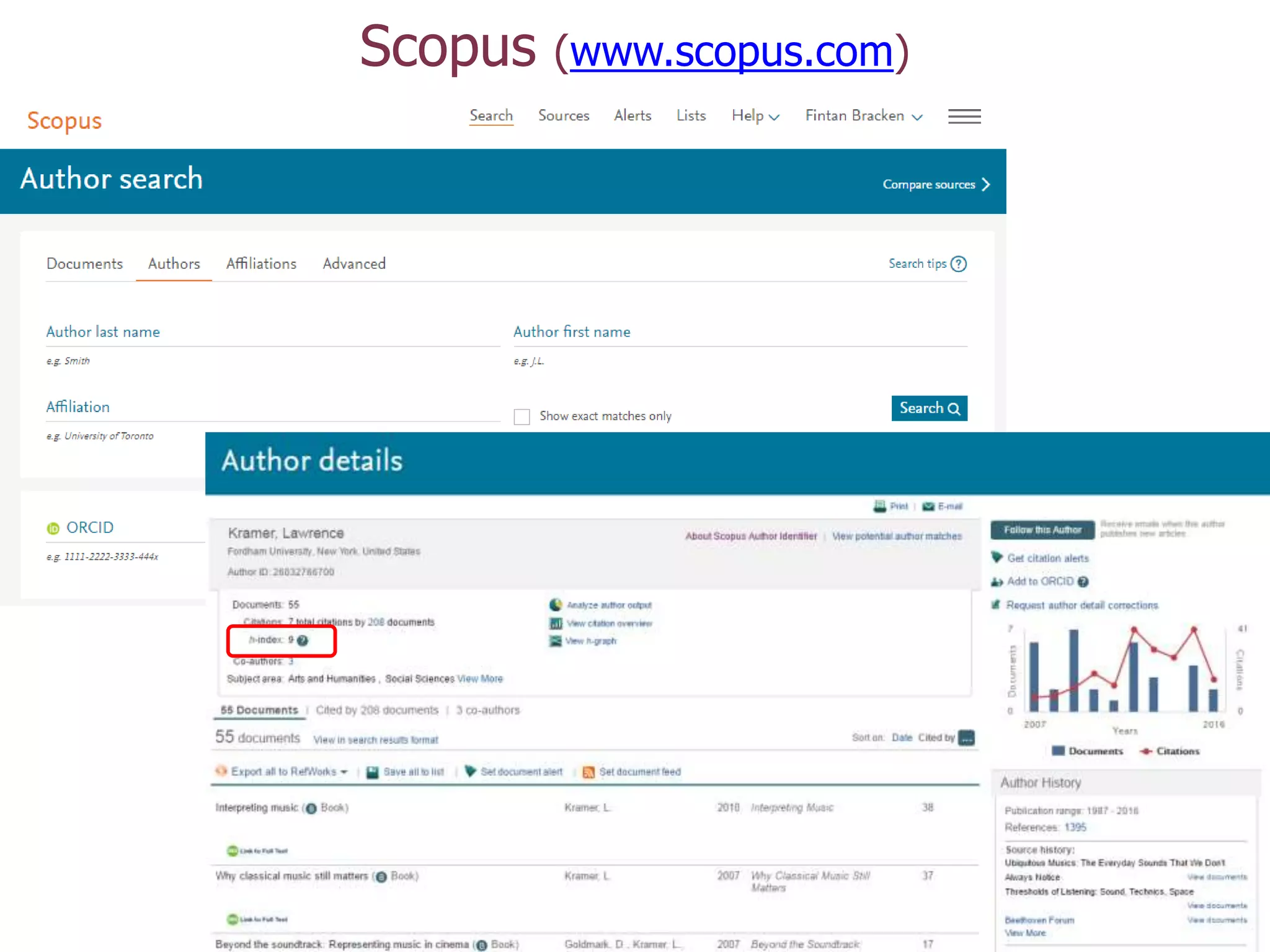
Tools to find citations & calculate the h-index
• Web of Science
• Scopus
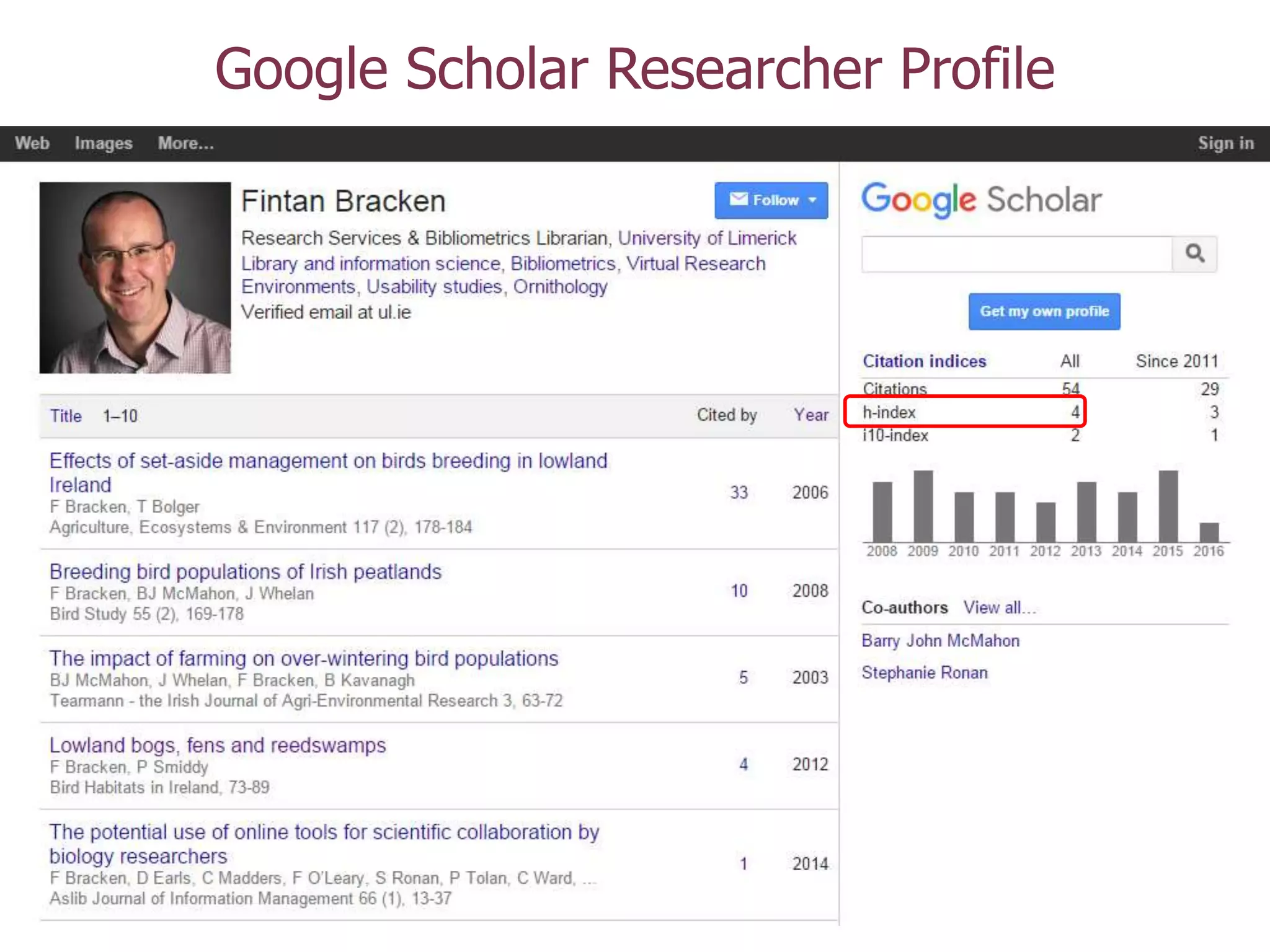
• Google Scholar
In general, better suited to
arts & humanities research
Scopus (www.scopus.com)
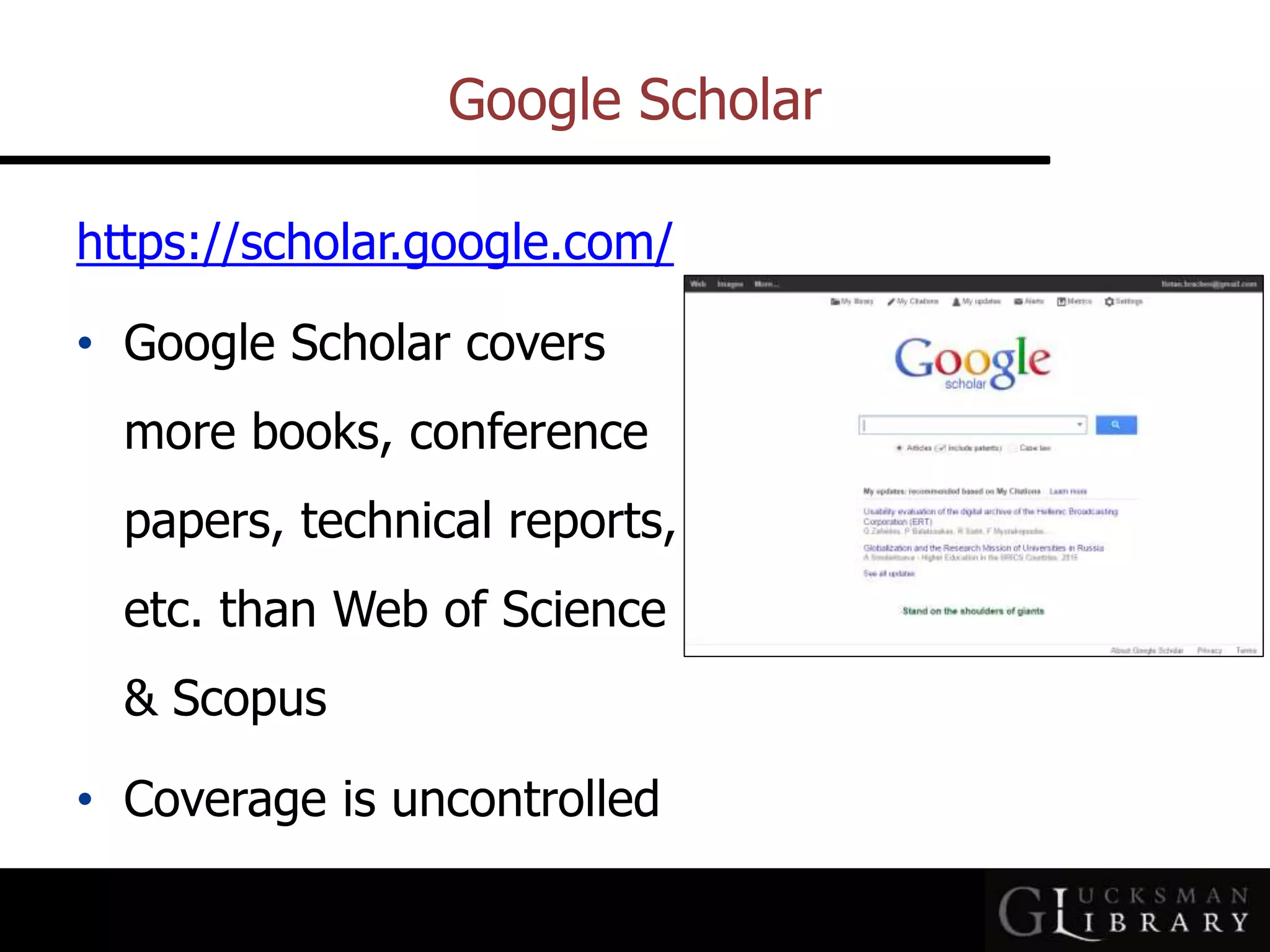
Google Scholar
https://scholar.google.com/
• Google Scholar covers
more books, conference
papers, technical reports,
etc. than Web of Science
& Scopus
• Coverage is uncontrolled
Google Scholar Researcher Profile
Altmetrics
• Altmetrics are measures that capture the attention a resource
generates on the social web or other sources.
• They can be applied to journal articles, books / book chapters,
software, datasets, websites, videos, etc.
• Altmetrics attempt to show influence and engagement of work
through blogs, reference management systems, scholarly social
networks, & other platforms.
• Altmetrics aim is to provide a more comprehensive picture of
scholarly activity & of the use & impact of a researcher's work.
Potential of Altmetrics in:
• Providing real-time indicators of impact
• Capturing ‘practitioner’ impact of those who may
never publish
• Showing evidence of public engagement
• Being an indicator for future citations?
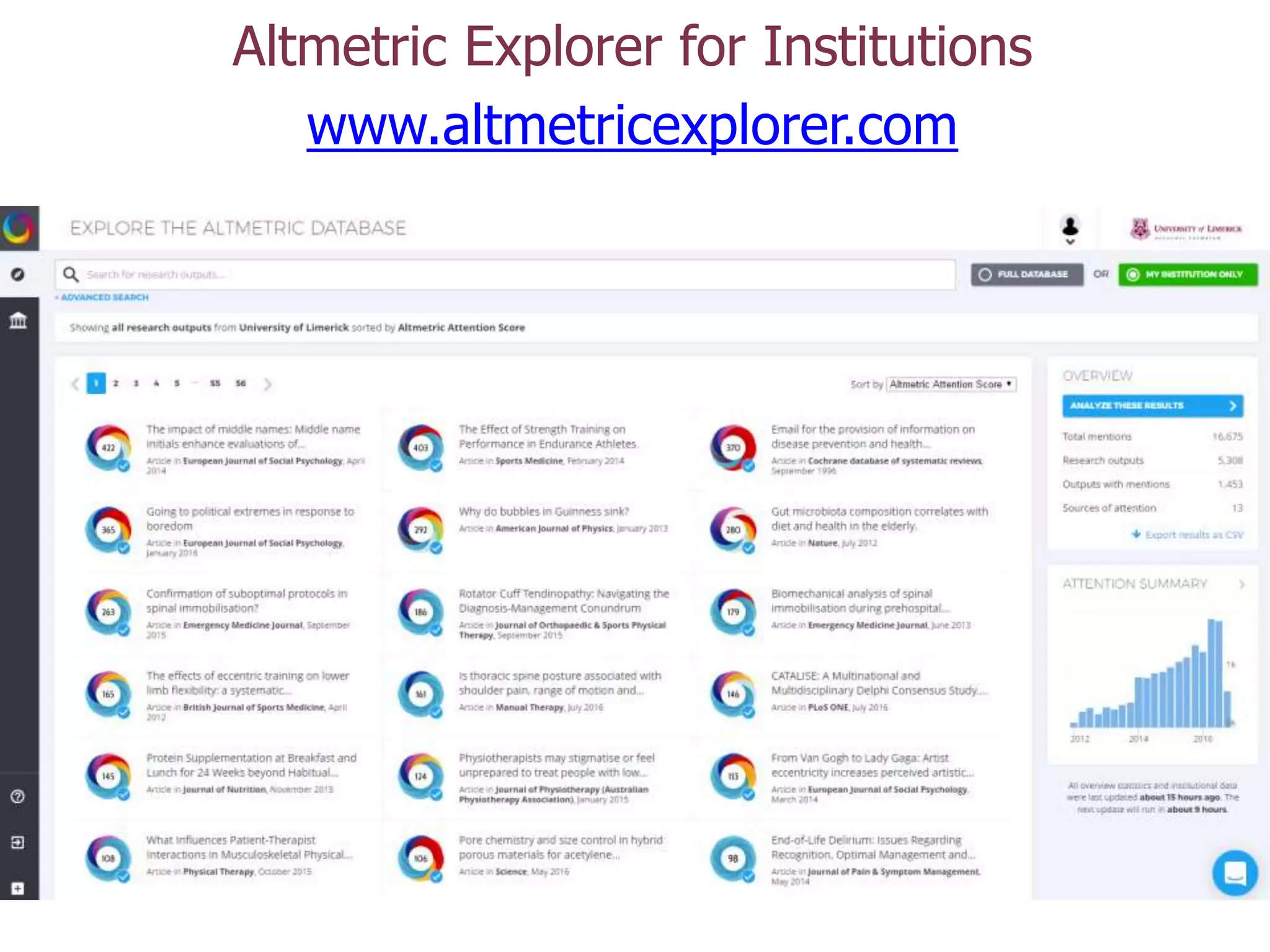
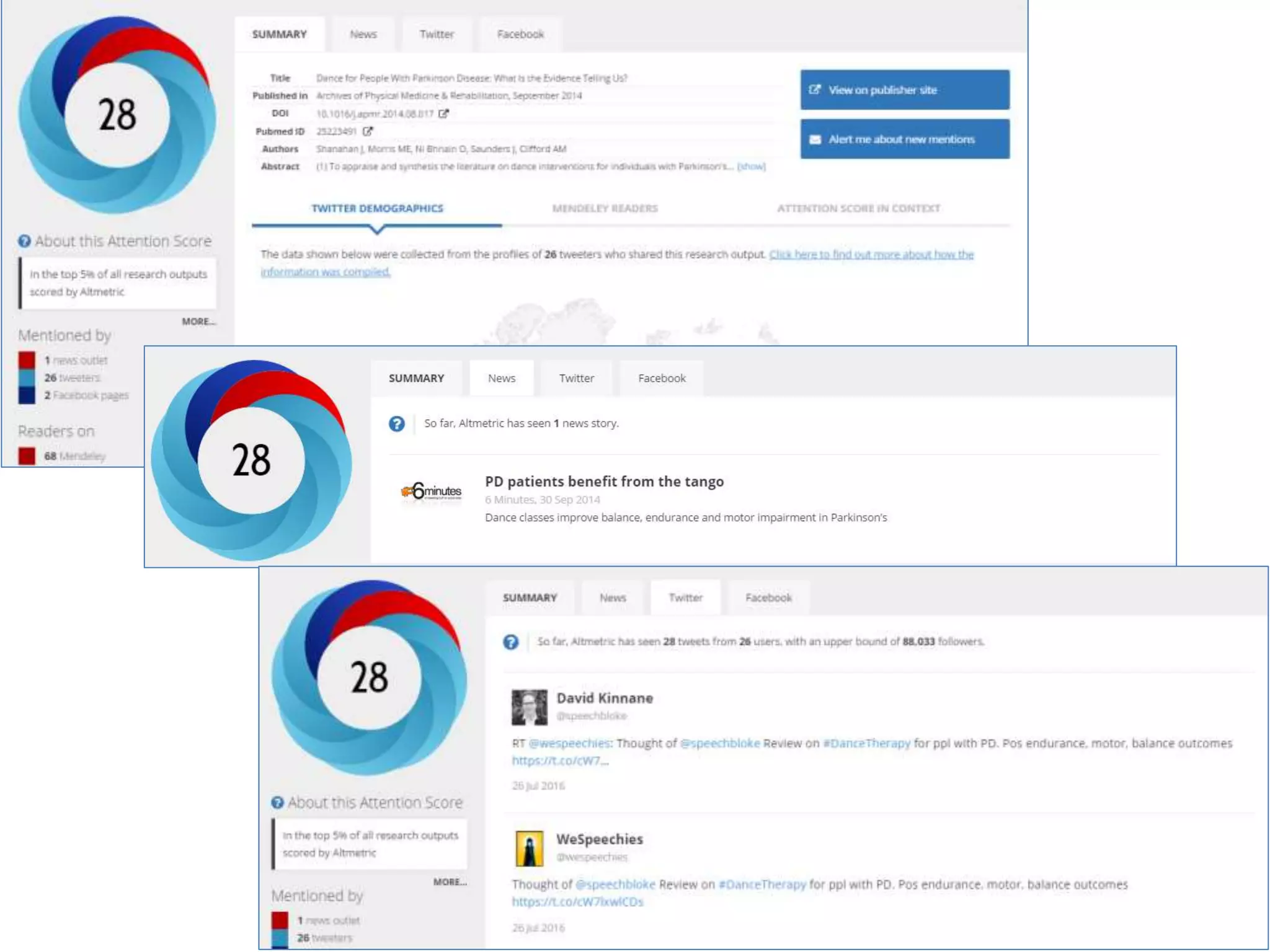
Altmetric Explorer for Institutions
www.altmetricexplorer.com
Other Places to Find Altmetrics
• Impactstory (http://impactstory.org/)
• Plum Analytics
(http://www.plumanalytics.com/)
• Individual journals & publishers
• Scopus
What you can do?
• Communicate & promote your research online: Twitter,
blogs, etc
• When talking online about your new publication include
the doi (digital object identifier) instead of the normal
publisher’s URL to ensure it is picked up by altmetrics
• A doi looks something like this: 10.1038/nature13684
• Add http://dx.doi.org/ in front of the doi to convert it
to a clickable URL e.g. http://dx.doi.org/10.1038/nature1368
Other Data to Showcase Your Research Impact
• Downloads / views of publications from
institutional repositories (if available)
• Download statistics for datasets / e-books /
Slideshare presentations / YouTube videos
• Reviews of books or book chapters
• Book sales
• Library Holdings (http://www.worldcat.org/)
Maximising Your Research Impact
1. Publish in high impact journals
2. Collaborate with other researchers
3. Ensure research is easily identifiable
4. Increase the visibility of research outputs
5. Communicate & promote research outputs
1. Publish in High Impact Journals
• If possible, when trying to publish a journal article, try to
publish in journals included in Web of Science or Scopus
• Impact factor type metrics (e.g. SJR) should be used as
a guide to selecting high impact journals
• You should consult with your peers & check that the
scope of the journal matches your article topic before
submitting to a journal
• Publishing in high impact journals does not guarantee
that an article will receive high citations
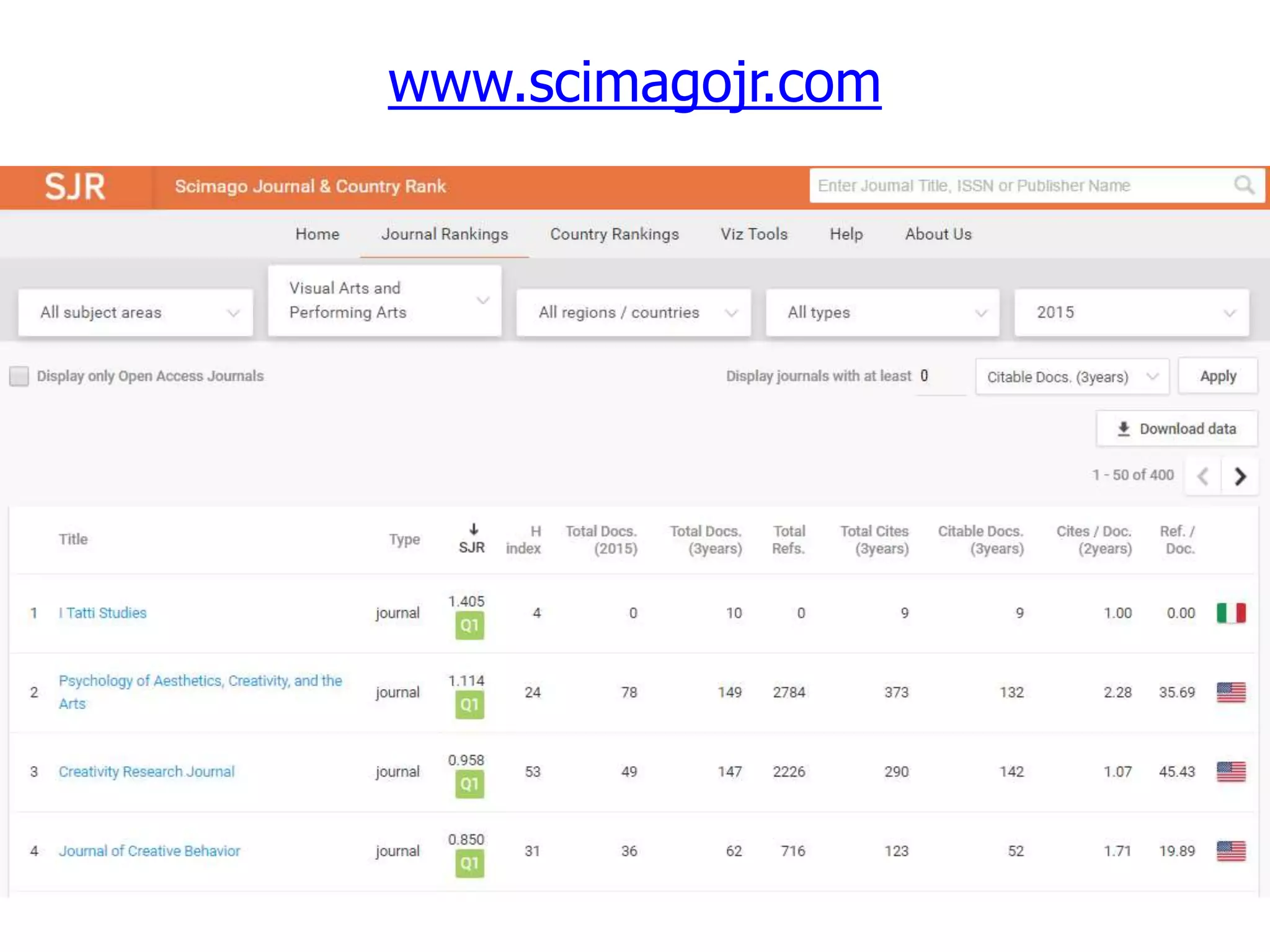
SCImago Journal Rank (SJR)
• Freely available on the web & via Scopus
• Uses Scopus dataset & Google PageRank™
algorithm
• SJR gives higher weight to citations from high
impact journals
• Calculated over a 3 year period
www.scimagojr.com
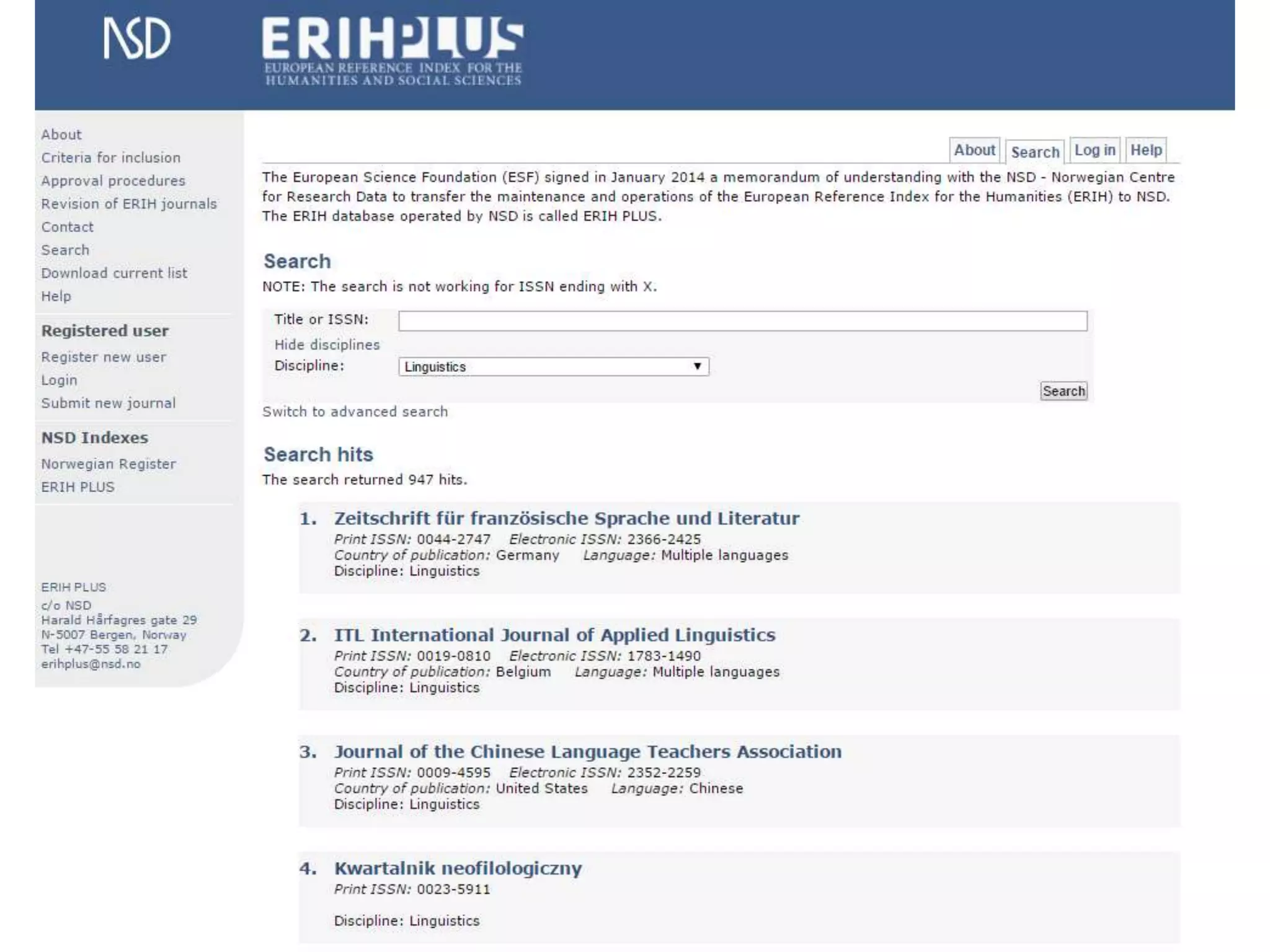
European Reference Index for the Humanities & the
Social Sciences (ERIH PLUS)
• ERIH PLUS includes scientific journals in
humanities & social sciences published in Europe
that meet benchmark standards
• Journals are not allocated to particular
categories
• https://dbh.nsd.uib.no/publiseringskanaler/erihplus/
2. Collaborate with Other Researchers
• Collaborate with researchers in other institutions
• Co-authored papers, especially with international
authors, are cited more frequently across all
disciplines
• Collaboration is often not common in some arts
& humanities disciplines
3. Ensure Research is Easily Identifiable
• You should always use the same name version
consistently throughout your career
• Create online researcher profile(s):
 ORCID
 Google Scholar Profile
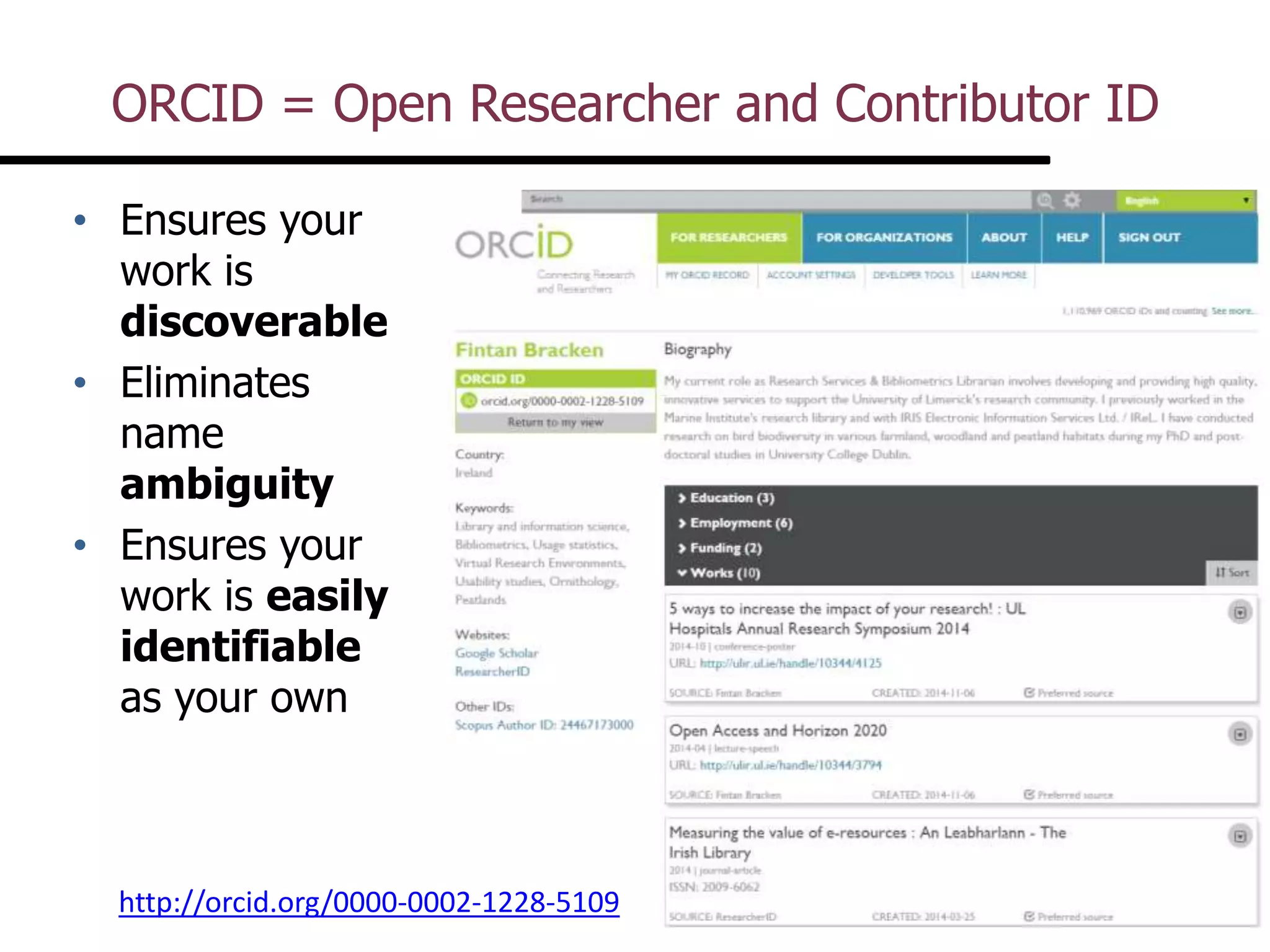
ORCID = Open Researcher and Contributor ID
• Ensures your
work is
discoverable
• Eliminates
name
ambiguity
• Ensures your
work is easily
identifiable
as your own
http://orcid.org/0000-0002-1228-5109
4. Increase the Visibility of Research Outputs
• Search Engine Optimisation (SEO)
 Carefully select the article title & keywords
• Make your work available on Open Access (OA)
 The practice of granting free Web access to
research articles & other research outputs
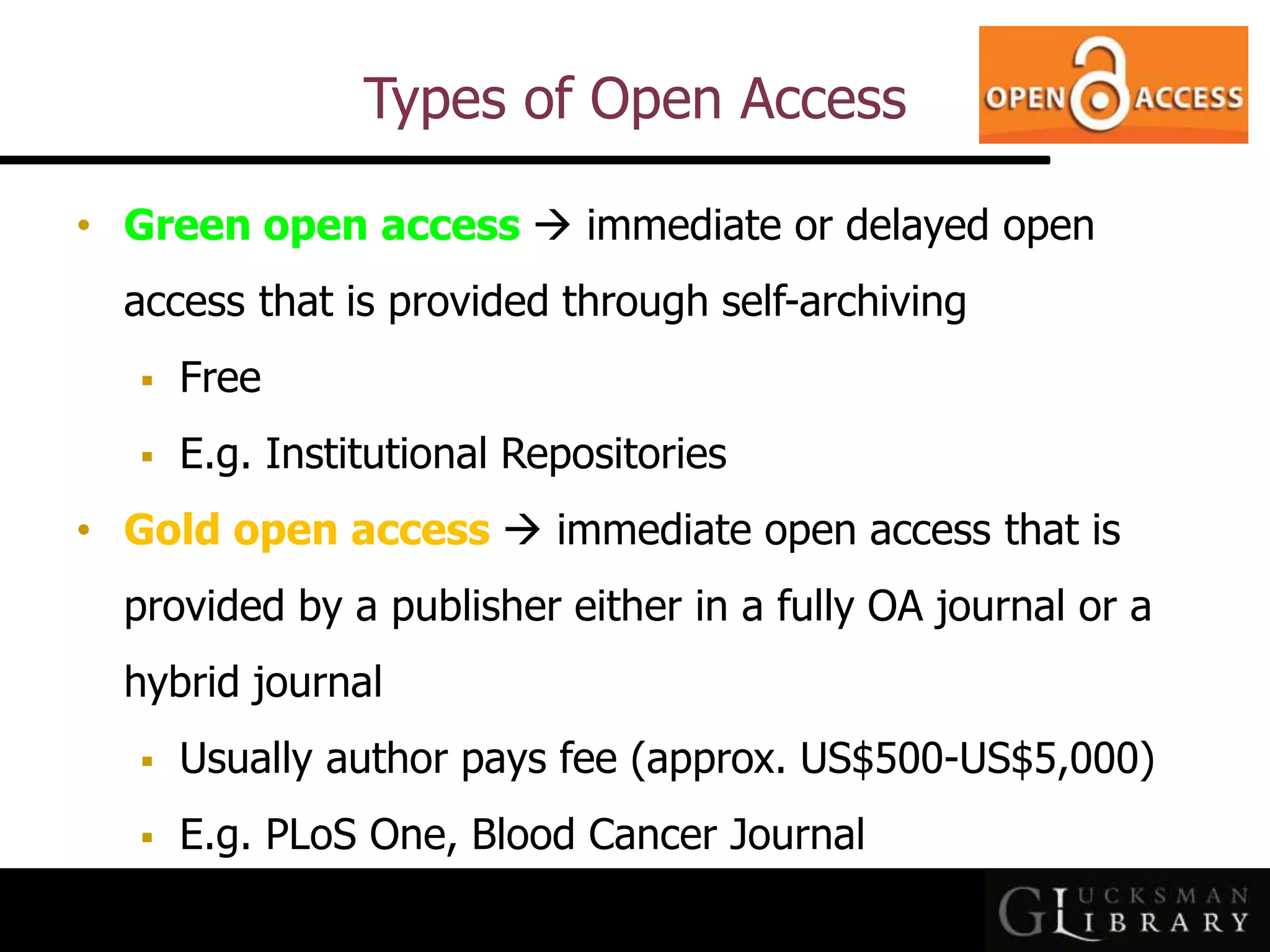
Types of Open Access
• Green open access  immediate or delayed open
access that is provided through self-archiving
 Free
 E.g. Institutional Repositories
• Gold open access  immediate open access that is
provided by a publisher either in a fully OA journal or a
hybrid journal
 Usually author pays fee (approx. US$500-US$5,000)
 E.g. PLoS One, Blood Cancer Journal
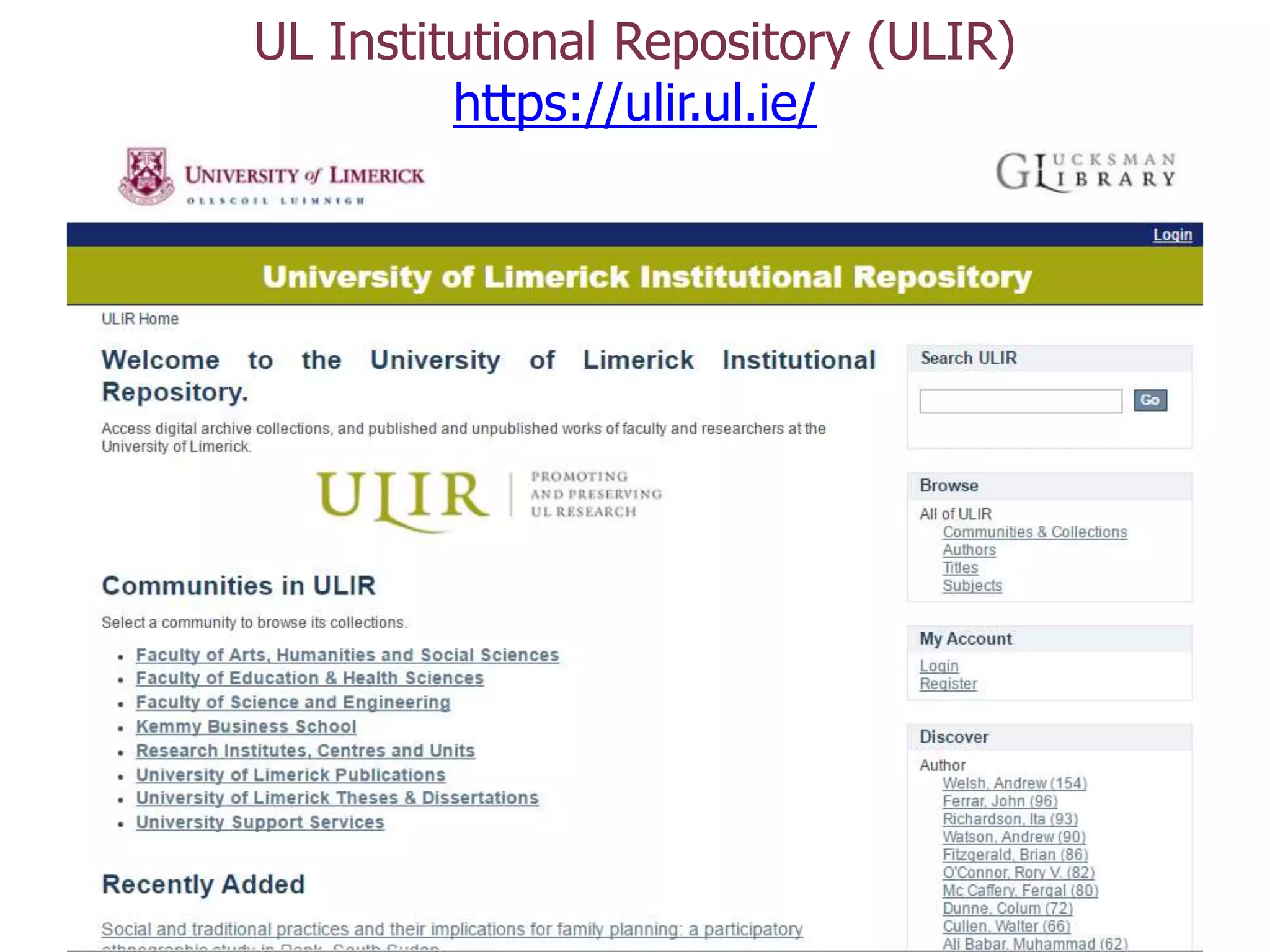
UL Institutional Repository (ULIR)
https://ulir.ul.ie/
Benefits of Open Access
• No subscriptions necessary
• Greater visibility of your research – indexed by
Google Scholar, Google, Bing, Yahoo, etc.
• Dissemination of knowledge – a public good
• Satisfy funding agency requirements (e.g. SFI, IRC,
EU)
• Increases research exposure and citation rate (Open
Access citation advantage)
5. Communicate & Promote Research Outputs
• Attend & present at conferences & seminars
 To communicate the results of research & meet
potential collaborators
• Use social media (Twitter, blogs, etc.) to publicise your
research & engage with your audience
• Profiles on academic social networking sites e.g.:
 Social Science Research Network (SSRN)
 Academia.edu
 ResearchGate
Thank you for listening
Questions?
Dr. Fintan Bracken
Research Services &
Bibliometrics Librarian,
University of Limerick
Email: fintan.bracken@ul.ie
For more information on topics discussed in this
presentation see http://libguides.ul.ie/research.

Introduction to Metrics and Impact Tracking

  • 1.
    Dr. Fintan Bracken Librarian,Research Services & Bibliometrics University of Limerick Introduction to Metrics and Impact Tracking Inbhear: Publishing and Disseminating Arts and Humanities Research 19th January 2017
  • 2.
    Presentation Outline • Whatis Impact? • Assessing Research Impact • Maximising Your Research Impact
  • 3.
    What is Impact? “Thedirect and indirect ‘influence’ of research or its ‘effect on’ an individual, a community, the development of policy, or the creation of a new product, service or technology.” (SFI, 2013)
  • 4.
    Academic Impacts Economic & Commercial Impacts Societal Impacts Impacts on PublicPolicy & Services Health Impacts Environmental Impacts Impacts on Professional Services Impact Types (based on SFI, 2013)
  • 5.
    Assessing Research Impact PeerReview • A process of research assessment based on the use of expert deliberation & judgement Bibliometrics • Bibliometrics refers to the quantitative measures used to assess research output i.e. publication & citation data analysis  h-index: Measure of consistency  Times cited: Amount of times an author/paper has been cited Altmetrics • Alternative metrics / Article level metrics
  • 6.
    h-index • The h-indexis a simple metric to quantify the scientific output of an individual (Hirsch, 2005) • A h-index of 10 means that of all of the papers written by this author, 10 papers have been cited at least 10 times each • Measure of consistency for a researcher's publications • Only meaningful when compared to others within the same discipline area & at the same career stage Hirsch, J. E. (2005). An index to quantify an individual's scientific research output. Proceedings of the National Academy of Sciences of the United States of America, 102(46), 16569-16572
  • 7.
    Title Journal TitleYear Google Scholar Citations Effects of set-aside management on birds breeding in lowland Ireland Agriculture, ecosystems & environment 2006 27 Breeding bird populations of Irish peatlands Bird Study 2008 5 The impact of farming on over-wintering bird populations Tearmann 2003 5 The diversity of birds and butterflies in Irish lowland landscapes with special reference to the effects of set-aside management on birds in the breeding season PhD Thesis 2004 1 Lowland bogs, fens and reedswamps Bird Habitats in Ireland 2012 0 The value of the Open Access Repository to the Marine Institute GLINT 2012 0 The potential use of online tools for scientific collaboration by biology researchers Aslib Journal of Information Management 2014 0 Measuring the value of e-resources An Leabharlann 2014 0 h-index = 3 The h-index is 3 as 3 publications have at least 3 citations each. In order to obtain a h-index of 4, the 4th ranked publication (the PhD thesis) would need to receive 3 more citations.
  • 8.
    Tools to findcitations & calculate the h-index • Web of Science • Scopus • Google Scholar In general, better suited to arts & humanities research
  • 9.
  • 10.
    Google Scholar https://scholar.google.com/ • GoogleScholar covers more books, conference papers, technical reports, etc. than Web of Science & Scopus • Coverage is uncontrolled
  • 11.
  • 12.
    Altmetrics • Altmetrics aremeasures that capture the attention a resource generates on the social web or other sources. • They can be applied to journal articles, books / book chapters, software, datasets, websites, videos, etc. • Altmetrics attempt to show influence and engagement of work through blogs, reference management systems, scholarly social networks, & other platforms. • Altmetrics aim is to provide a more comprehensive picture of scholarly activity & of the use & impact of a researcher's work.
  • 13.
    Potential of Altmetricsin: • Providing real-time indicators of impact • Capturing ‘practitioner’ impact of those who may never publish • Showing evidence of public engagement • Being an indicator for future citations?
  • 14.
    Altmetric Explorer forInstitutions www.altmetricexplorer.com
  • 16.
    Other Places toFind Altmetrics • Impactstory (http://impactstory.org/) • Plum Analytics (http://www.plumanalytics.com/) • Individual journals & publishers • Scopus
  • 17.
    What you cando? • Communicate & promote your research online: Twitter, blogs, etc • When talking online about your new publication include the doi (digital object identifier) instead of the normal publisher’s URL to ensure it is picked up by altmetrics • A doi looks something like this: 10.1038/nature13684 • Add http://dx.doi.org/ in front of the doi to convert it to a clickable URL e.g. http://dx.doi.org/10.1038/nature1368
  • 18.
    Other Data toShowcase Your Research Impact • Downloads / views of publications from institutional repositories (if available) • Download statistics for datasets / e-books / Slideshare presentations / YouTube videos • Reviews of books or book chapters • Book sales • Library Holdings (http://www.worldcat.org/)
  • 19.
    Maximising Your ResearchImpact 1. Publish in high impact journals 2. Collaborate with other researchers 3. Ensure research is easily identifiable 4. Increase the visibility of research outputs 5. Communicate & promote research outputs
  • 20.
    1. Publish inHigh Impact Journals • If possible, when trying to publish a journal article, try to publish in journals included in Web of Science or Scopus • Impact factor type metrics (e.g. SJR) should be used as a guide to selecting high impact journals • You should consult with your peers & check that the scope of the journal matches your article topic before submitting to a journal • Publishing in high impact journals does not guarantee that an article will receive high citations
  • 21.
    SCImago Journal Rank(SJR) • Freely available on the web & via Scopus • Uses Scopus dataset & Google PageRank™ algorithm • SJR gives higher weight to citations from high impact journals • Calculated over a 3 year period
  • 22.
  • 23.
    European Reference Indexfor the Humanities & the Social Sciences (ERIH PLUS) • ERIH PLUS includes scientific journals in humanities & social sciences published in Europe that meet benchmark standards • Journals are not allocated to particular categories • https://dbh.nsd.uib.no/publiseringskanaler/erihplus/
  • 25.
    2. Collaborate withOther Researchers • Collaborate with researchers in other institutions • Co-authored papers, especially with international authors, are cited more frequently across all disciplines • Collaboration is often not common in some arts & humanities disciplines
  • 26.
    3. Ensure Researchis Easily Identifiable • You should always use the same name version consistently throughout your career • Create online researcher profile(s):  ORCID  Google Scholar Profile
  • 27.
    ORCID = OpenResearcher and Contributor ID • Ensures your work is discoverable • Eliminates name ambiguity • Ensures your work is easily identifiable as your own http://orcid.org/0000-0002-1228-5109
  • 28.
    4. Increase theVisibility of Research Outputs • Search Engine Optimisation (SEO)  Carefully select the article title & keywords • Make your work available on Open Access (OA)  The practice of granting free Web access to research articles & other research outputs
  • 29.
    Types of OpenAccess • Green open access  immediate or delayed open access that is provided through self-archiving  Free  E.g. Institutional Repositories • Gold open access  immediate open access that is provided by a publisher either in a fully OA journal or a hybrid journal  Usually author pays fee (approx. US$500-US$5,000)  E.g. PLoS One, Blood Cancer Journal
  • 30.
    UL Institutional Repository(ULIR) https://ulir.ul.ie/
  • 31.
    Benefits of OpenAccess • No subscriptions necessary • Greater visibility of your research – indexed by Google Scholar, Google, Bing, Yahoo, etc. • Dissemination of knowledge – a public good • Satisfy funding agency requirements (e.g. SFI, IRC, EU) • Increases research exposure and citation rate (Open Access citation advantage)
  • 32.
    5. Communicate &Promote Research Outputs • Attend & present at conferences & seminars  To communicate the results of research & meet potential collaborators • Use social media (Twitter, blogs, etc.) to publicise your research & engage with your audience • Profiles on academic social networking sites e.g.:  Social Science Research Network (SSRN)  Academia.edu  ResearchGate
  • 33.
    Thank you forlistening Questions? Dr. Fintan Bracken Research Services & Bibliometrics Librarian, University of Limerick Email: fintan.bracken@ul.ie For more information on topics discussed in this presentation see http://libguides.ul.ie/research.