Journal Impact Factors
and Citation Analysis
The Ranking of Journals and
Articles
University of Wisconsin-Madison Libraries • Madison, WI 53706
Phone: (608) 262-3193 • www.library.wisc.edu
Ariel Andrea, Chemistry Library
Overview
• Introductions
• Measuring the importance of journals,
articles, and authors – Why?
• Types of Measurements & Tools
– Purpose, usage, and bias
• Altmetrics
Why Measure Impact?
• Hiring, advancement, tenure
• Grant applications
• Locating publications to publish in
• Identifying seminal research
• Identifying researchers whose work is
getting attention
Article Metrics
• Number of times an article has been cited
• Cited Reference Search - Search for journal
articles, books, proceedings, and other published
works that have cited a previously published work
• Discover who is citing your research and the
impact of your work
• Discover which journals have appropriate focus for
your research.
• “Cited by” links
Tools for Article Impact
• Web of Knowledge
– Library resource
• Google Scholar
• Scopus
– Library does not have subscription.
– Released in 2004; Citation tracking from 1996.
• Other Databases
Web of Knowledge
• Science, Social Science and Humanities
Citation Indexes in one database; coverage
better for sciences
• Citations from 10,000+ journals
• Books and conference proceedings too
• One of the first to offer Cited Reference
Searching and most widely known
Web of Knowledge: Tips
• Use first cited author
• Search author as last name, initials
• Use preferred journal title abbreviations and
potential variants of journal title or publication
• Use volume, issue, and page fields with caution
• Look for cited reference variations (sometimes
different pages of the same article are cited or
papers are cited incorrectly)
Google Scholar
• Articles, theses, books, preprints, abstracts,
and technical reports
• If article has been cited by others, Cited by
link will be part of the record. Link to other
articles in Google Scholar.
• Better international coverage than Web of
Knowledge, but less accurate overall
Other Databases
• Certain disciplines, journals, and document types may not
be well represented in major tools for citation analysis.
• Examples of other databases:
– ACM Digital Library
– ProQuest databases (e.g., EconLit, Sociological
Abstracts)
– EBSCOhost databases (e.g., CINAHL, PsycINFO) –
Cited References in navigation bar at top
– Full Text Journal Collections (e.g., JSTOR)
– PubMed
– SciFinder Scholar
Cautions/Limitations
• No one database is comprehensive.
• No one database covers all journals.
• No one database includes all publication
formats.
• Publication dates affect your results.
• Results can be misleading.
• All impact measures are controversial.
Source: http://researchguides.library.wisc.edu/publishingresearch
Individual/Author Metrics
• H-Index
– Variations
H-Index
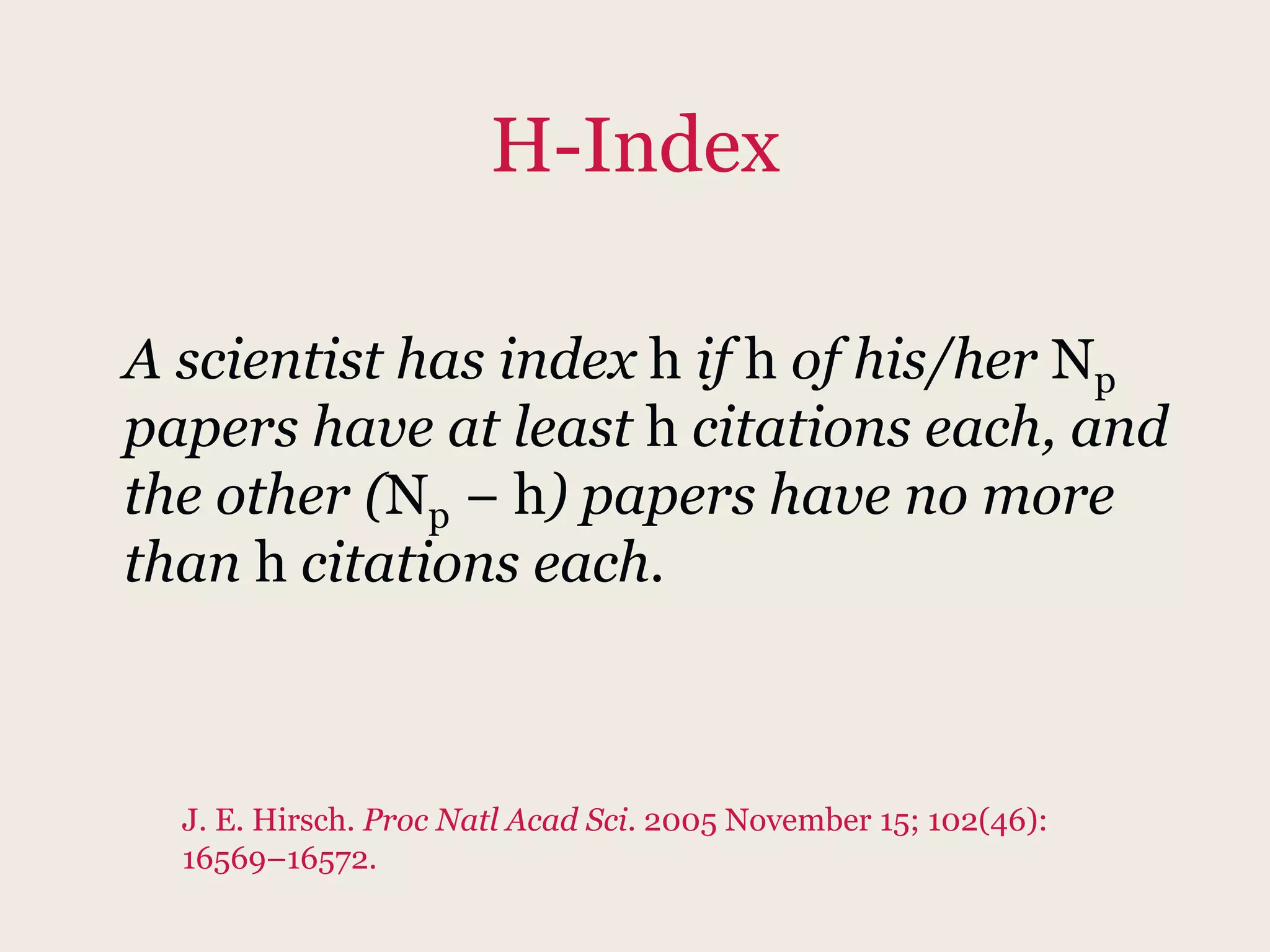
A scientist has index h if h of his/her Np
papers have at least h citations each, and
the other (Np − h) papers have no more
than h citations each.
J. E. Hirsch. Proc Natl Acad Sci. 2005 November 15; 102(46):
16569–16572.
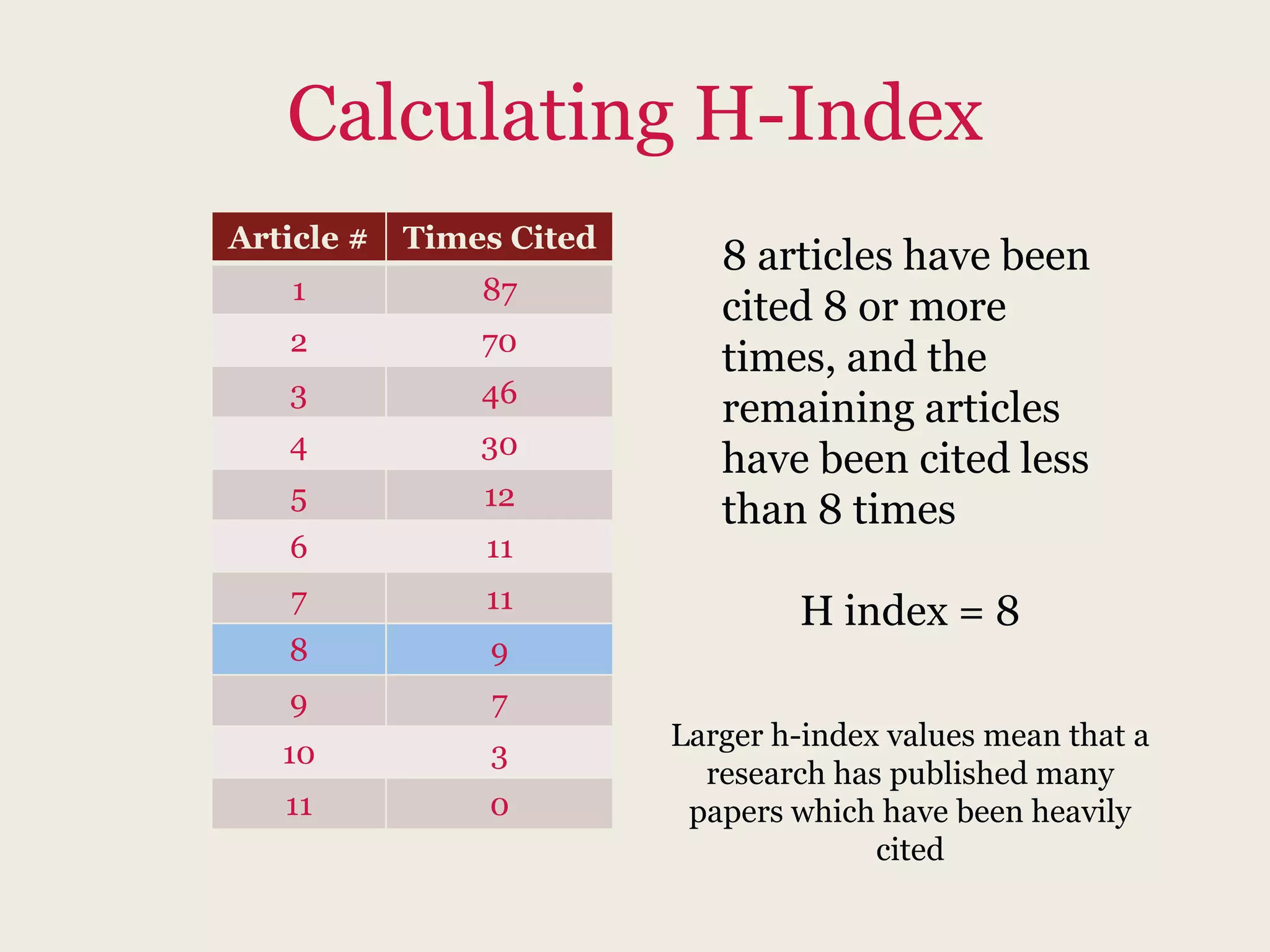
Calculating H-Index
Article # Times Cited
1 87
2 70
3 46
4 30
5 12
6 11
7 11
8 9
9 7
10 3
11 0
8 articles have been
cited 8 or more
times, and the
remaining articles
have been cited less
than 8 times
H index = 8
Larger h-index values mean that a
research has published many
papers which have been heavily
cited
Tools for H-Index
• Web of Knowledge databases
– Library resource
• Google Scholar
– Depends on if the researcher has a Google
account linked with their publications
• Scopus
– Library does not have a subscription
– Author impact search is free online
Other Tools
• Publish or Perish
– Calculates many different metrics based on
Google Scholar data
– Best for researchers in the humanities, social
science, business, engineering, math,
computer science, economics
• ResearcherID
– Uses Web of Science data
– Calculates individual metrics
Problems with H-Index
• Does not account for coauthors
– Favors large groups of authors (usually
experimental science over theoretical)
• Can be influenced by self-citation
• Cannot account for ‘first authors’
• Dependant on career length
• All types of citations are weighted the
same
– Reviews, books, primary research
H-Index Alternates
• M-Quotient = h/n
– n is the individual’s number of active years
– Better for young researchers
• G-Index = h-index for an averaged citations
count
– Weights heavily cited papers
– Egghe L., Theory and practice of the g-index,
Scientometrics, 69(2006),No 1,p.131–52
• Many other variations – see handout for
citations
Journal Impact
• ISI Journal Impact Factor
• Essential Science Indicators
• SJR: SCImago Journal Rank
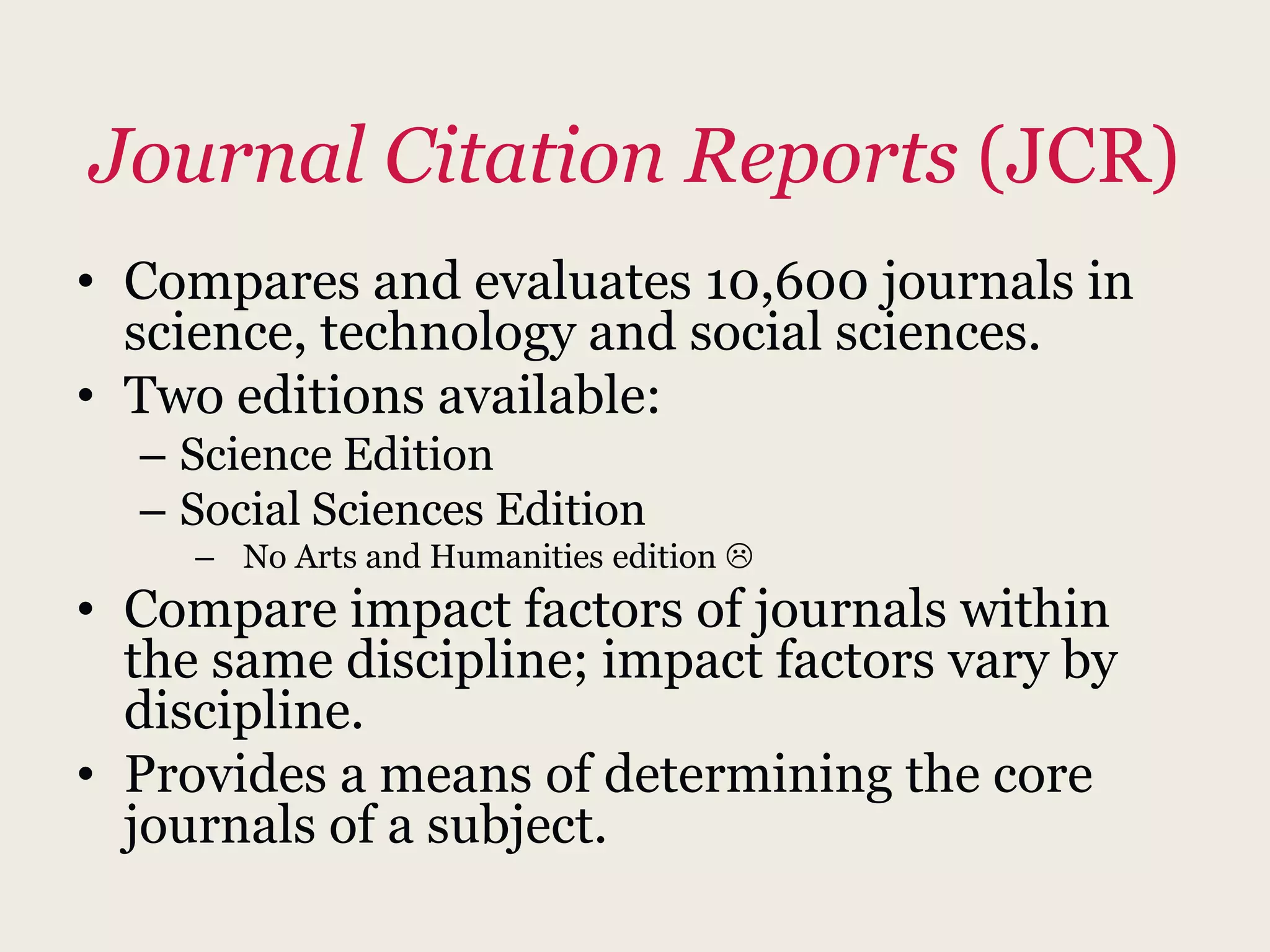
Journal Impact Factor
• Average number of times articles from the
journal published in the past two years have
been cited in the Journal Citation Report
(JCR) year.
• Calculated by dividing the number of
citations in the JCR year by the total number
of articles published in the two previous
years.
– An Impact Factor of 1.0 means that, on average,
the articles published one or two year ago have
been cited one time.
Source: http://admin-apps.webofknowledge.com.ezproxy.library.wisc.edu/JCR/help/h_impfact.htm
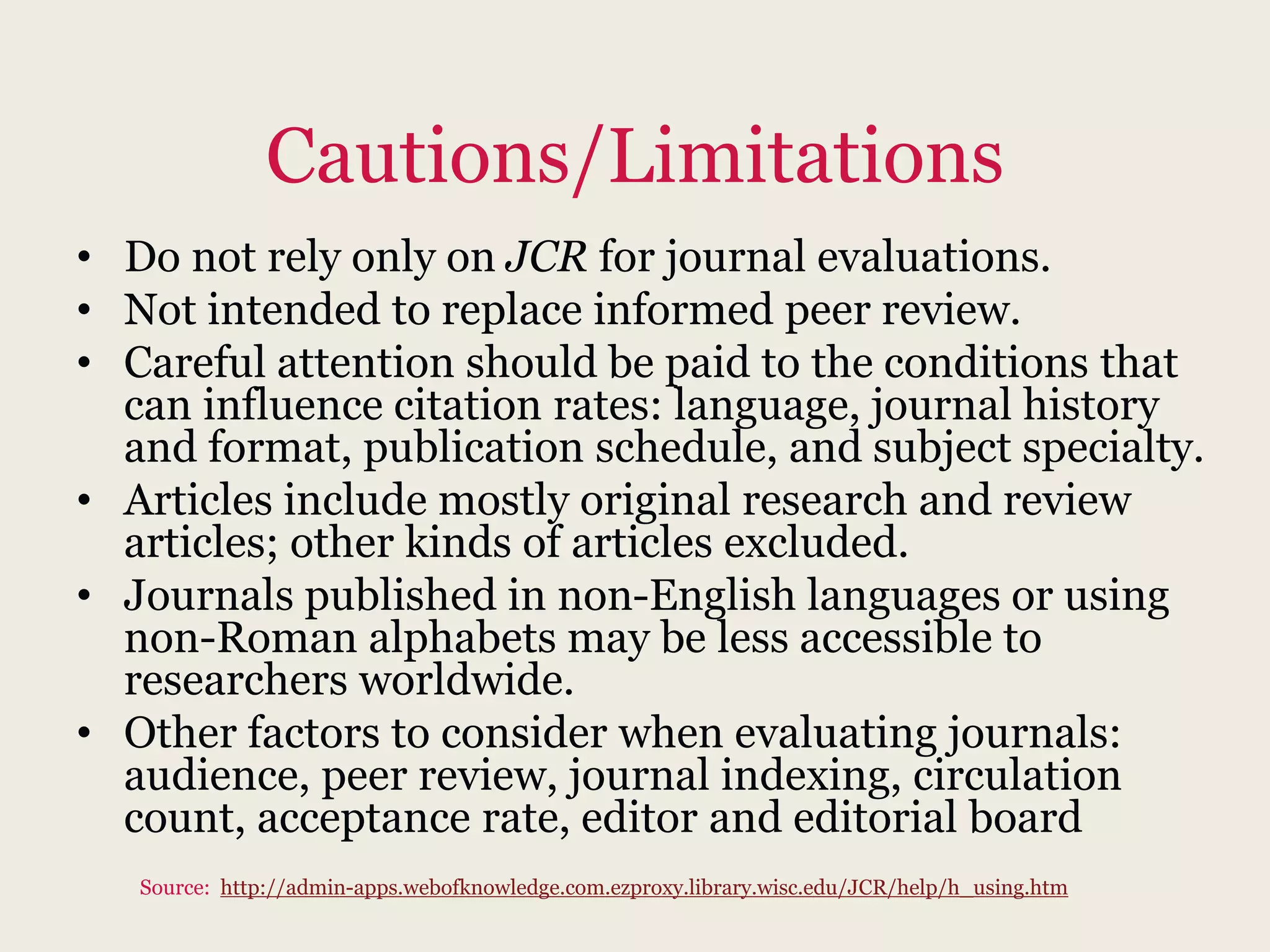
Journal Citation Reports (JCR)
• Compares and evaluates 10,600 journals in
science, technology and social sciences.
• Two editions available:
– Science Edition
– Social Sciences Edition
– No Arts and Humanities edition 
• Compare impact factors of journals within
the same discipline; impact factors vary by
discipline.
• Provides a means of determining the core
journals of a subject.
Cautions/Limitations
• Do not rely only on JCR for journal evaluations.
• Not intended to replace informed peer review.
• Careful attention should be paid to the conditions that
can influence citation rates: language, journal history
and format, publication schedule, and subject specialty.
• Articles include mostly original research and review
articles; other kinds of articles excluded.
• Journals published in non-English languages or using
non-Roman alphabets may be less accessible to
researchers worldwide.
• Other factors to consider when evaluating journals:
audience, peer review, journal indexing, circulation
count, acceptance rate, editor and editorial board
Source: http://admin-apps.webofknowledge.com.ezproxy.library.wisc.edu/JCR/help/h_using.htm
Essential Science Indicators
• Tracks most cited journals, authors,
research fields by country and institution
• New feature as part of Web of Science
platform
SJR: SCImago Journal Rank
• Based on the PageRank algorithm used by
Google
– Accounts for both the number of citations
received by a journal and the prestige of the
journals where such citations originated
• Data drawn from Scopus
• Free and open source
– Great alternative to IF for those without
access
Problems with SJR
• Uses Scopus – citations only from 1996-
present
• Divides the prestige gained by a journal,
through the citations of its articles, to the
total number of articles included, rather
than to the number of citable articles
– Plays down letters to editor, news, etc.
Altmetrics
• Systems which use social media data to
rank authors and journals rather than just
traditional citation methods
– Tracking “likes,” comments, tweets, and other
postings
Altmetrics
• Altmetric
– Search for any paper to see its impact in news outlets
and social media
• ImpactStory
– Compiles data on how scholars and the public use
articles in social media; includes citation manager
saves, Facebook and Twitter mentions, F1000
recommendations, and more
• Many of these tools now require paid
accounts – this is still a growing/changing
field

Citation Metrics and Journal Rankings

  • 1.
    Journal Impact Factors andCitation Analysis The Ranking of Journals and Articles University of Wisconsin-Madison Libraries • Madison, WI 53706 Phone: (608) 262-3193 • www.library.wisc.edu Ariel Andrea, Chemistry Library
  • 2.
    Overview • Introductions • Measuringthe importance of journals, articles, and authors – Why? • Types of Measurements & Tools – Purpose, usage, and bias • Altmetrics
  • 3.
    Why Measure Impact? •Hiring, advancement, tenure • Grant applications • Locating publications to publish in • Identifying seminal research • Identifying researchers whose work is getting attention
  • 4.
    Article Metrics • Numberof times an article has been cited • Cited Reference Search - Search for journal articles, books, proceedings, and other published works that have cited a previously published work • Discover who is citing your research and the impact of your work • Discover which journals have appropriate focus for your research. • “Cited by” links
  • 5.
    Tools for ArticleImpact • Web of Knowledge – Library resource • Google Scholar • Scopus – Library does not have subscription. – Released in 2004; Citation tracking from 1996. • Other Databases
  • 6.
    Web of Knowledge •Science, Social Science and Humanities Citation Indexes in one database; coverage better for sciences • Citations from 10,000+ journals • Books and conference proceedings too • One of the first to offer Cited Reference Searching and most widely known
  • 7.
    Web of Knowledge:Tips • Use first cited author • Search author as last name, initials • Use preferred journal title abbreviations and potential variants of journal title or publication • Use volume, issue, and page fields with caution • Look for cited reference variations (sometimes different pages of the same article are cited or papers are cited incorrectly)
  • 8.
    Google Scholar • Articles,theses, books, preprints, abstracts, and technical reports • If article has been cited by others, Cited by link will be part of the record. Link to other articles in Google Scholar. • Better international coverage than Web of Knowledge, but less accurate overall
  • 9.
    Other Databases • Certaindisciplines, journals, and document types may not be well represented in major tools for citation analysis. • Examples of other databases: – ACM Digital Library – ProQuest databases (e.g., EconLit, Sociological Abstracts) – EBSCOhost databases (e.g., CINAHL, PsycINFO) – Cited References in navigation bar at top – Full Text Journal Collections (e.g., JSTOR) – PubMed – SciFinder Scholar
  • 10.
    Cautions/Limitations • No onedatabase is comprehensive. • No one database covers all journals. • No one database includes all publication formats. • Publication dates affect your results. • Results can be misleading. • All impact measures are controversial. Source: http://researchguides.library.wisc.edu/publishingresearch
  • 11.
  • 12.
    H-Index A scientist hasindex h if h of his/her Np papers have at least h citations each, and the other (Np − h) papers have no more than h citations each. J. E. Hirsch. Proc Natl Acad Sci. 2005 November 15; 102(46): 16569–16572.
  • 13.
    Calculating H-Index Article #Times Cited 1 87 2 70 3 46 4 30 5 12 6 11 7 11 8 9 9 7 10 3 11 0 8 articles have been cited 8 or more times, and the remaining articles have been cited less than 8 times H index = 8 Larger h-index values mean that a research has published many papers which have been heavily cited
  • 14.
    Tools for H-Index •Web of Knowledge databases – Library resource • Google Scholar – Depends on if the researcher has a Google account linked with their publications • Scopus – Library does not have a subscription – Author impact search is free online
  • 15.
    Other Tools • Publishor Perish – Calculates many different metrics based on Google Scholar data – Best for researchers in the humanities, social science, business, engineering, math, computer science, economics • ResearcherID – Uses Web of Science data – Calculates individual metrics
  • 16.
    Problems with H-Index •Does not account for coauthors – Favors large groups of authors (usually experimental science over theoretical) • Can be influenced by self-citation • Cannot account for ‘first authors’ • Dependant on career length • All types of citations are weighted the same – Reviews, books, primary research
  • 17.
    H-Index Alternates • M-Quotient= h/n – n is the individual’s number of active years – Better for young researchers • G-Index = h-index for an averaged citations count – Weights heavily cited papers – Egghe L., Theory and practice of the g-index, Scientometrics, 69(2006),No 1,p.131–52 • Many other variations – see handout for citations
  • 18.
    Journal Impact • ISIJournal Impact Factor • Essential Science Indicators • SJR: SCImago Journal Rank
  • 19.
    Journal Impact Factor •Average number of times articles from the journal published in the past two years have been cited in the Journal Citation Report (JCR) year. • Calculated by dividing the number of citations in the JCR year by the total number of articles published in the two previous years. – An Impact Factor of 1.0 means that, on average, the articles published one or two year ago have been cited one time. Source: http://admin-apps.webofknowledge.com.ezproxy.library.wisc.edu/JCR/help/h_impfact.htm
  • 20.
    Journal Citation Reports(JCR) • Compares and evaluates 10,600 journals in science, technology and social sciences. • Two editions available: – Science Edition – Social Sciences Edition – No Arts and Humanities edition  • Compare impact factors of journals within the same discipline; impact factors vary by discipline. • Provides a means of determining the core journals of a subject.
  • 21.
    Cautions/Limitations • Do notrely only on JCR for journal evaluations. • Not intended to replace informed peer review. • Careful attention should be paid to the conditions that can influence citation rates: language, journal history and format, publication schedule, and subject specialty. • Articles include mostly original research and review articles; other kinds of articles excluded. • Journals published in non-English languages or using non-Roman alphabets may be less accessible to researchers worldwide. • Other factors to consider when evaluating journals: audience, peer review, journal indexing, circulation count, acceptance rate, editor and editorial board Source: http://admin-apps.webofknowledge.com.ezproxy.library.wisc.edu/JCR/help/h_using.htm
  • 22.
    Essential Science Indicators •Tracks most cited journals, authors, research fields by country and institution • New feature as part of Web of Science platform
  • 23.
    SJR: SCImago JournalRank • Based on the PageRank algorithm used by Google – Accounts for both the number of citations received by a journal and the prestige of the journals where such citations originated • Data drawn from Scopus • Free and open source – Great alternative to IF for those without access
  • 24.
    Problems with SJR •Uses Scopus – citations only from 1996- present • Divides the prestige gained by a journal, through the citations of its articles, to the total number of articles included, rather than to the number of citable articles – Plays down letters to editor, news, etc.
  • 25.
    Altmetrics • Systems whichuse social media data to rank authors and journals rather than just traditional citation methods – Tracking “likes,” comments, tweets, and other postings
  • 26.
    Altmetrics • Altmetric – Searchfor any paper to see its impact in news outlets and social media • ImpactStory – Compiles data on how scholars and the public use articles in social media; includes citation manager saves, Facebook and Twitter mentions, F1000 recommendations, and more • Many of these tools now require paid accounts – this is still a growing/changing field