Introduction to scholarly
publishing
The journal publishing cycle
Deirdre Dunne – Publisher Environmental Science & Health
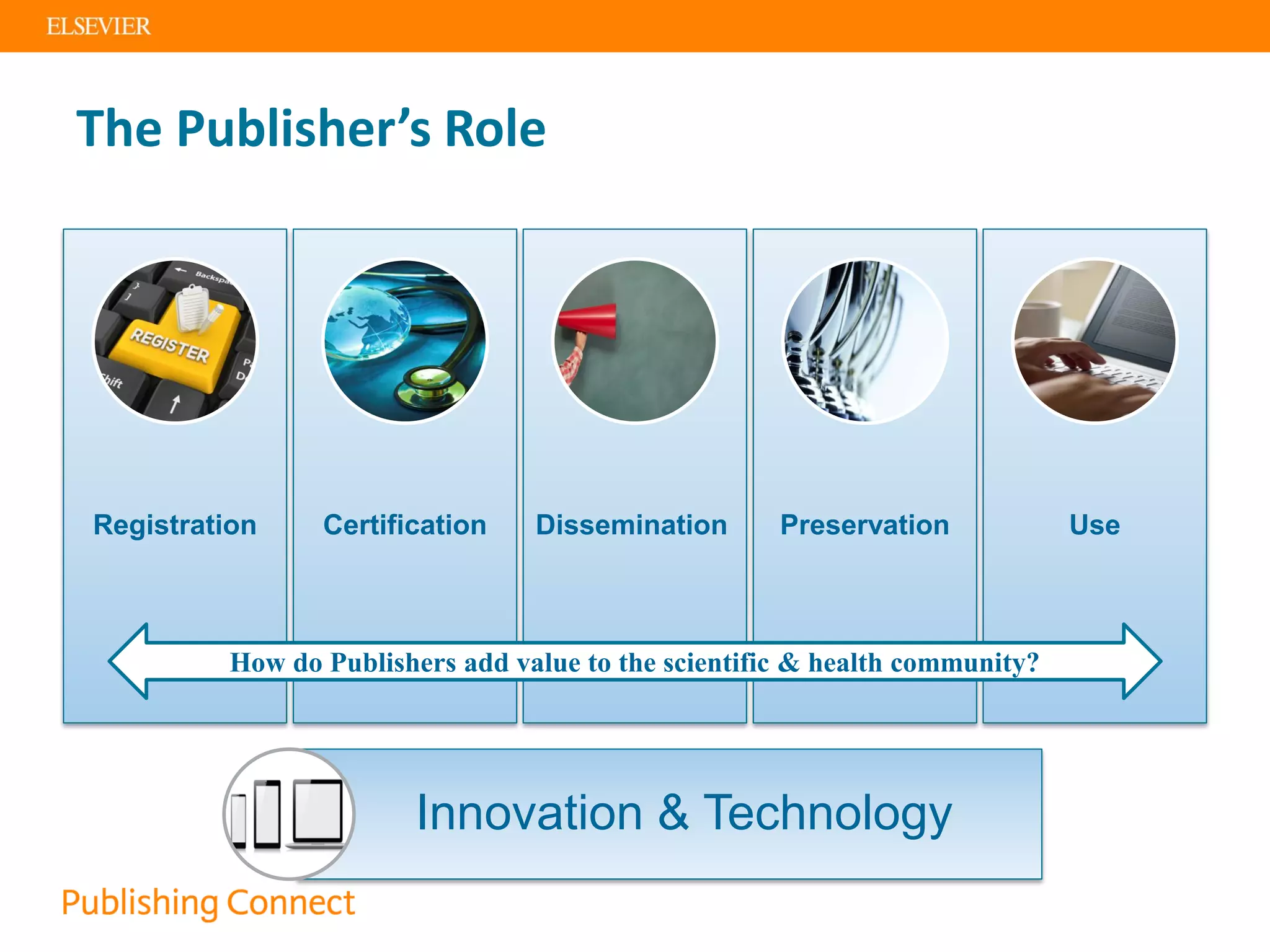
The Publisher’s Role
Registration Certification Dissemination Preservation Use
How do Publishers add value to the scientific & health community?
Innovation & Technology
The digital age of publishing
3
Solicit and
manage
submissions
Manage Peer
Review
Production
Publish and
Disseminate
Edit and
Prepare
Archive and
promote use
eJournal Backfiles
eReference Works
Mobile
content
Electronic
platforms
Electronic
warehousing
Author submission &
Editorial systems
Production tracking systems
Jacob de Boer
Shane Snyder
Damia Barcelo
Jay Gan
David Carpenter
Eddy Zeng
K. KannanJose Domingo
Ruth Alcock
Adrian Covaci
Ron Tjeerdema
Mikko Nikinmaa
Kirk Semple
Ravi Naidu
Yong-Guan Zhu
Guibin Jiang
Phil Demokritou
Jamie Lead
Bernd Nowack
| 5
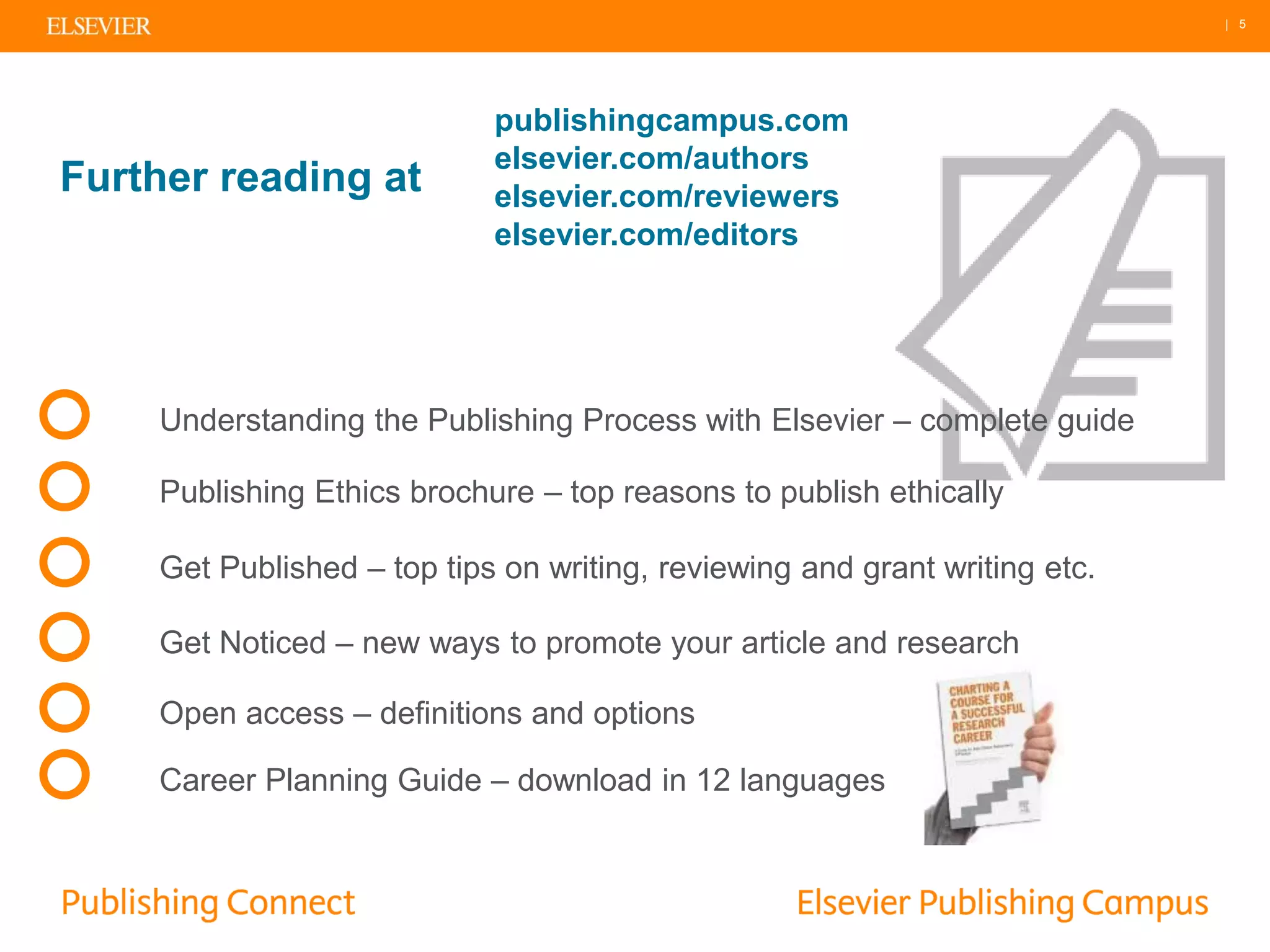
Further reading at
publishingcampus.com
elsevier.com/authors
elsevier.com/reviewers
elsevier.com/editors
Get Published – top tips on writing, reviewing and grant writing etc.
Publishing Ethics brochure – top reasons to publish ethically
Get Noticed – new ways to promote your article and research
Understanding the Publishing Process with Elsevier – complete guide
Open access – definitions and options
Career Planning Guide – download in 12 languages
| 6
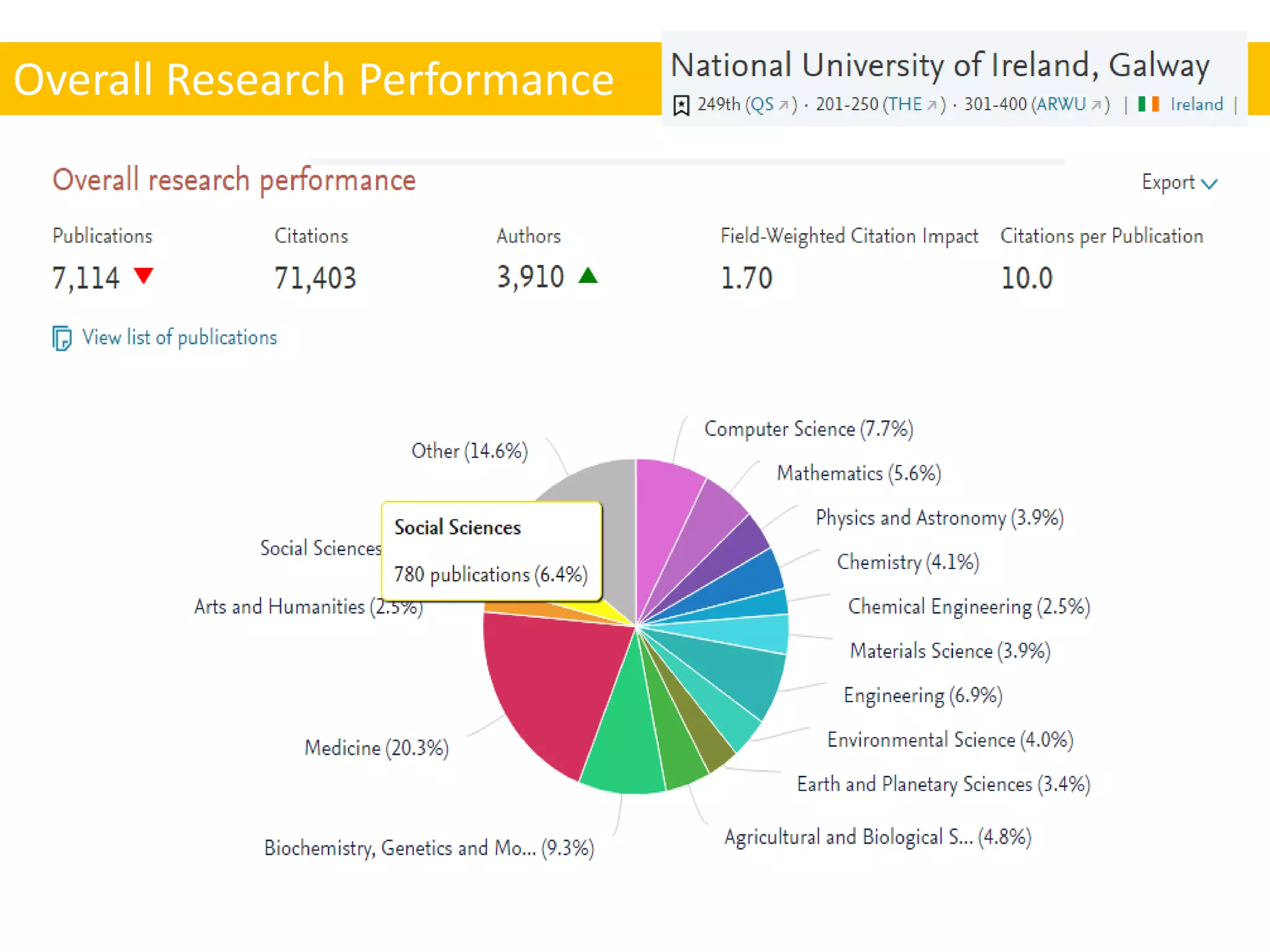
Overall Research Performance
Publications by Category (2011-2015)
Performance Indicators (2011-2015) - Publications
Institutions Collaborating with NUIG
Performance Indicators - Authors
Performance Indicators - Competencies
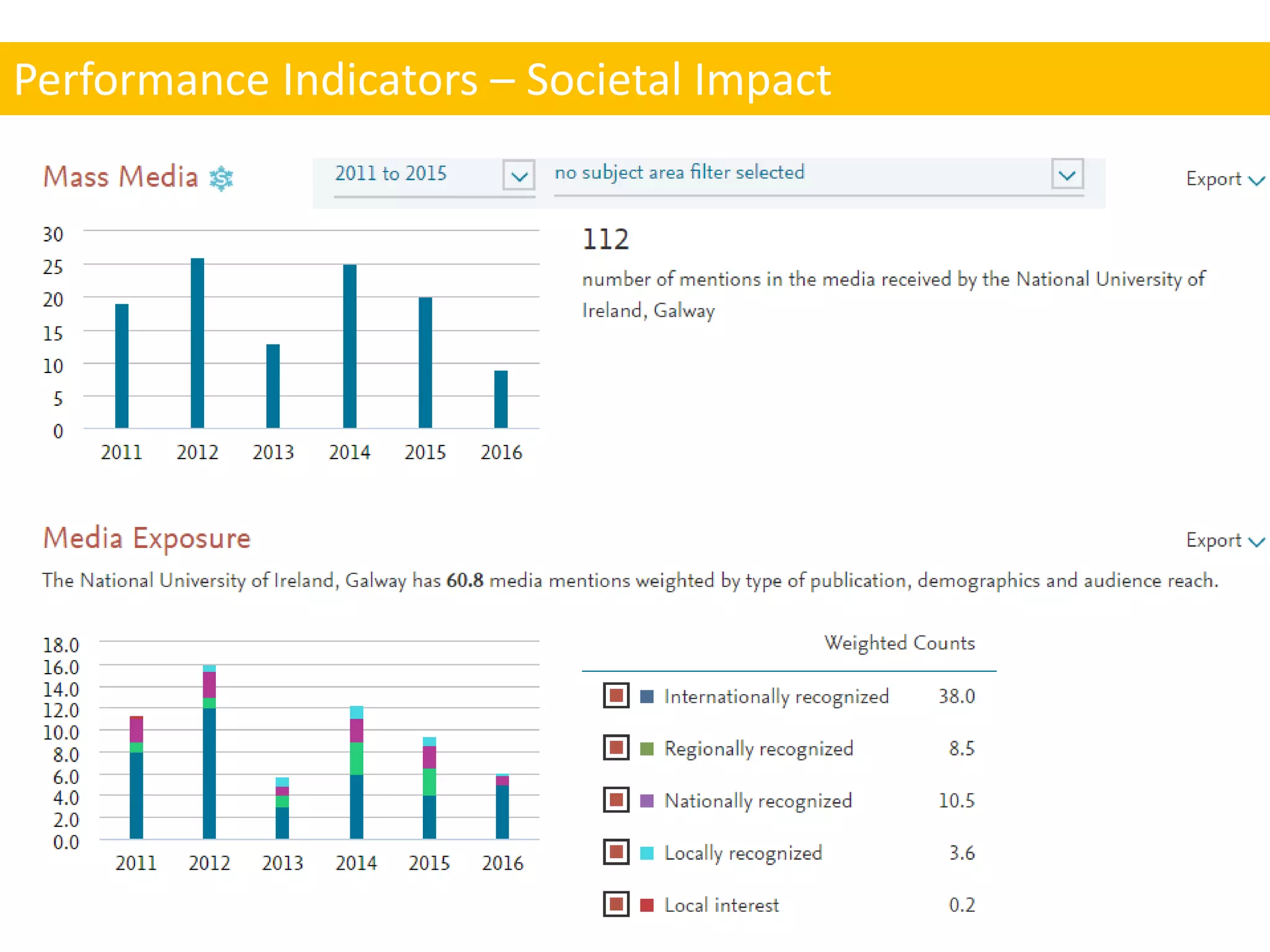
Performance Indicators – Societal Impact
Performance Indicators – Economic Impact
Performance Indicators – International Collaboration
Trends in Publishing
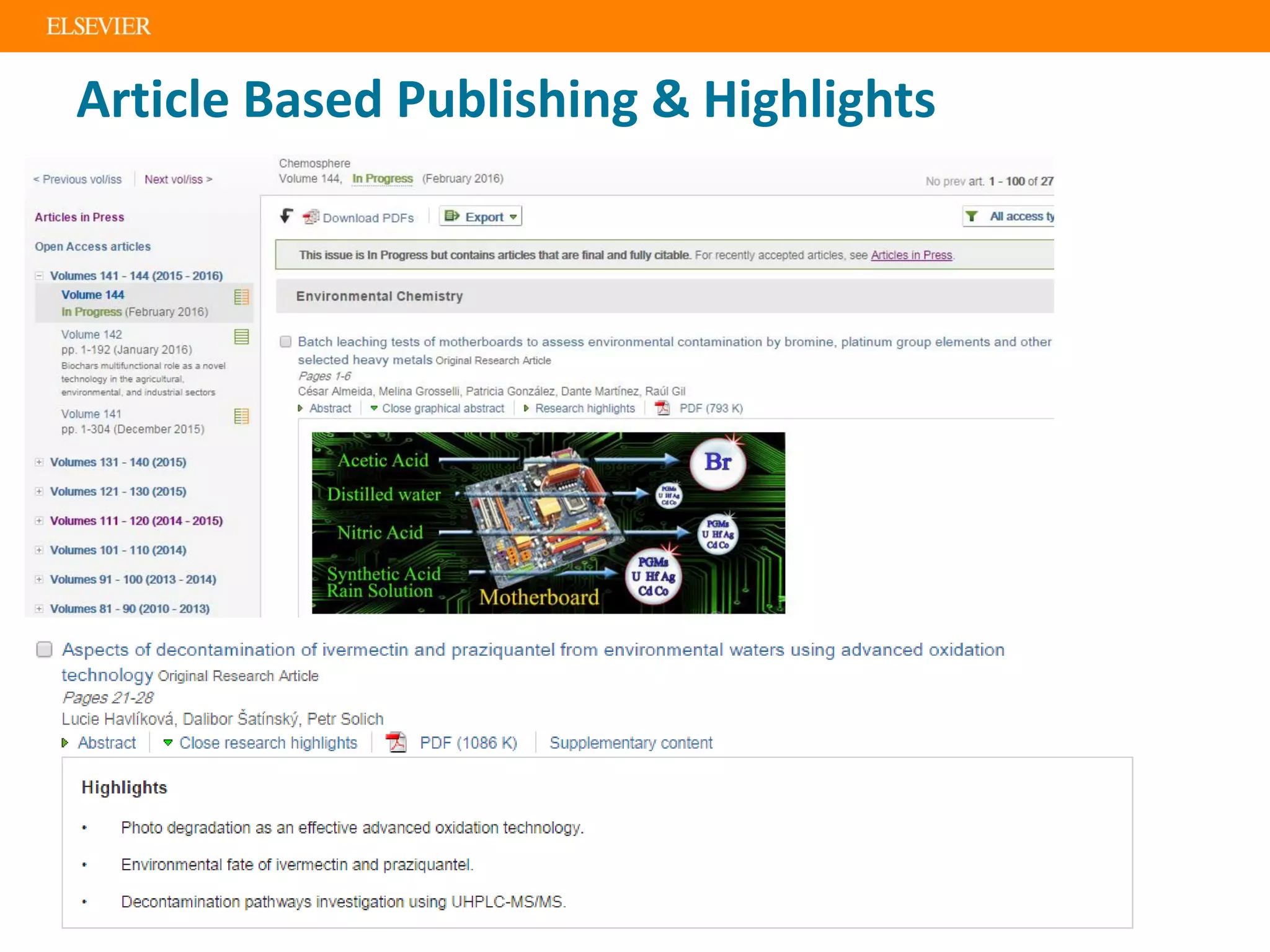
Article Based Publishing & Highlights
| 18
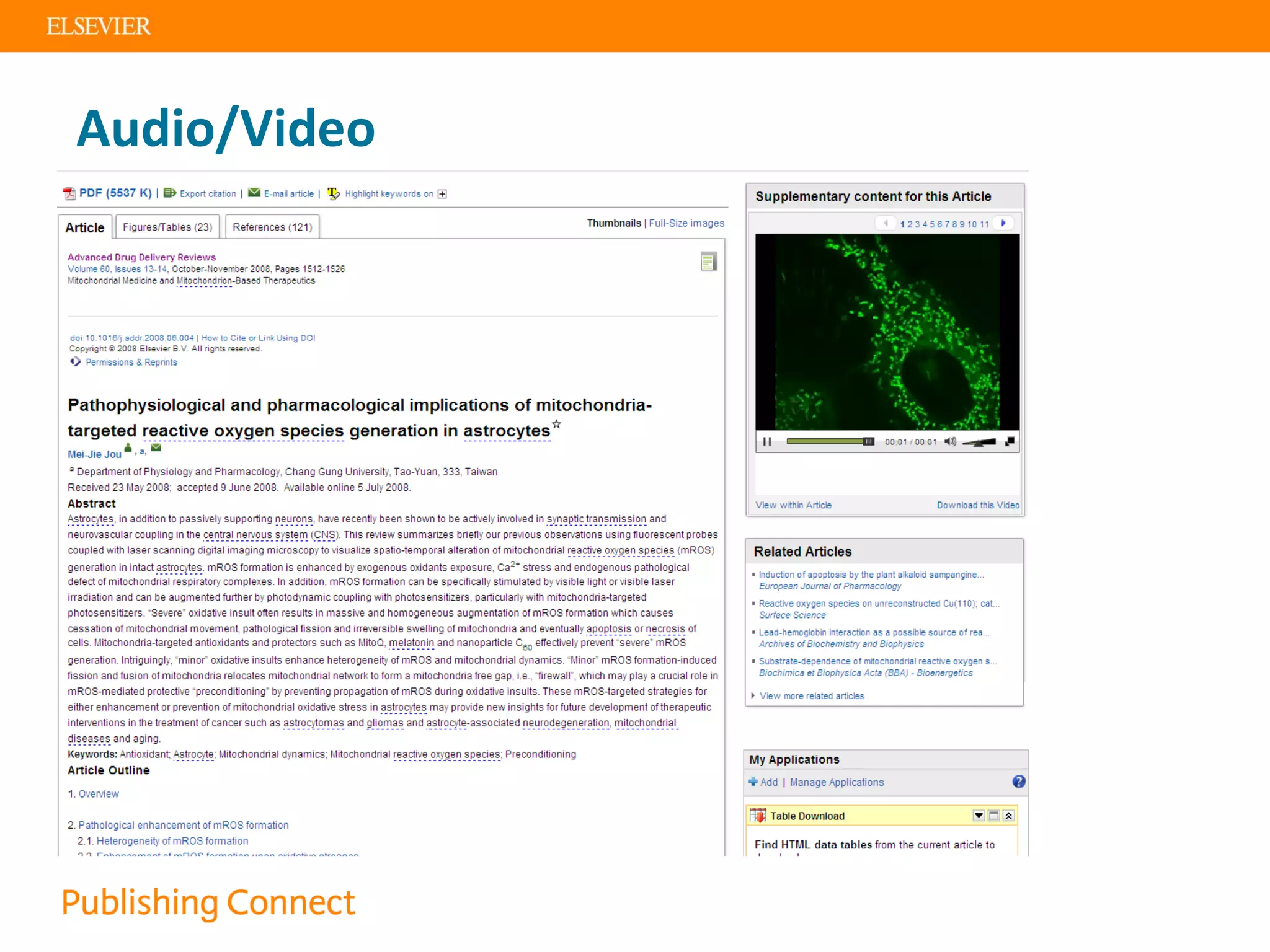
Audio/Video
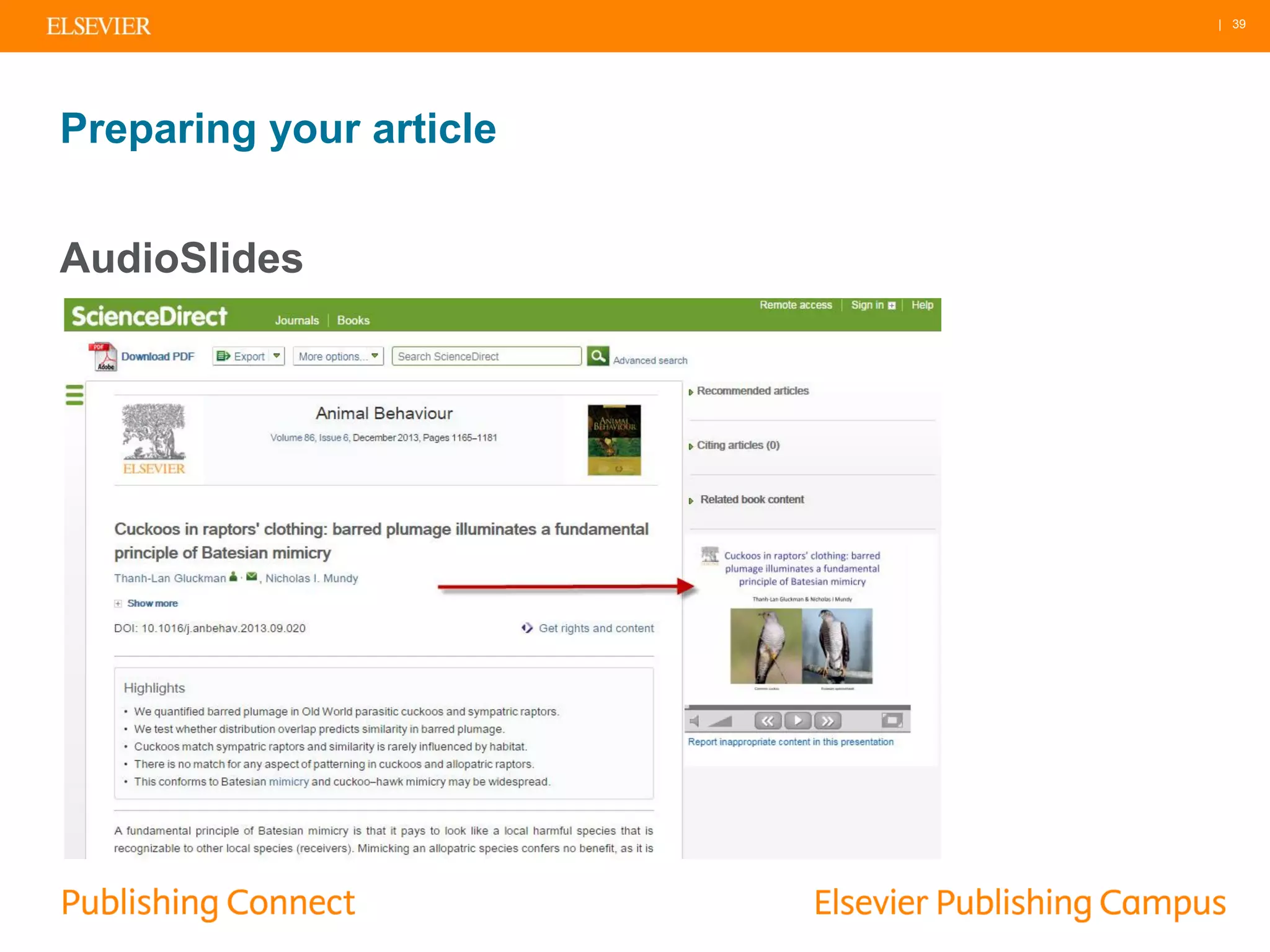
AudioSlides
• AudioSlides presentations have clocked up more than 100,000 views
• AudioSlides uploaded to YouTube or embedded on institutional websites also
encourage people to read the original articles
• 15% more downloads of papers with AudioSlides
Article Transfer Service
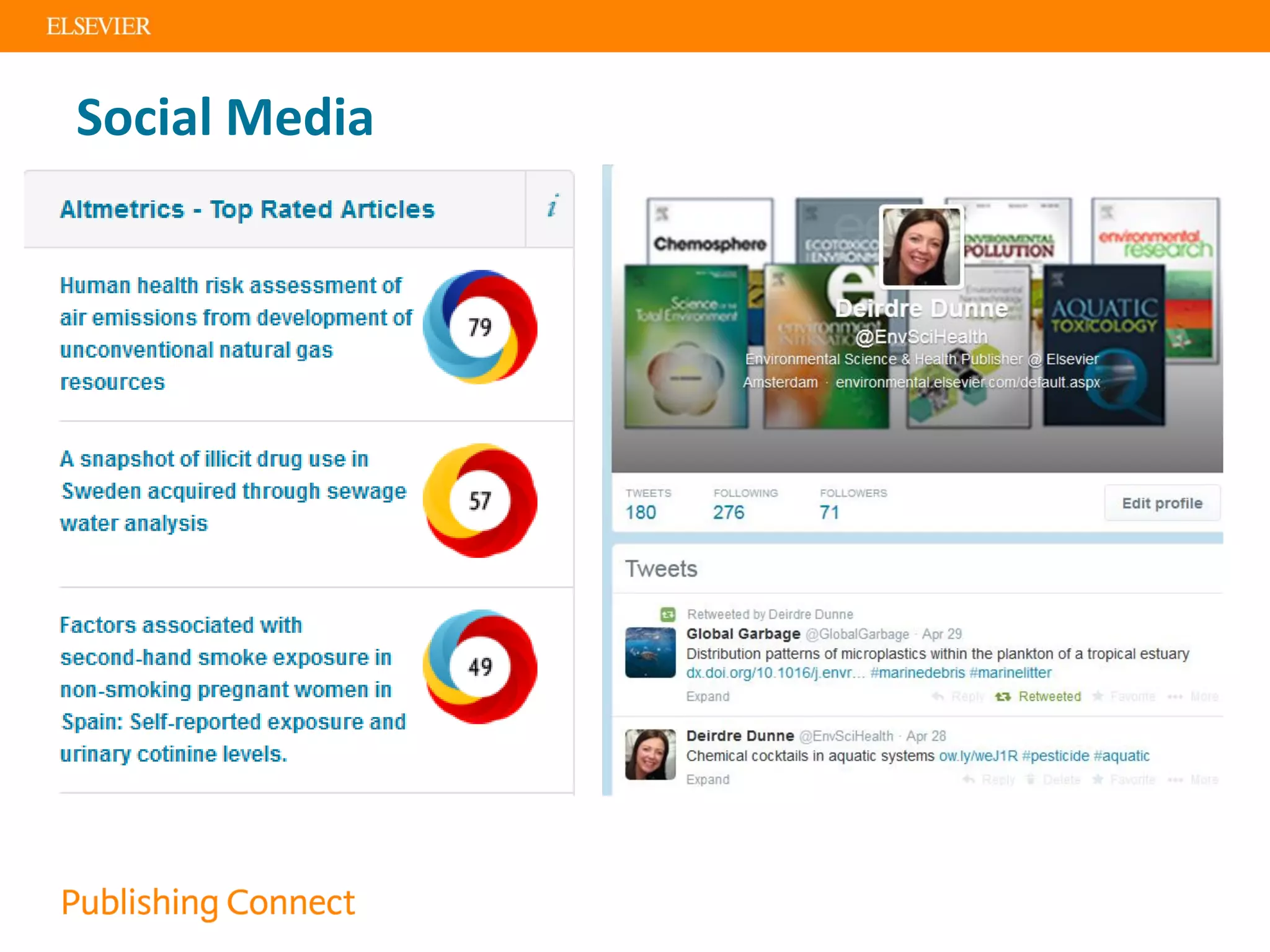
Social Media
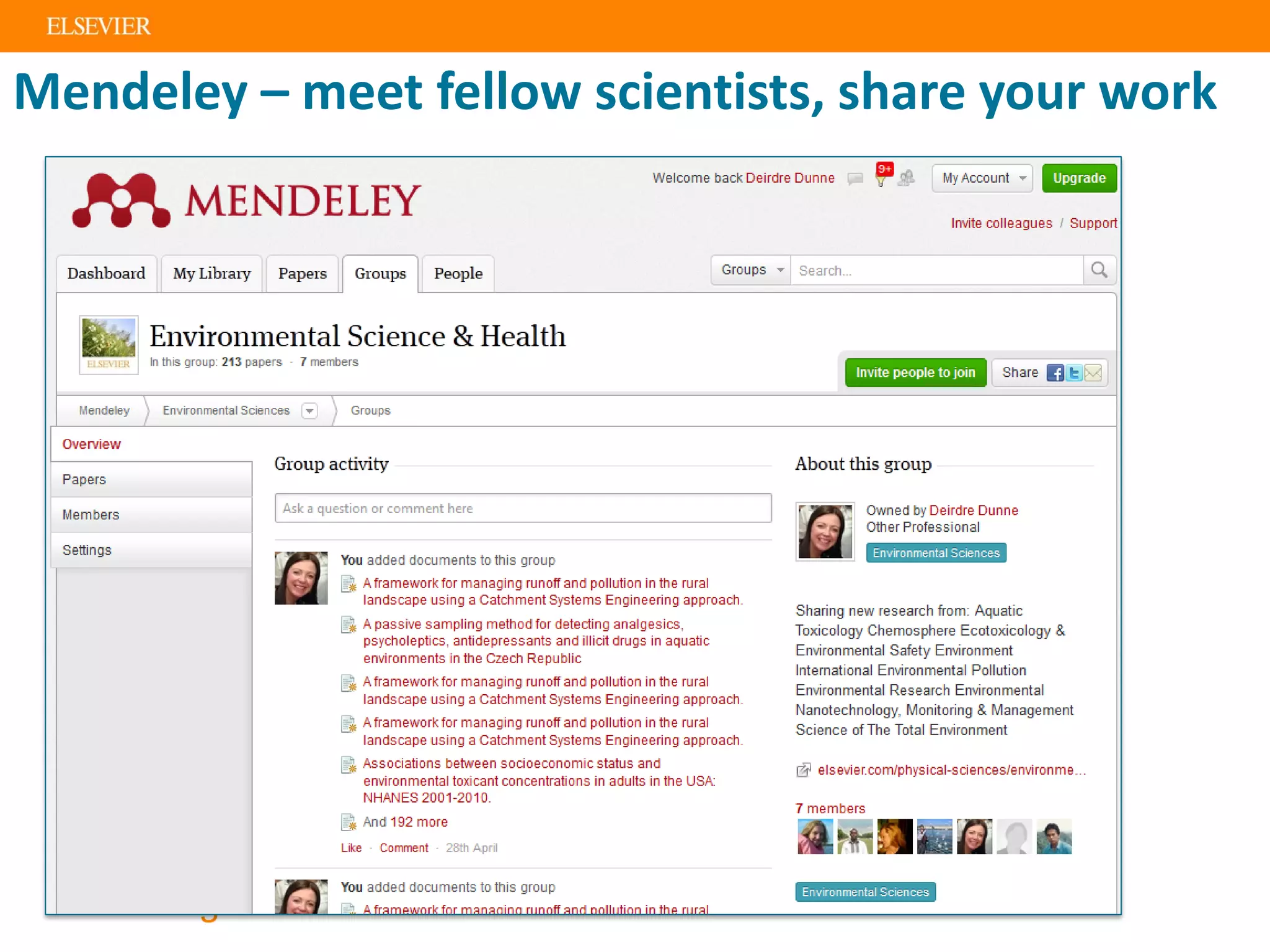
Mendeley – meet fellow scientists, share your work
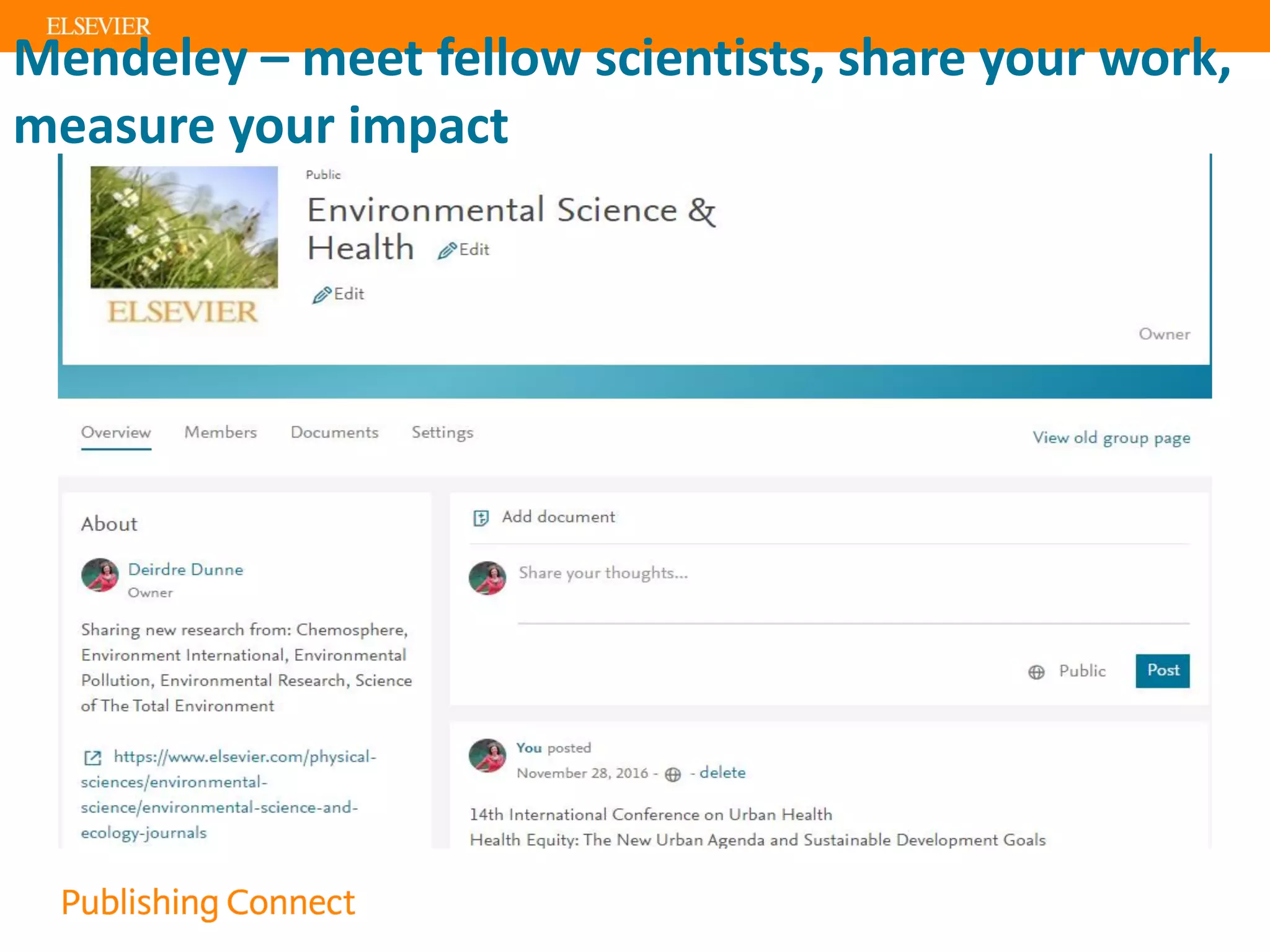
Mendeley – meet fellow scientists, share your work,
measure your impact
Journal Hompages
Open Access
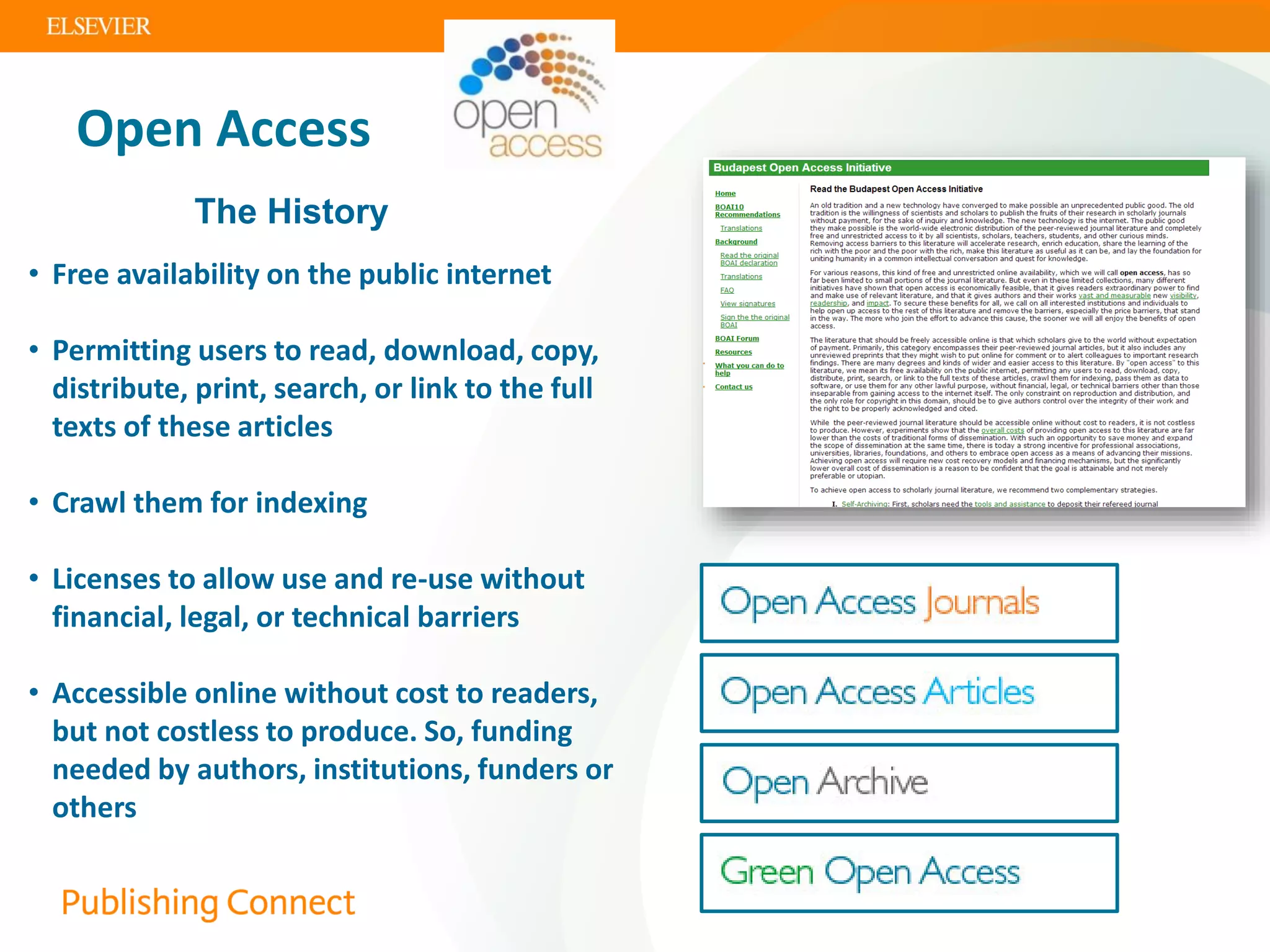
The History
• Free availability on the public internet
• Permitting users to read, download, copy,
distribute, print, search, or link to the full
texts of these articles
• Crawl them for indexing
• Licenses to allow use and re-use without
financial, legal, or technical barriers
• Accessible online without cost to readers,
but not costless to produce. So, funding
needed by authors, institutions, funders or
others
How To Get Your Article Published
Before you start
What is a strong manuscript?
• Has a novel, clear, useful, and exciting message
• Presented and constructed in a logical manner
• Reviewers and editors can grasp the scientific
significance easily
Editors and reviewers are all busy scientists –
make things easy to save their time
 Look at your references – these will help you narrow your choices.
 Review recent publications in each candidate journal. Find out
the hot topics, the accepted types of articles, etc.
 Ask yourself the following questions:
- Is the journal peer-reviewed?
- Who is this journal’s audience?
- What is the journal’s Impact Factor?
 DO NOT gamble by submitting your manuscript to more than
one journal at a time.
- International ethics standards prohibit multiple/simultaneous
submissions, and editors DO find out! (Trust us, they DO!)
Select the best journal for submission
Practical Advice
• Find out what’s Hot
 http://info.scopus.com/topcited/
 http://top25.sciencedirect.com/
 http://www.scitopics.com/
• Find the trends of the subject area
 Search tips (including alerts)
 Journals, authors, publications per year (Scopus)
• Evaluate which journal is right for your article
 Impact Factor
 Subject Specific Impact Factor (http://tinyurl.com/scopusimpact)
 SCImago Journal & Country Ranking (http://scimagojr.com/)
 Journal Analyzer
 h-Index
• Find out more about the journals
 Who are the editors?
 Guide for authors
IF
Find out what’s Hot
Impact Factor
[the average annual number of citations per article published
calculated over a 2 year period]
- e.g. 600 citations = 2
150 + 150 articles
What is the Impact Factor (IF)?
0.0 0.5 1.0 1.5 2.0 2.5 3.0 3.5
Mathematics & Computer Sciences
Social Sciences
Materials Science & Engineering
Biological Sciences
Environmental Sciences
Earth Sciences
Chemistry & Chemical Engineering
Physics
Pharmacology & Toxicology
Clinical Medicine
Neuroscience
Fundamental Life Sciences
Mean Impact Factor
Influences on Impact Factors: Subject Area
Identify the right audience for your paper
• Identify the sector of
readership/community for
which a paper is meant
• Identify the interest of your audience
• Is your paper of local or international interest
How To Structure Your Article
| 36
Preparing your article
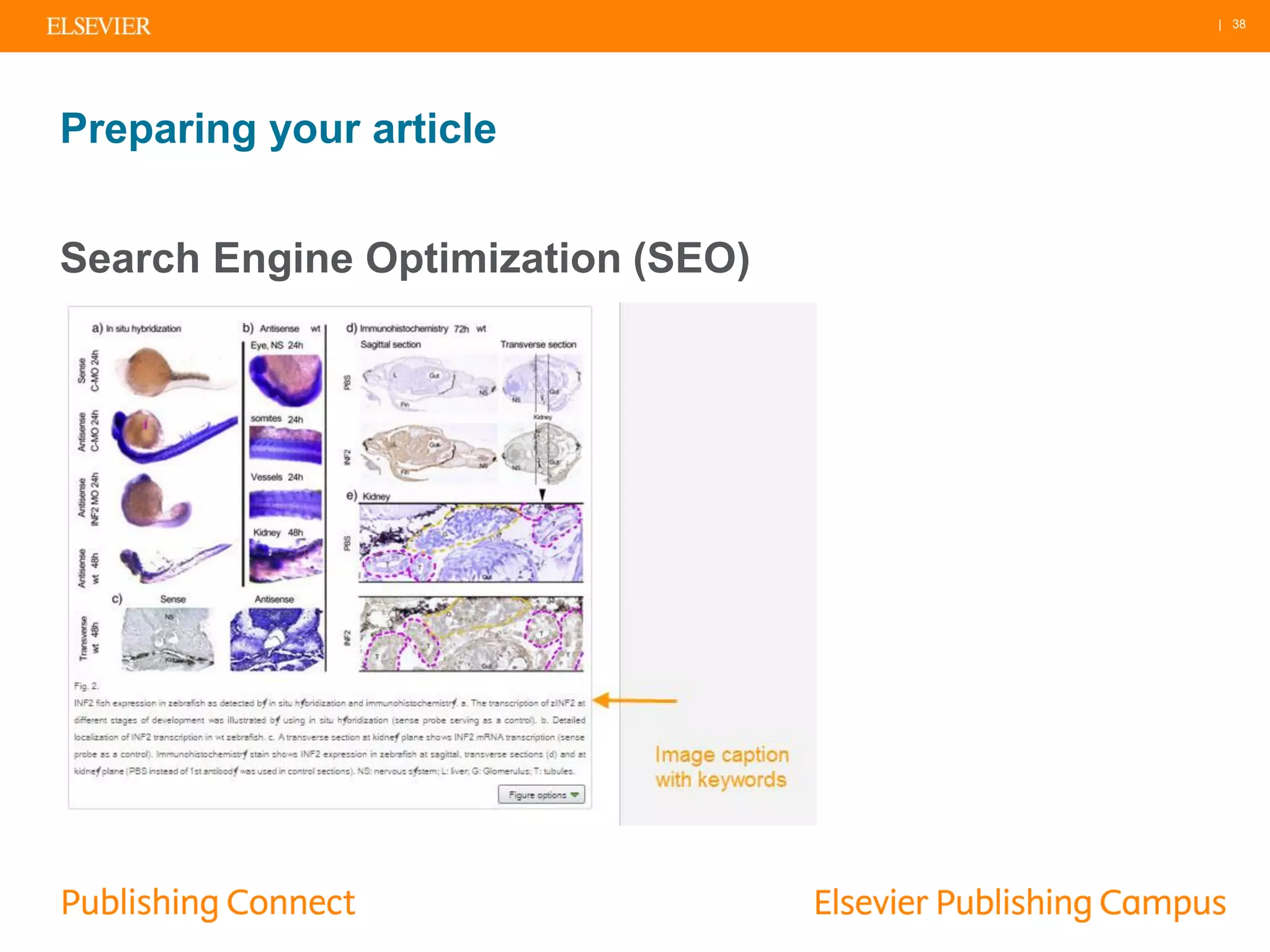
Search Engine Optimization (SEO)
| 37
Preparing your article
Search Engine Optimization (SEO)
| 38
Preparing your article
Search Engine Optimization (SEO)
| 39
Preparing your article
AudioSlides
| 40
Preparing your article
Graphical Abstracts
Targeting the lymphatics using dendritic polymers (dendrimers), Lisa M. Kaminskasa, Christopher
J.H. Porter, Advanced Drug Delivery Reviews, http://dx.doi.org/10.1016/j.addr.2011.05.016
General Structure of a Research Article
• Title
• Abstract
• Keywords
• Main text (IMRAD)
 Introduction
 Methods
 Results
 And
 Discussions
• Conclusion
• Acknowledgement
• References
• Supplementary Data
Journal space is not unlimited.
Your reader’s time is also scarce.
Make your article as concise as possible
- more difficult than you imagine!.
Make them easy for indexing and
searching! (informative, attractive,
effective)
Scientific Language – Overview
• Key to successful scientific writing is to be alert for
common errors:
 Sentence construction
 Incorrect tenses
 Inaccurate grammar
 Not using English
Check the Guide for Authors of the target journal for language
specifications
Write with clarity, objectivity, accuracy, and brevity.
Scientific Language – Sentences
• Write direct and short sentences
• One idea or piece of information per sentence is
sufficient
• Avoid multiple statements in one sentence
Methods Results Discussion
Conclusion
Figures/tables (your data)
Introduction
Title & Abstract
The process of writing – building the article
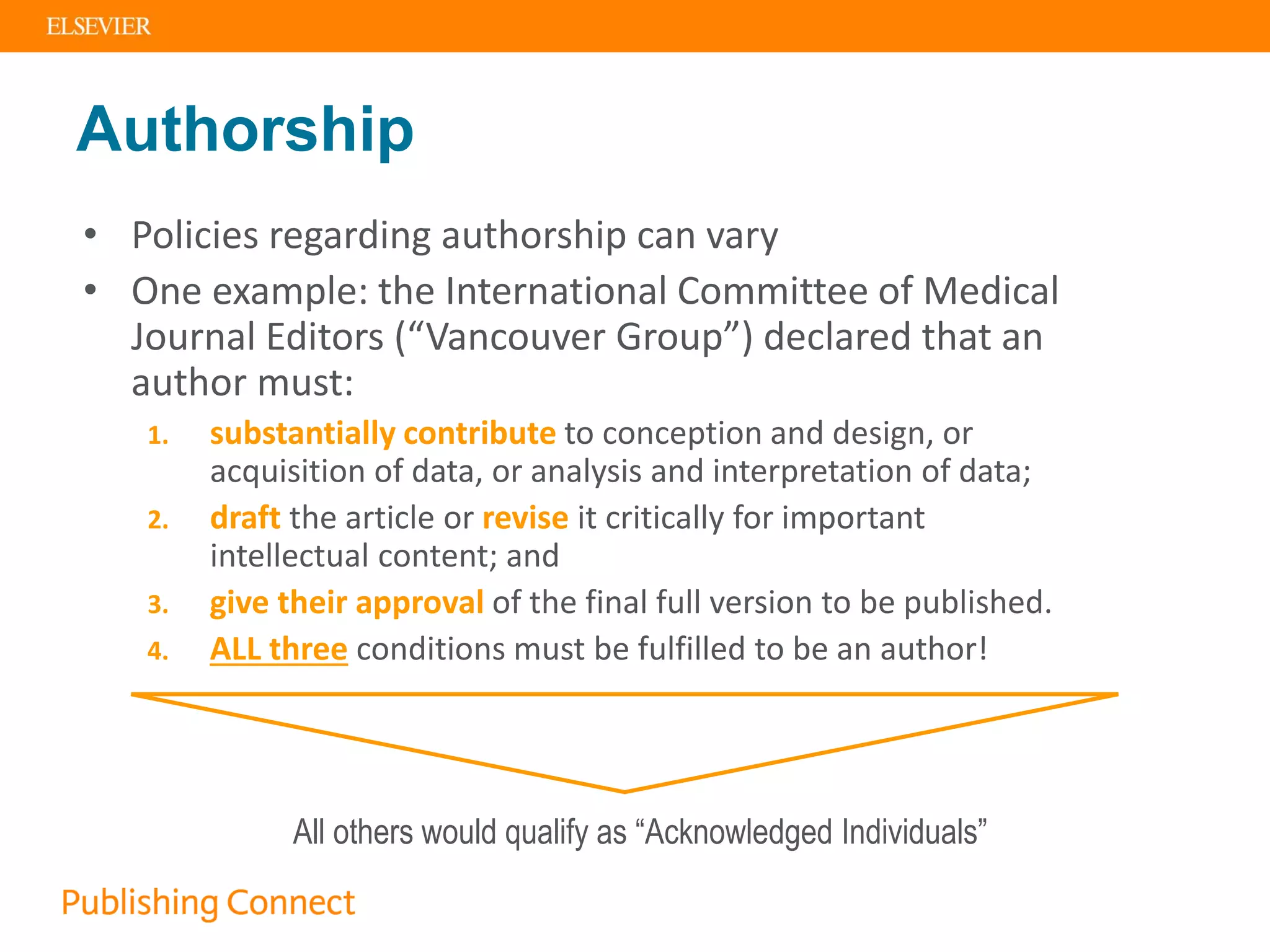
Authorship
• Policies regarding authorship can vary
• One example: the International Committee of Medical
Journal Editors (“Vancouver Group”) declared that an
author must:
1. substantially contribute to conception and design, or
acquisition of data, or analysis and interpretation of data;
2. draft the article or revise it critically for important
intellectual content; and
3. give their approval of the final full version to be published.
4. ALL three conditions must be fulfilled to be an author!
All others would qualify as “Acknowledged Individuals”
Authorship - Order & Abuses
• General principles for who is listed first
 First Author
- Conducts and/or supervises the data generation and analysis
and the proper presentation and interpretation of the results
- Puts paper together and submits the paper to journal
 Corresponding author
- The first author or a senior author from the institution
- Particularly when the first author is a PhD student or postdoc, and may
move to another institution soon.
• Abuses to be avoided
 Ghost Authors: leaving out authors who should be included
 Gift Authors: including authors who did not contribute significantly
Acknowledged Individuals
Recognize those who helped in the research, but do not
qualify as authors (you want them to help again, don’t
you?)
Include individuals who have assisted you in your study:
Advisors
Financial supporters
Proofreaders
Typists
Suppliers who may have given materials
Title
• A good title should contain the fewest possible words that
adequately describe the contents of a paper.
• Effective titles
 Identify the main issue of the paper
 Begin with the subject of the paper
 Are accurate, unambiguous, specific, and complete
 Are as short as possible
- Articles with short, catchy titles are often better cited
 Do not contain rarely-used abbreviations
 Attract readers - Remember: readers are the potential authors who
will cite your article
48
Abstract
Tell readers what you did and the important findings
• One paragraph (between 50-300 words) often plus Highlight bullet points
• Advertisement for your article
• A clear abstract will strongly influence if your work is considered further
Keywords
In an “electronic world, keywords determine
whether your article is found or not!
Avoid making them
 too general (“drug delivery”, “mouse”, “disease”, etc.)
 too narrow (so that nobody will ever search for it)
Effective approach:
Look at the keywords of articles relevant to your
manuscript
Play with these keywords, and see whether they return
relevant papers, neither too many nor too few
Introduction
The place to convince readers that you know why your work is relevant,
also for them
Answer a series of questions:
 What is the problem?
 Are there any existing solutions?
 Which one is the best?
 What is its main limitation?
 What do you hope to achieve?
51
General
Specific
Results – what have you found?
• The following should be included
 the main findings
- Thus not all findings
- Findings from experiments described in the Methods section
 Highlight findings that differ from findings in previous publications, and
unexpected findings
 Results of the statistical analysis
52
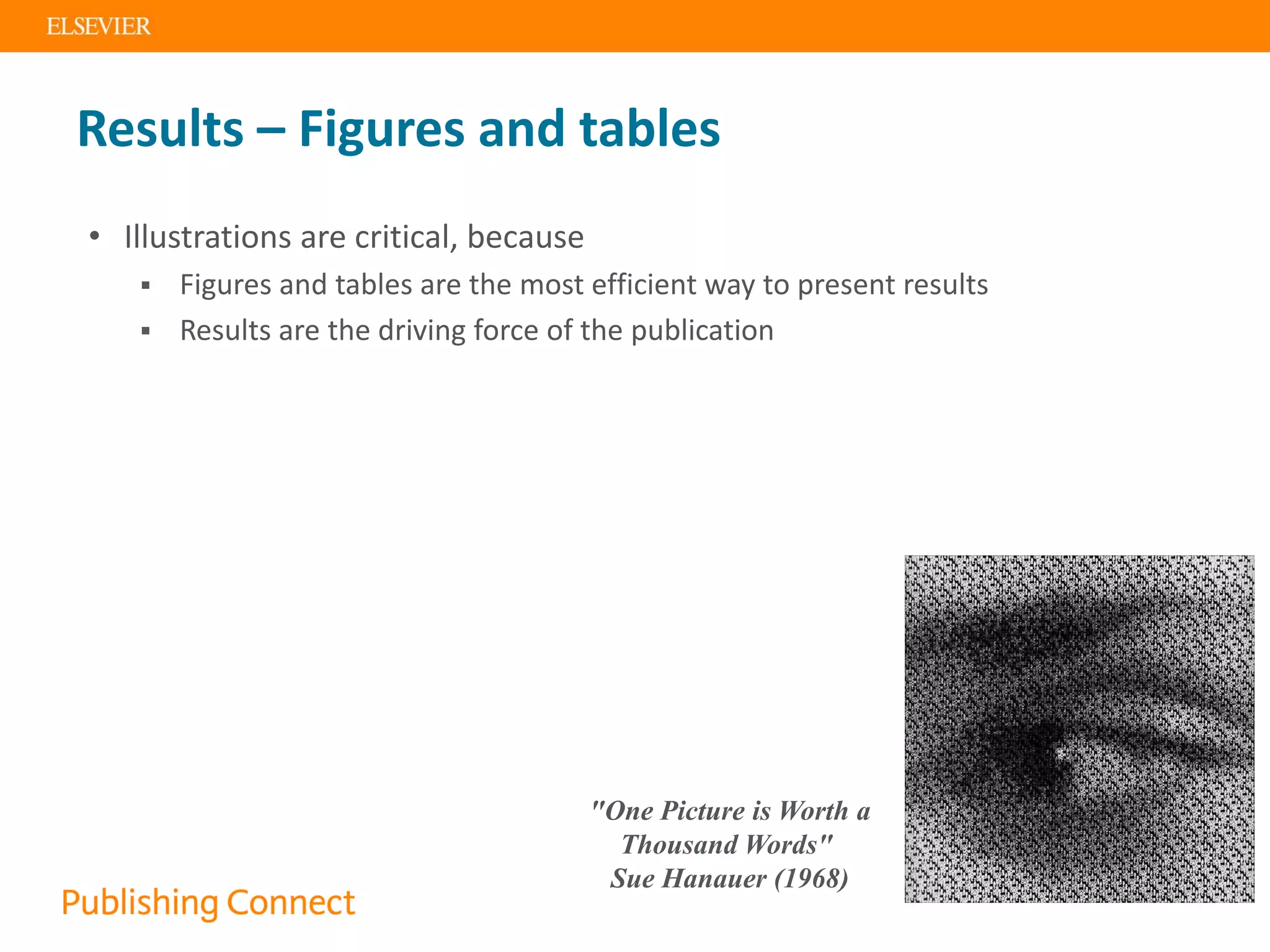
"One Picture is Worth a
Thousand Words"
Sue Hanauer (1968)
Results – Figures and tables
• Illustrations are critical, because
 Figures and tables are the most efficient way to present results
 Results are the driving force of the publication
Discussion – what do the results mean?
• It is the most important section of your article. Here you get the
chance to SELL your data!
 Many manuscripts are rejected because the Discussion is weak
• Check for the following:
 How do your results relate to the original question or objectives
outlined in the Introduction section?
 Do you provide interpretation for each of your results presented?
 Are your results consistent with what other investigators have
reported? Or are there any differences? Why?
 Are there any limitations?
 Does the discussion logically lead to your conclusion?
• Do not
 Make statements that go beyond what the results can support
 Suddenly introduce new terms or ideas
54
Conclusions
• Present global and specific conclusions
• Indicate uses and extensions if appropriate
• Suggest future experiments and indicate whether they are underway
• Do not summarize the paper
 The abstract is for that purpose
• Avoid judgments about impact
55
References: get them right!
• Please adhere to the Guide for Authors of the journal
• It is your responsibility, not of the Editor’s, to format references
correctly!
• Check
 Referencing style of the journal
 The spelling of author names, the year of publication
 Punctuation use
 Use of “et al.”: “et al.” translates to “and others”,
• Avoid citing the following if possible:
 Personal communications, unpublished observations,
manuscripts not yet accepted for publication
- Editors may ask for such documents for evaluation of the
manuscripts
 Articles published only in the local language, which are
difficult for international readers to find
56
Supplementary Material
• Data of secondary importance for the main scientific thrust of
the article
 e.g. individual curves, when a representative curve or a
mean curve is given in the article itself
• Or data that do not fit into the main body of the article
 e.g. audio, video, ....
• Not part of the printed article
 Will be available online with the published paper
• Must relate to, and support the article
57
Suggested length of a full article
• Not the same for all journals, even in the same field
• “…25- 30 pages is the ideal length for a submitted manuscript, including
ESSENTIAL data only.”
 Title page
 Abstract 1 paragraph
 Introduction 1.5-2 manuscript pages (double-spaced, 12pt)
 Methods 2-4 manuscript pages
 Results and Discussion 10-12 manuscript pages
 Conclusions 1-2 manuscript pages
 Figures 6-8
 Tables 1-3
 References 20-50
 Letters or short communications usually have a stricter size limitation, e.g.
3,000 words and no more than 5 figures/tables.
Cover Letter
Your chance to speak to the editor directly
• Submitted along with your manuscript
• Mention what would make your manuscript special to the
journal
• Note special requirements (suggest reviewers, conflicts of
interest)
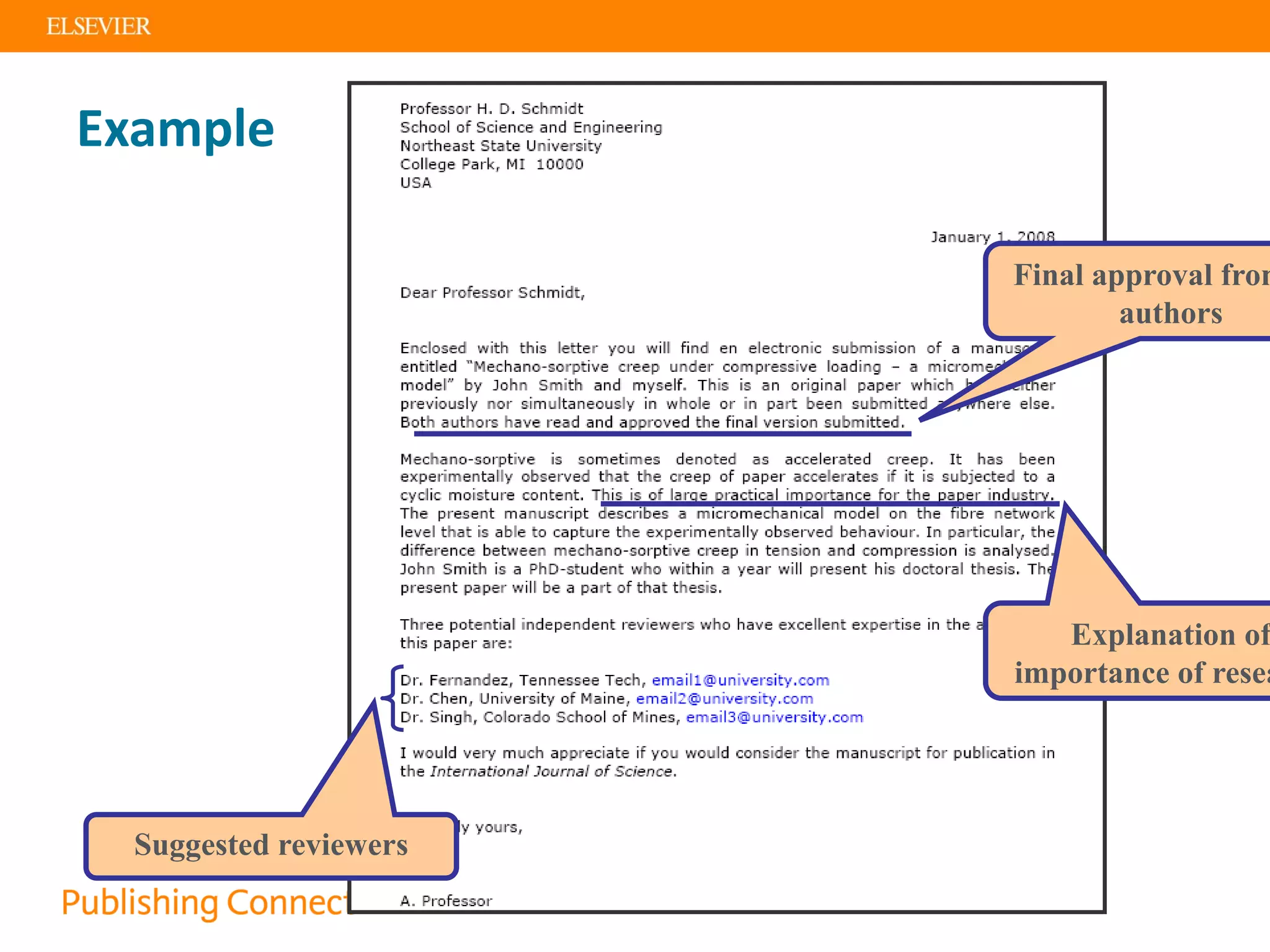
Example
Final approval from
authors
Explanation of
importance of resea
Suggested reviewers
Suggest potential reviewers
• Your suggestions will help the Editor to move
your manuscript to the review stage more
efficiently.
• You can easily find potential reviewers and
their contact details from articles in your
specific subject area (e.g., your references).
• The reviewers should represent at least two
regions of the world. And they should not be
your supervisor or close friends.
• Be prepared to suggest 3-6 potential reviewers,
based on the Guide to Authors.
First Decision: “Accepted” or “Rejected”
Accepted
• Very rare, but it happens
• Congratulations!
 Cake for the department
 Now wait for page proofs and
then for your article to be online
and in print
Rejected
• Probability 40-90% ...
• Do not despair
 It happens to everybody
• Try to understand WHY
 Consider reviewers’ advice
 Be self-critical
• If you submit to another journal,
begin as if it were a new
manuscript
 Take advantage of the reviewers’
comments
 They may review your manuscript
for the other journal too!
 Read the Guide for Authors of the
new journal, again and again.
First Decision: “Major” or “Minor” Revision
• Minor revision
 Basically, the manuscript is worth to be published
 Some elements in the manuscript must be clarified, restructured,
shortened (often) or expanded (rarely)
 Textual adaptations
 “Minor revision” does NOT guarantee acceptance after revision!
• Major revision
 The manuscript may be worth to be published
 Significant deficiencies must be corrected before acceptance
 Involves (significant) textual modifications and/or additional
experiments
Manuscript Revision
• Prepare a detailed Response Letter
 Copy-paste each reviewer comment, and type your response below it
 State specifically which changes you have made to the manuscript
- Include page/line numbers
- No general statements like “Comment accepted, and Discussion changed
accordingly.”
 Provide a scientific response to comments to accept, .....
 ..... or a convincing, solid and polite rebuttal when you feel the reviewer was
wrong.
 Write in such a manner, that your response can be forwarded to the reviewer
without prior editing
• Do not do yourself a disfavour, but cherish your work
 You spent weeks and months in the library to do the research
 It took you weeks to write the manuscript
Why then run the risk of avoidable rejection
by not taking manuscript revision seriously?
Get noticed
Promoting your researcher for
maximum impact
| 66
You want to make sure your research gets the attention
it deserves
7 hrs/week
average time
spent on literature
1970 2013
0
40M
 The volume of research articles is
growing at an accelerated pace
 For most researchers, it’s a real
challenge to keep up with the literature
 Your job: make sure your research
doesn’t fall through the cracks!
Write a lay summary
 Academic articles are written in a specific way
 They can be difficult to understand
 Lay summaries make research understandable
for a wider audience
| 67
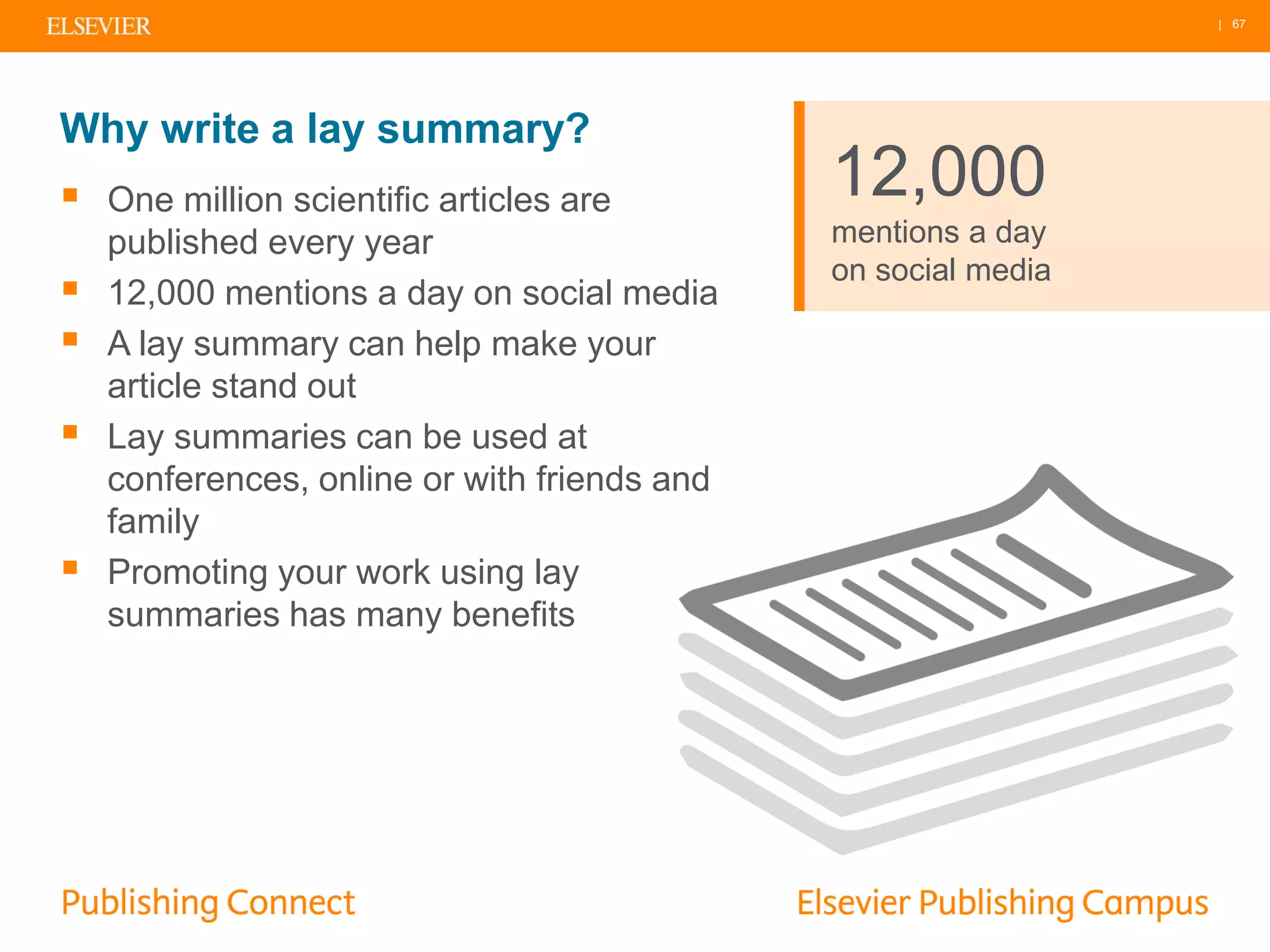
Why write a lay summary?
 One million scientific articles are
published every year
 12,000 mentions a day on social media
 A lay summary can help make your
article stand out
 Lay summaries can be used at
conferences, online or with friends and
family
 Promoting your work using lay
summaries has many benefits
12,000
mentions a day
on social media
| 68
What is a lay summary?
Lay summaries:
 Are short summaries of an academic
article
 Explain complex concepts and focus
on the results and impacts
 Describe research in plain English
 Can be used in funding applications
 Make research accessible to a wide
audience
 Improve public engagement with
science to benefit wider society
| 69
Promoting your article
1. Conferences
 Prepare to network
 Also connect online
 Online poster
2. Media relations
 Research statement
 Your institution’s communication’s channels
 Contact your editor or you can send an email
to: researchcomm@elsevier.com
| 70
Promoting your article
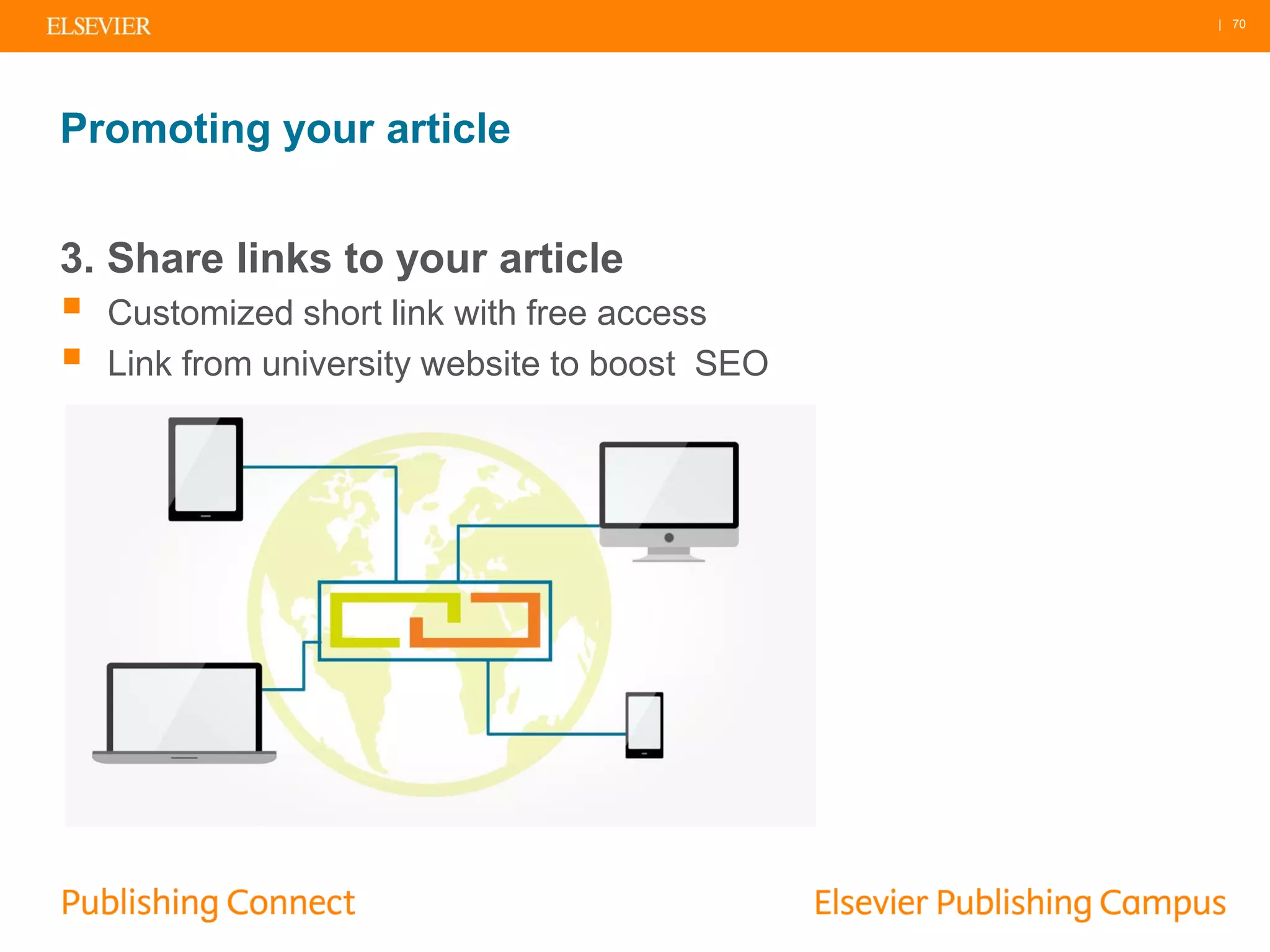
3. Share links to your article
 Customized short link with free access
 Link from university website to boost SEO
| 71
Promoting your article
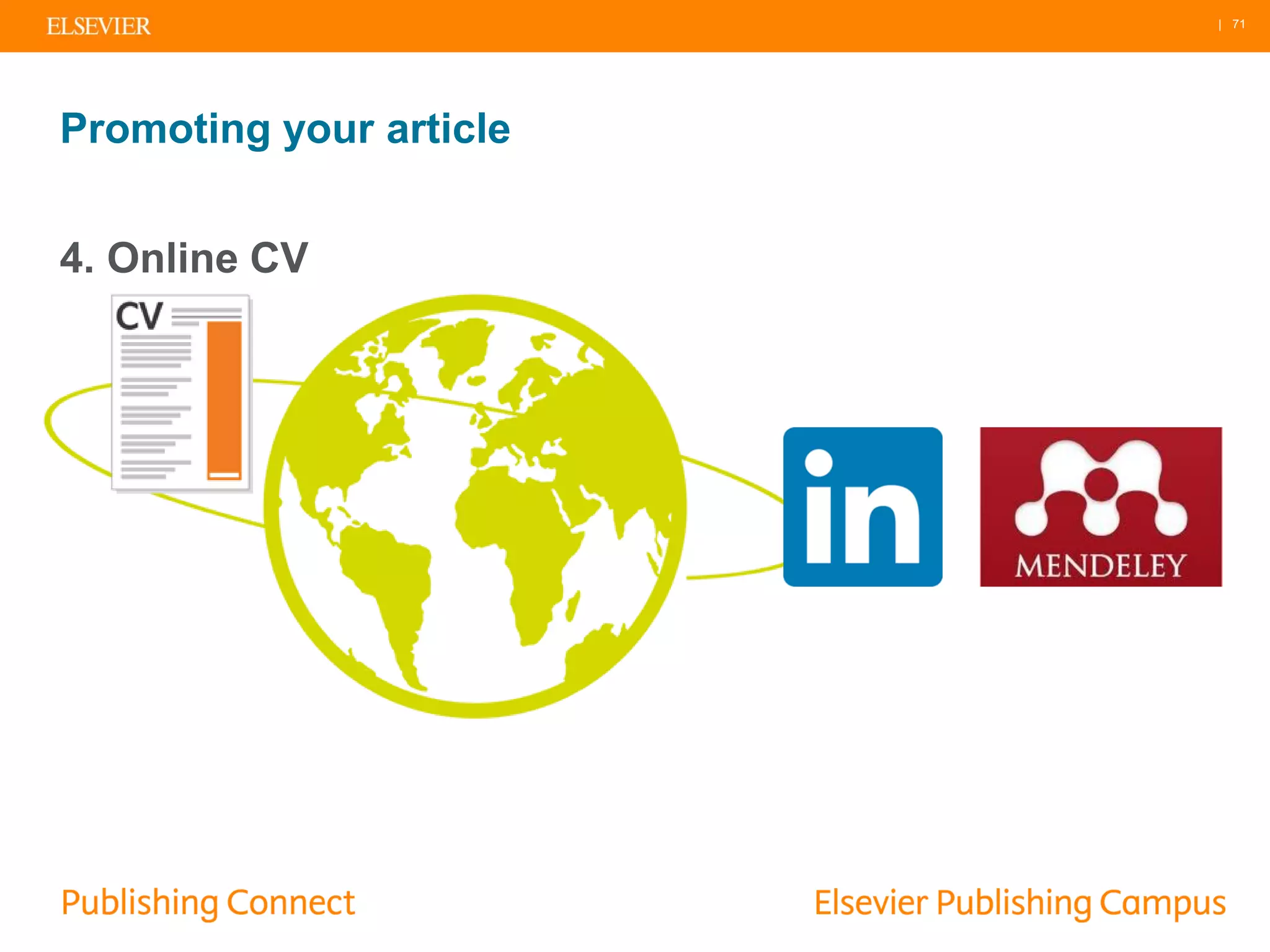
4. Online CV
| 72
Promoting your article
LinkedIn
 Share links to your articles, also in relevant
groups
 Add images
 Add videos, AudioSlides
 Reposition the publication section
Mendeley
 Scholarly collaboration network
 Free reference manager
 Fully-searchable library
 Cite as you write
 Read and annotate your PDFs
| 73
Promoting your article
Social media: Twitter
 Follow other researchers
 Post regularly and respond
promptly
 Retweet
 Use images
Social media: Facebook
 Create a ‘fan’ page
 Invite fellow researchers
 Share images, videos, AudioSlides
 Link to your articles
 Discuss and ask for feedback
one mention every seven seconds
| 74
Monitoring your article
My Research Dashboard:
 Early feedback on downloads,
shares and citations
 Data about the geographic
locations and research disciplines
of your readers
 Search terms used in ScienceDirect
to find your publications
 A comparison of the
performance of your article with
other people’s articles
| 75
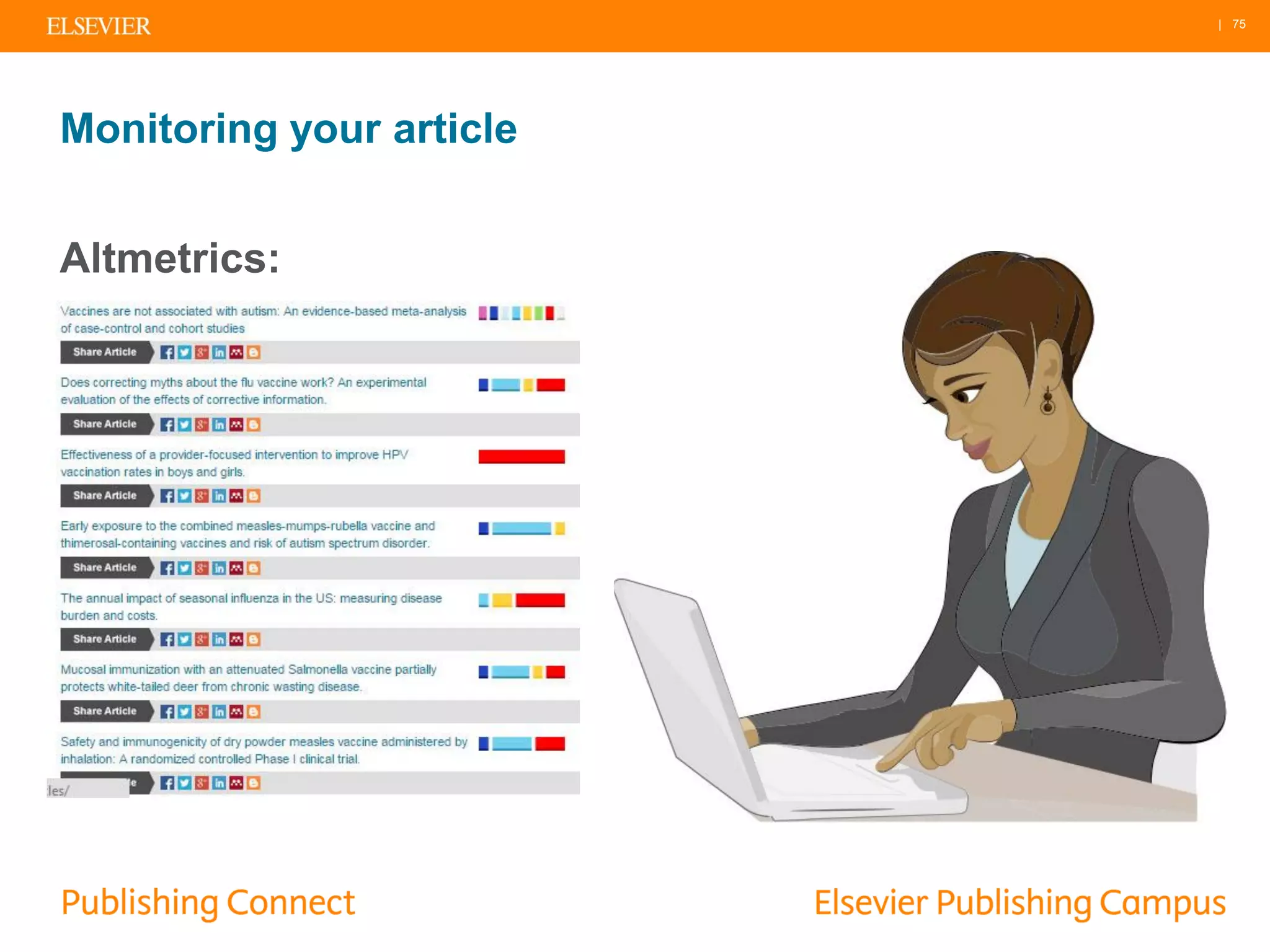
Monitoring your article
Altmetrics:
| 76
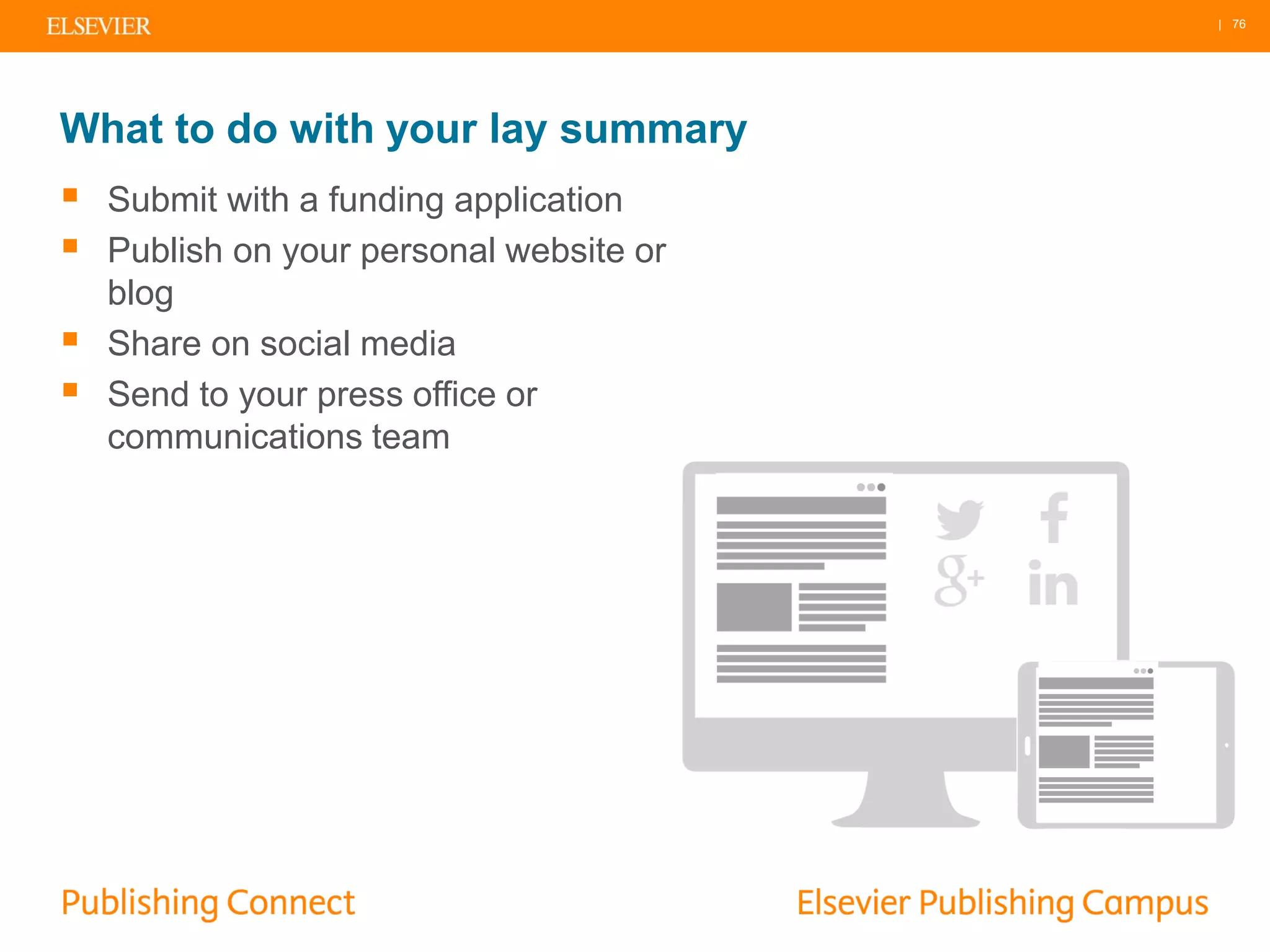
What to do with your lay summary
 Submit with a funding application
 Publish on your personal website or
blog
 Share on social media
 Send to your press office or
communications team

Publishing Connect NUI Galway - 31st Jan 2017

  • 1.
    Introduction to scholarly publishing Thejournal publishing cycle Deirdre Dunne – Publisher Environmental Science & Health
  • 2.
    The Publisher’s Role RegistrationCertification Dissemination Preservation Use How do Publishers add value to the scientific & health community? Innovation & Technology
  • 3.
    The digital ageof publishing 3 Solicit and manage submissions Manage Peer Review Production Publish and Disseminate Edit and Prepare Archive and promote use eJournal Backfiles eReference Works Mobile content Electronic platforms Electronic warehousing Author submission & Editorial systems Production tracking systems
  • 4.
    Jacob de Boer ShaneSnyder Damia Barcelo Jay Gan David Carpenter Eddy Zeng K. KannanJose Domingo Ruth Alcock Adrian Covaci Ron Tjeerdema Mikko Nikinmaa Kirk Semple Ravi Naidu Yong-Guan Zhu Guibin Jiang Phil Demokritou Jamie Lead Bernd Nowack
  • 5.
    | 5 Further readingat publishingcampus.com elsevier.com/authors elsevier.com/reviewers elsevier.com/editors Get Published – top tips on writing, reviewing and grant writing etc. Publishing Ethics brochure – top reasons to publish ethically Get Noticed – new ways to promote your article and research Understanding the Publishing Process with Elsevier – complete guide Open access – definitions and options Career Planning Guide – download in 12 languages
  • 6.
  • 7.
  • 8.
  • 9.
  • 10.
  • 11.
  • 12.
  • 13.
  • 14.
  • 15.
    Performance Indicators –International Collaboration
  • 16.
  • 17.
  • 18.
  • 19.
  • 20.
    AudioSlides • AudioSlides presentationshave clocked up more than 100,000 views • AudioSlides uploaded to YouTube or embedded on institutional websites also encourage people to read the original articles • 15% more downloads of papers with AudioSlides
  • 21.
  • 22.
  • 23.
    Mendeley – meetfellow scientists, share your work
  • 24.
    Mendeley – meetfellow scientists, share your work, measure your impact
  • 25.
  • 26.
    Open Access The History •Free availability on the public internet • Permitting users to read, download, copy, distribute, print, search, or link to the full texts of these articles • Crawl them for indexing • Licenses to allow use and re-use without financial, legal, or technical barriers • Accessible online without cost to readers, but not costless to produce. So, funding needed by authors, institutions, funders or others
  • 27.
    How To GetYour Article Published Before you start
  • 28.
    What is astrong manuscript? • Has a novel, clear, useful, and exciting message • Presented and constructed in a logical manner • Reviewers and editors can grasp the scientific significance easily Editors and reviewers are all busy scientists – make things easy to save their time
  • 29.
     Look atyour references – these will help you narrow your choices.  Review recent publications in each candidate journal. Find out the hot topics, the accepted types of articles, etc.  Ask yourself the following questions: - Is the journal peer-reviewed? - Who is this journal’s audience? - What is the journal’s Impact Factor?  DO NOT gamble by submitting your manuscript to more than one journal at a time. - International ethics standards prohibit multiple/simultaneous submissions, and editors DO find out! (Trust us, they DO!) Select the best journal for submission
  • 30.
    Practical Advice • Findout what’s Hot  http://info.scopus.com/topcited/  http://top25.sciencedirect.com/  http://www.scitopics.com/ • Find the trends of the subject area  Search tips (including alerts)  Journals, authors, publications per year (Scopus) • Evaluate which journal is right for your article  Impact Factor  Subject Specific Impact Factor (http://tinyurl.com/scopusimpact)  SCImago Journal & Country Ranking (http://scimagojr.com/)  Journal Analyzer  h-Index • Find out more about the journals  Who are the editors?  Guide for authors IF
  • 31.
  • 32.
    Impact Factor [the averageannual number of citations per article published calculated over a 2 year period] - e.g. 600 citations = 2 150 + 150 articles What is the Impact Factor (IF)?
  • 33.
    0.0 0.5 1.01.5 2.0 2.5 3.0 3.5 Mathematics & Computer Sciences Social Sciences Materials Science & Engineering Biological Sciences Environmental Sciences Earth Sciences Chemistry & Chemical Engineering Physics Pharmacology & Toxicology Clinical Medicine Neuroscience Fundamental Life Sciences Mean Impact Factor Influences on Impact Factors: Subject Area
  • 34.
    Identify the rightaudience for your paper • Identify the sector of readership/community for which a paper is meant • Identify the interest of your audience • Is your paper of local or international interest
  • 35.
    How To StructureYour Article
  • 36.
    | 36 Preparing yourarticle Search Engine Optimization (SEO)
  • 37.
    | 37 Preparing yourarticle Search Engine Optimization (SEO)
  • 38.
    | 38 Preparing yourarticle Search Engine Optimization (SEO)
  • 39.
    | 39 Preparing yourarticle AudioSlides
  • 40.
    | 40 Preparing yourarticle Graphical Abstracts Targeting the lymphatics using dendritic polymers (dendrimers), Lisa M. Kaminskasa, Christopher J.H. Porter, Advanced Drug Delivery Reviews, http://dx.doi.org/10.1016/j.addr.2011.05.016
  • 41.
    General Structure ofa Research Article • Title • Abstract • Keywords • Main text (IMRAD)  Introduction  Methods  Results  And  Discussions • Conclusion • Acknowledgement • References • Supplementary Data Journal space is not unlimited. Your reader’s time is also scarce. Make your article as concise as possible - more difficult than you imagine!. Make them easy for indexing and searching! (informative, attractive, effective)
  • 42.
    Scientific Language –Overview • Key to successful scientific writing is to be alert for common errors:  Sentence construction  Incorrect tenses  Inaccurate grammar  Not using English Check the Guide for Authors of the target journal for language specifications Write with clarity, objectivity, accuracy, and brevity.
  • 43.
    Scientific Language –Sentences • Write direct and short sentences • One idea or piece of information per sentence is sufficient • Avoid multiple statements in one sentence
  • 44.
    Methods Results Discussion Conclusion Figures/tables(your data) Introduction Title & Abstract The process of writing – building the article
  • 45.
    Authorship • Policies regardingauthorship can vary • One example: the International Committee of Medical Journal Editors (“Vancouver Group”) declared that an author must: 1. substantially contribute to conception and design, or acquisition of data, or analysis and interpretation of data; 2. draft the article or revise it critically for important intellectual content; and 3. give their approval of the final full version to be published. 4. ALL three conditions must be fulfilled to be an author! All others would qualify as “Acknowledged Individuals”
  • 46.
    Authorship - Order& Abuses • General principles for who is listed first  First Author - Conducts and/or supervises the data generation and analysis and the proper presentation and interpretation of the results - Puts paper together and submits the paper to journal  Corresponding author - The first author or a senior author from the institution - Particularly when the first author is a PhD student or postdoc, and may move to another institution soon. • Abuses to be avoided  Ghost Authors: leaving out authors who should be included  Gift Authors: including authors who did not contribute significantly
  • 47.
    Acknowledged Individuals Recognize thosewho helped in the research, but do not qualify as authors (you want them to help again, don’t you?) Include individuals who have assisted you in your study: Advisors Financial supporters Proofreaders Typists Suppliers who may have given materials
  • 48.
    Title • A goodtitle should contain the fewest possible words that adequately describe the contents of a paper. • Effective titles  Identify the main issue of the paper  Begin with the subject of the paper  Are accurate, unambiguous, specific, and complete  Are as short as possible - Articles with short, catchy titles are often better cited  Do not contain rarely-used abbreviations  Attract readers - Remember: readers are the potential authors who will cite your article 48
  • 49.
    Abstract Tell readers whatyou did and the important findings • One paragraph (between 50-300 words) often plus Highlight bullet points • Advertisement for your article • A clear abstract will strongly influence if your work is considered further
  • 50.
    Keywords In an “electronicworld, keywords determine whether your article is found or not! Avoid making them  too general (“drug delivery”, “mouse”, “disease”, etc.)  too narrow (so that nobody will ever search for it) Effective approach: Look at the keywords of articles relevant to your manuscript Play with these keywords, and see whether they return relevant papers, neither too many nor too few
  • 51.
    Introduction The place toconvince readers that you know why your work is relevant, also for them Answer a series of questions:  What is the problem?  Are there any existing solutions?  Which one is the best?  What is its main limitation?  What do you hope to achieve? 51 General Specific
  • 52.
    Results – whathave you found? • The following should be included  the main findings - Thus not all findings - Findings from experiments described in the Methods section  Highlight findings that differ from findings in previous publications, and unexpected findings  Results of the statistical analysis 52
  • 53.
    "One Picture isWorth a Thousand Words" Sue Hanauer (1968) Results – Figures and tables • Illustrations are critical, because  Figures and tables are the most efficient way to present results  Results are the driving force of the publication
  • 54.
    Discussion – whatdo the results mean? • It is the most important section of your article. Here you get the chance to SELL your data!  Many manuscripts are rejected because the Discussion is weak • Check for the following:  How do your results relate to the original question or objectives outlined in the Introduction section?  Do you provide interpretation for each of your results presented?  Are your results consistent with what other investigators have reported? Or are there any differences? Why?  Are there any limitations?  Does the discussion logically lead to your conclusion? • Do not  Make statements that go beyond what the results can support  Suddenly introduce new terms or ideas 54
  • 55.
    Conclusions • Present globaland specific conclusions • Indicate uses and extensions if appropriate • Suggest future experiments and indicate whether they are underway • Do not summarize the paper  The abstract is for that purpose • Avoid judgments about impact 55
  • 56.
    References: get themright! • Please adhere to the Guide for Authors of the journal • It is your responsibility, not of the Editor’s, to format references correctly! • Check  Referencing style of the journal  The spelling of author names, the year of publication  Punctuation use  Use of “et al.”: “et al.” translates to “and others”, • Avoid citing the following if possible:  Personal communications, unpublished observations, manuscripts not yet accepted for publication - Editors may ask for such documents for evaluation of the manuscripts  Articles published only in the local language, which are difficult for international readers to find 56
  • 57.
    Supplementary Material • Dataof secondary importance for the main scientific thrust of the article  e.g. individual curves, when a representative curve or a mean curve is given in the article itself • Or data that do not fit into the main body of the article  e.g. audio, video, .... • Not part of the printed article  Will be available online with the published paper • Must relate to, and support the article 57
  • 58.
    Suggested length ofa full article • Not the same for all journals, even in the same field • “…25- 30 pages is the ideal length for a submitted manuscript, including ESSENTIAL data only.”  Title page  Abstract 1 paragraph  Introduction 1.5-2 manuscript pages (double-spaced, 12pt)  Methods 2-4 manuscript pages  Results and Discussion 10-12 manuscript pages  Conclusions 1-2 manuscript pages  Figures 6-8  Tables 1-3  References 20-50  Letters or short communications usually have a stricter size limitation, e.g. 3,000 words and no more than 5 figures/tables.
  • 59.
    Cover Letter Your chanceto speak to the editor directly • Submitted along with your manuscript • Mention what would make your manuscript special to the journal • Note special requirements (suggest reviewers, conflicts of interest)
  • 60.
    Example Final approval from authors Explanationof importance of resea Suggested reviewers
  • 61.
    Suggest potential reviewers •Your suggestions will help the Editor to move your manuscript to the review stage more efficiently. • You can easily find potential reviewers and their contact details from articles in your specific subject area (e.g., your references). • The reviewers should represent at least two regions of the world. And they should not be your supervisor or close friends. • Be prepared to suggest 3-6 potential reviewers, based on the Guide to Authors.
  • 62.
    First Decision: “Accepted”or “Rejected” Accepted • Very rare, but it happens • Congratulations!  Cake for the department  Now wait for page proofs and then for your article to be online and in print Rejected • Probability 40-90% ... • Do not despair  It happens to everybody • Try to understand WHY  Consider reviewers’ advice  Be self-critical • If you submit to another journal, begin as if it were a new manuscript  Take advantage of the reviewers’ comments  They may review your manuscript for the other journal too!  Read the Guide for Authors of the new journal, again and again.
  • 63.
    First Decision: “Major”or “Minor” Revision • Minor revision  Basically, the manuscript is worth to be published  Some elements in the manuscript must be clarified, restructured, shortened (often) or expanded (rarely)  Textual adaptations  “Minor revision” does NOT guarantee acceptance after revision! • Major revision  The manuscript may be worth to be published  Significant deficiencies must be corrected before acceptance  Involves (significant) textual modifications and/or additional experiments
  • 64.
    Manuscript Revision • Preparea detailed Response Letter  Copy-paste each reviewer comment, and type your response below it  State specifically which changes you have made to the manuscript - Include page/line numbers - No general statements like “Comment accepted, and Discussion changed accordingly.”  Provide a scientific response to comments to accept, .....  ..... or a convincing, solid and polite rebuttal when you feel the reviewer was wrong.  Write in such a manner, that your response can be forwarded to the reviewer without prior editing • Do not do yourself a disfavour, but cherish your work  You spent weeks and months in the library to do the research  It took you weeks to write the manuscript Why then run the risk of avoidable rejection by not taking manuscript revision seriously?
  • 65.
    Get noticed Promoting yourresearcher for maximum impact
  • 66.
    | 66 You wantto make sure your research gets the attention it deserves 7 hrs/week average time spent on literature 1970 2013 0 40M  The volume of research articles is growing at an accelerated pace  For most researchers, it’s a real challenge to keep up with the literature  Your job: make sure your research doesn’t fall through the cracks! Write a lay summary  Academic articles are written in a specific way  They can be difficult to understand  Lay summaries make research understandable for a wider audience
  • 67.
    | 67 Why writea lay summary?  One million scientific articles are published every year  12,000 mentions a day on social media  A lay summary can help make your article stand out  Lay summaries can be used at conferences, online or with friends and family  Promoting your work using lay summaries has many benefits 12,000 mentions a day on social media
  • 68.
    | 68 What isa lay summary? Lay summaries:  Are short summaries of an academic article  Explain complex concepts and focus on the results and impacts  Describe research in plain English  Can be used in funding applications  Make research accessible to a wide audience  Improve public engagement with science to benefit wider society
  • 69.
    | 69 Promoting yourarticle 1. Conferences  Prepare to network  Also connect online  Online poster 2. Media relations  Research statement  Your institution’s communication’s channels  Contact your editor or you can send an email to: researchcomm@elsevier.com
  • 70.
    | 70 Promoting yourarticle 3. Share links to your article  Customized short link with free access  Link from university website to boost SEO
  • 71.
    | 71 Promoting yourarticle 4. Online CV
  • 72.
    | 72 Promoting yourarticle LinkedIn  Share links to your articles, also in relevant groups  Add images  Add videos, AudioSlides  Reposition the publication section Mendeley  Scholarly collaboration network  Free reference manager  Fully-searchable library  Cite as you write  Read and annotate your PDFs
  • 73.
    | 73 Promoting yourarticle Social media: Twitter  Follow other researchers  Post regularly and respond promptly  Retweet  Use images Social media: Facebook  Create a ‘fan’ page  Invite fellow researchers  Share images, videos, AudioSlides  Link to your articles  Discuss and ask for feedback one mention every seven seconds
  • 74.
    | 74 Monitoring yourarticle My Research Dashboard:  Early feedback on downloads, shares and citations  Data about the geographic locations and research disciplines of your readers  Search terms used in ScienceDirect to find your publications  A comparison of the performance of your article with other people’s articles
  • 75.
    | 75 Monitoring yourarticle Altmetrics:
  • 76.
    | 76 What todo with your lay summary  Submit with a funding application  Publish on your personal website or blog  Share on social media  Send to your press office or communications team