Publishing and ‘impact’
Information Literacy PhD students
February 16th, 2016 – Hugo Besemer & Ellen Fest
Programme
 Tools
 Publishing
 Metrics
● Article metrics
● Author metrics
● Journal metrics
● Research group metrics
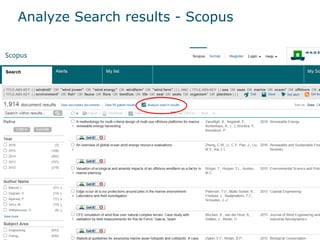
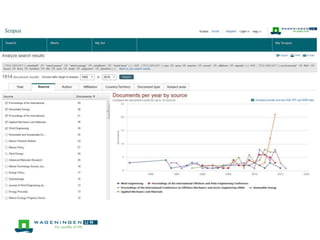
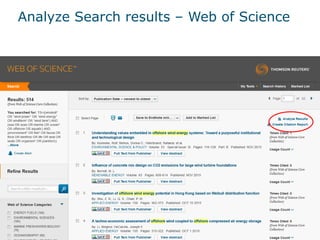
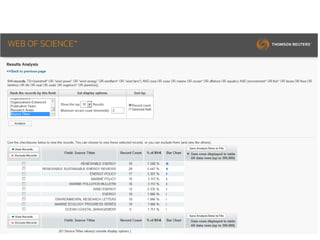
Analyze Search results
 to find interesting journals
 to identify key researchers / institutes
 Scopus or Web of Science
 use it to set up alerts
 contact people e.g. on ResearchGate
Analyze Search results - Scopus
Analyze Search results – Web of Science
Use BrowZine to access Scholarly Journals
 Access your key scholarly journals on
mobile or PC
 Journal subscribed by WageningenUR
Library and OA journals
 Personalised bookshelf
 Sync across devices
 Alerts for new content
 Integration with Endnote and
Mendeley
 Export to Dropbox, Evernote, Google
Drive
 Free!
8
BrowZine Video
Programme
 Tools
 Publishing
 Metrics
● Article metrics
● Author metrics
● Journal metrics
● Research group metrics
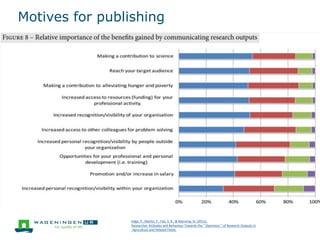
Motives for publishing
Edge, P., Martin, F., Fao, S. R., & Manning, N. (2011).
Researcher Attitudes and Behaviour Towards the “ Openness ” of Research Outputs in
Agriculture and Related Fields.
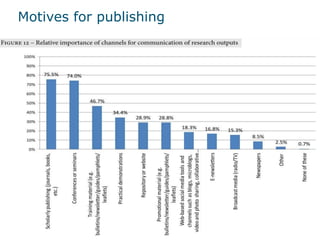
Motives for publishing
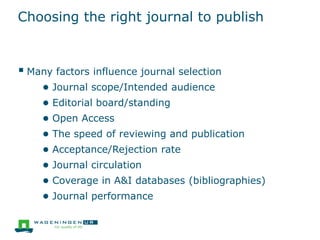
Choosing the right journal to publish
 Many factors influence journal selection
● Journal scope/Intended audience
● Editorial board/standing
● Open Access
● The speed of reviewing and publication
● Acceptance/Rejection rate
● Journal circulation
● Coverage in A&I databases (bibliographies)
● Journal performance
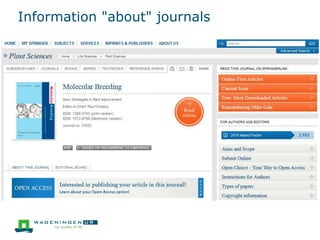
Information "about" journals
Open Access
 OA publishing e.g. PLoS, BMC and Sage Open
 Self-archiving in repositories e.g. Wageningen Yield
(WaY)
 SHERPA/RoMEO: Publisher copyright policies & self-
archiving http://www.sherpa.ac.uk/romeo/
 Directory of open access journals DOAJ (currently ca.
10,000 journals)
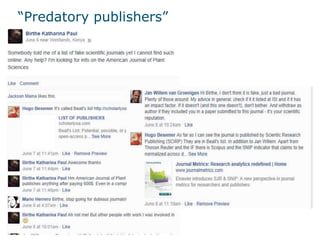
 Be aware of predatory OA publishers  Beall's List
“Predatory publishers”
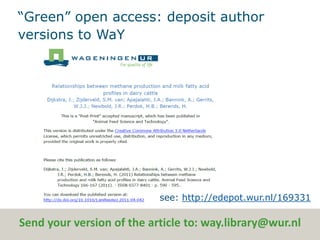
“Green” open access: deposit author
versions to WaY
see: http://edepot.wur.nl/169331
Send your version of the article to: way.library@wur.nl
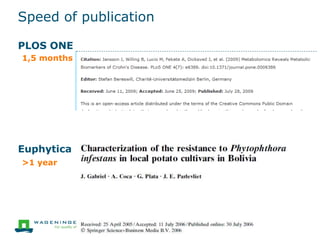
Speed of publication
PLOS ONE
1,5 months
Euphytica
>1 year
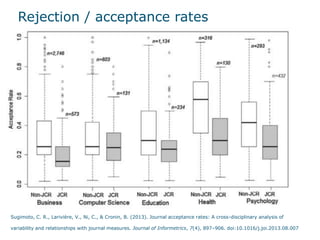
Rejection / acceptance rates
Sugimoto, C. R., Larivière, V., Ni, C., & Cronin, B. (2013). Journal acceptance rates: A cross-disciplinary analysis of
variability and relationships with journal measures. Journal of Informetrics, 7(4), 897–906. doi:10.1016/j.joi.2013.08.007
Journal circulation
 Compare e.g.
● “Agricultural Systems”
● "Proceedings of the National Academy of Sciences
of the United States of America"
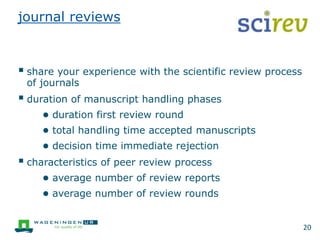
journal reviews
 share your experience with the scientific review process
of journals
 duration of manuscript handling phases
● duration first review round
● total handling time accepted manuscripts
● decision time immediate rejection
 characteristics of peer review process
● average number of review reports
● average number of review rounds
20
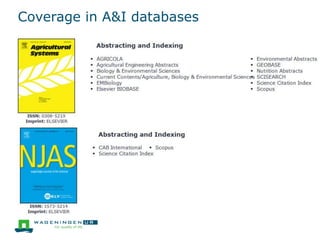
Coverage in A&I databases
Looking for journals?
 use our journal browser!
 www.wageningenur.nl/library
Exercises
 Manual Chapter 9.8
● Exercise 1
Coffee or tea?
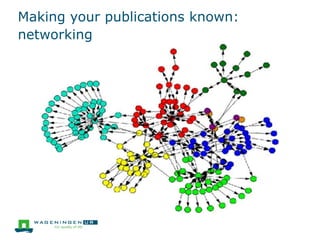
Making your publications known:
networking
Networking is important
Start early, make use of Social Networking tools
● Facebook
● LinkedIn
● Twitter
● Social networks for scientists
● Academia.edu, Researchgate.net
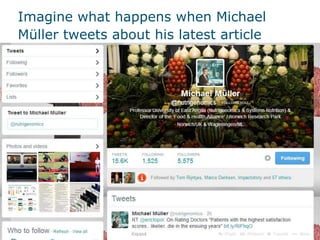
Imagine what happens when Michael
Müller tweets about his latest article
Advertise yourself
 Cite your previous articles!
 Be active at conferences
 Cooperate with other people/research groups
 Write, or expand, articles in the Wikipedia, refer to your
thesis.
 Blog or tweet about your research and thesis research
 Make use of social networking tools (LinkedIn,
Researchgate.net, Mendeley etc.)
 Create author’s identifiers (ScopusID, Researcher ID,
ORCID)
Claim your publications
 ResearcherID (Web of Science)
 Scopus Author ID (Scopus)
 Google Scholar Citations
Enserink, M. (2009). Scientific Publishing: Are You Ready to Become a Number? Science,
323(5922): 1662-1664 http://dx.doi.org/10.1126/science.323.5922.1662
 ORCID
● http://orcid.scopusfeedback.com/
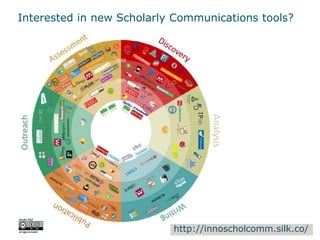
Interested in new Scholarly Communications tools?
http://innoscholcomm.silk.co/
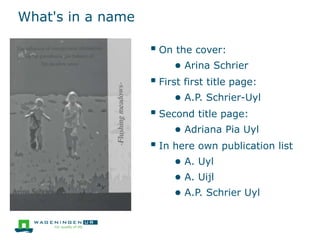
What's in a name
 On the cover:
● Arina Schrier
 First first title page:
● A.P. Schrier-Uyl
 Second title page:
● Adriana Pia Uyl
 In here own publication list
● A. Uyl
● A. Uijl
● A.P. Schrier Uyl
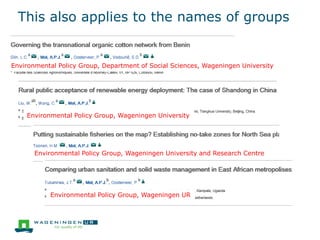
This also applies to the names of groups
Environmental Policy Group, Department of Social Sciences, Wageningen University
Environmental Policy Group, Wageningen University
Environmental Policy Group, Wageningen University and Research Centre
Environmental Policy Group, Wageningen UR
Get your affiliation right
For the university:
Chair group + Wageningen University
Plant Production Systems Group, Wageningen University,
P.O. box ..., 6700 HA Wageningen, The Netherlands
For the institutes:
Institute + Wageningen University & Research Centre
Alterra, Wageningen University & Research Centre, P.O.
box ..., 6700 HA Wageningen, The Netherlands
Some other options to make you articles
effective
Apart from doing good research and writing
well, that is
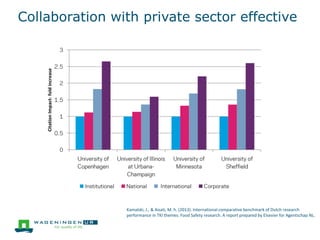
Collaboration with private sector effective
Kamalski, J., & Aisati, M. h. (2013). International comparative benchmark of Dutch research
performance in TKI themes: Food Safety research. A report prepared by Elsevier for Agentschap NL.
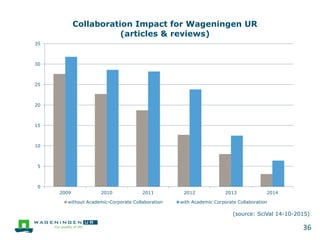
36
(source: SciVal 14-10-2015)
0
5
10
15
20
25
30
35
2009 2010 2011 2012 2013 2014
Collaboration Impact for Wageningen UR
(articles & reviews)
without Academic-Corporate Collaboration with Academic Corporate Collaboration
University-industry collaboration and impact
"The average scientific impact of university-
industry papers is significantly above that of
both university-only papers and industry-only
papers"
Lebeau, L. M., Laframboise, M. C., Larivière, V., & Gingras, Y. (2008). The effect of university-industry
collaboration on the scientific impact of publications: The Canadian case, 1980-2005. Research
Evaluation, 17(3), 227-232. http://dx.doi.org/10.3152/095820208x331685
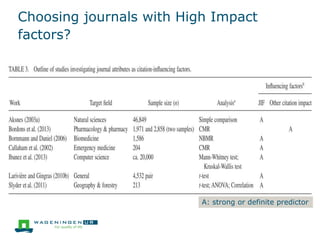
Choosing journals with High Impact
factors?
A: strong or definite predictor
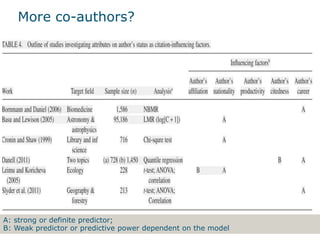
More co-authors?
A: strong or definite predictor;
B: Weak predictor or predictive power dependent on the model
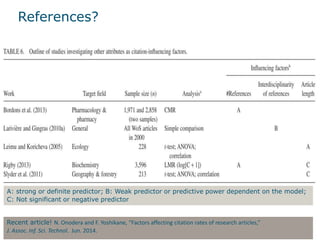
References?
Recent article! N. Onodera and F. Yoshikane, “Factors affecting citation rates of research articles,”
J. Assoc. Inf. Sci. Technol. Jun. 2014.
A: strong or definite predictor; B: Weak predictor or predictive power dependent on the model;
C: Not significant or negative predictor
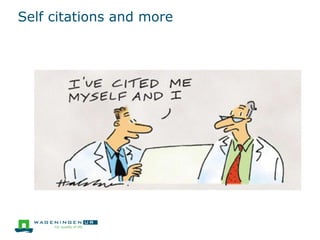
Self citations and more
Self citations
The model [...] implies that external citations are
enhanced by self-citations, so that we have the
“chain reaction:” Larger size leads to more self-
citations, which lead to more external citations.
van Raan, A. F. J. (2008). Self-citation as an impact-reinforcing mechanism in the
science system. Journal of the American Society for Information Science and
Technology 59(10): 1631-1643.
More articles per research project?
Publishing more articles results in higher citation counts if
the articles provide sufficient substantive content to
other researchers.
● Beware of the ethical standards
● Bornmann looked at total citations, not to relative
impact
Bornmann, L. & H.-D. Daniel (2007). Multiple publication on a single research study:
Does it pay? The influence of number of research articles on total citation counts in
biomedicine. Journal of the American Society for Information Science and
Technology, 58(8): 1100-1107 http://dx.doi.org/10.1002/asi.20531
Publish your data!
 Henneken et al. (2011) "articles with links to data result
in higher citation rates than articles without such links"
http://arxiv.org/abs/1111.3618
 Piwowar et al. (2007) "Sharing detailed research data is
associated with increased citation rate
http://dx.doi.org/10.1371/journal.pone.0000308
 Library assists in curating datasets:
www.wageningenur.nl/datamanagement
Programme
 Publishing
 Metrics
● Article metrics
● Author metrics
● Journal metrics
● Research group metrics
Web of Science
 Search:
● Articles are found based on Authors, Addresses,
etc.
● For each article Times cited is presented
 Cited reference search:
● Searches in the reference lists of records
● Not all of your articles are found. Non-cited articles
are missing
Beeldvullende foto met titel
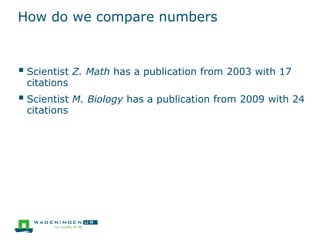
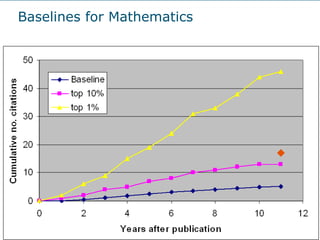
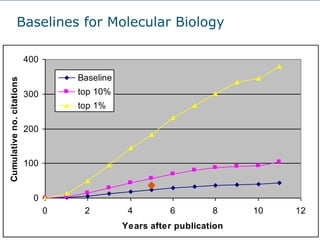
How do we compare numbers
 Scientist Z. Math has a publication from 2003 with 17
citations
 Scientist M. Biology has a publication from 2009 with 24
citations
Baselines for Mathematics
Baselines for Molecular Biology
0
100
200
300
400
0 2 4 6 8 10 12
Years after publication
Cumulativeno.citations
Baseline
top 10%
top 1%
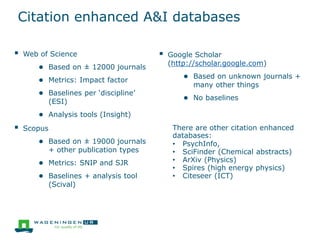
Citation enhanced A&I databases
 Web of Science
● Based on ± 12000 journals
● Metrics: Impact factor
● Baselines per ‘discipline’
(ESI)
● Analysis tools (Insight)
 Scopus
● Based on ± 19000 journals
+ other publication types
● Metrics: SNIP and SJR
● Baselines + analysis tool
(Scival)
 Google Scholar
(http://scholar.google.com)
● Based on unknown journals +
many other things
● No baselines
There are other citation enhanced
databases:
• PsychInfo,
• SciFinder (Chemical abstracts)
• ArXiv (Physics)
• Spires (high energy physics)
• Citeseer (ICT)
Programme
 Publishing
 Metrics
● Article metrics
● Author metrics
● Research group metrics
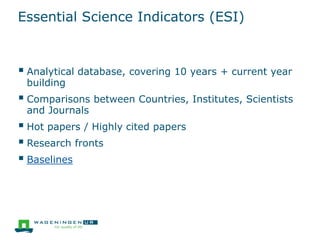
Essential Science Indicators (ESI)
 Analytical database, covering 10 years + current year
building
 Comparisons between Countries, Institutes, Scientists
and Journals
 Hot papers / Highly cited papers
 Research fronts
 Baselines
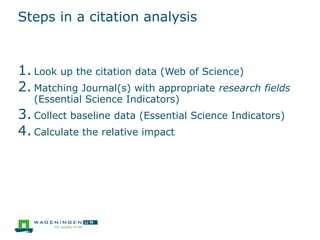
Steps in a citation analysis
1. Look up the citation data (Web of Science)
2. Matching Journal(s) with appropriate research fields
(Essential Science Indicators)
3. Collect baseline data (Essential Science Indicators)
4. Calculate the relative impact
Bibliometric indicators: An example
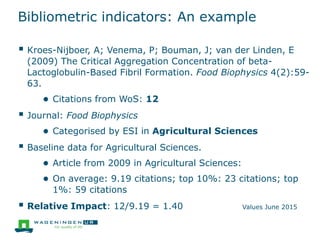
 Kroes-Nijboer, A; Venema, P; Bouman, J; van der Linden, E
(2009) The Critical Aggregation Concentration of beta-
Lactoglobulin-Based Fibril Formation. Food Biophysics 4(2):59-
63.
● Citations from WoS: 12
 Journal: Food Biophysics
● Categorised by ESI in Agricultural Sciences
 Baseline data for Agricultural Sciences.

● Article from 2009 in Agricultural Sciences:
● On average: 9.19 citations; top 10%: 23 citations; top
1%: 59 citations
 Relative Impact: 12/9.19 = 1.40 Values June 2015
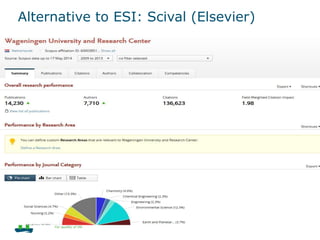
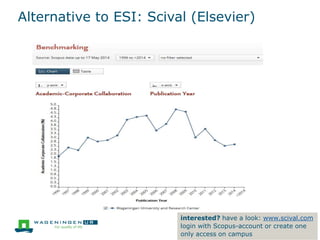
Alternative to ESI: Scival (Elsevier)
interested? have a look: www.scival.com
login with Scopus-account or create one
only access on campus
Exercises
 Manual Chapter 9.8
● Exercise 2: Number of publications and times cited
● Exercise 2.1
● Exercise 2.2 is optional
● Exercise 3: Citation impact and rankings (Essential
Science Indicators)
● Exercise 3.1a
● Exercise 3.1b is optional
Programme
 Publishing
 Metrics
● Article metrics
● Author metrics
● Journal metrics
● Research group metrics
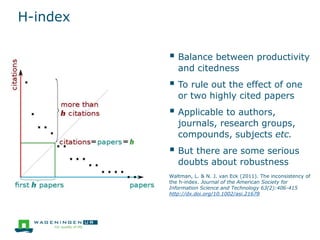
H-index
 Balance between productivity
and citedness
 To rule out the effect of one
or two highly cited papers
 Applicable to authors,
journals, research groups,
compounds, subjects etc.
 But there are some serious
doubts about robustness
Waltman, L. & N. J. van Eck (2011). The inconsistency of
the h-index. Journal of the American Society for
Information Science and Technology 63(2):406-415
http://dx.doi.org/10.1002/asi.21678
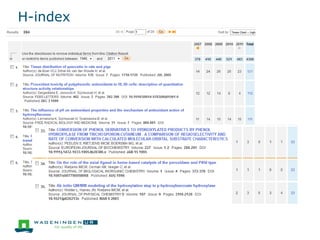
H-index
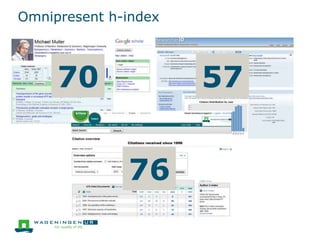
Omnipresent h-index
54 47
57
70 57
76
Programme
 Publishing
 Metrics
● Article metrics
● Author metrics
● Journal metrics
● Research group metrics
Journal Performance Indicators
 Journal performance indicators are based on citations to
articles
 Journal Citation Reports (JCR)
● a.o. standard Journal Impact Factors and 5-year
Impact Factors
 Scopus Journal Analyzer (SJA)
● a.o. SCImago Journal Rank (SJR) and Source
Normalized Impact per Paper (SNIP)
● Also available on http://journalmetrics.com/
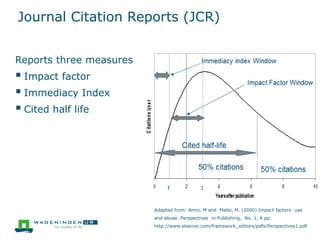
Journal Citation Reports (JCR)
Reports three measures
 Impact factor
 Immediacy Index
 Cited half life
Adapted from: Amin, M and Mabe, M. (2000) Impact factors: use
and abuse. Perspectives in Publishing, No. 1, 6 pp.
http://www.elsevier.com/framework_editors/pdfs/Perspectives1.pdf
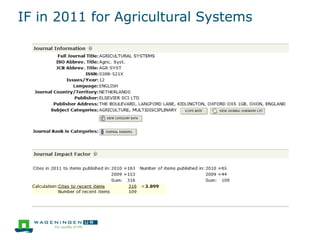
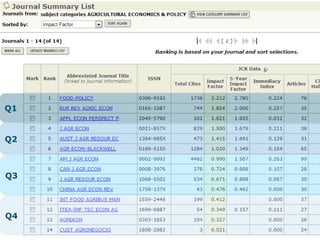
IF in 2011 for Agricultural Systems
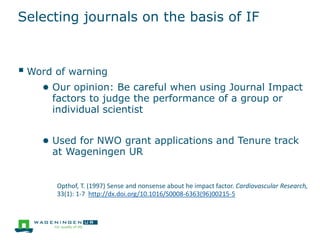
Selecting journals on the basis of IF
 Word of warning
● Our opinion: Be careful when using Journal Impact
factors to judge the performance of a group or
individual scientist
● Used for NWO grant applications and Tenure track
at Wageningen UR
Opthof, T. (1997) Sense and nonsense about he impact factor. Cardiovascular Research,
33(1): 1-7 http://dx.doi.org/10.1016/S0008-6363(96)00215-5
Q1
Q2
Q3
Q4
Exercises
 Manual Chapter 9.8
● Exercise 4: Journal Citation Reports (JCR)
Programme
 Publishing
 Metrics
● Article metrics
● Author metrics
● Journal metrics
● Research group metrics
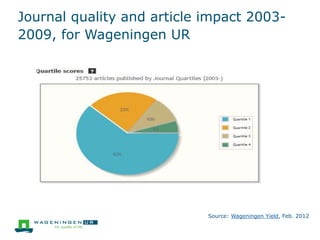
Journal quality and article impact 2003-
2009, for Wageningen UR
Source: Wageningen Yield, Feb. 2012
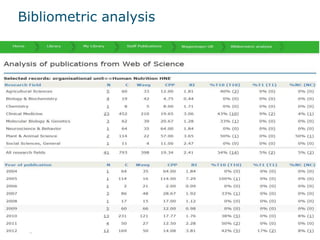
Bibliometric analysis
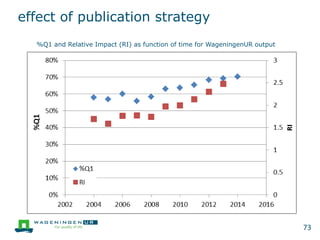
effect of publication strategy
73
%Q1 and Relative Impact (RI) as function of time for WageningenUR output
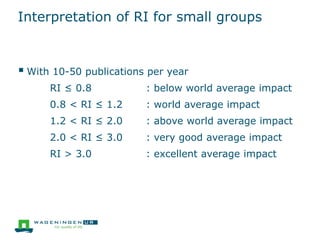
Interpretation of RI for small groups
 With 10-50 publications per year
RI ≤ 0.8 : below world average impact
0.8 < RI ≤ 1.2 : world average impact
1.2 < RI ≤ 2.0 : above world average impact
2.0 < RI ≤ 3.0 : very good average impact
RI > 3.0 : excellent average impact
Exercises

● Exercise 5: (Group) Bibliometric analysis
library links
 library: www.wageningenur.nl/library
 information on writing, citing, publishing and research
impact: http://www.wageningenur.nl/en/Expertise-
Services/Facilities/Library/Expertise/Write-cite.htm
 author profiles:
http://www.wageningenur.nl/en/Expertise-
Services/Facilities/Library/Expertise/Write-
cite/Profiles.htm
 data management support:
www.wageningenur.nl/datamanagement
76
Thank you!
Questions?
ellen.fest@wur.nl
0317-481594
77

Publishing and impact : presentation for PhD Infoirmation Literacy course

  • 1.
    Publishing and ‘impact’ InformationLiteracy PhD students February 16th, 2016 – Hugo Besemer & Ellen Fest
  • 2.
    Programme  Tools  Publishing Metrics ● Article metrics ● Author metrics ● Journal metrics ● Research group metrics
  • 3.
    Analyze Search results to find interesting journals  to identify key researchers / institutes  Scopus or Web of Science  use it to set up alerts  contact people e.g. on ResearchGate
  • 4.
  • 6.
    Analyze Search results– Web of Science
  • 8.
    Use BrowZine toaccess Scholarly Journals  Access your key scholarly journals on mobile or PC  Journal subscribed by WageningenUR Library and OA journals  Personalised bookshelf  Sync across devices  Alerts for new content  Integration with Endnote and Mendeley  Export to Dropbox, Evernote, Google Drive  Free! 8 BrowZine Video
  • 9.
    Programme  Tools  Publishing Metrics ● Article metrics ● Author metrics ● Journal metrics ● Research group metrics
  • 10.
    Motives for publishing Edge,P., Martin, F., Fao, S. R., & Manning, N. (2011). Researcher Attitudes and Behaviour Towards the “ Openness ” of Research Outputs in Agriculture and Related Fields.
  • 11.
  • 12.
    Choosing the rightjournal to publish  Many factors influence journal selection ● Journal scope/Intended audience ● Editorial board/standing ● Open Access ● The speed of reviewing and publication ● Acceptance/Rejection rate ● Journal circulation ● Coverage in A&I databases (bibliographies) ● Journal performance
  • 13.
  • 14.
    Open Access  OApublishing e.g. PLoS, BMC and Sage Open  Self-archiving in repositories e.g. Wageningen Yield (WaY)  SHERPA/RoMEO: Publisher copyright policies & self- archiving http://www.sherpa.ac.uk/romeo/  Directory of open access journals DOAJ (currently ca. 10,000 journals)  Be aware of predatory OA publishers  Beall's List
  • 15.
  • 16.
    “Green” open access:deposit author versions to WaY see: http://edepot.wur.nl/169331 Send your version of the article to: way.library@wur.nl
  • 17.
    Speed of publication PLOSONE 1,5 months Euphytica >1 year
  • 18.
    Rejection / acceptancerates Sugimoto, C. R., Larivière, V., Ni, C., & Cronin, B. (2013). Journal acceptance rates: A cross-disciplinary analysis of variability and relationships with journal measures. Journal of Informetrics, 7(4), 897–906. doi:10.1016/j.joi.2013.08.007
  • 19.
    Journal circulation  Comparee.g. ● “Agricultural Systems” ● "Proceedings of the National Academy of Sciences of the United States of America"
  • 20.
    journal reviews  shareyour experience with the scientific review process of journals  duration of manuscript handling phases ● duration first review round ● total handling time accepted manuscripts ● decision time immediate rejection  characteristics of peer review process ● average number of review reports ● average number of review rounds 20
  • 21.
    Coverage in A&Idatabases
  • 22.
    Looking for journals? use our journal browser!  www.wageningenur.nl/library
  • 23.
    Exercises  Manual Chapter9.8 ● Exercise 1
  • 24.
  • 25.
    Making your publicationsknown: networking
  • 26.
    Networking is important Startearly, make use of Social Networking tools ● Facebook ● LinkedIn ● Twitter ● Social networks for scientists ● Academia.edu, Researchgate.net
  • 27.
    Imagine what happenswhen Michael Müller tweets about his latest article
  • 28.
    Advertise yourself  Citeyour previous articles!  Be active at conferences  Cooperate with other people/research groups  Write, or expand, articles in the Wikipedia, refer to your thesis.  Blog or tweet about your research and thesis research  Make use of social networking tools (LinkedIn, Researchgate.net, Mendeley etc.)  Create author’s identifiers (ScopusID, Researcher ID, ORCID)
  • 29.
    Claim your publications ResearcherID (Web of Science)  Scopus Author ID (Scopus)  Google Scholar Citations Enserink, M. (2009). Scientific Publishing: Are You Ready to Become a Number? Science, 323(5922): 1662-1664 http://dx.doi.org/10.1126/science.323.5922.1662  ORCID ● http://orcid.scopusfeedback.com/
  • 30.
    Interested in newScholarly Communications tools? http://innoscholcomm.silk.co/
  • 31.
    What's in aname  On the cover: ● Arina Schrier  First first title page: ● A.P. Schrier-Uyl  Second title page: ● Adriana Pia Uyl  In here own publication list ● A. Uyl ● A. Uijl ● A.P. Schrier Uyl
  • 32.
    This also appliesto the names of groups Environmental Policy Group, Department of Social Sciences, Wageningen University Environmental Policy Group, Wageningen University Environmental Policy Group, Wageningen University and Research Centre Environmental Policy Group, Wageningen UR
  • 33.
    Get your affiliationright For the university: Chair group + Wageningen University Plant Production Systems Group, Wageningen University, P.O. box ..., 6700 HA Wageningen, The Netherlands For the institutes: Institute + Wageningen University & Research Centre Alterra, Wageningen University & Research Centre, P.O. box ..., 6700 HA Wageningen, The Netherlands
  • 34.
    Some other optionsto make you articles effective Apart from doing good research and writing well, that is
  • 35.
    Collaboration with privatesector effective Kamalski, J., & Aisati, M. h. (2013). International comparative benchmark of Dutch research performance in TKI themes: Food Safety research. A report prepared by Elsevier for Agentschap NL.
  • 36.
    36 (source: SciVal 14-10-2015) 0 5 10 15 20 25 30 35 20092010 2011 2012 2013 2014 Collaboration Impact for Wageningen UR (articles & reviews) without Academic-Corporate Collaboration with Academic Corporate Collaboration
  • 37.
    University-industry collaboration andimpact "The average scientific impact of university- industry papers is significantly above that of both university-only papers and industry-only papers" Lebeau, L. M., Laframboise, M. C., Larivière, V., & Gingras, Y. (2008). The effect of university-industry collaboration on the scientific impact of publications: The Canadian case, 1980-2005. Research Evaluation, 17(3), 227-232. http://dx.doi.org/10.3152/095820208x331685
  • 38.
    Choosing journals withHigh Impact factors? A: strong or definite predictor
  • 39.
    More co-authors? A: strongor definite predictor; B: Weak predictor or predictive power dependent on the model
  • 40.
    References? Recent article! N.Onodera and F. Yoshikane, “Factors affecting citation rates of research articles,” J. Assoc. Inf. Sci. Technol. Jun. 2014. A: strong or definite predictor; B: Weak predictor or predictive power dependent on the model; C: Not significant or negative predictor
  • 41.
  • 42.
    Self citations The model[...] implies that external citations are enhanced by self-citations, so that we have the “chain reaction:” Larger size leads to more self- citations, which lead to more external citations. van Raan, A. F. J. (2008). Self-citation as an impact-reinforcing mechanism in the science system. Journal of the American Society for Information Science and Technology 59(10): 1631-1643.
  • 43.
    More articles perresearch project? Publishing more articles results in higher citation counts if the articles provide sufficient substantive content to other researchers. ● Beware of the ethical standards ● Bornmann looked at total citations, not to relative impact Bornmann, L. & H.-D. Daniel (2007). Multiple publication on a single research study: Does it pay? The influence of number of research articles on total citation counts in biomedicine. Journal of the American Society for Information Science and Technology, 58(8): 1100-1107 http://dx.doi.org/10.1002/asi.20531
  • 44.
    Publish your data! Henneken et al. (2011) "articles with links to data result in higher citation rates than articles without such links" http://arxiv.org/abs/1111.3618  Piwowar et al. (2007) "Sharing detailed research data is associated with increased citation rate http://dx.doi.org/10.1371/journal.pone.0000308  Library assists in curating datasets: www.wageningenur.nl/datamanagement
  • 45.
    Programme  Publishing  Metrics ●Article metrics ● Author metrics ● Journal metrics ● Research group metrics
  • 46.
    Web of Science Search: ● Articles are found based on Authors, Addresses, etc. ● For each article Times cited is presented  Cited reference search: ● Searches in the reference lists of records ● Not all of your articles are found. Non-cited articles are missing
  • 47.
  • 48.
    How do wecompare numbers  Scientist Z. Math has a publication from 2003 with 17 citations  Scientist M. Biology has a publication from 2009 with 24 citations
  • 49.
  • 50.
    Baselines for MolecularBiology 0 100 200 300 400 0 2 4 6 8 10 12 Years after publication Cumulativeno.citations Baseline top 10% top 1%
  • 51.
    Citation enhanced A&Idatabases  Web of Science ● Based on ± 12000 journals ● Metrics: Impact factor ● Baselines per ‘discipline’ (ESI) ● Analysis tools (Insight)  Scopus ● Based on ± 19000 journals + other publication types ● Metrics: SNIP and SJR ● Baselines + analysis tool (Scival)  Google Scholar (http://scholar.google.com) ● Based on unknown journals + many other things ● No baselines There are other citation enhanced databases: • PsychInfo, • SciFinder (Chemical abstracts) • ArXiv (Physics) • Spires (high energy physics) • Citeseer (ICT)
  • 52.
    Programme  Publishing  Metrics ●Article metrics ● Author metrics ● Research group metrics
  • 53.
    Essential Science Indicators(ESI)  Analytical database, covering 10 years + current year building  Comparisons between Countries, Institutes, Scientists and Journals  Hot papers / Highly cited papers  Research fronts  Baselines
  • 54.
    Steps in acitation analysis 1. Look up the citation data (Web of Science) 2. Matching Journal(s) with appropriate research fields (Essential Science Indicators) 3. Collect baseline data (Essential Science Indicators) 4. Calculate the relative impact
  • 55.
    Bibliometric indicators: Anexample  Kroes-Nijboer, A; Venema, P; Bouman, J; van der Linden, E (2009) The Critical Aggregation Concentration of beta- Lactoglobulin-Based Fibril Formation. Food Biophysics 4(2):59- 63. ● Citations from WoS: 12  Journal: Food Biophysics ● Categorised by ESI in Agricultural Sciences  Baseline data for Agricultural Sciences. ● Article from 2009 in Agricultural Sciences: ● On average: 9.19 citations; top 10%: 23 citations; top 1%: 59 citations  Relative Impact: 12/9.19 = 1.40 Values June 2015
  • 56.
    Alternative to ESI:Scival (Elsevier)
  • 57.
    Alternative to ESI:Scival (Elsevier) interested? have a look: www.scival.com login with Scopus-account or create one only access on campus
  • 58.
    Exercises  Manual Chapter9.8 ● Exercise 2: Number of publications and times cited ● Exercise 2.1 ● Exercise 2.2 is optional ● Exercise 3: Citation impact and rankings (Essential Science Indicators) ● Exercise 3.1a ● Exercise 3.1b is optional
  • 59.
    Programme  Publishing  Metrics ●Article metrics ● Author metrics ● Journal metrics ● Research group metrics
  • 60.
    H-index  Balance betweenproductivity and citedness  To rule out the effect of one or two highly cited papers  Applicable to authors, journals, research groups, compounds, subjects etc.  But there are some serious doubts about robustness Waltman, L. & N. J. van Eck (2011). The inconsistency of the h-index. Journal of the American Society for Information Science and Technology 63(2):406-415 http://dx.doi.org/10.1002/asi.21678
  • 61.
  • 62.
  • 63.
    Programme  Publishing  Metrics ●Article metrics ● Author metrics ● Journal metrics ● Research group metrics
  • 64.
    Journal Performance Indicators Journal performance indicators are based on citations to articles  Journal Citation Reports (JCR) ● a.o. standard Journal Impact Factors and 5-year Impact Factors  Scopus Journal Analyzer (SJA) ● a.o. SCImago Journal Rank (SJR) and Source Normalized Impact per Paper (SNIP) ● Also available on http://journalmetrics.com/
  • 65.
    Journal Citation Reports(JCR) Reports three measures  Impact factor  Immediacy Index  Cited half life Adapted from: Amin, M and Mabe, M. (2000) Impact factors: use and abuse. Perspectives in Publishing, No. 1, 6 pp. http://www.elsevier.com/framework_editors/pdfs/Perspectives1.pdf
  • 66.
    IF in 2011for Agricultural Systems
  • 67.
    Selecting journals onthe basis of IF  Word of warning ● Our opinion: Be careful when using Journal Impact factors to judge the performance of a group or individual scientist ● Used for NWO grant applications and Tenure track at Wageningen UR Opthof, T. (1997) Sense and nonsense about he impact factor. Cardiovascular Research, 33(1): 1-7 http://dx.doi.org/10.1016/S0008-6363(96)00215-5
  • 68.
  • 69.
    Exercises  Manual Chapter9.8 ● Exercise 4: Journal Citation Reports (JCR)
  • 70.
    Programme  Publishing  Metrics ●Article metrics ● Author metrics ● Journal metrics ● Research group metrics
  • 71.
    Journal quality andarticle impact 2003- 2009, for Wageningen UR Source: Wageningen Yield, Feb. 2012
  • 72.
  • 73.
    effect of publicationstrategy 73 %Q1 and Relative Impact (RI) as function of time for WageningenUR output
  • 74.
    Interpretation of RIfor small groups  With 10-50 publications per year RI ≤ 0.8 : below world average impact 0.8 < RI ≤ 1.2 : world average impact 1.2 < RI ≤ 2.0 : above world average impact 2.0 < RI ≤ 3.0 : very good average impact RI > 3.0 : excellent average impact
  • 75.
    Exercises  ● Exercise 5:(Group) Bibliometric analysis
  • 76.
    library links  library:www.wageningenur.nl/library  information on writing, citing, publishing and research impact: http://www.wageningenur.nl/en/Expertise- Services/Facilities/Library/Expertise/Write-cite.htm  author profiles: http://www.wageningenur.nl/en/Expertise- Services/Facilities/Library/Expertise/Write- cite/Profiles.htm  data management support: www.wageningenur.nl/datamanagement 76
  • 77.

Editor's Notes