Bibliometrics & Research Impact Workshop: Sciences and Engineering Fields 
Show your Research Impact using Citation Analysis 
Diane Clark 
Jessica Thorlakson 
Virginia Pow
AGENDA 
● 
A little bit of background 
● 
The metrics and what they measure 
● 
How to use them and how to get them 
● 
Manage your scholarly identity
Handout & Checklist 
Relax and take it easy. 
Most of what you need to know is in the handout. 
Feel free to email us: 
diane.clark@ualberta.ca 
jessica.thorlakson@ualberta.ca 
virginia.pow@ualberta.ca
“All indicators are weighted differently, and thus produce different results. … we can never have just one ranking system: we must have as wide a choice of indicators as possible. No single metric can do justice to all fields and deliver one perfect ranking system” (Moed, 2005).
Metrics: Why? 
D. Julien (2011). Wired. Flickr. Retreived from:http://goo.gl/8pq3je
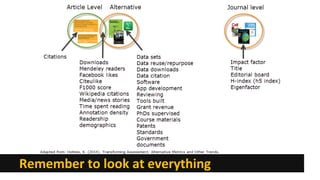
Non-traditional metrics 
● 
number of grad students/post docs 
● 
work influence policy/decision-makers 
○ 
government agencies, clinical guidelines, protocols 
● 
lab influence 
● 
impact of your research data 
● 
presentations, guest lectures, invited speaker - “engagement”
Alternative metrics 
Altmetric tools measure 
● 
tweets, blog mentions, Facebook posts, presentations, media & news articles, shared citations, data uploads 
dcuz (2009). A blob of molten wire wool to the head!. Flickr. Retrieved from: https://www.flickr.com/photos/adcuz/3536735043/
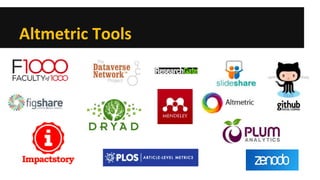
Altmetric Tools
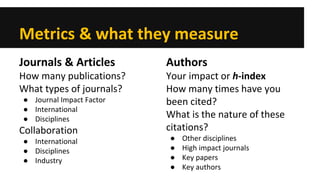
Metrics & what they measure 
Journals & Articles 
How many publications? 
What types of journals? 
● 
Journal Impact Factor 
● 
International 
● 
Disciplines 
Collaboration 
● 
International 
● 
Disciplines 
● 
Industry 
Authors 
Your impact or h-index 
How many times have you been cited? 
What is the nature of these citations? 
● 
Other disciplines 
● 
High impact journals 
● 
Key papers 
● 
Key authors
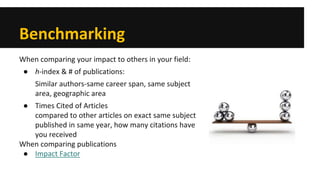
Benchmarking 
When comparing your impact to others in your field: 
● 
h-index & # of publications: 
Similar authors-same career span, same subject area, geographic area 
● 
Times Cited of Articles compared to other articles on exact same subject published in same year, how many citations have you received 
When comparing publications 
● 
Impact Factor
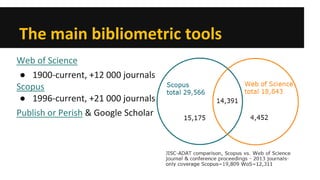
The main bibliometric tools 
Web of Science 
● 
1900-current, +12 000 journals 
Scopus 
● 
1996-current, +21 000 journals 
Publish or Perish & Google Scholar
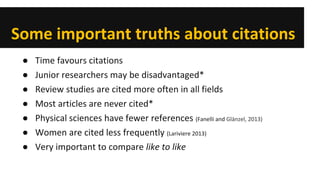
Some important truths about citations 
● 
Time favours citations 
● 
Junior researchers may be disadvantaged* 
● 
Review studies are cited more often in all fields 
● 
Most articles are never cited* 
● 
Physical sciences have fewer references (Fanelli and Glänzel, 2013) 
● 
Women are cited less frequently (Lariviere 2013) 
● 
Very important to compare like to like
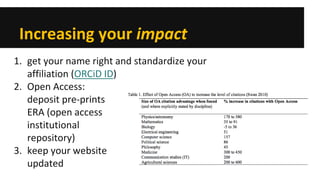
Increasing your impact 
1. 
get your name right and standardize your affiliation (ORCiD ID) 
2. 
Open Access: deposit pre-prints ERA (open access institutional repository) 
3. 
keep your website updated
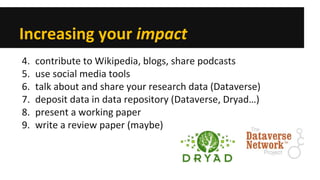
Increasing your impact 
4. 
contribute to Wikipedia, blogs, share podcasts 
5. 
use social media tools 
6. 
talk about and share your research data (Dataverse) 
7. 
deposit data in data repository (Dataverse, Dryad…) 
8. 
present a working paper 
9. 
write a review paper (maybe)
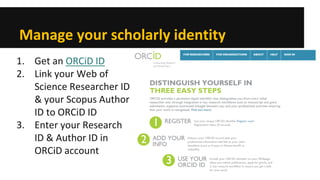
Manage your scholarly identity 
1. 
Get an ORCiD ID 
2. 
Link your Web of Science Researcher ID & your Scopus Author ID to ORCiD ID 
3. 
Enter your Research ID & Author ID in ORCiD account
Remember to look at everything
References 
Chamber, T. (2014). Research Impact. Workshop conducted from University of Alberta, Edmonton, Alberta. 
Costos, R. & Bordon, M. (2007). The h-index: Advantages, limitations and its relation with other bibliometric indicators at the micro level. Journal of Informatics, 1, 193-203. From doi:10.1016/j.joi.2007.02.001 
Fanelli D., Glänzel W. (2013). Bibliometric Evidence for a Hierarchy of the Sciences. PLoS ONE 8(6): e66938. From doi:10.1371/journal.pone.0066938 
Holmes, K. (2014) Assessing and reporting impact - A role for the library. NISO Virtual Conference, Transforming assessment: Alternative metrics and other trends, June, 18 2014. 
Moed, H. (2010) Measuring contextual citation impact of scientific journals. Arvix. From (arxiv.org/abs/0911.2632) 
Moed, H. F. (2005). Citation Analysis in Research Evaluation. Springer Netherlands. Retrieved 26 September 2014, from <http://www.myilibrary.com?ID=33728>

Bibliometrics and research impact workshop in the scienes and engineering fields

  • 1.
    Bibliometrics & ResearchImpact Workshop: Sciences and Engineering Fields Show your Research Impact using Citation Analysis Diane Clark Jessica Thorlakson Virginia Pow
  • 2.
    AGENDA ● Alittle bit of background ● The metrics and what they measure ● How to use them and how to get them ● Manage your scholarly identity
  • 3.
    Handout & Checklist Relax and take it easy. Most of what you need to know is in the handout. Feel free to email us: diane.clark@ualberta.ca jessica.thorlakson@ualberta.ca virginia.pow@ualberta.ca
  • 4.
    “All indicators areweighted differently, and thus produce different results. … we can never have just one ranking system: we must have as wide a choice of indicators as possible. No single metric can do justice to all fields and deliver one perfect ranking system” (Moed, 2005).
  • 5.
    Metrics: Why? D.Julien (2011). Wired. Flickr. Retreived from:http://goo.gl/8pq3je
  • 6.
    Non-traditional metrics ● number of grad students/post docs ● work influence policy/decision-makers ○ government agencies, clinical guidelines, protocols ● lab influence ● impact of your research data ● presentations, guest lectures, invited speaker - “engagement”
  • 7.
    Alternative metrics Altmetrictools measure ● tweets, blog mentions, Facebook posts, presentations, media & news articles, shared citations, data uploads dcuz (2009). A blob of molten wire wool to the head!. Flickr. Retrieved from: https://www.flickr.com/photos/adcuz/3536735043/
  • 8.
  • 9.
    Metrics & whatthey measure Journals & Articles How many publications? What types of journals? ● Journal Impact Factor ● International ● Disciplines Collaboration ● International ● Disciplines ● Industry Authors Your impact or h-index How many times have you been cited? What is the nature of these citations? ● Other disciplines ● High impact journals ● Key papers ● Key authors
  • 10.
    Benchmarking When comparingyour impact to others in your field: ● h-index & # of publications: Similar authors-same career span, same subject area, geographic area ● Times Cited of Articles compared to other articles on exact same subject published in same year, how many citations have you received When comparing publications ● Impact Factor
  • 11.
    The main bibliometrictools Web of Science ● 1900-current, +12 000 journals Scopus ● 1996-current, +21 000 journals Publish or Perish & Google Scholar
  • 12.
    Some important truthsabout citations ● Time favours citations ● Junior researchers may be disadvantaged* ● Review studies are cited more often in all fields ● Most articles are never cited* ● Physical sciences have fewer references (Fanelli and Glänzel, 2013) ● Women are cited less frequently (Lariviere 2013) ● Very important to compare like to like
  • 13.
    Increasing your impact 1. get your name right and standardize your affiliation (ORCiD ID) 2. Open Access: deposit pre-prints ERA (open access institutional repository) 3. keep your website updated
  • 14.
    Increasing your impact 4. contribute to Wikipedia, blogs, share podcasts 5. use social media tools 6. talk about and share your research data (Dataverse) 7. deposit data in data repository (Dataverse, Dryad…) 8. present a working paper 9. write a review paper (maybe)
  • 15.
    Manage your scholarlyidentity 1. Get an ORCiD ID 2. Link your Web of Science Researcher ID & your Scopus Author ID to ORCiD ID 3. Enter your Research ID & Author ID in ORCiD account
  • 16.
    Remember to lookat everything
  • 17.
    References Chamber, T.(2014). Research Impact. Workshop conducted from University of Alberta, Edmonton, Alberta. Costos, R. & Bordon, M. (2007). The h-index: Advantages, limitations and its relation with other bibliometric indicators at the micro level. Journal of Informatics, 1, 193-203. From doi:10.1016/j.joi.2007.02.001 Fanelli D., Glänzel W. (2013). Bibliometric Evidence for a Hierarchy of the Sciences. PLoS ONE 8(6): e66938. From doi:10.1371/journal.pone.0066938 Holmes, K. (2014) Assessing and reporting impact - A role for the library. NISO Virtual Conference, Transforming assessment: Alternative metrics and other trends, June, 18 2014. Moed, H. (2010) Measuring contextual citation impact of scientific journals. Arvix. From (arxiv.org/abs/0911.2632) Moed, H. F. (2005). Citation Analysis in Research Evaluation. Springer Netherlands. Retrieved 26 September 2014, from <http://www.myilibrary.com?ID=33728>