Raising your research profile 
Evidence of exposure: measuring 
your research IMPACT 
Research Support Team
By the end of the session you will be able to: 
• Understand the role of research impact metrics 
• Identify and apply relevant metrics to your research 
• Create alerts to monitor the continued impact of your research 
• Understand the potential of social media (and alternative metrics) to 
increase research impact 
18 September 2014 
2
Research impact metrics (Bibliometrics) 
what are they? 
• A quantifiable way of measuring research output (beyond the 
traditional peer-review process) 
• They can be used to measure the impact of many aspects of 
research (research groups, universities, journals and individuals) 
• Found in a variety of places: Scopus, Web of Science, Google 
Scholar etc. 
• Traditionally impact measured by the ‘quality’ of where you publish 
– now there is marked move towards article levels metrics (ALMs) 
• Based on citations of your papers 
• h-index most commonly used for measuring individuals. 
18 September 2014 
3
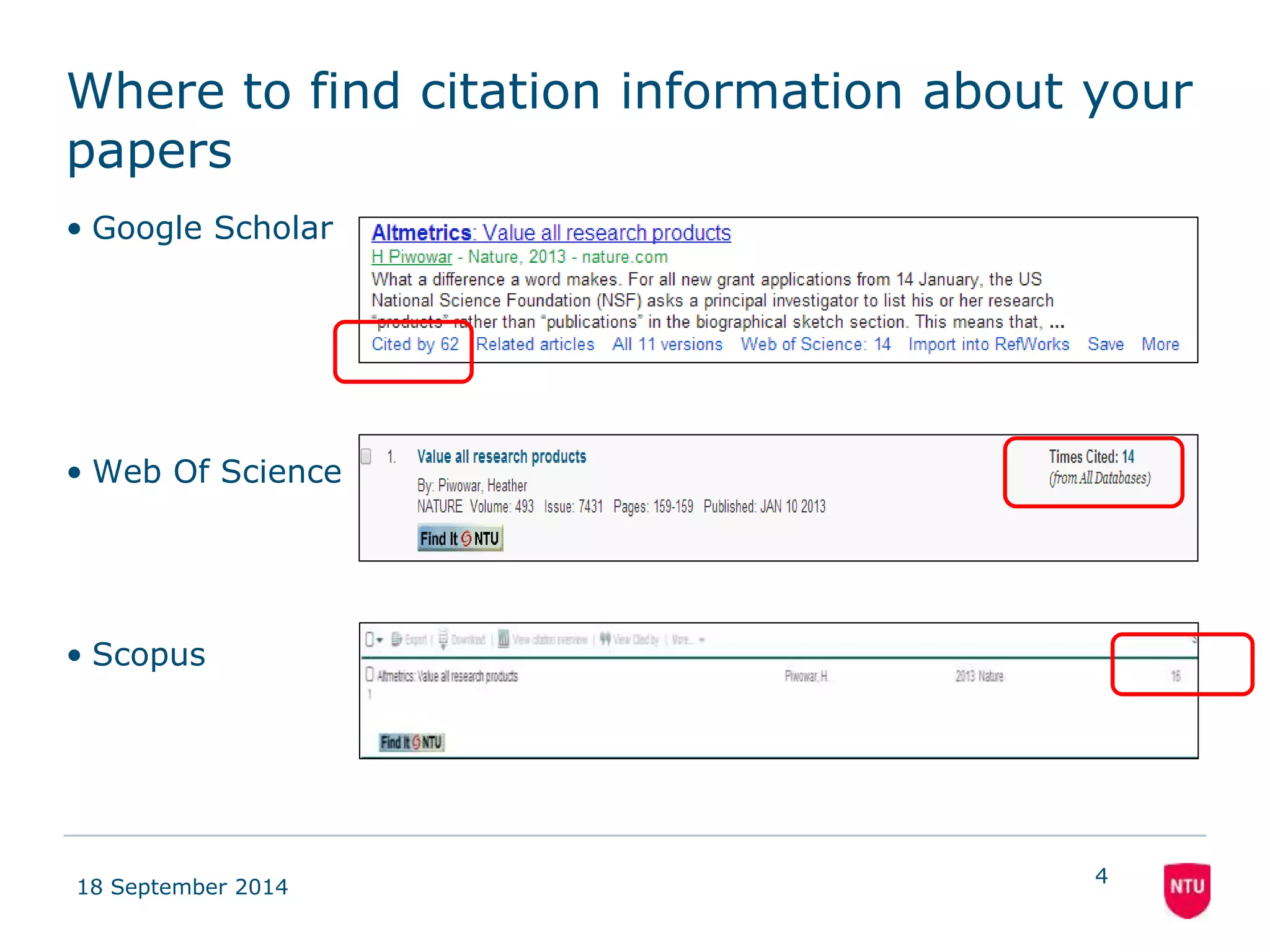
Where to find citation information about your 
papers 
• Google Scholar 
• Web Of Science 
• Scopus 
18 September 2014 
4
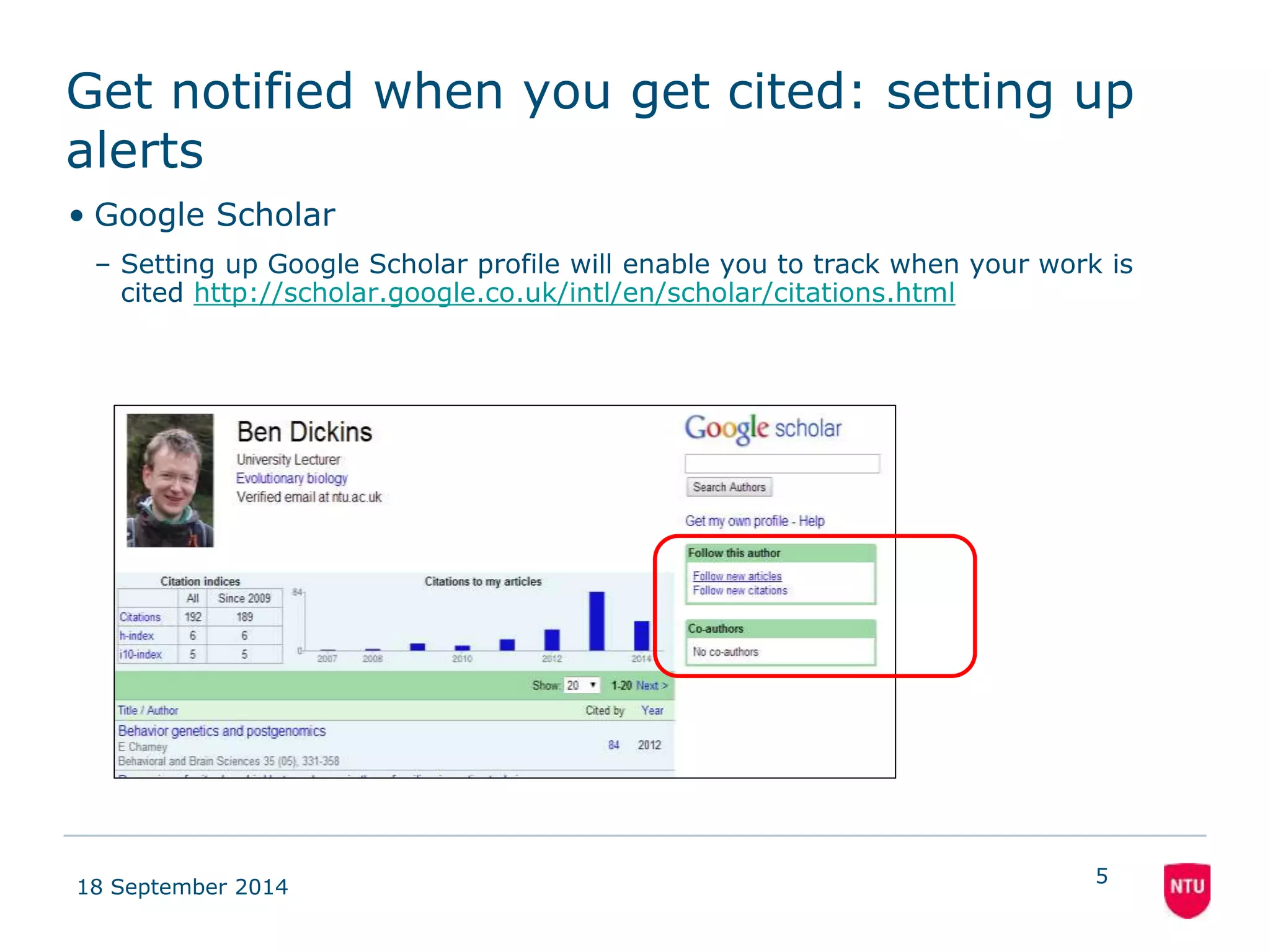
Get notified when you get cited: setting up 
alerts 
• Google Scholar 
– Setting up Google Scholar profile will enable you to track when your work is 
cited http://scholar.google.co.uk/intl/en/scholar/citations.html 
18 September 2014 
5
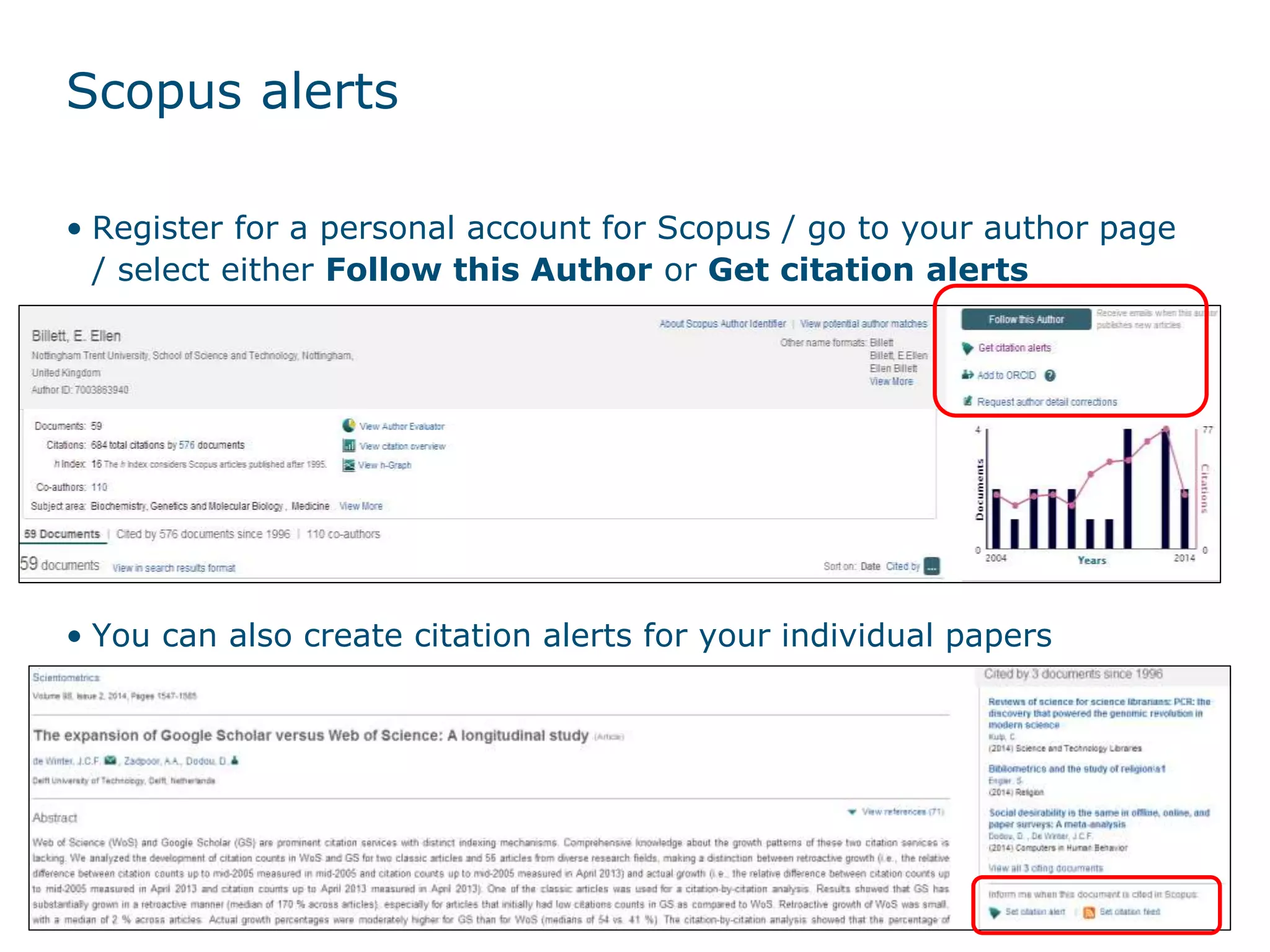
Scopus alerts 
• Register for a personal account for Scopus / go to your author page 
/ select either Follow this Author or Get citation alerts 
• You can also create citation alerts for your individual papers 
18 September 2014 
6
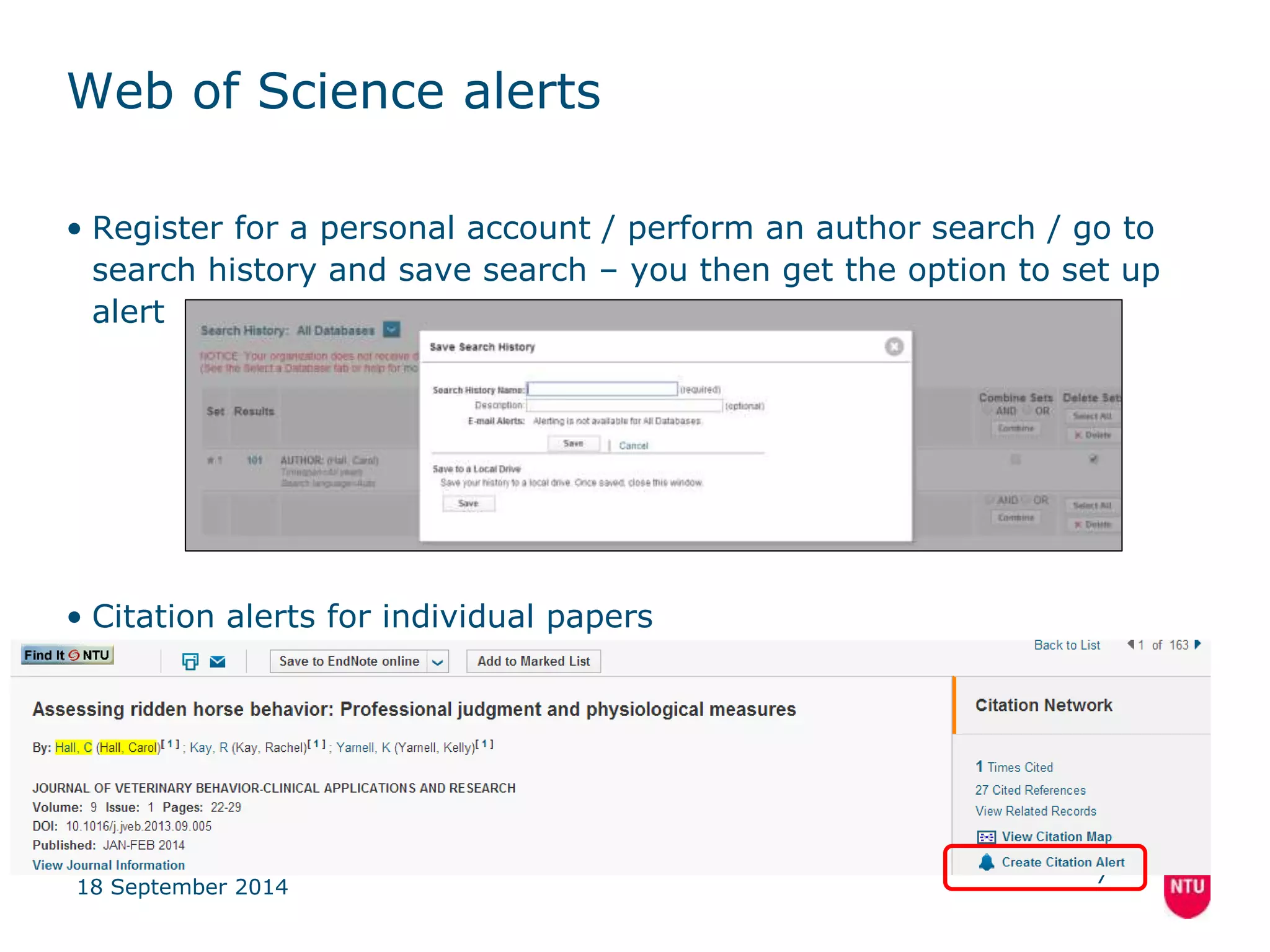
Web of Science alerts 
• Register for a personal account / perform an author search / go to 
search history and save search – you then get the option to set up 
alert 
• Citation alerts for individual papers 
18 September 2014 
7
What is the h-index? 
• Developed by Professor Jorge E. Hirsch 
• h short for highly cited or Hirsch 
• Measures the impact and quantity of an individual’s research 
performance i.e. their body of work (unaffected by other factors). 
• Enables easier evaluation of authors within specific subject area 
• Can helps publishers find new reviewers 
• Can help predict future success (Hirsch 2007) - could help with 
funding applications /employment. 
• Recognised way of showing impact. 
18 September 2014 
8 
h-index
How it works 
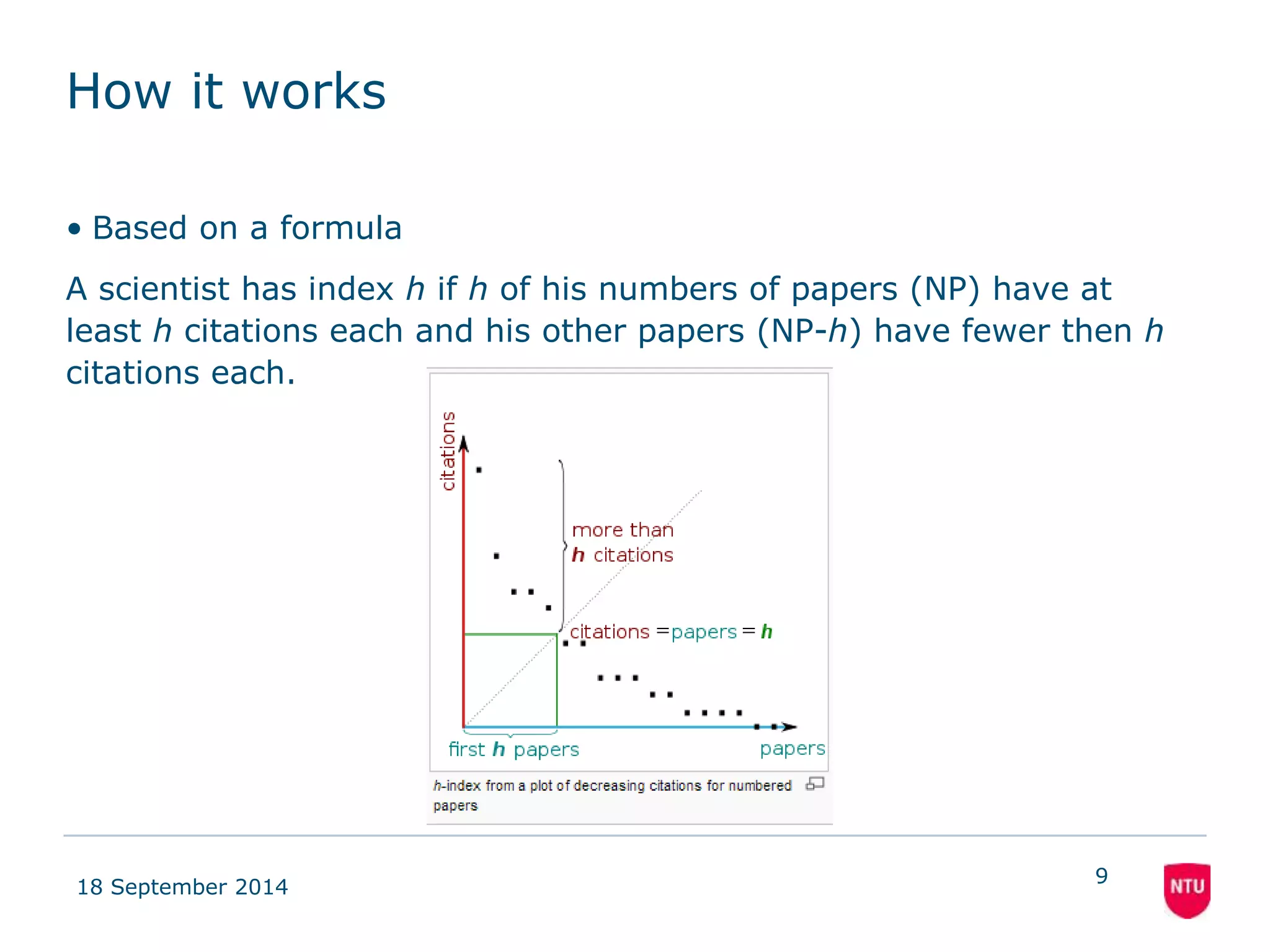
• Based on a formula 
A scientist has index h if h of his numbers of papers (NP) have at 
least h citations each and his other papers (NP-h) have fewer then h 
citations each. 
18 September 2014 
9
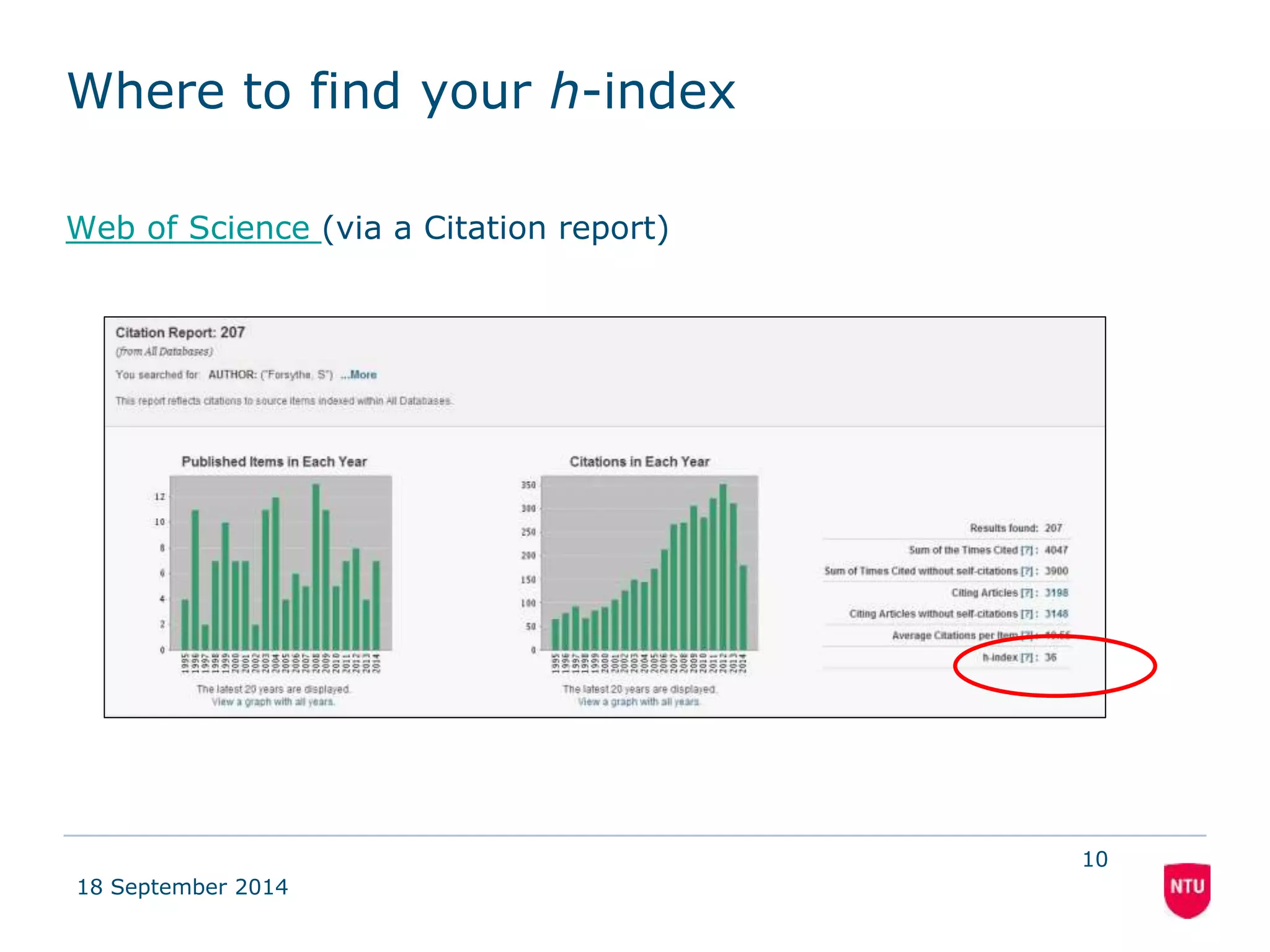
Where to find your h-index 
Web of Science (via a Citation report) 
18 September 2014 
10
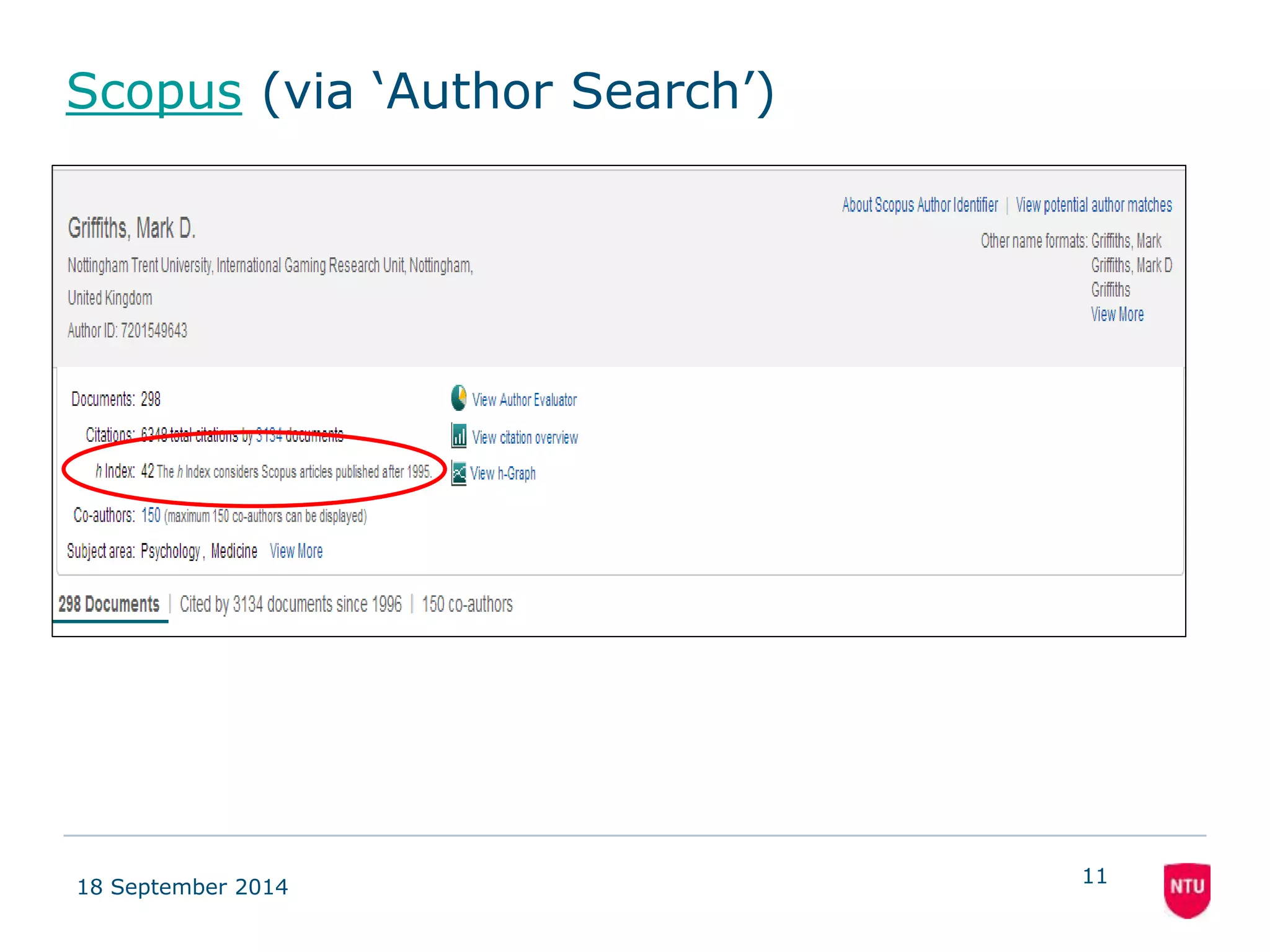
Scopus (via ‘Author Search’) 
18 September 2014 
11
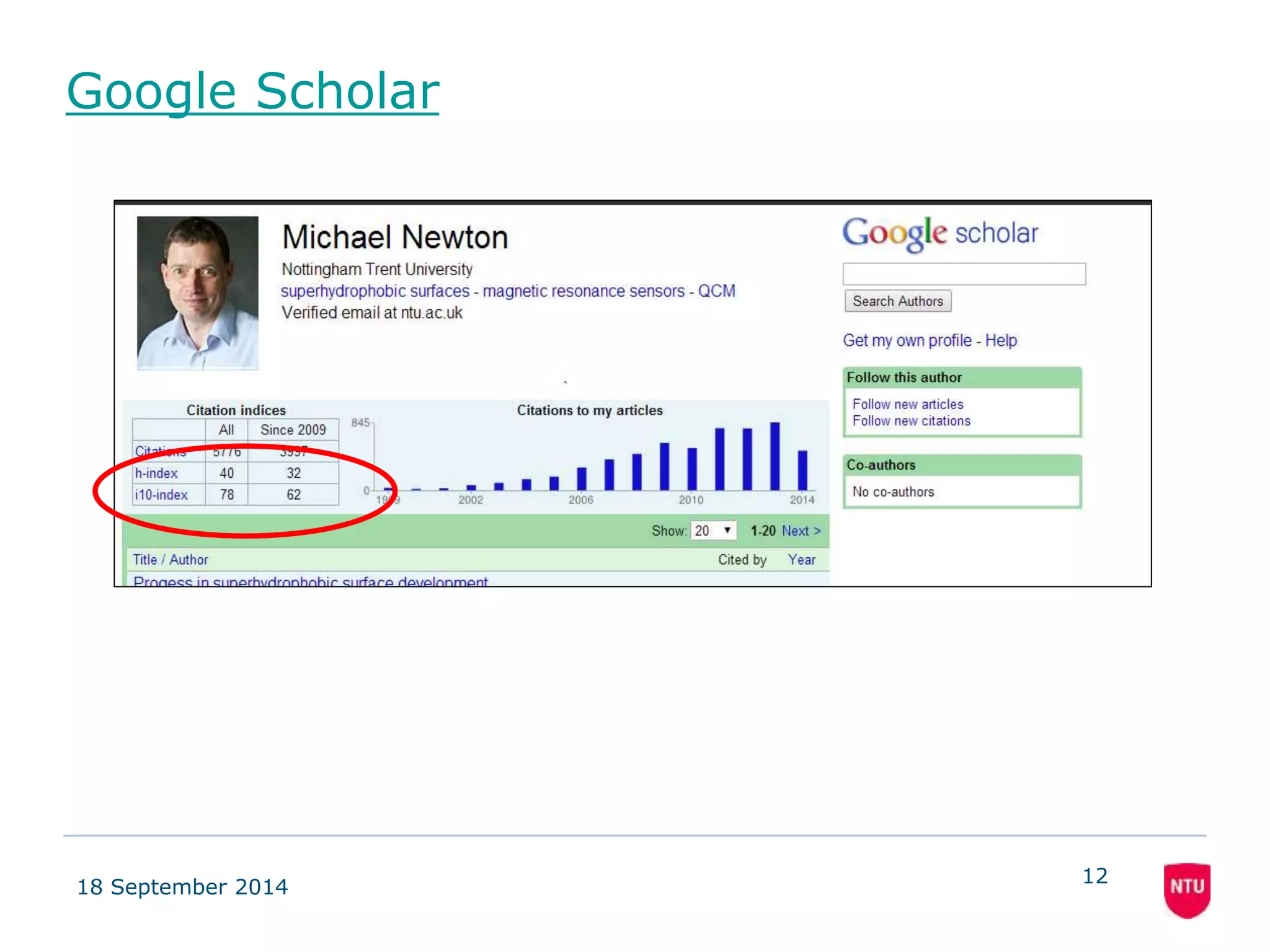
Google Scholar 
18 September 2014 
12
Which h-index to use? 
• Variants are due to different source data. 
– WOS includes references of an author regardless of whether cited items are 
indexed by WOS or not. 
– Scopus only provides citation data for items indexed by it. 
– Google Scholar indexes free abstract data, from open access sources such as 
institutional repositories, personal websites. Supports disciplines are supported 
better than others (Computing, Mathematics etc.) due to limited content in 
traditional databases. 
• The one that gives you the HIGHEST score! 
18 September 2014 
13
Things to note 
• h values will vary between subject disciplines (so this must be 
considered when comparing authors). 
• No accounting for age – a more seasoned researcher could 
potentially have higher h-index as he has had a longer to publish 
and be cited. 
• Check for currency – a researcher may have a high h-index but may 
not have published for some time and conversely an active (new) 
researcher may have a low h-index (but of course may has the 
potential to be cited in the future.) 
• h-index is only applicable to traditional research outputs (articles, 
conference proceedings) 
• It can’t capture influence on public policy, improved global health 
etc. 
18 September 2014 
14
Alternative metrics (or Altmetrics): what are 
they? 
• They “expand our view of what impact looks like, but also of what’s 
making the impact.” (Altmetrics manifesto, 2011 http://altmetrics.org/manifesto/) 
• New(ish) way of measuring scholarly impact beyond traditional 
citation counting in the online environment. 
• They can reflect the broader social impact of research (a different 
view of the influence of your work) 
• They capture social media references to scholarly output and can 
reflect public/social engagement 
• They are more timely than traditional metrics – can quickly see 
impact quickly (citation data takes time to accrue). 
• Also include PDF downloads and information about abstract/article 
views. 
18 September 2014 
15
Examples of Altmetric tools 
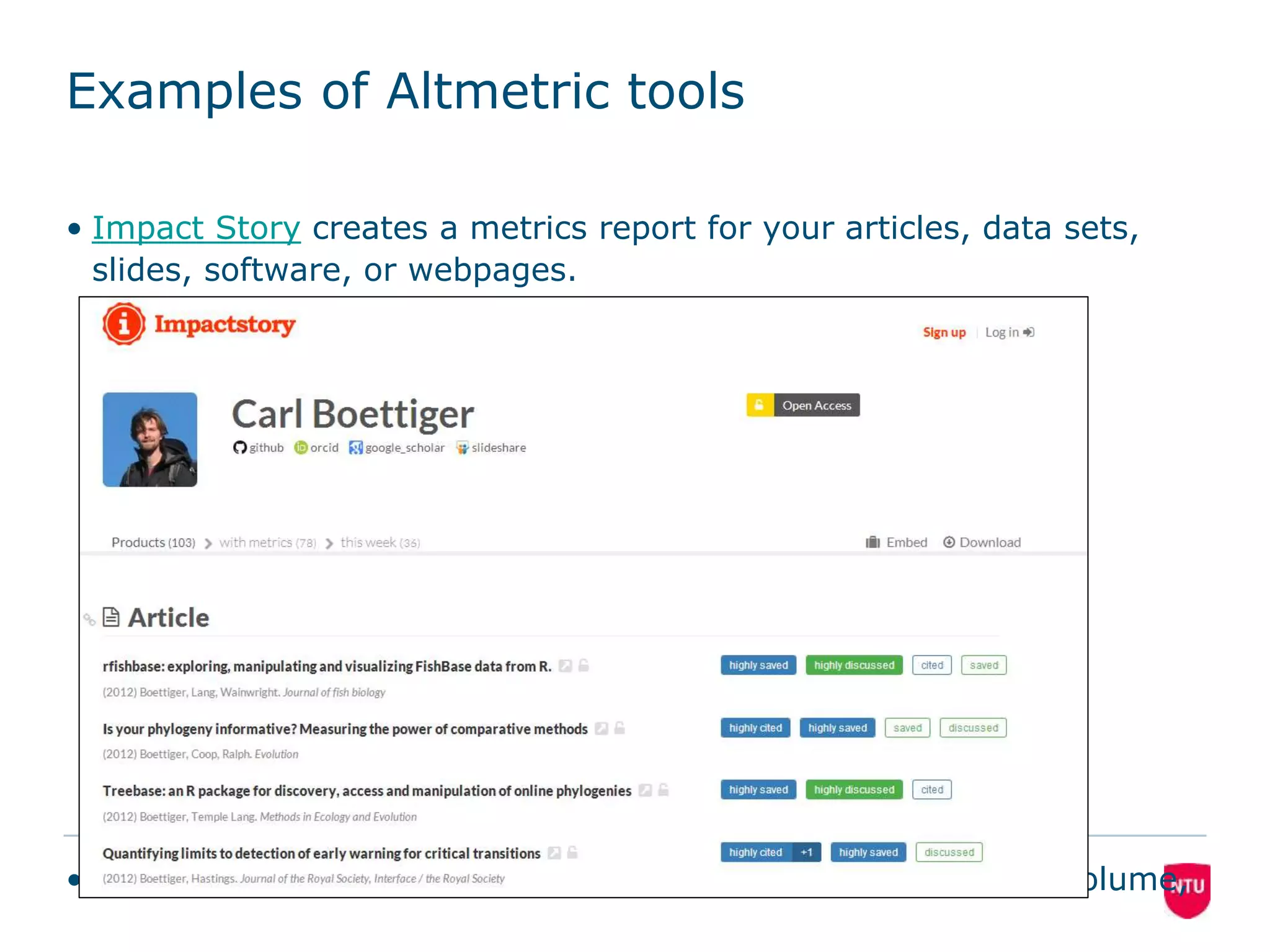
• Impact Story creates a metrics report for your articles, data sets, 
slides, software, or webpages. 
16 
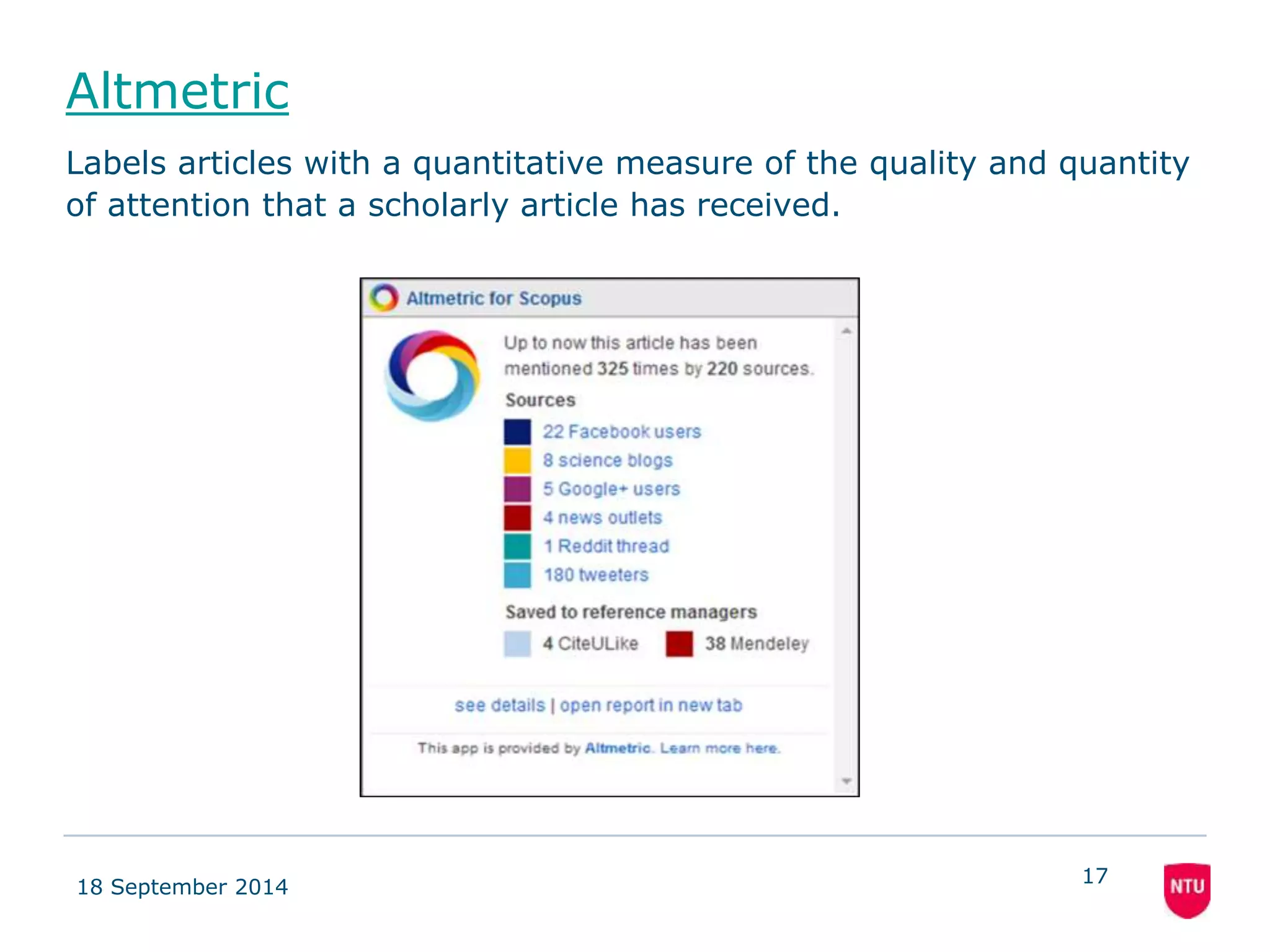
• Altmetric Labels articles with an altmetrics score, which is a volume,
Altmetric 
Labels articles with a quantitative measure of the quality and quantity 
of attention that a scholarly article has received. 
18 September 2014 
17
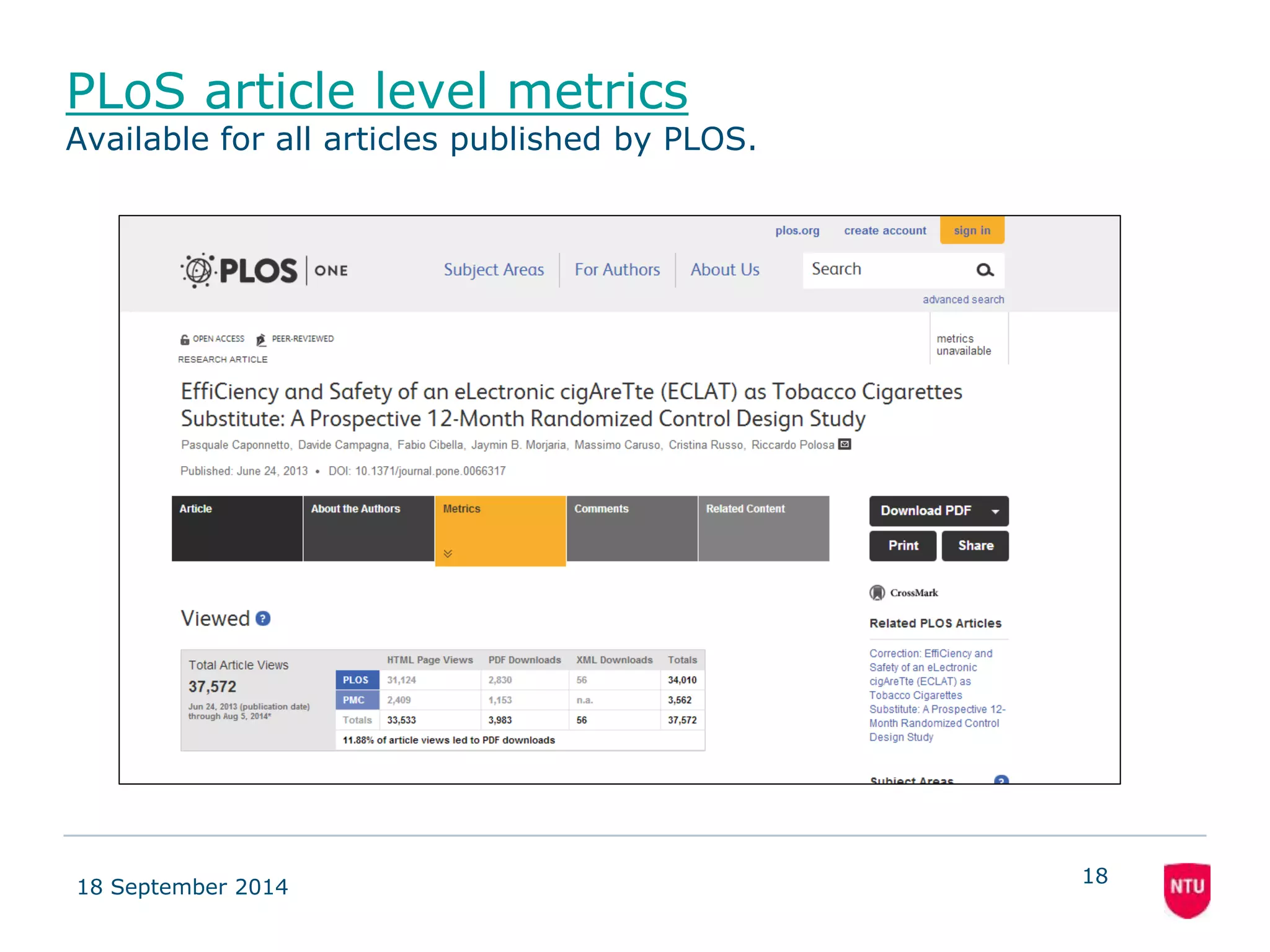
PLoS article level metrics 
Available for all articles published by PLOS. 
18 September 2014 
18
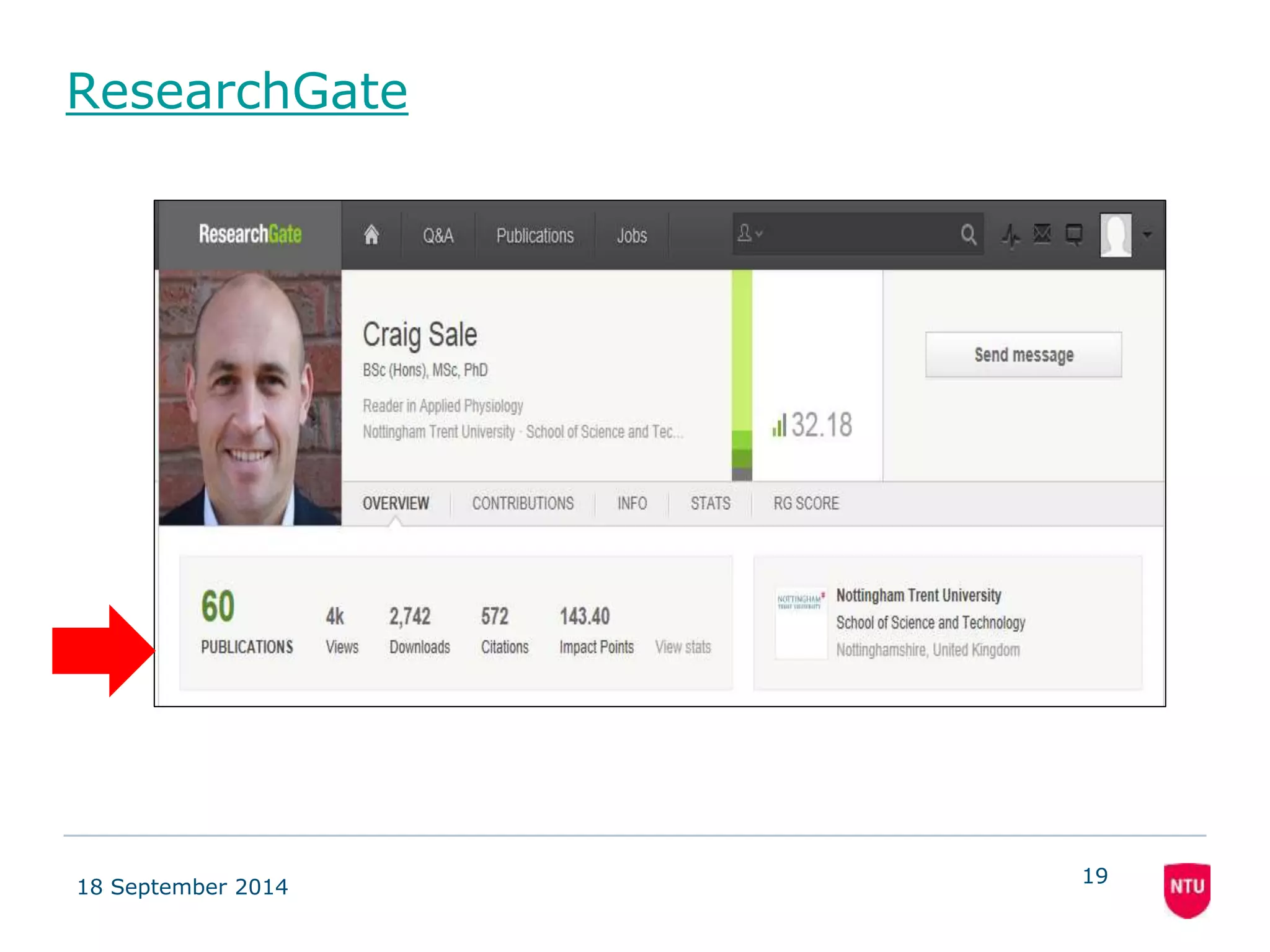
ResearchGate 
18 September 2014 
19
Altmetrics and you 
• They can offer a more nuanced insight into impact – enabling you to 
see if your article is being read and discussed. 
• Can demonstrate the influence of your research on a more diverse 
audience (not just academics) practitioners, educators, general 
public etc. 
• Public engagement can help engaging with funding, securing 
employment/promotion and being accountable. 
• They can complement traditional citation metrics. 
• For early career researchers (or those changing direction) you can 
showcase impact earlier. 
18 September 2014 
20
References & further reading 
• Ael 2, [online]. Wikipedia. Available at: http://en.wikipedia.org/wiki/File:H-index-en.svg [Accessed 19th February 2014]. 
• Bar-Ilan, J., 2008. Which h-index?—A comparison of WoS, Scopus and Google Scholar. Scientometrics, 74 (2), 257-271. 
Available at: http://150.214.190.154/hindex/pdf/Bar-Ilan2008.pdf [Accessed 5th August 2014]. 
• Google Scholar coverage: http://scholar.google.co.uk/intl/en/scholar/metrics.html#coverage 
• Hirsch, J.E., 2007. Does the H index have predictive power? Proceedings of the National Academy of Sciences of the 
United States of America, 104 (49), 19193-19198. Available at: http://www.ncbi.nlm.nih.gov/pmc/articles/PMC2148266/ 
[Accessed 06/08/2014]. 
• Hirsch, J.E., 2005. Proceedings of the National Academy of Sciences of the United States of America, 102 (46), 16569- 
16572. An index to quantify an individual's scientific research output. Available at: 
http://www.ncbi.nlm.nih.gov/pmc/articles/PMC1283832/?iframe=true&width=100%25&height=100%25 [Accessed 19th 
February 2014]. 
• Neylon, C. and Wu, S., 2009. Article-level metrics and the evolution of scientific impact. PLoS Biology, 7 (11), e1000242. 
Available at: http://www.plosbiology.org/article/info%3Adoi%2F10.1371%2Fjournal.pbio.1000242 [Accessed 
06/08/2014]. 
• Piwowar, H., 2013. Introduction altmetrics: What, why and where? Bulletin of the American Society for Information 
Science and Technology, 39 (4), 8-9. Available at: http://asis.org/Bulletin/Apr-13/AprMay13_Piwowar.pdf [Accessed 5th 
August 2014]. 
• Piwowar, H. and Priem, J., 2013. The power of altmetrics on a CV. Bulletin of the American Society for Information Science 
and Technology, 39 (4), 10-13. Available at: http://www.asis.org/Bulletin/Apr-13/AprMay13_Piwowar_Priem.pdf [Accessed 
5th August 2014]. 
18 September 2014 
21
Further help 
• Scopus tutorials 
• Web of Science help pages 
• Setting up your Google Scholar profile 
• h-index variants 
• List of alternative metrics tools 
18 September 2014 
22

Raising Your Research Profile: Evidence of Exposure Measuring Your Research Impact

  • 1.
    Raising your researchprofile Evidence of exposure: measuring your research IMPACT Research Support Team
  • 2.
    By the endof the session you will be able to: • Understand the role of research impact metrics • Identify and apply relevant metrics to your research • Create alerts to monitor the continued impact of your research • Understand the potential of social media (and alternative metrics) to increase research impact 18 September 2014 2
  • 3.
    Research impact metrics(Bibliometrics) what are they? • A quantifiable way of measuring research output (beyond the traditional peer-review process) • They can be used to measure the impact of many aspects of research (research groups, universities, journals and individuals) • Found in a variety of places: Scopus, Web of Science, Google Scholar etc. • Traditionally impact measured by the ‘quality’ of where you publish – now there is marked move towards article levels metrics (ALMs) • Based on citations of your papers • h-index most commonly used for measuring individuals. 18 September 2014 3
  • 4.
    Where to findcitation information about your papers • Google Scholar • Web Of Science • Scopus 18 September 2014 4
  • 5.
    Get notified whenyou get cited: setting up alerts • Google Scholar – Setting up Google Scholar profile will enable you to track when your work is cited http://scholar.google.co.uk/intl/en/scholar/citations.html 18 September 2014 5
  • 6.
    Scopus alerts •Register for a personal account for Scopus / go to your author page / select either Follow this Author or Get citation alerts • You can also create citation alerts for your individual papers 18 September 2014 6
  • 7.
    Web of Sciencealerts • Register for a personal account / perform an author search / go to search history and save search – you then get the option to set up alert • Citation alerts for individual papers 18 September 2014 7
  • 8.
    What is theh-index? • Developed by Professor Jorge E. Hirsch • h short for highly cited or Hirsch • Measures the impact and quantity of an individual’s research performance i.e. their body of work (unaffected by other factors). • Enables easier evaluation of authors within specific subject area • Can helps publishers find new reviewers • Can help predict future success (Hirsch 2007) - could help with funding applications /employment. • Recognised way of showing impact. 18 September 2014 8 h-index
  • 9.
    How it works • Based on a formula A scientist has index h if h of his numbers of papers (NP) have at least h citations each and his other papers (NP-h) have fewer then h citations each. 18 September 2014 9
  • 10.
    Where to findyour h-index Web of Science (via a Citation report) 18 September 2014 10
  • 11.
    Scopus (via ‘AuthorSearch’) 18 September 2014 11
  • 12.
    Google Scholar 18September 2014 12
  • 13.
    Which h-index touse? • Variants are due to different source data. – WOS includes references of an author regardless of whether cited items are indexed by WOS or not. – Scopus only provides citation data for items indexed by it. – Google Scholar indexes free abstract data, from open access sources such as institutional repositories, personal websites. Supports disciplines are supported better than others (Computing, Mathematics etc.) due to limited content in traditional databases. • The one that gives you the HIGHEST score! 18 September 2014 13
  • 14.
    Things to note • h values will vary between subject disciplines (so this must be considered when comparing authors). • No accounting for age – a more seasoned researcher could potentially have higher h-index as he has had a longer to publish and be cited. • Check for currency – a researcher may have a high h-index but may not have published for some time and conversely an active (new) researcher may have a low h-index (but of course may has the potential to be cited in the future.) • h-index is only applicable to traditional research outputs (articles, conference proceedings) • It can’t capture influence on public policy, improved global health etc. 18 September 2014 14
  • 15.
    Alternative metrics (orAltmetrics): what are they? • They “expand our view of what impact looks like, but also of what’s making the impact.” (Altmetrics manifesto, 2011 http://altmetrics.org/manifesto/) • New(ish) way of measuring scholarly impact beyond traditional citation counting in the online environment. • They can reflect the broader social impact of research (a different view of the influence of your work) • They capture social media references to scholarly output and can reflect public/social engagement • They are more timely than traditional metrics – can quickly see impact quickly (citation data takes time to accrue). • Also include PDF downloads and information about abstract/article views. 18 September 2014 15
  • 16.
    Examples of Altmetrictools • Impact Story creates a metrics report for your articles, data sets, slides, software, or webpages. 16 • Altmetric Labels articles with an altmetrics score, which is a volume,
  • 17.
    Altmetric Labels articleswith a quantitative measure of the quality and quantity of attention that a scholarly article has received. 18 September 2014 17
  • 18.
    PLoS article levelmetrics Available for all articles published by PLOS. 18 September 2014 18
  • 19.
  • 20.
    Altmetrics and you • They can offer a more nuanced insight into impact – enabling you to see if your article is being read and discussed. • Can demonstrate the influence of your research on a more diverse audience (not just academics) practitioners, educators, general public etc. • Public engagement can help engaging with funding, securing employment/promotion and being accountable. • They can complement traditional citation metrics. • For early career researchers (or those changing direction) you can showcase impact earlier. 18 September 2014 20
  • 21.
    References & furtherreading • Ael 2, [online]. Wikipedia. Available at: http://en.wikipedia.org/wiki/File:H-index-en.svg [Accessed 19th February 2014]. • Bar-Ilan, J., 2008. Which h-index?—A comparison of WoS, Scopus and Google Scholar. Scientometrics, 74 (2), 257-271. Available at: http://150.214.190.154/hindex/pdf/Bar-Ilan2008.pdf [Accessed 5th August 2014]. • Google Scholar coverage: http://scholar.google.co.uk/intl/en/scholar/metrics.html#coverage • Hirsch, J.E., 2007. Does the H index have predictive power? Proceedings of the National Academy of Sciences of the United States of America, 104 (49), 19193-19198. Available at: http://www.ncbi.nlm.nih.gov/pmc/articles/PMC2148266/ [Accessed 06/08/2014]. • Hirsch, J.E., 2005. Proceedings of the National Academy of Sciences of the United States of America, 102 (46), 16569- 16572. An index to quantify an individual's scientific research output. Available at: http://www.ncbi.nlm.nih.gov/pmc/articles/PMC1283832/?iframe=true&width=100%25&height=100%25 [Accessed 19th February 2014]. • Neylon, C. and Wu, S., 2009. Article-level metrics and the evolution of scientific impact. PLoS Biology, 7 (11), e1000242. Available at: http://www.plosbiology.org/article/info%3Adoi%2F10.1371%2Fjournal.pbio.1000242 [Accessed 06/08/2014]. • Piwowar, H., 2013. Introduction altmetrics: What, why and where? Bulletin of the American Society for Information Science and Technology, 39 (4), 8-9. Available at: http://asis.org/Bulletin/Apr-13/AprMay13_Piwowar.pdf [Accessed 5th August 2014]. • Piwowar, H. and Priem, J., 2013. The power of altmetrics on a CV. Bulletin of the American Society for Information Science and Technology, 39 (4), 10-13. Available at: http://www.asis.org/Bulletin/Apr-13/AprMay13_Piwowar_Priem.pdf [Accessed 5th August 2014]. 18 September 2014 21
  • 22.
    Further help •Scopus tutorials • Web of Science help pages • Setting up your Google Scholar profile • h-index variants • List of alternative metrics tools 18 September 2014 22

Editor's Notes

  • #4 Metrics measuring influence and impact journals you may be familiar with: JCR, Eigenfactor. Other indexes are available: g-index, a-index, r-index, i-10 index. (All measure slightly differently)
  • #5 Citation data is useful but does not take into consideration research field
  • #7 Register for Scopus and WoS on campus – there is known problem registering from home.
  • #8 More clunky!
  • #9 Developed in response to a need to measure an author’s performance rather then journal performance. Using journal performance as a metric to evaluate authors was felt to not consider aspects over which and author/researcher has no control i.e. editorial policy, change of journal focus etc. There have are lots of other indexes developed from h-index…but h-index is the most recognised.
  • #11 WoS – Forsythe S*
  • #12 Can also demonstrate the h-Graph
  • #13 Also show the time variance – second figure (since 2009) demonstrates the most ‘recent’ h-index - in the last 5 years.
  • #14 Problems with GS include limited searching capabilities (it gets dates, authors mixed up – citations can get misappropriated), GS doesn’t tell you what sources it is indexes, sometimes references are listed more than once with separate citation counts. Note – Scopus only includes first 100 authors & WOS all authors.
  • #15 Some fields publish and cite more than others. Useful but don’t show the whole picture…how about incorporating alternative metrics into your impact assessment.
  • #16 For many years most common metric for evaluating articles – amount of times cited. As scholarly communication moves more online more measurement possibilities have become available. Altmetrics have been around for over 5 years…also becoming less ‘alternative’ _ HEFCE currently undertaking a review of the role of metrics (including alternative metrics) in research assessment for future iterations of the REF.
  • #17 Not that individual accounts are often free – institutional ones cost money. Basically form an online CV – another example is Helen Piwowar. (search name and impact story) Cited-In, ScienceCard,
  • #19 Using social networks like ResearchGate and academia eu also provide you with metrics.
  • #20 Citations – picks up data from 7 major databases and over 1,000 Open Access databases simultaneously, including PubMed, ArXiv, IEEE and CiteSeer. Impact points – nothing to do with JCR just the amount of hits received by a paper.
  • #21 The more people who read it – the more likely it is to be cited. Don;’t have to wait to be accepted by a journal with high reputation (notoriously difficult).