People in Media vs. People as Media
they are the people behind another form of media. They use other forms of
media such as text media, visual media, multimedia, etc. in disseminating
information and imparting knowledge.
People as Media – they are the MEDIA itself. The person serves as the
medium for another person to learn or acquire new knowledge
MULTIMEDIATEXT MEDIA
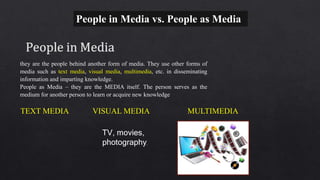
TV, movies,
photography,
VISUAL MEDIA
History
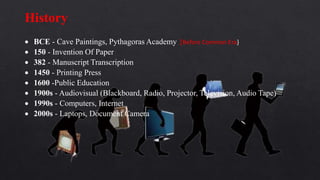
 BCE - Cave Paintings, Pythagoras Academy {Before Common Era}
 150 - Invention Of Paper
 382 - Manuscript Transcription
 1450 - Printing Press
 1600 -Public Education
 1900s - Audiovisual (Blackboard, Radio, Projector, Television, Audio Tape)
 1990s - Computers, Internet
 2000s - Laptops, Document Camera
Applications (in Education)
 Real time discussions in or outside classrooms
 Both teachers and students can act as media with their interactions
 Reportings, skits, and other educational requirements that will demand
students to act as giver of information (media)
Advantages
 Flexibility - can correct mistakes last minute (thought-process) •
 Interactive
 Ability to process the feelings of its media receivers
 Ability to maintain relationships between sender and receiver
 Fast feedback between sender and receiver
Issues Involved
 Reliability- Capable of being relied on; dependable
 Plagiarism- the practice of taking someone else’s work or ideas and
passing them off as one’s own
TEXT
 Is a simple and flexible format of presenting information or conveying
ideas whether hand-written, printed or displayed on-screen.
 is very powerful as well in disseminating information, providing
direction and giving suggestions.
 is available in different sources whether it is formal (news articles,
published books, newspapers, magazines, advertisements, research
works, etc.) or informal (blogs, personal e-mails, SMS or text
messages, online messengers, social media platforms, etc.).
2 Types of Text
1. Formal text-based materials are created and distributed by established
institutions (such as publishing companies, news agencies, etc.) and go
through a rigorous process of editing or evaluation and are usually
governed by censorship of the state.
2. Informal text-based materials, on the other hand, come from personal
opinions or views on different issues, processes, etc.
Text as Visual
• Typeface (also called font, font type, or type) refers to the representation or
style of a text in the digital format.
A typeface is usually comprised of alphabets, numbers, punctuation marks,
symbols and other special characters. When fonts are installed in the
computer, they usually come in file formats such as True Type Font (.ttf),
Open Type Font (.otf), etc.
In the absence of images or drawings, text is the easiest way of
communicating to your audience. The use of various font types can express
different emotions or meaning.
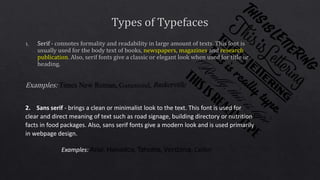
2. Sans serif - brings a clean or minimalist look to the text. This font is used for
clear and direct meaning of text such as road signage, building directory or nutrition
facts in food packages. Also, sans serif fonts give a modern look and is used primarily
in webpage design.
Examples: Arial, Helvetica, Tahoma, Verdana, Calibri
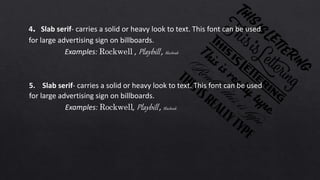
4. Slab serif- carries a solid or heavy look to text. This font can be used
for large advertising sign on billboards.
Examples: Rockwell , Playbill , Blackoak
5. Slab serif- carries a solid or heavy look to text. This font can be used
for large advertising sign on billboards.
Examples: Rockwell, Playbill , Blackoak
Making Typography Posters
Identify an advocacy or issue that they would like to
campaign against the Prevalence of False Truth (Fake
News) in Media through a typography poster design. The
campaign poster will have a statement consisting of 10-20
words.
People media

People media

  • 5.
    People in Mediavs. People as Media they are the people behind another form of media. They use other forms of media such as text media, visual media, multimedia, etc. in disseminating information and imparting knowledge. People as Media – they are the MEDIA itself. The person serves as the medium for another person to learn or acquire new knowledge MULTIMEDIATEXT MEDIA TV, movies, photography, VISUAL MEDIA
  • 7.
    History  BCE -Cave Paintings, Pythagoras Academy {Before Common Era}  150 - Invention Of Paper  382 - Manuscript Transcription  1450 - Printing Press  1600 -Public Education  1900s - Audiovisual (Blackboard, Radio, Projector, Television, Audio Tape)  1990s - Computers, Internet  2000s - Laptops, Document Camera
  • 10.
    Applications (in Education) Real time discussions in or outside classrooms  Both teachers and students can act as media with their interactions  Reportings, skits, and other educational requirements that will demand students to act as giver of information (media)
  • 11.
    Advantages  Flexibility -can correct mistakes last minute (thought-process) •  Interactive  Ability to process the feelings of its media receivers  Ability to maintain relationships between sender and receiver  Fast feedback between sender and receiver Issues Involved  Reliability- Capable of being relied on; dependable  Plagiarism- the practice of taking someone else’s work or ideas and passing them off as one’s own
  • 13.
    TEXT  Is asimple and flexible format of presenting information or conveying ideas whether hand-written, printed or displayed on-screen.  is very powerful as well in disseminating information, providing direction and giving suggestions.  is available in different sources whether it is formal (news articles, published books, newspapers, magazines, advertisements, research works, etc.) or informal (blogs, personal e-mails, SMS or text messages, online messengers, social media platforms, etc.).
  • 14.
    2 Types ofText 1. Formal text-based materials are created and distributed by established institutions (such as publishing companies, news agencies, etc.) and go through a rigorous process of editing or evaluation and are usually governed by censorship of the state. 2. Informal text-based materials, on the other hand, come from personal opinions or views on different issues, processes, etc.
  • 15.
    Text as Visual •Typeface (also called font, font type, or type) refers to the representation or style of a text in the digital format. A typeface is usually comprised of alphabets, numbers, punctuation marks, symbols and other special characters. When fonts are installed in the computer, they usually come in file formats such as True Type Font (.ttf), Open Type Font (.otf), etc. In the absence of images or drawings, text is the easiest way of communicating to your audience. The use of various font types can express different emotions or meaning.
  • 16.
    2. Sans serif- brings a clean or minimalist look to the text. This font is used for clear and direct meaning of text such as road signage, building directory or nutrition facts in food packages. Also, sans serif fonts give a modern look and is used primarily in webpage design. Examples: Arial, Helvetica, Tahoma, Verdana, Calibri
  • 17.
    4. Slab serif-carries a solid or heavy look to text. This font can be used for large advertising sign on billboards. Examples: Rockwell , Playbill , Blackoak 5. Slab serif- carries a solid or heavy look to text. This font can be used for large advertising sign on billboards. Examples: Rockwell, Playbill , Blackoak
  • 18.
    Making Typography Posters Identifyan advocacy or issue that they would like to campaign against the Prevalence of False Truth (Fake News) in Media through a typography poster design. The campaign poster will have a statement consisting of 10-20 words.