Chapter 1 -
1
Palestine Polytechnic University
Department of Mechanical Engineering
ME251: Materials Science
Course Objective:
Introduce fundamental concepts in Materials Science
Syllabus Link: http://cet.ppu.edu/depts/me/metemplate/syllabus/maher_s/
Material%20Sc%20SYLLABUS.htm
You will learn about:
• material structure
• how structure dictates properties
• how processing can change structure
This course will help you to:
• use materials properly – material selection
• realize new design opportunities with materials
Lecturer: Dr. Maher Al-Jabari
Chapter 1 -
2
Concept of
Material Science and Engineering
Processing
Structure Properties
level
Types
Chapter 1 -
3
COURSE OUTLINE AND CALENDER
TOPICS WEEKS/HOURS
Introduction to Materials Science (Chapter 1) 1st
/ 2+
Atomic Structure & Interatomic Bonding (Chapter 2) 2nd
/ 2+
The Structure of Crystalline Solids (Chapter. 3) 3rd
-5th
/ 8
Short Exam 1 5th
/ 1
Imperfections in Crystals (Chapter 4) 6th
-7th
/ 4
Diffusion (Chapter 5) -7th
/ 2
Mechanical Properties of Metals (Chapter 6) 8th
-9th
/ 6
Phase Diagrams (Chapter 9) 10th
-12th
/9
Midterm Exam 13th
/1
Phase Transformation in Metals (Chapter 10) 13th
/2
Heat treatment of metals (Chapter 11) 14th
/3
Short Exam 2 15th
/1
Introduction to other materials
(Polymers and Ceramics - as time permit)
15th
- rest
Final Exam University Schedule
Chapter 1 -
4
COURSE POLICIES
GRADING SYSTEM
Short Exam-1 10 %
Midterm Exam 30 %
Short Exam-2 10 %
Quizzes and Attendance 10 %
Final Exam 40 %
Students are required to attend all classes
Unexcused absence of exams is not accepted
Make-up exams are expected to be harder.
Chapter 1 -
5
Chapter 1 - Introduction
• What is materials science / engineering ?
• Why should we know about it?
• Materials drive our society ???????
• History
– Stone Age
– Bronze Age
– Iron Age
– Now?
• Silicon Age?
• Polymer Age?
Chapter 1 -
6
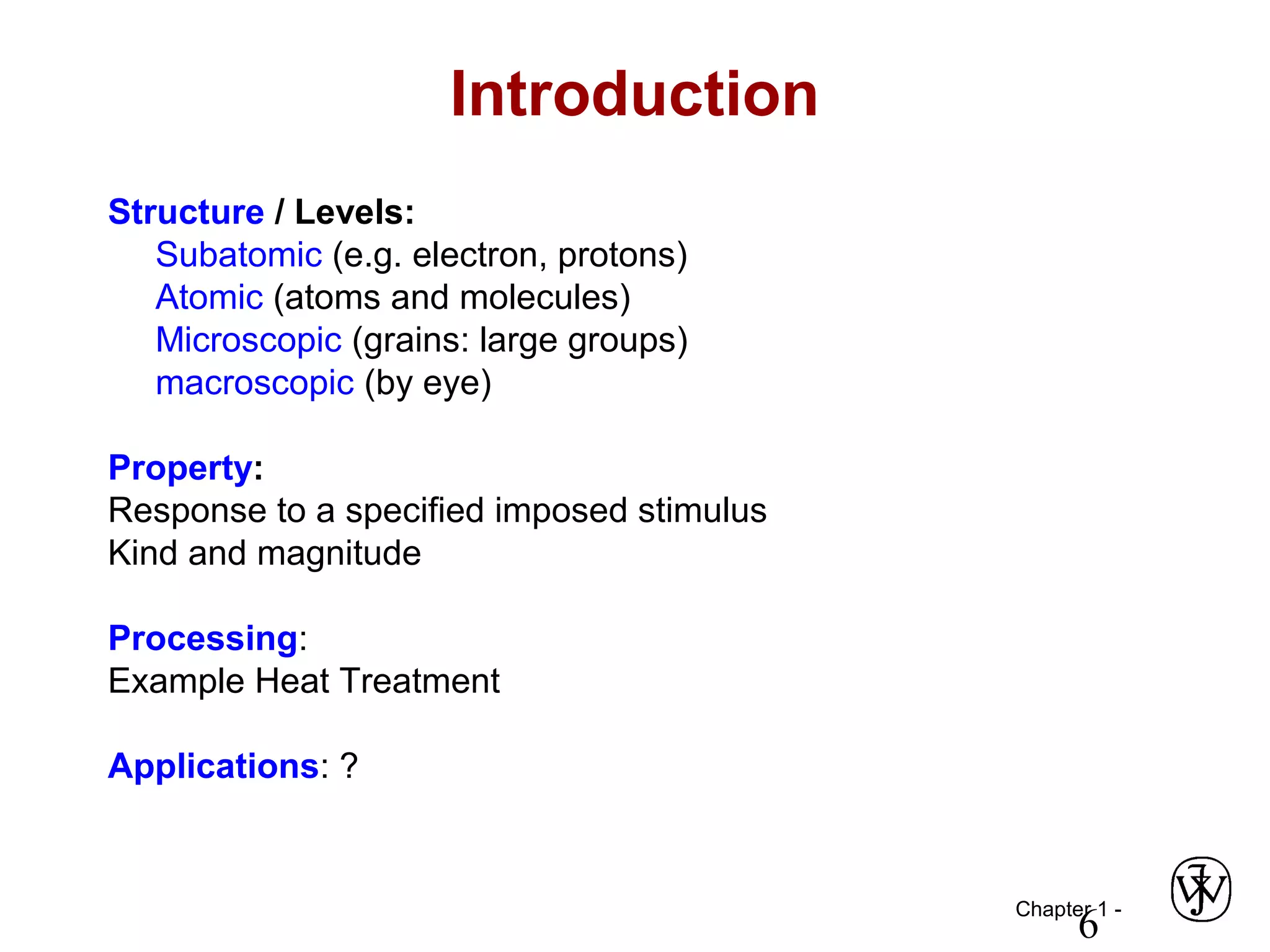
Introduction
Structure / Levels:
Subatomic (e.g. electron, protons)
Atomic (atoms and molecules)
Microscopic (grains: large groups)
macroscopic (by eye)
Property:
Response to a specified imposed stimulus
Kind and magnitude
Processing:
Example Heat Treatment
Applications: ?
Chapter 1 -
7
Example – Biomedical - Hip Implant
• Requirements
– mechanical strength
(many cycles)
– good lubricity
– biocompatibility
Femoral
Stem
Ball
Acetabular
Cup and Liner
Chapter 1 -
8
Other Applications
• Industry
• Metal manufacturing
• Dentists ?
• Think of Others
• In Hebron ?
• In History ?
• In Future ?
Chapter 1 -
9
Developments of New Types of Polymers
• Commodity plastics
Ex. Polyethylene
Polypropylene
Polystyrene
etc.
• Engineering Resins
Ex. Polycarbonate
Nylon
Polysulfone
etc.
Can polypropylene be “upgraded” to properties (and price) near
those of engineering resins?
Chapter 1 -
10
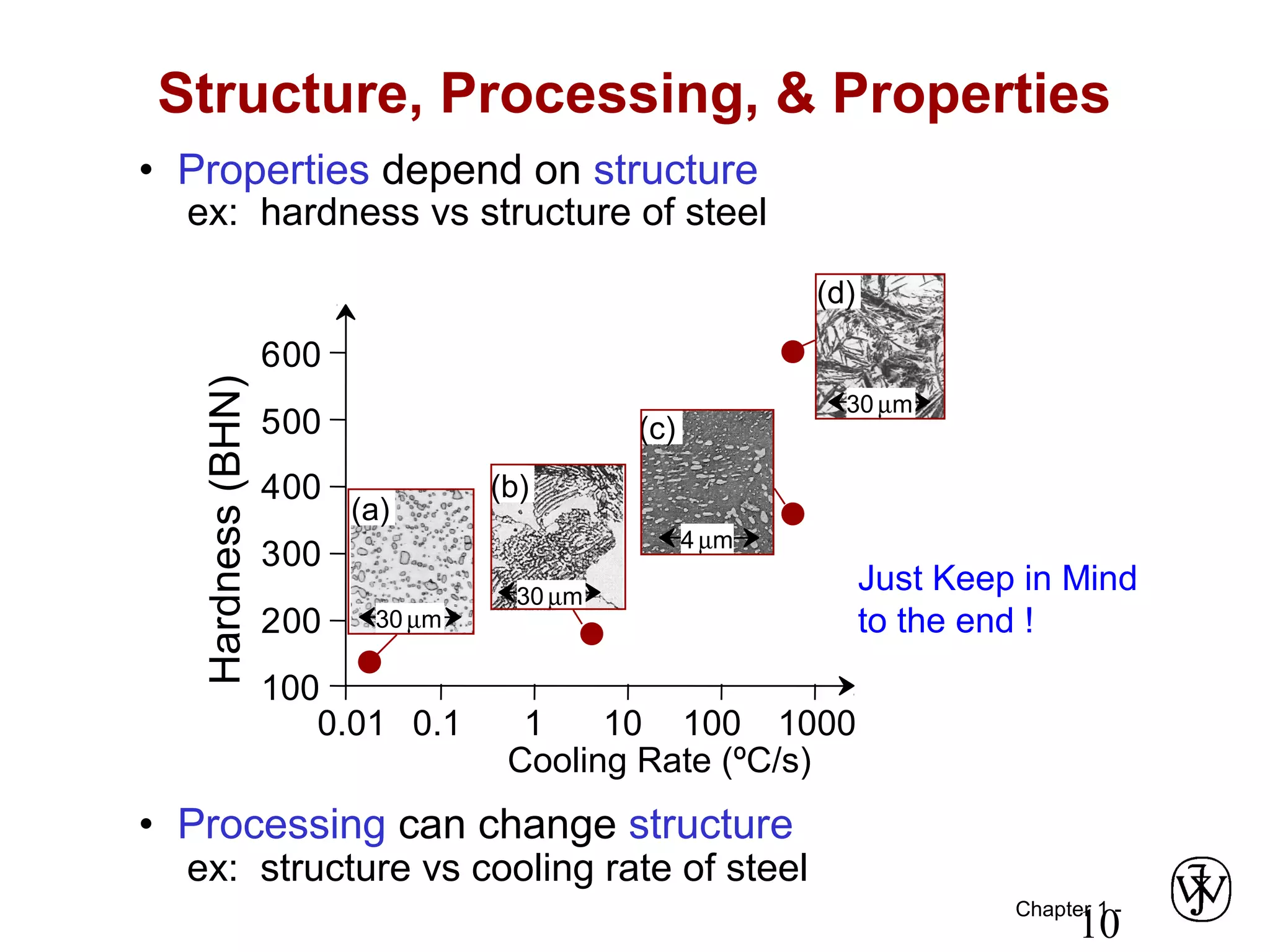
ex: hardness vs structure of steel
• Properties depend on structure
ex: structure vs cooling rate of steel
• Processing can change structure
Structure, Processing, & Properties
Hardness(BHN)
Cooling Rate (ºC/s)
100
200
300
400
500
600
0.01 0.1 1 10 100 1000
(d)
30 µm
(c)
4 µm
(b)
30 µm
(a)
30 µm
Just Keep in Mind
to the end !
Chapter 1 -
11
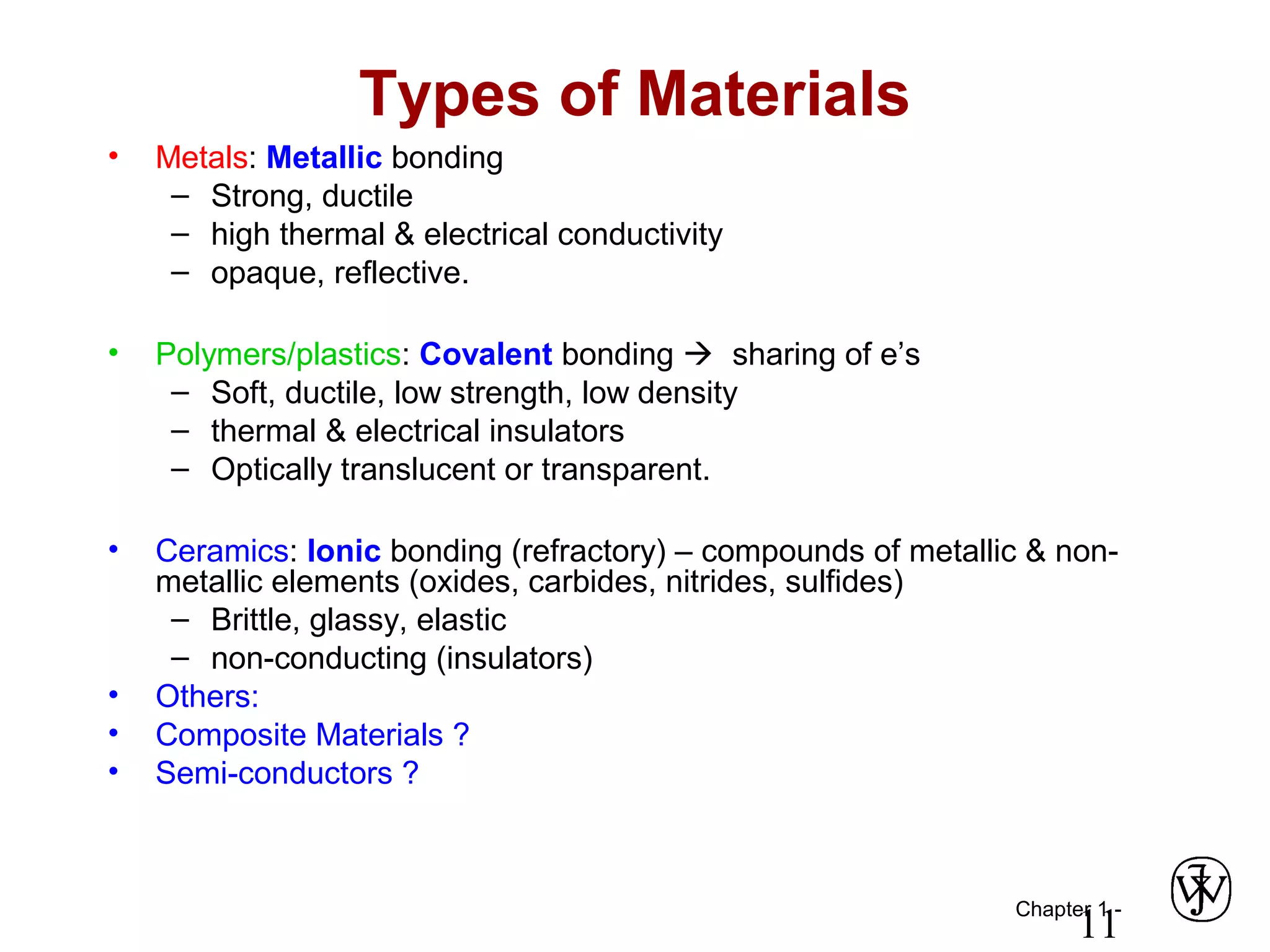
Types of Materials
• Metals: Metallic bonding
– Strong, ductile
– high thermal & electrical conductivity
– opaque, reflective.
• Polymers/plastics: Covalent bonding  sharing of e’s
– Soft, ductile, low strength, low density
– thermal & electrical insulators
– Optically translucent or transparent.
• Ceramics: Ionic bonding (refractory) – compounds of metallic & non-
metallic elements (oxides, carbides, nitrides, sulfides)
– Brittle, glassy, elastic
– non-conducting (insulators)
• Others:
• Composite Materials ?
• Semi-conductors ?
Chapter 1 -
12
1. Pick Application Determine required Properties
2. Properties Identify candidate Material(s)
3. Material Identify required Processing
Processing: changes structure and overall shape
ex: casting, vapor deposition, forming, joining,
quenching, annealing.
Properties: mechanical, electrical, thermal,
magnetic, optical, deteriorative.
Material: structure, composition.
The Materials Selection Process
Chapter 1 -
13
Properties
• THERMAL
• ELECTRICAL
• MAGNETIC
• OPTICAL
Chapter 1 -
14
THERMAL
• Space Shuttle Tiles:
- Silica fiber insulation
offers low heat conduction.
• Thermal Conductivity
of Copper:
-It decreases when you add zinc!
Composition (wt% Zinc)
ThermalConductivity
(W/m-K)
400
300
200
100
0
0 10 20 30 40
Chapter 1 -
15
ELECTRICAL
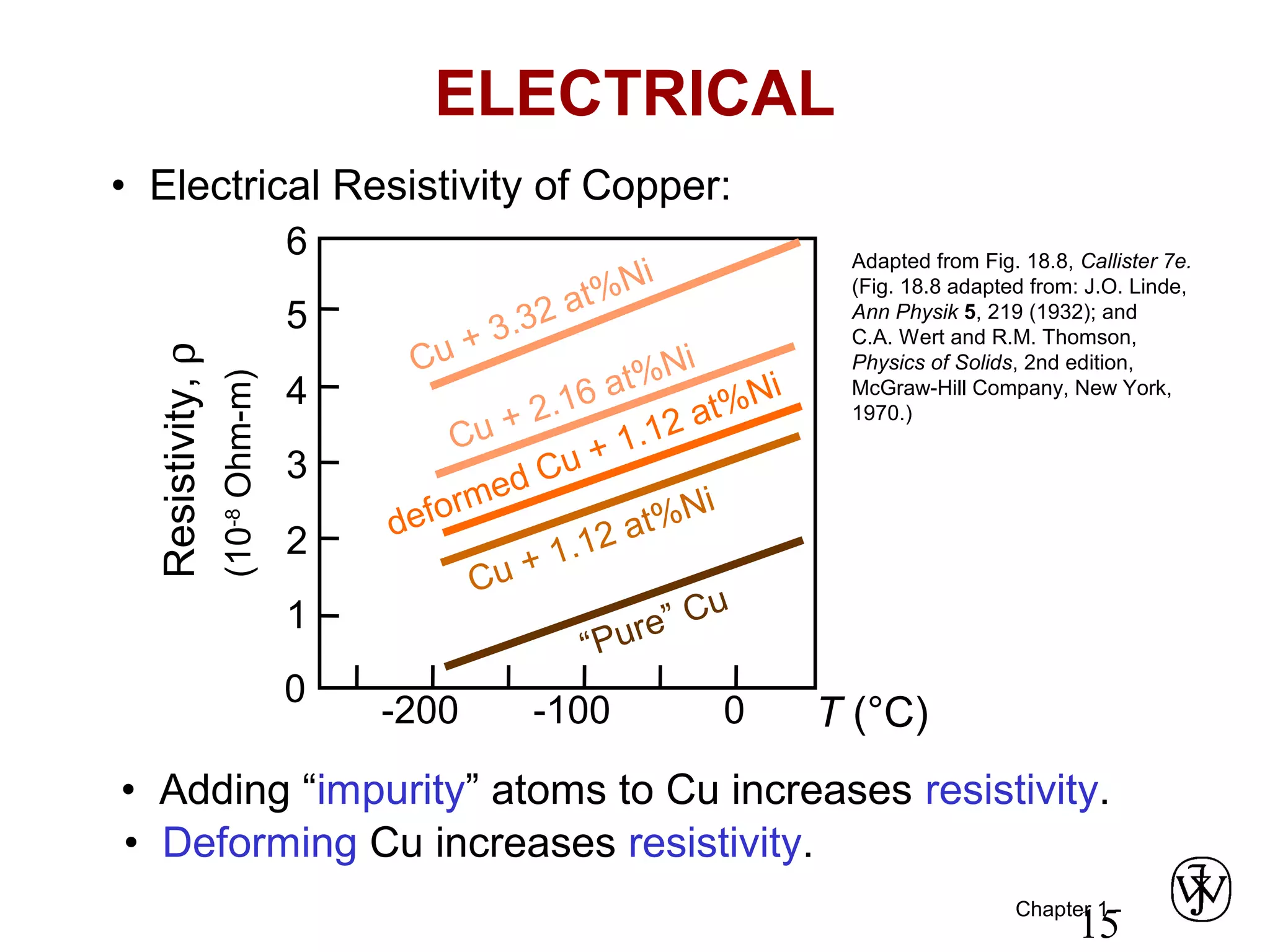
• Electrical Resistivity of Copper:
• Adding “impurity” atoms to Cu increases resistivity.
• Deforming Cu increases resistivity.
Adapted from Fig. 18.8, Callister 7e.
(Fig. 18.8 adapted from: J.O. Linde,
Ann Physik 5, 219 (1932); and
C.A. Wert and R.M. Thomson,
Physics of Solids, 2nd edition,
McGraw-Hill Company, New York,
1970.)
T (°C)-200 -100 0
Cu + 3.32 at%Ni
Cu + 2.16 at%Ni
deformed Cu + 1.12 at%Ni
1
2
3
4
5
6
Resistivity,ρ
(10-8
Ohm-m)
0
Cu + 1.12 at%Ni
“Pure” Cu
Chapter 1 -
16
MAGNETIC
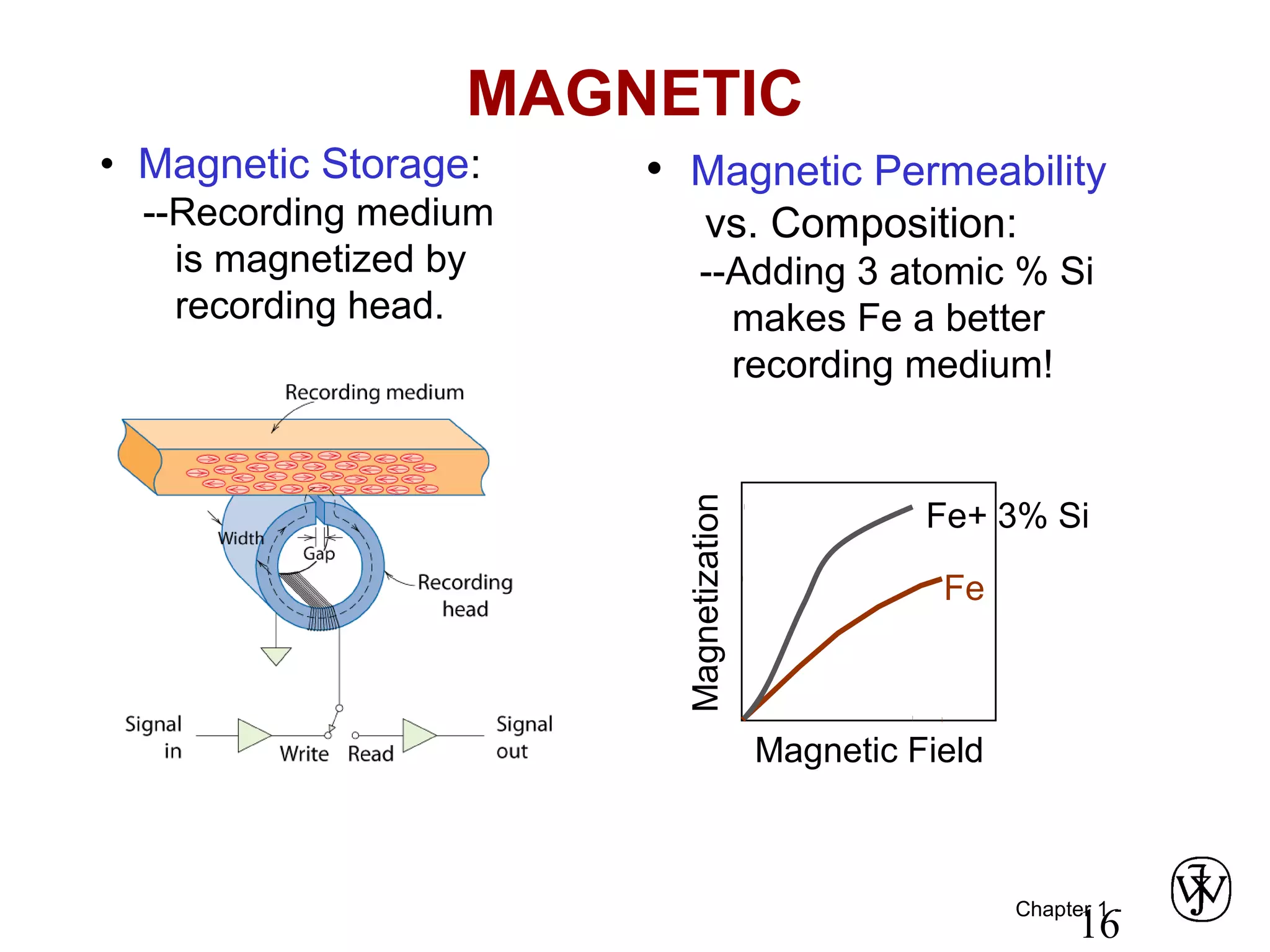
• Magnetic Permeability
vs. Composition:
--Adding 3 atomic % Si
makes Fe a better
recording medium!
• Magnetic Storage:
--Recording medium
is magnetized by
recording head.
Magnetic Field
Magnetization
Fe+ 3% Si
Fe
Chapter 1 -
17
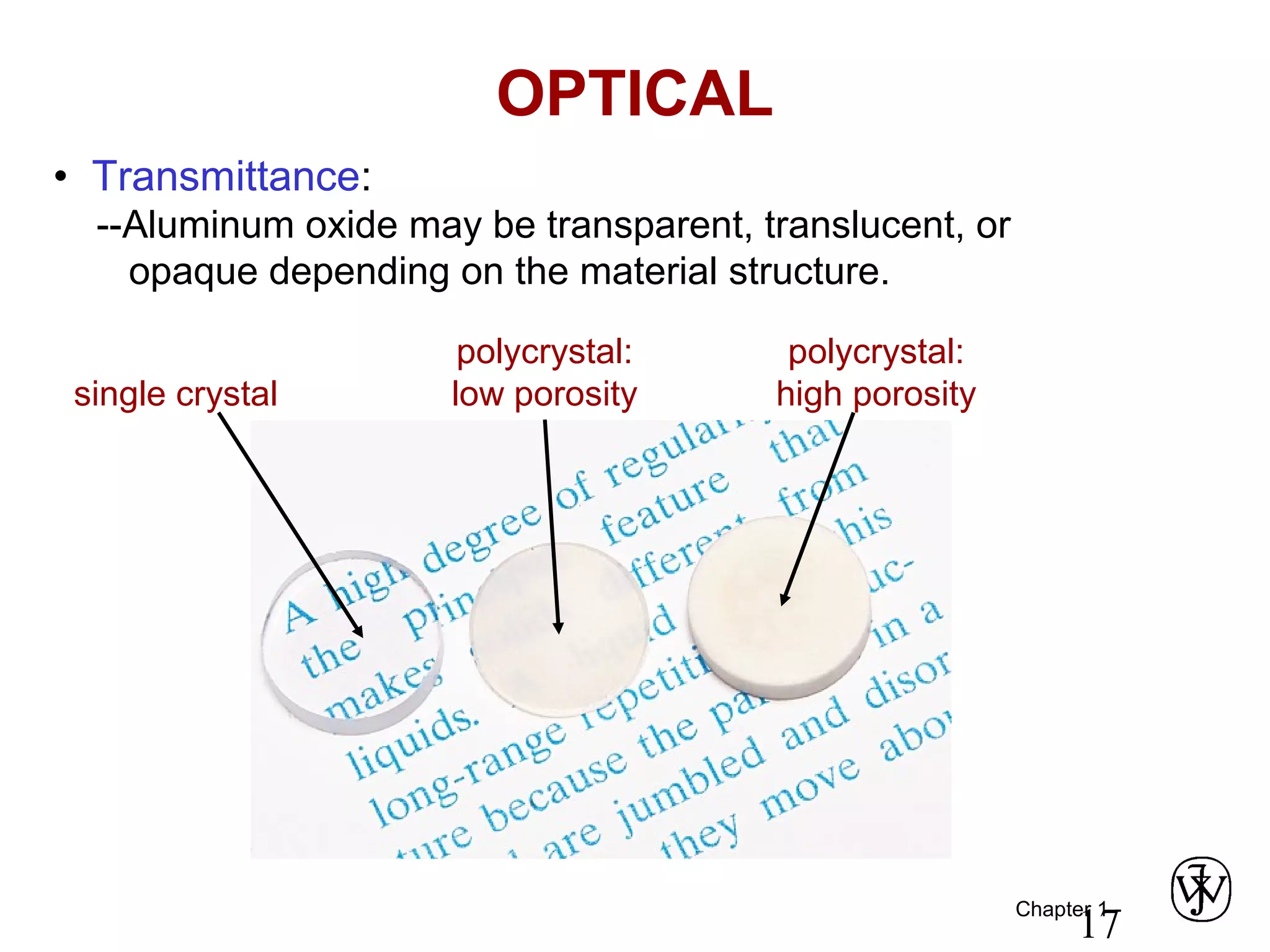
• Transmittance:
--Aluminum oxide may be transparent, translucent, or
opaque depending on the material structure.
single crystal
polycrystal:
low porosity
polycrystal:
high porosity
OPTICAL
Chapter 1 -
18
• Strength
• Fabricability
• Corrosion Resistance
• Availability
• Cost
• Appearance
Factors
Material Selection
Chapter 1 -
19
• Use the right material for the job.
• Understand the relation between properties,
structure, and processing.
• Recognize new design opportunities offered
by materials selection.
• Do not forget the triangle:
Course Goals:
SUMMARY
Processing
Structure Properties

Ch01 m

  • 1.
    Chapter 1 - 1 PalestinePolytechnic University Department of Mechanical Engineering ME251: Materials Science Course Objective: Introduce fundamental concepts in Materials Science Syllabus Link: http://cet.ppu.edu/depts/me/metemplate/syllabus/maher_s/ Material%20Sc%20SYLLABUS.htm You will learn about: • material structure • how structure dictates properties • how processing can change structure This course will help you to: • use materials properly – material selection • realize new design opportunities with materials Lecturer: Dr. Maher Al-Jabari
  • 2.
    Chapter 1 - 2 Conceptof Material Science and Engineering Processing Structure Properties level Types
  • 3.
    Chapter 1 - 3 COURSEOUTLINE AND CALENDER TOPICS WEEKS/HOURS Introduction to Materials Science (Chapter 1) 1st / 2+ Atomic Structure & Interatomic Bonding (Chapter 2) 2nd / 2+ The Structure of Crystalline Solids (Chapter. 3) 3rd -5th / 8 Short Exam 1 5th / 1 Imperfections in Crystals (Chapter 4) 6th -7th / 4 Diffusion (Chapter 5) -7th / 2 Mechanical Properties of Metals (Chapter 6) 8th -9th / 6 Phase Diagrams (Chapter 9) 10th -12th /9 Midterm Exam 13th /1 Phase Transformation in Metals (Chapter 10) 13th /2 Heat treatment of metals (Chapter 11) 14th /3 Short Exam 2 15th /1 Introduction to other materials (Polymers and Ceramics - as time permit) 15th - rest Final Exam University Schedule
  • 4.
    Chapter 1 - 4 COURSEPOLICIES GRADING SYSTEM Short Exam-1 10 % Midterm Exam 30 % Short Exam-2 10 % Quizzes and Attendance 10 % Final Exam 40 % Students are required to attend all classes Unexcused absence of exams is not accepted Make-up exams are expected to be harder.
  • 5.
    Chapter 1 - 5 Chapter1 - Introduction • What is materials science / engineering ? • Why should we know about it? • Materials drive our society ??????? • History – Stone Age – Bronze Age – Iron Age – Now? • Silicon Age? • Polymer Age?
  • 6.
    Chapter 1 - 6 Introduction Structure/ Levels: Subatomic (e.g. electron, protons) Atomic (atoms and molecules) Microscopic (grains: large groups) macroscopic (by eye) Property: Response to a specified imposed stimulus Kind and magnitude Processing: Example Heat Treatment Applications: ?
  • 7.
    Chapter 1 - 7 Example– Biomedical - Hip Implant • Requirements – mechanical strength (many cycles) – good lubricity – biocompatibility Femoral Stem Ball Acetabular Cup and Liner
  • 8.
    Chapter 1 - 8 OtherApplications • Industry • Metal manufacturing • Dentists ? • Think of Others • In Hebron ? • In History ? • In Future ?
  • 9.
    Chapter 1 - 9 Developmentsof New Types of Polymers • Commodity plastics Ex. Polyethylene Polypropylene Polystyrene etc. • Engineering Resins Ex. Polycarbonate Nylon Polysulfone etc. Can polypropylene be “upgraded” to properties (and price) near those of engineering resins?
  • 10.
    Chapter 1 - 10 ex:hardness vs structure of steel • Properties depend on structure ex: structure vs cooling rate of steel • Processing can change structure Structure, Processing, & Properties Hardness(BHN) Cooling Rate (ºC/s) 100 200 300 400 500 600 0.01 0.1 1 10 100 1000 (d) 30 µm (c) 4 µm (b) 30 µm (a) 30 µm Just Keep in Mind to the end !
  • 11.
    Chapter 1 - 11 Typesof Materials • Metals: Metallic bonding – Strong, ductile – high thermal & electrical conductivity – opaque, reflective. • Polymers/plastics: Covalent bonding  sharing of e’s – Soft, ductile, low strength, low density – thermal & electrical insulators – Optically translucent or transparent. • Ceramics: Ionic bonding (refractory) – compounds of metallic & non- metallic elements (oxides, carbides, nitrides, sulfides) – Brittle, glassy, elastic – non-conducting (insulators) • Others: • Composite Materials ? • Semi-conductors ?
  • 12.
    Chapter 1 - 12 1.Pick Application Determine required Properties 2. Properties Identify candidate Material(s) 3. Material Identify required Processing Processing: changes structure and overall shape ex: casting, vapor deposition, forming, joining, quenching, annealing. Properties: mechanical, electrical, thermal, magnetic, optical, deteriorative. Material: structure, composition. The Materials Selection Process
  • 13.
    Chapter 1 - 13 Properties •THERMAL • ELECTRICAL • MAGNETIC • OPTICAL
  • 14.
    Chapter 1 - 14 THERMAL •Space Shuttle Tiles: - Silica fiber insulation offers low heat conduction. • Thermal Conductivity of Copper: -It decreases when you add zinc! Composition (wt% Zinc) ThermalConductivity (W/m-K) 400 300 200 100 0 0 10 20 30 40
  • 15.
    Chapter 1 - 15 ELECTRICAL •Electrical Resistivity of Copper: • Adding “impurity” atoms to Cu increases resistivity. • Deforming Cu increases resistivity. Adapted from Fig. 18.8, Callister 7e. (Fig. 18.8 adapted from: J.O. Linde, Ann Physik 5, 219 (1932); and C.A. Wert and R.M. Thomson, Physics of Solids, 2nd edition, McGraw-Hill Company, New York, 1970.) T (°C)-200 -100 0 Cu + 3.32 at%Ni Cu + 2.16 at%Ni deformed Cu + 1.12 at%Ni 1 2 3 4 5 6 Resistivity,ρ (10-8 Ohm-m) 0 Cu + 1.12 at%Ni “Pure” Cu
  • 16.
    Chapter 1 - 16 MAGNETIC •Magnetic Permeability vs. Composition: --Adding 3 atomic % Si makes Fe a better recording medium! • Magnetic Storage: --Recording medium is magnetized by recording head. Magnetic Field Magnetization Fe+ 3% Si Fe
  • 17.
    Chapter 1 - 17 •Transmittance: --Aluminum oxide may be transparent, translucent, or opaque depending on the material structure. single crystal polycrystal: low porosity polycrystal: high porosity OPTICAL
  • 18.
    Chapter 1 - 18 •Strength • Fabricability • Corrosion Resistance • Availability • Cost • Appearance Factors Material Selection
  • 19.
    Chapter 1 - 19 •Use the right material for the job. • Understand the relation between properties, structure, and processing. • Recognize new design opportunities offered by materials selection. • Do not forget the triangle: Course Goals: SUMMARY Processing Structure Properties

Editor's Notes

  • #12 Metals have high thermal & electrical conductivity because valence electrons are free to roam