Introduction toIntroduction to
market structuremarket structure
modelsmodels
Learning outcomes
Understand the
characteristics
of market
structure
Understand
how firm
behaviour is
affected by
market
Define the four
market structures
Explain and give
examples of
barriers to entry
Market structureMarket structure
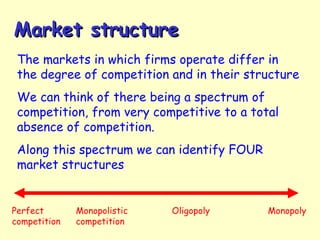
The markets in which firms operate differ in
the degree of competition and in their structure
We can think of there being a spectrum of
competition, from very competitive to a total
absence of competition.
Along this spectrum we can identify FOUR
market structures
Perfect Monopolistic Oligopoly Monopoly
competition competition
Market structure characteristicsMarket structure characteristics
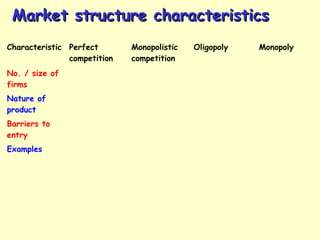
Characteristic Perfect
competition
Monopolistic
competition
Oligopoly Monopoly
No. / size of
firms
Nature of
product
Barriers to
entry
Examples
Characteristic Perfect
competition
Monopolistic
competition
Oligopoly Monopoly
No. / size of
firms
Large no. of
small firms
Large no. of
small firms
Small no. of
large firms
One (theory)
> 25% mkt
share (CC)
Nature of
product
Barriers to
entry
Examples
Market structure characteristicsMarket structure characteristics
Characteristic Perfect
competition
Monopolistic
competition
Oligopoly Monopoly
No. / size of
firms
Large no. of
small firms
Large no. of
small firms
Small no. of
large firms
One (theory)
> 25% mkt
share (CC)
Nature of
product
Identical Differentiated Differentiated No
substitutes
Barriers to
entry
Examples
Market structure characteristicsMarket structure characteristics
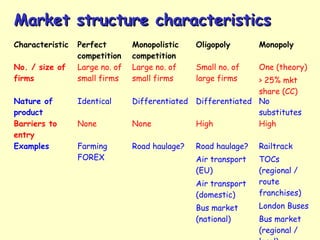
Characteristic Perfect
competition
Monopolistic
competition
Oligopoly Monopoly
No. / size of
firms
Large no. of
small firms
Large no. of
small firms
Small no. of
large firms
One (theory)
> 25% mkt
share (CC)
Nature of
product
Identical Differentiated Differentiated No
substitutes
Barriers to
entry
None None High High
Examples Farming
FOREX
Road haulage? Road haulage?
Air transport
(EU)
Air transport
(domestic)
Bus market
(national)
Railtrack
TOCs
(regional /
route
franchises)
London Buses
Bus market
(regional /
Market structure characteristicsMarket structure characteristics
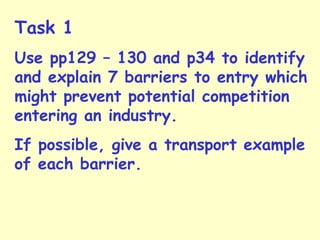
Task 1
Use pp129 – 130 and p34 to identify
and explain 7 barriers to entry which
might prevent potential competition
entering an industry.
If possible, give a transport example
of each barrier.
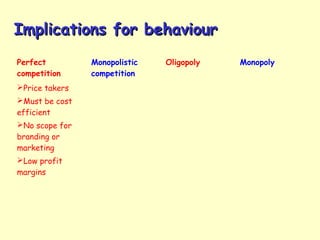
Implications for behaviourImplications for behaviour
Perfect
competition
Monopolistic
competition
Oligopoly Monopoly
Perfect
competition
Monopolistic
competition
Oligopoly Monopoly
Price takers
Must be cost
efficient
No scope for
branding or
marketing
Low profit
margins
Implications for behaviourImplications for behaviour
Perfect
competition
Monopolistic
competition
Oligopoly Monopoly
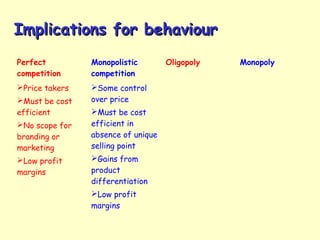
Price takers
Must be cost
efficient
No scope for
branding or
marketing
Low profit
margins
Some control
over price
Must be cost
efficient in
absence of unique
selling point
Gains from
product
differentiation
Low profit
margins
Implications for behaviourImplications for behaviour
Perfect
competition
Monopolistic
competition
Oligopoly Monopoly
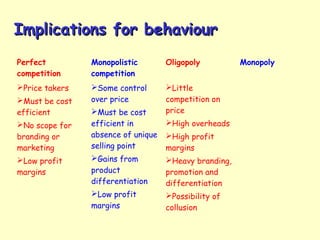
Price takers
Must be cost
efficient
No scope for
branding or
marketing
Low profit
margins
Some control
over price
Must be cost
efficient in
absence of unique
selling point
Gains from
product
differentiation
Low profit
margins
Little
competition on
price
High overheads
High profit
margins
Heavy branding,
promotion and
differentiation
Possibility of
collusion
Implications for behaviourImplications for behaviour
Perfect
competition
Monopolistic
competition
Oligopoly Monopoly
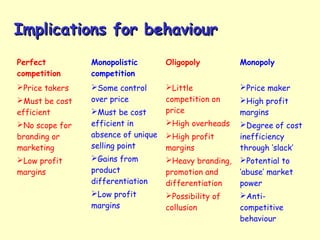
Price takers
Must be cost
efficient
No scope for
branding or
marketing
Low profit
margins
Some control
over price
Must be cost
efficient in
absence of unique
selling point
Gains from
product
differentiation
Low profit
margins
Little
competition on
price
High overheads
High profit
margins
Heavy branding,
promotion and
differentiation
Possibility of
collusion
Price maker
High profit
margins
Degree of cost
inefficiency
through ‘slack’
Potential to
‘abuse’ market
power
Anti-
competitive
behaviour
Implications for behaviourImplications for behaviour
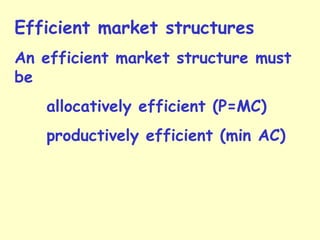
Efficient market structures
An efficient market structure must
be
allocatively efficient (P=MC)
productively efficient (min AC)
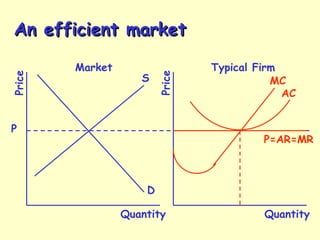
An efficient marketAn efficient market
Price
Price
Market Typical Firm
Quantity Quantity
D
S
P
P=AR=MR
MC
AC
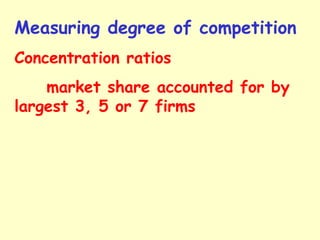
Measuring degree of competition
Concentration ratios
market share accounted for by
largest 3, 5 or 7 firms
Task 2
Answer the following questions from
the specimen paper
(a) (i)
(a) (ii)
(b) (i)
(b) (ii)

Introduction to market structures

  • 1.
    Introduction toIntroduction to marketstructuremarket structure modelsmodels
  • 2.
    Learning outcomes Understand the characteristics ofmarket structure Understand how firm behaviour is affected by market Define the four market structures Explain and give examples of barriers to entry
  • 3.
    Market structureMarket structure Themarkets in which firms operate differ in the degree of competition and in their structure We can think of there being a spectrum of competition, from very competitive to a total absence of competition. Along this spectrum we can identify FOUR market structures Perfect Monopolistic Oligopoly Monopoly competition competition
  • 4.
    Market structure characteristicsMarketstructure characteristics Characteristic Perfect competition Monopolistic competition Oligopoly Monopoly No. / size of firms Nature of product Barriers to entry Examples
  • 5.
    Characteristic Perfect competition Monopolistic competition Oligopoly Monopoly No./ size of firms Large no. of small firms Large no. of small firms Small no. of large firms One (theory) > 25% mkt share (CC) Nature of product Barriers to entry Examples Market structure characteristicsMarket structure characteristics
  • 6.
    Characteristic Perfect competition Monopolistic competition Oligopoly Monopoly No./ size of firms Large no. of small firms Large no. of small firms Small no. of large firms One (theory) > 25% mkt share (CC) Nature of product Identical Differentiated Differentiated No substitutes Barriers to entry Examples Market structure characteristicsMarket structure characteristics
  • 7.
    Characteristic Perfect competition Monopolistic competition Oligopoly Monopoly No./ size of firms Large no. of small firms Large no. of small firms Small no. of large firms One (theory) > 25% mkt share (CC) Nature of product Identical Differentiated Differentiated No substitutes Barriers to entry None None High High Examples Farming FOREX Road haulage? Road haulage? Air transport (EU) Air transport (domestic) Bus market (national) Railtrack TOCs (regional / route franchises) London Buses Bus market (regional / Market structure characteristicsMarket structure characteristics
  • 8.
    Task 1 Use pp129– 130 and p34 to identify and explain 7 barriers to entry which might prevent potential competition entering an industry. If possible, give a transport example of each barrier.
  • 9.
    Implications for behaviourImplicationsfor behaviour Perfect competition Monopolistic competition Oligopoly Monopoly
  • 10.
    Perfect competition Monopolistic competition Oligopoly Monopoly Price takers Mustbe cost efficient No scope for branding or marketing Low profit margins Implications for behaviourImplications for behaviour
  • 11.
    Perfect competition Monopolistic competition Oligopoly Monopoly Price takers Mustbe cost efficient No scope for branding or marketing Low profit margins Some control over price Must be cost efficient in absence of unique selling point Gains from product differentiation Low profit margins Implications for behaviourImplications for behaviour
  • 12.
    Perfect competition Monopolistic competition Oligopoly Monopoly Price takers Mustbe cost efficient No scope for branding or marketing Low profit margins Some control over price Must be cost efficient in absence of unique selling point Gains from product differentiation Low profit margins Little competition on price High overheads High profit margins Heavy branding, promotion and differentiation Possibility of collusion Implications for behaviourImplications for behaviour
  • 13.
    Perfect competition Monopolistic competition Oligopoly Monopoly Price takers Mustbe cost efficient No scope for branding or marketing Low profit margins Some control over price Must be cost efficient in absence of unique selling point Gains from product differentiation Low profit margins Little competition on price High overheads High profit margins Heavy branding, promotion and differentiation Possibility of collusion Price maker High profit margins Degree of cost inefficiency through ‘slack’ Potential to ‘abuse’ market power Anti- competitive behaviour Implications for behaviourImplications for behaviour
  • 14.
    Efficient market structures Anefficient market structure must be allocatively efficient (P=MC) productively efficient (min AC)
  • 15.
    An efficient marketAnefficient market Price Price Market Typical Firm Quantity Quantity D S P P=AR=MR MC AC
  • 16.
    Measuring degree ofcompetition Concentration ratios market share accounted for by largest 3, 5 or 7 firms
  • 17.
    Task 2 Answer thefollowing questions from the specimen paper (a) (i) (a) (ii) (b) (i) (b) (ii)