Objectives:
By the end of this section you should be able to:
1) State the characteristics of Monopoly
2) Draw the monopoly diagram
3) Explain how Monopolies exist in the long run
4) Analyse the case against Monopoly (using efficiency arguments)
5) Analyse the case for Monopoly (using efficiency arguments)
Efficient Market Structure
An efficient market structure is allocatively efficient (P=MC) and
productively efficient (produce at the lowest point on the AC curve

Revenue/
costs

MC

1) Firms are price

LRAC

P

D=MR=AR

takers, they face
a perfectly elastic
demand curve
2) No abnormal profits
can be made because of
perfect knowledge, so
no incentive of
firms in and
out of the industry
3) Long run equilibrium
is established
4) AC=AR=MR=MC

Output
Price

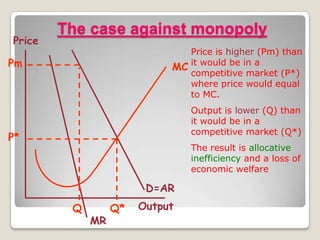
The case against monopoly
Price is higher (Pm) than
MC it would be in a
competitive market (P*)
where price would equal
to MC.

Pm

Output is lower (Q) than
it would be in a
competitive market (Q*)

P*

The result is allocative
inefficiency and a loss of
economic welfare

D=AR
Q

MR

Q*

Output
Price

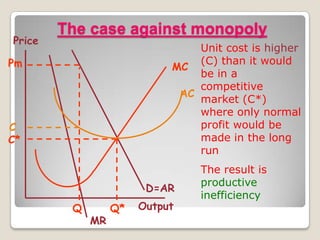
The case against monopoly
Unit cost is higher
(C) than it would
MC
be in a
competitive
AC
market (C*)
where only normal
profit would be
made in the long
run

Pm

C
C*

D=AR
Q

MR

Q*

Output

The result is
productive
inefficiency
The case against monopoly
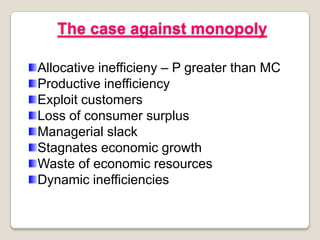
Allocative inefficieny – P greater than MC
Productive inefficiency
Exploit customers
Loss of consumer surplus
Managerial slack
Stagnates economic growth
Waste of economic resources
Dynamic inefficiencies
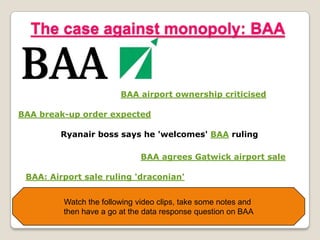
The case against monopoly: BAA

BAA airport ownership criticised
BAA break-up order expected
Ryanair boss says he 'welcomes' BAA ruling
BAA agrees Gatwick airport sale
BAA: Airport sale ruling 'draconian'
Watch the following video clips, take some notes and
then have a go at the data response question on BAA
DISCUSSION: Is there a case for monopoly?

Dynamic efficiency
Productive efficiency
Economies of Scale
International trade

ESSAY TASK:
Discuss the extent to which the monopoly provision of transport
services is beneficial to producers and consumers. [20]
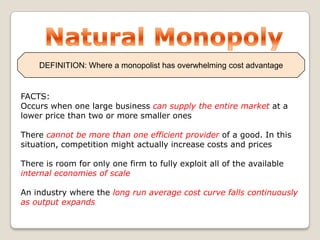
DEFINITION: Where a monopolist has overwhelming cost advantage

FACTS:
Occurs when one large business can supply the entire market at a
lower price than two or more smaller ones

There cannot be more than one efficient provider of a good. In this
situation, competition might actually increase costs and prices
There is room for only one firm to fully exploit all of the available
internal economies of scale

An industry where the long run average cost curve falls continuously
as output expands
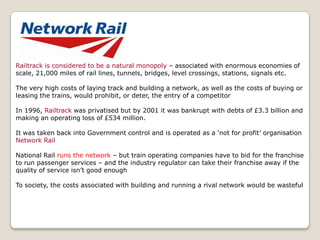
Railtrack is considered to be a natural monopoly – associated with enormous economies of
scale, 21,000 miles of rail lines, tunnels, bridges, level crossings, stations, signals etc.
The very high costs of laying track and building a network, as well as the costs of buying or
leasing the trains, would prohibit, or deter, the entry of a competitor
In 1996, Railtrack was privatised but by 2001 it was bankrupt with debts of £3.3 billion and
making an operating loss of £534 million.
It was taken back into Government control and is operated as a ‘not for profit’ organisation
Network Rail
National Rail runs the network – but train operating companies have to bid for the franchise
to run passenger services – and the industry regulator can take their franchise away if the
quality of service isn’t good enough
To society, the costs associated with building and running a rival network would be wasteful
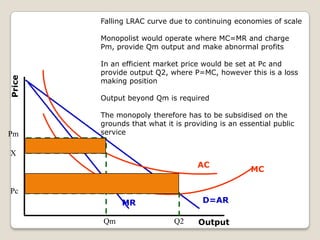
Falling LRAC curve due to continuing economies of scale

Price

Monopolist would operate where MC=MR and charge
Pm, provide Qm output and make abnormal profits

Pm

In an efficient market price would be set at Pc and
provide output Q2, where P=MC, however this is a loss
making position
Output beyond Qm is required
The monopoly therefore has to be subsidised on the
grounds that what it is providing is an essential public
service

X
AC
Pc

D=AR

MR
Qm

Q2

Output

MC

Monopoly slides slg (1)

  • 1.
    Objectives: By the endof this section you should be able to: 1) State the characteristics of Monopoly 2) Draw the monopoly diagram 3) Explain how Monopolies exist in the long run 4) Analyse the case against Monopoly (using efficiency arguments) 5) Analyse the case for Monopoly (using efficiency arguments)
  • 2.
    Efficient Market Structure Anefficient market structure is allocatively efficient (P=MC) and productively efficient (produce at the lowest point on the AC curve Revenue/ costs MC 1) Firms are price LRAC P D=MR=AR takers, they face a perfectly elastic demand curve 2) No abnormal profits can be made because of perfect knowledge, so no incentive of firms in and out of the industry 3) Long run equilibrium is established 4) AC=AR=MR=MC Output
  • 3.
    Price The case againstmonopoly Price is higher (Pm) than MC it would be in a competitive market (P*) where price would equal to MC. Pm Output is lower (Q) than it would be in a competitive market (Q*) P* The result is allocative inefficiency and a loss of economic welfare D=AR Q MR Q* Output
  • 4.
    Price The case againstmonopoly Unit cost is higher (C) than it would MC be in a competitive AC market (C*) where only normal profit would be made in the long run Pm C C* D=AR Q MR Q* Output The result is productive inefficiency
  • 5.
    The case againstmonopoly Allocative inefficieny – P greater than MC Productive inefficiency Exploit customers Loss of consumer surplus Managerial slack Stagnates economic growth Waste of economic resources Dynamic inefficiencies
  • 6.
    The case againstmonopoly: BAA BAA airport ownership criticised BAA break-up order expected Ryanair boss says he 'welcomes' BAA ruling BAA agrees Gatwick airport sale BAA: Airport sale ruling 'draconian' Watch the following video clips, take some notes and then have a go at the data response question on BAA
  • 7.
    DISCUSSION: Is therea case for monopoly? Dynamic efficiency Productive efficiency Economies of Scale International trade ESSAY TASK: Discuss the extent to which the monopoly provision of transport services is beneficial to producers and consumers. [20]
  • 9.
    DEFINITION: Where amonopolist has overwhelming cost advantage FACTS: Occurs when one large business can supply the entire market at a lower price than two or more smaller ones There cannot be more than one efficient provider of a good. In this situation, competition might actually increase costs and prices There is room for only one firm to fully exploit all of the available internal economies of scale An industry where the long run average cost curve falls continuously as output expands
  • 10.
    Railtrack is consideredto be a natural monopoly – associated with enormous economies of scale, 21,000 miles of rail lines, tunnels, bridges, level crossings, stations, signals etc. The very high costs of laying track and building a network, as well as the costs of buying or leasing the trains, would prohibit, or deter, the entry of a competitor In 1996, Railtrack was privatised but by 2001 it was bankrupt with debts of £3.3 billion and making an operating loss of £534 million. It was taken back into Government control and is operated as a ‘not for profit’ organisation Network Rail National Rail runs the network – but train operating companies have to bid for the franchise to run passenger services – and the industry regulator can take their franchise away if the quality of service isn’t good enough To society, the costs associated with building and running a rival network would be wasteful
  • 11.
    Falling LRAC curvedue to continuing economies of scale Price Monopolist would operate where MC=MR and charge Pm, provide Qm output and make abnormal profits Pm In an efficient market price would be set at Pc and provide output Q2, where P=MC, however this is a loss making position Output beyond Qm is required The monopoly therefore has to be subsidised on the grounds that what it is providing is an essential public service X AC Pc D=AR MR Qm Q2 Output MC

Editor's Notes

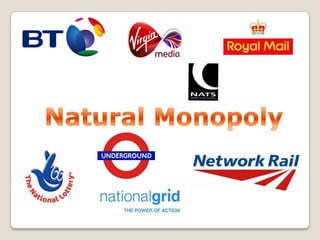
  • #9 1. British Telecom building and maintaining the UK telecommunications network for the broadband industry – especially the ‘final mile’ copper wiring from the local exchanges to each household 2. The Royal Mail’s postal distribution network – collection / sorting / delivery 3. Virgin Media owning and running the cable telecommunications network 4. Camelot operating the national network for the UK lottery 5. National Rail owning, maintaining and leasing out the UK rail network 6. National Grid plc which owns and operates the National Grid high-voltage electricity transmission network in England and Wales. Since April 1, 2005 it also operates the electricity transmission network in Scotland. Owns and operates the gas transmission network (from terminals to distributors). 7. London Underground9. National Air Traffic Services
  • #10 An important point is that a natural monopoly does not mean that there is only one business operating in the market or that only one firm can survive in the long run. Indeed there may be many smaller businesses operating profitably in smaller ‘niche’ segments of a market (however that is defined).