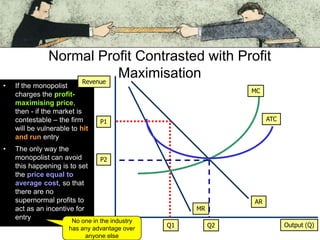
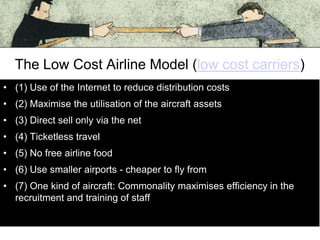
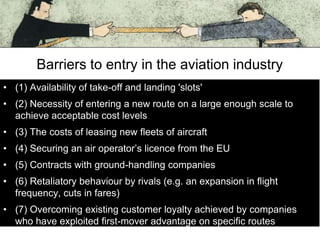
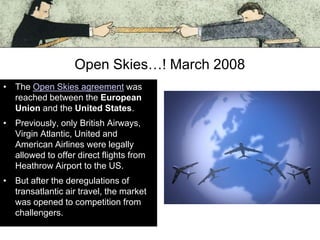
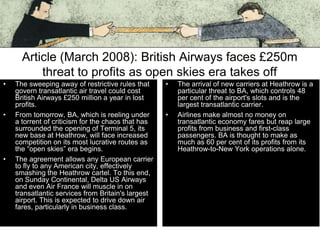
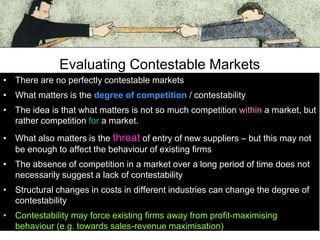
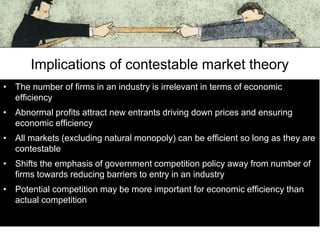
Markets can become more contestable through deregulation, tougher competition laws, and new technologies lowering entry costs. Contestable market theory holds that the threat of entry, not just current competitors, keeps prices low and forces firms to act efficiently. For example, the open skies agreement allowed more airlines to compete on transatlantic routes, threatening British Airways' profits from high-fare passengers. While no market is perfectly contestable, the degree of ease of entry and threat of competition influences firm behavior and market outcomes.



![Competitive response
•
•
•
•
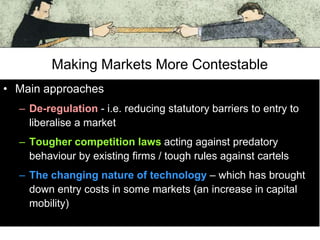
Today, major airline carriers are judged according to their "low-cost" label. As a result, the
biggest impact of Low Cost Carriers (LCCs) on business travel might soon lie in the
reactions of traditional airlines. To fight back against the cheap fares advertised by LCCs,
major carriers have adopted two parallel strategies:
First, they have focused on the quality of their service (their line is, in short: we do
not skimp on service).
Second, they have launched low fares of their own to meet the LCCs in the price
war.
This has been understood more quickly in the UK than anywhere else in Europe. For
companies, the issue of "low-cost carriers" is "out of date". The focus is now about
leveraging traditional airlines low fares. Large German and Dutch companies are also
heading in this direction. Potential cost cutting is likely to grow in the months ahead.
Major savings opportunities await companies, providing they are able to take full
advantage of them."
Source: Quote taken from What benefits do low-cost carriers really bring to
business travel in Europe?, a 'White Paper' report from Carlson Wagonlit Travel
[PDF, 260 KB]](https://image.slidesharecdn.com/contestablemarkets-new-131119082311-phpapp01/85/Contestable-markets-new-5-320.jpg)