MARKET
STRUCTURE
PRESENTATION BY:
HIMANSHI POKAR
SAVITASHREE WASNIK
HARDEEP SINGH
CONTENT
1. INTRODUCTION TO MARKET
2. IMPORTANCE OF MARKET STRUCTURE
3. CLASSIFICATION OF MARKET STRUCTURE
4. MARKET STRUCTURE COMPARISON
5. MARKET STRUCTURE IN REAL WORLD
6. MARKET STRUCTURE AND CONSUMER’S WELFARE
7. GOVERNMENT REGULATION
8. CONCLUTION
WHAT IS
MARKET??
Market structure refers to the organizational
characteristics and features of a specific
market, such as the number and size of firms,
the degree of competition, the nature of
products, and the ease of entry and exit. It
helps categorize markets into different types,
like perfect competition, monopoly, oligopoly,
or monopolistic competition, based on these
defining elements. Understanding market
structure is essential for analyzing how
markets operate, the behavior of firms within
them, and their impact on consumers and the
economy.
IMPORTANCE OF UNDERSTAND MARKET
STRUCTURE
Understanding market structure is essential for informed consumer
choices, effective business strategies, and sound policy decisions. It
promotes competition, protects consumers, and influences economic
growth. It guides investment and trade policies, ensuring a balanced
economic landscape and incentivizing innovation. In short, market
structure knowledge is crucial for a well-functioning economy.
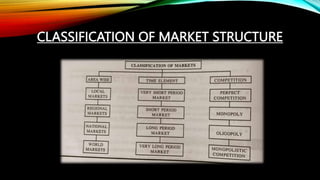
CLASSIFICATION OF MARKET STRUCTURE
LOCAL
MARKET
• In such a market the buyers and sellers
are limited to the local region or area.
• They usually sell perishable goods of
daily use since the transport of such
goods can be expensive.
REGIONAL
MARKET
These markets cover a wider are than local
markets like a district, or a cluster of few
smaller states.
NATIONAL
MARKET
• This is when the demand for the goods is
limited to one specific country.
• Or the government may not allow the
trade of such goods outside national
boundaries.
• • The same product or service is offered to
customers who are spread around the
country
• • A business may have several (or many)
locations in the country in order to reach
those customers
• • A start-up or small business can be
focused on a national market, although it is
likely that it will have a very small share of
the market.
WORLD
MARKET
The system that allows commercial,
financial and labor exchange between
different countries without any type of
restriction.
VERY SHORT PERIOD
MARKET
• a market that lasts few hours or few
days
• Example: fish, vegetables, milk, the
market for flowers, Fruits etc.
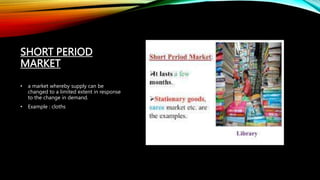
SHORT PERIOD
MARKET
• a market whereby supply can be
changed to a limited extent in response
to the change in demand.
• Example : cloths
LONG PERIOD
MARKET
• a market whereby supply can be fully
adjusted to the changes in demand.
• A firm can change its production
capacity.
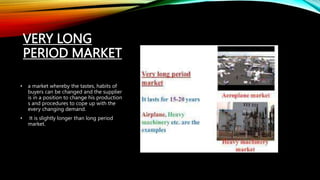
VERY LONG
PERIOD MARKET
• a market whereby the tastes, habits of
buyers can be changed and the supplier
is in a position to change his production
s and procedures to cope up with the
every changing demand.
• It is slightly longer than long period
market.
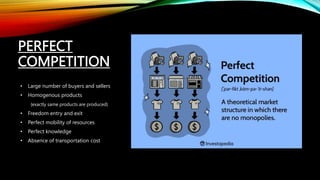
PERFECT
COMPETITION
• Large number of buyers and sellers
• Homogenous products
{exactly same products are produced}
• Freedom entry and exit
• Perfect mobility of resources
• Perfect knowledge
• Absence of transportation cost
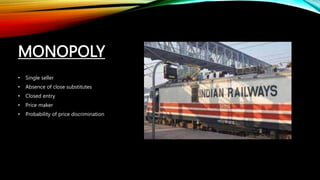
MONOPOLY
• Single seller
• Absence of close substitutes
• Closed entry
• Price maker
• Probability of price discrimination
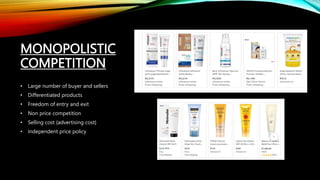
MONOPOLISTIC
COMPETITION
• Large number of buyer and sellers
• Differentiated products
• Freedom of entry and exit
• Non price competition
• Selling cost {advertising cost}
• Independent price policy
OLIGOPOLY
• Few sellers
• Interdependence
• Intense competition
• Homogeneous or non homogeneous
products
• Importance of selling cost
• Barrier to entry
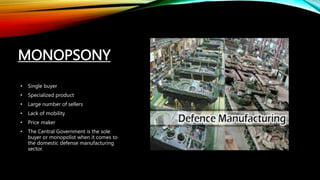
MONOPSONY
• Single buyer
• Specialized product
• Large number of sellers
• Lack of mobility
• Price maker
• The Central Government is the sole
buyer or monopolist when it comes to
the domestic defense manufacturing
sector.
MARKET STRUCTURE IN REAL WORLD
1. Perfect Competition
Agricultural Markets: The agricultural industry often exhibits perfect competition. Many
farmers produce homogeneous products like wheat or corn, and no single producer has
significant control over the market price.
2. Monopoly
Local Utilities: Many local utilities, like water or electricity providers, operate as
monopolies in their respective regions. Consumers have no choice but to use their services
due to high entry barriers.
3. Oligopoly
Automobile Industry: The global automobile industry is dominated by a few major players,
such as Ford, Toyota, and Volkswagen. These firms have substantial market control and
often engage in price and product differentiation strategies.
4. Monopolistic Competition
Restaurant Industry: The restaurant industry is a good example of monopolistic
competition. There are numerous restaurants in any given area, each offering a slightly
different dining experience, creating a competitive yet differentiated market.
Theseexamplesdemonstratethattherealworldisnotneatlycategorizedintoonemarketstructure;often,industries mayhave
elementsof multiplestructures.
MARKET STRUCTURE AND CONSUMER’S
WELFARE
1. Monopoly : Mixed impact, as high prices and limited
choices can harm consumers, but monopolies might also
invest in innovation.
2. Oligopoly : Variable impact depending on firm behavior,
from better products to price collusion.
3. Perfect Competition : High consumer welfare due to low
prices and abundant choices.
4. Monopolistic Competition : A balance between variety
and slightly higher prices, offering moderate consumer
welfare.
Overall, the impact of market structure on
consumer welfare is not uniform and
depends on factors such as competition,
regulation, and the behavior of firms within
the structure. In practice, various industries
may exhibit characteristics of multiple
market structures, making it essential for
policymakers to strike a balance between
encouraging competition and regulating
monopolistic behavior to ensure consumer
welfare.
GOVERNMENT REGULATION
Government regulation plays a crucial role in different market structures by ensuring
fair competition, consumer protection, and economic stability.
In competitive markets, regulations aim to prevent monopolies, promote market
efficiency, and safeguard consumers from fraud. In monopolistic or oligopolistic
markets, regulations can control anti-competitive behavior, such as price-fixing, to
maintain fair prices and quality.
In markets with externalities, like pollution, government regulation can internalize
costs through taxes or emission limits. In less regulated markets, government
intervention may be minimal, while heavily regulated markets, like utilities, require
extensive oversight to ensure equitable access and pricing.
Overall, regulation balances market forces and societal interests.
CONCLUSION
In conclusion, market structure plays a crucial role in shaping the behaviour of firms,
the level of competition, and ultimately, the outcomes for consumers and the
economy.
There are various market structures, including perfect competition, monopolistic
competition, oligopoly, and monopoly, each with its own characteristics and
implications.
The choice of market structure can have significant impacts on pricing, innovation,
product diversity, and overall market efficiency. Understanding market structure is
essential for policymakers, businesses, and consumers to make informed decisions
and ensure that markets operate in a manner that aligns with their objectives and
values.
power point presentation for market structure.pptx

power point presentation for market structure.pptx

  • 1.
  • 2.
    CONTENT 1. INTRODUCTION TOMARKET 2. IMPORTANCE OF MARKET STRUCTURE 3. CLASSIFICATION OF MARKET STRUCTURE 4. MARKET STRUCTURE COMPARISON 5. MARKET STRUCTURE IN REAL WORLD 6. MARKET STRUCTURE AND CONSUMER’S WELFARE 7. GOVERNMENT REGULATION 8. CONCLUTION
  • 3.
    WHAT IS MARKET?? Market structurerefers to the organizational characteristics and features of a specific market, such as the number and size of firms, the degree of competition, the nature of products, and the ease of entry and exit. It helps categorize markets into different types, like perfect competition, monopoly, oligopoly, or monopolistic competition, based on these defining elements. Understanding market structure is essential for analyzing how markets operate, the behavior of firms within them, and their impact on consumers and the economy.
  • 4.
    IMPORTANCE OF UNDERSTANDMARKET STRUCTURE Understanding market structure is essential for informed consumer choices, effective business strategies, and sound policy decisions. It promotes competition, protects consumers, and influences economic growth. It guides investment and trade policies, ensuring a balanced economic landscape and incentivizing innovation. In short, market structure knowledge is crucial for a well-functioning economy.
  • 5.
  • 6.
    LOCAL MARKET • In sucha market the buyers and sellers are limited to the local region or area. • They usually sell perishable goods of daily use since the transport of such goods can be expensive.
  • 7.
    REGIONAL MARKET These markets covera wider are than local markets like a district, or a cluster of few smaller states.
  • 8.
    NATIONAL MARKET • This iswhen the demand for the goods is limited to one specific country. • Or the government may not allow the trade of such goods outside national boundaries. • • The same product or service is offered to customers who are spread around the country • • A business may have several (or many) locations in the country in order to reach those customers • • A start-up or small business can be focused on a national market, although it is likely that it will have a very small share of the market.
  • 9.
    WORLD MARKET The system thatallows commercial, financial and labor exchange between different countries without any type of restriction.
  • 10.
    VERY SHORT PERIOD MARKET •a market that lasts few hours or few days • Example: fish, vegetables, milk, the market for flowers, Fruits etc.
  • 11.
    SHORT PERIOD MARKET • amarket whereby supply can be changed to a limited extent in response to the change in demand. • Example : cloths
  • 12.
    LONG PERIOD MARKET • amarket whereby supply can be fully adjusted to the changes in demand. • A firm can change its production capacity.
  • 13.
    VERY LONG PERIOD MARKET •a market whereby the tastes, habits of buyers can be changed and the supplier is in a position to change his production s and procedures to cope up with the every changing demand. • It is slightly longer than long period market.
  • 14.
    PERFECT COMPETITION • Large numberof buyers and sellers • Homogenous products {exactly same products are produced} • Freedom entry and exit • Perfect mobility of resources • Perfect knowledge • Absence of transportation cost
  • 15.
    MONOPOLY • Single seller •Absence of close substitutes • Closed entry • Price maker • Probability of price discrimination
  • 16.
    MONOPOLISTIC COMPETITION • Large numberof buyer and sellers • Differentiated products • Freedom of entry and exit • Non price competition • Selling cost {advertising cost} • Independent price policy
  • 17.
    OLIGOPOLY • Few sellers •Interdependence • Intense competition • Homogeneous or non homogeneous products • Importance of selling cost • Barrier to entry
  • 18.
    MONOPSONY • Single buyer •Specialized product • Large number of sellers • Lack of mobility • Price maker • The Central Government is the sole buyer or monopolist when it comes to the domestic defense manufacturing sector.
  • 19.
    MARKET STRUCTURE INREAL WORLD 1. Perfect Competition Agricultural Markets: The agricultural industry often exhibits perfect competition. Many farmers produce homogeneous products like wheat or corn, and no single producer has significant control over the market price. 2. Monopoly Local Utilities: Many local utilities, like water or electricity providers, operate as monopolies in their respective regions. Consumers have no choice but to use their services due to high entry barriers. 3. Oligopoly Automobile Industry: The global automobile industry is dominated by a few major players, such as Ford, Toyota, and Volkswagen. These firms have substantial market control and often engage in price and product differentiation strategies.
  • 20.
    4. Monopolistic Competition RestaurantIndustry: The restaurant industry is a good example of monopolistic competition. There are numerous restaurants in any given area, each offering a slightly different dining experience, creating a competitive yet differentiated market. Theseexamplesdemonstratethattherealworldisnotneatlycategorizedintoonemarketstructure;often,industries mayhave elementsof multiplestructures.
  • 21.
    MARKET STRUCTURE ANDCONSUMER’S WELFARE 1. Monopoly : Mixed impact, as high prices and limited choices can harm consumers, but monopolies might also invest in innovation. 2. Oligopoly : Variable impact depending on firm behavior, from better products to price collusion. 3. Perfect Competition : High consumer welfare due to low prices and abundant choices. 4. Monopolistic Competition : A balance between variety and slightly higher prices, offering moderate consumer welfare. Overall, the impact of market structure on consumer welfare is not uniform and depends on factors such as competition, regulation, and the behavior of firms within the structure. In practice, various industries may exhibit characteristics of multiple market structures, making it essential for policymakers to strike a balance between encouraging competition and regulating monopolistic behavior to ensure consumer welfare.
  • 22.
    GOVERNMENT REGULATION Government regulationplays a crucial role in different market structures by ensuring fair competition, consumer protection, and economic stability. In competitive markets, regulations aim to prevent monopolies, promote market efficiency, and safeguard consumers from fraud. In monopolistic or oligopolistic markets, regulations can control anti-competitive behavior, such as price-fixing, to maintain fair prices and quality. In markets with externalities, like pollution, government regulation can internalize costs through taxes or emission limits. In less regulated markets, government intervention may be minimal, while heavily regulated markets, like utilities, require extensive oversight to ensure equitable access and pricing. Overall, regulation balances market forces and societal interests.
  • 23.
    CONCLUSION In conclusion, marketstructure plays a crucial role in shaping the behaviour of firms, the level of competition, and ultimately, the outcomes for consumers and the economy. There are various market structures, including perfect competition, monopolistic competition, oligopoly, and monopoly, each with its own characteristics and implications. The choice of market structure can have significant impacts on pricing, innovation, product diversity, and overall market efficiency. Understanding market structure is essential for policymakers, businesses, and consumers to make informed decisions and ensure that markets operate in a manner that aligns with their objectives and values.