Models of market structure
Monopolistic competition

© Economics Department, King’s School, Chester
Key assumptions
 Each firm in the industry produces a product which is differentiated
from that of others
 branding and advertising exists
 location plays an important part in this product differentiation
 each firm has a degree of monopoly power and faces its own downward
sloping demand curve, but there are many close substitutes
 firms act as price makers and not price makers

 The industry is made up of a large number of buyers and sellers.
 in particular firms are small in comparison to the size of the market
 The actions of one firm do not affect rivals (ie independence)

 There is freedom of entry to the industry
 abnormal profits attract new entrants

© Economics Department, King’s School, Chester
Price

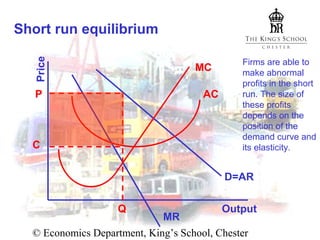
Short run equilibrium
MC

P

AC

C

Firms are able to
make abnormal
profits in the short
run. The size of
these profits
depends on the
position of the
demand curve and
its elasticity.

D=AR
Q

Output

MR
© Economics Department, King’s School, Chester
Price

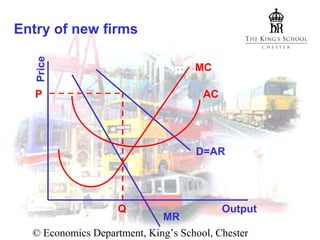
Entry of new firms
MC

P

AC

D=AR

Q

Output

MR
© Economics Department, King’s School, Chester
Price

Entry of new firms
MC
AC
P
D=AR

Q

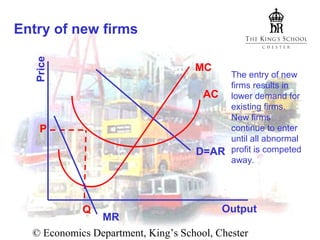
The entry of new
firms results in
lower demand for
existing firms.
New firms
continue to enter
until all abnormal
profit is competed
away.

Output

MR
© Economics Department, King’s School, Chester
Price

Long run equilibrium
MC
AC
P

D=AR
Q

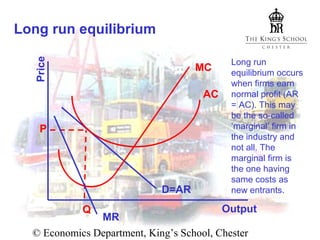
Long run
equilibrium occurs
when firms earn
normal profit (AR
= AC). This may
be the so-called
‘marginal’ firm in
the industry and
not all. The
marginal firm is
the one having
same costs as
new entrants.

Output

MR
© Economics Department, King’s School, Chester
Implications
 Economic efficiency
 Firms do not produce at the bottom of their AC curve
– productive inefficiency
– firms are forced to charge higher prices
– firms have ‘excess capacity’
 Prices are above MC
– allocative inefficiency
 Such inefficiencies may be small since substitutes result in elastic demand
 There is greater product variety than in perfect competition
– product variety is likely to be valued by consumers
– higher prices may simply be the cost of variety

© Economics Department, King’s School, Chester
Implications
 Non-price competition
 Since entry reduces demand and price, firms can be expected to use nonprice methods of competition
– Product development
– Service quality
– Location
– Opening times
– Frequency of service
– Advertising
 Non-price competition attempts to
– Reduce the elasticity of demand
– Create brand loyalty so that new entry does not reduce demand

© Economics Department, King’s School, Chester
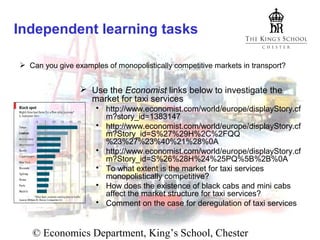
Independent learning tasks
 Can you give examples of monopolistically competitive markets in transport?

 Use the Economist links below to investigate the
market for taxi services
 http://www.economist.com/world/europe/displayStory.cf
m?story_id=1383147
 http://www.economist.com/world/europe/displayStory.cf
m?Story_id=S%27%29H%2C%2FQQ
%23%27%23%40%21%28%0A
 http://www.economist.com/world/europe/displayStory.cf
m?Story_id=S%26%28H%24%25PQ%5B%2B%0A
 To what extent is the market for taxi services
monopolistically competitive?
 How does the existence of black cabs and mini cabs
affect the market structure for taxi services?
 Comment on the case for deregulation of taxi services

© Economics Department, King’s School, Chester
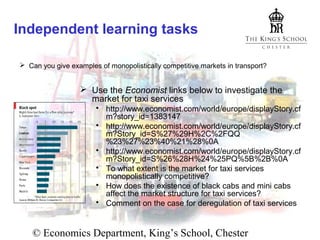
Independent learning tasks
 Can you give examples of monopolistically competitive markets in transport?

 Use the Economist links below to investigate the
market for taxi services
 http://www.economist.com/world/europe/displayStory.cf
m?story_id=1383147
 http://www.economist.com/world/europe/displayStory.cf
m?Story_id=S%27%29H%2C%2FQQ
%23%27%23%40%21%28%0A
 http://www.economist.com/world/europe/displayStory.cf
m?Story_id=S%26%28H%24%25PQ%5B%2B%0A
 To what extent is the market for taxi services
monopolistically competitive?
 How does the existence of black cabs and mini cabs
affect the market structure for taxi services?
 Comment on the case for deregulation of taxi services

© Economics Department, King’s School, Chester

Monopolistic competition (2)

  • 1.
    Models of marketstructure Monopolistic competition © Economics Department, King’s School, Chester
  • 2.
    Key assumptions  Eachfirm in the industry produces a product which is differentiated from that of others  branding and advertising exists  location plays an important part in this product differentiation  each firm has a degree of monopoly power and faces its own downward sloping demand curve, but there are many close substitutes  firms act as price makers and not price makers  The industry is made up of a large number of buyers and sellers.  in particular firms are small in comparison to the size of the market  The actions of one firm do not affect rivals (ie independence)  There is freedom of entry to the industry  abnormal profits attract new entrants © Economics Department, King’s School, Chester
  • 3.
    Price Short run equilibrium MC P AC C Firmsare able to make abnormal profits in the short run. The size of these profits depends on the position of the demand curve and its elasticity. D=AR Q Output MR © Economics Department, King’s School, Chester
  • 4.
    Price Entry of newfirms MC P AC D=AR Q Output MR © Economics Department, King’s School, Chester
  • 5.
    Price Entry of newfirms MC AC P D=AR Q The entry of new firms results in lower demand for existing firms. New firms continue to enter until all abnormal profit is competed away. Output MR © Economics Department, King’s School, Chester
  • 6.
    Price Long run equilibrium MC AC P D=AR Q Longrun equilibrium occurs when firms earn normal profit (AR = AC). This may be the so-called ‘marginal’ firm in the industry and not all. The marginal firm is the one having same costs as new entrants. Output MR © Economics Department, King’s School, Chester
  • 7.
    Implications  Economic efficiency Firms do not produce at the bottom of their AC curve – productive inefficiency – firms are forced to charge higher prices – firms have ‘excess capacity’  Prices are above MC – allocative inefficiency  Such inefficiencies may be small since substitutes result in elastic demand  There is greater product variety than in perfect competition – product variety is likely to be valued by consumers – higher prices may simply be the cost of variety © Economics Department, King’s School, Chester
  • 8.
    Implications  Non-price competition Since entry reduces demand and price, firms can be expected to use nonprice methods of competition – Product development – Service quality – Location – Opening times – Frequency of service – Advertising  Non-price competition attempts to – Reduce the elasticity of demand – Create brand loyalty so that new entry does not reduce demand © Economics Department, King’s School, Chester
  • 9.
    Independent learning tasks Can you give examples of monopolistically competitive markets in transport?  Use the Economist links below to investigate the market for taxi services  http://www.economist.com/world/europe/displayStory.cf m?story_id=1383147  http://www.economist.com/world/europe/displayStory.cf m?Story_id=S%27%29H%2C%2FQQ %23%27%23%40%21%28%0A  http://www.economist.com/world/europe/displayStory.cf m?Story_id=S%26%28H%24%25PQ%5B%2B%0A  To what extent is the market for taxi services monopolistically competitive?  How does the existence of black cabs and mini cabs affect the market structure for taxi services?  Comment on the case for deregulation of taxi services © Economics Department, King’s School, Chester
  • 10.
    Independent learning tasks Can you give examples of monopolistically competitive markets in transport?  Use the Economist links below to investigate the market for taxi services  http://www.economist.com/world/europe/displayStory.cf m?story_id=1383147  http://www.economist.com/world/europe/displayStory.cf m?Story_id=S%27%29H%2C%2FQQ %23%27%23%40%21%28%0A  http://www.economist.com/world/europe/displayStory.cf m?Story_id=S%26%28H%24%25PQ%5B%2B%0A  To what extent is the market for taxi services monopolistically competitive?  How does the existence of black cabs and mini cabs affect the market structure for taxi services?  Comment on the case for deregulation of taxi services © Economics Department, King’s School, Chester