
COMPILED BY :
Mardiyatul Maula (D75214042)
Nurul Dwi Oktaviana (D75214069)
Yunika Trikarunia Anwar (D75214074)
TYPES OF MEANING
THOUGHT AND SYMBOL
• The most obvious feature of
language and the most obscure
aspect to study.
MEANING IS …
DEPEND ON LEECH’
CLASSIFICATION OF MEANING
A. SEVEN TYPES OF MEANING
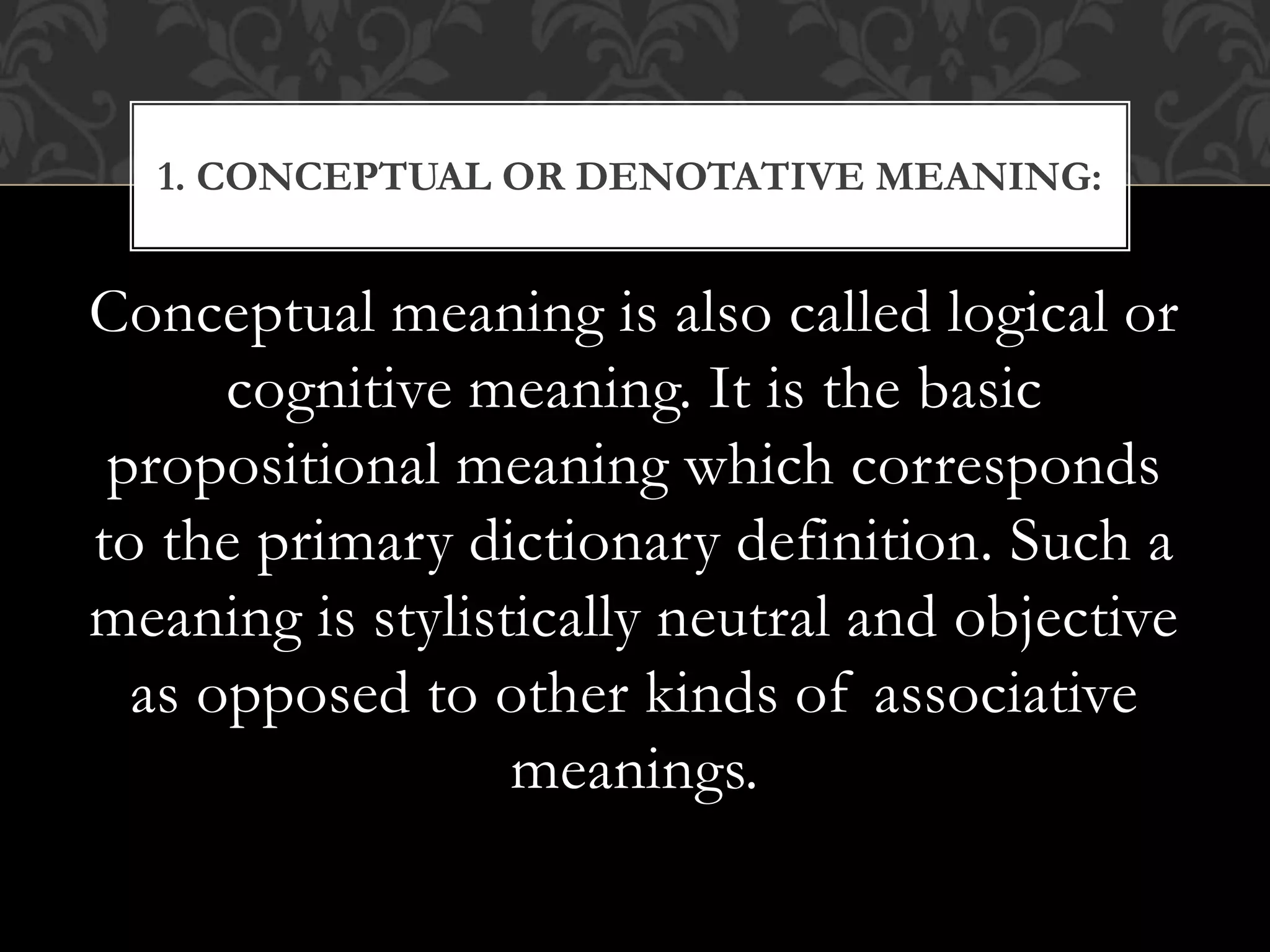
Conceptual meaning is also called logical or
cognitive meaning. It is the basic
propositional meaning which corresponds
to the primary dictionary definition. Such a
meaning is stylistically neutral and objective
as opposed to other kinds of associative
meanings.
1. CONCEPTUAL OR DENOTATIVE MEANING:
Connotative meaning is the communicative
value of an expression over and above its purely
conceptual content. It is something that goes
beyond mere referent of a word and hints at its
attributes in the real world. It is something more
than the dictionary meaning.
2. CONNOTATIVE MEANING
The meaning conveyed by the piece of language
about the social context of its use is called the social
meaning. The decoding of a text is dependent on our
knowledge of stylistics and other variations of language. We
recognize some words or pronunciation as being dialectical
i.e. as telling us something about the regional or social origin
of the speaker. Social meaning is related to the situation in
which an utterance is used.
3. SOCIAL MEANING
For some linguists it refers to emotive
association or effects of words evoked in the reader,
listener. It is what is conveyed about the personal
feelings or attitude towards the listener. In affective
meaning, language is used to express personal
feelings or attitude to the listener or to the subject
matter of his discourse.
4. AFFECTIVE OR EMOTIVE MEANING
At the lexical level of language, Reflected
meaning arises when a word has more than one
conceptual meaning or multiple conceptual
meaning.
5. REFLECTED MEANING
Collocative meaning is the meaning which a
word acquires in the company of certain words.
Words collocate or co-occur with certain words
only e.g. Big business not large or great. Collocative
meaning refers to associations of a word because
of its usual or habitual co-occurrence with certain
types of words.
6. COLLOCATIVE MEANING
It refers to what is communicated by the way in
which a speaker or a writer organizes the message in
terms of ordering focus and emphasis .Thus active is
different from passive though its conceptual meaning
is the same. Various parts of the sentence also can be
used as subject, object or complement to show
prominence.
7. THEMATIC MEANING
1. LITERAL
Sentences have literal meanings. The literal
meaning of a sentence is entirely determined by the
meanings of its component words (or morphemes)
and the syntactical rules according to which these
elements are combined.
B. SOME TYPES OF MEANING
2. FIGURATIVE
Figurative” has the same root as “figure,”
which is another word for a diagram, display; an
image or illustration. A “figurative” meaning is a
meaning that is not literal; the meaning used is
not the meaning of the word or phrase itself, but
a different meaning implied by it.
a. Sentence Meaning
It is referred to as the meaning that can be
predicted from the semantic relationship between
the words that the sentence contains. In other
words, the meaning of the sentence is bound up
with the meaning of each lexical item it comprises.
D. SENTENCE OR WORD MEANING AND SPEAKER
MEANING
b. Speakers Meaning
Speakers meaning is not directly related to the
grammatical and lexical structure. Instead, it includes all
the various types of meaning obtained either from
prosodic and paralinguistic features. That is, speakers
meaning is associated with meanings, ideas, and thoughts
that are to be communicated with non verbal language and
some phonetic features of a given system (language).
Ogden and Richards developed the “Symbol
Theory” in order to explain how words expressed in
communication evoke images, thus providing a
personal meaning based on experience. Symbols are
inherently arbitrary by themselves; however, when
used in conjunction with one another, meaning is
created for the ideas being expressed.
E. THOUGHT AND SYMBOL
A good example of a symbol is text. Text, by
itself, is meaningless, as it draws no relation to anything
outside itself. However, when we combine text with a
word and even a picture, we create a workable definition
from which to operate. This is the fundamental principle
behind Ogden and Richards’ theory.
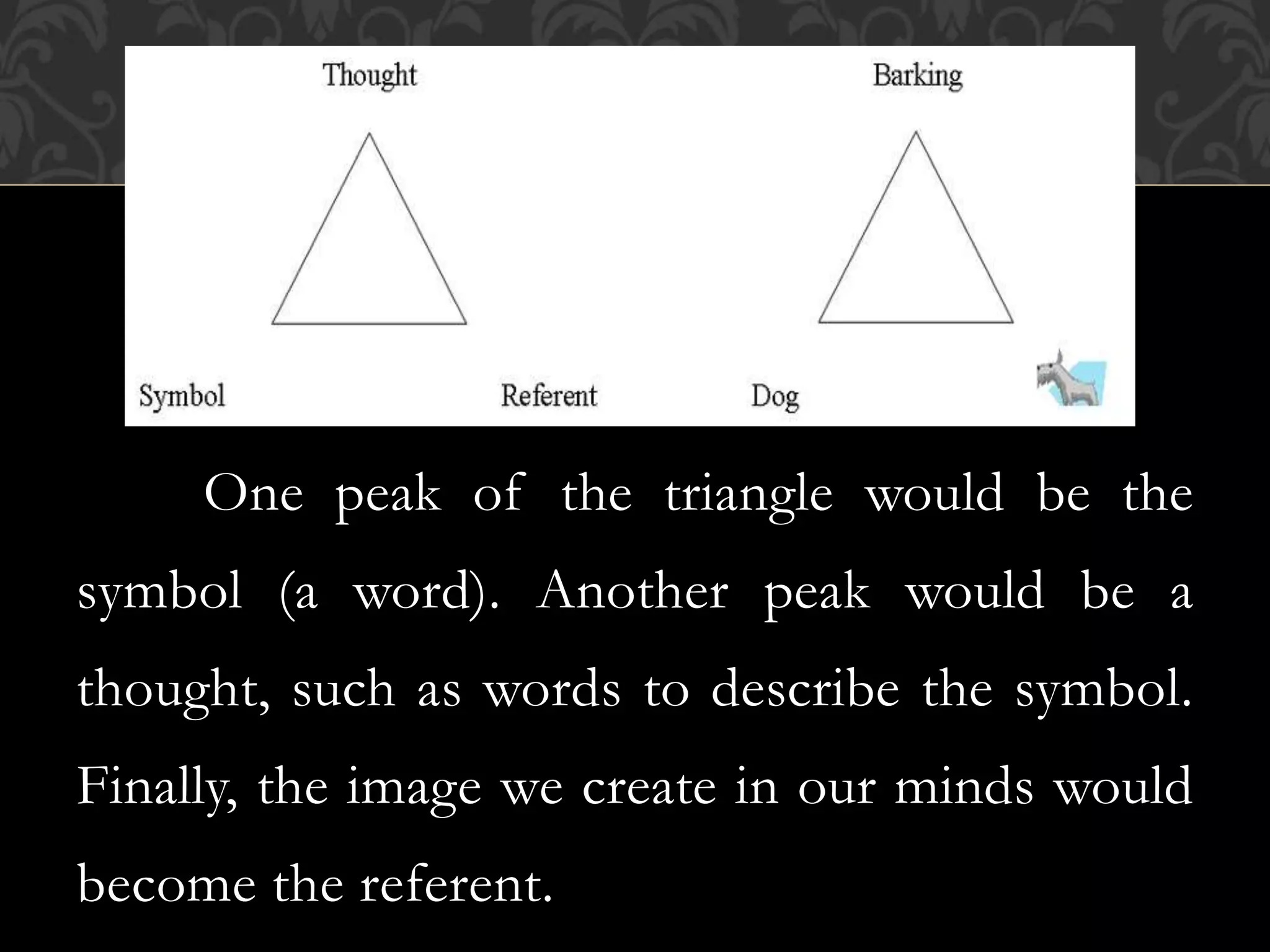
In order to illustrate his point that there is a direct
relationship between symbols and thought, Ogden and
Richards created the “Semantic Triangle.” The triangle is
a simple model in which the three factors involved with
the statement or idea are placed in the corners and the
relationships between them are represented by the sides.
One peak of the triangle would be the
symbol (a word). Another peak would be a
thought, such as words to describe the symbol.
Finally, the image we create in our minds would
become the referent.
Thank You

Types of meaning

  • 1.
    COMPILED BY : MardiyatulMaula (D75214042) Nurul Dwi Oktaviana (D75214069) Yunika Trikarunia Anwar (D75214074) TYPES OF MEANING THOUGHT AND SYMBOL
  • 2.
    • The mostobvious feature of language and the most obscure aspect to study. MEANING IS …
  • 3.
    DEPEND ON LEECH’ CLASSIFICATIONOF MEANING A. SEVEN TYPES OF MEANING
  • 4.
    Conceptual meaning isalso called logical or cognitive meaning. It is the basic propositional meaning which corresponds to the primary dictionary definition. Such a meaning is stylistically neutral and objective as opposed to other kinds of associative meanings. 1. CONCEPTUAL OR DENOTATIVE MEANING:
  • 5.
    Connotative meaning isthe communicative value of an expression over and above its purely conceptual content. It is something that goes beyond mere referent of a word and hints at its attributes in the real world. It is something more than the dictionary meaning. 2. CONNOTATIVE MEANING
  • 6.
    The meaning conveyedby the piece of language about the social context of its use is called the social meaning. The decoding of a text is dependent on our knowledge of stylistics and other variations of language. We recognize some words or pronunciation as being dialectical i.e. as telling us something about the regional or social origin of the speaker. Social meaning is related to the situation in which an utterance is used. 3. SOCIAL MEANING
  • 7.
    For some linguistsit refers to emotive association or effects of words evoked in the reader, listener. It is what is conveyed about the personal feelings or attitude towards the listener. In affective meaning, language is used to express personal feelings or attitude to the listener or to the subject matter of his discourse. 4. AFFECTIVE OR EMOTIVE MEANING
  • 8.
    At the lexicallevel of language, Reflected meaning arises when a word has more than one conceptual meaning or multiple conceptual meaning. 5. REFLECTED MEANING
  • 9.
    Collocative meaning isthe meaning which a word acquires in the company of certain words. Words collocate or co-occur with certain words only e.g. Big business not large or great. Collocative meaning refers to associations of a word because of its usual or habitual co-occurrence with certain types of words. 6. COLLOCATIVE MEANING
  • 10.
    It refers towhat is communicated by the way in which a speaker or a writer organizes the message in terms of ordering focus and emphasis .Thus active is different from passive though its conceptual meaning is the same. Various parts of the sentence also can be used as subject, object or complement to show prominence. 7. THEMATIC MEANING
  • 11.
    1. LITERAL Sentences haveliteral meanings. The literal meaning of a sentence is entirely determined by the meanings of its component words (or morphemes) and the syntactical rules according to which these elements are combined. B. SOME TYPES OF MEANING
  • 12.
    2. FIGURATIVE Figurative” hasthe same root as “figure,” which is another word for a diagram, display; an image or illustration. A “figurative” meaning is a meaning that is not literal; the meaning used is not the meaning of the word or phrase itself, but a different meaning implied by it.
  • 13.
    a. Sentence Meaning Itis referred to as the meaning that can be predicted from the semantic relationship between the words that the sentence contains. In other words, the meaning of the sentence is bound up with the meaning of each lexical item it comprises. D. SENTENCE OR WORD MEANING AND SPEAKER MEANING
  • 14.
    b. Speakers Meaning Speakersmeaning is not directly related to the grammatical and lexical structure. Instead, it includes all the various types of meaning obtained either from prosodic and paralinguistic features. That is, speakers meaning is associated with meanings, ideas, and thoughts that are to be communicated with non verbal language and some phonetic features of a given system (language).
  • 15.
    Ogden and Richardsdeveloped the “Symbol Theory” in order to explain how words expressed in communication evoke images, thus providing a personal meaning based on experience. Symbols are inherently arbitrary by themselves; however, when used in conjunction with one another, meaning is created for the ideas being expressed. E. THOUGHT AND SYMBOL
  • 16.
    A good exampleof a symbol is text. Text, by itself, is meaningless, as it draws no relation to anything outside itself. However, when we combine text with a word and even a picture, we create a workable definition from which to operate. This is the fundamental principle behind Ogden and Richards’ theory.
  • 17.
    In order toillustrate his point that there is a direct relationship between symbols and thought, Ogden and Richards created the “Semantic Triangle.” The triangle is a simple model in which the three factors involved with the statement or idea are placed in the corners and the relationships between them are represented by the sides.
  • 18.
    One peak ofthe triangle would be the symbol (a word). Another peak would be a thought, such as words to describe the symbol. Finally, the image we create in our minds would become the referent.
  • 19.