F SUN GÖKDO ANİ Ğ
ELEMENTS OF LANGUAGE & STYLE
1. How language works ?
2. Oral style and
written style
3. The Humorous style
HOW LANGUAGE WORKS ?
It offers four general principles of
language:
Directness
Abstraction
Objectivity
Formality
1. Language Varies in Directness
Consider the following sentences :
ATTENTION :
 The style of direct sentence should be active
(rather than passive) and personal (rather than
impersonal )
 Use personal pronouns and personal references
 Refer to your audience as “ you” rather than “
the audience” or “my listeners”
After this rules, Your speech should be relaxed
and direct.
2. Language Varies in Abstraction
3. Language Varies in Objectivity
The best way to explain how language varies in
objectivity is to introduce two new terms :
 Denotation
&
 Connatation
*Objectivity :the state or quality of being objective
a. Denotation
 The denotative meaning of a term is its
objective meaning, which is the meaning that
you would find in a dictionary that points to
specific references.
o “ Dictionary meaning “
For example:
the denotation of a word book is ,
“ the actual book , a collection of pages bound
together between two covers.”
b. Connotation
 Connotative meaning , however , is different.
 The Connotative meaning is our affective,
emotional meaning for the term.
For example:
 the word “ book “
 It may signify boredom or excitement.
 It may recall the textbook you have to read or
the novel that you cannot put down.
Consider the following word :
“ politicians “
 may mean to some people : poorly paid public servant
who take abuse from the people they represent. ( and thus
be very positive )
 may mean to some people : self-serving, money-grubbing
individuals who live off the taxpayer’s money. ( and thus
be extremely negative )
!!! Consider the audience’s evaluation of your key term before
using them in a speech. If there is any doubt, select another
word or qualify word to make clear exactly what you wish to
communicate
4. Language Varies in Formality
Consider the following sentences :
ATTENTION :
 !!! Use comman words but avoid slang.
 !!! Use informal constructions but avoid forms
that your audience would consider incorrect.
SUMMARY
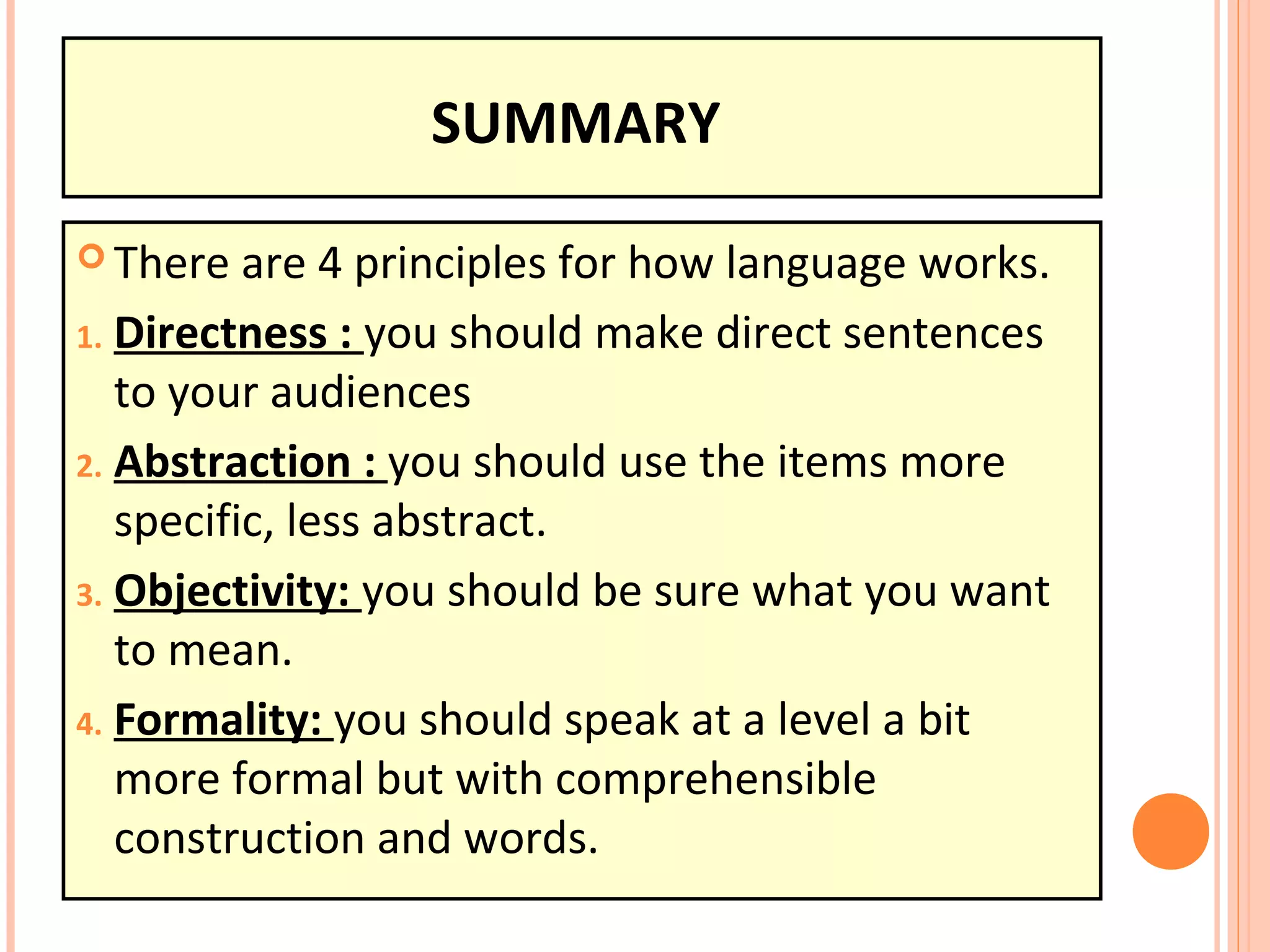
 There are 4 principles for how language works.
1. Directness : you should make direct sentences
to your audiences
2. Abstraction : you should use the items more
specific, less abstract.
3. Objectivity: you should be sure what you want
to mean.
4. Formality: you should speak at a level a bit
more formal but with comprehensible
construction and words.
for listening to me
&
for your attendance to
lesson

elements of language &style

  • 1.
    F SUN GÖKDOANİ Ğ
  • 2.
    ELEMENTS OF LANGUAGE& STYLE 1. How language works ? 2. Oral style and written style 3. The Humorous style
  • 3.
    HOW LANGUAGE WORKS? It offers four general principles of language: Directness Abstraction Objectivity Formality
  • 4.
    1. Language Variesin Directness Consider the following sentences :
  • 5.
    ATTENTION :  Thestyle of direct sentence should be active (rather than passive) and personal (rather than impersonal )  Use personal pronouns and personal references  Refer to your audience as “ you” rather than “ the audience” or “my listeners” After this rules, Your speech should be relaxed and direct.
  • 6.
    2. Language Variesin Abstraction
  • 7.
    3. Language Variesin Objectivity The best way to explain how language varies in objectivity is to introduce two new terms :  Denotation &  Connatation *Objectivity :the state or quality of being objective
  • 8.
    a. Denotation  Thedenotative meaning of a term is its objective meaning, which is the meaning that you would find in a dictionary that points to specific references. o “ Dictionary meaning “ For example: the denotation of a word book is , “ the actual book , a collection of pages bound together between two covers.”
  • 9.
    b. Connotation  Connotativemeaning , however , is different.  The Connotative meaning is our affective, emotional meaning for the term. For example:  the word “ book “  It may signify boredom or excitement.  It may recall the textbook you have to read or the novel that you cannot put down.
  • 10.
    Consider the followingword : “ politicians “  may mean to some people : poorly paid public servant who take abuse from the people they represent. ( and thus be very positive )  may mean to some people : self-serving, money-grubbing individuals who live off the taxpayer’s money. ( and thus be extremely negative ) !!! Consider the audience’s evaluation of your key term before using them in a speech. If there is any doubt, select another word or qualify word to make clear exactly what you wish to communicate
  • 11.
    4. Language Variesin Formality Consider the following sentences :
  • 12.
    ATTENTION :  !!!Use comman words but avoid slang.  !!! Use informal constructions but avoid forms that your audience would consider incorrect.
  • 13.
    SUMMARY  There are4 principles for how language works. 1. Directness : you should make direct sentences to your audiences 2. Abstraction : you should use the items more specific, less abstract. 3. Objectivity: you should be sure what you want to mean. 4. Formality: you should speak at a level a bit more formal but with comprehensible construction and words.
  • 14.
    for listening tome & for your attendance to lesson