MANUFACTURING
TECHNOLOGY – I
CRAFTED BY:
RAMESH KUMAR A
ASSISTANT PROFESSOR
SONA COLLEGE OF TECHNOLOGY
SALEM
07-02-2019 05:25 1
METAL JOINING PROCESSES
07-02-2019 05:25 2
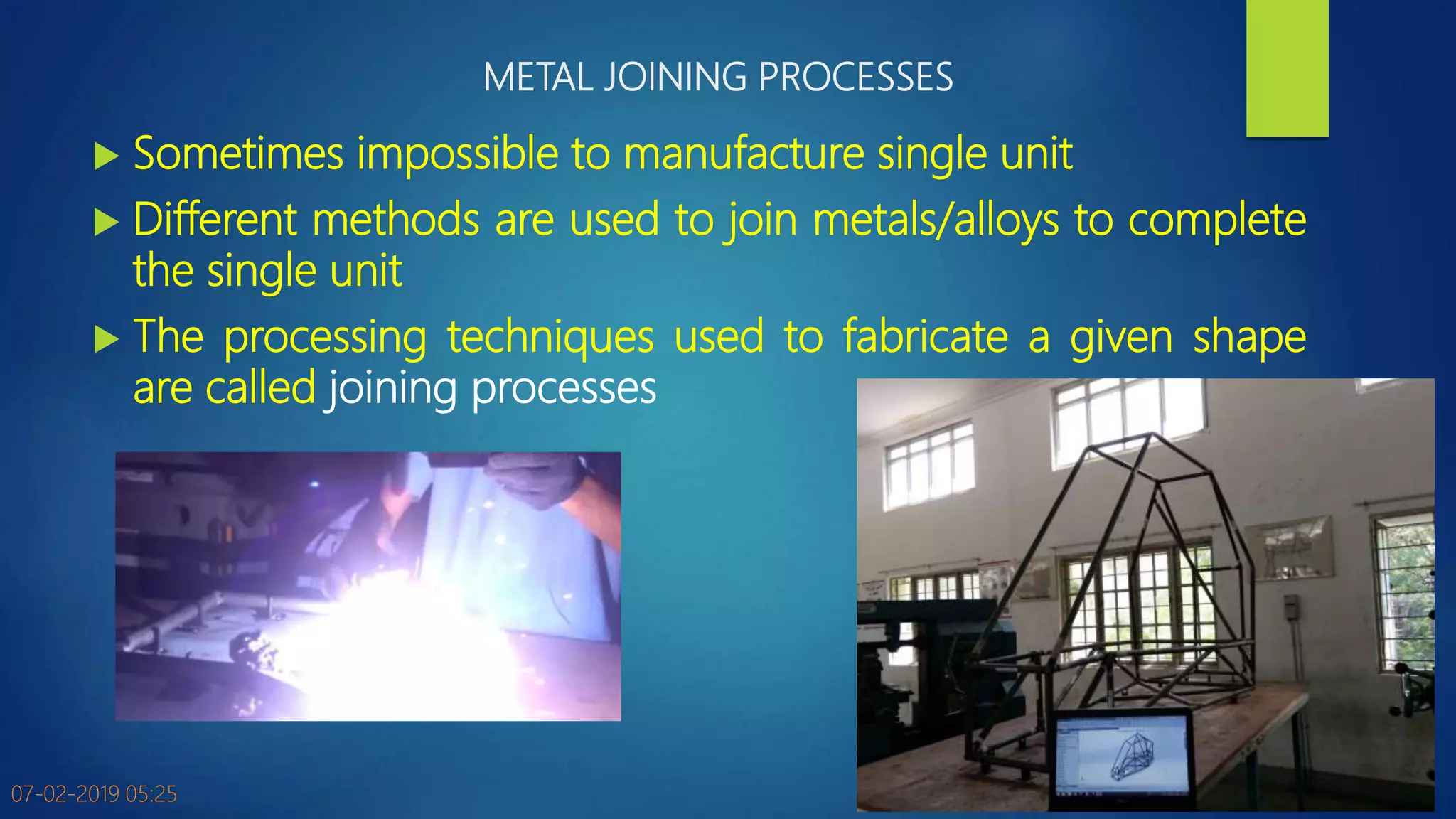
METAL JOINING PROCESSES
 Sometimes impossible to manufacture single unit
 Different methods are used to join metals/alloys to complete
the single unit
 The processing techniques used to fabricate a given shape
are called joining processes
07-02-2019 05:25 3
METAL JOINING PROCESSES
 Mechanical joining
Welding
Soldering and brazing
Adhesive joining
Riveting
Screwed fastening
 Electrical and electronic joining
Soft soldering
Hard soldering and brazing
Crimping
07-02-2019 05:25 4
METAL JOINING PROCESSES
WELDING
07-02-2019 05:25 5
WELDING
 Welding is the process of joining two metallic pieces
together in permanent manner
 Heat or pressure and sometimes both are used to
achieve the required joint
 The coalescence is obtained when atoms of the two
pieces to be joined come very close to each other
 Advantage: portable, permanent, stronger than the
parent materials with a filler metal
 Disadvantage: Expensive manual labor, high energy and
dangerous, does not allow disassemble and defects
07-02-2019 05:25 6
CLASSIFICATION OF WELDING PROCESSES
 Based on the composition of the joints:
Autogeneous joining
No filler material used
Solid phase welding and resistance welding
Homogeneous joining
Filler material same as of parent material
Ex. Arc, gas and thermit welding
Hetrogeneous joining
Filler material different of parent material
Ex. Soldering and Brazing
07-02-2019 05:25 7
CLASSIFICATION OF WELDING PROCESSES
 Based on the application of pressure:
Fusion welding
Required joint is obtained by heating the two metal
pieces to liquid state locally at the place of the joint
Plastic or Pressure welding
The two metal pieces are heated to some
temperature below their melting temperature and
the required joint is obtained by applying sufficient
pressure between the two pieces
Solid-state welding
07-02-2019 05:25 8
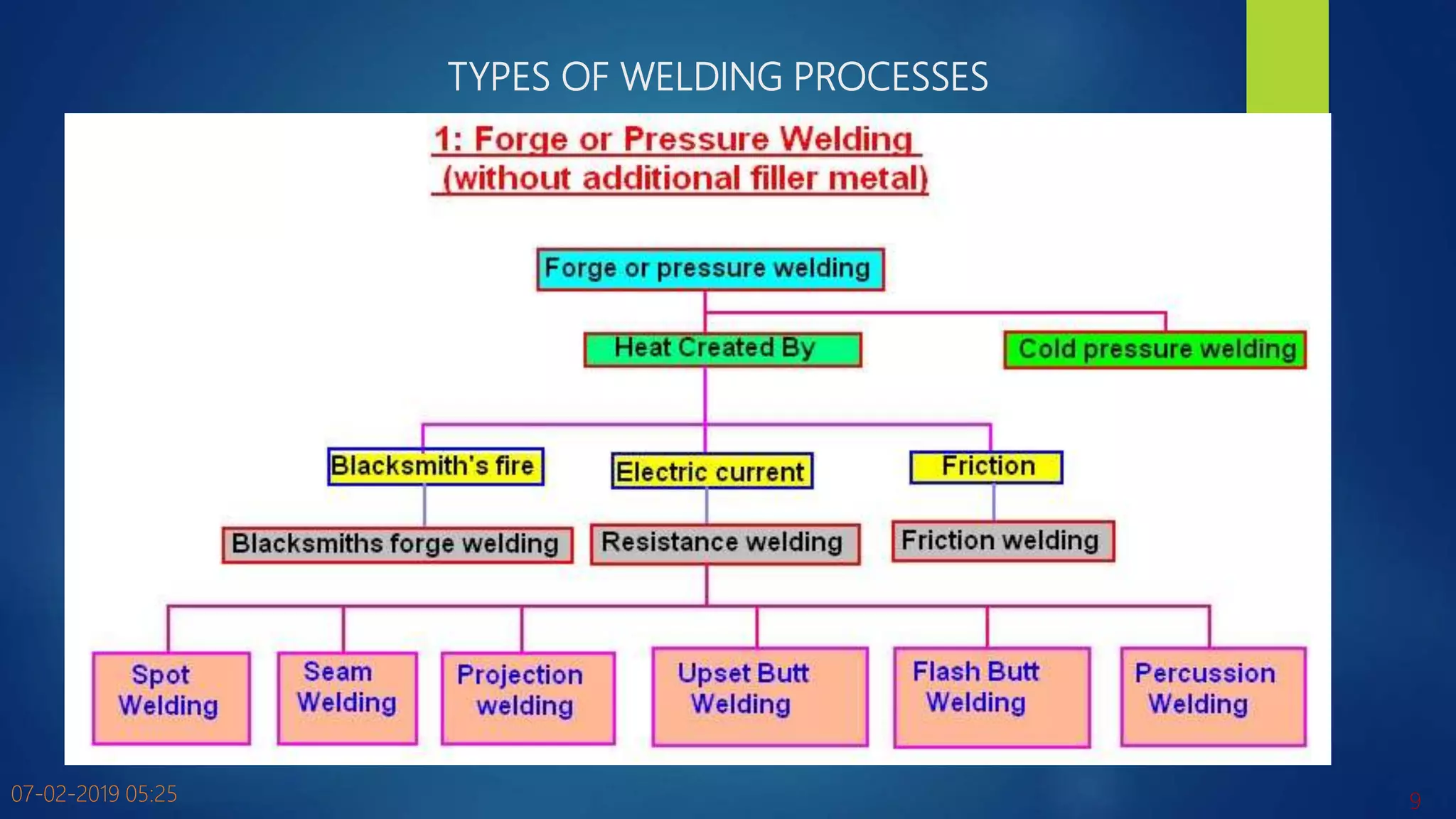
TYPES OF WELDING PROCESSES
07-02-2019 05:25 9
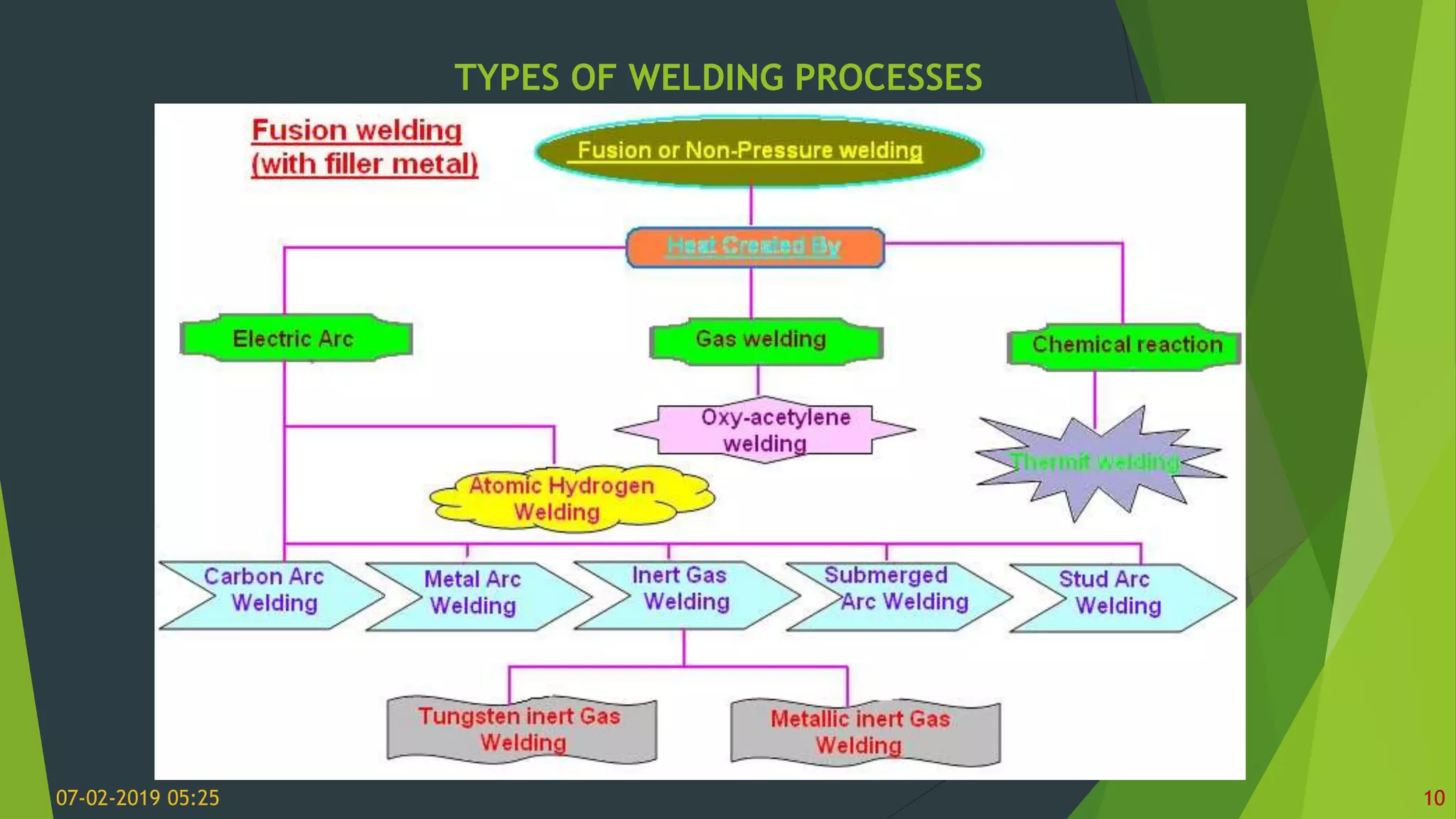
TYPES OF WELDING PROCESSES
07-02-2019 05:25 10
WELDABILITY
 Weldability of a material is defined as its ability to be
welded
 Depends on various factors such as metallurgical
changes that occur during the process of welding, its
hardness, and gas evolution and absorption, extent of
oxidation and others
 Low carbon steel (c<0.12%) have the best weldability
amongst metals
 As the carbon content increases, weldability decreases
07-02-2019 05:25 11
WELDING TERMINOLOGY
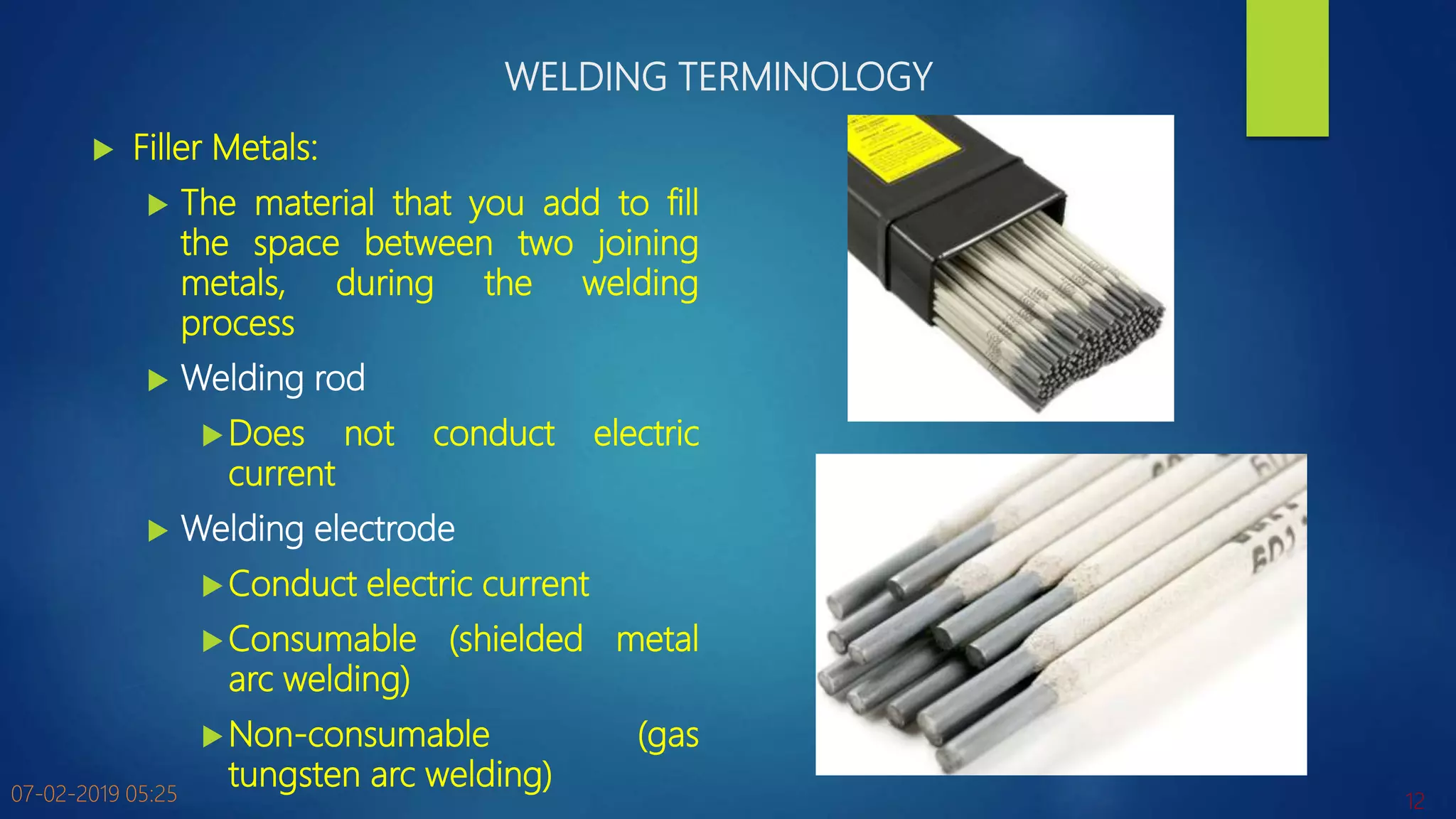
 Filler Metals:
 The material that you add to fill
the space between two joining
metals, during the welding
process
 Welding rod
Does not conduct electric
current
 Welding electrode
Conduct electric current
Consumable (shielded metal
arc welding)
Non-consumable (gas
tungsten arc welding)07-02-2019 05:25 12
WELDING TERMINOLOGY
 Fluxes
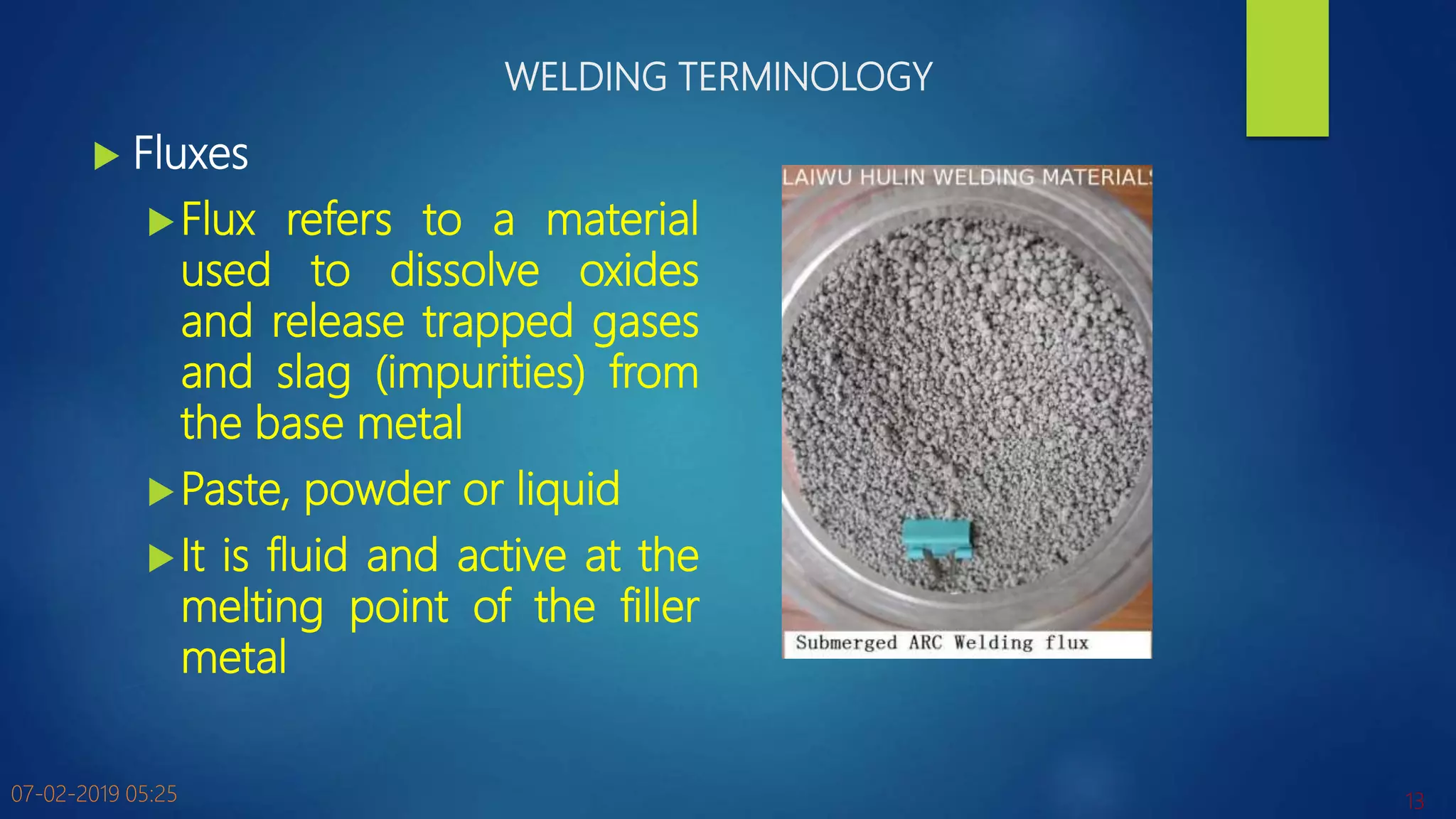
Flux refers to a material
used to dissolve oxides
and release trapped gases
and slag (impurities) from
the base metal
Paste, powder or liquid
It is fluid and active at the
melting point of the filler
metal
07-02-2019 05:25 13
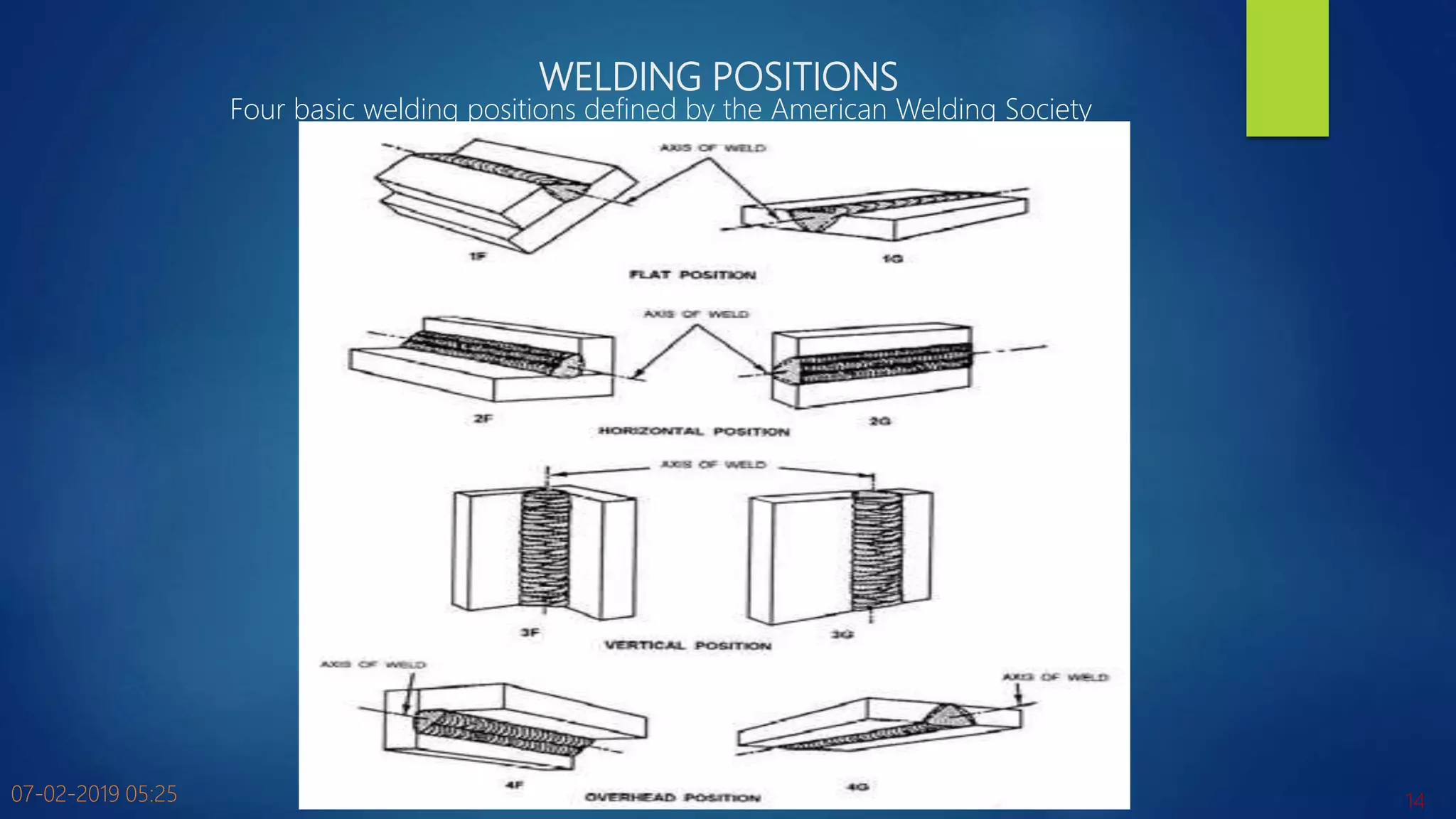
WELDING POSITIONS
07-02-2019 05:25 14
Four basic welding positions defined by the American Welding Society

Introduction to joining process, welding classification,terminology,positions

  • 1.
    MANUFACTURING TECHNOLOGY – I CRAFTEDBY: RAMESH KUMAR A ASSISTANT PROFESSOR SONA COLLEGE OF TECHNOLOGY SALEM 07-02-2019 05:25 1
  • 2.
  • 3.
    METAL JOINING PROCESSES Sometimes impossible to manufacture single unit  Different methods are used to join metals/alloys to complete the single unit  The processing techniques used to fabricate a given shape are called joining processes 07-02-2019 05:25 3
  • 4.
    METAL JOINING PROCESSES Mechanical joining Welding Soldering and brazing Adhesive joining Riveting Screwed fastening  Electrical and electronic joining Soft soldering Hard soldering and brazing Crimping 07-02-2019 05:25 4
  • 5.
  • 6.
    WELDING  Welding isthe process of joining two metallic pieces together in permanent manner  Heat or pressure and sometimes both are used to achieve the required joint  The coalescence is obtained when atoms of the two pieces to be joined come very close to each other  Advantage: portable, permanent, stronger than the parent materials with a filler metal  Disadvantage: Expensive manual labor, high energy and dangerous, does not allow disassemble and defects 07-02-2019 05:25 6
  • 7.
    CLASSIFICATION OF WELDINGPROCESSES  Based on the composition of the joints: Autogeneous joining No filler material used Solid phase welding and resistance welding Homogeneous joining Filler material same as of parent material Ex. Arc, gas and thermit welding Hetrogeneous joining Filler material different of parent material Ex. Soldering and Brazing 07-02-2019 05:25 7
  • 8.
    CLASSIFICATION OF WELDINGPROCESSES  Based on the application of pressure: Fusion welding Required joint is obtained by heating the two metal pieces to liquid state locally at the place of the joint Plastic or Pressure welding The two metal pieces are heated to some temperature below their melting temperature and the required joint is obtained by applying sufficient pressure between the two pieces Solid-state welding 07-02-2019 05:25 8
  • 9.
    TYPES OF WELDINGPROCESSES 07-02-2019 05:25 9
  • 10.
    TYPES OF WELDINGPROCESSES 07-02-2019 05:25 10
  • 11.
    WELDABILITY  Weldability ofa material is defined as its ability to be welded  Depends on various factors such as metallurgical changes that occur during the process of welding, its hardness, and gas evolution and absorption, extent of oxidation and others  Low carbon steel (c<0.12%) have the best weldability amongst metals  As the carbon content increases, weldability decreases 07-02-2019 05:25 11
  • 12.
    WELDING TERMINOLOGY  FillerMetals:  The material that you add to fill the space between two joining metals, during the welding process  Welding rod Does not conduct electric current  Welding electrode Conduct electric current Consumable (shielded metal arc welding) Non-consumable (gas tungsten arc welding)07-02-2019 05:25 12
  • 13.
    WELDING TERMINOLOGY  Fluxes Fluxrefers to a material used to dissolve oxides and release trapped gases and slag (impurities) from the base metal Paste, powder or liquid It is fluid and active at the melting point of the filler metal 07-02-2019 05:25 13
  • 14.
    WELDING POSITIONS 07-02-2019 05:2514 Four basic welding positions defined by the American Welding Society